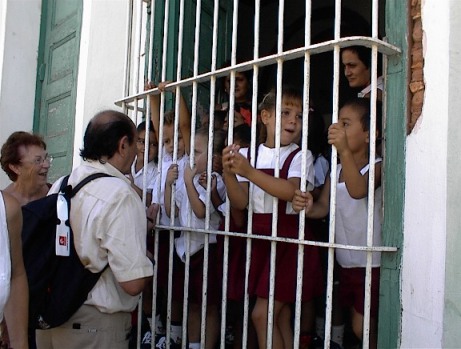
Indoctrinate or Instruct? / Cuban Law Association, Noel Rodríguez Ávila

From paraclito.net
From paraclito.net

Lic. Noel Rodríguez Ávila

Now they aren’t applying themselves to instruct, only to indoctrinate. Education is entirely the responsibility of the family, as the fundamental cell of society.

José Martí stated that “education is depositing in the child all of humanity’s culture, to put him in tune with his times, and, in return, he contributes to the education of other people.

Our educational system has deteriorated badly, both from the point of view of the teacher and of the student, as a result of trying out different methods and styles in order to perfect it

An example of this is the compressed courses for “emergent teachers”*; of which there are an increasing number because of the scarcity of teachers and professors in primary and secondary education, largely because of the some of them retiring and others emigrating, which is happening due to educational disengagement, with people moving to other sectors of the economy looking for better pay.

It has been a policy mistake to try to instruct and educate kids and young people using methods which minimise the role of the teacher or professor, such as using television and video classes, reducing the level of review; in the end insisting that everyone has to pass their grade, no matter what their level of intelligence, so that “regular” has to become “good,” and good or very good has to become “excellent.”

If we sow poor seed we cannot expect good fruit.

*Translator’s note: The “Emergent Teachers” program took high school age students and fast tracks them to a teaching career. After poor results, including the death of at least one student at the hand of an “emergent teacher,” the program was scaled back.

Translated by GH
2 May 2013

Analysing What’s Happened / Cuban Law Association, Wilfredo Vallín Almeida

By Wilfredo Vallín Almeida

It’s good news. People like Yoani Sánchez, Eliecer Ávila and Berta Soler find themselves abroad enjoying a right which was denied for fifty years

In the Asociación Jurídica Cubana (Cuban Law Association) we are always happy to receive everything which implies more liberty for the Cuban people, without closing our eyes to the problems which continue to be presented by government decisions, especially when there continue to be unclear or arbitrary legal positions.

Let me explain

In the year 2003, 75 people were accused of crimes against the Cuban state. Tried immediately, they were condemned to different and severe prison sentences. During the following seven years they were all freed.

In relation to that something is happening which I would like to share with our readers, but which will require more than one post, and because of that, in this one I want to set out essential introductory elements to help with this analysis

For someone in jail, who hasn’t completed their sentence, there are two ways of waiving the remaining term and going free. They are:

A reprieve

An amnesty

In the case of a reprieve, they extinguish the criminal responsibility and it is construed as pardoning the penalty which was applied to the person. If it is a complete reprieve, they extinguish the prisoner’s entire sentence. If it is a parcial reprieve, part of the prisoner’s penalty disappears or they change it for more minor sanctions.

A reprieve applies to one individual person. In order for it to have effect, it is necessary to have an administrative act and a firm sentence and you don’t necessarily have to extinguish the preceding penalties of the individual in question. Normally the possibility of a reprieve (also known as “The Law of Pardon”) rests in the hands of important representatives of the State.

As far as an amnesty is concerned, it doesn’t refer to the penalty, but to the offence itself. It relates to all those who have committed it, not to particular individuals, it extinguishes total criminal responsibility and eliminates the preceding penalties in removing the criminal status.

In he case of an amnesty, it is necessary to pass a law in order to arrange it, and it extinguishes the antecedent penalties of the individuals involved given that it covers all who committed the crime and not particular individuals.

The amnesty is used above all for political offences and not normal crimes.

With these elements, we are ready for an analysis of what has happened.

Translated by GH

24 April 2013

Particularity of Human Rights / Cuban Law Association, Argelio M. Guerra

Society – International – Rights – Justice. ORDER Disorder

Lic. Argelio M. Guerra

The fight for freedom has been, to a large extent, the fight to restrain the power of the State, mainly through the creation of recognized spaces of individual freedom. The idea that certain rights derive from the very nature of man was developed by different positions on natural law, both was based on the idea that such rights were granted to man by God, as well as having developed starting from concepts of human nature itself.

Several expressions were used interchangeably to refer to what are commonly designated as human rights: fundamental human rights, rights, freedoms, individual rights, etc. The recognition and legal protection of such rights is intended to offer a necessary path by which human development should be treated at all levels.

These rights have a set of characteristics that distinguish them, namely:

– Inborn or Inherent: All human beings are born with rights, so that the state can not grant them, and one must recognize and protect themas a norm.

– Needed: Being derived from human nature itself, they should be considered necessary, so the distinction is imposed by the legal system.

– Inalienable: Belonging to humans by their very nature they can not be divided, transferred, alienated or waived.

– Imprescriptible: They cannot be extinguished or lose value, either because the person does not exercise them voluntarily or is prevented from doing so.

– Enforceable erga omnes: They can be enforced against any person, whether natural or juridical.

– Indivisible and Interdependent: There cannot be a hierarchy with one right above another, but as an entire set they should bein full effect and achievable.

– Universal: They must apply to all people, regardless of race, skin color, national origin, sex, religion, social status, domicile, residence, etc.

20 April 2013

From the Wolf, a Hair* / Cuban Law Association, Wilfredo Vallin Almeida

Photo: Marcelo López Bañobre

By Wilfredo Vallín Almeida

Like many compatriots, I sat down to watch the appearance of General of the Army Raul Castro during his recent speech before the National Assembly of People’s Power.

I talked with other lawyers about his words before that forum and, unsurprisingly, some were interested in certain aspects of his speech, while others fixed on different details.

Personally, he caught my attention when he said:

We have to have the Party Congress set the course to update the Cuban economic model and to achieve a sustainable and prosperous socialist society, a less egalitarian but more just society .  . .”

It’s with regards to …”a less egalitarian but more just society”that I want to reflect about. continue reading

For many years we have heard of a justice that meant a classless society, and we were witnesses of how those who departed from this scheme were persecuted or segregated.

I remember very clearly that one of the elements that was always reflected in the investigation of a person was their standard of living — whether they had relatives abroad, received outside help, etc. A positive finding of those details was an aggravating factor for their situation.

Until recently, the following paragraph from the Universal Declaration of Human Rights was, for the extreme champions of the EGALITARIAN society, a dead letter and condemnable:

“Whereas the peoples of the United Nations have in the Charter reaffirmed their faith in fundamental human rights, in the dignity and worth of the human person and in the equal rights of men and women and have determined to promote social progress and better standards of living in larger freedom . . .”

Social progress? Better standards of living? That smacked of ideological deviation.

But time passed, “and an eagle passed over the sea. . .”**

Things change by inner conviction or because there is no alternative. But in the midst of the stagnation that has gripped the country for half a century, the fact that the current head of state speaks in favor of less egalitarianism, may mean that it is already happening somewhat, though still far from what we would want.

But like my grandmother used to say: from the wolf, a hair.*

Translator’s notes:

*The Spanish proverb “Del lobo un pelo, y ése de la frente” can be translated, roughly, “From the wolf [take] a hair, and this from the forehead,” and means, roughly, when you can’t expect to receive good from someone, take whatever little you can.

**From “The Pink Shoes”, a poem by Jose Martí

Translated by Tomás A.

16 April 2013

About Leaders and Responsibilities / Cuban Law Association, Lic. Rodrigo Chavez

Lic. Rodrigo Chávez

In the newspaper Granma, an article published with the title “About leaders and responsibilities”, by Félix López, makes it clear that a well-known old Cuban proverb “the rope breaks at the weakest point” would be ideal for this article.

How many of us who have always been subordinates have carried the blame for something which we had nothing to do with? And I say subordinate because whenever we have a superior, we are inevitably subordinate.

Say to yourself crime, contravention or indiscipline, they categorise and describe actions in this way because they are gathered up in legal regulations, but what’s for sure is that as a general rule, when regulations go unobserved, and are breached, usually the weight of the law falls on or breaks the weakest point: the “subordinate”.

Is it the workers who designate or choose their bosses? That’s as untrue as the belief that in the Management Board of any Employment Centre, the chief feels he is subject to the same conditions as his employees. Going to any Management Council is like being in the presence of a contract of adhesion “take it or leave it” – and to tell you the truth, we can understand even better than the people who work there that the chief has his entourage, incapable of or prevented from disagreeing with the decision of the supremo, except in rare circumstances, which are always viewed with disapproval and in terms of whingeing, trouble-making or out to make problems.

What can you say when a chief takes disciplinary measures against a subordinate and the latter complains to the Employment Law Authority (OJLB)? It would be a bit awkward if the worker were to leave victorious after the confrontation, because both he and the OJLB are employees and who would think of going against the wishes of the chief they will ask  themselves. “Who will guarantee my employment if we let the worker win?” Because although the regulations say that the Authority has to comply with the law when carrying out its functions, when the function of delivering justice gets to the decision, will they continue being employed?

When you get to a work location trying to work and experiencing difficulties, you will find out who is the Chief, Manager, Director, Administator… perhaps you will be lucky enough to see him and hear him from a distance at a meeting, but you also learn that this individual has been shifted out … how is this person supposed to know about the activities he has been asked to run? How are things going to operate? There are lots of unanswered questions, and anybody who is able to answer them does not do so.

Translated by GH

23 March 2013

Metamorphosis / Osvaldo Rodriguez Diaz

2_osvaldoBy Osvaldo Rodríguez Díaz

Of how a common citizen is transformed into common criminal in minutes.

On the morning of October 23, 2012, William Estevez Acosta, 51-years-old, married and with no criminal record or police, was summoned to the Criminal Cotorro Municipal Court for a hearing in which he would be declared insolvent and, immediately afterwards, he would be tried for the offense of Breach of the Obligations arising from the violations; that is, not paying a fine for lack of money. continue reading

The origin: His home was searched and an uninstalled and shabby satellite dish was found for which he was fined 30,000 pesos, which, after a month, the time to make it defective, is doubled, and must pay for this item 60,000 pesos.

Unable to verify that obligation as soon narrated occurred.

In the court, William confirmed that he didn’t have the economic capacity, as an ordinary citizen, to pay the fine and that for four years he’d had no job, because he suffers various illnesses that prevent him from working in the kind of occupations his intellectual capacity allow him to perform.

The defendant provided a summary of his medical history which includes diabetes mellitus type II, chronic migraine, circulatory problems and others, with their respective treatments.

The result after deliberation by the court, was that he did have money, because they had taken an antenna, they did not believe in his illnesses, and they dismissed the summary of his medical history, something he was experiencing at this time.

The sanction was: six months in prison, and he was arrested on the spot. Not being accompanied by anyone, a member of the public was provided to alert his family and, unable to leave, William should have filed the appeal in his own right.

Supposedly, everyone sentenced is responsible for a crime. William was sentence and the crime proved. Having woken up that day as a citizen, he became a common criminal after the story told here.

Article 170.1 which was applied, in section 2, enjoins courts to replace custodial sentences by correctional work with internment, but Opinion 305 Agreement 43 of 11 July 1989 the Governing Council of the Supreme Court  says that does not preclude the option of other measures such as limiting freedom.

William was unfortunate, he said that if the fine had been appropriate he would have paid it, but he committed the crime of not having money.

February 6 2013

True or False? / Jorge Hojas Punales

OLYMPUS DIGITAL CAMERAJorge Hojas Puñales

In Cuba there are company directors but no CEOs as such. A CEO is always ready to listen to (and not just hear) his legal advisor as well as his financial advisor. They are considered both the left and right arms of the entrepreneur.

I am also of the opinion that in our country there really is no such thing as what might be called institutionality (as one might hope for in a state with the rule of law). If everyone does whatever he thinks best or what he feels like doing, what would our Apostle* say in the face of such irresponsibility, such disrespect, such indolence and complacency? Call it what you will, all this has a common denominator – contempt and disobedience.

The bureaucracy, far from being eradicated, it setting down roots like the marabou weed. In the same way that globalization is the playing field of capitalism, kicking things back and forth is what we do in socialism. continue reading

Let’s take a look at just three issues.

A CEO is free to make decisions, though not without first conferring with his management team. He listens, evaluates and makes projections based on the information provided by his advisors and specialists. He knows all too well that not doing so might inevitably lead to a costly error that could threaten the future of the company. It is rare that one of his advisors or specialists would, at the point the contract is about to be signed, express reservations after everything has been thoroughly discussed. It is appropriate to address the rights and obligations being contracted, but it is not the norm in a business setting for this entrepreneur to preside over every meeting or negotiation since he knows he must allow each person to play his or her role in the business’ operation.

The Cuban CEO is very limited in his responsibilities, even though he is recognized as a legal entity in charge of his own assets. This is a fiction, however, since he is subordinate to the decisions of his superiors. In board of directors meetings — which could more aptly described as the director’s meeting — the opinions, assessments and considerations offered by specialists are not taken into account. For example, a financial advisor might point out that company X has not paid its bill, which is long overdue. The legal advisor would then discuss the need to begin legal proceedings immediately. The director would then respond that the company or branch could not be sued because the higher-ups would not allow it.

The economic and financial situation of the company is of no significance. What matters it the the opinion of those higher up.

There has been much talk about institutionality and institutionalization. But does anyone believe in this? Is anyone even even aware of it? To whom is it directed? How to put a stop to all the disregard, the damage, the impunity? From childhood we have been taught that the law begins at home. At this stage our house is our country, a country governed by law, a law that no one respects or simply interprets as he pleases. It is rare not to encounter violation after violation of the law on a daily basis. There are violations of contracts, violations of accounts payable and accounts receivable, violations of city ordinances, price and weight violations, violations in general and of the rules that govern the country, the nation and the rights of the people.

What prevents the state from fulfilling its mandate to enforce the law when an official or director violates established legal statutes and is simply transferred, demoted or, as in most cases, reprimanded? Is it not significant when a sentence handed down by a court is not served by the person who is supposed to serve it? Is it not significant when either accidentally or intentionally milk is not delivered according to schedule? Is it not significant that every manner of signed contracts goes unfulfilled daily?

As a people we enjoy a high level of education, but the same cannot be said for the level of legal awareness. In this regard we are a third world country. We are a legally illiterate country. Or we are defenseless and helpless before the law. What hope do we have if courts and prosecutors do not play the roles for which they were created? There are situations that have been reported and broadcast in our news media, but they go unheeded. They exist only as ink on paper or in the surrounding ether. In the press one can read about Sentence no. 1322, handed down by the People’s Supreme Court on October 31, 2011, which found in favor of the plaintiff. However, as of this year, 2012, the sentence has not been carried out. If this is what we call respect, then to hell with institutionality!

If education and respect begin in the cradle, then where will education and respect for the law be born? Benito Juárez declared that “peace means respect for foreign laws.” And with good reason we might ask ourselves: Can we live in peace if our own laws are not respected? Is it true or false that extraterritorial laws subvert our peace? Why are our own nation’s laws subverted in full view and through the apathy of all of us.

*Translator’s note: a reference to José Martí.

January 22 2013

Tabula Rasa / Wilfredo Vallin Almeida

Tomada de Internet

6-vallin_21 Wilfredo Vallín Almeida

On the 160th anniversary of the birth of José Martí, it occurs to me to say something about two of his writings. The first, extremely well-known: the letter that the Apostle* wrote to his friend Manuel Mercado hours before his death in Dos Rios.

In this letter cataloged by some as his political testament, the Maestro* says:

I lived in the monster and I know its entrails and my sling is that of David.

 This phrase has been repeated countless times by all media in Cuba since 1959, in schools and colleges and has been part of countless political texts. continue reading

The objective of dissemination of the phrase — as widely as possible — l seems clear to me. Therefore I want to dwell a little more on this other, which for some unpardonable omission, I have never heard or read in any appearance or any means of education or mass information.

About the independence of Cuba, the Apostle said in an article published in La América, in New York in October of 1883:

“… man is not guilty of being born with conditions of intelligence raised in a fair, heroic and respectable struggle, about other men, that the combined result of genius, natural talent, and perseverance, virtues more valuable to possess than that of genius, cannot respond as to a crime to he who has put to use the power of the mind and the will of nature; nor does one stop to see that whatever might be the systematic attempts at life, enjoyment and common benefits which come as proof of the remedy of evil will never be resigned to men to nullify the mind that populates the highest reaches of the cranium, nor to drown the autocratic and individual passions that boil in his chest, nor to confuse with the confused work of others, that which looks like a piece of his entrails and the wings ripped from his back, and his victory, his own idea.”

These words bring to mind the “brain drain” of the “traitors who leave for economic reasons and not for political reasons,” the Cubans who can not invest in their own country and that the standard of living of many people has always been viewed with suspicion by those who are obliged to know everything, insert themselves into everything and sink into poverty, absurdly, human nature.

At least from it says here, the most universal of Cubans do not seem very comfortable with the idea of making from all Cubans a tabula rasa.

*Translator’s note: Cubans commonly call José Martí “the Apostle” and “Maestro.”

January 28 2013

A Kafkaesque Tale / Esperanza Rodriguez Bernal #Cuba

21-kafkiano

espeby Esperanza Rodríguez Bernal, Attorney at Law

Many people come to see us about the fines imposed on them by the Port Captain.

The great majority of them have been notified after more than two months have passed from the time they committed the act, making the judicial process ineffective by not fulfilling the established formalities, in this case, the term for the application of the law. continue reading

This violates Decree-Law 99/87, which provides the following in Chapter V.:

Article 39: Violations shall be punished immediately, as soon as they are known at the moment of commission, or when their effects have continued to survive at the moment of verification.

In this way the Port Captain, protected by Decree Law No. 194/99, has imposed the aforementioned fines in violation of Decree Law 99, “Personal Contraventions” of December 25, 1987.

People who in one form or another have been affected, have requested our advice, among other things because the same Decree Law 194 in Chapter II, Article 2.1, Subsections a, b and c establishes fines from 500 to 2,000 pesos.

These people, for the most part, have tried to leave the country on flimsy rafts, risking their lives, indicating that they do it because of fundamentally economic problems.

This begs the question: How can a person who lives in Cuba, where the average salary is approximately 340 pesos in national money, pay such a high fine?

The migratory accords signed by Cuba and the United States establish among other things that Cubans apprehended leaving the country in rafts should be returned with the condition that no reprisals will be taken against them.

Furthermore, the concept of “embarkation” used by the Port Captain is absurd. For them, anything that floats constitutes an embarkation, whether it’s a surf board or a camera truck. In addition, the fact that the sanction has to be appealed before the same people who apply it converts this into a kind of Kafkaesque tale and not into a serious and responsible resolution of a state entity that legislates on such an important problem for the citizens.

 Translated by Regina Anavy

January 23 2013

Santiesteban: The Fundamentals of Law and Reasonable Doubt / Angel Santiesteban #Cuba

1359244819_6-vallin_21Wilfredo Vallín Almeida

The case of the honored and prize-winning writer Angel Santiesteban Prats has been appealed to the Supreme Court by his defense attorney, using the right to appeal to the highest court in the land.

In a previous post I analyzed the facts that were present in the case and now I will do the same with the law that, in my opinion, is also involved in this controversial issue. continue reading

First of all, let me start with what has been called the principle of immediacy. This principle refers to the time that may elapse between the events and the trial and essentially proposes that this time should be as short as possible.

When so much time has elapsed between the events that are going to be addressed in the trial and the holding of that trial (as in the present case because between the events and the trial it was more three years), the passage of time can:

  • Distort memories, erase details, change impressions;
  • Lead to the absence of important witnesses for one reason or another;
  • Other undesirable and disruptive elements of objectivity, truthfulness and accuracy that in a case of this nature should be avoided.

Moreover, article 70 paragraph 4 of the Criminal Procedure Act reads: “When not expressed clearly and strictly in the judgment, the facts are considered proven, or there a manifest contradiction between them.”

And this is the case with Santiesteban: there was a contradiction in the facts given by the court and proved by other evidence presented at the trial and the testimony of several witnesses. Also there is a lack of clarity because of “the omission of essential elements legal significance.”

To add another legal element (I could add others), I will refer to Article 350 of the Criminal Procedure Act itself when it says:

“If some element or circumstance has been omitted that, without substantially altering the facts, can affect the classification of the crime, or if an error has been committed regarding this or the degree of participation of the accused or the aggravating circumstances of criminal responsibility … “

The judgment requires compliance with this article, but the formalities have not been observed.

A final detail (for reasons of space):

The Provincial Court itself recognizes in its judgments the personal merit and prizes awarded to Santiesteban. Moreover Instruction 175 of 21 July 2004 the Governing Council of the People’s Supreme Court directs, when the penalty of imprisonment does not exceed five years, such a penalty can be replaced with one that does not involve incarceration.

However, for Ángel Santiesteban the sanction does not refer to these substitutions, leaving jail as the only option.

Is there some special problem with Santiesteban that has been ignored in this trial?

Cuban Law Association

January 26 2013

Is Killing a Cow Worse than Murder? / Miguel Iturria Medina #Cuba

OLYMPUS DIGITAL CAMERA
Lic. Miguel Iturria Medina

For years I’ve heard the popular saying that initially provoked skepticism and today, after learning something about the law, makes me uncomfortable. Surely almost all of us have heard it, and many have said it. It’s said that, under the Law, someone who kills a cow is more severely published than someone who takes the life of another human being: “It’s worse to kill a cow than…”

The phrase deserves a brief analysis from the perspective of the Penal Code to try to answer its macabre sense. I will take as a reference the crime of Illegal Slaughter of Major Livestock and the Sale of Their Meat, under Article 240.1 of this body of law: continue reading

He who, without prior authorization from the state agency specifically empowered to do so, slaughters major livestock, is punished with imprisonment from four to ten years.

The other point of reference is the crime of homicide which is governed by Article 261 of the Penal Code:

Whoever kills another, shall be punished by imprisonment from seven to fifteen years.

Analyzing both offenses, obviously shows that in the general case, the popular voice is not correct; because while the Illegal Slaughter of Major Livestock (which includes cattle and horses) has a criminal penalty range of four to ten years imprisonment, murder has a wider range of seven to fifteen years.

Another criterion against that phrase is that the Illegal Slaughter allows for alternatives to prison sentences when the amount is five or fewer years’ imprisonment (With correctional labor with or without confinement and restriction of freedom).

So far we have disproved the aforementioned popular opinion, but it is possible, though rare, that the statement is true. Both offenses have room to coincide in the criminal context: between seven to ten years of imprisonment. So it could be that someone, for example, is sentenced for sacrificing a cow to ten years in prison while another is sentenced to seven for murder.

With all due respect for the animal kingdom and for some kind of Hindu philosophy I’m not familiar with, the value of human life is unparalleled. These overlaps should be deleted in future amendments to the Criminal Law.

January 19 2013

Italy Reduces Number of Provinces While Cuba Adds Them / Rodrigo Chavez Rodriguez #Cuba

CHAVEZLic. Rodrigo Chávez Rodríguez

An article appeared recently  newspaper Granma the official Organ of the Communist Party of Cuba, entitled Italy eventually to eliminate forty provinces, which aroused my curiosity.

Italy has developed industry, is an exporter and importer, a state with a long trading tradition, famous for the well-known Italian Mafia, and within its entrails a Lilliputian state coexists, recognized as the Vatican with the Pope. However, it could not escape the expanded worldwide economic and financial crisis.

The article goes on to express that regions and provinces in Italy are often pockets of corruption and waste, which, we must assume, due to geopolitical reasons as well as reasons related to governance and the full exercise of power of those who detest the sovereign power and, therefore, dominate the basic means of production and therefore the economy.

It strongly draws our attention that we are a small, long and narrow Island which, since the time of Spanish colonization, was divided into six regions or provinces. After the Revolution  and with the new political-administrative division, it was divided into 14 provinces and the special municipality of Isla de la Juventud.

Although one would want to say otherwise, this new territorial division forced the dispersed regional or provincial governments, which have different locations, to redistribute the infrastructure, which meant more means and resources for these new settlements, such as transportation, communications, building materials for the exercise of government and administration, signifying that some would be closer to central power than others.

With the shortcomings, limitations and other consequences that coexist in our context — the mechanisms of control, supervision and oversight — it’s not the same to perform these tasks, for example, in the single province of Santiago de Cuba, formerly the Province of Oriente, as in Las Tunas, Holguin, Guantanamo, etc. The current division presupposes the siting if director,  officials,party cadres , and other administrative order to provide coverage for the structure that was generated, with decision-making power in economic, political and social spheres.

If the dispersion of so many regions or provinces in Italy has caused concern and seems in that country to lead to the ineffectiveness of control to be exercised, and also is cause and conditions conducive to corruption and waste, how to explain and understand that in our small, narrow and long island or archipelago, this social phenomenon does not occur, when the movements, demotions or removal from office of directors, officers or cadres, filled by citizens appointed or designated by the sovereign power, have become commonplace.

Is the division into many more provinces well thought out and in keeping with true reality? What will be the results? Will there be the LAW there?

“IT’S AN ILL WILL THAT BLOWS NO GOOD.”

January 16 2013

End of Year Gift / Wilfredo Vallin Almeida #Cuba

11-AJC

6-vallin_21
Wilfredo Vallín Almeida

One of a country’s most precious things is its traditions They constitute the people’s soul and shape identity and belonging.

And culture and traditions are shaped by the nuances and vicissitudes of popular history over a long period of evolution and development of nationality and personality.

We Cubans have many and they are and very beautiful. For their authenticity, they have remained despite efforts to make them disappear following the dictates of an absurd and dogmatic social engineering.

One of these was the Christmas festivities and, among them, the gifts placed under the tree to be opened on the morning of the birth of baby Jesus, and the pleasant and emotive sound of a Christmas carol.

That was an experience so beautiful as to never be forgotten.

Then there were no more Christmases or New Years, or Three Kings or gifts under the tree or under the bed.

Then came adulthood, after maturity, and it has not crossed my mind that the possibility of a return with a huge cargo of human warmth, familiarity and Cubanness.

However, unexpectedly, they have returned, no less than in these last Christmases, to receive a gift that fills my heart with joy and hope, and it comes from an unexpected place: INTERNET tells us that the Cuban Law Association (AJC) ends 2012 with more than 110,000 visits to its blog.

The fact that a blog of legal issues, often highly technical and difficult to understand, created with much effort as we try to write in an understandable way for those not versed in the law, has reached that impressive figure can only fill us with joy and a sense of accomplishment in a fair fight.

Within Cuba are more than 1,200 entries to the AJC blog. In a country like ours, without INTERNET and where the overwhelming majority of the population does not have a computer, that number is not negligible.

Of course this involves us more, but now, we want to thank from the bottom of our hearts all who come to read to us and give us their comments, which are almost entirely respectful and encouraging.

Thank you all for this delightful, stimulating — and very emotional for us — NEW YEAR’S GIFT.

January 17 2013

“Being held” or illegally arrested? / Veizant Boloy #Cuba

1355868031_veizantBy Veizant Boloy

Last 24th September, Angel Moya, ex-prisoner of conscience of the Spring of 2003, and a group of activists, were arrested for three hours by police agents and the State Security, for having handed out copies of the petition Por otra Cuba (For a different Cuba).

According to Moya, the agents involved in the arrest told him he was not being arrested, but “temporarily held.”

“They didn’t take us to jail as they usually do,” commented Moya. But, can a Cuban citizen be “held”?

According to Spanish law, the ability to hold can only be exercised in relation to goods. It is defined as a means to assist someone to extend his possession of something by way of security. The counter-intelligence people, the political police in the island, in order to avoid any legal or civic constraints, use the status “held” to justify arbitrary arrest.

The term “hold” doesn’t exist in the criminal law process. The agents of the State Security and the police are not authorized to hold anybody, as this term does not exist in the criminal legislation.

The International Treaty of Civil and Political Rights, in Art. 9, First Part, establishes, and I quote: “Every individual has the right to liberty and personal security. No-one may be subject to detention or arbitrary arrest. No-one may be deprived of their liberty, except for reasons defined in law and by way of the relevant established procedure.”

Moya was not “held”, he was arbitrarily arrested, in breach of the precept of Art. 9 of the Universal Declaration of Human Rights, signed by the Cuban state in 1948: “No-one may be arbitrarily arrested, nor imprisoned, nor exiled.”

Translated by GH

December 18 2012

The Consumer and His Rights / Veizant Boloy #Cuba

20-derecho consumidor

by Lic. Veizant Boloy

In shops in the capital where they sell things for foreign currency, they offered various food products and things for the home at reduced price, which pleased the people living there. Jams, packets of biscuits, boxes of caramel powder, packets of fried tomatoes, custard, alarm clocks, and other things costing no more than one CUC (Cuban Convertible Peso).

Both customers and retailers took advantage of the discounts and bought as much as they could afford. “This is a bargain,” said one of the retailers.

The vast numbers of customers didn’t spot the flaw. Some, who took the precaution of turning the product over to note the expiry date, read the information: best before the month of August 2012. Others didn’t notice this until they got home.

The shop assistants told them to try the products, but they wouldn’t accept any returns. The nonsense was that, in the case of the clocks, they didn’t have any batteries so you couldn’t try them. In various parts of Havana there are shops which are skilled in selling faulty products, but this wasn’t the case here. These products had passed their sell-by date and others were just useless.

Selling date-expired food to people constitutes a commercial and public health offence. The offence is the greater when most of the consumers of the jams are children.

The consumer’s rights are set out in the regulations issued by the public authorities intended to protect purchasers or users in the market of goods and services, which bestow and regulate certain rights and duties.

In spite of the fact that the consumer’s rights are not an independent branch of the law, fundamental aspects of the relationship between producers and consumers are to be found in Commercial Law, Civil Law; others in Administrative Law and also Procedural Law.

In Cuba, there are legal regulations which protect the purchaser’s rights, but they are not heeded. The inspectors look the other way. The people are on the whole unaware of their rights, and, in a time of scarcity, accept these infringements of their rights as consumers.

The best advice to Cuban consumers is to check before you buy. And insist on it.

Translated by GH

January 3 2013