…I became a teacher, which is like making myself a creator / Jorge Hojas Punales #Cuba

10-me hice maestro

By Lic. Jorge Hojas Puñales

The Bible is a great book, maybe many people have it in their homes, and from time to time they read it, trying to teach themselves, without really moving on from just reading it. It is clear that they need someone who knows about it, who can explain the teaching which it contains.

A law, a decree, a resolution, or whatever legal instrument, is of no use in our hands, if we don’t have someone who can guide us, explain the contents in a reasoned manner, who can teach us every precept and help us understand the scope of its application. Just as with the Bible, legislation has to be preached or taught, and even better, with examples. Disobeying it amounts to sacrilege.

It’s no good if knowledge of the law which applies in our state is reserved exclusively to legal professionals, to those organisations and institutions charged with its development and endorsement, or those who are required to work with it. It becomes more and more necessary, and indispensable, to have at least some knowledge in order to live, live with others, in the Rule of Law in a civil society

The most basic rules for living together, are modified by Law, in accordance with the society in which they are sorted out. It would be wonderful if someone designed them in a spontaneous, honest and disinterested way, teaching the law, bringing it within reach of everybody, without distinction. What great satisfaction he would feel, knowing that he had contributed a grain of sand to add to the spreading and enrichment of the legal culture and the good of the people!

Possibly the conditions for this to occur don’t exist, but the desire to do it is something many people feel.

Translated by GH

December 22 2012

Professionals / E. Javier Hernandez H. #Cuba

Lic. Edilio Javier Hernández H.

There is a group of professionals in our society called to play an important role in the restoration of harmony between the people and the government, in the context of a Rule of Law which is seriously damaged, cracked and corrupt. We differentiate ourselves from the professionals of the health service, because apathy, idling, and ignoring of the Hippocratic Oath directly and lethally affect the general public.

Many professionals have decided to get rid of the connection with the impositions, demagogy, corruption and double standards, not agreeing to any more exploitation or manipulation or messing about indefinitely in bureaucracy.

We have recognised a new open group (years ago I knew about two of them who browsed the health website infomed) of surgeons and doctors from the Calixto Garcia Hospital, who courageously say what the majority of the Cuban population think but do not dare to express, about the administrative chaos experienced by our society in all the administrative structures and organisations of the state

All praise to those doctors who step forward for other professionals and intellectuals who stick their heads in the sand like ostriches when they see any danger. There are numerous examples of official and social associations, congresses, events and workshops, which act as umbrellas or windbreaks, shielding themselves against the rain and gusts of disappointment, frustration and unachievable hopes, which are our reality.

It seems also that analysis of the Lineamientos (Guidelines) has failed to serve as a problem bank or a generator of ideas to take forward as action to break through the inertia. Is it so hard, considering that the leaders don’t account to us for what they are managing, or say when things they are doing will be completed, or not, or tell us how much longer we will have to wait or continue to trust in them.

In tribute to those brave doctors, I would like to say to the other professionals in our country:

I still like my work; how much could we do, how much could we change if only some tribunal lawyers, some prosecution lawyers, legislative lawyers, defence lawyers, or consultants were to stop submitting and giving in to law which is ideological and burdensome, above all imposed by all the well-known organisations, the Party, the Military and the Ministries.

These are extracts from the Eighth Congress of the United Nations on Prevention of Crime and Treatment of Criminals, which took place from 27th August to 7th September 1990 in Havana, Cuba:

… considering that the appropriate protection of human rights and fundamental liberties which may be invoked by every person, whether they be economic, social and cultural or civil and political, requires that every person have effective access to legal services provided by an independent legal profession.

the Basic Principles of Legal Practice which appear below, which have been formulated in order to assist member states in their task of promoting and guaranteeing the proper performance of lawyers, should be taken into account and respected by governments when framing their legislation and practice in their countries, and should be brought to the attention of lawyers, and others such as judges, prosecutors, members and officials of the executive and legislative powers, and the public in general …

 Access to expert assistance and legal services

1. Every person is entitled to seek the assistance of a lawyer of their own choosing, in order that they may protect and demonstrate their rights and and defend them in all stages of the legal process.

2. Governments will ensure that they establish efficient procedures and adequate mechanisms to enable effective and equal access to expert assistance on the part of all persons within their territory and who are subject to their jurisdiction, without any kind of distinction, such as discrimination based upon race, color, ethnic origin, sex, language, religion, their opinions whether political or of other type, national or social origin, economic situation or position, birth, or other condition.

The sentences of tribunals will gain greater conviction and their debates greater majesty.

The lawyers will be more highly regarded; the guarantees are to be published and affirmed.

For people to be free, their rights have to be clear. For people to govern themselves,  their rights have to be common …

From Nuestra América, José Martí.

We still have time to set an example to other professions.

Translated by GH

December 21 2012

Hold on and wait a few minutes please. The lines are busy. / Rodrigo Chavez Rodriguez #Cuba

1356696026_chavezLic. Rodrigo Chávez Rodríguez

Shall we carry on waiting a few minutes? When we have already waited decades, we continue every day a bit more painfully dealing with the lines, or rather the twists of this “planet Cuba”

When I talk about twists, what I am obviously getting at is that at least they should give us some idea of how to follow the tricky route to actually communicate something, which is every day more controlled by the armed institutions of our Republic of Cuba. PNR*, DTI*, Immigration and Aliens, DSE* (Eyesight Test, known as Cajoteros because of its old initials KJ, as in “KT”, meaning illegal Phone Tapping).

We are also becoming subject to the latest technology such as “KE” (Checks in the Ether), “KF” (Checks on Films), “KM” (Microphone Checks) and the customary checking over letters and documents official and unofficial “KC” (Correspondence Checks) , like those to do with Illegal Arrest, without any legal recourse and completely ignoring what is expected and established in the Laws of this PLANET CUBA, on the part of the police instructors (DTI, DSE), who expect to be called Lawyers, when all they have is a Degree in Rights, which isn’t the same thing. Respect them!

Everyone is subject to this. From a Cuban citizen or foreigner of any position in society, to a tourist and including political leaders, and accredited diplomats both national and visiting.

Our Public Prosecutor will watch out for the true and only legality in any proceeding, delivering with absolute and clear justice its verdict and firm sentence via POPULAR TRIBUNALS, or, as applicable, those of the People, in relation to people of whatever position in society.

Those who find it impossible to give in to the powerful, will not be waiting for a few minutes please nor GETTING OFF THE LINE

In this way, phone calls are not guaranteed, and calls for our RIGHTS confirmed in our CONSTITUTION OF THE REPUBLIC, in the unknown UNITED NATIONS AGREEMENTS, which are  unknown to the great majority of the population and whatever RIGHTS experts.

Don’t hang up, don’t let them carry on making us wait any longer, for the only opportunity to speak more and more clearly. Don’t block the lines PLEASE.

Translator’s Notes:
PNR: National Revolutionary Police
DTI: Technical Department of Investigations
DSE: Department of State Security

Translated by GH

December 28 2012

Couldn’t the Journalist Wait? #Cuba

By Osvaldo Rodríguez Díaz

In the month of November 2011, the concern and emotional state of the family and friends of an accused person reached an intolerable level. They were shocked at the in-your-face and disrespectful manner in which the press referred to the defendant.

The following appeared in the newspaper Granma on 8 November 2011 in a piece headed Theft and Killing of Cattle:

One of the accused, ex-director of CENOP, in a municipality in the capital city, refers, in a totally impertinent manner, to the insecurity of the control arrangements, which he took advantage of, in order to carry out illegal acts, and he boasted of having got round the requirements of laws and decisions, making use of wide open gaps in the arrangements. 

We don’t know how the journalist got access to the information during the preliminary investigation stage, as neither the attorney nor the lawyer, as parties in the legal procedure, were notified of this.

The obvious concern of the relatives of the accused was that this report in a national newspaper could, from that moment, have a negative influence on the views of the judges appointed to deal with the case, which is unhealthy in terms of due process, apart from the fact that in our country we have complained when other parts of the media have got up to such tricks for this kind of purpose.

Fortunately, the judgement has already occurred and it is possible that the tribunal members were not aware of the aforementioned article.

The journalist doesn’t know whether the information provided by the accused is very useful, and it is a great source of regret that tribunals take it into account as mitigating circumstance, by way of Article 52 of the Penal Code.

But, remarkably, the same journalist says that, taking into account similar judgements (to those of the accused, presumably),the Ministry of Agriculture (MINAGRI) now expects to make the procedures more flexible in order to deal with the present gaps.

Beware: every accused person is presumed innocent until proven guilty in open court; couldn’t the journalist have waited for that?

Also, it wasn’t proved in the judgement that the accused would obtain any personal benefit, but would only assist the owners of the cattle in getting the better of the bureaucrats.

Translated by GH

December 26 2012

Double Immunity / Cuban Law Association, E. Javier Hernandez #Cuba

By Lic. E. Javier Hernández

Parallel to our inefficient system of managing the economy, also cracked, flawed and inefficient is the functioning of many of the the organs of the state administration at all levels, validating the principle of “poor economic foundation, poor superstructure above”; the latter linked to the negative performance of management officials and leaders, as well as the little punishment or sanctions when they work badly.

For years there has been a vicious circle with regards to who holds the primary jobs for managing the economy and other sectors of society, based on loyalty, not talent, that has eroded and deteriorated all its actions. In most cases, when they don’t perform their duties they are transferred to another body, perpetuating the mediocrity, inaction and inability to solve problems.

But there is something worse in a number of officials, which are damaging and creating problems, whether in the areas of economics, individual liberties, citizen rights; and it is the impunity for their actions, because there is no legal and moral will in our country for to make mid-level and high officials pay for bad decisions, bad solutions, worst omissions.

The worst, in a State that proclaims rights and equality, are those cases involving people (read their liberties, their property, their opportunities), dodging and avoiding the weight of law and justice, well-defined, at least with regards to written and regulated procedures throughout the whole legal system, including the courts, which apparently give them a pass when it involves senior cadres and leaders of the State, or their family members.

In Cuba, since 199, we have had Decree-Laws 196 and 197 (which provide the legal standard regarding how, when, and why bosses are approved and disapproved), amended in a few by Decree-Act No. 251 of August 1, 2007, primarily by adding sections with regards to the administrative disciplinary violations that have to do with the supposed ambiguities in the Decree when it excludes the liability of directors and officers for negligence, passivity, prevention, in short the so-called “collateral” responsibility for the acts of subordinates.

There is also Article 26 of the Constitution of the Republic of Cuba, “… Any person who suffers damages unjustly caused by state officials or from the performance of the duties of their office, has the right to demand and obtain the corresponding indemnification in the manner established by law… ”

In most cases these people have double responsibility, and double immunity, which leads almost all of them into double passivity, double immobility, double servility, to ensure a corresponding double privilege, although Article 82 of the Constitution states… “The condition of deputy does not entail personal privileges or economic benefits.”

But what happens in practice? As the famous “collateral measures” always work for the company directors or leaders and functionaries of Establishments or Organizing Base Units, as well as the municipal leaders.

In recent cases of corruption in the country, the most famous, from the General Acevedo, foreign firms, Ministers, Deputy Ministers, continuing on through the breaches of the Communist Congresses, we might ask… when will the “top brass” be faulted, those who are the bosses of the bosses for removing or sanctioning them.

But unfortunately I also remember the in the same Cuban Constitution of 1976 ….. Article 83:

“No deputy to the National Assembly of People’s Power may be arrested or criminally prosecuted without the authorization of the Assembly or the Council of State if it is not in session, except in case of flagrante delicto … “

We might hope for true justice in Cuba that all are equal before the law, that our People’s Courts behave impartially and just as citizens hope they would, so that at least in that instance workers, subordinates, the helpless find protection for their rights, their hopes and desires.

October 8 2012

Campaign for Another Cuba: Video #Cuba

This video is less than 4 minutes long.

About Our Justice / Cubal Law Association, Wilfredo Vallin Almeida #Cuba

By Wilfredo Vallín Almeida

One of the fundamental elements required for a credible trial is PUBLIC.

While not synonymous with total transparency, a public trial allows us to be informed about it, as the events take place before our eyes and actions of the court are exposed to the severe scrutiny of those who are watching. Especially when it comes to judicial proceedings that, no doubt, feature in the nation’s history and in the personal history of its players.

When the trial is public and allows any interested party to attend, it’s difficult for things to happen that are not observed and so, to undermine justice.

Thus the importance for participants on both sides.

The trial for the event that cost the life of the winner of the Sakharov Human Rights Prize, Oswaldo Paya Sardinas — promoter and executor of the already historical Varela Project — which was held against the Spaniard Ángel Francisco Carromero Barrios, the person who was driving the vehicle in which Payá was traveling with his collaborator. Harold Cepero and a Swedish citizen, was held in secret.

This event sparked, from the beginning, a series of controversial opinions because the Cuban authorities always considered it an accident and a great many of the government’s opponents did not share this opinion.

They should have acted, then, in ways that would not allow any doubt about this troublesome issue, where it was clear that we were in the presence of an unfortunate accident. Such a practice could only be achieved by strict adherence to the provisions of these cases.

Thus, in the Criminal Procedure Act (LPP), Article 305, we read:

The trial is public unless reasons of state security, morality, public order or the respect due to the person aggrieved by the offense or their relatives suggest it should be held behind closed doors.

The trial was held behind closed doors with a large police presence around the court. If indeed the authorities did not consider what happened as a mere traffic accident, why did not declare their privacy for reasons of state security which is much closer to the real facts and why did they publish that the trial would be public?

Later in the same article 305 mentioned above, we read:

The only people who will attend the sessions of closed door trails are the parties, their representatives, advocates, support staff and people that the President or the Court authorize.

But, inconceivably, they did not allow the children of the deceased, Payá Sardinas, access to the courtroom of the Tribunal in clear contrast to what we just read in Art. 305 of the LPP. Would these two young people have been able to cause public disorder in the courtroom? I doubt it.

Finally, the article we are discussing closes:

The Court can make this decision before the trial, or any state thereof, or upon its own motion, stating on the record the reasons to support that decision.

We already have experienced how simple administrative processes trials are held in secret and with a police deployment without any explanation for it.

In any event, I would like to read in the minutes of the Court the reasons for acting the way they did in this case. But I doubt that’s possible with everything we’re seeing … and despite what is reported at international events about our justice system.

October 12 2012

CONCEPTS: Criminal Code / Cuban Law Association, Wilfredo Vallin Almeida #Cuba

By Wilfredo Vallín Almeida

As our readers know, the legal education of the national population constitutes one of the founding purposes of the Cuban Legal Association.

Given the importance of the topic and its need, we intend to continue working in this direction in this space, to assist with the preparation so necessary for everyone given current conditions.

So, we begin with a question and an answer: What is the Criminal Code?

Usually a Criminal Code is a compilation of those human behaviors deemed detrimental to social harmony and therefore  punishable because of theirs damage to the established order and organized peaceful relations that should exist in any civilized human community.

When the dangerousness of a human act (or even a failure to act) or conduct for the rest of the people in society is defined by the state as seriously harmful, it is considered and then defined as a “crime” and comes to occupy a place in the conduct to which we referred in the previous paragraph.

Each and every one of those human behaviors designed and offenses are listed, then retained and reflected in articles written consisting of the Criminal Code in question, so that individual behavior can be collated as described in the article prohibiting it, and which is understood that if it occurs, the subject’s behavior is criminal.

If the behavior of the subject in question does not match closely to the provisions of the letter of the law, then there is no crime.

So, in short, a criminal code is not simply the compilation of state-forbidden behavior, but also cover other aspects relating to the adequacy and enforcement of criminal justice.

Non-observance of its precepts will entail the suffering of a punishment (sentence) imposed by the state apparatus established for this purpose (the judicial system).

The Cuban criminal code, opens with some Preliminary Provisions which describe the objectives of the code in force in our country and which, in my opinion, it would be interesting to analyze in detail in future editions.

October 17 2012

On Your Marks, Get Set… / Cuban Law Association, Yanelis Ramirez Cruz #Cuba

By Lic. Yanelis Ramírez Cruz

With this motto conscientious teachers prepared us in physical education classes for the stretching our tense muscles, somewhat stunted by the idleness in the classroom where another  classroom professional, this time in math or other subjects, tried to awaken our dormant adolescent neurons.

We had to run a section of the yard, to the finish, near a close neighbor.

I bring up this topic with regard to the publication in the Official Gazette of  Decree Law 302 amending Law 1312, the Emigration Act of September 20, 1976.

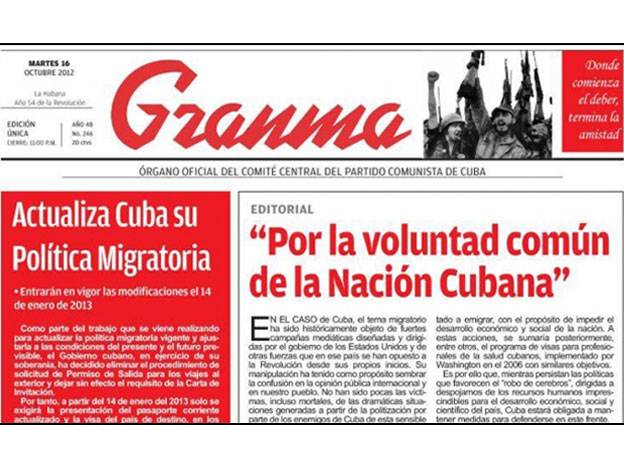
On October 16, we Cubans woke up listening to reports on all the news media about changing immigration policy. The Granma newspaper article read:

Updating Cuba’s Immigration Policy.

As expected, the queue to buy the paper that day took on significant proportions, and it was another big surprise that the Official Gazette mentioned was available along with the paper.

The news has become the talk of meetings around the table, in the parks and the corridors: now Cubans can travel where they want, without having to receive a letter of invitation from relatives, friends or acquaintances from other countries, after paying the high consular fees to the Cuban Embassy.

It seems a radical change but, looking sharp eye, not so much. It’s enough to look with an analytical spirit at Decree No.306 “With Regards to the Treatment of Cadres, Professionals and Athletes who require permission to travel abroad .

This is a complicated puzzle because the decree, with incredibly dark and convoluted language, inaccurately states who are those who can not leave the country with the supposed ease offered by the modifications.

It talks about those classified as cadres, managers of the central apparatus of the state, managers and executives who work in activities “vital” to developing the country’s ’strategic’ programs, research projects and health services, as well as technicians performing those same vital and strategic activities and high-performance athletes, coaches and trainers who are vital to the Cuban sports movement.

In a word, no doctors, no nurses, no health personnel, no athletes, no physical education teachers, no teachers of any kind. These are excluded from the amendment.

Does this mean there will be a new law increasing their miserable salaries. Could be. I doubt it.

They will continue to be asked for sacrifice, work and more work. Meanwhile, thousands of young people are crouched on one knee and look towards the finish line, waiting for the teacher’s signal with the old phrase: On your mark, get set, … out!

November 1 2012

Loyalty and Integrity / Cuban Law Association, Wilfredo Vallin Almeida #Cuba

By Wilfredo Vallín Almeida

We are at a difficult time in our history. So difficult that even nature seems to have conspired to bring us trouble. You have to be totally blind not to see the continuing and rapid deterioration of Cuba’s social health.

What happens around us is not new for history lovers. Similar situations have occurred in other places and other times. No wonder scholars say that “history repeats itself every so often.”

The deterioration of the environment should not lead, however, to loss of internal values. These values are the only ones that can save us amid the general disaster.

And it can’t happen, that between ourselves we have same situations that we criticize and fight. That is something that should be very clear to all of us in the Cuban Law Association.

Every day we see (and deal with) corruption, crime of all kinds, the little or no integrity of entities which should be paradigms for the country, constant violations of the law, ignorance or evil intention of their agents … all types of misconduct.

It is, moreover, what Cubans have called “to resolve,” that is, to get money by any means, without considering how in order to alleviate the shortages and general need we all suffer.

But beyond  all the hardships and vicissitudes, is the legacy left to us by the founding fathers of the Cuban nation and the sense of probity that we maintain at all costs. And that legacy reads verbatim:

When there are many men without decorum, there are always others who bear in themselves the honor of many men. Those are the ones who rebel with terrible strength against those who rob a people of their liberty which is to rob men of their decorum. In those men are thousands of men, a whole people, human dignity.

We will not and cannot renounce these paradigms . This would be to lose everything in this country and to sink the few handholds with which we can rescue the nation tomorrow.

The Cuban Law Association will always require absolute adherence of its members to the previous paradigms at any cost, even that of running out of members. And the lawyers who are not at the level that this time requires and who are carried away by human misery to which we may be exposed, because we are in Cuba, must abandon the Cuban Law Association, without distinction of person.

Because all we need now, greatly need, is LOYALTY AND INTEGRITY

November 5 2012

Uncertain Benefit / Cuban Law Association, Miguel Iturria Medina #Cuba

By Lic. Miguel Medina Iturria

Embezzlement appears as an offense in many jurisdictions. In our case it is governed by Article 336 of the Penal Code and embodies when an individual consents to take for themselves or with the consent of another, goods they have access to relating to the management, availability or custody because of their job.

This offense falls within the so-called frauds and despite being included under the heading of crimes against property, because of the magnitude of its impact it is considered as an offense that lacerates the national economy and has most negative influence on it.

In Article 336, different criminal penalties are applied according to the amount defrauded. Three to eight years in prison, if the economic impact is between $1,000 and $10,000; from eight to twenty when more than $10,000; and six months to two years or a fine, when it is below $1,000. The related amounts are provided in the Instruction 165 of the Governing Council of the People’s Supreme Court. This responds more severely the bigger the fraud to state assets. Personally I share this idea.

In the 6th paragraph of this provision provides a benefit to the accused which I quote:

“If the offender returns, before the conclusion of the trial, the appropriate goods or through his management this refund is achieved, the court may reduce by up to two thirds the minimum sanction as noted in each case.”

The purpose of this course is clear, through this expectation the person who commits this type of crime is motivated to reimburse the defrauded in hopes of improving his legal situation, but this paragraph has interesting practical drawbacks in the use of the term “may” which makes it an optional standard; in the case of return of the assets the Court is not obliged to grant the benefit described. In our judicial practice the latter variant is happening frequently.

In my view it constitutes an act of disloyalty to urge someone to give you what they have stolen with the expectation of improving their status in the process and then not to grant them the expected benefit. This legal standard should be mandatory or binding on the forums of justice, since the judgments not only have an impact on those involved, but on society and future offenders.

For example, if those involved in such matters know that returning the money will not bring a definite advantage, certainly they will not choose this option, but if complying with it provides certainty, every defendant would cooperate and would, without doubt, return the result of their corruption to its place of origin.

October 5 2012

The Harassment of Cotorro / Cuban Law Association, Esperanza Rodriguez Bernal #Cuba

By Lic. Esperanza Rodríguez Bernal

On more than one occasion the citizen William Alexis Cacer Diaz has requested assistance from the Cuban Law Association for having been the victim of unlawful conduct by police officers.

First, he was robbed of a camera, a mobile phone and a mini tape recorder he used in his work as a self-employed photographer).

At that time he was oriented with regards to what he needed to do in accordance with the provisions of Article 66, paragraph 1) in relation to Article 401 and following of the Law of Civil Administrative, Labor and Economic Procedure, to lodge a Demand for Process of Protection of Possession, against the Relevant Acts of the Authorities before the corresponding court.

Now William returns to us for advice as he continues to suffer arrests.

On none of the occasions on which he has been detained have they showed him an arrest warrant: he has been taken in a police car to the Cotorro Police Station and kept in a cell there for several hours.

When he asks about the reason for this the answer has been: “it’s a CI (counterintelligence) matter.”

Now William refers also to the threat that, for going to Estado de Sats, they have warned him he will be arrested every time there is an event announced at the home of Antonio Rodiles.

It is legal to do what the law does not prohibit and therefore if the agents arrest William again for attention Estado de Sats it will confirm their illegal conduct and they can be accused before the Military Prosecutor for this act that contravenes Article 58 of the Constitution of the Republic:
Freedom and inviolability of persons is assured to all who reside in the country.

No one may be arrested except in the cases, in the manner and with the guarantees prescribed by the laws…

What is happening with William reminds me of that famous work of Victor Hugo, in which a police displayed a visceral satisfaction in a lifelong pursuit of a former convict who, in the end, ended up saving the life of his pursuer.

Who can refute that life, with its avatars someday repeats an episode similar to Les Miserables? … Only with new characters and and a new location, and so it seemed to me a good idea to call this the Harassment of Cotorro.

October 3 2012

The Dilemma of Economic Contracting (2) / Cuban Law Association, Rodrigo Chavez #Cuba

Lic. Rodrigo Chávez

The underutilization of the attorney and the little or poor participation accorded to him in the contracting process, ultimately leads to problems with regards to the intentions or expected outcomes of the established relations.

In any state agency, it is not difficult to see that the activity of the lawyer, or the legal counsel, the attorney, or whatever you call him, is limited or tied to the development of disciplinary action, claims that could have been avoided, had he worked on the economics of the case, or even in some instances as secretary to the Board of Directors. In the latter role, discrepancies exist because some people advocate for him and others do not, but in the end, whenever one is in a subordinate role, the decision of the boss prevails without exception. A rational use of human capital makes sense, but in the same vein is the irrational use of the attorney.

There are lines which lead to imperfections in contracts, their normal development, and given that in the end a contract is a voluntary agreement, these must be true, solid, achievable objectively true and not fictitious, things that in our day constitute justification, failures to meet production or distribution or provide services, the inadequate or improper use of the contract; it would not be improper to speak in these terms same terms with regards to planning.

The labyrinth through which contracting passes, affects the stipulations for agricultural production, as well as those for supplies, and even the execution of the work; in these three alone the incidence rate is so negative, it deserves special attention devoted to it, given that even if the performance of a farmer’s harvest exceeds expectations that, too, does not meet the objective of achieving the terms because it was not reflected in the contract.

How is it possible that markets are largely unserved, making it possible to supplement the initial contract, but here’s another great dilemma: if it is nefarious to fail to meet the plan, it is more nefarious to over fulfill it. They would have to walk hand in hand as binomial-procurement planning. With proper planning, could well provide an adequate contract, and with a good solution, it would lead to a good distribution and a high probability of satisfying the consumer, right?

October 2 2012

The Dilemma of Economic Contracting (1) / Cuban Law Association, Rodrigo Chavez #Cuba

By Lic. Rodrigo Chávez

Monotony? War of attrition? Psychological pressure? False expectations? Or direct or indirect solutions in the short, medium or long term?

With so many questions, we do not know how to start, but it is true and, as always, there is a beginning and an end, that … God forbid, has started and can be completed, directly or indirectly in the short, medium or long term.

The issue of contracting, which is so inherent to the Cuban, that you can almost say he has become a specialist in this area without even knowing the essential elements that comprise it, suffice it to say that “horse trading” or “haggling” or whatever you want to call it is a daily form of establishing contractual relations between two or more people who want to be engaged in a relationship, legal or illegal (it’s very trendy in the underground market), and even though the State knows it, it cannot act effectively against them and believe me, in this market there is more than enough supply to meet the demand.

Let’s look at the issue of the newspaper Granma, on August 3, 2012, on page 4, titled Companies Must Play Their Part, by the journalist Ivette Sosa Hernandez. We ask ourselves, if the international contraction goes badly, as required, is contracting at the national level in good health? The rules for international contracts (covering a larger number of subjects, different economies, etc.), are not the same as those that apply to the national (internal order in the state enterprise sector and even in the private sector).

Indeed, the laws and regulations that still apply to economic contracting, do not conform to current conditions, so we can infer they have been frozen in time.

Both internationally and nationally, concluding a legal instrument of the magnitude of a contract, involves a solemn act, seriousness, responsibility, rights and obligations for the parties, but is primarily a meeting of the minds, wills backed by trust and commitment to its full implementation, so much so that in its commitment and arbitration clauses it does not become a dead letter.

Formalism, has become for Cuban entrepreneurs, something commonplace and everyday and therefore close to creativity, so it is unusual to speak about about bidding, negotiating; in such cases, the lawyer’s voice or intervention is usually relegated to the background, the lawyer is not on the plane where he should be but is called in cases of default, when conflict is already imminent, when given sufficient time he would have known the state of gestation that led to the evolution, development and delivery of such conflict.

October 1 2012

Cessation of Cohabitation / Cuban Law Association, Miguel Iturria Medina

By Miguel Iturria Medina

Property Law governs the use, enjoyment, possession and availability of good which one owns. The ultimate power is related, in short, to the possibility of the title holder doing with his property what he deems to be best. In the case of housing one of the issues is the disposition it, that is the owner’s decision about who lives in his property.

This is addressed in Article 64 of our General Housing Act, Act No. 65; however there are exceptions provision regulated in Article 65 of the law itself, which limits the cessation of cohabitation for ancestors and descendants of the owner, mothers with children born during the marriage, formalized or not with the owner, or mothers with children living in the housing for three or more years and having no other residence; elderly who have lived for more than three years in the building and who do not have a place to reside, cases of manifest injustice or inhumane acts.

Outside of these exceptions, the owner may terminate the cohabitation of any person without requiring an administrative or judicial declaration, but if the cohabitant refuses to leave the property, then the owner can call the Municipal Department of Housing to issue a resolution which determines whether unwanted cohabitant must leave, a process that can be achieved in the second instance in the Provincial Court, by application of nonconformity of the administrative decision, and which ends, finally, in appeal to the Supreme Court.

The real problem lies in the Order to Cease Cohabitation because once it is signed, either by resolution of the Municipal Housing (DMV) or Judgment of the Provincial or Supreme Court, whether the cohabitant refuses to leave the property and which is antisocial behavior unrelated to a work center, the competent authority comes to force removal by the police. But if the cohabitant does not meet these characteristics, the DMV only issues a provision ordering them to leave the house in 30 days and if they do not they will be fined 30% to 50% of their salary which will accrue to the State. So far.

Why doesn’t the competent authority take action in all cases where a final decision calls for the cessation of cohabitation? What coercive force is there in reducing the minimum wage by 30% to 50% when the cost of renting a home is around 20 Cuban Convertible Pesos (around 500 pesos in “national money”), and this figure is more than 50% of what the average worker earns? How can the owner get someone out of his house who doesn’t meet this requirement of an “anti-social labor link”?

There is no other option than to modify the Law so that it truly guarantees this ability.

September 30 2012