Giron (Bay of Pigs), Sara and Forgetting / Rosa Maria Rodriguez

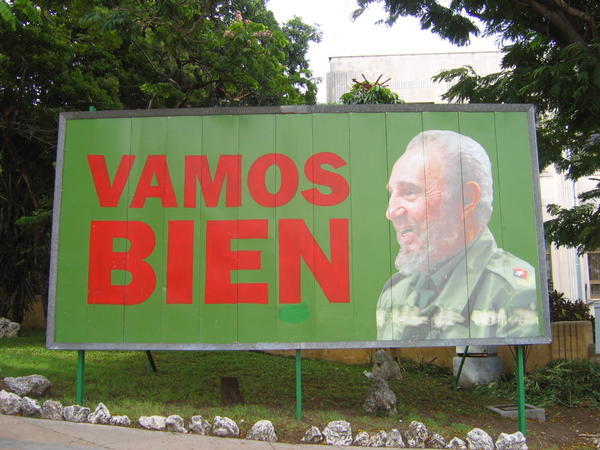
The annual carrying on over the victory of Playa Giron (Bay of Pigs) happened this fourth month, with the national media playing it down. The elections in Venezuela were the priority of the Cuban government after the physical death of Hugo Chavez and it seems that a matter of so much preoccupation and occupation, a vital matter of political survival for them, that they quietly commemorated the victory gained April 15-19 of 1961 by the then young Revolution, against the invaders.

The remains of Sara Gonzalez* must have been spinning in the stinking waters of Havana Bay this month. Her iconic song “Giron, the Vanguard,” an allegory of that military success of the nascent Cuban dictatorship, wasn’t even heard as usual in the four days of the media hammering that usually accompanies the remembrance.

Sometimes it seems that the government thinks that we are a subnormal people or that we have learning difficulties, so they must repeat to us, over and over again, the events and dates and produce multiple TV and radio programs to  repeat the events and dates over and over again and make many radio and television programs to plant the understanding in our minds over the entire year; but the more repetitions on the anniversaries. Perhaps others, like myself, noticed the government slip-up, but they chose to let us escape, although just this one time, from the persistent official harassment, the manipulation of consciousness that historically reigns over the minds of our subjected people. What a relief!

*Translator’s note: Sara Gonzalez Gomes (~1950-12012) was a Cuban singer songwriter who was part of the Nuevo Trova with figures such as Silvio Roriguez and Pablo Milanes.

25 April 2013

Killing Without Showing Their Faces / Rosa Rodriguez

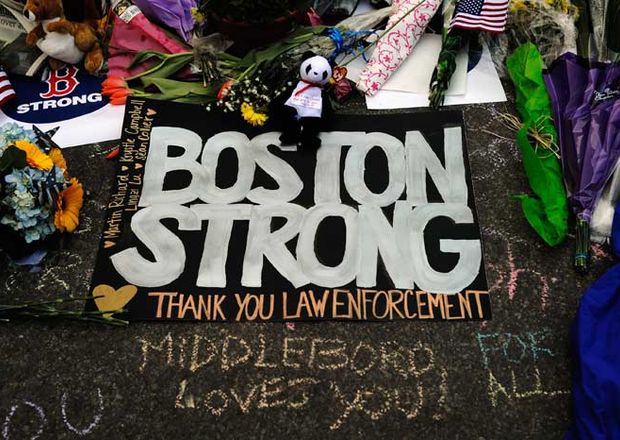
Again terrorism achieved its murderous aims when many innocents were killed at the finish line of the Marathon held in Boston, Massachusetts for more than half a century. Naturally, the bombing also erupted in the media, which sent us images of the two Chechen youths who were the authors of this act of terror that cost three lives and injured more than 170 people.

I sincerely sympathize with the pain of the families of the victims of this vile episode committed from a distance without showing their faces; and I also sympathize with the families and friends of all who perished in the same or similar circumstances.

So far, the Cuban press only referred to the event from the news perspective, with nothing of the usual sociological and super-politicized analysis — with a visible justifying subtext — of the reasons that in some regions, countries or social groups inclines people to violence as a means to express disagreement with certain policies, political or power centers, which is the same as using the lives of people to send messages to the “criminal complaints inbox.”

The official media in my country always mentions social injustice, poverty, the domination of foreign powers, cultural issues and religious fundamentalism, and uses and abuses the term “double standard” to demonstrate their disagreement with the treatment given to some known terrorists. Doesn’t that make them the same?

When their allies throw Molotov cocktails it’s a revolutionary activity, if other people do it they’re terrorists. Their allies, the FARC, don’t kidnap, they “retain”; but if the an antagonistic group executes an analogous action it’s kidnapping. The saddest thing is that these manipulations are not confined to the field of semantics, but are commonly conceptualized.

When it comes to something like the case of Bin Laden and action of the CIA, the media are supersaturated with criticism of the U.S. government and its imperial and interventionist methods of domination.

When they talk about governments partial to Cuba, like Russian and its two wars launched against Chechnya to prevent its independence, the immorality of the double-speak or the scandalous silence. Perhaps they are waiting for the trial of the young survivor “terrorized by the cruelties and injustices” involved in the massacre, to highlight the exaggerated punishment the judicial system of the United States imposes on the defendant.

I know that peace is fickle and threatened, at least by verbal violence, cultural differences, socioeconomic, geopolitical, strategic or hidden and diverse interests. From primitive times there were people trying to control others and governments or groups who, in the legitimate exercise of their defense, applied the laws as established — unlike dictatorships — in favor of maintaining peace and political and social stability. These values and rights of communities or societies remain today and we must respect, without interference, what is established in the legislation of each State when it comes time for justice.

The reasons that may predispose a person to choose the option of terrorism are dissimilar and complex to analyze in the personal space of a blog, which has its   communication codes for amenable and digestible reading; but I blame these acts contrary to human rights, proclaiming premeditated aggression against innocent civilians even outside, the objective pursued, in order to strike terror to a part of society through fear and achieve a political purpose or otherwise.

I repudiate these violent actions aimed at creating alarm and social instability, inciting ethnic hatred, religious or political, and that use of any weapon of war, explosives, chemical or biological weapons, to endanger the life or physical integrity and psychological health of people.

23 April 2013
Ballots in Boots / Rosa Maria Rodriguez

The model that has governed my country for the last 54 years didn’t always have  constitution nor hold elections. The bases of these were created in 1976 — after the government had been in power for 17 years — as a wise move to legitimize their leadership of Cuba and create a political-social structure that allowed them to prolong their domain. And so it proved.

The created the organs of popular power to enshrine Marxism and perpetuate “Made in China” socialism, to justify a model of participative democracy that is not democracy because it is not plural, nor is there a separation of powers, nor is it participative, because it discriminates and Cubans with points of view that differ from the official line cannot hold office.

Democracy of a small group and one party is a bluff. It’s a monochromatic political landscape in the absence of ideological colors, the unhealthy totalitarianism of peoples, the fattening of egos with praise, in short, it is a single party, despite what the Cuban government says, it is a predator of the democratic values of every nation.

21 April 2013

Hiding the Merchandise / Rosa Maria Rodriguez

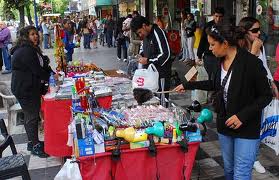
On two occasions in Guanabo, a seaside town east of Havana, the authorities launched an action against the vendors who gather at 5th Avenue and C; but this Saturday there were much more despotic and cruel, because along with the abuse, the seized the goods of the self-employed.

Local residents and those of us who learned of the abuse wonder why they confiscate things from people that they had to pay for. Residents also question why they are now forbidden to sell on the town’s main street, with the coming of the season when the place is full of Cubans who go there to swim and they may find it easier to sell their products.

As usual, the police don’t give explanations about the change and nor do they give any reason for the abuse or the use the expropriated goods are put to. What they do make clear is that they have no interest in promoting trade and supporting the vendors.

It came to mind, in contrast, how the merchants on 23rd or on G, in Havana, are permitted and no one comes and throws them off those streets. The answer may be that it is easier to abuse people and violate their rights on the outskirts of the city, away from witnesses and bystanders of all colors and influences, and far from embassies and tourists with cameras.

18 April 2013

Microphone Obscenities / Rosa Maria Rodriguez

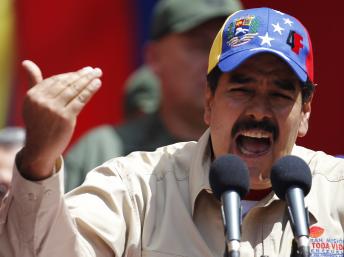
Nicolas Maduro. Image from http://www.espanol.rfi.fr

I already said in two tweets Sunday: “Even after death #Chavez won elections in #Venezuela. Maybe now, his imitator will let him rest in peace.” And I added the following: “The socialist bus driver takes the helm of #Venezuela. Let’s see how he drives from now on, Chavism without #Chavez.”

This April 14 the presidential elections in Venezuela ended with the hard-fought victory of Nicolas Maduro Moros. The leftist TC network Telesur — which we call TeleMaduro these days — constantly favored the incumbent candidate with extensive media coverage, so I could not confirm if the opponent Henrique Capriles followed the same pattern of behavior and showed himself as exalted and disrespectful as Maduro.

It’s true, I saw interviews throughout the campaign on that television network with followers of either presidential candidate: Maduro’s “Chavistas” knew and spoke highly of the candidate’s programs; Capriles’s supporters didn’t know a thing about his projects. It seemed that the respondents had been chosen and it was just like we were in Havana, in the presence of the usual discriminatory traps of the Cuban government.

It is no secret that Cuban authorities had bet on Maduro, no matter if the core of his campaign program was talk over and over again about Hugo Chavez, exploiting its undisputed leadership, charisma and image, giving with both hands — and even with his feet, like a magician king throwing a people’s money out the window of irresponsibility — the country’s resources just to get elected and stay in power. The obvious case is those eternal leaders of the Antillean archipelago who were forced to avoid jeopardizing the advantageous oil commitments made with Venezuela, and the security of continuity that they have provided for the last fourteen years.

On this side, the authorities did their part to give a boost to the driver’s* association. I’m referring to visible aid, as television programs reiterated over the last days devoted to Chavez and the so-called “Bolivarian revolution.”

In the past, in Venezuela, surely they also favored him with supporting the campaign openly on Telesur and with good advise to help the support his path to Miraflores. I imagine that knowing the results of the contested election, having received an alert about the odds advantage of the Socialist candidate, whom we don’t know if he’ll be capable of properly leading the destiny of this South American nation during his presidency.

I imagine that the Cuban leaders focus their gaze with more interest in the cardinal point to the north, focused on the survival of their own model of government, but while they are so intolerant and show no signs of real democratization and respect for diversity and political pluralism, they will not be taken seriously by any first world country.

Returning to Venezuela, I add that I don’t know if there be “Chavism without Chavez” or “immaturity” with “Mr. Mature” — i.e. Maduro –  what most concerns us and what we don’t have, is a financially independent Cuba. That, coupled with the destruction that “the most patriotic” have led the country in a general sense — well, if these are good …! — and the stubbornness of the U.S. government to refuse to normalize relations with Cuba, forced many Cubans to express their satisfaction with the electoral victory of the Chavista candidate. To want something different would have been a parody of the popular irony and ask for a rope for our suffering neck

*Translator’s note: Maduro was previously a bus driver.

16 April 2013

Nuclear Peace / Rosa Maria Rodriguez

Image from Wikipedia Kiwix (offline)

For some time North Korea seems to be “resetting its war of the ’big bark’” and increasing its verbal “shockwaves” and tensions in general. The discourse heats up the diplomatic tone and increases general tension. They assert that it is the opponents who are the provocateurs, because they are engaging in joint military exercises with the United States, but everything seems to indicate that the it is due to the hunger of its people, the inability of the government to solve that, and the reaffirmation of a dynastic president, who arrived at his post through blood ties and needs to morally consolidate his power before his army.

The Japanese military occupation ended in 1945, Korea was divided in two by the 38th parallel: the north, occupied by the then Union of Soviet Socialist Republics and the South by the United States Army. In 1950, Kim Il Sung’s grandfather, supported by China and Russia, invaded the south of the peninsula, which cost him the war with the United Nations. In 1953 he signed an armistice that ended the shooting war, but both countries are still officially at war, as they have not signed a peace treaty.

This is always the threat, but is more danger every time there is an undemocratic caudillo leading a country supported by opportunistic people who do not want anything to change to maintain their standing. They are the manufacturers of perks, the irresponsible dispatchers of misery, who see the specter of conflict everywhere to keep their interests intact.

Because of bad decisions in the People’s Democratic Republic of Korea — essentially dictatorships tend to emphasize “democratic” in the name of the country — the human species is approaching the precipice of war. We already faced this Cuba in 1962 and the earthquake caused serious geopolitical tensions worldwide. Today, with the possession of weapons of mass destruction by North Korea, the threat becomes a conclusive ultimatum.

The use of force is an animal instinct that human behavior assumes despite its complete lack of reasonableness. I hope that on this occasion, as on others, once again sanity and the spirit of survival will prevail, and that in the near future no country will again become victim of irresponsible leaders, who in order to “send messages” to their own subalterns, international allies and enemies, and to stay in power, threaten world peace.

2 April 2013

What Comes as a Surprise and What Does Not / Rosa Maria Rodriguez

I had already read in a newspaper article by a fellow from the interior of Cuba that the salsa singer and musician Isaac Delgado, “the cool salsa guy”, had visited our country and offered his music, along with Silvio Rodríguez, in Santo Suárez neighborhood. The incident, although silently mentioned in the national media, has aroused suspicions among the Cubans that found out about it; but there is — and it looks like there will be — more. On the night of April 6th I was waiting for a delayed projection of a film, but since the TV programming was as bad as usual, I started anxiously switching between the six channels “mounted” (“hooked”) to the remote control and stopped at channel 6 (Cubavisión) surprised by the image before my eyes; it was the presence of Malena Burke’s, who was performing at the “Boleros de Oro” (Golden Boleros) Festival, which this time was dedicated to her mother, the late singer Elena Burke, better known as “the sentiment Lady”.

What I could see from her performance, I liked, and I wished I had seen the show from the beginning, given that it had been almost three decades since I last enjoyed one of this “cat’s daughter’s” performance who left this place but not Cuba. However, I still remember the historic diatribes put forward by the authorities and their spokesmen against Cubans who left the country. Since when had recent visitors stopped being stateless? Of course, any attempt to relax relations, mend fences, respect differences, and cut down the distances is something positive and I approve; especially if they are people born from the same womb of the fatherland. But, when will they allow the rest of Cuban artists and all the other immigrants in general who wish to do so to travel freely to our common homeland?

If the presence of this Cuban artist was a surprise for me, the implicit government’s coercion — that seeks to influence the behavior of Cuban immigrants — was not. The new immigration law took effect on January 14th for all Cubans on the archipelago but not for those who reside abroad. Why? What is justified as a selection, it is simply an unjustifiable discrimination and violation. In short, many suspect that the law is not an act of justice to the Cuban society, but rather it is oriented to help wash the dictatorial face of the authorities, who have set out to “charm” the US administration in order to normalize the relations with Cuba.

The formula that the government has used on the migrants does not come as a surprise to anyone, the one that does not allow them to travel to Cuba if they become involved in politics, with the exception of a few. As long as the “masters of the key of our homeland” don’t start from a place of respect for the diversity of opinions, it will be difficult to slide open the bolts to the gates of the national home to all Cubans.

9 April 2013

The Universal Flavor / Rosa Maria Rodriguez

I am not going to talk about the flavor most in demand by everyone, but rather about the local ingenuity, which manufactures, in the midst of difficulties and shortages, the gastronomic inventions that make it possible to find tons of things, water “in paper money,” to satisfy one’s thirst and survive. In my Havana, where in the ’90s they invented “floor rag steak*,” pizza with melted condoms instead of cheese, and plastic ham, it’s been easy for today’s self-employed to create a generic ice cream flavor, that consists of coloring the fake stuff with a sweet and universal taste.

I refuse to buy ice cream in the private sector any more. It doesn’t matter what color it is, if it’s in a cone, ice cream bar, salad or bowl: it all tastes the same. I feel like a little girl who’s been ripped off with a box of culinary colors. In a country that calls itself democratic where there is no democracy, that says there is freedom but we’re not free, it’s natural that everyone — literally — “swallows the bitter pill” of the scam.

This new and authorized disrespect for the consumer, is one more in a long and historic list of State irregularities — like almost everything in Cuba — in the restaurant industry. It is the universal flavor of a government that has educated three generations to make them believe in what doesn’t exist, in what is actually a big lie.

We promote and encourage foreign investment in our country in this area as well, but morally we must begin with Cubans — immigrants and here at home. Unlike the former socialist republics, we have the advantage of capital that can break the economic inertia. It would be a stretch, but it would be possible with political will, to acknowledge that part of our people who “got their feet wet” in search of greener pastures, of places to live that are less suffocating and more just. It’s time for them to open the doors of citizen rights — doors that never should have been closed — to our compatriots abroad.

It would then be possible that we could all enjoy the enormous ice cream of human brotherhood and the delicious flavor of reconciliation between a captive people and its diaspora.

*Translator’s note: “Floor rag steak” is exactly that.  This video, easy to follow even if you don’t understand Spanish, shows how it is made.

6 April 2013

Fundamentalism and Oppression

We’re doing fine. From http://rezzonics.blogspot.com

Fundamentalism and oppression. Both are ingredients essential to dictatorships and cause fear and immobility and societies. Fundamentalism, whether religious or ideological, is the banner of totalitarian regimes and the quintessential seasoning of the armies and police of oppressive governments. They are the two drugs that produce the group’s eternal dream of remaining in power, to the detriment of the sociopolitical, cultural and economic development of the whole country.

Worth comparing, for example, to what Japan was before and after 1945 and how it exchanged futons for beds, har-kari for mea culpas, and how it evolved from feudalism to be one of the major economic powers of the world. The Korean case is even more illustrative. A people divided by two different government systems: the north, abusive and a violator of people’s fundamental rights, evidence of a manipulated egalitarianism and fictionalized uniformity, while in the south, citizens go on strike, demand their rights, elect governments, produce …

I think of Cuba and what we have and what we will become — if God lets me live — and I feel more optimistic. And so, some time ago I started moving and exercising my right to think, speak and act with freedom of conscience, despite the fifty-year dictatorship that oppresses us, nor do I rest in planting the seeds. Now we are beginning to see the positions…

4 April 2013

Easy / Rosa Maria Rodriguez

Cubans line up in Havana to pay their respects on the death of Hugo Chavez

The dynamics of modern life offer lots of reasons to reject stagnation in human activity. Because of that historically Cubans emigrate en masse to wherever there are more lively sociopolitical and economic rhythms, although afterwards we complain about the fast pace of life and “how hard you have to work” in other countries. Those who go away email us about the compensations, or they tell us about it with their own voice when they come to visit a relative who has remained penniless in this country. Many of our countrymen say that when they come to Cuba they have the impression that they are flying back in time to an earlier age. “Nothing seems to move forward here”, they say and comment that “whatever they do is so slow that you can’t notice it.” They add that where they have come from everything goes forward quickly and efficiently. Some foreigners are more diplomatic and prefer not to comment about our way of getting along by way of cars pulled by mental horses in the age of nanotechnology.

An ancient lyric of the disappeared musician and composer Ignacio Piñeiro, went “slowly is more enjoyable”. Of course he was using a crafty double reference to Cuban dance music, because in many other respects  – before as well as now – this statement is counterproductive. For example: imagine you are waiting to go into an establishment which prices things in dollars and that the cashier keeps the queue waiting while he or she is counting money. Why are they always doing that in shops in Havana? At different times of day and in different towns they do the same thing: as an indication of contempt they delay all the customers who are keen to buy things and leave. Why do they have to do all this counting? Why can’t they do it at the end of the day? Some suspicious people in the line in a shop the other day commented that they do it to keep on top of things and take money out to make sure they have no surplus in the event of a surprise audit.

I would like to share with my readers and visitors my view that we live “conveniently” slowly at the pace which suits a government interested in its own permanence. It’s always been like that, and the previous president, to aid his personal war against the United States, favoured an irrational obstinacy which ruined Cuba and which today is moving closer to the future annexation which he was supposedly trying to prevent. The change in mentality which they talk about now, in the form of the latest and most manipulative slogan, is just like the education which is provided free at the price of eternal submission, in order to justify what is unjust and badly done. We shouldn’t show impatience  because we are made to wait, if this long oppressive line, after outrages and repeated screw-ups, now looks as if it is beginning to move forward. We’ve only had to wait 54 years.

 Translated by GH

26 March 2013

Any Wednesday / Rosa Maria Rodriguez

Marakka 2000

It’s Wednesday night and from a nearby radio I hear the theme song of Nocturno, the old Radio Progreso program which on this day of the week is devoted to the music of the prodigious decade (the ’60s and ’70s). The Spanish group Los Mitos with their pipi pipi pipi (It’s Very Easy) burst my sound space and take me back to my childhood, when not being old enough to enjoy this music, I copied the tastes and preferences of my older sister who was already a young woman and did enjoy it.

A neighbor yells to another that the water’s on, my children no longer fight over the remote control, but the World Baseball Classic is about to start and Rafa, my husband, who is a fan — well addicted, actually — to the news, is watching Telesur non-stop. It’s been a long time since I listened to the radio, because there’s nothing like the perfect and indissoluble marriage of image and sound.

Other voices come from the passage next to my house. A dog barks, someone hits it and it squeals, another neighbor passes under my window fighting with her two-year-old daughter, and the drunk from the block is having his night of fame giving “a concert” in which he spews flowers — obscenities — from his mouth as if he were the noon loudspeaker. I also hear some of the information broadcast by Telesur, including that from now on, in speaking of Latin America, we will have to refer to before and after Chavez.

Such an historical inflection makes me think of the Cuban ex-president, Raul Castro’s brother, who both sparked and supported — although I have no evidence I assume he also had patronage — a Latin American guerrilla movement against the United States. I’ve always felt that in his actions, and even more in what he said, he paraphrased a thought of Jose Marti: “All the glory of the world is contained in me.

So it was his tenure, history, and his different work teams, offering praise, grandstanding and mystique in that guerrilla sack and fabricating a myth. I think the comment by Telesur doesn’t do him any favors, because although Hugo Chavez was his political partner, the zeal for his image has been a constant, especially since his involuntary retirement.

He will invent something, be it a campaign, a new book, or some other trick, but surely it will more of the same from recent years, as he doesn’t have the time or health to return to his old ways.

My reflections were long and took me to the recent Cuban vote — that the official spokespeople call elections — when a Telesur reporter approached Fidel Castro after he voted and asked his opinion about the current changes in Cuba. He responded with a parody of his former energy — a genius and figure to his grave: “What changes? Here the changes were made in 1959, with the Triumph of the Revolution,” which silenced his interlocutor.

I laugh at myself because I can’t focus my attention, rather I look like a receiving antenna of all information around me, an inverted oscillating fan that instead of blowing air tries to receive the breeze from its environment.

I shake off the abstraction of my thoughts and return to Wednesday night when the melody “Your Eyes,” by the Spanish duo Juan and Junior comes on, missing for years from the radio; it tells me with its note that for the time being we’ve reached the end. “Almost as grey as the sea in winterrrrrrrrr….

28 March 2013

Spring Kidnappers / Rosa Maria Rodriguez

Arrest from the 2003 Black Spring. Image from “http://america.infobae.com/”

At present, despite the continued pervasiveness of the political police, which hinders the proper performance of our work, and systematically violates our rights and freedoms, harasses and threatens us with many years of jail, alternative civil society is strengthened numerically and ethically and works for certain outcomes, possible and definitely better for our country.

Those brave peaceful fighters — from the Black Spring of 2003 — were already released and some of them remain in the country. They were 75, but there are many more stories of errors and horrors of the government to discourage the opposition movement in Cuba. Nevertheless, this multiplied from 2003 and it is an intellectual and moral power that denounces the arbitrariness of the powerful and proposes politically democratizing alternatives to the redundant and systemic immobile modus operandi of the totalitarian regime.

I hope to God that that repressive episode with another sequence of arrests like in 2003 is not repeated, which would make even more difficult the necessary reconciliation between Cubans and prevent the permanent insertion of my country into the group of the world’s democratic nations.

21 March 2013

The Departure of a Mortal / Rosa Maria Rodriguez Torrado

Image found on Wikipedia Kiwix offline

I won’t judge the politician or military man, I’ll identify with the man, the son, the father, the grandfather, the Venezuelan leader of the United Socialist Party of Venezuela and the idol of his supporters: Hugo Chávez died, the 52nd president of Venezuela. On February 2, 1999 he became the elected ruler of his country and this past October 2012 he was reelected one more time for another term. Beginning with his arrival at the throne of government, he tried to goodly prolong his stay in power and to accomplish this he was behind a ’just’ referendum and modified the constitution — a practice repeated in other so-called revolutionary processes — to guarantee the continuity of a small group at the head of the country and to eternalize himself in the job with the “revolutionary” pretext of developing his programs of government.

Fidel Castro took note of him in February 1992 when he headed a “justified and good” coup d’etat against the constitutional president Carlos Andrés Pérez. For that event he spent two years in prison — had he done so in Cuba, they probably would have sentenced him to more than three decades (although it’s speculative there are certain precedents) or condemned to death — and he was invited by the Cuban government to visit our country.

Here they treated him like a head of state and apparently arrived at commitments that marked his journey in politics, which culminated with his arrival at the presidency of Venezuela, his eternal thanks to the Cuban ex-ruler sealed publicly and repeatedly. Nobody has described the genesis of the political marriage between a high-ranking official of the savannah like Chavez with a mountain fighter like Fidel; between a man from humble roots like Chávez and one of bourgeois origin like Castro; between a dictator who killed the liberal structures of Cuba and the commander with the most democratic image recorded in the history of Latin America.

A form of government has to be created in the countries of our America in which the leaders who come to power democratically defend the maintenance of the mechanisms that made it possible for them to get there; no political system that sustains itself on duress, physical or verbal violence, the violation of rights, or on the denial of freedom of expression on the part of the people, and fear can really consider itself free.

Although I never sympathized with the ideas and plans of Chávez’s so-called Boliviarian revolution — so similar to those that have impoverished Cuba for over 54 years — I lament his death and identify with the pain of his family, and with that of the millions of followers who still mourn his physical loss.

Translated by: JT

14 March 2013

Spring Kidnappers / Rosa Maria Rodriguez Torrado

Arrest in March 2003. Image from america.infobae.com

At present, despite the continued omnipresence of the political police–which hinders the proper performance of our work, systematically violates our rights and freedoms, and harasses us and threatens us with many years of jail–alternative civil society is strengthened numerically and deontologically and labors for certain potential destinations definitely better for our country.

Those brave peaceful fighters of the 2003 Black Spring were already released and some of them remain in the country. They were 75, but there are many more stories of errors and horrors of the government to discourage the opposition movement in Cuba.

However, this movement has grown from 2003 and it is an intellectual and moral power that denounces the arbitrariness of the powerful and proposes politically democratizing alternatives to the systemic immobility modus operandi of the totalitarian regime.

I hope to God that there will not be a repeat of a repressive sequence of arrests like that of 2003, which makes the necessary reconciliation between Cubans more difficult and prevents my country from permanently joining the world’s democratic nations.

21 March 2013

The World Baseball Classic / Rosa Maria Rodriguez

Image downloaded from http://puentelibre.mx

The third World Baseball Classic ended early for the Cuban team and left many of us with wishes to see them win over their neighboring ball club and Cuban sports narrators with wishes to travel to the Californian city of San Francisco in the United States.

If the Classics have brought us anything positive, these have been the possibility of seeing good stadiums on television, quality officiating — despite the fact that it’s not perfect — and the possibility of comparing averages and the conditions of our stars with the records and the caliber of the ballplayers of other latitudes. Nobody understands why only they permit ours to contract with leagues from other countries like Venezuela, Mexico,  Dominican Republic etc.; or why, when they retire, that they pay much less than to active ballplayers. To what or to whom do we owe this bad idea?

This Classic has been exceptional in that the games were broadcast of our teams and our commentators refer to them with respect . Could this be the preamble to a change of mentality or of flexibility of sports politics followed until now? A very little while ago we learned that the authorities respected their right to visit their country and the province of Pinar del Río, for pitcher José Ariel Contreras, who stayed abroad* on one of the trips with the Cuban baseball team and was contacted by the big leagues.

The “balls and strikes” athletes in my country play for love of the sport and in deplorable conditions in comparison with many other teams of the world. They train like professionals, but they are treated almost like slaves. All to defend an amateurism that played its propaganda role during the so-called revolutionary era, but in reality is erratic and oppressive.

Fields aren’t in optimal conditions, balls are counted and used too many time in each game, the officiating is horrible, and those chosen to make up the team that represents us internationally are victims of different pressures: seen off in political acts of our country’s leaders, “commitment to the Motherland”, speeches, display of the flag — as if they were going to war — and now, at last, also subject to the despotic attitudes of their manager.

I’ll continue defending my thesis that to be a manager you don’t have to have tyrannical characteristics or roots. In a frank summary of stress, personal needs are also present; the pressure of finding the time to go to the store to buy a team to replace Cuba’s broken one and other compromises. And to do it watched over by maybe it’s that the “guardian angels” that always accompany sports delegations which guarantee their safety suspect that it’s a pretext to stay abroad and act “in consequence”, as usual.

I can only imagine how our ballplayers feel interacting with those of  the other countries in hotels and stadiums: like orphan children whose wealth is the “dignity” of playing according to the managers and the whim of a small political group and its political model in decadence. Beyond who ends up the winner of the Classic, there will also be the Cuban fan who will have won, who has expanded his culture of baseball, enjoyed other styles of play, of management, batting and pitching coaches, and above all, better conditions in which to develop, play, and enjoy our national pastime.

*Translator’s note: These ’defections’ of Cuban sports figures have been seen as treasonable acts by the Cuban Government in the past. The fact that a defector would be allowed to visit his family home is remarkable.

Translated by: JT

16 March 2013