
 Click images or here to watch.
20 January 2014, 1:00 PM Havana time
English Translations of Cubans Writing From the Island
Click images or here to watch.
20 January 2014, 1:00 PM Havana time

Finally he’s left alone.
Bent over, his perfect Greek profile now that of a vulture.
There is some classic wisdom in the raptor species. Something of nobility in the adaptive gesture of eating carrion.
He’s not even remotely senile, as his enemies from the antipodes claim.
He is simply alone, in an irreconcilable world, surrounded by reminiscent faces. Traces of totalitarianism.
All around him, everyone understands the scene perfectly. They smile at him with pity. Take photos with impunity. They believe themselves privileged to attend the latest anecdotes of the Revolution. Also there is, notably, some impatience, or maybe nervousness. They know the Revolution will end with this hesitant body.
Meanwhile, we gaze ghoulishly at the vacant eyes of the Minimum Leader, the Companion in Chief, who no longer holds any dictatorial job, and, barely able to touch objects with an index finger, soon will no longer murder even something as innocent as a baby. After having imposed so much barbarity as a strategy of eternal governance, Fidel is now living in Braille. His death will be tactile. The Cuban rite of extreme unction will come to him on his spotted skin, perhaps at the hands of the Cardinal.
The senile, in any case, are us. Who allow him this saintly solitude, backs to the recognizable world, surrounded by repressors in an exquisite state of futurity, already ready to compromise our future in a new totalitarianism about to be designed.
10 January 2014
PLASTIC TEARS
Orlando Luis Pardo Lazo
In the Boniato jail, in Santiago de Cuba, a physically impaired man, a common prisoner (for me no prisoner is common), Norge Cervantes, blind, said in farewell to Antonio Villarreal, one of the 75 prisoners of the Black Spring with which Fidel Castro reacted to the Varela Project: ”The tears that run down my cheeks are from the heart, because I have plastic eyes.”
Antonio Villareal was found dead in Miami last Saturday December 28. Day of the Innocents, may this noble child of sixty-something years who was tortured to the hilt in Cuba rest in peace. Even losing control in stages over his more basic reflexes, like controlling his urination. And his tears. He spoke with many crying inside and out of Cuba by telephone or on camera, but his olive green tormentors never managed to break him. That is why they savaged him.
Of course, nothing like that will happen to us. We are healthy and in control. We triumph, as Miami already triumphed and very soon Havana will triumph. Miami, a city largely shaped from Havana, in order to complete its historic role that after 2014 will rush to it: saving the Castro Revolution, managing a future enterprise for its militarized white collar mafioso. Putinism unaided. continue reading
There is nothing that the Cuban government does that is not marked by death (hence its true power in perpetuity). The liberation of the 75, for example, already drags with it with several deaths, including that of Laura Pollan, who would still be with us if those “liberations” had not occurred, because she alone knew how to defend herself much better from the assassin plot that took her life from behind and cremated her in order to leave no evidence.
Cardinal Jaime Ortega is architect of all these forced deportations and complicit in the string of crimes to which he in person is giving the consummatum est. The Castros just supply the labor.
It is speculated that it was a suicide and soon the press will pardon him because Antonio Villareal had “mental problems” or “was sick in his nerves.” Killing oneself is not a symptom of mental illness, but of spiritual strength: It is a blow to the arrogance of God or the senselessness of Nothingness. If he killed himself, it is because Miami deserved it. But, in any case, there exists not the least evidence that it was a suicide. Menaced or sick, what is a fact is that we Cubans had abandoned him, even from Havana.
We Cubans are all like that blind prisoner, but in reverse. Our tears are plastic, like the eyes with which we look without seeing.
Translated by mlk.
Note: The following video is in Spanish.
30 December 2013

What if the light or freedom doesn’t reach us in time.
What it Evil prevails over our bodies and our exhausted demand for freedom.
What if Fidel and Raul Castro don’t die, as they threaten.
What if the surname Castro remains a cruel scar after Raul and Fidel.
What if Cuba falls into the hands of or never emerges from the Latin American debacle.
What if the United States doesn’t remember our nation any more.
What if free Europe never stops betraying us.
What if the truth is too true.
What if it’s too late to revive the broken soul of our people.
What if the Cuban exile never returns, as it already never returned.
What if even more violence lies ahead for us.
What if death, always death, looks us in the eye and undermines the love that remains in our heart.
What if memory degrades our will to love.
What if we are not.
What if we weren’t.
Cuba, nobody would have love you more than you and me.
31 December 2013

December starts in New York.
The people don’t notice it, because they are not Cubans. But December is the month of death and of hope. The end of a year. We are still here. Another year begins. We don’t know if it will be our final date. Beauty and liberty surround us leaving us no alternative to sadness. We miss some love.
That’s Manhattan. The place where with each new life we miss the same old love. Although people don’t notice, because they aren’t Cubans, and December just appears to be another excellent commercial opportunity.
My name is Orlando Luis. I was born on the 10th of this month in 1971. I will turn 42 outside Cuba. Pardon the ambivalence. Maybe outside of Cuba I will turn 42. Perhaps it has been 42 years since my homeland deported me.
Whatever the statistics of the Revolutionary State say and their comparisons with other emigrants, there is not one Cuban outside of Cuba who has not been deported. The dreams demonstrate it, although they are not enough to take the Castro brothers to an international court. continue reading
Those recurrent nightmares of exile bring us together around the evil axis of what Castroism has meant for our bodies. We know that the Cuban people is a fascist invention from before independence. But our bodies suddenly collimated by the same sovereign dreams still permit us to recognise ourselves as a nation.
We are Cubans because we dream the same terror, because our land terrifies us so that nobody who is really Cuban really wants to return.
We are Cubans because our heads sway in communion during the mornings of sweat, tremors, sleepwalking, funny faces, halitosis, frog in the throat, pills, snoring, apnea, and awakening with tears, while we imagine we are in Havana, but what perversely persists outside is now New York.
December in Manhattan is the most desolate and uncomfortable season of the year.
We remember, also, our cadavers abandoned with the prosaic haste of the party. Well, I have bad news recently arrived from our island: in the Cuban cemeteries there is a dismal sacrilegious fraud going on. Many bones have been looted by the negruno pantheon. Others have been captured by the political police to osteoporosisize the history of their crimes and, in passing, to sabotage any future homage to their victims. Still others are in the hands of apprentice doctors and also artisans working for CUC (Cuban convertible currency) making tortoiseshell jewellery.
The rest is a mixing up of common graves with family ones. Neither Martí nor Ché nor any of the remnants of our despotic heritage are what it says on the label. The marble tells lies. Neither grandmother nor aunt nor your love are waiting for you there. Cuban cemeteries are a puzzle which our own flight has left without a code to decipher.
I repeat it but not without pain: it’s very late already, we won’t go back there where no-one is left.
The diffused December nation waits for the first snows and celebrations summing up the year. The Cubitas diaspora thickens little by little, according to the Cuban exile it disappeared. We are a will-o-the-wisp, juggling lights, an optical error of refraction.
We breathe. We swallow the free air of New York. We recognise ourselves as strange beings in front of the shop windows of almost mournful luxury. To be the phantom mannequins on this side. Not mixing with anything, because we will always be with one half of our soul on each side of the glass, violently Cuban shadows whose memory is fragile but very well fermented. We are not simply at the moment, but we are indeed half New York and half Havana.
I put up my coat collar. Stick my hands in my pockets. I look like someone out of a crime thriller, half way between private detective and serial killer. I cough. The New York cough of Cubans without a Cuba is also a lingering symptom. We cough out of sheer stubbornness. We worry about our lungs, about the rheumatic rhythm of our breathing, but in practice we hardly ever get ill unless it’s to die.
By then, by the time we suffer a New York December, we will be destroyed, consumed. People will not notice, because they will not be Cubans. But December will again be the month of the death of hope. Another year which will not have put an end to everything. Still we will not be so many here. Another year which never stops starting, since no date would be able to finish us off.
The sadness which surrounds us makes us free and beautiful with that brilliance which is wonderful and has no alternative, implying complete truth. We do of course miss some love.
Translated by GH
2 December 2013
Imagine. That this coup d’etat on the first of January 1959 would be considered a Revolution by half the planet. Or planet and a half. Imagine. And that the whole country would be militarized and export war for more than 55 years of world history. Imagine. That what could not be conquered by death, would finally be conquered by the ballot box and capital. Imagine. That in 2014 we Cubans would still be talking about some Fidel or whatever his name was. Imagine.
28 December 2013

What is our lesson after 55 years of the Castro regime, more than there were before Batista in Cuba (“Castroism” predates Castro), and there are still more to come, as long as the Castro brothers don’t die (there will be no Castroism after Castro), and the violence of freedom finally begins? Is there a lesson? What a perverse historical pedagogy! But yes. And if there isn’t any, then there should have been.
Like the good teachers in the public elementary schools, I would like to reduce everything to a couple of elemental points, although they will seem farfetched juxtaposed on the blackboard. I promise to be brief. Also, the chalk disappears quite easily before a damp rag leaving no trace in the classroom’s memory.
1. From the beginning, the Revolution was a fallacy in our national imagination. It wasn’t betrayed by Fidel Castro, far from it. In fact the Revolution was the foundational cause of our independence and it was this we were playing at during the Republican period, aborting any instant of understanding. We believed in the violent transformation of society. We tried our contemporaries so as not to criminally succumb before them.
Castro was carefully incubated by Cubans, until he accumulated sufficient critical evil to become what he is: an evil unbeatable without applying sufficient evil. With luck, or as revenge, Castroism should mean, then, the end of that string of Cuban Revolutions.
We have to stop thinking and acting revolutionarily, because all of the initial allies of the Revolution, betrayed, imprisoned, exiled or murdered, also committed the sin of complicit naiveté: they purposely ignored that no Revolution ever in the key of death has brought anything but that, more death.
2. Organized communism has committed genocide in Cuba. It sold the nation to foreign powers, under a popular and nationalist disguise. It made a pact with a charismatic gangster, a permanent dictator, watching while he and his clan lived. It cauterized all civic life: meaning it disintegrated the nation, fostering an exile that irreversibly diasporized Cuba.
It abolished the idea of the individual, and it did this from Marxism not as a concept but as a historical juncture (we now know that a capitalist communism is viable).
It debased the god in man that lived in Cuba, leaving us as a people despotically exposed before the State. Left without any hope of change in the future. Thus it has lost is right to form any part of a more inclusive future, after the debacle that will follow the fall of the Castros.
Although few Cubans have the courage to mention it (an exception is Oswaldo Payá Sardiña’s Transition Project), as long as organized communism on the island is not illegal, there will be no national reconstruction that isn’t controlled or hijacked by organized communists.
Like every good elementary public schoolteacher, I earn no salary for my chalk lesson on the blackboard. I’ve fulfilled my promise to be more than brief. I don’t lie to the students. Now they can erase me. Or leave the classroom.
25 December 2013
23 December 2013

From Julian del Casal (1863-1893) all he kept was the winterphilia.
Weekly chronicles long for months of Cuban winter so the pleasure of silence can reign supreme on streets which would barely feel like Havana after twilight:
[…] would that snow would begin to fall so tree rings and white caps on evergreen mountains would turn into the shroud of snowy folds we would all wear.
Storyline: After 1998, Cuban Christmases have become less and less worthwhile and plausible for me. The subtle and old glow of a December 24-25 Christmas Eve has been lost. Before, a certain floating sacrosanctness came from resisting the prohibition by official decree. Now the sadness has become all too tangible.
As Cuba blends in more substantially with the rest of the world, and as “demagoguery ” and “democracy” endure or elude or mockery, and as people feel more enthusiastic the day after or maybe the day before committing suicide, I instinctively realize our future is doomed to repeat the same empty and repressive performance.
We live in an uninhabited Havana forsaken even by languishing films like “The Umbrellas of Cherbourg” which movie houses never failed to play ever so punctually at every year’s end.
December 2002 caught me by surprise at The International Book Fair in Guadalajara (Jalisco, Mexico). Starting the first days of the month, the city became filled with red flowers which I couldn’t name and ridiculously mixed up with all the artificial bric-a-brac decorations.
A civil servant and Cubanophile asked in good faith how revolutionary Cuba decorated for Christmas (the good man reminded me of a John Lennon Christmas tune). Back then, regretfully, I hadn’t a clue about the value of applying rhetorical diplomatic language, so I rebuffed him but later regretted doing so. I subsequently apologized with an e-mail and said, “we hang flags and miniature Fidel faces on our Christmas trees.”
Indeed, for the past couple of years, I have seen them once again at currency exchange locations in the city of Havana. They look like Christmas stamps of Comrade Fidel. The beard looks grey and is somewhat reminiscent of St. Nick. The olive-green fatigues are the Santa Claus uniform. The background is awash with a sea of human reindeer parading just in front of la Plaza of la Revolution.
It was the end of 2002 and a brave and soft-spoken poetess from Matanzas wrote me a poem about the embers and aftertaste of love as a Christmas gift; an unpleasant post-Padilla style nightmare flavor remains whenever I re-read her words:
[…] They cut short our childhood with empty slogans,
with tales of the sea and useless prisons.
They tore our hands away from building sand castles,
kept our legs from running ahead of death,
kept our voices from singing psalms, and our eyes from looking up at the stars.
They made us turn austere and sinister.
They wanted to erase our souls until all we had left with was weeping and rage
and the need to use memory as a shield to guard against so many lies.
Today everything is stuck in a void and a thickened peace clings to the night [….]
In December of that year, my friend the poetess and I had our 31st birthday. Joseph Brodsky was also 31 when he wrote “December 24, 1971″ (the very year my friend the poetess and I were born):
[…] Void. But standing in front of the void you can see
a sudden light appearing from nowhere.
If only the Monster knew that the stronger he is,
the more believable and inevitable the miracle becomes […]
Meanwhile, the Cuban press recounts memorable patriotic events time and time again. Obviously, the State rejects the absence of memory: According to Ricardo Piglia, what’s in the boxing ring is fiction authors vs. state fiction. Just luck (bad) we are again reading recycled headlines and eye-witness accounts about the local Herod Fulgencio Batista’s bloody Christmas crimes which, despite being nearly half a century old, still seems useful garnish for the Revolution’s amniotic fluid.
From solstice to saturnalia, under papal license or puritanical prohibition, from mangers to despotism, or to the beat of Christmas carols or reggaeton, perhaps Christmas in Cuba lands me in a turn-of-the-century chronicle where a longed for millennium of winter would finally make it possible for us to enjoy the silence of twilight streets before they become Havana’s:
[…] what better shroud than snow for people who yawn from hunger and agonize from consumption?
From Penultimos Dias
Translated by: JCD (Merry Christmas, 2013)
30 November 2013
[youtube=http://www.youtube.com/watch?v=MPZ6HR3UsqQ&w=640&h=360]
8 December 2013

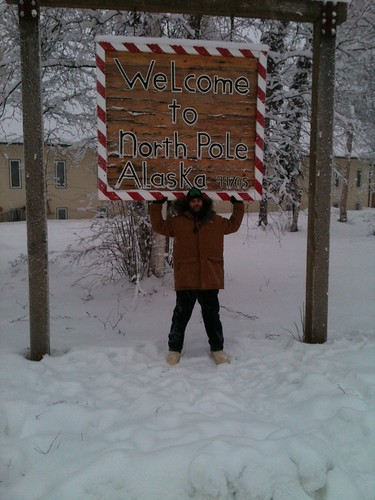
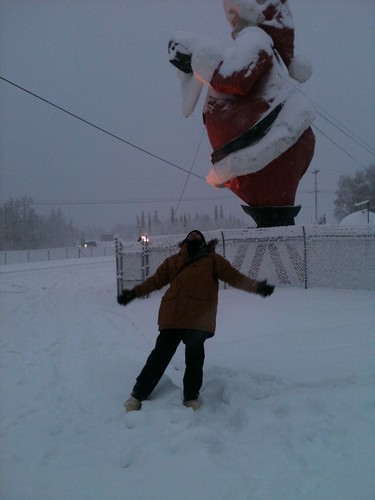
I arrive at the little house in Queens after a week in Alaska. Six intercontinental planes. Minus twenty degrees Celsius and the noonday sun peeking over the horizon. I was so free and so happy. I am going to love there, under the Fairbanks Aurora Borealis. My son will be born there. And he will be as Cuban as you. Or more so. Because he will have no memory of horror.
I arrive at the little house in Queens and fall down dead on the couch. I don’t even unpack. I’m dying of hunger. I have almost no voice. If I get sick in the United States I will have to heal myself alone. To go back to Cuba would be suicide. There the doctors from State Security would wait for me to fulfill their mission.
I go out and get some Colombian roast beef with rice and red beans. They put a slice of avocado on it. Nothing tastes like anything, but in the United States that’s how it is. The smell revolts me. I stay hungry.
Actually, I don’t like buying from the Latinos in the neighborhood. They have a mortuary look that even post-Castro Cubans don’t have. You go into the restaurant and they look at you like iguanas, with toothpicks between their teeth and the ugliest clothes in the world, exceeded only by the schmaltzy music playing.
I bought it anyway. Chewed a bit. Then, I toss the whole mess into the trash. Or not. I go to toss it, but I can’t reach the can in the kitchen. Because at that instant there’s a little mouse in the middle.
It’s gray. It’s starving. It’s clear that it spent a week without me, locked out of the little house in Queens without a thing to nibble. It must be very young. Now it’s almost begging me with its eyes, like a spontaneous pet. it would be so easy to smash it with a shovel. That’s what we’d do on the little island.
But I put the leftovers in a plastic bag. I almost put it in his mouth. And the mouse started to eat the rest of my food in the little house in Queens. Every now and then he looks at me. I look at him. We look at each other. We’re both fucked up. Alone. Helpless. Nobody would remember us if we didn’t help each other.
I kick back on the couch. This is exile. Substitute for what in Cuba would have been a bloody death a hint of mutual pity and solidarity.
29 November 2013

ALASKA
Orlando Luis Pardo Lazo
“Would you like to live in Alaska?”,
my father used to say.
“If you never go to Alaska, son,
death will surprise you incomplete”.
Mysterious words
pronounced in the late 70´s of an island
under the shrieking socialist sun of
La Habana.
Words not in English
nor in Spanish, of course,
but in a Cuban jargon with no references:
a dead tongue that in my childhood
sounded
as a curse.
I was 9 or 10
or maybe no age at all
and I looked as frightened as today.
But I had my father
which was also my grandpa
although he talked of death
and
Alaska
and
other incomprehensible
fates.
He was 52
when I was born
in the early 70´s of an island
under the socialist sunny shrieks of
La Habana.
Besides the transparency
of his Sicilian eyes,
I inherited two private homelands
from dad:
chess
and
English,
two labyrinths hard to distinguish
in the magic of his bookshelf.
We lived in Lawton
a delicate neighborhood
in the outskirts of La
Habana
now turned into a suburban wasteland
in the outskirts of La
Revolución.
My father so humble
so lucid
so loser
so tamed under the spell
of the official speech,
swallowing permitted pills
to overcome his nightmares of
Alaska
and
death.
My father so much my
grandfather.
He retired when I was still a kid.
Here and there he insisted
with his northern case
(technically, an escape)
calling me sometimes
“son”
and sometimes
“grandson”.
He hated life under Fidel
for sure
but this was something nobody around him
ever
guessed.
My father so shrewd.
He thought he would survive the
Commander in Chief.
But August is the cruelest month.
And on the 74th birthday of the
Maximum Leader
my father was generous enough
as to pass away
thus losing forever his bet
with his former Jesuit classmate:
Fidel.
It was a sudden Sunday and grandpa
had just turned 81.
An amateur autopsy
told us later he had cancer,
a merciful metastasis
that put him to sleep with no nightmares
and
no pain.
Never been to a doctor.
Never suspected a thing.
Just a couple of coffee-like throw-ups
and the transparency of his Sicilian eyes
became so opaque.
Maybe he did win his bet
with the decaying corpse of
Fidel.
“Forget about life in Alaska, son”,
were almost his last words:
“there´s not such a place on Earth”.
His name was Dionisio Manuel Pardo Fernández
(almost a 19th century name).
Since then,
I has taken me 13 years to understand
I wouldn´t need to pronounce more
his long and musical name.
No need to take him out of his sacred chamber
where decades and decades of American magazines
were frozen after the splendor of the 50´s
in his bookself.
His reading resistance resembled
the dearest delusions of a Don Quixote in La Habana of
Fidel.
I´m sorry, grandpa.
A deal is a deal, dad.
Not only there was indeed such a place on Earth called
death
or
Alaska
but I am here now
to challenge you to display
the chessboard
over those archaic English dictionaries
bought in the 80´s for a couple of Cuban pesos in
La Habana.
1. Pawn King-Four.
I know how you will defend.
Once Sicilian, always Sicilian.
The terminal transparency of your eyes
makes obvious that black square
now emptied for the ages.
1. (…) Pawn Queen-Bishop-Four.
Note: Original poem is in English
30 November 2013

Having spent eight months traveling in the US, I’m starting to make Cuban State Security nervous, just as I’m making the island’s dissidents nervous, since the two entities are sometimes so similar that you can barely tell them apart.
Several state police agents went to intimidate my neighbors on the corner of Fonts and Beales in Havana’s Lawton neighborhood, and threatened the friend who took me to José Martí International Airport on March 5. They accused him of illegally loaning me his vehicle, which is untrue. They spread the rumor that I had applied for political asylum in the US and was conspiring against the Cuban government as part of an organization, which is also untrue. They made sure that my 78-year-old mother was shaken up when she realized what was going on, although they didn’t interrogate her this time.
They have also pressured friends of mine on the island who are not linked to pro-democratic social activism, getting them to communicate with me by email and “extract” information on my activities in the US. They forced one of my friends to visit my mother and place a hidden microphone in my house, even though I wasn’t there at the time. They interrogated another friend about my sexual orientation, and practically forced him to testify that I was having clandestine homosexual relationships (under Castroism homophobia is criminal).
I have also received messages from supposed activist colleagues in Cuba, urging me to come back immediately. Apparently there’s no one on the island who can take over my work. One of them even called me from Havana, despite the fact that I’ve never given my cell number to anyone in Cuba. To top it all off, the independent journalist Julio Aleaga went so far as to spread lies about me on a Cuban protest site, suggesting that I was an “economic migrant”: A term with which the Castroist government makes a mockery of the always political nature of Cuban exile.
If my foreign residence permit is valid for two years, why is there such anxiety over my presence here from everyone in Cuba? Forget about OLPL for a little while, I beg you. Then—and only then—will I give you a surprise that the people will never forget. Thank you.
From Sampsonia Way
26 November 2013
27 November 2013
27 November 2013