The official press blames the embargo for the collapse in the production of latex goods, which was going very well until 2017
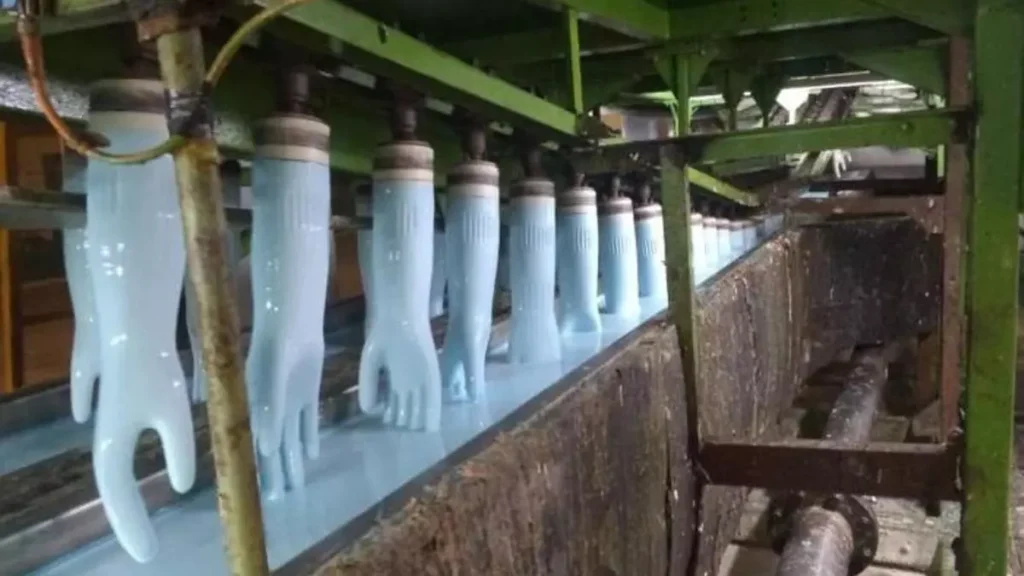
 14ymedio, Havana, October 26, 2026 / It has been nine years since the Las Tunas Latex Goods Factory, the only one of its kind in Cuba, produced surgical gloves. That, at least, is what a report published this Sunday in the official press states, blaming the situation on the “economic, commercial, financial and energy blockade that the United States Government intensifies day after day to suffocate the people.”
With this example, the report seeks to shore up the Cuban regime’s traditional excuse – the US embargo – to explain the fragility of the country’s productive apparatus, but at the same time it does not hide one of its main weaknesses: dependence on imports of raw materials, in addition to not paying its bills. In this case, they acknowledge that the Las Tunas plant “had a supplier of natural latex in Guatemala that could not maintain its commercial relations, and as an alternative, Cuba found a more secure market in an Asian nation.”
The “Asian nation” that the official media refuses to identify is India, which sold the island 29,876 kilograms of natural latex in 2024 for a value of $55,600. In previous years, China and Thailand were also suppliers, as well as Panama and Trinidad and Tobago.
The “Asian nation” that the official media refuses to identify is India, which sold the island 29,876 kilograms of natural latex in 2024 for a value of $55,600
One of the factory’s officials, Milaydys García Aguilar, laments that the “solution” has “an enormous cost due to the distance,” although they do not specify which country they are referring to or explain why they do not buy it from a closer nation, such as Brazil or Mexico, which are also friends of the Havana regime. According to World Bank data, Cuba bought 353 tons of natural latex from Guatemala in 2015 for a value of $640,000 and barely 59 tons in 2022. The following year the island imported nothing and, in 2024, almost all of it came from India. In 2025, only 2,400 kilograms were imported, from the European Union.
The statement does not explain why Guatemala stopped selling to the island, but exporters in various sectors are known to have suspended their shipments because of Havana’s failure to pay.
The official statement does not explain why Guatemala stopped selling to Cuba, but exporters in various sectors are known to have suspended their shipments because of Havana’s failure to pay
García Aguilar, on the contrary, expands on her explanation, saying that “it’s not only a matter of paying a higher price for the product,” but that “the corresponding transportation fees and tariffs also increase,” even though these depend on the Cuban Government, which can lower or eliminate them to reduce costs for its factories.
Furthermore, with the arrival of raw materials delayed, the factory’s production manager argues, “some may arrive expired or defective.” To make the gloves, those in charge explain, other products purchased abroad are needed, “which are nonexistent in the factory right now,” such as potassium oleate, the ZDBC accelerator and liquid pigments.
“The last time, we received those dyes in powder form, and to use them they had to be reduced to particles smaller than those that make up the latex. At the center we don’t have suitable mills to handle that process, and it’s another of the reasons why we haven’t been able to produce this year,” García Aguilar specified.
According to the official statement, the latex factory went into decline in a single year. Or so, at least, it appears from the statements of the plant’s head, Antonio Elio Núñez Nojas, who stated that in 2016 they set “a production record amounting to six million pairs of sterilized surgical gloves,” an output that “helped supply health services throughout the country.”
The plant’s head stated that in 2016 they set “a production record amounting to six million pairs of sterilized surgical gloves”
One of the key factors in the lack of surgical glove production is that the plant’s sterilizer, “with a total capacity of ten cubic meters, which ranks among the largest of its kind in the country,” is shut down. “The equipment remains unused because it runs on ethylene oxide, a product that must be imported in 34-kilogram cylinders,” says the official press.
The paralysis of the factory does not affect only medical items, they explain. The “auxiliary” lines, where household gloves were made – with much less strict safety requirements – as well as membranes for collecting bee venom and cones used in the collection of bovine semen for artificial insemination, have also been put out of service.
This is not the first time the plant, which belongs to the Thaba Basic Business Unit (UEB) of the National Saddlery Company, has made news in the state media. In 2021, in the midst of the Covid-19 pandemic, Cubadebate reported the reactivation of the plant, after six months at a standstill, with the goal of producing almost 300,000 pairs of household gloves in one month.
In 2021, in the midst of the Covid-19 pandemic, Cubadebate reported the reactivation of the plant, after six months at a standstill, to produce household gloves
That report did not mention surgical gloves, but it referred to a recent purchase of some 26,000 kilograms of “centrifuged natural latex,” the main raw material for those items, “along with some twenty components that are also imported,” all at a cost of two million pesos, at the official exchange rate of 24 CUP to one dollar, equivalent to $83,333. In the same piece they announced more materials for September, something that would allow manufacturing to continue until the end of that year.
Nor did they refer to the US embargo, an idea that does form the backbone of this Sunday’s report in Granma.
In this one, however, there is no trace of the disastrous figures for the manufacturing industry on the island in general, which in 2025 showed a decline in almost all its categories. In the list detailed by the National Office of Statistics and Information in a report on the subject last May, there were only five products whose indicators improved: tobacco, detergent, beer, bed sheets and frozen lobster.
During 2025, manufacturing industry on the island showed a decline in almost all its categories, except tobacco, detergent, beer, bed sheets and frozen lobster
Three products closely linked to construction and the home fell by somewhat more than 94% over the last five years: corrugated steel bars, air conditioners and hydraulic floor tiles, and wooden doors and windows are not far behind, with reductions of 92%. If these are combined with the large drops in cement (65%), lime (66%), concrete blocks (84%) and sanitary fixtures (62%), the serious housing problem becomes understandable, both for building and for renovating, causing a housing shortage that leaves entire families sharing minimal spaces in poor condition.
Among the data provided by the official body, which also include a slight decline in the number of people working in this sector and in their average wages, the energy consumption of these industries is also shown, which has fallen notably in recent years due to the difficulties in generating electricity. In 2020, manufacturing industry – the sugar industry is, as always, excluded from these data and reported separately – consumed an average of about 1,089 GWh, compared with 613 in 2024, a 44% drop whose direct consequence is the collapse of all the indicators.
Translated by GH.
______________________
COLLABORATE WITH OUR WORK: The 14ymedio team is committed to practicing serious journalism that reflects Cuba’s reality in all its depth. Thank you for joining us on this long journey. We invite you to continue supporting us by becoming a member of 14ymedio now. Together we can continue transforming journalism in Cuba.