Conversation Between an Opponent and a Colonel / Tania Diaz Castro

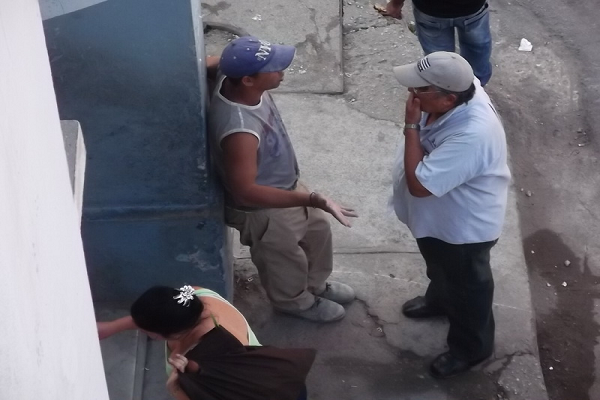
HAVANA, Cuba, January, cubanet.org  — It does not matter whether his name is Armando, Pedro or Juan. What is important is that a few days ago my neighbor the colonel and I found ourselves briefly chatting face to face at the entrance to my house. Such are the oddities of life. He, wore an old coat and a scarf wrapped around his neck, apparently from one of the former Soviet countries. I then wondered where the average senior citizen might be able to buy a coat and scarf to wear during these cold winter months.

It was the first time we had spoken, though we see each other almost every day. The reason was immediately obvious. It all started with poor quality of the bread, which we buy at the same place on 17th Street in El Roble, a neighborhood in the Santa Fe district of western Havana.

“It’s because they steal the fat that goes in it,” I said.

“The salt too,” said the colonel.

Tearing down the Berlin Wall

We talked about things that later he might have had reason to regret, but I took the opportunity to encourage this exchange since it is not often that such a spontaneous conversation takes place between a government opponent and a colonel, even a retired one, in the middle of the street on a cold January afternoon.

“I wonder how they will put an end to all this theft,” I said, trying to look naive.

“It’s difficult. The problem has been going on now for a long time,” he said. “In my village back in the 1950s it was unusual to come across a thief. The police were mainly concerned with drunkards and revolutionaries.”

“And there weren’t even that many drunks back then,” I added. “Those were the days.”

We then launched into an analysis of the Cuban experience. He did not defend Raul Castro’s “new economic model” (as I was expecting). Sometimes it even seemed to me he had his doubts, such as when he acknowledged that so far they had yielded no visible results.

When I asked him what he thought the path forward was, he pursed his lips and exclaimed, “I don’t believe in God. But if he exists, he must know what to do.”

I smiled. Was he making a joke? Was it a response born of pathos? I do not know the answer now anymore than I knew then.
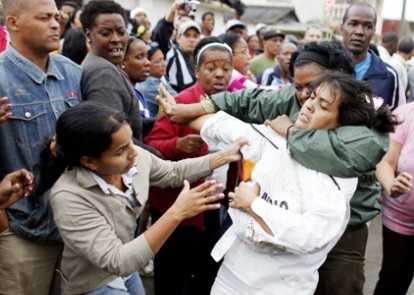
The Ladies in White being harassed by State Security agents.

“Everything started getting worse when the Soviets threw Stalin overboard and then Gorbachev gave Lenin the coup de grace,” he said. “The Russians wanted to stick us with a bill that was impossible to pay.”

And what about socialism in the 21st century,” I asked. “Does this suggest there will be civil liberties. In Cuba that doesn’t seem likely. Not long ago a government minister said that opposition political parties would never be allowed to take part in elections.”

“You might very well be right,” he said. “Things could change. Everything in life changes. But one must never lose hope, even if it seems there is nothing else that can be done. But if there is one thing that bothers me, it is how much the people are to blame for what is happening.”

“The people are tired,” I said, interrupting him. “They are exhausted. They don’t have hope. They have been living under dictatorship for many years.”

The word “dictatorship” brought him back to his own reality. He frowned, his face tightened and he waved to leave without saying goodbye. Maybe it was the cold evening air in those impassioned times which forced him to see the two of us as we really were: an old man, maybe a little less faithful to the three sprigless stars on the colonel’s uniform he kept in a closet, and an old woman who says what she thinks because she has nothing to hide.

Cubanet, January 31, 2014, 

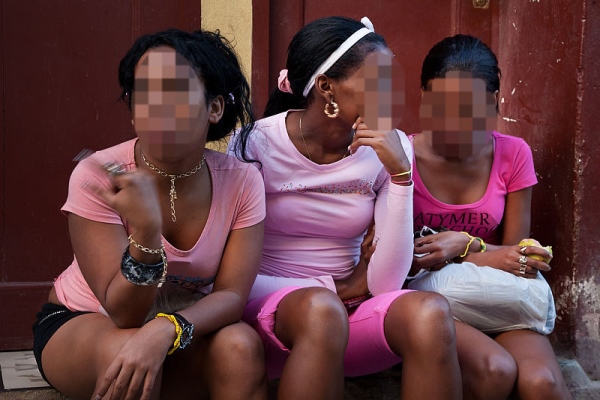
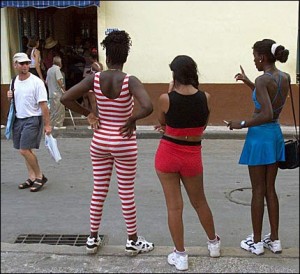
Jineteras [Hookers] in Cuban Pesos / Reinaldo Emilio Cosano

Havana, Cuba – The colonial authorities never imagined that the covered portals of the buildings and homes of Havana, a mandatory construction to protect pedestrians from the sun, rain and night dew would have another use, also very human.

E.O.F., age 31, counts on the notoriety, although not exclusively, of the portals of Monte street. Or rather Monte and Cienfuegos, the sin corner.

“There is a secret commerce after eleven at night. In the past, you’d find nothing. For a few months pretty women of different ages and races are parked there. They accost the men, inviting them for ’a good time.’ They knew what they were doing there and why men were there at that time. An occupation easy to recognize from the way they walk, the really short skirts, tight clothing, vivid lip colors, eyebrows and eyelashes. Prices are adjusted with few words. They accompany them to a nearby room and pay the rent. In the end, they’re paid. ’A good time…’”

EOF explains a curiosity, “There is no commerce with homosexuals and transvestites with intermediaries. Not from discrimination. They’ve found their half-tolerated space on the Malecon, the Coppelia ice cream parlor, and other places in the capital, although at times the police harass them.

“Now you don’t see them in any of the doorways. It’s the intermediary. He approaches, asking, ’Looking for a girl. They’re good, nice and cheap.’

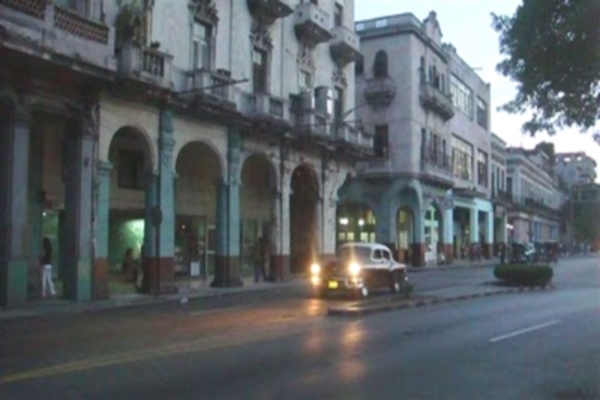
The doorways of Monte and Prado

Five CUC (in domestic currency, one CUC=25 Cuban pesos) for the jinetera [hooker*], one CUC for the intermediary, and another CUC for renting a room for an hour in some solar [as the tenements are called in Havana]. For the most part small, dark, warm, not very clean.

“You go and six or seven women, who a minute ago were chatting, laughing, drinking, between puffs of smoke, stand up. Not for courtesy but intentionally, rubbing their breasts, biting their lips, trying to be chosen. It’s hard to decide, you have to choose fast, pay by the hour, and not overstay your time. Outside two strong guards have the keys and twist the arms of those who try to leave without paying.

“We climb up to the ’barbecue’ [an improvised platform to extend the space]. Generally there are two ’rooms’ separated by a wood partition across which you can hear the whispers and imagine the positions. Not very hygienic rooms. The same sheet all night. Sometimes no water to wash with. No towels, just newspapers. I ask ’Violeta,’ my occasional companion about the chance of catching AIDS. Immediate response, ’Without a condom, nothing!’”

Alejo Carpentier (1904-1980), a Cuban writer and musicologist called Havana “The City of Columns” (1970). The doorways of houses and important commercial establishments were well-lit at dusk on Monte, Reina, Belascoaín, Paseo del Prado and Diez de Octubre streets. So many that it was pure pleasure to walk along the colonnades and contemplate the full shop windows, ruined, in shadows, with many gaps from the sad collapses of our patrimony.

“Why have the jineteras — a word accepted as natural — disappeared from the doorways?”

’Violeta’ answers:

“The police step up the repression streak against prostitution. Sometimes they resolve it with some fulitas (CUCs — hard currency). But if they’re… A….s, not even that. They grab us and we end up in jail. The situation is tough. But many women and men live this.”

A report from the Minister of Justice published on the website of Foreign Ministry last October, said that 241 people were prosecuted for the crime of pimping. Of them 224 were found guilty. Formerly prostitute was relegated and controlled by the authorities to the so-called Tolerance Zones, which now permeates the city.

“And what if the police surprise them in the room?”

’Violeta’ replies:

“Every trade has risks. We would test fate saying that we are friends who are celebrating one of our birthdays, and may God protect us!”

*Translator’s note: The word for hooker/prostitute in Cuban Spanish, jinetera, comes from “jockey.”

Cubanet, 31 January 2014,

cosanoalen@yahoo.com

With the Port of Mariel, Cuba Reassesses its Geographical Position / Miriam Leiva

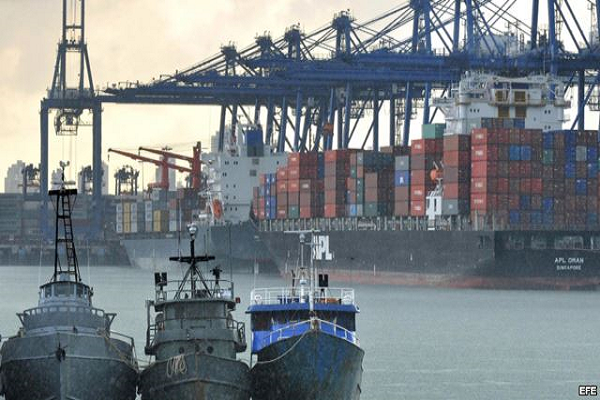
Mariel Port, Cuba

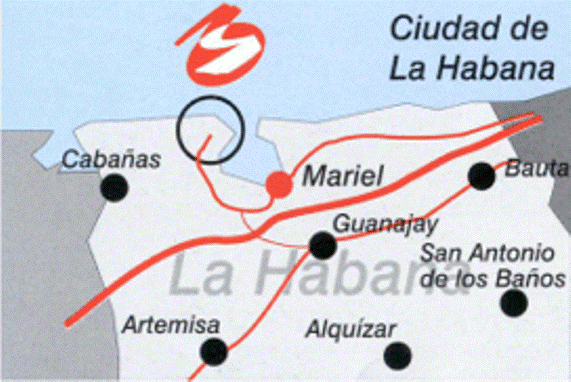
HAVANA, Cuba, 31 January 2014, www.cubanet.org – The position of the Port of Mariel has revalued the geographical importance of Cuba, lost with the end of the Cold War. The soldiers who for 46 years were the support of the government, when they began to direct everything in mid-2006 they found a country undercapitalized, productively and humanly.

General Raul Castro has moved the troops towards economic ends to confront the disaster that can not be overcome, despite his straitjacketed reforms that don’t encourage hard work and creativity to supply imports and increase exports.

As his travels through the friendly countries failed to achieve a financial injection for core investments and the replacement for the possible reduction or loss of petrodollars from Venezuela, he seems to have taken advantage of the changes in the 21st century, to preserve the fifty-year revolution, the “unity in diversity” of CELAC, beyond militant ALBA.

The transit of senior officers of the Armed Forces to create civilian businesses in innovative sectors began in the late 1980s and, especially, with the debacle of the “Special Period in Peacetime” and the loss of subsidies from the Soviet Union and other countries of real socialism.

In the early ’90s, Fidel Castro authorized the company Gaviota to engage in tourism, the TRDs or stores for the recovery of hard currency, and Raul Castro sought the implementation of the successful business system in the Revolutionary Armed Forces, but passing into the civilian sector without the conditions of organizational control military did not give the same results. From here much of the current entrepreneurs emerged.

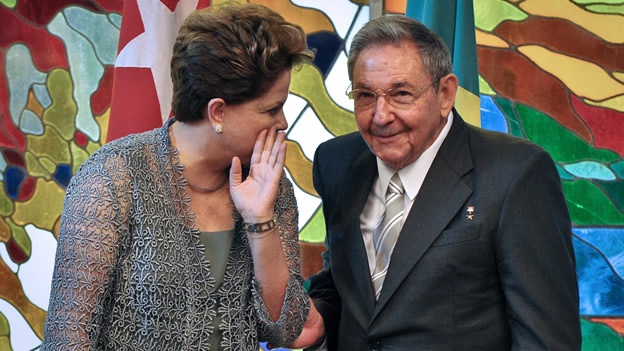
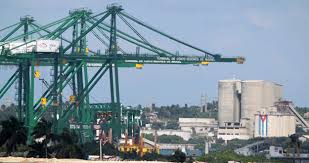
The Port of Mariel is the only great monument built by the Revolution and will remain as a legacy of Raul Castro. Companies of the Ministry of the Armed Forces appear to have met the schedule and built a quality container terminal, inaugurated by the president and his Brazilian counterpart Dilma Rousseff last January 27.

Upon completion of all the works, perhaps it will join the seven wonders of Cuban engineering, like the Albear aqueduct, from the nineteenth century, still in use. Furthermore, the Special Development Zone boosts the national economy. A stark contrast to the legacy of destruction across the country, critically wrought over previous decades.

Undoubtedly, President Jose Inacio Lula da Silva and his successor, Mrs. Rousseff, calculated well the positioning in an economically asphyxiated Cuba. The Brazilians arrived in a big way to “help confront the northern neighbor,” to open American trade and tourism. The companies of the competitive Yankees advance with the best technology in the world.

Of course, it also entered the current priority calculations: Super Post-Panamax vessels, the Panama Canal expansion. In the Cuban press reports it was noted that the top leaders of the works are executives of the Brazilian company Odebrecht — the principal in the project — and Raul Castro said the administration of the container terminal will be in charge of one of the largest port operators in the world. Lamentable guarantee that inexperienced Cubans will not hard the adequate functioning.

As a prelude to the opening, the advantages of foreign investment in the Mariel Special Development Zone have been divulged. Russian, Chinese, German, British, French, Italian and Brazilian companies of course are mentioned as interested. The approach of the Mexican president could follow the same course. However, investors need guarantees that the old law doesn’t offer. Hence a new version has been promised.

As the project only benefits those who desire to hide their problems and arbitrariness, a greatly cultivated style in Cuba for decades, the presence of more European Union countries and the United States could be advantageous to the competence of the best economic opportunities, most advanced technologies, training, sources of jobs and less dependence.

Cubanet, 31 January 2014,

The Self-Employed: Unemployed or Illegal / Odelin Alfonso Torna

HAVANA, Cuba — January offers to close its curtains with 100 empty stands in the country’s markets, self-employed who hope for job relocation, government fines  shielded in absurd justifications and the promise of a wholesale market that does not arrive.

While the print and television press emphasize new regulations for the private sector in 2014, the so-called “small businessmen” line up in municipal offices of the Tax Administration (ONAT) in order to turn in their licenses.

Rosa Maria, resident of Washington Street and Bejucal in the Havana township of Arroyo Naranjo, is one of those who delivered her license recently.  As a seller of ice cream and slushes, Rosa received innumerable visits from inspectors:

“The last fines were 50 and 500 pesos (2 and 20 dollars at current exchange), both from Public Health.  The 50 was because of my long nails and the 500 because there was dust on the counter of the cafeteria; now I’m tired!” she exclaimed.

La Cuevita Market before its closure

According to the Ministry of Work and Social Security, at the close of February 2013, 450,000 individuals worked for themselves.  An official economist, Ariel Terrero Font, said on television that judging by growth in the first months, it would not be possible to reach “half a million self-employed workers” by the close of that same year.

Nevertheless, after the prohibition on the sale of imported clothes and hardware items bought on the retail market, the body of licenses awarded by the ONAT for private work, say food vendors, cabbies (we call them “boatmen”), clothing and hardware sellers, decreased sharply.

The tsunami that passed through Havana

Hundreds of tarps lie empty in the capital’s markets.  It is said unofficially that at a national level, a mid-range of 62,000 individuals have frozen or turned in their licenses.

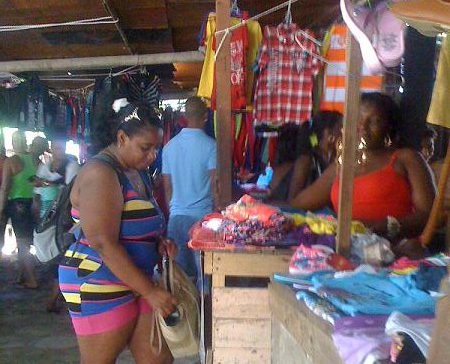
In the Electrico neighborhood market, located at Camilo Cienfuegos and Calzada de Managua, Arroyo Naranjo township, 17 stands have closed since the beginning of January and only two operate with the sale of pirated CDs and handicrafts.  The market located on Porvenir Avenue, between San Gregorio and Georgia, in the same township, closed totally: more than 70 stands offered clothes and imported shoes, including four cafeterias that used to serve the self-employed.

Self-employed market after closure by authorities

In one of the best attended markets of Arroyo Naranjo, sandwiched between Atlanta and Diez de Octubre, 43 stands have remained empty since January 6. The occupied stands, a total of 32, offer tailored clothes, handmade shoes, and costume jewelry.  In Central Havana, another of the leading markets in supply and demand, located at Angeles and Reina, barely keeps 3 or 4 stands active out of approximately 60 mini-kiosks.

Nevertheless, while in the main the extermination of taxpayers is visible, others give the impression of recovery. That is the case at the Virgen del Camino Market, situated on San Miguel and B Street, San Miguel del Padron township. This market, which reopened at the beginning of January, has 55 abandoned sales stands and 63 in service, above all with the sale of shoes and leather items.  This township is characterized for being the greatest producer of handmade shoes.

For Natividad Jimenez, a specialist in physical planning for the National Tax Administration Office (ONAT) in the capital township of Arroyo Naranjo, the taxpayers who used to sell imported clothes were never unemployed because some have accepted relocation and others have not.

“No place has been closed. They (the sellers) were alerted since last year, nothing has been done outside of the law. Many of the sellers from La Cuevita (Havana’s most prolific market) were illegal, that’s why they haven’t done anything, they haven’t complained and they have remained quiet,” Natividad pointed out.

Unemployment:  A secret tax?

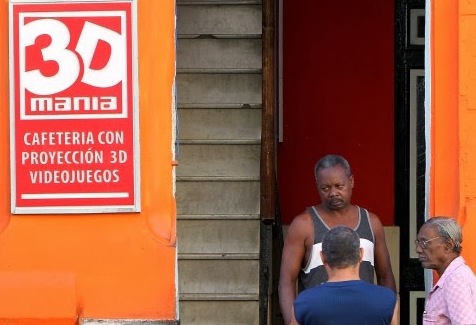
Three-D theaters were the first required to close

At the close of 2011, the Office of National Statistics (ONE) published its last report about the numbers of taxpayers enrolled at the ONAT, a total of 391 thousand self-employed workers.  Nevertheless, statistics published in the official press reflect, until that date, a mid-range of 444,109 individuals registered with the ONAT.

Given the growing number of taxpayers cancelled in the ONAT, the municipal and provincial offices close ranks when it comes time to offer information.

The black market as a solution

Maybe the ONAT, charged with receiving the liquidation of taxes for private workers who seek cancellation, does not register in its data base the number of licenses turned in?

Judging by the official statistics, since December 2011 to date, only 54,000 Cubans have sought a license in the offices of ONAT. This tells us that the private sector remains at the bottom of the sewer, in spite of the grandiloquent displays of “transparency and timely information.”

Cubanet, January 30, 2014, 

Translated by mlk.

Taguayabon: Village Pastor Abducted / Yoaxis Marcheco Suárez

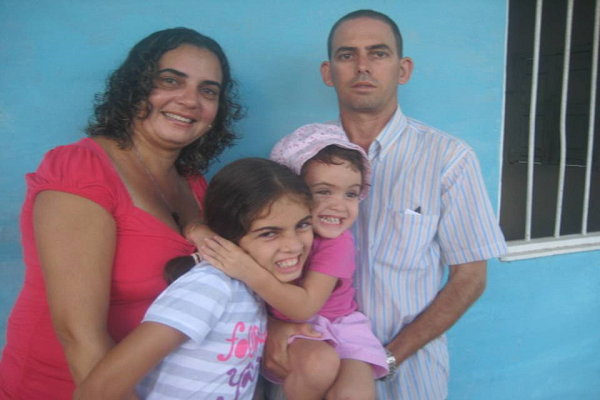
The Marcheco-Lleonart family

Taguayabon, Cuba – I could have written a simple informative note about one of the many arrests carried out by Cuban State Security agencies during the days leading up to the CELAC Summit in Havana. But in this case I was both eyewitness and victim, and had to deal with the fact that my daughters saw it all.

On Saturday January 25, my husband, the Baptist pastor Mario Felix Lleonart, and I, together with our daughters, Rocío, 13, and Rachel, 5, left our home in Taguayabón, intending to travel to the neighboring city of Remedios to spend a relaxing family afternoon.  We were stopped by two State Security agents, dressed in civilian clothes, riding a small Suzuki motorcycle, who approached my husband and told him he was under arrest.

The situation became very tense a few minutes later when a National Revolutionary Police patrol car appeared, with a uniformed police officer and another civilian agent who joined the first two and pounced on Mario Félix as if he were a common criminal, handcuffing him and speeding him off toward Remedios, without telling me where they were going. continue reading

Our daughters were in shock and both began to cry. The younger one kept saying: “Save my daddy! Those bad men have taken him away!”  It was a tremendous struggle for me to calm them and try to help them understand what was happening. The girls love their father dearly, and know that he is an honest and good-hearted man; his abduction was something they could not fathom, especially because they knew he had set the afternoon aside for them.

Swallowing this bitter pill, especially my indignation–because I don’t hide that in the face of all this arbitrariness and despotism I am deeply outraged–I took the little ones to Remedios, walking with them and highlighting the figure of their father. Somehow my little Rachel latched onto my words and then kept saying: “If those cops come here looking for my dad’s house, I’ll tell them to leave him alone because my father is a free man.” I do not know if my daughters have understood fully that message, but freedom is ours and we belong to it, and so I hope they both grow up knowing that no human system, nor repressive body, nor dictatorship, nor dictator, nor tyrant can prevent us from being free.

state
The State Security agents who abducted pastor Mario Félix. Photo courtesy of Yoaxis Marcheco.

We returned home to await Mario’s fate. We did not know for sure where they had taken him. Caibarién and Remedios are in the same direction and we only knew that the patrol car had headed to one of those two places. A legally authorized kidnapping, obvious state terrorism–citizens are taken away someplace, the family not even knowing where.

Arrests can occur anytime, anywhere, to anyone, without explanation, using brute force as well. They repress, they persecute, not the increasing numbers of common criminals, but political and ideological opponents.

At six that evening my husband showed up. My daughters ran to him and kissed him, relief evident on their faces. Since then, a police operation has encircled our home and our church, and the ban was extended to me. We could only go and pick up the girls at their respective schools, and always guarded by the political police. The Suzuki is parked on the corner near the schools, visible to our daughters; it was a reminder to the girls that they were still there, and a way of keeping them upset.

As before, our phones were blocked by Cubacel, the state-run monopoly that controls the lines. Perhaps divine providence intervened at some point, allowing the messages to leave my phone, like bottles thrown into the sea of liberty, carried along on the blessed twitter. So foreign friends had news of our fate. I could also call activists who found themselves in the same situation as we did, though not always with much luck because some of their phones were also disrupted. Every night we pray for those who have had worse fortune, because they have ended up in the cold cells.

The CELAC summit concluded and did not bring anything new to the Cuban context. No one defined it any better than my daughters: “CELAC is bad because it’s responsible for our dad being taken prisoner.” The CELAC meeting in Havana has has left a shameful stain on the Latin American political landscape; its complicit stance toward an anti-democratic regime is now marked forever and ever, amen.

Cubanet, February 1, 2014,

Translated by Tomás A.

CELAC Summit Passed Like a Storm / Martha Beatriz Roque Cabello

Informers on guard at the corner of my home — Martha Beatriz Roque

HAVANA, Cuba — There is not a single time that the phone rings for good news; these days every conversation is based on arrests, beatings and demonstrations, an eloquent way to carry out the Summit of CELAC (Community of Latin-American and Caribbean States) which turned into a parody of the famous novel “Wuthering Heights” by Englishwoman Emily Bronte.

But although the meeting was held in Havana, the capital was not the only place where these situations were produced.  In other sites as distant as the eastern provinces also there were moments of tension because of the repressive work of the political police.

In Manzanillo, Granma province, on January 28, some members of the Cuban Community Communicators Network could not leave their homes, as, for example, Xiomara Moncada Almaguer who wanted to visit her ill six-year old grandson; when she came out of her house, six women armed with parasols attacked her in front of State Security officer Camilo Mandiel (alias The Joker), who permitted them to hit the peaceful woman.

Leonardo Cancio Santana Ponce tried to leave his house — on the same day — on bicycle and was impeded by Captain Napoles, Sector Chief, whom he found in the company of four State Security officers, among them Alexis Guerra and the older Able Guevara. Cancio explained that they lifted him and threw him inside his house, together with the bicycle. A drunk neighbor, by the name of Pedro, defended him, yelling “abusers,” and they arrested him.

Also, the house of Tania de la Torre Montesinos, in Manzanillo, was under surveillance by political police, and they did not allow her daughter Ariuska Marquez to go out to the street, in spite of the fact that she is not a dissident activist.

In Holguin province, at two in the afternoon, a demonstration against Doctor Ramon Zamora Rodriguez began at his house on Avenue of the Americas 66 between Comandante Fajardo and Playa Giron in the Ramon Quintana Division; it lasted until 9 at night.  The cheerleaders broke the fence of the house, the windows and the door by stoning and body slams; but what is most regretful is that they hit his 13-year-old son. When they withdrew, those in the dwelling tried to fix some of the damage, but they had to put furniture behind the door in order to be able to sleep with some security.  The next day, several dissidents went to try to repair all the breakage done by the mob.

In the basement of my home

On the 29th — like one more Wednesday — no one was permitted to enter my home, and I was under house arrest. A mob of some 10 or 12 people on the stairs, some of them neighbors who were paid in the morning to dedicate themselves to those functions, did not let anyone up. Our collaborator Arnaldo Ramos Lauzurique asked them to identify themselves in order to learn with what authority they were doing this, and one of the repressors, by the name of Juan Carlos, (a well-built man of about 35 years of age), who in April 2013 beat me inside my house, went up to Arnoldo, and the State Security officer there had to intervene so that he would not hit him, because he surely had orders to do so if something occurred. You have to remember that Arnoldo is a man of 73 years of age who suffered 8 years in prison.

From this unclean practice the following community communicators were arrested: Evelyn Pineda Concepción, Laudelina Alcalde, Maritza Concepción Sarmientos, Blanca Hernández Moya, Arnaldo Ramos Lauzurique, José Antonio Sieres Ramallo, Juliet Michelena Díaz, Billy Joe Landa Linares, Julia Estrella Aramburu Taboas (seized two times because they jumped on her when she returned), Juan Carlos Díaz Fonseca and Judit Muñiz Peraza.

The first three women in this regard were transferred in a patrol car — the same as everyone — but with the special feature that they left them in the township Melena del Sur in the Mayabeque Province. When they arrived at that place, a clearing, they told the police that they were not going to get out there, and they said they were complying with orders, that if they did not get out of the car, they would get them out by force.*

Also, Julia Estrella Aramburo Taboas, in her second effort to enter her home, was arrested and taken by patrol car past the town of Santiago de las Vegas.  She resides in Central Havana township and found herself alone.

If the protagonist of Wuthering Heights saw the specter of a woman, in the Cuban parody we are in front of a ghost that has turned into a nightmare for the opposition, but unfortunately no president of the democratic countries of Latin America, who have just visited Havana, have seen it.

*Translator’s note: A popular tactic now is for State Security or the police to simply pick up dissidents and drive them to ’the middle of nowhere’ and abandon them, never recording any arrest or detention.

Cubanet, January 30, 2014, Martha Beatriz Roque Cabello

Translated by mlk.

31 January 2014

The Sputnik that got on Fidel Castro’s Nerves / Tania Diaz Castro

The Soviet magazine was prohibited.  Goodbye goose who lays the golden eggs. The Special Period arrived.

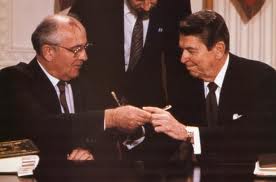
Mikhail Gorbachev and Ronald Reagan

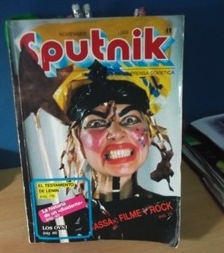
HAVANA, Cuba — The last Soviet SPUTNIK magazine that circulated in Cuba, corresponding to the month of November 1988, was the one that got on Fidel Castro’s nerves. In it, an extensive article by Yelizaveta Dabrina recounts the details of the last years of Vladimir Ilich Lenin during his illness, the will where he exposed the reasons for which Joseph Stalin ceased to be Secretary General of the Central Committee and in which he practically proves that a dispute between Stalin and the wife of Lenin could have hastened the death of the Bolshevik leader.

The Magazine SPUTNIK, whose name comes from the satellite that the Soviets put in orbit in 1957, could only survive for 24 years, as in 1991 it was definitively shut down after the collapse of the USSR. It was considered the counterpart of the famous Reader’s Digest from the United States, and although it was published in seven languages, it was imported to very few countries, principally because of the bad quality of its texts and its lousy translations. continue reading

To the surprise of many, with the advent of Perestroika and Glasnost, SPUTNIK was transformed into a news outlet that everyone looked for in order to learn the reality about what was happening in the USSR.

The last Sputnik magazine that circulated in Cuba

There began to appear on its pages stories that the Soviet Communists would have never approved:  repression of dissidents, freedom the common Soviets had to say what they thought, the reasons for Soviet invasions, the bad quality of their products, economic difficulties, prohibited films, the image of the communist bureaucrat, etc.

It was remarked in Cuban newspapers of the time that when Fidel Castro saw a full color photo of Mikhail Gorbachev seated next to Ronald Reagan in the Kremlin on May 30, 1988, in SPUTNIK Magazine number 11, all hell broke loose in the main office of the Cuban Communist Party Central Committee.

One of the first decisions he made, on sensing the disintegration of the USSR, was to order an inventory of food crops, “in case he had to feed them in case of war” and to approve 28 austerity measures for saving hard currency.

On exactly August 4, 1989, the Granma newspaper published an article entitled “An Urgent Decision,” where it explained why the circulation of SPUTNIK, Moscow News and others had been suspended, although since November of the year before, with the last November issue, it already was impossible to acquire the Magazine at that time, the one most coveted by Cubans anxious for liberty. SPUTNIK’s new thinking was clear: The Castro regime had to resolve its economic problems without outside help. It had lost its godfather forever.

Cubanet, February 4, 2014,

Translated by mlk.

Charges Laid Against Manual Cuesta Morua / Leonardo Calvo Cardenas

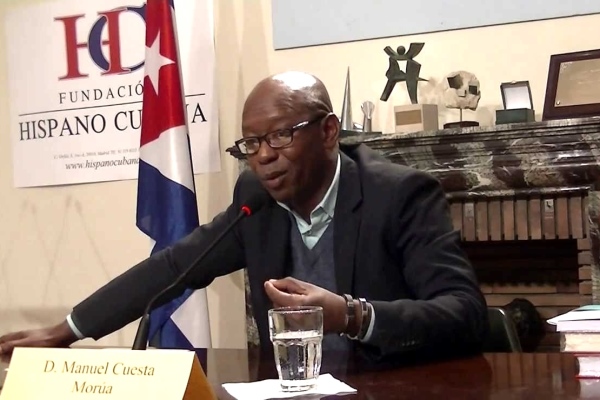
HAVANA, Cuba — On the night of January 30 Manual Cuesta Morúa, spokesperson for the Progressive Arch Party and coordinator of the New Country project, was finally released after several days of arbitrary arrest which was a part of the repressive wave unleashed by the Cuban authorities in relation of the celebration in Havana of the Second Summit of the Community of Latin American and Caribbean States (CELAC). Threats, undisguised persecution in the street, dozens of arrests and cases of regime opponents besieged, were all a part of this escalation that reaffirms the panic of the State that derives from the lack of political and moral reason that afflicts the Cuban leaders.

The opposition leader was arrested on a public street on Sunday, January 26, when while touring the city to finalize details for the Forum Parallel to the CELAC Summit, organized by several opposition organizations in coordination with the Center for  Opening and Democracy for Latin America (CADAL), whose director, the Argentine activist Gabriel Salvia, was arrested on the afternoon of Monday 27 at Havana airport and expelled via El Salvador. Cuesta Morúa was transferred to the Fifth Station of the National Revolutionary Police on 7th at A and 62nd in the Havana municipality of Playa.

For several days the Social Democratic leader underwent numerous subsequent interrogations and threats by several top officials of the political police. According to the testimony of Cuesta Morúa, the law enforcement agents were very irritated by his convening and hosting the Forum in parallel to CELAC, and pressured him to abort the call in exchange for his release. continue reading

On Thursday the 30th, the recently released independent lawyer Veizant Boloy — who has been arrested on the afternoon of Monday the 27th — became engrossed in the development of a Habeas Corpus petition which was finally presented at the Provincial Court of Havana at noon by Gloria Llopiz, Cuesta Morúa’s wife.

In the afternoon several leaders and activists appeared at the Fifth Station accompanied by Cuesta Morúa’s mother, with the intention of gathering information, interviewing the detainee, and pressing for his release. After more than four hours of fruitless waiting without being able to see her son, Mrs. Mercedes Morúa was dismissed with the promise of the quick release of the opposition leader.

Opponents gathered outside the police station remained in constant contact with international media and institutions interested in  Cuesta Morúa’s situation, and propelled the global campaign for his release, not believing the false information supplied by the agents of the People’s Revolutionary Police on the alleged release of the detainee.

Before being finally being released in the evening hours, Cuesta Morúa is informed by his captors that he will be criminally prosecuted in Case No. 5 of 2014 for the alleged crime of “dissemination of false news against international peace,” under the weak argument of several articles and texts published by the opposition on racial and academic problems in Cuba, which, according to the official, distort the Cuban reality and “the work” of the Revolution in support of racial equality.

A precautionary measure was imposed requiring Cuesta Morúa to report his  presence each week at the same police station where he spent several days under arrest, which by the way will prevent his meeting various political and academic commitments abroad. This is an unfortunate consequence of this new judicial arbitrariness, in fact unsustainable by the weakness of charging arguments which fall apart before the Cuban reality and the strength of the increasingly growing challenges in this sensitive and complex issue for the present the future of Cuba.

The unjust detention of Cuesta Morúa generated a worldwide wave of revulsion against the intolerant and hypocritical behavior of the Cuban authorities, who, in the plenary of the Summit of CELAC, spoke of respect for diversity and pluralism, while in the streets they unleashed a frankly fascist inspired repression.

Recently there have been many expressions of sympathy and support that have come in various forms from many parts of the world as a sign of increased sensitivity to Cuba’s complex reality that is generated in the democracies of the world and in contrast to the indolent and complicit attitude of the vast majority of democratically elected presidents at the CELAC Summit.

Cubanet, 31 January 2014,

Goodbye to the Self-employed Worker / Gladys Linares

caption
Dragones and Galiano after prohibition of imported items — photo by Gladys Linares

HAVANA, Cuba, January, www.cubanet.org — For the majority of us, January generally is a month of privations. For decades people often have been heard lamenting in the first days of the year about how difficult their situation is, but never like now. This 2014, according to some, the scarcity is felt more than at other times.

Many think that this is due, in great part, to the arbitrary measure applied to self-employed workers since the November 2, 2013, news brief in the Granma newspaper announcing the prohibition of the sale of articles imported or acquired in the state commercial network. In addition, it gave a brief term of 59 days (until December 31) for liquidating merchandise. This order caused the failure of many of the self-employed because in spite of having good demand from the population, the term was not sufficient.

One of the damaged sellers — who did not want to identify himself — had a license as a producer-seller of several items for the home. A great portion of his merchandise was acquired through a friend who travels to Ecuador. For three years inspectors visited him, always looking for a way to find some fault, but they never told him that he could not sell imported items. continue reading

Another one injured used to sell clothes imported at the Virgen del Camino fair; she commented — anonymously — that although she is unionized, she did not approach the union because it answers to the Government. Also, she adds, “If I make a claim, I stand out; better to keep selling behind closed doors.”

Many times the Government tried to blame shortages on the self-employed who “monopolized” the stores in the absence of a wholesale market. Nevertheless, in the opinion of the great majority, now the falsity of this hypothesis has been demonstrated because after the new prohibition, the shelves of stores, kiosks and state containers are emptier than before.

With the fever of self-employment, Havana came to life. Fixing and painting dwellings and facades and taking advantage of idle or under-used spaces for new cafeterias, small restaurants, second-hand shops, or kiosks, hanging cheerful posters of all kinds advertising offers and causing the comings and goings of onlookers and customers, it is indisputable that those who began to test their luck changed the urban landscape.

Among those new places, the Caridad fair came to be one of the most attended in Central Havana. It is located on the corner of Dragones and Galiano, on land equipped by the Government for renting to self-employed but that today is found vacant given that the majority of the stands were devoted to the sale of imported items.

Space equipped by the State, now empty -- photo by Gladys Linares
Space equipped by the State, now empty — photo by Gladys Linares

But the sellers are not the only ones hurt with this measure. These self-employed meet many needs of the people who now have nowhere to go because historically the State has not be able to provide us with certain products.

One of the affected clients is a neighbor who needed two water faucets, but since the sellers of plumbing supplies in Lawton closed their businesses, he had to go to Central Havana to see if he could find some. On returning in the afternoon, tired from walking and without faucets, he commented: “The stores are empty, the stands and kiosks, ’bare.’  First they authorized the self-employed to sell and now they prohibit them. In short, as Cantinflas* would say, ’There are moments in life that are truly momentous.’”

*Translator’s note: Cantinflas was a hugely successful Mexican comedic actor, on the level of a “speaking” Charlie Chaplin (Chaplin called him “the best comedian alive”).

Cubanet, January 31, 2014,

Translated by mlk

Mariel: Another Mockery of Cuban Workers / Leonardo Calvo Cardenas

HAVANA, Cuba  – The first 700 meters of dock of the Mariel mega-port are inaugurated by the presidents of Cuba, Raul Castro, and Brazil, Dilma Rousseff, in parallel to the II Summit of CELAC (Community of Latin American and Caribbean States).

Rousseff ’s government — Cuba’s the second largest trading partner after Venezuela — has funded 75 percent of the works. Four years ago it gave the island a credit of $600 million and is studying whether to award a second. The center of the project is the mega-port. The bay of the capital will be reserved for cruise ships.

These business partnerships with foreign capital appear to be the main option of the Cuban authorities to rebuild its battered economy. A multimillion dollar investment from the Brazilian government assumes the greatest weight in the reconstruction and modernization of the port of Mariel, located several kilometers west of the capital. The investment seeks, in a short time, to turn the port enclave into a space for international shipping.

From the technical point of view, the project includes, besides the port for large Post Pamanax vessels — capable of carrying over 12,000 containers — built by the Brazilian company Odebrecht, an industrial and commercial zone covering 180 square miles, and facilities for the movement and storage of goods, establishment of industrial production plants, formerly known as maquiladoras. continue reading

Beyond the possible success of this new economic salvation that the regime seems to cling to, there are concerns about its human and social implications. Two “socialist” governments have joined together to once again exploit and cheat Cuban workers. On one side, Lula da Silva and the Brazilian Workers Party (PT), and on this side the everlasting Castro brothers, present us a design in which the socialist-impresarios maintain monopoly control, while Cuban workers only receive crumbs from a huge business and, above all, continue to be deprived of basic rights and economic and employment benefits.

Cuban authorities report, without even blushing, on the recruitment of labor through an employment agency and, naturally, with a salary that has nothing to do with their work contribution. Added to this is the absence of union protection suffered by workers here, victims of a single union, which only acts as an instrument of control and manipulation to serve the regime.

According to testimony from workers and neighbors, labor and management inconsistencies that undermine both the business process and the interests of Cuban workers have already begin to manifest themselves. There is already talk of desertion by Brazilian executives and specialists, who, they say, can not stand up to nor understand how Cuban workers can tolerate such poor working conditions.

The fleeting and almost surprise visit in recent months made to the enclave by Brazilian President Dilma Rousseff, seems to confirm that everything is not going without a hitch in the ambitious project. In any event, investors in Brazil are responsible for their investment and the risks they take to join such bad partners.

Suffice it to recall the example of the huge Canadian company Sherritt, which, after years of economic association with Castro, and investing in Cuba during the crisis of the nineties, at the cost of seeing their executives suffer damages of the United States’ Helms-Burton Law, now do not even know if they can recover hundreds of millions of dollars owed by their Caribbean partners.

It remains to be seen if the expectations of great benefits prevents these Brazilian “comrades” (once militant trade unionists and anti-employers) from seeing how the Cuban government exploits its workers and how it crushes the emerging small businesses with confiscatory taxes and draconian and arbitrary rules. Or how much inhuman indolence their partners demonstrate to the elderly, the unemployed, the single mothers, who have to face the enormous challenges of the current economy without any support, or the thousands of self-employed thrown into helplessness and hopelessness.

We do not know what will happen in the Mariel project in economic terms. Will this ambitious project become another failure and another resounding scam? But what is visible now is the shameful attitude of Brazilian politicians, hardened in social struggles and with obvious achievements in this area, who accept the benefits of a  business where access to labor is politically conditioned.

An attitude so reminiscent of the nineteenth century European colonialists, many of whom were liberals in European culture and monarchists and slave-owners in their American possessions.

Cubanet, 27 January 2014 | 

Montesinos3788@gmail.com

“I’m For Sale From the Neck Down” / Camilo Ernesto Olivera Peidro

Habana, Cuba.- The girl rests beside me, as naked as a country without rights. She turns tricks on weekends to keep alive her mother, who became infected with HIV when she herself was a prostitute over a decade ago.

“My mother had to do it to raise me, when things got tough during the nineties.  Now it is my turn.”

She may be called Adriana, Yusimi, Anisley… Prostitution has thousands of faces; many are feminine but many others are masculine or transsexual. I ask her if she knows anything about a regional meeting of heads of state that is to be held here at the end of January. She looks at me in disbelief and answers:

“I saw something about in on Telesur, but I don’t see any benefit in their meeting. Other countries may fare better, but here we are going downhill, every day its worse…”

Soon, the Community of Latin American and Caribbean States (CELAC) will meet for the fourth time; this time in an impoverished Havana. Raul Castro and his court of generals will try to combine the art of “Political Prostitution” and “tick  techniques*” on the backs of the economic integration groups. Now that the European Economic Community “seems to be feeling squeamish” toward the repeal of its Common Position on Cuba, CELAC emerges for the Castro leadership as the ideal house pet.

The Chinese, for their part, come to play the role of the developed countries at the Port of Mariel. They won’t be alone, but they want to ensure a convenient springboard for foreign trade in the area from the Caribbean area to Latin America.

I explained all this to the girl, who looked at me puzzled. After listening intently (I think), she turns over and asks me to scratch her back. When I think she’s not going to say anything, she confides, continue reading

“This government knows that as the only one it can continue to sell the country. What it’s doing is creating a paradise where the yumas — the foreigners — can earn a ton of money and the Cuban people continue to be fucked.”

“All those presidents,” she continues, “come to see how they’re going to share out the cake those here are offering, and the result will be more money for the government and more poverty for us.”

Then the girl stretches out her body, and sighs with the nonchalance of someone who knows she has nothing to lose except, perhaps, the next minute.

She looks at me and smiles:

“Most men don’t even talk to me. You at least try to make me feel comfortable. We hookers can’t afford the luxury of being noble, just like we can’t stop earning money. Me, from the neck up, I don’t let anyone in… What I sell starts here,” and she places both hands on her clavicles.

Cubanet, 22 January 2014 | 

*Translator’s note (Thank you to Ernesto Suarez)

“Tick techniques” means pretending to solve the problem while perpetuating it to profit from it. It comes from an old Cuban joke: There was an old country doctor whose son was also a doctor.  The father had not taken a vacation in a very long time, and the son convinced him one day to take a holiday in Havana.  Off went the old doctor, and the younger one took care of his patients. Within a few days, the old one receives a telegram from his son: “All is well in the town. Cured Mr. Garcia’s earache. It was a tick.”  Mr. Garcia was the richest man in town.  The old doctor flies into a rage and fires back a telegram: “You stupid idiot. That tick put you through medical school!”

Translated by: Antonio Otero Saínz

22 January 2014

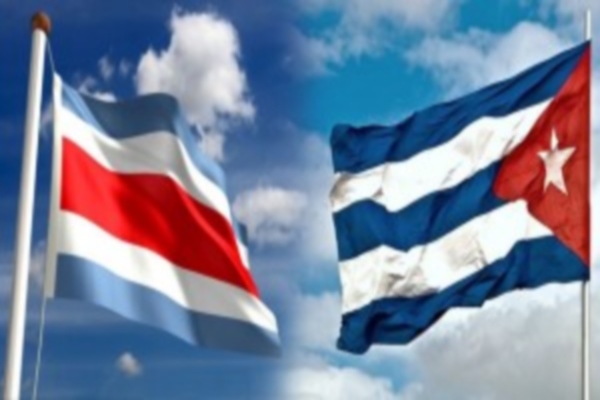
Costa Rica Meets with the Cuban Commission on Human Rights

The Cuban Commission on Human Rights and National Reconciliation (CCDHRN) reported that this Wednesday, 29 January, late in the morning, they met with Costa Rican diplomats, one of whom was a part of that country’s official delegation to the Second Summit of the Community of Latin American and Caribbean States (CELAC).

The meeting took place at the Costa Rican Embassy in Cuba and representing Costa Rica were Señora Ingrid Picado Monge, Ceremonial Head of State, and his Excellency Señor Don Hubert Mendez Acosta, Costa Rican Ambassador. For CCDHRN, attendees were Kirenia Yalit Nuñez, Information Officer, and CCDHRN Spokesman, Elizardo Sánchez.

The Costa Rican diplomats took notes and assured they would report to the President of the Delegation of their country to the CELAC Summit.

CCDHRN members prepared a report about the unfavorable situation in Cuba with regards to civil and political rights, as a context in which the Summit is taking place, and we expressed our hope that the Cuban government will accept, in a climate of inter-American cooperation, the need to adopt and respect international standards, particularly in the areas of civil, political, economic and cultural rights.

At the time of the meeting at the Costa Rican site, at least 16 peaceful Cuban dissidents remained jailed because of the CELAC Summit, and at least 8 were under house arrest.

The Cuban Commission on Human Rights supports the request made to the Cuban authorities by Mr. Ban Ki Moon, Secretary General of the UN, about the need for the government of Cuba to ratify the Covenants on Civil and Political Rights and Social and Cultural Rights, which they signed six years ago. It is hoped that the government, in addition to ratifying the agreements, guarantees unrestricted and unreserved compliance with them.

The CCDHRN asked for meetings with several delegations attending the CELAC Summit, through their respective embassies in Cuba. Only the Republic of Costa Rica responded positively.

 | 29 January 2014

Impossible Zone of Peace / Rene Gomez Manzano

Represión-en-Cuba-a-disidencia-política_EFE-300x200
Repression of a political dissident in Cuba. Source: EFE

HAVANA, Cuba – In the last several hours the Castro propaganda campaign has come to a climax on the occasion of the Second Summit of the Community of Latin American and Caribbean States, which will be held in Havana between today and tomorrow. Of course this focus is justified if we consider the swaddling this event implies for the totalitarian regime in Havana.

Meanwhile, the independent press informs us about the intense reservation exercised by the Castro government against all of society. Even beggars and pimps have been affected by the delirium of the conclave. Many of them are warned that, during the great event, they should abstain from exercising their ancient craft.

On a slightly more serious note, it should be remembered that several documents have been agreed to within the CELAC framework. In one of them, dating from just a year ago, it reiterates that this Community is based on, among other things, “the protection and promotion of all human rights, the rule of law at the national and international level and democracy.” Can anyone believe these beautiful words are compatible with the regime imposed in Cuba by the Castro brothers?

Of course not. But the totalitarians usually get by with ease. We have the experience of the clauses about freedoms and pluralism adopted years ago by the Ibero-American Summit in Viña del Mar. With to what was agreed to there, the Havana authorities commented: The documents signed by Cuba we interpret according to our own conception of democracy. And problem solved!

The fact of the matter lies in that the governments of our cultural environment, who for the most part respect Human Rights internally, don’t allow among their members a regime that systematically violates them like that of Havana, but they even selected it to preside and host its meetings, as is happening now with the CELAC Summit in Havana. Its fig leaf is the supposed “uniqueness of Cuba.”

In the interim, Cuban authorities do a disservice to those democratic states. We hope the world press and the internal press of those countries report on the fierce repression unleashed in the Great Antille; in this case, the respective governments confront certain difficulties. Serves them right! For having tried to patronize the only totalitarian regime in the West.

At the same time, in the context of the Summit, Castro spokespeople have recalled the words spoken by General-President Raul Castro in South Africa: “Dialog and cooperation are the way to solve differences and the civilized coexistence of those who think differently.” Events show that this is proclaimed (and applied) in relations between states, not between the totalitarian regime and its subjects.

Meanwhile, Deputy Foreign Minister Abelardo Moreno, told the newspaper Granma a supposed new important aspect of the Havana Summit: “We believe that another contribution is the proclamation of Latin America and the Caribbean as a Zone of Peace. This is a proposal that we hope will be adopted during the 2nd Summit by its 33 member countries.”

That’s the way it is! And I thought that CELAC had already solved this in the Declaration of Santiago, agreed on in Chile a year ago! Its Point 14 establishes: “We commit that the climate of peace that prevails in Latin America and the Caribbean be strengthened throughout our region and consolidated in a Zone of Peace, and which differences among nations are resolved in a peaceful way through dialog and negotiation or other forms of solution, and fully consistent with International Law.”

Meanwhile, Foreign Minister Bruno Rodríguez Parrilla, at a press conference, affirmed that in Cuban there is no need to hold a summit of the peoples, as is generally held in other latitudes on similar occasions. For him this is because, according to what he said, the delegations meeting in Havana represent the governments as well as the masses.

The minister didn’t say what principles of Bolshevik alchemy apply now to make this happen. Surprisingly, such a thing doesn’t happen when these meetings are held in other sites, where, in the opinion of the radical left, it is necessary that in parallel to the official meetings, there is a Summit of the peoples.

Cubanet, 28 January 2014, René Gómez Manzano

No One Wants to Talk About CELAC / Lilianne Ruiz

Police on the Malecon -- Havana -- internet
Police on the Malecon — Havana — internet

HAVANA, Cuba — The morning of the 28th, there were fewer people on the street than any other Tuesday.  Also it was notable that the flow of cars on a street as central as 23rd, in El Vedado, had diminished.

Who can find out what is in the heart of the Cuban people, subjected to political propaganda 24 hours a day?

The Malecon, almost deserted.  Two twenty-somethings talk about the Summit of Latin American and Caribbean States (CELAC) as an opportunity for Latin American integration. They speak of the collective, not of the individual. They said that it is about “an opportunity to show the world how much we have tried to rectify some things.”

A man of 40 complains that beer is missing and he associates it with the international event.

Going down O street, another man of 30 laments that the host only tries to fix how Cuba presents itself and accepts that there is another invisible part in permanent crisis. He is not aware of the alternative Forum that the opposition was going to hold that same day.

No one agrees to say his name.

Also on O street, between 15th and 17th, there is an artisan fair, selling the same things as always: pieces of wooden sculpture, costume jewelry of nickel and bone, stamps with the Cuban flag, berets and t-shirts printed with the Korda photo of Che Guevara. But no seller wants to talk to me of his expectations with respect to CELAC. Only one customer, a native, says that he hopes the economic situation will improve.

Leaving the fair, a lady signals me to look some meters away at a man dressed in plainclothes who does not move from the corner. She explains to me that he is part of the State Security force that watches over the CELAC Summit. Every once in a while the man gets out a radio transmitter-receiver and speaks; he seems to be reporting what is happening around him. For a minute I think that I am going to meet with Manuel Cuesta Morua in the dungeons of the Fifth Police Station.

Young women, dressed in the olive-green uniform of the Ministry of the Interior and orange vests, appear on some corners, alternating with the uniformed officers of the PNR (People’s Revolutionary Police). These latter are not too remarkable because they are a daily presence in the streets, patrolling.

A system that requires individuals to deny themselves to be able to survive, in a society that punishes non-conformists, is being irrigated with the impunity that it is granted by 33 regional heads of State, the secretary general of the UN, Ban Ki-Moon, and the Organization of American States, Jose Miguel Insulza, silent about the indefensible situation in which the Cuban people live in matters of civil and political, economic, social and cultural rights.

The internal opposition had conceived of Democratic Forum II in International Relations and Human Rights, as an event parallel to the CELAC summit, a Forum that yours truly should attend. The political police incarcerated the leaders and organizers, and in that way the project was dismantled.

According to information offered by the Cuban Commission of National Human Rights and Reconciliation (CCDDRN), more than 200 arrests have been reported in the last days, some in the nature of house arrest and others in police jail cells, throughout the whole Island.  In all the cases it is about arbitrary detentions to restrain free movement or to impede the activists from meeting.

If they insist on selling again the idea of socialism as a panacea for eradicating poverty, Cubans from the Island have something more to show the world: not only the devastated country, police control, State violence, but also our souls which have been still more poor — practically incapable of understanding and defending themselves — after 55 years without the desired liberty.

Cubanet, January 29, 2014, Lilianne Ruiz

Translated by mlk.

Raul’s Reforms Turn us Into Lice / Jose Hugo Fernandez

Cuban-Americans arrive at Havana; photo taken from the internet

HAVANA, Cuba — The announcement of new email and internet navigation services that directives of ETECSA — the state (and only) telephone company in Cuba — have just made public confirms the regime’s tendency to design each measure of its “progressive reforms” having always as their objective the Cubans of the diaspora.  In recent times not even a single economic liberalization has been produced that is not based on the money of Cuban emigres, and the success of which does not depend entirely on them.

The circumstance is paradoxical: those whom our bosses obliged to flee from the country have become not only one of the main sources of economic sustenance for its power, but also the cornerstone of a new political strategy with which they today try to clean up their image before the world.

Any barely awake observer could take the fact as a key in order to understand the failure of the Revolution. And not only that. Also to corroborate the outrageous nature of the so-called Raulist reforms, delineated in order to manipulate international opinion, while they exhibit scorn and disrespect towards Cubans, whether they live on or outside of the Island. continue reading

Should we then reject the measure?  Each with his skin makes drums.  I approve it, in spite of the regrets. And in agreement with the first reactions that I have observed in my surroundings, it seems that there are many in my case.

That leads to another paradox: in the same way in which our bosses adapted the people to depend almost absolutely on their guardianship, today, now that the systemic crisis keeps them from continuing to adopt us as foolish children, they pass the hot potato to emigration. “But, look, only in respect to economic dependency, without making any allowances in the political field, and counting a priori on those who here or there are going to come along for the changes without changes that they (the political elite) are planning.”

A friend, with whom I conversed about the matter, commented in jest that the best thing that President Obama could do right now to support our aspirations for democracy and progress is to sign an exceptional decree giving salary increases for all Cubans who live in the United States.

It is a joke that also contains a paradox, and a very serious one. Thanks to that delusional decree signed by Obama, emigrants and exiles could continue being the support of the Raulist “progress” which, sooner rather than later, will turn against the regime itself, because each step, however minimal and mediocre it may be, opens a gap through which people from here look, explore and know the real world, something that without a doubt will end up changing their expectations.

That, it is clear, should not keep us from visualizing a last paradox, or two, the saddest:

1) It’s unfreakingbelievable that after confronting the drama that emigration or exile implies, those on the other side have to break their backs in order to supply even the minimum necessary for the relatives who remain here.  2) It shakes this metamorphosis that they have imposed on Cubans on the island: we’ve been transformed from from measly parasites of the State to useless parasites of our loved ones.

We now know that the Cubans of the future will not be like Che, but will we be able to avoid in time becoming like lice, after having permitted parasitism to become a trait of our national identity?

Cubanet, 29 January 2014, Jose Hugo Fernandez

Translated by mlk