Mariel, the Past and Present of an Exodus / Cubanet, Camilo Ernesto Olivera

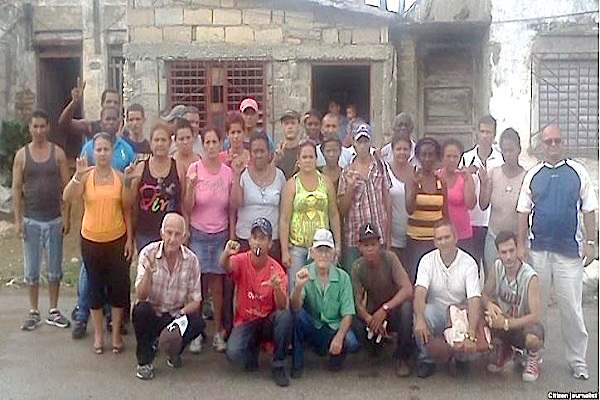
Fishing school, El Mosquito camp in 1980, seen from the point of view of the River Homonimo (photo by the author)

“They left through here and will never return,” recited a sign on the wall of the power plant. Nevertheless, those who “left” became the support of those who stayed. Today many share the Miami exile with those who said goodbye to them by throwing eggs or rocks

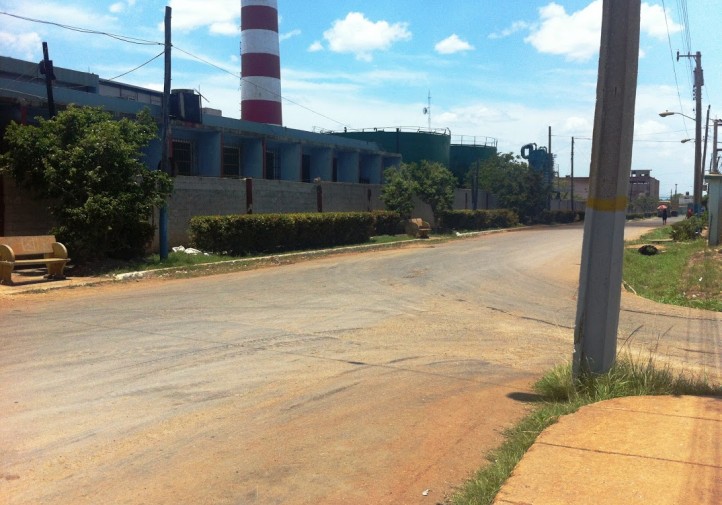
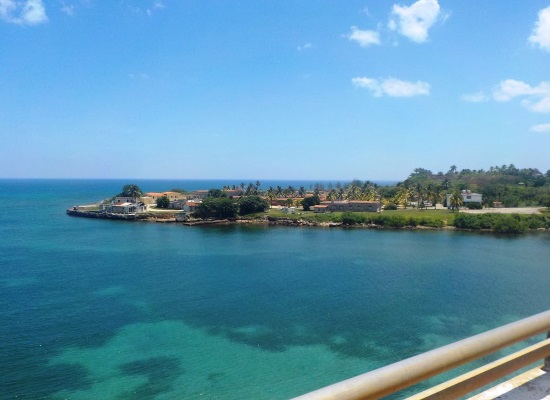
cubanet square logoCubanet.org, Camilo Ernesto Olivera Peidro, Havana, 28 May 2015 – In the town of Boca del Mariel there is a small beach preferred by the locals. Next to it are the facilities of the former bulk sugar terminal. A little further beyond operates the Maximo Gomez power plant.

One Sunday in mid-April 1980 the beach-goers saw four boats flying the flag of the United States enter. They observed how they were directed toward the area of the neighboring pier. At that time the presence of armed Cuban officials became apparent. Later it was learned that there, in a sugar storage warehouse, was the temporary headquarters of the captaincy.

In the days following, the presence of boats and yachts from the north increased. The people from the town of La Boca as well as Mariel were taken militarily by army troops and police personnel. continue reading

Fifteen years earlier the Cuban government had equipped the port of Mariel, located 20 miles to the west of Havana, as an embarkation point for a migratory bridge leading through Boca de Camarioca in Matanzas. Between April and October of 1980, 125,000 Cubans left for Florida, in what came to be known in the United States as the Mariel Boat Lift.

The way of the cross of the Marielitos

The Cuban government announced that all who wanted to do so could leave. But, as a condition, they had to apply for permanent dismissal from their places of work or education. With this safe-conduct pass, many who had taken refuge in the Peruvian embassy went out. They were victims of fascist acts of repudiation in favor of the regime.

Many Cubans carried out diverse actions in order to visit relatives who were waiting for them in that port. Men, women and children arrived there with visible signs of the humiliation suffered at their places of origin.

But something as bad or worse awaited them at the last stop.

At the corner of the Wakamba pizzeria, the mobs armed with sticks and iron bars lurked, cheered on by local government officials. Those who arrived were hunted down and beaten with a vengeance. Then the police “intervened.”
Little beach near the mouth of the port, town of Boca del Mariel (photo by the author)

Those attacked were taken to the Border Guard Unit known as El Mosquito, located at the mouth of the river of the same name four kilometers from Mariel. They were confined there for days or weeks. The conditions in the barracks were inhumane. They mixed the families with criminals or prisoners taken from penitentiaries, sent to this checkpoint to then be deported. The place was guarded by armed military personnel and trained dogs.

On the trip back, the buses took a route to Mariel crossing the bridge. At the end of this, the authorities posted children brought from the schools of Baracoa and Henequen. The teachers passed out eggs and rocks for the students to throw at those in the vehicles.

Currently, on this site, where so many Cubans suffered, is a school that teaches fishing.

The threshold of freedom

The pier of the Camaronera Flota (today the Astilleros Astimar Company) was the last step in the way of the cross. Those who were leaving were concentrated there on two boats next to the pier, at that time, empty and half finished. They waited to be called from a list. Then on boarding they passed through another control.

As a condition of being able to take their relatives, those who came with the boats had to permit themselves to let their decks be stuffed with other people of various kinds. There were those who chose refuge for their families in the cabins.

When the boats pulled away from the coast, the last image, from afar, was of the columns of smoke coming from the chimneys of the Mariel power plant.
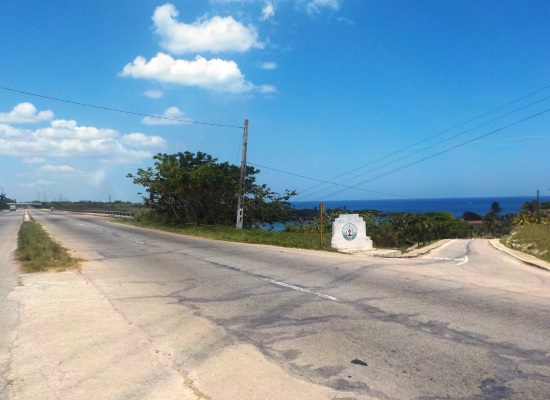
Entry point of the former Mosquito Camp, currently a fishing school (photo by the author)

On a stretch of the perimeter wall of that plant, there was for many years a sign that said: “Through here they left and they will never return.”

The sign disappeared during the nineties. That was when the crisis increased. Those who “left” turned into the support for those who stayed.

Today those who left in 1980 share exile in Miami with many who said goodbye with eggs or rocks and later fled in the raft stampede of 1994.

The dictatorship that made them abandon the country still governs with an iron fist poorly disguised with a fine silk glove.
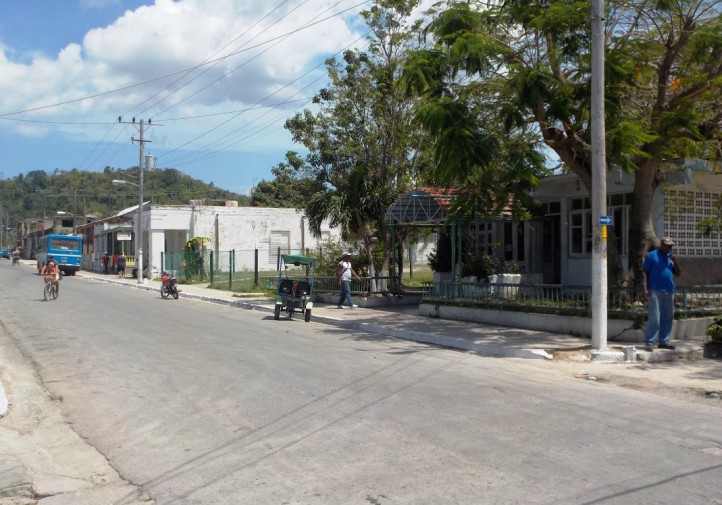
Pizzaria Wakamba in Mariel where the trip ended on Route 218 from Miramar (photo by the author)
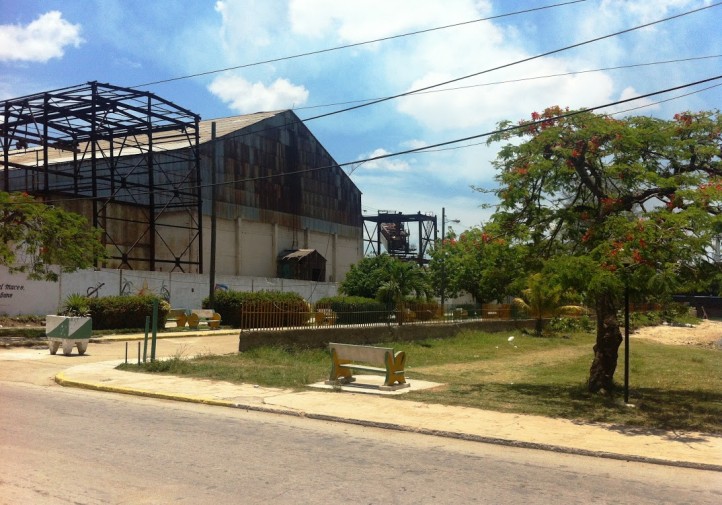
Warehouse where the registry of the Port Captaincy was located during the Mariel exodus (photo by the author)
Muro-de-la-refineria-Maximo-Gomezen-este-tramo-existio-este-cartel-Por-aqui-salieron-y-jamas-volveran-Foto-Camilo-Ernesto-Olivera-722x505
Section of the Maximo Gomez refinery wall where the sign existed (photo by the author)

About the author

camilo-ernesto-olivera.thumbnailCamilo Ernesto Olivera Peidro – City of Havana (September 14, 1970) – Screenwriter and Researcher – He has participated in theorist events in almost all the rock festivals that have taken place in Cuba from 2001 to the present – Workshop for screenwriting, production and staging of musical events (UNEAC, CARICATO) 2004 Graduate of television script and drama course (ICRT Teletransmisora training department) 2006 collaborator on Cuban non-official publications concerning the rock genre like “El Punto G,” “Insanedrac,” “Ilusion.” Since December 2007, he has been part of the Cuban Rock Agency where he works as a cultural promoter and member of the editorial board of the magazine “Rock del Patio” (in process). His texts are published in “La Corchea” (ICM), websites AHS, maximrock.com, cubametal.com, esquife.cu, Cubaencuentro, Voces, Cubanet and Diario de Cuba.

Translator: MLK
Laritza Diversent, the Cuban Lawyer who met with Obama / Cubanet, Manuel Guerra Perez

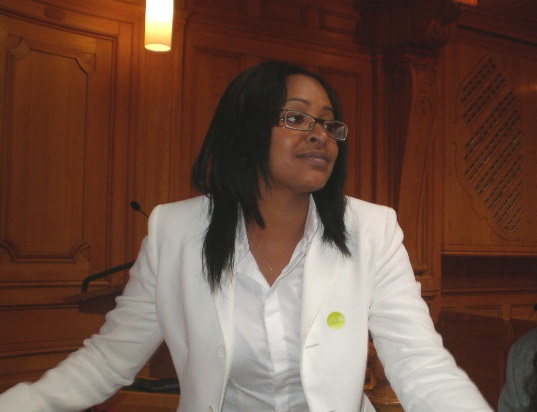
Laritza Diversent independent lawyer (Internet photo)

cubanet square logoCubanet, Manual Guerra Perez, Havana, 30 April 2015 — Laritza Diversent is a lawyer and director of the Cubalx Center of Legal Information, an independent office that has offered free legal advice since 2010. She graduated from the University of Havana in Law (2008), she is married and has a 16-year-old son.

What exactly is Cubalex and for what purpose did this project come about?

Cubalex is an office that specializes in human rights issues, focusing on national law and the conventions of international laws, which Cuba supposedly relies on. We try to document violations of Human Rights, but our core business is to provide free legal advice to citizens.

The legal advice is for citizens who are ignorant of the law with regards to disparate issues, topics as diverse as housing, criminal, immigration procedures, in short, the varied issues we face daily. Always in legal terms.

Do you collaborate with lawyers from the collective law firms to represent your clients? Who makes up Cubalex?

Our organization is composed of several lawyers, human rights activists, a medical assistant, paralegal and secretary, here in Havana. We also have offices in Camagüey, Granma and Las Tunas. We received requests from the Isle of Youth and to the East, from Baracoa for example. continue reading

We do not work with lawyers from the collective law firms, although we do work with other independent lawyers. They don’t allow us to represent our clients in court proceedings, so we have no link with lawyers from collective law firms.

Should Cuba modify the current judicial system?

The Cuban judicial system needs many reforms. Many articles of the Universal Declaration of Human Rights are not addressed in national legislation. There are no laws to exercise the right to complain, protest, freedom of speech, nor for the protection of women, or people with disabilities.

Cuba has signed many international treaties that have no direct application within the system. The National Assembly (Parliament) has had no interest in legislating on human rights issues. This is a very difficult issue for the government. To date it has not evidenced any intention to provide protection or guarantees for citizens’ rights.

Recently you lost a lot of information from computers in this center

There was a robbery in our office where they stole all the computers, all the mass storage media with all the information of years of work.

It was an intentional theft, with a specific order to take only what contained information. My husband and I were abroad and my son had gone to school.

At that time part of the team was undertaking a training abroad. Inside the house there was valuable equipment that wasn’t stolen. This incident resulted in our being unable to serve the public for a month.

Why are people flocking to Cubalex and not the collective law firms?

I think in collective law firms they don’t give the required attention to their clients. They do not provide the free legal advice they offer and we do.

The lawyers of the collective law firms have a conflict of interest because they act on behalf of an individual and the state at the same time.

The Ministry of Justice has established fees for legal service contract but the lawyers of the collective firms charge extra to try to complement the service they offer. The people who usually come to us are poor and are unable to pay those extra fees a lawyer asks. If a customer does not pay those fees, there is a complete lack of interest and motivation that results in little or no results.

In many cases, lawyers for law firms act more like judges and prosecutors than like defense lawyers. They are also ignorant with regard to Human Rights, which is where we specialize. ”

Cubalex office in Havana (photo by the author)

Cubalex collaborates with international organizations

We collaborate on Human Rights, information and complaints to agencies of the United Nation. With the Office of the High Commissioner for Human Rights or the Inter-American Commission on Human Rights, through the provision of injunctions, presenting petitions, hearings. We also have contacts with other international organizations specializing in human rights and other related organizations.

We had to go to these institutions because we are not educated on Human Rights. Although we studied law we were not given adequate training on the subject and so we had to go to these organizations to give us tutorials, information to present strategic litigation at the international level on this issue, as we do the State. If this does not resolve it, then we present them to international organizations. This is the kind of relationship that we have these bodies.

Do you feel satisfied with the work done Cubalex?

We have grown from the legal, personal and cognitive point of view. We have been able to learn more about the concerns of the population, to know what are the main violations toward society. In 2013 we went to the United Nations and participated in report to the Cuban State on the convention on discrimination against women. We have presented reports on people with disabilities, the situation of human rights defenders such as the Ladies in White and independent journalists at hearings of the Inter-American Commission. We want to give a minimum of information to the majority who do not know that Human Rights are violated in Cuba. We live in a society almost closed in terms of information, with limited access to the Internet.

Have Cubalex members been assaulted or harassed by the authorities?

Assaulted, not directly, but they have been visited by the Department of State Security (DSE) members working here. Our lawyers in Eastern Cuba have received a lot of pressure because the authorities say they will not allow a site like we have here. Authorities also increased the smear campaigns in digital media.

We have requested an injunction from the Inter-American Commission on Human Rights that was given to us to protect our work team. The State must follow the recommendations of the Commission although we know that they do not do so but have responsibilities toward the commission. Therefore we ask for our lives and our personal integrity. Everyone knows that the Law 88 remains in force, it has not been commuted, or suspended, so we fear that they could take any legal action against us.

What are your thoughts on the resumption of relations between the governments of the United States and Cuba?

On a personal level I am in favor of this reset because I think it’s the first step to end the conflict. This is a conflict between governments and those who principally suffer are the Cuban people.

On the other hand, the new policy published by the White House on the issue of the private sector, human rights, support for civil society and communications, we still have reservations about, in the sense that there is a legal system of citizen control that prevents this development. Because I believe it is a necessary step does not mean I agree with everything or believe that it will be effective.

It is the responsibility of civil society to find information on these legal restrictions that exist and prevent the politics of goodwill of the United States toward the private sector (which I still insist this sector does not exist in Cuba), Human Rights and civil society, to warn about the dangers could represent, because here there is a blockade of the government against its citizens.

The contact between the two governments has awakened civil society, which sees that change in Cuba is not dependent on any foreign government but on Cubans themselves. We are preparing ourselves, therefore to seek ways to put pressure on the government, if they do not want to talk to us we have to out pressure on them to do so.

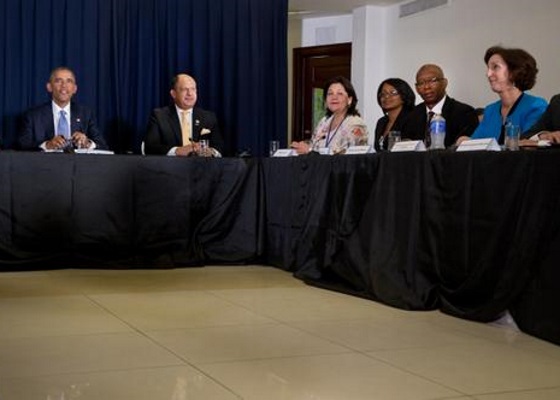
Barack Obama meet in Panama (Internet photo)

How would you describe VII Summit of the Americas in Panama, where you participated?

In general terms the summit was a positive balance for independent Cuban civil society, and I had the opportunity to participate on an equal footing with others in Latin America. This was very helpful to make it known that there are people in Cuba who think differently than the government, who want democracy and respect for human rights.

Moreover, the Cuban State showed its own nature, violent and intolerant.

Describe your meeting with US President Barack Obama, in the forum of civil society in Panama

“Firstly I should clarify that I didn’t participate in the forum of civil society, as I was not accepted by the Panama NGO that selected the participants.

I was in a private meeting by invitation, where the dissident Manuel Cuesta Morua and 13 other leaders of Latin American civil society were also present. There President Barack Obama expressed his support to foster the development of civil society in the region, and invited those present to say in which way they (also there were the the presidents of Uruguay and Costa Rica) could support us and encourage the Latin American civil society. Venezuela and Cuba were the ones who began to offer recommendations because both countries have the most repressive contexts in the entire region. Most agree that civil society must have sources of funding to develop and to carry out their projects.

In my particular case I called attention to the dangers that surround the Cuban legal system with regard to the policy that the US government intends to develop with Cuba on the issue of the private sector, communications and everything else. It is impossible to obtain any financial or material resources through donations or any other kind of help that can be given by current banking regulations within Cuba.

State Inefficiency, Convenient Business / Cubanet, Ernesto Perez Chang

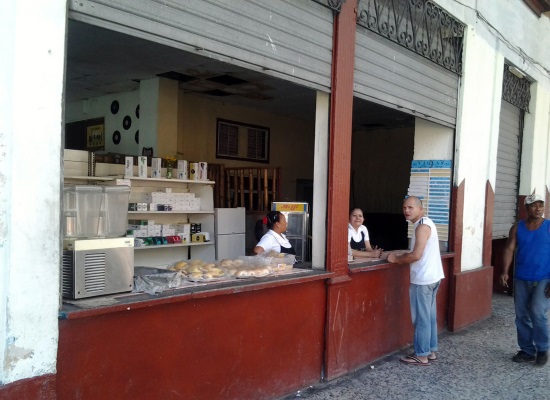
Selling yields no benefits (photo by the author)

cubanet square logoCubanet.org, Ernesto Perez Chang, Havana, 22 May 2015 — Attestations about poor or non-existent attention in Cuban state businesses are so abundant that few pay attention to them. In order to offer a response to the indignant, the island’s official press searches for causes of such abuse not in the inefficiency of the state enterprise but in other absurd factors like poor education or lack of professionalism, which do not reveal the corrupt essence of a system that, in spite of the proof of its uselessness, will be kept in place by government will, as is expressed in the Guidelines of the Sixth Congress of the Communist Party.

Why do we receive better treatment in a private restaurant or cafeteria? Why do customer demands bother the clerk and managers of a state eatery and why do they not improve the quality of their offerings? Why do they hide behind any justification in order to remain closed or to reduce their public service hours to the minimum?

According to Vladimir Rodriguez, owner of a busy little restaurant in downtown Vedado, the problem is in the objectives of each:

“As the owner of my business I seek to attract more customers, to offer more variety. I listen to the opinions of the people, the suggestions, I serve them like they were kings because it winds up as earnings. In a state restaurant the earnings do not come from the clients’ consumption and satisfaction but in that quite miserable thing that happens in the warehouse, in the sale to the black market of everything that arrives to be produced and sold to the customers, who turn into a nuisance. What little gets to the table is only to justify the work in case an inspector comes, but the clerks as well as the manager live on the black market. continue reading

“That is something everyone knows. (…) I worked for years in restaurants in Havana, even in luxury hotels in Varadero, and what I saw in the kitchens is nasty. (…) Rice that customers leave on their plates went back in the casseroles, a bit of meat, salads, the olives, everything that people leave on the plates is served again. That is way of dealing with leftovers. That’s why I left and opened my own business. I would not be caught dead in a State restaurant; God only knows what they are serving you.”

For Iraida, a clerk in a private cafeteria in Arroyo Naranjo, the matter is more complicated: “It is a secret to no one that in the stores as well as in all the state enterprises the people do not work, they are going, as they say, to struggle, that is to say, to steal. And the worst is that the government knows it and “plays the silly goat” [pretends not to know]. (…) Why? Because it is convenient for them. If they attack the black market the people will rebel because everyone lives off that, even them. There, yes, the revolution is over. They promised to create a wholesale market for the self-employed and even now we continue in the same way, buying on the black market because there is nothing in the stores or if there is, it is hidden in the warehouses, so that you have to buy from a warehouseman, who has a fix with the manager, and so forth and so on. There you realize that the government is involved in that mess (…) if it does not benefit with money, at least it does by leaving it to the people ‘to struggle’ so that they see the ‘blessings of socialism.’ In troubled waters, fishermen gain.”

Marta Li, owner of a café in Vedado, illustrates for us with her own examples what she considers the superiority of private enterprise. “In a State café no one worries about serving the customer well because it does not end up as earnings. They sell or not, the salary is the same for the manager as well as for the sales clerk. They care about what is left from a liter of oil and the chicken, to resell the cheese and the spaghetti; they are not sold because no one would buy them. I, on the other hand, have to constantly create sales strategies; my objective is that nothing is left, not in the pots or in the freezers, to sell everything because what I have paid is quite a lot. (…) Since I am close to the university, I make offers to the students who present their student ID, I discount the price. Sometimes for someone who buys more than one pizza or for a repeat customer I give them a free drink. People come because they know that they will receive good attention. It is not about lowering prices but giving good service.”

Customers do not matter; what’s good is what happens in the warehouse (photo by the author)

A former civil servant of a business enterprise in Havana, who wishes to remain anonymous because she is currently the owner of a restaurant, tells us of her experiences in a state business:

“Satisfying the customer is the last of the priorities [of a state enterprise]. Whatever it may be. They all work in order to steal everything that can be stolen and in the least time possible. One enters with good intentions and ends up coming to terms with the corruption because there is no other path. (…) The socialist economy has neither feet nor head. When I studied [economics] at the university the professors themselves said that there is no way to explain the Cuban economy. And when you try to apply any model you realize that they all fail. (…) It is not that you propose to steal, it’s that you have to do it because everyone is out for himself. It didn’t matter to me or to any of the workers in all the stores where I worked, which were more than twenty; it didn’t matter if the wages were low or not, not even the bonus, the salary was a formality, the true earnings are not even on the counter as many think. Where the money comes from (…) is not the counter. And be careful with making yourself the conscious one [honest] because you wind up blaming yourself for everything.”

Will they be able someday to prove the efficiency of the socialist state enterprise, as Cuban leaders claim, based on a couple of suspicious exceptions? According to the recent statements by Miguel Diaz-Canel, this “demonstrative work” is one of the main undertakings of “the country’s leadership with the Cuban people.” As if half a century of failures that we Cubans currently suffer did not matter, the government pushes to prolong an economic experiment behind which is hidden a vast fabric of corruption.

Against that piece of nonsense, for years it has been very common to hear on the street a phrase that sums up the inefficiency of state enterprises: “The government pretends to pay us, and we pretend to work.”

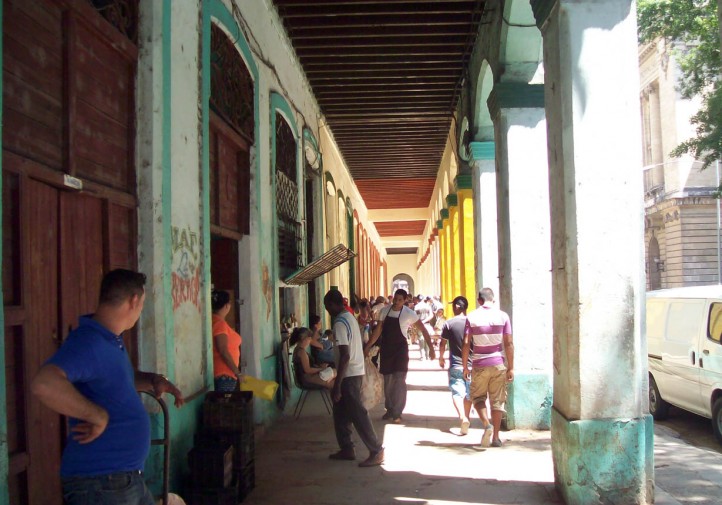
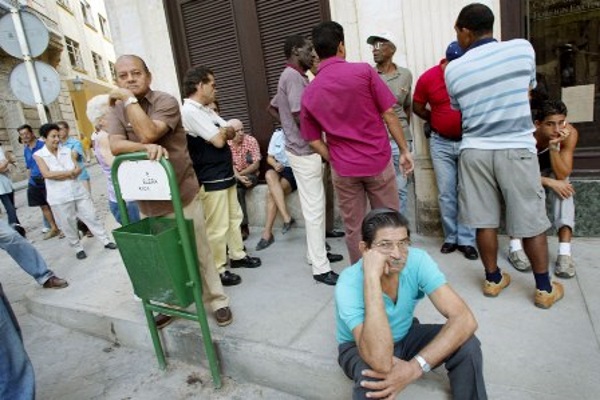
Outside the businesses, in the doorways, people resell products on the black market, in view of everyone (photo by the author).
Iniciativas-a-favor-del-cliente.-Una-paladar-privada-en-el-Vedado.-Foto-P.-Chang-722x505
Initiatives in support of the customer. A private restaurant in El Vedado (photo by author)
This snack bar gives students 5% off (photo by author)
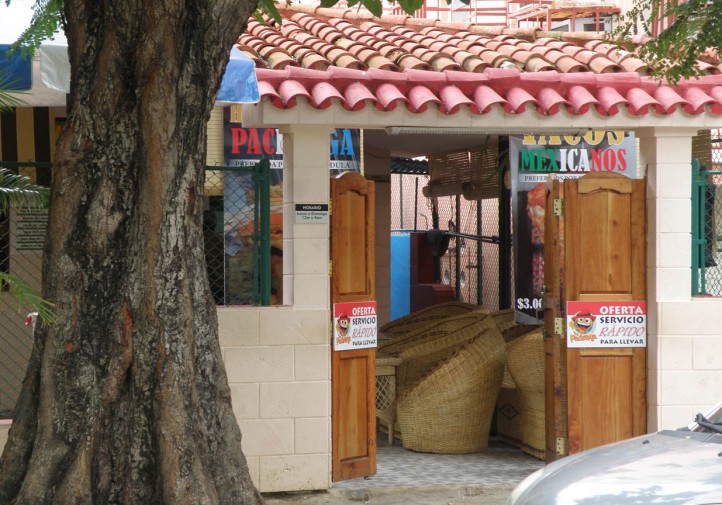
Satisfying the customer is the objective of private business. There are more menu items than in State companies. This snack bar gives students 5% off (photo by author)
Guarapera-estatal-cerrada-en-horario-laboral.-Foto-P.-Chang-722x505
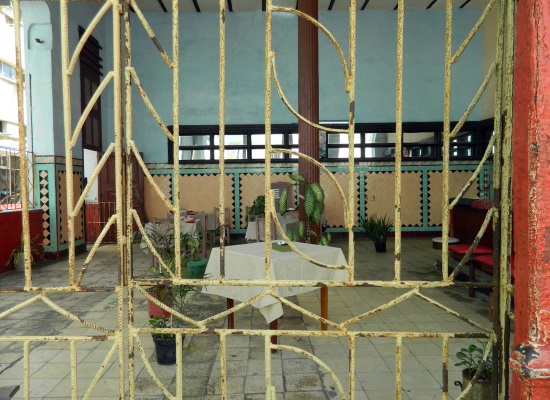
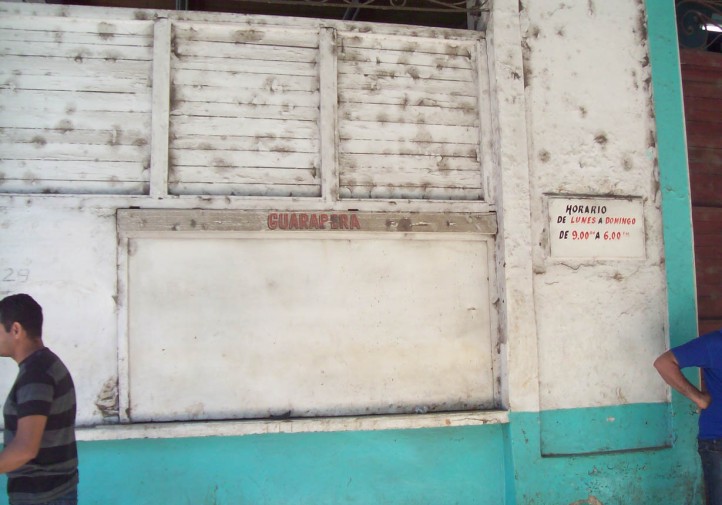
A State business closed during working hours (Photo by author)

About the Author
448.thumbnailErnest Perez Chang (El Cerro, Havana, 15 June 1971). Writer, graduate in philology from the University of Havana. He studied Galician Language and Culture in the University of Santiago de Compostela. He has published the novels: Your Eyes Are in front of Nothing (2006) and Alicia under Her Own Shadow (2012). At the end of 2014, the publisher Silueta, in Miami, will publish his most recent novel: Food. He is also the author of books of stories: Last Photos of Mama Nude (2000); Sade’s Ghosts (2002); Stories of Silk (2003); Variations for the Preliterate (2007), The Art of Dying Alone (2011) and One Hundred Deadly Stories (2014). His narrative work has been recognized with prizes: David de Cuento of the Cuban Gazette twice, 1998 and 2008; Julio Cortazar Latin American Story prize on its first call in 2002; National Critics Prize in 2007; Alejo Carpentier Story Prize in 2011, among others. He has worked as editor for numerous Cuban cultural institutions like the House of the Americas (1997-2008), Art and Literature Publisher, the Center for Research and Development of Cuban Music. He was Chief Editor for the magazine Union (2008-11).

Translated by MLK

“If I had someone to sponsor* me…” / Cubanet, Rafael Alcides

colasss

cubanet square logoCubanet, Rafael Alcides, Havana, 19 May 2015 – This morning I woke up pessimistic. There was no milk in the house, and the kind they sell at the “shopping” [hard-currency* store] is priced out of reach for anyone who is not an executive at a firm or who does not have relatives out there who love him very much and are well-off.** But at the bakery where I purchase the bread allotted to me via the libreta [ration book], I ran into somebody who today was more pessimistic than I am. He is a retired teacher and, without taking into account his age, one of those characters who pride themselves on being well informed told him that the ration book is about to be discontinued, that in fact it would be eliminated before August.

The teacher understands that this book weighs heavily in the pocket of the government, but he also thinks that instead of taking it away, the government should make it selective. Neither the powerful musician, nor the executive, nor he who receives remittances from abroad, nor any other characters of the New Bourgeoisie, need the ration book. The teacher, however, retired on a pension of nine dollars per month (that is, less than 30 cents a day), and with no one abroad—what would he do without this small assistance? There are just four little items that the ration book now subsidizes, but these four little items keep him from begging in the streets. The teacher spoke to me very badly of the Revolution, to which he had dedicated his life. continue reading

To console him, and because I don’t believe that, for now, the government intends to abolish the ration book—a costly burden, yes, but an even greater psychological benefit—I advised him to relax. “Don’t believe in rumors,” I told him.

“This was the only life I had,” he replied.

I let him vent.

Have you considered leaving the country?” I asked him.

He sighed heavily.

“If I had someone to sponsor me*…”

I purchased my three little rolls of 20-something grams each, and perhaps because an evil shared among many is easier to bear, I returned home feeling better. On the way back I compared the disenchantment of this teacher—a fragile but dynamic man who used to dress in his militia uniform festooned with all his decorations—with the latest hobby of a certain neighbor. This is a widowed doctor who grew old dreaming of leaving the country, and who, now that he could do so without major paperwork and without losing the house he inherited from his elders, refuses to go. Neither his children nor his nieces and nephews (all of whom are abroad) are able to persuade him otherwise. Of these, one who was visiting in January, told me, grinning, “Imagine, with the remittances we send him, he’s living like a king, with a maid, lots of Viagra, and three, 20-something doctor-girlfriends to keep him busy.”

They seemed to be saying—that disenchanted teacher who wouldn’t know how to live without the ration book, and that doctor who has discovered that, with money, even being widowed and very elderly one can be happy—that the Cuban exodus would not have been so massive had the socialist government been able to provide a privation-free life for the citizen. However, the end of Pinochet, even though he left Chile off the charts in terms of a First-World standard of living, or of Franco, despite the vertiginous development achieved by Spain during the Generalísimo‘s last two decades, demonstrate that the issue is not just an economic one. As I read somewhere once, without freedom there is no lasting splendor. Nor is there ground that can withstand the cathedral placed upon it.

It has always been thus. Rome, once the ruler of the world, that mighty Rome of patricians and slaves where, moreover, the Christian was persecuted, eventually disappeared. A comparable lack of freedom ended Spanish colonial domination of lands in Our America, as well as the English, Portuguese and French. Vanished from that former America were Juan Manuel de Rosas, and Gaspar Rodríguez Francia, and Rufino Barrios and Porfirio Díaz and Gerardo Machado. In the America of my time, that America from when I was young, we saw the last of Trujillo with his braided uniform, and Somoza, and Stroessner, and Pérez Jiménez, and the Brazilian Joao Goulart, and Cuba’s Batista…

In recent times, following the fall of the Berlin Wall, the world has continued lightening up. No longer are there even Hussein, Milosevic, Gaddafi, nor now, finally, that odious fellow in Yemen. With efficiency, in each of these cases, the lack of liberty—that secret gift of the oppressed—has done its fatal deed.

I do not surrender, and therefore do not give up the dream that today or tomorrow—that is, sooner or later (and these things almost always happen when one least expects them)—I and others like me, who number 11 million, including the glum teacher from this morning, will see solutions to our problems putting food on the table—as well as the slum housing, our city falling apart, and everything else that we know too well.

Translated by: Alicia Barraqué Ellison

Translator’s Notes:
* To obtain a visa to immigrate to the U.S., a Cuban national must have a sponsor. This page from the U.S. Interests Section in Havana explains.
** Cuba has two currencies: Cuban pesos, also called moneda nacional (national money), abbreviated CUP; and Cuban convertible pesos, abbreviated CUC. In theory CUCs are a hard currency, but in fact, it is illegal to take them out of Cuba and they are not exchangeable in other countries. Cubans receive their wages and pensions primarily in CUPs, with wages roughly the equivalent of about $20 US per month, and pensions considerably less. The CUC is pegged 1-to-1 to the American dollar, but exchange fees make it more expensive. The CUP trades to the CUC at about 24-to-1. See here a concise description of Cuba’s dual-currency system and an announced plan to unify it.
*** The average Cuban citizen relies on “remittances”—material help—from relatives abroad. A Cuban blogger explains it here.

About the Author

461.thumbnailRafael Alcides was born in Barrancas, municipal district of Bayamo (Cuba) in 1933. A poet and storyteller, he was a master baker in his teen years. He has worked as a farmhand, cane cutter, logger, wrecking crew cook, and manager of a sundries store in a cane-cutters’ outpost. In Havana in the 1950s he worked variously as a mason, broad-brush painter, exterminator, insurance agent, and door-to-door salesman. In 1959 he was the chief information officer for the Department of Latin American Affairs in the Ministry of Foreign Relations, and spokesman of this agency in a daily television program in which he hosted and interviewed foreign political personalities. He was chief press officer and director of Cultural Affairs in the Revolutionary Delegation of the National Capitol.

Among his most recently-published titles are the poetry collections, GMT(2009), For an Easter Bush (2011), Travel Log (2011), Anthologies, in Collaboration with Jaime Londoño (2013), Conversations with God(2014), the journalistic Memories of the Future (2011), the multi-part novel, Ciro’s Ring (2011), and the story collection, A Fairy Tale That Ends Badly (2014).

As of 1993, he had been employed by the Cuban Institute of Radio & Television for more than 30 years as a scriptwriter, announcer, director and literary commentator when, at that time, he ceased all publishing and literary work in collaboration with the regime in Cuba. As a participant in numerous international literary events, Rafael Alcides has given conferences and lectures in countries in Central and South America, Europe, and the Middle East. His texts have been translated into many languages. He was honored with two Premios de la Crítica, and a third for a novel co-written with another author. In 2011 he received the Café Bretón & Bodegas Olarra de Prosa Española prize.

Deportees in Their Own Country / Cubanet, Reinaldo Cosano

In Cuba, if you do not have permission to reside in Havana, they deport you to your province of origin (internet photo)

Cuban Apartheid, suffered by families who abandoned their homes and went to Havana in search of a new life

cubanet square logoCubanet.org, Reinaldo Emilio Cosano Alen, Havana, 15 May 2015 – Rodolfo Castro, from Santiago de Cuba, met with three other young men detained at the Guanabo police station east of Havana. Driven to the Central Train Terminal in a patrol car – so that they could not escape – they were put on the train and deported to their provinces, following imposition of a fine of a thousand Cuban pesos – some 50 dollars – each. So says Osmany Matos, of Guanabo, arrested for a traffic offense who witnessed the incident.

The “Palestinians” (as they ironically call those who come from the eastern provinces) Yordanis Reina, Maikel Cabellero and Edilberto Ledesma, from the rural area El Parnaso; and Amaury Sera, from the Manati township, all in the Las Tunas province, explained to Graciela Orues Mena, independent trade unionist: continue reading

We went to work at Guira de Melena in Mayabeque province, because here either we don’t work or they pay a pittance, always hired by a farmer. One afternoon we were walking through the city with work clothes covered in red dirt, when two police officers asked us for identification. We were arrested and deported for the crime of ‘being illegal.’ They put us on the train with the warning that if we came back we would wind up in the courts. They didn’t let us collect our pay for the time we worked or change clothes or get our belongings. We spent so many hours hungry on the train, without money. An abuse.”

The Crime? Not having a registered address in Havana.

Independent lawyer Rene Lopez Benitez, resident of Arroyo Arenas in Havana, explains: “The Law Decree 217 of April 22, 1997, Internal Migratory Regulations for the City of Havana and its Contraventions, better known as the Internal Immigration Law, tries to control immigration to Havana (also to the capitals of the western provinces). They justify its application because of the dire housing situation, difficulty getting work, public transportation crisis, the supply of water, drainage, electricity, domestic fuel, sanitation, the low level of quality in the provision of other services, which put great pressure on the capital’s infrastructure. The Decree arranges for the eradication of illegal persons and settlements in Havana and the other provincial capitals with work of the Interior Ministry and the National Housing Institute. They have carried out thousands of deportations, forced evictions. Appeals to the Government and the Communist Party for legal protection are a waste of time. The evictions seriously undermine the integrity of entire families, including children and elderly people, who had achieved labor, social and personal stability.”

Slums surround the country’s western cities. There are onslaughts of demolitions “in the name of urban order and discipline in the charge of the Institute of Physical Planning, whose director is the Division General Samuel Rodiles, which intends to eradicate the slum areas that have emerged in the face of the government’s construction paralysis. Now – with the failure of the state initiative – they are trying to increase housing construction through their own efforts and a policy of bank credits and subsidies,” adds Lopez.

Graciela-Orúes
Graciela Orúes (photo by author)

Acts of rebellion across the island against the evictions have managed to paralyze some removals and building collapses.

Resolution 267 of Internal Immigration is at odds with recent laws related to self-employment and Housing. Says Lopez:

“On October 7 of 2010 the Minister of Employment and Social Security issued Resolution 32-2010 arranging for the Regulation of the Practice of Self-Employment by which the restrictions of Law Decree 217 – among other reasons because of lack of work – do not have justification. Many go to the capital to work for themselves in the most varied trades to provide services in construction, plumbing, house cleaning, child care, health care, agriculture, trade, agricultural supplies, farming. Also the essential requirement of proving legality in housing in order to get a license to work is facilitated through Law Decree 288 from the October 28, 2011, Modifications to Law 65, General Law of Housing, in reference to the conveyance of property by buying and selling, inheritance and gift; and it supports the leasing of dwellings, rooms and spaces. All of which, in fact, would annul the restrictions of migration to the capital and decrease the record ‘floating population’ of almost half a million, according to the Housing and Population Census of September 2012.”

The most important thing would be to eliminate, above all, the inhumane deportation. People and even whole families abandoned their homes in order to work, study and try to move forward, but then they were deported like pariahs.

The Internal Immigration Law denies Article 13, Paragraph 1 of the Universal Declaration of Human Rights (1948): “All people have the right to freely move and to choose their place of residence within the borders of a nation.”

The construction industry, prosperous until 1958, was in rapid decline thereafter. Internal deportation for political reasons was used by the colonial Spanish government in the 19th century. Carlos Manuel de Cespedes (1819-1874), Founding Father, was banished to Contramaestre, near Bayamo, his hometown.

About the Author

cosano.thumbnailReinaldo Emilio Cosano, Havana, May 1943, graduate in Philology from the University of Havana. He worked as a teacher the last 20 years of his career. He was removed teaching for lack of “political suitability,” as recorded in the minutes of his final dismissal. He was a member of the Cuban Committee for Human Rights and participated in the Cuban Democratic Coalition. He has written for more than ten years for CubaNet, through the Sindical Press agency, with email address of cosanoalen@yahoo.com

Translated by MLK

Fidel Castro’s “Hardships” in Prison / Cubanet, Roberto Jesus Quinones

Fidel Castro’s mug shot (photo from the internet)

“We sleep with the lights off, we have no roll calls or formations all day, we get up whenever (…) Plenty of water, electric lights, food, clean clothes and all for free”

cubanet square logoCubanet.org, Roberto Jesus Quinones Haces, Guantanamo, 15 May 2015 – This May 15 marks the 60th anniversary of the release of the Moncadistas. The attack on the Moncada barracks is characterized by many as a terrorist act. Beyond the adjectives, always debatable, those who have been charged with praising the rebellious generation and denigrating the army officers of the time say nothing about the soldiers killed that Carnival dawn. Nineteen officers fell, but their names do not count for the official historians.

What would happen today if a group of Cubans, tired of political discrimination and abuses, were to attack a military unit? Would they receive sanctions as benign as those applied to the Moncadistas? Would they be allowed to meet in jail and be separated from the regular prisoners? Would they be granted amnesty? continue reading

The “cruel” prison of the Moncadistas

In the articles that the figureheads of Castro Communism have written about the event, it is emphasized how “cruel” the prison was for the Moncadistas during the year and nine months that they were held. It is embarrassing to read that in comparison with what many opponents of the regime later had to — and still — suffer.

In the book “The Fertile Prison,” published in 1980, historian Mario Mencia says that Melba Hernandez and Haydee Santamaria were sentenced to seven months for their participation in that event, a surprising sentence compared to the sentences currently meted out to the brave women who dare to raise their voices against the regime. Suffice it to say that recently Sonia Garro spent more than a year in jail awaiting trial.

Arriving at the women’s jail at Guanajay, Melba and Haydee were not only allowed to make phone calls to inform their families, but they were fixed up with accommodations consisting of a bedroom, kitchen, bathroom and dining room; they were permitted to receive all kinds of books, visits by family and friends, and they were always separated from the ordinary prisoners. I must add that before 1959 only three women were sentenced for political reasons, all during the Batista dictatorship, an insignificant number if we compare it to what happened after 1959.

The 27 Moncadistas were sent to the Model Prison on the Island of Pines and separated from the common prisoners, something that Castro-communism has never done with political prisoners. Mr. Mencia says that jail was a hell because it had 460 cells for 930 prisoners and only three showers and two toilets per 25 men. I would like, if he is still alive, for Mr. Mencia to see the 2C outpost of the Guantanamo prison where I was a prisoner between 1999 and 2003, a place built for 90 men and that at that time came to house up to three hundred, many of them sleeping on the floor with only two holes for defecating and two showers. Or he should see the sealed cells where political prisoners are kept. Would Mr. Mencia write about that?

The Moncadistas – according to Mencia – were allowed to have an electric stove, a library with more than 600 books, to read even after the 10 pm roll call, to play ping pong and volleyball and to form an ideological academy in which they debated all kinds of subjects without intervention by the prison authorities. Fidel Castro had at his disposal a Silvestone brand radio. Sixty years later, no Cuban political prisoner enjoys such benefits.

On page 76 of the book there appears a letter by Fidel dated April 4, 1954, where he wrote: “I am going to dinner: spaghetti with squid, Italian chocolates for dessert, fresh brewed coffee and then an H. Upman 4 [cigar]. Don’t you envy me? They take care of me, they take care of me a little among everyone… They take no notice, I am always fighting so that they do not send anything. When I take the sun in the morning in shorts and feel the sea air, it seems that I am on a beach, then a little restaurant here. They are going to make me believe that I am on vacation. What would Karl Marx say about such revolutionaries?”

The permissiveness of the authorities so encouraged the prisoners that their families bought them a refrigerator.

In another letter from August 1954, page 149, the despot in the making wrote: “Cleaning is for the prison staff, we sleep with the lights off, we do not have roll call or formations all day, we get up whenever; I did not ask for these improvements, of course. Abundant water, electric lights, food, clean clothes, and it’s all free.”

The Supposed Isolation

The supposed isolation of the Moncadistas is another falsehood because the book records that on July 8, 1954, Bohemia published an interview with Fidel Castro with the title “The Political Prisoners on the Isle of Pines.”

The prisoners’ mothers formed the group “Cuban Mothers,” which would become the Committee of Pro-Amnesty Relatives of Political Prisoners. They were never beaten for fighting for their relatives’ freedom, much less arrested or slandered as the most worthy Ladies in White are today by the government.

On March 25 of 1955 Bohemia magazine published a document by the Moncadistas addressed to the Cuban people, and on several occasions they were visited by high officials of the regime. Castro-Communism has never permitted that liberty to its opponents.

The lessons of a political mistake

The mistake by the politicians of that era was to believe that if they granted amnesty to the Moncadistas, they would renounce the violent vocation that the letters written by Fidel Castro from his comfortable prison clearly announced.

The dictatorship disguised as Revolution, which that young man of supposed ideals imposed on us, is now 56 years old. He and his brother learned the lesson very well. Hopefully some day the Cuban people will learn that the best leader of a country is respect for institutions and, consequently, will create the needed mechanisms so that we never again suffer another dictatorship.

About the Author

jesus-quinones-haces.thumbnailRoberto Jesus Quinones Haces was born in the city of Cienfuegos September 20, 1957. He is a law graduate. In 1999 he was unjustly and illegally sentenced to eight years incarceration and since then has been prohibited from practicing as a lawyer. He has published poetry collections “The Flight of the Deer” (1995, Editorial Oriente), “Written from Jail” (2001, Ediciones Vitral), “The Folds of Dawn,” (2008, Editorial Oriente), and “The Water of Life” (2008, Editorial El Mar y La Montana). He received the Vitral Grand Prize in Poetry in 2001 with his book “Written from Jail” as well as Mention and Special Recognition from the Nosside International Juried Competition in Poetry in 2006 and 2008, respectively. His poems appear in the 1994 UNEAC Anthology, in the 2006 Nosside Competition Anthology and in the selection of ten-line stanzas “This Jail of Pure Air” published by Waldo Gonzalez in 2009.

Translated by MLK


The Harvest of the Sowing of Violence / Cubanet, Rafael Alcides

Repression Against the Ladies in White (Internet photo)

cubanet square logoCubanet, Rafael Alcides, Havana, 13 May 2015 – Extremely worried, doctoral candidate in physics Antonio Rodiles and his wife the actress and political activist Ailer Gonzalez, in their home, related to me two events that I have prayed over, that those events that started with the blood of Moncada wouldn’t end up being a circular story. Ailer and Antonio spoke of the increased police repression after December 17, most particularly of the brutality with which the oppressors are being dispatched.

On Sunday the 26th of last month, with their trucks crammed with martial arts experts at the end of the usual parade of the Ladies in White, Carlitos, the son of Jesus Menendez, an elderly diabetic with heart problems, was grabbed, dragged and thrown in the back of the truck like a sack of potatoes. Yury, Blas Roca’s grandson, was put in plastic handcuffs so tightly that his hands turned black and they didn’t cut them off. Up Calabazar, the truck with the prisoners inside was left in the sun to bake them a little. They grabbed Antonio among the many present and pushed him with blows to the back before throwing him headfirst into the truck. An endless number of books could be written about the mistreatment and repression of the Ladies in White, apparently excluded from government’s media campaign to end violence against women. continue reading

There has been no lack of repression since 1959. Nor cruelty. In the Canary Islands, during a tribute to the poet Manuel Díaz Martínez, Raúl Rivero talked to me about a blind dissident attorney on the outskirts of Ciego Avila who for a time took lottery bets from the area’s cops. They detained him and when night came they left him in the boondocks. The cop won a bet on what time the blind guy would be seen groping his way into the village using a stalk of sugar cane or a bare branch.

Amazed at not having seen him for a long time, at the Cuban Writers and Artists Union (UNEAC) I met the Galician Regueral, now in his 60s, a Spanish journalist who has lived in Cuba since the 40s. “I was imprisoned for a year in Villa Marista,” he told me. “Why?” “I asked them that when they let me go. ‘Get out of here you Galician, go! Go!’ was the response. They never interrogated me.”

But it couldn’t be pinned on the political police. Kidnapped, homes invaded at midnight and turned upside down, and struggling, taking down the opponent by force, but it can’t be pinned on them. Or not exposed. For this they use the supposed “outraged people,” a mob disguised by its sheer numbers.

Repression intensifies against opponents in Cuba (Internet photo)

On the other hand, this is the least likely moment to make a show of brutality. They’re expecting investors in the Port of Mariel project (although those in the know say with so little bait they’re not going to catch big fish) There are also the American government authorities frequently visiting the Island, and behind them, or in front or them, are those who come to check out the part where they would like to stay, the government and entrepreneurs are expecting four million American tourists who speak of the myth. And in September Pope Francis will come. It is, I insist, the least likely moment to step up the heat.

After the first years of the Revolution, there were no more firecrackers going off, no place for sabotage, or attacks or an uprising to happen. Those methods of fighting, traditional on the Island in and those that in the 26th of July Movement were considered excellent, disappeared. The dissidence, in that regard, has been more peaceful than plaster saints. But violence often engenders violence.

I remember a boy from those times of Aguirre Park who didn’t want to get involved in anything. Seeing him appear, the group changed the subject. “Hush,” they said. It scared him. “I’m getting cold,” he complained. One night he came close to tears, but was determined. “Gentlemen, count me in on whatever,” he said. A cop whose girlfriend he’d offended had punched him. Then, from what I learned after 1959, he became the best at planting bombs.

A man without a job in dangerous, but a man with a policeman’s hand over him could be the beginning of civil war. I understand Army General Raul Castro. If he allows the demonstrations of the Ladies in White, he would have to allow others and all the rest, but if he doesn’t allow them, he will have to continue to use brutality and then he has crossed the line than can’t be crossed. He’s caught in a lose-lose situation. All that’s left is to open the game. Inaugurate democracy. His time has run out.

Mass in Cuba for Oswaldo Payá and Harold Cepero / Cubanet, Ignacio Gonzalez and Osmel Almaguer

cubanet square logoCubanet, Ignacio Gonzalez and Osmel Almaguer, Havana, 13 May 2015 – A Mass for the deceased Oswaldo Payá Sardiñas, opposition leader, and Harold Cepero, activist, was held this afternoon at the Church of Los Pasionistas in Havana, with Rosa María Payá in attendance. Rosa María, daughter of the Cuban human rights activist and recipient of the European Union’s Andrei Sakharov Prize for Freedom of Thought, arrived from the Miami Airport to Cuba on the morning of May 11, to reunite with her family and friends and to honor the memory of her father.

The Mass was attended by activists of the Estado de Sats project, Antonio Rodiles and Ailer González, and by Manuel Cuesta Morua, leader of Progressive Arc, among others.

Their Weapon is the Word, Peaceful is their Struggle / Cubanet, Rafael Alcides

The dissidents, labeled as “mercenaries,” seek only, through peaceful means, democracy for Cuba (file photo)

Our “mercenaries” do not plant bombs, nor do they plan attempts on people’s lives, nor sabotages, as did those who today are in power.

cubanet square logo

Cubanet, Rafael Alcides, Havana, 30 April 2015 – A young Communist, lamenting how the Cuban government delegation (supposedly there representing Cuban civil society) made fools of themselves in Panama, told me, “Well, at any rate, all you people are mercenaries.”

“First of all,” I responded, “exclude me from that group. I do not belong to any party, I am an independent voice. Secondly, regarding that ‘mercenary’ label, even the government doesn’t believe it. It has always been thus: for the autocrat, there is no ‘opponent,’ no ‘adversary’ – there is only ‘the enemy.’ ”

I took a mental trip back to the administration of José Miguel Gómez, when, to take advantage of the recently enacted Platt Amendment, the striking term “annexationist” came into use to exterminate the opponent, the enemy. Indeed, extermination is the issue. The “mercenary” term began having the demolishing effect of ten tons of cast concrete falling on its target. continue reading

It is the equivalent of the Germanophile appellation, nurtured by the Major General of the Liberating Army, Mario García Menocal, in the days of the First World War, and when Cuba, following the United States’ lead, declared war on Germany and even purchased 30 aircraft and trained 30 aviators to send them to the battlefields on the other side of the Atlantic.

It is poetic to observe, at all times in history, the behavior of the autocrat toward his enemies. In those days, there were no strikes, especially in the sugar industry where, other than the local “Germanophile,” no true Germans (Germans who came from Germany to help Cuban workers) took part. There are even reports of ambushes and crossfire between the rural police force and Germans who, with the help of certain elements in the area, managed to break through the enclosure and, on one occasion, sink a submarine that was to have collected them at the heights of Nuevitas.

But the Germans lost the war and the Russians expanded the territory that had been taken by the Czar and, on the ideological front, spread out over the world. Machado, to keep up with the times, started calling his political enemies “Bolsheviks” and preached hatred towards the “Russian experiment.”

To save the country from such an odious potential destiny, one must cast the enemy to the sea, for the expeditious man does not waste time executing the common malcontent, nor agitating him until he grabs four boards and two truck tires and heads for the sea.

No, a man like General Machado throws the fellow to the sharks right there at the mouth of El Morro, so that if this enemy is heard from again, it is only through fishermen’s bad habit of describing a wristwatch still on an arm, or a pair of underpants still bearing a Chinese laundry stamp, which they at times discover upon opening a shark’s belly – for which reason President Machado, being unable to tape fishermen’s mouths shut, ended up outlawing shark fishing.

Batista during his second term, perhaps exaggerating a bit but not lying, called the 26th Enemy (i.e. the 26th of July Movement) by a name that turned out, to a great extent, to predict the future: “Fidelocommunist.” I say, to a great extent, because many worthy members of the movement did not accept its surprising turn towards the Leninism which was evident by the time they emerged from The Sierra. It was the “traitor,” the “pro-imperialist,” created under duress by Fidel Castro, that served as the model (for those who did not come down from The Sierra and stopped applauding) for the later, “worm,” “scum,” “unpatriotic one” – and, from the Bay of Pigs, the “mercenary.” *

In other words, the dissident, who, having no place in the totalitarian state where it is the ruler who imparts the law and distributes employment, needs the help of the countries and institutions interested in democracy; just as, for reasons opposed to democracy, the Cuban government has aided numerous foreign political movements and has, in turn, been helped by Russia, China, Czechoslovakia and other socialist countries, and later – and up until today – by Hugo Chavez’s (and now Nicolas Maduro’s) “Chavista” Venezuela.

But, you know what? Even those little epithets created to diminish the opponent get worn down and lose their edge from overuse, i.e. “mercenary,” which used to inspire such fear, and is already being disputed by children when organizing their games, and which is borne with pride because of what it implies, with that same pride with which half the Cuban exile community today bears yesterday’s dishonorable title of “worm.”

I don’t know if I have convinced you, but the young Communist (a law student, by the way) did not reply to me. Along the way I had made him note that our “mercenaries” have put their trust in words and images to serve as their weapons, which can be seen in the only space where with much effort they manage to rear their heads: the Internet. No bombs, no assassination attempts nor sabotages, such as were committed by those who today are in power. So peaceful and patient they are that, so as not to hurt anybody, they don’t even want to proclaim themselves as “dissidents.”

About the Author

rafael461.thumbnail

Rafael Alcides was born in Barrancas, municipal district of Bayamo (Cuba) in 1933. A poet and storyteller, he was a master baker in his teen years. He has worked as a farmhand, cane cutter, logger, wrecking crew cook, and manager of a sundries store in a cane-cutters’ outpost. In Havana in the 1950s he worked variously as a mason, broad-brush painter, exterminator, insurance agent, and door-to-door salesman. In 1959 he was the chief information officer for the Department of Latin American Affairs in the Ministry of Foreign Relations, and spokesman of this agency in a daily television program in which he hosted and interviewed foreign political personalities. He was chief press officer and director of Cultural Affairs in the Revolutionary Delegation of the National Capitol.

Among his most recently-published titles are the poetry collections, GMT (2009), For an Easter Bush (2011), Travel Log (2011), Anthologies, in Collaboration with Jaime Londoño (2013), Conversations with God (2014), the journalistic Memories of the Future (2011), the multi-part novel, Ciro’s Ring (2011), and the story collection, A Fairy Tale That Ends Badly (2014).

As of 1993, he had been employed by the Cuban Institute of Radio & Television for more than 30 years as a scriptwriter, announcer, director and literary commentator when, at that time, he ceased all publishing and literary work in collaboration with regime in Cuba.

As a participant in numerous international literary events, Rafael Alcides has given conferences and lectures in countries in Central and South America, Europe, and the Middle East. His texts have been translated into many languages. He was honored with two Premios de la Crítica, and a third for a novel co-written with another author. In 2011 he received the Café Bretón & Bodegas Olarra de Prosa Española prize.

*Translator’s Notes: The epithets “worm,” “scum,” and “unpatriotic one” have been used for decades by Fidel Castro and his supporters against those who oppose the regime.

Translated by: Alicia Barraqué Ellison

No More Blackouts? / Cubanet, Gladys Linares

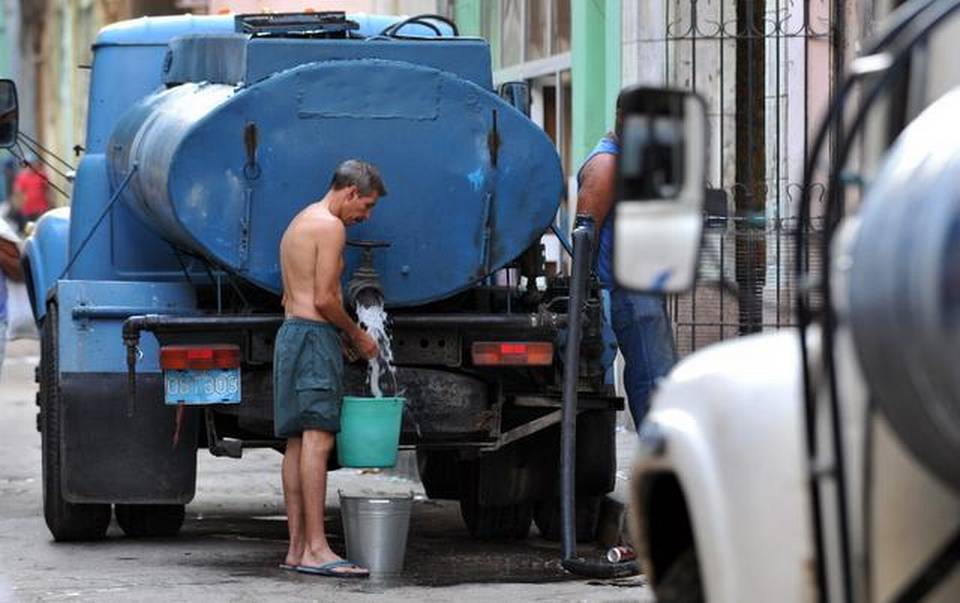
The blackouts occur very frequently “at the time of the water,” in those 4 or 5 hours on alternate days that the liquid arrives at our houses

“If water and electricity have the same owner, why do they turn off my power when I need it most?”

cubanet square logoCubanet.org, Gladys Linares, Havana, 28 April 2015 – The word “blackout” was eliminated by the Electric Company.  Nevertheless, blackouts continue, managed, disguised, masked with terms like free channel, breakdown, maintenance, pole change, broken cables, etc., causing a thousand and one miseries among the population.

For Andres, a self-employed man who sells pizzas, spaghetti and smoothies in Lawton, the blackouts, he says, have turned into a nightmare.  He says that  recently he cannot sell a smoothie because the fruit pulp was spoiled in a blackout, and as his oven is electric, when the lights go out he cannot make pizzas, either. continue reading

Several times a week the same hell confronts those who are obligated to cook with electricity; without it there is no food.  There are those who solve the problem with a cylinder of gas (almost always bought on the black market because few have the 500 pesos necessary for getting a contract for the unrationed gas canisters).

The Island stopped in time

The first electric plant was established in Cuba in 1889 (in Cardenas), only seven years after New York’s first electric plant was inaugurated.  For the republic’s half century, few complained about blackouts.  But after 1959, the Cuban electric system did not escape the disaster, and as in so many spheres of our calamitous economy, it was at the point of collapse.

In the Tribune of Havana newspaper of August 15, 2010, the program’s chief engineer, Pedro Felipe de las Casas, declared that he had carried out 75 percent of the necessary improvements in order to offer a high quality service to the capital’s clients, and among those works he mentioned were: rush changes, increased transformer capacity, improvements in street lighting – though not in the outlying neighborhoods – and to conclude he said, “So far 3,109 low voltage areas have been eliminated which stands out as one of the results most noticed by the people.”

Tendido-eléctrico-y-árboles-sin-podar-en-la-Calzada-de-Porvenir-Lawton
Power lines and untrimmed trees in Calzada de Porvenir, Lawton

In spite of the government’s triumphant propaganda about energy efficiency, frequent fluctuations in voltage continue which damage appliances, and in the neighborhoods we spend long hours without electricity.

The pruning of trees that damage lines that hang from poles is only carried out in a marathon manner in the face of an imminent cyclone. The branches are another of the frequent cause of electric service interruption or of accidents. On Friday, April 10 in the suburb of Abel Santamaria, a 12-year old boy climbed a tree to knock down mangoes and was electrocuted by a line that passed through the branches.

The lights go out when the water arrives

The blackout happens very frequently at the “water time,” that is to say, in those 4 or 5 hours in which on alternate days the vital liquid arrives at our houses.  When this happens, you can hear the curses of the neighbors who had washing machines going (although many have to wash by hand).  Worse occurs in the case of multi-family buildings or other multi-story houses: without electricity the motors don’t start, and without motors to run the pumps, the water does not get to them.

For these reasons, more than a few are outraged, and some wonder: if in 48 hours we only have water for 5 hours, maybe 6, generally 4 hours, if it is true that they turn off the electricity to make repairs, if the water and the electricity are from the same owner: Why do they have to take my power when I need it most?  Is it that you cannot make the repair in the other 40 hours?

On one of these days that corresponded to the arrival of the water, an affected neighbor, who asked me not to mention her name, called 18888 and asked the operator how long was the blackout was going to be.  She countered her: “In Cuba there are no blackouts.”

On another occasion another neighbor called to find out, and they told him that a pole at 16th and Conception (Lawton) had caught fire.  To verify it, he went out for a spin on his bicycle in the area but did not manage to find the supposed incident.

Julia Cecilia Ramos, an old lady who receives a monthly pension of 240 pesos (less than US$10), was due her payment on March 26.  She arrived at the CADECA closest to her house, and the store was closed for lack of electricity.  She continued to the bank, and there found the same situation. The old woman told me that she decided to return to her house, “because the blackouts in Cuba, although they no longer exist, they last hours.”

Caption:  Blackouts and water shortages go hand in hand in the daily tribulations of Havana

About the author

gladys-linares.thumbnailGladys Linares.  Cienfuegos, 1942.  School teacher.  She worked as a geography teacher and a principal in different schools for 32 years.  She joined the Human Rights Movement at the end of 1990 through the Women’s Humanitarian Front organization.  She actively participated in the Cuban Council and the Varela Project.  Her chronicles reflect the daily life of the people.

Translated by MLK

Cuba Increases Control over Its Doctors / Cubanet, Roberto Jesus Quinones

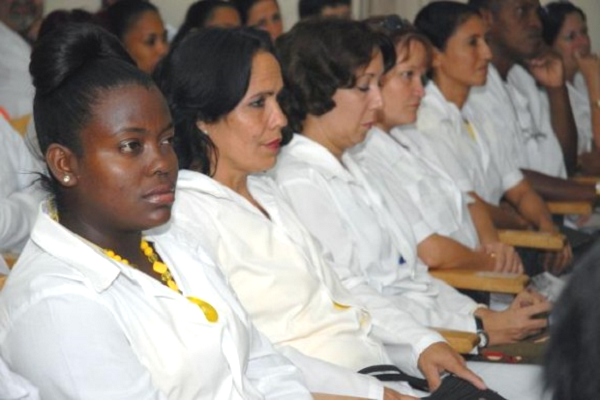
cuban doctorsThe government is trying, among other measures, to curb hiring of its professionals by foreign clinics

cubanet square logoCubanet, Roberto Jesus Quinones Haces, Guantanamo, 20 April 2015 — The exodus of Cuban health professional does not stop, and the Ministry of Public Health (MINSAP) apparently has decided to act to counter a phenomenon that is damaging domestic medical services but much more the country’s income.

A document attributed to the senior management of MINSAP, adopted in a meeting held in mid-March of this year, has been making the rounds in the e-mail of health professionals in which the sector’s new policy is expressed. This event was confirmed to CubaNet by an official from the Provincial Management of Public Health in Guantanamo, whose identity we do not reveal for obvious reasons. continue reading

The document has 18 instructions. The first three are focused on the re-organization of services and the re-location of professionals as a result of the staff review carried out last year.

The other 15 are directed to curbing the exodus of health professionals through private contracts or other avenues and steering the application of the measures in each case.

The document

One of the most controversial, instruction number 4, establishes that Cuban doctors in Angola must be relieved, but without increasing the collaboration with that country, until its authorities stop handing down measures that discourage the hiring of Cuban professional in private clinics or institutions.

Another measure, number 5, directs the withdrawal of the passport, in the airport itself, of professionals who later return from the completion of a mission.

Measures 6, 7 and 8 aim to get the private clinics of other countries to hire Cuban doctors through MINSAP, an agency that claims the right to review the professional’s individual contract, obviously so that the doctors pay the corresponding tax to the Cuban government and in no way receive all the money that is due them from the agreed upon wage.

Measure number 10 requires concluding the process of cancelling the diplomas of the 211 professionals who left service without authorization, and number 11 directs MINSAP’s vice-minister of International Relations to carry out a study of the existing rules in the International Labor Organization (ILO), the World Health Organization (WHO) and the Pan-American Health Organization (PAHO), as it relates to the migration of the sector’s professionals.

Punishing the “undisciplined”

Rule 12 considers it a serious breach for a health professional to not return to Cuba upon fulfillment of his mission abroad without good cause verified by MINSAP, and it requires final separation from the profession by those who engage in said conduct, with the subsequent withdrawal of the degree.

Meanwhile, Rule 13 orders the creation of records of disqualification for those professionals who violate the established procedures for leaving the country. If any of them repents and returns, Rule 14 directs that they cannot be re-located in their previous workplace but in an inferior status.

Another cage for the army of white coats

Rules 16 and 17 of the document are intended to promote meetings with ambassadors of the countries where Cuban health professionals travel, largely for the purpose of discouraging their being recruited to remain and practice in that country.

The heads of Cuban medical teams and ambassadors have received that same instruction. Besides interfering in the internal affairs of other countries, this shows one of the thus-far-discouraged facets of Cuban medical collaboration, which is none other than exerting pressure over the countries receiving these types of services to make them faithful to the regime’s policy, which is clearly established in instruction number 4 with respect to Angola.

Finally, number 18 establishes a monthly coordination between MINSAP and the Department of Identification, Migration and Foreign Affairs of the Interior Ministry so that it will report to MINSAP on the doctors who leave the country as well as those who have begun proceedings for that purpose, in order to take appropriate measures.

Being a health professional in Cuba, a doubtful advantage

The above measures show the doubtful advantage of being a health professional in Cuba, although the same could be said with respect to other professionals.

Determined to provide the country with qualified personnel, the government never concerned itself with steadily encouraging the efforts of the professionals themselves. That explains their massive exodus to foreign countries and other better paying jobs with the consequential social loss.

At the dawn of the 21st Century, renowned Cuban professionals have been subjected to a financial exploitation that not even the fiercest capitalist would have dared to impose. Paid miserable wages, many times they sign unfair contracts that the government offers for them to work abroad because it is the only chance they have of improving their housing or getting housing, or acquiring a car or having some savings for their retirement.

In doing so, at a sometimes irreversible familial cost, they damage their freedom and self-esteem in service to a government for which they are only a source of income that allows it to continue dominating the people.

About the Author

jesus-quinones-haces.thumbnail (2)Roberto Jesús Quiñones Haces was born in the city of Cienfuegos September 20, 1957. He is a law graduate. In 1999 he was unjustly and illegally sentenced to eight years incarceration and since then has been prohibited from practicing as a lawyer. He has published poetry collections “The Flight of the Deer” (1995, Editorial Oriente), “Written from Jail” (2001, Ediciones Vitral), “The Folds of Dawn,” (2008, Editorial Oriente), and “The Water of Life” (2008, Editorial El Mar y La Montana). He received the Vitral Grand Prize in Poetry in 2001 with his book “Written from Jail” as well as Mention and Special Recognition from the Nosside International Juried Competition in Poetry in 2006 and 2008, respectively. His poems appear in the 1994 UNEAC Anthology, in the 2006 Nosside Competition Anthology and in the selection of ten-line stanzas “This Jail of Pure Air” published by Waldo Gonzalez in 2009.

Translated by MLK

They Voted for Everything to Continue the Same / Ana Mercedes Torricella

elecciones1
My neighbor Nelly, when she learned that I did not go vote and I again clarified that I did not want to leave Cuba, told me: “You independent journalists and dissidents are going to be alone with the hard-liners and the snitches! Come on, you have to leave, there is nothing else!”

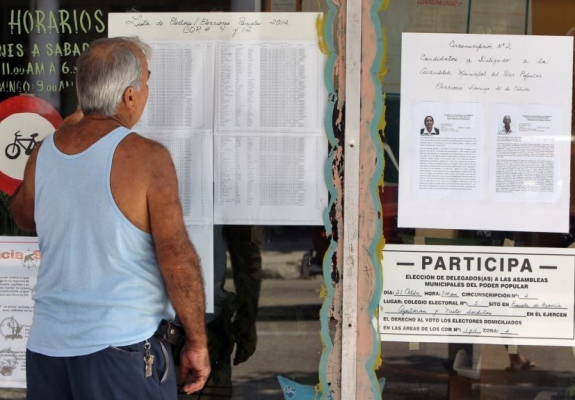
cubanet square logoCubanet.org, Ana Mercedes Torricella, Havana, 22 April 2015 – On Sunday, April 19, those who voted in the municipal delegates election of the Popular Power did it under compulsion, as is customary. They voted, like it or not, for business as usual and for “the same people.” In other words, “these people,” as many Cubans say in reference to the regime.

For the majority, the voting does not matter. Their most expensive and cherished interests are food and the money to acquire it.

I have some neighbors who live a misery of fear. The youngest, who was very beautiful, managed to marry an Italian, and she move to Genoa. Some years ago, when she came to visit Cuba, she bought gifts and brought them Euros. But that family did not use that money to buy furniture or to fix the dilapidated dwelling: they used it to buy stereo equipment. Currently, they alleviate their hunger with blaring music, which they listen to while they drink rum or some other cheap liquor. continue reading

Often they get the speakers to the front door. So the whole neighborhood feels the music. They get them out when it is one of their birthdays, for Mother’s Day, the end of the year or any other day that there is something to celebrate. And also when there is some party for the Revolution or what they call elections.

Last Sunday, from before midday, my neighbors had the speakers out and put on the music. If that can be called music. They were the first to vote. “To get out of that shit fast,” they told me. They voted for any of the candidates. It was all the same to them. Later they ended the day with reggaeton and cheap alcohol.

My neighbors speak horrors of “these people,” they say that they owe them no gratitude, but they give no sign of giving up voting and every time insist that they need them for something, the recommendation certificates that the CDR (Committees for the Defense of the Revolution) grants to “those who fulfill the work of the revolution.”

Compulsion, extortion and blackmail are the mechanisms for arranging massive membership in the CDRs, the FMC (Federation of Cuban Women), the CTC (Cuban Workers Center) and the other official organizations that the regime puts forward as “civil society.” Repression, always present, completes the picture of the necessary unanimity.

That was the scene on Sunday, April 19, in the districts open to called elections for delegates to the municipal assemblies throughout Cuba.

The candidates’ biographies had the usual typographical errors in full view with almost no one interested in reading them. Maybe with a little more discretion than on other occasions, the PC (the trusted people of the only party) indicated for whom to vote.

According to preliminary official figures, 85% of registered voters voted. Then they corrected and added a little: 87.30%. We suppose that the true percentage of abstention was higher. Now the government does not dare to speak of more the 97% participation as it used to some years ago.

A 13 to 15% abstention rate may be normal in other countries, but in Cuba it is quite significant: here the only ones who do not vote are those who are openly against the regime.

To not answer the call to vote suggests losses that not everyone is ready to assume. He who works for the master, omnipresent, omnipotent, and omniscient state may lose his job. He who is self-employed might lose his license. He who lives in the limbo of a tolerated illegality, like the lottery bet takers or the vendors of something stolen for someone, will have to confront the police.

In these terms, the best thing is to go vote early and not look for trouble. “Overall, everything is going to be the same!” is the general consensus. No one wants to look for trouble, and not going to the polls is certainly looking for big and very serious trouble.

My neighbor Nelly, when she learned that I did not go vote and I again clarified that I did not want to leave Cuba, told me: “You independent journalists and dissidents are going to be alone with the hard-liners and the snitches! Come on, you have to leave, there is nothing else!”

This is a bleak truth. Especially for young people. Like Nelly. Almost no young person has plans for the future in Cuba. All aspire to go. Anywhere. By plane or raft, with passport or without. They no longer want to share the air with “these people” who don’t let them live. Much less to bring children into this corrupt environment. So, Cuba languishes, ages, dies of stagnation.

On Sunday April 19 they voted for everything to remain the same, which means not only bad, but worse.

Translated by MLK

The Ordeal of the Independent Journalist / Cubanet, Jorge Olivera Castillo

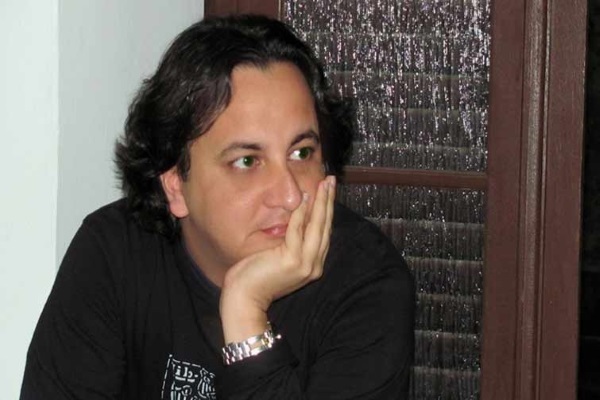
Ernesto Perez Chang, writer and journalist CubaNet (Internet photo)

cubanet square logoCubanet, Jorge Olivera Castillo, Havana – The sensation that the Cuban regime is counting on a kind of blank check to carry out its abuses is increasingly apparent.

The monthly reports of the Cuban Commission for Human Rights and National Reconciliation (CCDHRN), which expose to the world the repressive actions of the political police against pro-democracy activists, are ignored by the majority of international organizations responsible for monitoring this topic, flashing past their computer screed and being archived as soon as they read the headlines.

It is logical, before the avalanche of events that anyone with a minimum of responsibility would classify as cruel, inhumane and degrading, without the intervention of censorship which contributes to its relevance. Month after month the arbitrary and violent arrests are repeated, the acts of repudiation that often include vandalism, and the drama of the political prisoners whose incarceration exposes them to a major dose of arbitrariness. The international interest in the face of these episodes is markedly declining, fortunately always with exceptions, which to some extent helps the issue from disappearing from some agendas.

A method within the scientific repression applied by the Ministry of the Interior in its effort to prevent the growth of protest movements, are its veiled threats, blackmail, and covert actions that end with the loss of a job, or the impediment to occupy a certain place, all lined up against the friends and family members of the “counterrevolutuionary.”

In this jurisdiction of State terrorism we now find the writer Ernesto Perez Chang who decided to inscribe himself on the roll of independent journalists. It is only the beginning of his ordeal. He knows it and assures that he will not go back on his decision. Something truly meritorious in the scenario that demands the complex and inexorable combination of talent and courage.

His work leaves no room for doubts. Along with his pedigree as an excellent storyteller, he has exhibited in his still short journey in the unofficial press, his gifts for reporting and background. Without pretensions of turning myself into the bird of ill omen, nor to assume pedagogical poses, I would suggest not underestimating the capacity of the common adversary to do him harm, with its lack of scruples and determination to take the most misconceived reprisals.

I say is with knowledge of the cause. In the blink of an eye, I was arrested on 18 March 2003 and one month later I was sentenced to 18 years in prison for writing outside the established lines. It is often alleged that times have changed, but the criminal nature of the Power has not. Prison may be used as a last resort corrective, but the manual of the G-2 political police agents overflows with “persuasive” tactics.

Before concluding I reiterate my support for a colleague who had the courage to jump the barriers of fear and censorship. It doesn’t matter when he did it, what matters is that we are sharing a necessary and enriching and spiritual experience. Hopefully other government writers will decide to take off their masks and start to publish in the pages available to them to write with objectivity and transparency. That have nothing to do with obeisance to illegitimate and excluding Powers.

Made in Cuba / Cubanet, Rafael Alcides

Photo from the Internet

cubanet square logoCubanet, Rafael Alcides, Havana, 10 April 2015 – Thinking of my son Reuben (whom I have not seen in twenty-one years, five more than his age when he emigrated in 1993) I wrote in 2003 a text collected in a booklet in 2011 which was published by Mangolele, in Logrono, Spain. Here it is:

 ASTRONOMICAL

Miami is far away.

As far as a remote planet.

And in that remote planet

today lies a part of my heart.

In Miami, Lord,

in that remote planet

that was so close

in the days of Pan American.

I never traveled by Pan American. When I was in Miami in 1959 (as part of an official delegation attending the July 4 celebrations) I went on the ferry, and returned from Tampa by Aerovías Q. Nor was I a shareholder in Pan American. But the name Pan American, like all the names of my past, formed a part of my identity. continue reading

I remember them, however far away they are, they give me back my sky, my streets, my people, the odors of my neighborhood, they take me back to certain days, certain events, and then, suddenly, unable to abstain, the word “Camagüey” brings me the vision of Ignacio Agramonte, machete held high, with this thirty-five immortals on that afternoon of victory when he snatched General Julio Sanguily from the well-armed Spanish column of one hundred and twenty soldiers who had taken him prisoner.

For an instant, the past and my cultural self were then something so much of the present, so timeless, that not even Agramonte and his legendary cavalry were beings of the past, nor was his corpse burnt after death because it frightened the king’s soldiers*, nor did any one of his immortals grew old. All of them were, to me, like in their portraits, or perhaps they had just departed on the 1:00 pm train to almost surely return in the evening.

Triggering fantasies and truths that, equally, can, and in the Cuban case, make such patriotic attributes as the flag and the shield, the tocororo**, and the flower called mariposa, to Ingelmo shoes, for instance.

Today, when everything we see and touch in Cuba is Chinese or comes from Brazil, or Chile, or Spain, or the United States if it is something to eat, because from food to ideology we are ruled by foreigners, today young Cubans have to show their identity card to verify they are Cubans.

It was a disgrace that I didn’t know in my past when I so hungered, like I was talking about the other day in a dinner table conversation with my son Rafael, who is twenty-one and like the young of all times needs to complete himself knowing the world where he was born in a time before him, this region of the past where the young were not, and that later they books tell them about with the gaps that books usually have, especially when interested hands wrote them. I lived in a Cuba where the mark “Made in Cuba,” present even on my toothbrush, reminded me of my nationality and reinforced it. Other than the vehicle fleet and electronics, almost everything else in those times was “Made in Cuba.”

And as one lives proud of the pride of their country, I was proud to know that many Cuban products were equal in quality with the best brands in the world, and even superior to them. All this in a republic fifty-six years old in 1958, and in a Havana that, outside the center, was less than seventy years old, and then with painted houses and reputed to be among the most beautiful cities of the world. They were killing in those times, the dead appeared every day, but not even Havana stopped growing (its three tunnels and most important buildings and hotels and hospitals were built between 1952 and 1958), nor can we forget the new production every day of tires, footwear, textiles, preserved foods. (We had seventeen brands of soft drinks.) Because, curious dichotomy, the killing went on on one side and the industry on another saying without lying, “To eat what the country produces is to make a homeland.”

Many of these productions, it is true, were made with imported supplies coming partly or entirely from the United States, cut off after 1959 by the economic embargo law imposed on the socialist government, but it is a calamity that cannot explain the total absence of 99% of the manufactured goods circulating on the island of the patriotic mark “Made in Cuba” that, in those remote days of Pan American, was a source of such pride to us, who also felt ourselves to be a proud product “Made in Cuba.”

Translator’s notes:
*A fragment lifted from this poem.
** Cuba’s national bird

“The Regime Wants the US to Buy Cuba with the Dictatorship Included” / Cubanet, José Luis León Pérez

Guillermo Fariñas, coordinator of the "Juan Soto García Guilfredo"  United Anti-totalitarian Forum (FANTU), winner of the 2010 European Parliament "Andrei Sakharov" Prize
Guillermo Fariñas, coordinator of the “Juan Soto García Guilfredo” United Anti-totalitarian Forum (FANTU), winner of the 2010 European Parliament “Andrei Sakharov” Prize

“If the Cuban government aspires to be included among the democracies it must accept and respect the opposition.” Interview with Guillermo Farinas.

cubanet square logoCubanet.org, Jose Luis Leon Perez, Santa Clara, 7 April 2015 — Before leaving for Panama for the Civil Society Forum, Guillermo Farinas, Coordinator of the United Anti-totalitarian Forum (FANTU), who holds a critical view of the negotiations between Cuba and the United States, agreed to an interview with Cubanet.

What is your opinion about the Seventh Summit of the Americas, about the presidents of Cuba and the United States sitting for the first time at the same table?

Dialog is better than war. Personally, I think that Barack Obama erred by not taking into account Cuban civil society, the internal, non-violent opposition, when he took that step. But we must not concentrate on criticizing Obama, but the Raul Castro regime, his character and that of the top leaders, our true adversaries. continue reading

When Raul Castro returns from the Summit, will there be more tolerance toward the opponents?

The Cuban government wants the United States to buy Cuba with the dictatorship included. So far, the US administration says that it will invest in Cuba without dictatorship. I believe that depends on what happens in Venezuela. Fidel Castro and his brother have shown themselves to be opportunists. They are searching for another lifesaver, and they see it in the United States. But President Castro needs to understand that in order to be able to advance in this world he must comply with the Universal Declaration of Human Rights.

What do you hope for from the Summit for Cuba and Latin America?

That they engage in dialog and understand the different political trends and be able to come to agreements and forget historical strife, to strengthen Latin America as a zone of peace. With respect to Cuba, not just the government is represented at this Summit. There the world will be able to appreciate the presence of the opposition by Cuban civil society. It will be shown that in Cuba there is not that unanimity that the Cuban government has peddled for 56 years.

In your recent letter to Raul Castro, you sought to include in the new Electoral Law the Transparent Ballot Box project. What is your objective?

The Cuban government aspires to insert itself into the world but without fulfilling democracy, and with democracy there is no exceptionality: either there is democracy or there is not. That’s why we must fight. It is necessary, in order to avoid spilling blood, to take into account the different opinions. I raised it in my letter to Raul, as president of all Cubans, and not just the Cubans who follow his political ideals.

If the Cuban government aspires to join democracies, it must accept and respect the opposition that exists in any democratic country.

How did the Transparent Ballot Box project come about?

We agreed on it at a meeting of the United Anti-totalitarian Forum. Now we are raising awareness about other political projects in order to form part of the Steering Committee.

“Transparent Ballot Box” proposes that all political trends that exist in Cuba be represented and permitted to participate in the next general elections that are going to take place in the year 2018. Also that all public offices, including the President of the State Council and Ministers, be by direct vote. And that all citizens born in Cuba, although they may reside abroad, have the right to vote and to participate in the elections

We also think that all candidates for eligible public offices must have the material resources to be able to bring the messages of their respective plans in equality of conditions. And it is important there be international observers to supervise the election processes. These points that we ask to be included in the new Electoral Law are based on Article 88, subsection G of the Constitution of the Republic of Cuba.

Do the members of the Steering Committee represent all the opposition political trends?

This committee is not finished. On return from the Summit we will continue this labor. I can tell you about this committee that there are people from all over the country. We have not been able to speak with some but we are sure that they are going to accept this plan.

Members of the United Anti-totalitarian Forum

Do you plan to involve all citizens?

The most important thing is not that the opposition signs; we must add all the citizens who are discontented, hopeless, angered by the deceptions that they have suffered through for more than 56 years of Revolution, so that in a civilized way they ask the government to change. When ten thousand citizens or more present an initiative, their opinions have to be taken into account.

Do you think the government will permit you to gather the necessary signatures?

I think they are going to try to discredit Transparent Ballot Box, they will try to add false signatures, they will use blackmail in order to prevent people joining the project, they will try to create unfavorable states of mind, they will cultivate discouragement.

Against all that there are countermeasures. We must do something so that they regard us as people, as the non-violent opposition, as civil society independent of the government. We have to seek power in the number of signatures, which is the most important thing. When that happens, the governments of Cuba as well as the rest of the world cannot be indifferent.

According to 14ymedio, opponents like Hildebrand Chaviano, of Plaza of the Revolution and Yuniel Lopez O’Farrill of Orange Creek, could become pioneers of a nascent opposition within the government. What is your assessment?

Hildebrando Chaviano and Yuniel Lopez OFarrill

In 1996, in the Santiago de Las Vegas township, the residents voted for an opponent who put himself forward, and the government committed him to a psychiatric hospital for three months. That they now permit several opponents to be nominated is a step forward. But it is too little, too late. They are doing it now because they want a democracy to appear where there is none, because there exists no law of association and parties, and without that, there will be no democracy.

Do you want to add anything for the readers of Cubanet?

I am sure that during the Summit, some members of independent civil society and the opposition will be the subject of attacks on the part of the intolerant followers of the government of Raul and Fidel Castro. We are prepared to refute the provocations with non-violent methods. In Panama it will be seen who the terrorists are, who imposes violence.

About the author

468.thumbnail

José Luis León Pérez

He graduated as a doctor and Comprehensive General Professor in the “Felix Varela” Higher Education Institute of Villa Clara in 2007. He worked in several ESBUs (Basic Urban Secondary Schools) in Santa Clara. He served as a Methodological Consultant and teacher in the “Lazaro Cardenas del Rio” Computer Science Polytechnic Institute located in the same city. He holds a Masters of Science in Education. He serves as a citizen-journalist and independent blogger. He is also a proofreader for the weekly El Cartero Nacan and Nacan magazine, both alternative independent publications. He was born in Santa Clara, Villa Clara, where he currently resides.

Translated by MLK