The Language of the Enemy / Cubanet, Camilo Ernesto Olivera

One of the urinals is "clouse" (photo: Camilo E. Olivera)
One of the urinals is “clouse” (photo: Camilo E. Olivera)

Decades of stigmatization of the English language weigh on Cubans’ collective unconscious

cubanet square logoCubanet.org, Camilo Ernesto Olivera Peidro, Havana, 27 November 2015 – It was Saturday night at a restaurant located on the downtown corner of O Street and Avenue 23. The bathroom was closed but, at least not completely. A sign, placed on the door to one of the available toilets, announced that it was out of order. As the Hotel Saint John is very close by and the restaurant is in a tourist area, whoever placed the sign tried to write it in Spanish and English.

But where it meant to announce closed was written “clouse.”

Imperialism talked and sang in English

After 1972, the Russian language requirement became widespread at various levels of education.

For years, repression of Anglo music, especially rock, marked more than a generation of Cubans. According to the regime, imperialism spoke and sang in English. As a result, classics of Anglo Saxon rock and pop from the sixties and seventies were known in Cuba through Spanish versions by groups from Madrid and Barcelona. Or there emerged on the island musical duos like Maggies Carles and Luis Nodal, “translating” into Spanish songs that were originally from Britain or the United States. continue reading

Ten years later, in some urban schools and high schools, English classes were offered using the Spectrum manual. This coincided with the period that followed the first Cuban law of foreign investment in 1982. The 1990’s marked a radical change after the end of the Soviet Union. In the midst of the crisis, language schools were filled with Anglo Saxon language learners.

The Americans come. The Cubans go.

This time the US invasion seems to be serious. They are not the “assassin marines” that, like the famous “Coco” of the horror stories for children, the regime showed in its political cadre training schools. The blondes do not disembark with M-16 rifles; they arrive with sunglasses, cameras, dollars and an almost insatiable curiosity.

In the capital’s private inns and restaurants knowledge of the language pays well in order to cater to those potential visitors. Few reckon that, when the current US president leaves the White House – Obama has been the main promoter of rapprochement between the two countries – things could take another turn between the two shores. A Republican leader, winner of the November 2016 elections in the US, would have the option of reversing the current process of detente.

Nevertheless, the perspective plans for “Yuma tourism” grow in the minds of the small business owners. The closest thing to the fable of the shepherdess and her jug of milk.

Meanwhile, other Cubans offer to sell their homes, cars, bodies, whatever will bring them money. The first step is to fly to Ecuador, then begin the odyssey en route to the United States which, recently, has taken on dramatic overtones on Costa Rica’s border with Nicaragua.

Talk to me in English

English language proficiency is essential for entering the US labor market on good footing. Weighing over thousands of potential Cuban emigrants from several generations is ignorance of that language that opens doors and opportunities. Others reject it being in Cuba.

Arriving in the north, they need to double their effort in order to adapt to another way of life which includes the need to communicate in the language of the host country.

Misnamed a thousand times in Cuba as “the language of the enemy,” it is the most important commercial language in the world. The greater part of music, movies and popular culture in general that is produced and consumed at a worldwide level is of Anglo Saxon origin. Cognizance and observance of federal laws of the United States and of each state also require knowledge of English.

The United States has not only been the refuge for those who flee the Cuban regime but also a challenge to creativity and self-improvement for those who arrive from the Island. And the English language forms a logical part of that necessary challenge.

camilo-ernesto-olivera.thumbnailClick name for author bio: Camilo Ernesto Olivera Peidro


Translated by Mary Lou Keel

Vladimiro Roca: “Many just saw me as the son of Blas Roca” / Cubanet, Martha Beatriz Roque Cabello

vladimir roca
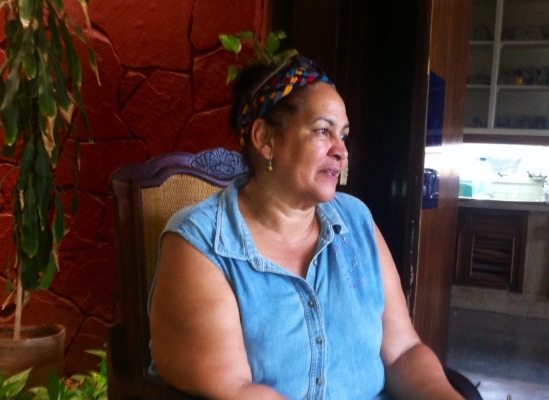
Vladimiro Roca, in an interview with CubaNet (photo by the author)

cubanet square logoCubanet, Martha Beatriz Roque Cabello, Havana, 16 November 2015 – Vladimiro Roca Antunez is one of “the old guard” group of dissidents who is still in Cuba. He holds a degree in International Economic Relations, and was a MIG fighter pilot in the Revolutionary Armed Forces. He served 5 years, from 1997 to 2002, in Ariza prison in Cienfuegos, as one of a group of four dissidents who wrote “The Nation Belongs to Everyone.”

Vladimir will be 72 on December 21. His family, friends and neighbors call him Pepe.

Martha Beatriz Roque: What were your years as a MIG fighter pilot like? Where did you learn to fly these planes?

Vladimir Roca: I have always considered the years I spent as a pilot, both as a fighter and in transport, as the best of my life, because the profession of pilot is entirely vocational. Anyone who doesn’t feel a passion for flying can never be a good pilot, and not just a good one, not even an ordinary one.

Speaking of my years as a pilot is something that fills me with emotion. The day that I flew solo for the first time, it was the greatest feeling of freedom I have felt in all the days of my life. It’s very hard to describe. continue reading

I studied in the former Soviet Union. I was in the first group of young rebels who studied aviation in that country. We went for a quick course that was supposed to last a year, but then there was a change of plans and they divided up the group of pilots into those who would end up flying the MIG-15, those who passed to flying the MIG-19, and a group that was going to fly the Il-28 tactical bombers. I was in the last group, as a bomber navigator in those planes.

During the Missile Crisis, the bombers were retired. When I returned to Cuba, I went to a base in the Holguin area, which was under the command of then First Lieutenant Rafael del Pino. He put me to flying the MIG-15s.

Martha Beatriz Roque: People associated with politics locate you on the left. From the ideological point of view, what is your position?

Vladimir Roca: It is a definition that comes from our founding of the Democratic Socialist Current, with many people who defined themselves as leftists. As for me, from the practical point of view I define myself more as center left, with a tendency to the center, because according to physics the equilibrium is in the center, and this is precisely what I seek. The extremes are, in my opinion, pernicious.

Laughing at the Castros, a Mortal Sin / Cubanet, Victor Manuel Dominguez

Eleuterio
Eleuterio, character in the play “Crematorium” (archive photo)

For the Cuban government, when satire is against the “enemy,” it is useful and refreshing. Otherwise it is subversive

cubanet square logoCubanet.org, Victor Manuel Dominguez, Havana, 15 October 2015 – In a country where joking, sarcasm, satire, mockery, in sum, any kind of humor, are more daily than our stunted, acidic, furry and greenish daily bread, the authorities become tense and wage war on any joke large or small that unleashes laughter.

Apparently, political and economic control, leftovers for citizens and other deeds by a Revolution in power, prevent them from chuckling, laughing or even cracking a smile that allows them to resemble a human being and not the miserable lout who fears a raspberry more than the Devil on the cross. continue reading

According to the article, A Very Serious Joke, published in the State newspaper Granma by Sergio Alejandro Gomez, the Office of Cuban Broadcasting (OCB) from the United States, is prepared to finance an act of subversion in Cuba, in the form of a satirical program.

Mocked Mockers

For the information and serenity of the “de-humarized” spokesman, if “humor is the gentler of despair,” as Oscar Wilde said, we Cubans are the friendly gentlemen of the joke, the courteous knights of mockery, and the attentive guests of parody, in a country where one laughs in order not to cry.

And if not even Jorge Manach himself, with his Investigation of Mockery, could prevent us Cubans from laughing at ourselves, still less will a bitter dictator be able to do it, a lap dog with an anemic smile or anyone who publicly censors humor because of fear and locks himself away in order to laugh.

Besides, there is no one like the Cuban authorities for inciting mockery as long they are not mocked. From the beginning of the Revolution, the magazine Mella and the Juventud Rebelde supplement, El Sable, began to satirize the American people, their government and their way of life.

Marcos Behmaras, in his Salacious Stories from Reader’s Indigestion and Other Tales mocked them with “a fresh and suggestive humor, a tone in keeping with our character, but always provoking reflection by means of accurate, witty satire through a sense of humor that always attacks deeply, not remaining on the surface,” according to “joke-ologist” Aleida Lilraldi Rodriguez.

Which is to say that when satire is directed at the other, the enemy, it is useful and refreshing. Otherwise, it is subversive. If Marcos Behmaras had trained his satirical guns at olive-green prudishness and excessive modesty, the salacious stories would have fallen on him like a flood of party membership cards.

His brilliant satirical articles Is It Worth It Having Money?, Those Happy Ones Dead from Hunger, by “Miss Mona P. Chugga” Eisenhower’s Trip: Failure or Triumph? by “Mary Wanna,” or Are You a Potential Psychopath? by “Doctor John Toasted” would have gotten him condemned to death for joking.

A Hanging Offense

To illustrate even further what a joke, satire or any other kind of humor costs when it is aimed at a totalitarian regime, let’s remember, incidentally, that The Joke (1961), a novel by Czech writer Milan Kindera, was described as “the Bible of the counter-revolution.” Another of his works, The Book of Laughter and Forgetfulness, got him stripped of his nationality. Tolerant, no?

But Cuban rulers do not lag far behind. Like imitators of any system or religion, they consider laughter a relaxation of good customs, a lack of seriousness and from other priestly poses that bring on death by boredom, they contribute their grain of bitterness against humor.

In the 1960’s, the comedy duo Los Tadeos was expelled from Cuban television and exiled for the simple crime of asking on a live program: “What is the crowning achievement for a president?” and answering: “Starving people to death and giving them a free burial.”

Around the same time, but in the Marti Theater, a comedian as great as Leopoldo Fernandez (Three Skates), in a scene where he had to hang several paintings of famous figures on the wall, on seeing that one was the image of Fidel, he pointed at it with his finger and said: “Look, I hung him.” It was the last straw.

That joke sufficed to have him shut out of the theater, and the humorist had to leave for exile or starve at home. And although other cases right up to today attest to the rulers’ fear of mockery or satire, none remained in the popular imagination like those.

All except for a popular and prescient joke that was attributed to Cataneo, a singer with Trio Taicuba, who on seeing the Caravan of Liberty with the bearded ones pass along Havana’s Malecon on that distant January 8th of 1959, he was said to say: “Only those who know how to swim will be saved.” And so it was.

Translated by Mary Lou Keel

Chronicle of a Free Man’s Arrest / Cubanet, Roberto Jesus Quinones Haces

Se-completó-la-operación-de-arresto

They do not show me the arrest warrant. My mother begs me to go; I hug her and leave with them for the police station.

Cubanet.org, Roberto Jesus Quinones Haces, Guantanamo, 8 Cuba 2015 – Five thirty-five in the morning on Monday, October 5, 2015. I get up, go to the bathroom, brush, put the coffee pot on the electric burner. The day seems like any other until some harsh knocks on the door tell me that I may be wrong.

I open the door. A group from the Ministry of the Interior (MININT) is in the doorway of my home. Between uniformed and plainclothes officers there are 19 people, not counting those remaining in the surrounding area where there are also special troop members, as I will later learn.

A young military officer who introduces himself as Captain Gamboa informs me that they have come to carry out a search. I ask for the warrant, and he shows it to me at a distance. I try to read it but he quickly withdraws it. Nevertheless, I manage to see that the objective is to find objects related to my “subversive activity.” That’s what they call my work as an independent journalist. continue reading

In my room they find my personal calendar and some books, a broken cell phone and one that works, a Canon camera that I have not used for lack of a USB cable and a laptop that my brother who lives in the United States sent to me. In my work room they find a desktop personal computer, property of the Catholic Church of Guantanamo, which my wife, my nephew and I call “the tractor” due to its years of use.

They also confiscate some twenty CDs, four flash drives – among them one of my mother’s, which contains several episodes of “Case Closed” and dozens of chapters of a Mexican soap opera – a music record by Compay Segundo and another of jazz, an issue of the magazine Cuban Culture Encounter and another of Coexistence, a magazine managed in Pinar del Rio by Dagoberto Valdes. Added to the list of ‘subversive objects’ are 700 dollars that I have been saving to repair my house.

At eleven thirty in the morning, they finish. Then I discover that the search warrant is not signed by any prosecutor, but it is already too late; I made the mistake of letting them enter.

The arch-bishop of the dioceses arrives, Monsignor Wilfredo Pino Estevez, and witnesses the moment when I ask Captain Eyder to show me the arrest warrant. He answers that if I want an arrest warrant, he can make it right then. I protest. My mother, a 77 year-old woman, gets nervous. The officer says that if anything happens it will be my responsibility. She begs me to leave, I hug her, and I leave with them for the police station. The street is full of onlookers.

At MININT’s Provincial Operations Unit they bring me prisoner garb and assign me number 777. I tell Captain Gamboa that I am not a number but a human being and that if they call me by that number, I will not respond. “Then we’ll get you,” he says.

In 1999 I spent 49 days in one of these cells. I see that nothing has changed except that now a young nurse takes my blood pressure and asks several questions about my health. Then they take me to the cell that has no water and is equipped with cement beds and a hole for defecating in view of the four inmates who welcome me.

They call for lunch. I do not go. I manage to sleep some. At about five in the afternoon a guard opens the door, looks at me and says: “You, come.” I leave. They photograph me and take my fingerprints. Captain Eyder receives me in the interrogation room. He accuses me of publishing news containing truths but also lies, that I am not a journalist. Later Captain Gamboa and Colonel Javier will tell me the same thing. I answer that between 1986 and 1990 I published film criticism and cultural articles in the Venceremos newspaper, an official publication of the Communist Party in Guantanamo, and no one said then that I was not a journalist, that Cuban cultural history demonstrates that hundreds of writers practiced journalism.

They threaten me with another jail and show me Complaint 50 from 2015 in which I am accused of Dissemination of False News against International Peace because, according to them, my articles seek to disrupt relations between Cuba and the United States. I did not know I was so important.

At one point in the interrogation they assure me that they are not going to return some of my items of property, that it depends on my behavior and that thanks to the generosity of the Revolution, they are going to set me free.

At about eleven at night they give me a Warning that I do not sign because they do not give me a copy. For the same reason I did not sign the Registration Record or the other documents.

I return home. My mother is sleeping under the effect of a sedative but awakens. I feel great pain when she hugs me and cries. Some moments later she asks me: “Did you eat?” and goes to the kitchen.

My children and siblings who live in the United States, where my wife is travelling, call me. They tell me that they learned what happened on the news. They ask me not to continue. I want to tell them that the only thing that sustains me is this freedom, but I remain silent. Such confessions can sound pompous.

Then everything is silent. The day ends as if my routine had been completed.

About the Author

Journalist Roberto de Jesus Quinones

Roberto Jesus Quinones Haces was born in the city of Cienfuegos September 20, 1957. He is a law graduate. In 1999 he was unjustly and illegally sentenced to eight years’ incarceration and since then has been prohibited from practicing as a lawyer. He has published poetry collections “The Flight of the Deer” (1995, Editorial Oriente), “Written from Jail” (2001, Ediciones Vitral), “The Folds of Dawn,” (2008, Editorial Oriente), and “The Water of Life” (2008, Editorial El Mar y La Montana). He received the Vitral Grand Prize in Poetry in 2001 with his book “Written from Jail” as well as Mention and Special Recognition from the Nosside International Juried Competition in Poetry in 2006 and 2008, respectively. His poems appear in the 1994 UNEAC Anthology, in the 2006 Nosside Competition Anthology and in the selection of ten-line stanzas “This Jail of Pure Air” published by Waldo Gonzalez in 2009.

Translated by Mary Lou Keel

Raul Castro in His Worldwide Debut / Cubanet, Miriam Leiva

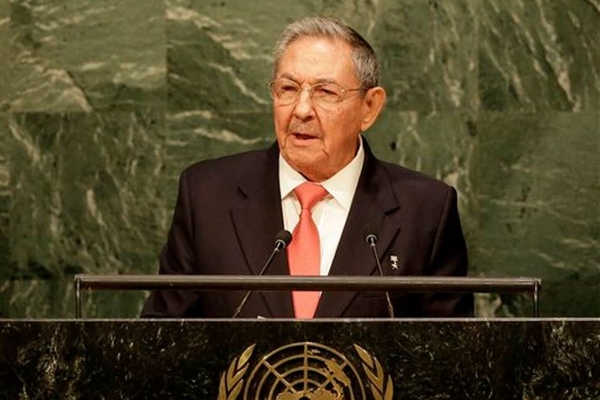
raul-castro-ONUCubanet, Miriam Leiva, Havana, 30 September 2015 – The organization United Nations organization is celebrating the 70th anniversary of its creation in a big way. The most important players in world politics and the dignitaries from the majority of its member countries met in New York. The 2030 Sustainable Development Summit, where Pope Francis gave his first speech before the UN, took place from 25-27 September, and the Conference on Gender Equality was held on the 27th. The high-level meetings of the UN’s 70th session began on the 28th.

Raúl Castro traveled for the first time to the United States as President of Cuba on 24 September. The General-President wore the halo of the reestablishment of diplomatic relations with the United States, the reopening of the respective embassies, conversations with President Obama, the constant flow of dignitaries from other countries and American visitors to Cuba, the mediation between Venezuela and the US, and participation in the meeting of Colombian President Juan Manuel Santos and the chief of the FARC-EP for the signing in Havana of their first peace accord. continue reading

The Cuban leader seemed to enjoy the influence of his constant accompaniment of Pope Francis during his Cuban tour—with a synchronicity developed during the papal facilitation of conversations with the US—and appeared to be counting on the symbolism continuing in Washington, New York and Philadelphia.

But the media stumble caused to the Supreme Pontiff over the detention of more than 150 activists from the independent civil society, among them three ladies who had been invited by the Papal Nunciature to greet him, uncovered the buried reality that in Cuba the same dictatorship from the last almost 57 years still exists; and it tarnished the arrival of Raúl Castro in the US, and his presence in the Cuban seat during the speech by the Holy Father before the United Nations on 25 September. Then he did not hear Cuba explicitly named for the negotiations with the US, nor the condemnation of the embargo/blockade, just as had not happened in the speeches by Pontiff previously during the US Congress joint session. The public greeting, and the Francis/Castro/Obama meeting that had been predicted by the media, did not occur.

Nonetheless, Raúl Castro saturated the UN as planned, to make up for his prior absence since assuming power nine years ago. He delivered speeches on 26, 27 and 28 September at the 2030 Development Summit, the Gender Equality Conference, and the high-level segment of the UN General Assembly, consecutively.

The General held meetings with: Bill Clinton; the Prime Minister of Sweden; Ban Ki-Moon; the President of Guyana; Vladimir Putin; Xi Jinping; Lukashenko (the dictator of Belarus); Francois Hollande; Democratic senators and representatives; the president of the US Chamber of Commerce and CEOs of major corporations; the Governor of the State of New York, Andrew Cuomo, and the mayor of the City of New York, Bill de Blasio; as well as other personalities. Also, diplomatic relations were established with the Marshall Islands.

During the inauguration of the 70th Session of the UN General Assembly, on 28 September, Obama reiterated that the policy maintained by the US towards Cuba for 50 years had failed in bettering the lives of the Cuban people, that the US will continue having differences with the Cuban government, and that it would defend human rights—but that it would deal with these matters through diplomatic channels as well as through increased levels of commerce and people-to-people ties (a policy initiated by President Obama in 2009).

He added that, as progress is made, he is confident that the Congress will inevitably lift “an embargo that should not be in place anymore.” He similarly reaffirmed that his policies have the same objectives, through other means: “Change won’t come overnight to Cuba, but I’m confident that openness, not coercion, will support the reforms and better the life the Cuban people deserve, just as I believe that Cuba will find its success if it pursues cooperation with other nations.”

Raúl Castro delivered a speech in Comandante style, albeit closely hewing to the brevity required in the UN (unlike Fidel Castro on 28 September 1960). He reiterated demands on the US for normalizing relations: elimination of the embargo, compensation for the embargo/blockade, return of the territory occupied by the Naval Base at Guantánamo, and the cessation of broadcasts from Radio and TV Martí.

That night he attended the reception hosted by Barack Obama for high-level dignitaries attending the UN—the first such occasion, since the reestablishment of diplomatic relations, in which he participated as Chief of State and Government at an official activity of the United States Government.

The presidents met the next morning, accompanied by their chancellors, Alejandro Castro Espín (Raúl’s son), and other functionaries. Later, [Foreign Affairs Minister] Bruno Rodríguez held press conference where he stated that the meeting had taken place in a respectful and productive atmosphere.

Regarding the detention of government opponents during the visit by Pope Francis, the minister responded that the Cuban government is proud of its record of achievement in human rights, that the exercise of all rights is guaranteed, that the laws and courts adjudicate and sanction according to the legal classification of behaviors, and that laws regarding foreign government agents in the US and European countries are much more severe.

This answer constitutes a warning that the Cuban government continues to categorize all opponents as US agents, and that it could go back to using Law #88 of 1997, on “Protection of the National Independence and Economy of Cuba,” for which they sentenced 75 peaceful individuals to terms of up to 28 years in prison. Twelve of those so condemned are still in Cuba on parole.

The world has opened up for Raúl Castro. How he will fulfill his promises remains to be seen. He cannot forget the “disposable ones”: almost all the people of Cuba.

Translated by Alicia Barraqué Ellison

Naty Revuelta, Fidel Castro’s Lover / Cubanet, Luis Gonzalez Suarez

Naty Revuelta (photo taken from the Internet)

cubanet square logoCubanet, Jorge Luis Gonzalez Suarez, Havana, 21 September 2015 – The last time I spoke with Naty Revuelta by phone, she said, “I fell and I can’t go out alone any more. I’m here at home all the time, come whenever you like.”

I never saw her again alive. Shortly afterwards came the news of her death, last February 28. A few months earlier she had been admitted to DIMEQ Hospital for a stroke, which on that occasion she survived.

I had the pleasure of meeting Naty Revuelta when I was working at the “El Ateneo” bookstore on Linea Street in Vedado. She had been invited to participate in a conversation with Rafael Alcides, who was her friend. At the end of the discussion, Naty Revuelta engaged in a dialog with me and asked me to get her a copy of “Destinatario: José Martí,” a compilation of Martí’s letters and notes prepared by Luis Garcia Pascual. She gave me her telephone number and address to deliver the parcel, which I did very quickly. continue reading

This event allowed me to open the doors of her home, thus forming a friendship that lasted until the final years of her life. During this time, I came to learn many anecdotes from her interesting and eventful life, from the times of her relationship with Fidel Castro, when she joined the July 26 Movement.

She told me on one occasion about when she was sent to France in the early 1960s, to contact the scientist Andre Voisin. She was entrusted with the mission by Fidel Castro, who wanted to bring Voisin to Cuba because he had done research on the genetic improvement of cattle.

Naty showed me photos of Voisin and his wife, with dedications to her, as undeniable proof of what she was telling me. She explained to me the details of the steps she had to take through the embassy to locate him and convince him to come to Cuba.

Once she showed me a handwritten letter from Fidel Castro, when he was in the Model Prison on the Isle of Pines. It had been written one New Years. The missive, although it started with phrases of love, then became a discourse where he expounded on his ideas about the revolutionary struggle.

The day she showed me the letter Naty, it seemed, felt the weight of frustration and abandonment. She asked me, “Do you think this is a letter from a person in love?”

Then she complained about feeling relegated, because he had not publically recognized her active participation in the clandestine fight against the Batista regime, and for having been fired from her work in the Cuban Petroleum Institute without justification. She, who had sold her jewelry to amass the money to buy arms for the attack on the Moncada barracks, on 26 July 1953.

One day the conversation dealt with her daughter, Alina Fernandez. She showed me a Spanish magazine with an interview, where among other things she affirmed that Fidel Castro was Alina’s father.

According to what Naty told me, until that time, almost by mutual agreement, neither she nor Fidel had spoken publically about the matter.

She told me about her daughter’s first wedding and the incidents she had with the bodyguards because of the beverage Fidel Castro brought. She told me about it from the terrace of the apartment that Alina occupied facing her residence. There were several more comments on the relationship between father and daughter, about the lack of communication between the two of them, finally telling me, “Because of this she didn’t even want to see him.”

Naty’s personal charisma was impressive. A product of the mid-bourgeoisie, her elevated culture was part of her interesting personality, but she expressed herself without ostentation. She was simple, treating everyone she talked with affably and cordially, without distinction of rank.

She had very beautiful blue eyes, large and expressive. Her small stature did not match her voice, which was strong, but with a refined accent.

The great room of her house seemed like an art gallery, with the number of paintings and valuable objects it contained. Prominent was a large portrait of her, painted in oil during her youth. As could be seen in the portrait, she was a woman of extraordinary beauty, which may explain the strong attraction the Maximum Leader had for this lady in her younger years.

The loss of Natalia Revuelta Clews left a great void for her many friends, like that old song of Alberto Cortez says, “the arrival of another friend cannot fill the void.”

The Abuse of My Rights and The Repression Reaffirmed My Opinions / Cubanet, Miriam Leiva

The independent journalist Miriam Leiva was detained on two occasions during the visit of Pope Francis (File Photo)

cubanet square logoCubanet, Miriam Leiva, Havana, 24 September, 2015 – I received the pleasant surprise of a brief visit to my little apartment by Msgr. Veceslav Tumir, secretary of the Apostolic Nunciature in Havana, around 11:30am on 19 September. It gave me great joy to receive the invitation to go to the Nunciature at 4:00 pm that day to greet the admired Pope Francis, who would be arriving there at approximately 5:30 pm. Up until that moment, I had planned to attend the welcome event at 31st Avenue (five blocks from my home) with the community of St. Agustín church, or the one at St. Rita church, and to attend the Mass at José Martí Plaza, as I did when Pope John Paul II (at which time I also went to the mass in Santa Clara), and Pope Benedict XVI came to Cuba.

When at 3:10 pm I was walking along the sidewalk about 20 yards from my home en route to the Nunciature, a State Security official, accompanied by a young woman from the National Revolutionary Police (PNR), told me that I was detained, took my cellular phone and my little camera, and took me in a patrol car to the PNR precinct on Zanja Street. continue reading

Shortly thereafter, a Lieutenant Colonel (who called himself Vladimir) arrived and said, “You are detained because….”

“…it is absurd that I cannot attend the welcome for the Pope,” I added, serenely.

I said that I had been invited to welcome Pope Francis at the entrance to the Nunciature. Between the departures of the two officers, obviously to report, my treatment was professionally respectful.

Soon after the Holy Father arrived at the Nunciature, they took me to the entrance of my little apartment in the same PNR patrol car. The whole proceeding took four hours total. The State Security official remained on the sidewalk facing the building where I reside (I don’t know for how long because I don’t have a window that faces the street).

On 20 September, around 7:24 am, I received a telephone call from a lady telling me, in the name of the Secretary of the Nunciature, that I should be at the entrance to Havana Cathedral at 4:00 pm, to greet the Pope upon his arrival there. At approximately 3:30 pm, I boarded a taxi-almendrón (a typical automobile made in America between 1925 and 1959), at the corner of my residence.

As I was traveling along San Lázaro Street, passing by Ameijeras Hospital, suddenly two cars brusquely intercepted the almendrón. The driver and passengers started babbling with astonishment as they spied a license on the windshield with an “SE” in red. “What’s going on?” they asked, alarmed.

I murmured, “Take it easy, this is my problem.” I exited the car. The same official from the day before yelled, “You are detained!” A plain-clothed woman rushed forward, I told her to let go of my arms, I turned to pay the taxi, and then surrendered my cell phone and camera. They sat me in a vehicle between a man and the woman, with two other officials on the front seat. They took me to the PNR station at 62nd & 7th in Miramar, and held me there until the end of the meeting with the young men at San Carlos Seminary.

At the door of the station the female official warned me: “You cannot exit your house nor participate in any activity of the Pope’s.” When I calmly argued against this measure, she replied that I did not possess any credentials, and did not have a written invitation to attend. I asked if the entire population of Cuba had them. The behavior of these four officials was also respectful. This “operation against a dangerous female subject” lasted two hours until my return to my “mansion.”

They used a lieutenant colonel and a State Security official on 19 September, and four officials on 20 September, to detain and guard a calm lady, accompanied and protected by God on the way to Him, whose lethal weapons were a straw hat, a little purse, a cellular phone and a little, almost-useless, camera. I am strengthened by the pain of being denied the honor of greeting Pope Francis and receiving his blessing. The abuse of my rights and the repression to which I was subjected reaffirmed my opinions and my perseverance over the last 23 years to work towards a democratic Cuba. More than 150 Cuban women and men throughout the country have been harassed and detained during the visit by Pope Francis.

Translated by: Alicia Barraqué Ellison

The Stigma Of Having Fought Alongside Huber Matos / Cubanet, Frank Correa

Tomasa War veteran of the Revolution, now survives on a meager pension and surrounded needs (photo by the author)

cubanet square logoCubanet, Frank Correa, Havana, 18 September 2015 – Many stories of the struggle in the Sierra Maestra against the Batista government survive into oblivion, like its protagonists.

Tomasa Guerra, 92, a native of Palma Soriano, wasa messenger, cook and sometimes guide for the “Antonio Guiteras” Column 9, under the command of Comandante Huber Matos, one of the architects of the Revolutionary triumph of January 1, 1959, ousted in October of that same year for refusing to follow the path of communism.

Although very ill and elderly, Tomasa still enjoys a good memory. Mind you walked with the column 9 since its foundation; sites like El Toro, El Cristo, La Herradura, Sao Grande and San Pablo de Yao, cooking and carrying messages. continue reading

“I was thirty, I was a die-hard revolutionary. I remember like it was yesterday the day I arrived at the camp. I strained a coffee with too much sugar, and instead of criticizing me Comandante Huber said that was how he liked it,” she recalls. “I followed the troops until the end, cooking and serving missions all over the Oriente, always accompanied by my daughter Silva who was 11, who helped me break through fences and outwit operatives pretending to be sick. We carried the fast messages, riding on trucks, on tractors, on whatever appeared. Silvia was one more combatant, because she was also exposed to the danger and the bombs.”

Smiling, she confesses, “We had email at that time. They coordinated the major actions with the messengers. In the battle of Cayo Espino I managed to bring an important message to Fidel, and after a while, hiding with my daughter at a shop in the village, I heard a plane bomb the positions where our men no longer were, thanks to my message arriving on time.”

Excited, she remembers when in the midst of El Cristo battle, she managed to pass a message from Dr. Castanellas for Huber Matos, announcing the birth of his daughter Carmen Luisa, “news that gave an important twist to his actions, because then the commander became a lion and the enemy fled in disarray.”

The contribution of Column 9 to the victory against Batista is undeniable, as are the missions performed by the messenger, cook and guide Tomasa Guerra, who after the triumph of the Revolution was never contacted in recognition of her rebel contributions, nor is her name engraved today on the list of fighters of the Cuban Revolution.

“It’s as if neither Column 9 nor commander Huber Matos ever existed. Having fought with him later became a stigma. I had to work in food service, from where I retired. I survive on 130 pesos [about $5.50 US a month], that I spend on medications. Thankfully my daughter Silvia lives with me and helps me however she can. Yes! The same one who passed herself off as sick to break through fences and outwit operatives! Now she is really sick, like me, and retired from a bodega with a pension that isn’t even enough to die on.”

“Mom has diabetes, hypertension, kidney problems and ischemic heart disease,” says Silvia. “We urgently need three types of medicines that the pharmacy doesn’t have, and a glucose meter; we looked for one a long time, and when it appeared it didn’t work.” Other essential elements also do not appear for the former fighter.

The old woman never forgets an anecdote in the camp. After dinner, on the eve of taking Palma Soriano, when Comandante Huber Matos spoke to the troops he said: “Remember always that with the Revolutionary triumph, we will all enjoy the goods necessary to live.”

“Sometimes I think that that idea was lost, because look at me, in the war I risked my life 100 times, and I have no right even for disposable pads [for her kidney problem]. Peeing oneself is the worst humiliation you can suffer. I spoke several times with Camilo [Cienfuegos], and with the captains Napoleon Becher, Raul Barandela, Miguel Ruiz, Rosendo Lugo, Roberto Cruz. They seemed to me to be men who fought for truth, but where is it? If I were reborn doubt I would expose my daughter again to the bombing. I would have looked for a foreigner, like the young people do today, and resolved my problem of a future in a different way. I’m sure that today I would have the glucose meter and the pads and the medicine, which I need so badly.”

The Blessing and Not the Miracle / Cubanet, Luis Cino Alvarez

E1F01C44-2FD2-4FFB-9168-4D52E9540238_cx0_cy10_cw0_mw1024_s_n_r1

Cubanet, Luis Cino Alvarez, Havana, 19 September 2015 – Out of respect for His Holiness, so as not to bring up an unpleasant topic, or whatever — I would prefer not to have to say that — contrary to reports by certain foreign media, I have not sensed hope nor much enthusiasm among my compatriots regarding the visit by Pope Francis. Rather, what I’ve heard are jokes, some quite irreverent, about the potatoes that are not in the markets [jokes based on the fact that in Spanish “papa” means both “pope” and “potato”], and many comments ranging from skeptical to cynical.

And do not speak to me of multitudinous masses; we had them, too, when John Paul II and Benedict XVI came. There is no talk of how we Cubans are mainly Catholics (after our own fashion, but we are). Even, and above all, practitioners of Santería, almost all of whom were baptized and who pray the Our Father and the Hail Mary, and at least three or four times per year—on the feast days of the Virgin of Charity of Cobre, St. Barbara, St. Lazarus, and the Virgin of Las Mercedes—go to church, despite the displeasure of some priests at what they consider to be “pagan superstitions.” continue reading

We do not take lightly the papal blessing, but neither do we expect miracles. Nor is there any reason to demand from the Pope who lives in Rome* what we Cubans have not been able to do ourselves: change the circumstances of our country for the better.

We have been unable to do so, among other reasons, because the dictatorship—which called itself Marxist-Leninist, materialist and atheist—for decades kept us distant from God, the one who could cure our fear and give us courage.

Beyond praying for us and blessing us, which is no small thing, what more can the Pope do (Oh, Violeta Parra!*), whose doves are being slaughtered* everywhere in this world that is ever more selfish and pragmatic

It was known that the regime would manipulate the papal visit to reflect the glory on itself. Also, that the nation’s Catholic hierarchy, in return for spaces in the very earthly neo-Castro kingdom, will continue slobbering over and pandering to the regime, without defining what, exactly, its intentions are. Although there now remain few doubts that it will be satisfied with obtaining a construction permit to build some church, organize workshops for the self-employed, continue publishing its magazine, have some of its confiscated properties returned, and be given air time on television now and then.

Neither the three papal visits, nor the wind blowing at full blast in favor of relations between the Cuban state and the Catholic Church, will make up for all the times we could not pray in our churches, the children we were unable to baptize, and the Christmases that went uncelebrated. But there is no need for drama. We will pretend as best we can to forgive past wrongs, and we will remain as Catholic (after our own fashion) as ever. Amen.

Luis Cino Alvarez: luicino2012@gmail.com

Translator’s Notes:

*Reference to Chilean folk singer Violeta Parra and her song, ¿Que dirá el Santo Padre?, which includes a refrain that can be translated as, “What will the Holy Father say / who lives in Rome / and whose dove is being slaughtered.”

Translated by: Alicia Barraqué Ellison

“El Sexto,” on a Hunger Strike and in a Punishment Cell / Cubanet, Camilo Ernesto Olivera

Maria Victoria , “El Sexto’s” mother (photo by the author)

The artist’s mother denounces her son’s treatment

Cubanet.org, Camilo Ernesto Olivera Peidro, Havana, 17 September 2015 – Danilo Maldonado, “El Sexto,” is being held in a punishment cell, and his hunger strike continues. His mother, Maria Victoria Machado, managed to visit him on Wednesday afternoon in the Valle Grande Prison, located on the outskirts of the Cuban capital.

During these days when the temperatures in Havana get very high, “the jailers give him water only twice a day,” said Maria Victoria to Cubanet. The artist’s mother says that “eight days after the beginning of the hunger strike, Danilo has spent four in the punishment cell. They hold him incommunicado wearing only underwear. He has refused to put on the prisoner clothing.”

“I have no reason to put it on because I have no reason to be a prisoner,” responded Danilo to the officer who informed him that he had to wear the uniform, according to Maria Victoria’s account.

On Tuesday afternoon, two State Security officers visited her. Their objective was to convince Maldonado, using her, to abandon his strike. Maria Victoria’s answer was that “she supports her son and stands firmly by him.”

The agents told her “that he just played into the hands of ‘the enemy’.” But Machado told them that “those whom you label that way, they are the only ones who have helped me in all this time that my son has been a prisoner.”

According to Maria Victoria, her son told her that the hunger strike is “to the end.” He said that he is prepared physically and mentally to sustain it until they give him “an immediate release, because the only other option is death.”

The performance and graffiti artist Danilo Maldonado Machado, “El Sexto,” has been a prisoner since last December 25. Police arrested him that day when he was headed to Havana’s Central Park. He was carrying two pigs with the names Fidel and Raul painted on them. His intention was to release them in that central location as part of a performance entitled “Animal Farm.”

His case file was “lost,” according to the prosecution. However, they notified his mother three days ago that the document had been “recovered.”

They accuse Danilo of the supposed crime of “contempt” against public figures of State power.

Translated by Mary Lou Keel

Gangs in Havana, Crime Gains Ground / Cubanet, Ernesto Perez Chang

A member of the gang Blood for Pain shows us the marks used to identify the group (photo by the author)

The landscape could become very similar to those found in Central American countries where the issue is out of control

cubanet square logoCubanet.org, Ernesto Perez Chang, Havana 20 August 2015 – Hector arrived in Havana at the end of 2005. He was only 15 years old when he had to confront a city where its residents’ greatest ease came from knowing how to survive amid so much uncertainty. Today he is 25 years old, and he knows no way of subsisting other than prostitution, pimping and gangs.

Hector was living in Niquero, Granma Province, when bad luck invaded his home: his father died in a domestic accident while he was trying to re-fill a gas cylinder for cooking. A couple of years later, his mother got sick with cancer, and he had to leave high school in order to go to work on the farm of his paternal uncle who, besides paying him very little, abused him sexually and even forced him to prostitute himself.

Although he was only 12, his uncle took him almost every night to the home of a friend who paid 100 pesos [four dollars] in order to rape the little boy who, with time, came to accept that the world was that evil atmosphere that surrounded him and from which he could not escape but could only adapt in order to survive.

“Here you have to survive in whatever way,” says Hector. He has only agreed to speak with me about his life because he was asked by a mutual friend who is none other than the doctor to whom he has always gone in emergency situations. “He is the only guy for whom I give my life. The only one who has helped me without any self-interest since I came to Havana at age 15.” continue reading

Hector was a boy when he entered the world of prostitution and gangs. Today he has HIV (photo by the author)

Hector has HIV (Human Immunodeficiency Virus). They found the virus a couple of years ago when he was hospitalized due to gunshot wounds he received in a confrontation with other gang members from the Mantilla neighborhood in Arroyo Naranjo.

“Back then I was not in the gang [referring to the Diamond Gang which mainly operated in the areas surrounding Brotherhood Park and Monte Street up to the Train Terminal] but my cousin was. He had about ten transvestites who worked for him, but one was connected to a pinguerito [a man who lives from male prostitution] from Mantilla who was in the Blood for Pain [gang], because they are all queers there. (…) One day Lanier [the cousin] tells me that there is a party in Mantilla, and I go with him. I did not know that we could not enter Mantilla, and that is why I went, and we just went into the house and all hell broke loose. (…) They shot at Lanier and me, I took a shot in this leg and another in the back which almost left me crippled.”

According to Maria del Carmen Cordero, a sociologist participating in a study of the subject, although they tend to disband after a short time, five to ten new gangs emerge every year in Havana, made up mainly of adolescents who live in the poorest areas of the capital. An increase is also noted in the gangs composed of youth from the eastern provinces – especially from Granma (almost 40 percent of the youth) and Guantanamo (almost 30 percent) – who cannot aspire to a legal status in the city due to migratory laws that prosecute them as criminals.

“You have to keep in mind that, although some even have initiation rites and identity marks like specific tattoos, the gangs function as a kind of syndicate where the members get protection,” says Maria del Carmen who also explains what the protection consists of: “I have gathered statements from young people who say they have bribed police to let them operate in a certain area. (…) I don’t mean to say that there is a direct relationship with the policing institution, I don’t believe that exists as such, but that there are established relationships of compromise with the officers who usually patrol the streets.

“Those who walk around Brotherhood Park or Rampa by night – well, if they dare to do it – can identify the presence of gangs who control male prostitution and of transvestites, I have even seen transactions carried out, sex deals, in front of officers, and nothing has happened, which is a sign not of tolerance but of corruption. (…) If the boy, the girl, don’t join that syndicate, work becomes very difficult, getting shelter, connections. (…) Remember that they gather them up in trucks and deport them. Just like the dogcatcher with animals. It is a crime to be from eastern Cuba and spend more than the set time in Havana. Those regulations have created other phenomena related to regionalism, racism, the establishment of social hierarchies among Cubans themselves and have increased these ‘syndicates’ which is what the gangs are.”

Although black, Adrian uses the swastika to identify himself with his group (photo by the author)

Adrian, from Ciego de Avila, is 31 and for more than five years was tied to the Blood for Pain gang where he admits he committed several violent crimes but only under the influence of alcohol and drugs:

“There is a story about Blood for Pain. It is true that sometimes we told some new member to bug [wound with a knife] someone, whoever they wanted, but we did that for screwing around, you would start drinking, smoking a cigarette, and then see some wretch going by and we made the night with him. It’s not like people say, as if we were some criminals. (…) It is true that there were those who snatched a tourist’s wallet or camera, a gold chain, but that does not mean that it was the gang. What is always abnormal they want to say is by Blood for Pain. What is true about us is the transvestites and because they like that. Having the male that controls them, and I like that, to each his own.”

When Adrian was in jail, he broke ties with Blood for Pain to join a gang called The Angels, connected with drug dealing, pimping and male prostitution and which uses the swastika as an identifying mark although they say they do not agree with Nazi ideology. One curious detail is that some of its members are black, like Adrian himself who does not hide his racist thoughts:

“I am black, that is true, but I never hang out with blacks. I don’t know, but I have never liked hanging out with blacks. (…) The tattoo does not mean anything. I liked it, and I made it. So do those I hang out with. (…) I know what the Nazis did, but me putting that on myself does not mean I am like that. (..) I am not homosexual, but I like transvestites, and that is another thing, a transvestite is a woman.”

Although regional statistics do not classify Havana among the most violent cities in Latin America and the Caribbean, in recent years an increase in criminality associated with gangs has been noted. Psychologist Manuel Fabian Orta, who leads a group that assists adolescents with behavioral disorders, recognizes that the phenomenon could be on the rise and that, as a consequence, the landscape could become very similar to that of some Central American countries where the issue is out of control:

“The violence associated with criminal gangs is increasing and at a worrying pace. If something is not done soon, it will be like in El Salvador or Guatemala. That is what poverty brings. There is too much poverty. Spiritual and material. Family, social values, they have cracked, and a new mentality has emerged, a real “New Man” who does not believe in any value except money. Everything is fair game for getting it, and Cuban society, far from becoming a society with high values, as was supposedly the plan of the Revolution, turned into a boxing ring where one can only resist, fight, win, but in the worst sense of those words.

“Selling his body is not a problem for this “New Man,” losing his nationality is not either, and let’s not speak to them about national or cultural identity or of working for the future because they would understand nothing. The typical Cuban, the common man, only knows the present, the rest, as the young people themselves say, is ‘being dizzy’ (not being clever).”

The New Man: Group of medical students playing dice (photo by the author)
Criminal organizations, mainly made up of adolescents who fight as they can to survive, proliferate in the poorest neighborhoods (photo by the author)
Police asking for identification in Central Park. If they are illegal easterners, they are immediately deported (photo by the author)

EPC448.thumbnail (1)

Read here about the author: Ernest Perez Chang 

Translated by Mary Lou Keel

The Cost of a Steak in Cuba / Cubanet, Alberto Mendez

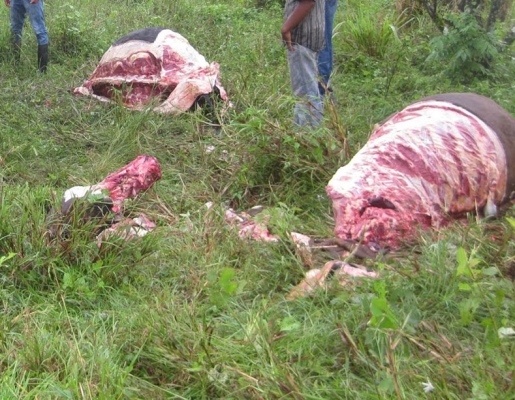
Remains of a freshly slaughtered cow (photo taken from caracoldeagua-arnoldo.blogspot.com)

Cubanet, Alberto Mendez Castello, Las Tunas, 21 August 2015 — “The crime of theft and slaughter of cattle continues at high levels in Puerto Padre,” the official press reported in July.

The prosecutor Jose Luis Pupo Rueda said in an interview broadcast on the radio that, beyond the lack of control of the cattle and poor supervision of both state and private herds, a factor that encourages the theft of cattle is the existence of “a market because of the meat situation.”

What the prosecutor called “the meat situation” is the total absence of beef in stores or its supply under the state monopoly at prohibitive prices.

One kilogram of minced beef, with 10% fat, costs 5.05 convertible pesos (over $5.00 US), or 126.25 “Cuban” pesos (CUP), i.e., almost half the 260 peso monthly pension of a retired worker. continue reading

In the informal market, meat from stolen cattle or those “lifted” from state slaughterhouses is much cheaper and of better quality. It costs 25 CUP a pound.

“And if you have old people or children in your house and have nothing to feed them, you buy meat without asking where the cow came from,” a woman confessed to this reporter. She has elderly parents and two little grandchildren in her care.

“I do not blame them [the illegal butchers] or hate them, the real culprit is the State with its laws,” said a cattle rancher who has lost thousands of pesos at the hands of cattle rustlers said. “They stole three mares from me, a breeding stallion, two bulls and I don’t even know how many cows, but this is a dance I’ve had to dance with the worst people,” he said with a farmer’s philosophy.

By Resolution Number 329, and according to the rules set forth by the Institute of Agrarian Reform on October 1, 1962, the Cuban government established full control over the trade of beef, the slaughter of cattle and the disposition of their flesh, limited only to the State.

In Cuba the slaughter of cattle and meat sales between private parties became a crime “against the national economy,” initially punishable by two to five years in prison.

As those sanctions did not stop the continuous theft of cattle, they were increased to the range of four to ten years in prison for those who slaughter the animals; while selling, transporting or in any way trading in beef can lead to sentences of between three and eight years in prison. A person buying such meat can go to prison for from three months to one year.

To give an idea of ​​how much slaughtering livestock is punished in Cuba, note that the penalty of ten years imprisonment that judges can impose in such cases is less than the courts are empowered to apply the crime of murder. “He who kills another, shall be punished by imprisonment from seven to fifteen years,” says Article 261 of the Criminal Code.

Thousands of Cubans have gone to jail needlessly in the past 53 years, since the beef trade became an exclusive monopoly of the State to “protect the national herd.” And rather than grow, the national herd declined further. In the 1950s there was one cow per person in Cuba, and we occupied third place in Latin America in per capita meat consumption, after Argentina and Uruguay. That time is distant history.

“In thirty years, from 1958-1988, the number of cattle in Cuba declined from more than 1,080,000 head, while the population nearly doubled. The ratio of livestock to population dropped from 0.92 per per person 0.46,” an agronomist told this reporter.

If in Cuba cattle once spent the night in the pastures, producing meat and milk while grazing at will with suitable temperatures, without the inclement tropical sun, now they remain within steel enclosures from dusk until dawn to protect them from rustlers.

And what’s worse, is that breeding cattle is so discouraging that more than a few of the children and grandchildren of the rangers are not following in the footsteps of their elders.

In Jack London’s story, “A Piece of Steak,” the boxer Tom King loses a fight because he can’t even get a loan to buy some meat to eat. Had he lived in Cuba he also would have lost the contest, because in Cuba a steak costs you your freedom.

Mariela Castro Violates the Constitution / Cubanet, Manuel Alberto Morejon

epa03135767 Mariela Castro Espin, Director of National Center of Sexual Education (Cenesex, as in Spanish) of Cuba and daugther of Cuban President Raul Castro, speaks druing a press conference in Santo Domingo, Dominican Republic, 07 March 2012. Castro will give the conference 'Sexual education in processes of social transformation in Cuba' on next 08 March in this city to commemorate the International Women's Day.  EPA/Orlando Barria (Newscom TagID: epaphotos320006) [Photo via Newscom]
Mariela Castro Espin, daughter of Cuban President Raul Castro, speaks during a press conference in Santo Domingo, Dominican Republic in 2012.  [Photo via Newscom]
cubanet square logoCubanet, Manuel Alberto Morejon, Havana, 12 August 2015 – Haughtiness is sense of superiority that could cause one to be distant and contemptuous towards others, and even incite hatred.

Attorney Mariela Castro Espin, director of the National Center for Sex Education (Cenesex), deputy to the National Assembly of People’s Power and the eldest daughter of General President Raul Castro, in an interview with ABC about the Cuban opposition said, “They are little groups of ignoramuses who say things and travel all over the place.” continue reading

The current dissidence in Cuba is a segment of society, no longer as unpopular as in prior decades, who peacefully oppose the dictatorship established by Fidel Castro since 1959. While they do indeed think differently this should not be a reason for them to be discriminated against, much less is it a crime, and Attorney Mariela’s expression is not in accord with the political position she occupies in the national assembly, nor with our Constitution, which speaks in Chapter IV about EQUALITY:

ARTICLE 41. All citizens have equal rights and are subject to equal duties.

ARTICLE 42. Discrimination because of race, skin color, sex, national origin, religious beliefs and any other offense against human dignity is prohibited and punishable by law.

In a country with the Rule of Law Attorney Castro Espin could be subject to sanctions for violating Article 42 of the Constitution.

manuel-alberto-morejon.thumbnailAbout the author

Manuel Alberto Morejon is an evangelical pastor and chairs the Christian Alliance Ministry in Cuba.

Redefining the Cuban Opposition After 17 December / Cubanet, Alexis Jardines Chacon

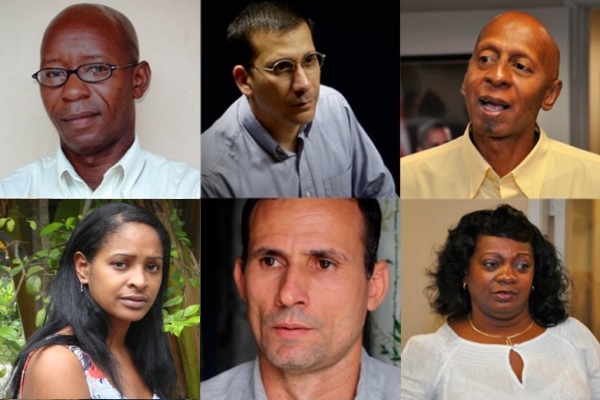
Clockwise from top left – Cuban activists: Manuel Cuesta Morua, Antonio Rodiles, Guillermo Fariñas, Berta Soler, Jose Daniel Ferrer, Laritza Diversent

cubanet square logoCubanet, Alexis Jardines Chacon, Miami, 7 August 2015 – The First National Cuban Conference will be held August 13-15 in San Juan, Puerto Rico. It is an event that Cubans United of Puerto Rico have been preparing for a year, inviting organizations from both shores. The meeting hopes to focus on the unity of diversity. What follows explores the nature of the differences and the bases on which unity might rest.

The danger of reformism

When Raul Castro took over the nation after the desmerengamiento* of his brother Fidel in 2008, the opposition, to some extent, had to reinvent itself. A series of measures – outstanding among them being the new law regarding travel and emigration – temporarily left the dissidents without an anchor, because they could now leave the country and return without consequences. But the explosive side of the new law was something else: the dissidents soon were more engaged abroad than toward the interior of Cuba. And, naturally, we didn’t have to wait for a media reaction against this kind of tourist-dissent. continue reading

The absence of a structured political opposition leaves civil society activism very vulnerable to the impact of Raul’s reforms. When opposition activity is reduced to a package of demands to the current government, any change undertaken by the regime could exceed the expectations of the dissidence itself. The dissidence, for example, was not prepared to assume to the challenges of the lifting of the travel restrictions, while the effect for the government was a revitalization of its impoverished symbolic capital.

It is a fact that ordinary Cubans are more radical in their anti-Castro convictions than a good part of the so-called opposition. And it is at least curious that from the side of the opposition they are asking for reforms in a system that bases its politics in the reforms of its model (of socialism). The paradox is solved when we realize that the logic of reformism is compatible with the dissidence, but not with the political opposition.

The other crushing blow came from the hand of President Obama. A good part of the dissidence and activists were left outside the umbrella of the American government, now interested in those who unconditionally support the process of normalization.

A major campaign is being conducted – inside and outside of Cuba – to sell the bi-tonal (black/white) scheme of what is taking place. It would seem there are no nuances; whomever does not support the Obama pact, Castro places automatically on the side of the extremism and violence associated with the construct of the extreme-right-reactionary-bloodthirsty-living-in-the-past.

This biased and misleading way of labeling does not recognize the current that defends normalization, but with conditions. Rather, it puts in the same sack a broad spectrum of those it considers hostile to both governments, from the activists of Estado de Sats to those of the Miami exile group Vigilia Mambisa.

The hardcore, instead, pass themselves off as open people with a string of virtues: inclusion, spirit of dialog, pacifism and a long et cetera. In short, they see themselves as what sells, what is in fashion and in tune with the current times. This posture, which bears fruit inside and outside of the country, shows no interest in ordinary Cubans.

Their concern is focused on the environment of relations between the Cuban and the United States governments, so they are only interested defending – moderated through the interior of Cuba and extreme pressure groups, such as Cuban Americans for Engagement (CAFE) – dialog with the Cuban regime, masked under the innocuous idea of non-confrontation. And it is clear that when there is talk of conditions, from the other side of the opposition spectrum, it is about dialog and rapprochement in general between the governments of Cuba and the United States and not about the classic and sterile demands of the Cuban government before 17 December, which do not transcend the logic of reformism and would have to abandon taking concrete steps in the physical space, for the same reason that they haven’t worked in all the years of the dictatorship.

My question, then – in accord with the premise offered by President Obama – is: if what doesn’t work is changed, why don’t the hardcore supporters of normalization take to the streets to support, at least, the marches of the Ladies in White? If the majority of the Cuban people are anti-Castro and the weak side of the opposition knows that it has been incommunicado vis-à-vis ordinary Cubans, why not go discretely house-to-house to prepare people for a referendum? These are true opposition actions that do not require funds or immolations.

What is the danger, in short, of reformism? That comes from delimiting a front in which the frontiers between the ruling party, the dissidence and the trusted opposition are increasingly erased? In this scenario, the real opposition turns out to be an obstacle.

The light at the end of the tunnel

It is obvious that rulers who adopt the totalitarian model do so with the express purpose of staying in power indefinitely. If this happens in a country like Cuba the chances of regime change, even in the long term are minimal. There is a cultural issue, in this case, which takes its toll. Personally, I am convinced that if Einstein was resurrected and was standing on a corner in Havana, inside of five minutes he would have in front of him a couple of individuals explaining the theory of relativity. These types – in the unlikely event they would allow the genius to discuss the matter – would end up reproaching him with the argument that “you don’t know shit about physics.”

Then comes the issue of the bodeguita, as a friend of mine defines it: in the face of any suggestion of collaboration, if it’s a question of survival it’s every man for himself. One can imagine how difficult it is to unite the dissidence, activists and opposition around an objective that transcends the expectations of a guild. But, even if we make an abstraction of the anthropological-cultural theme, the principal obstacle would stand: are you interested in the validation of a democratic regime, or in democratizing the current regime? Whatever your option you will achieve nothing without dismantling the one-party system. Therefore, consensus – if it were possible – should not be built on the basis of reformist objectives.

In any event, since 17 December things are becoming ever more clear and it will have to be defined on what bases a lobbying in favor of unconditional dialog with the dictatorship and a resistance interaction with ordinary Cubans enter into the extension of the concept of opposition. In the year 2011 – having recently gone into exile – I came to the defense of Estado de Sats before some accusations of Marta Beatriz Roque branding the projects as dissidence-light, and pondered the logic of the traditional opposition, rooted in ideas of heroism and the barricade. The beatings they gave us was the weighty argument that the venerable opposition wielded against us.

Since then, each in his own way, we have been radicalized. I, who thought more as a dissident, now do so from the angle of the opposition. And I don’t know about the ironies of destiny, only that the issue of Cuba is a GPS constantly being relocated: today Antonio Rodiles, leader of Estado de Sats, is the one who receives the beatings and not a few of the old guard opposition look away when the Ladies in White begin their march every Sunday.

Personally, I believe that the conditions are given. Access to public spaces, to the street, is there in front of everyone. It is not a chimera, it is not impossible. If you are an opponent marching with these untamed women you protect the space that they were able to conquer for all of us. Sacred space, because it is the only thing we really have and the only thing that puts the dictatorship in check. If you are an opponent looking to connect with the people, you go house to house – as the Jehovah Witnesses have done in much more difficult times – with the purpose of making every Cuban see the need to put an end to the one-party system through a popular referendum. If you are an opponent you work to give a voice to the people, the ordinary Cuban.

The combination of these three factors could be the unity of purpose sought by the opposition in the diversity of its ways, namely: support, through one’s physical presence, of the Sunday marches, the individual and systematic contact – face-to-face – with the people in the neighborhoods, the blocks and the homes to get them to vote NO to the hegemony of the Cuban Communist Party in the popular vote of 2016; the consequent need for the people to decide how and by whom they should be governed through a plebiscite. This line and its media support is what, in my opinion, defines the opposition camp in Cuba after the moves of 17 December. The rest is also necessary, but not necessarily opposition. Ergo, if this embassy that will soon open in Havana limits its contacts to the reformist scene, then we will know – at least with regards to the issue of Cuba – who is the boss in Washington.

379.thumbnail

Alexis Jardines Chacon

Jardines has a degree in Philosophy from Saint Petersburg State University (Russia) with specialization in History of Philosophy. He holds an MA in Philosophy from the same University and a Ph.D. from the University of Havana, an institution where he taught for more than 15 years and where he attained the highest category as a professor. In 2011 he went into exile in Puerto Rico and works as Professor Lecturer at the University of Puerto Rico, Rio Piedras campus. Distinguished Scholar in Residence. Cuban Research Institute, FIU.

*Translator’s note: Desmerengamiento was coined by Fidel Castro to embody, in a single word, the debacle of the Soviet Union. It comes from the word “meringue” and, like a failed meringue, refers to the idea of a complete collapse.

The Future Begins on August 14 / Cubanet, Rafael Alcides

One segment of the Island's population looks favorably upon the rapprochement between the two countries. (File Photo)
One segment of the Island’s population looks favorably upon the rapprochement between the two countries. (File Photo)

Cubanet, Rafael Alcides, Havana, 3 August 2015 – For some, it began on 17 December of last year, when – as surprisingly as a goal scored at the last minute deciding a world championship – the leaders Barack Obama and Raúl Castro publicly announced the reestablishment of diplomatic relations between Cuba and the United States, following 50-some-odd years of politicians on both shores hurling invective at each other. But that was still just an announcement, the prologue. The materialization of the historic event – the first part of which was accomplished on 20 July when the Cuban government inaugurated its embassy in Washington – will take place when, this coming 14 August, John Kerry will raise the US flag at the American embassy’s old-time home facing Havana’s Malecón.

It is a moment awaited with curiosity by Cubans in general – and, very particularly, by that part of the dissidence that supports the reconciliation of the two governments. What will come later? The conjectures are flying and there is not one that can be taken seriously. But one thing that is known, that is certain, everywhere, is that tomorrow has begun, and yesterday has started to become a distant memory. It’s what can be heard in the lines to buy eggs, at the neighborhood domino tables, at bus stops, in factories, in offices, at funeral wakes, and at any other place where two or more Cubans are together, talking. continue reading

The government doesn’t see it this way, and it continues to make plans with the optimism of someone who is sure of its people’s unconditional approval. It insists on governing under the rallying cry of “Socialism or Death” for all time.

Nor does a certain segment of the dissidence see it this way. This is the part that has seen Obama give everything in return for nothing; that fears that the measures to soften the economic embargo, which have already begun to be seen, will regenerate a regime which (notwithstanding what should, by natural law, have already occurred in Venezuela, but has not) would otherwise be a memory today.

The other segment, the optimistic one, already sees itself raising a glass on that great day marking the start of the future, as they come and go amongst government authorities who, in Panama, fearing contamination, refused to stay under the same roof and breathe the same air as their opponents. Because of course, those people (the ones in Panama, at least) could not but be there that day, when their foreign minister, Bruno Rodriguez, sat down with his counterpart, John Kerry.

It is not to be believed that the US Embassy will also then allow itself to be restricted by the condition that for several years now has been governing festivities sponsored by accredited diplomats in Cuba. It is an unusual constraint that prevents ambassadors from simultaneously receiving on their premises both government dignitaries and dissidents. Or to put it another way, it obliges them to have the government people enter through the front door, and the dissidents through the back.

The US would never accept such a thing. In that case, the optimistic dissidence maintains, the other embassies would find themselves dispensed from continuing to carry such an onerous burden. Thus, another significant breach between the two sides of the opposition.

Of course, “Who Knows Who” does not live far from there. But in any case – as an estimable dissident told me who practically applauded the skin off his hands on December 17 and who today avidly awaits August 14 – “that embassy” is over there, too, to provide its occupants the pleasure of looking over their celebratory glasses towards those captious attendees of the Panama summit, as if to say, “Never say never.”

“That embassy over there,” he continued, will be an important and none-too-silent witness of what is happening with human rights in Cuba. For the moment, the government will continue to arrest and abuse, but it will have to do so with much caution, given that it is being observed in situ; and given that neither the tourist, nor the investor, nor any of the characters who will play a role in the future that has just started, would much like the spectacle of police massacring the citizenry who, in exercising a universal right such as that of dissent, has gone out on the street to demonstrate. Besides, what’s coming now in the bilateral relations is “I’ll give this much if you give that much.” And Time, for Its part, continues to march over the administration of little old men who have run out of time.

All this would seem to confirm what the journalist Regina Coyula was saying in a tweet launched into the ether at 12 midnight on July 20 that, while seeming to have given all in exchange for nothing, the astute Obama had reopened the US embassy in Havana in a “subtle stratagem that one day will be dubbed a novel version of the Trojan Horse.”

About the Author

Translated by: Alicia Barraqué Ellison