The Government boasts that it has brought solar energy to 99% of its healthcare centers and 89% of its nursing homes.
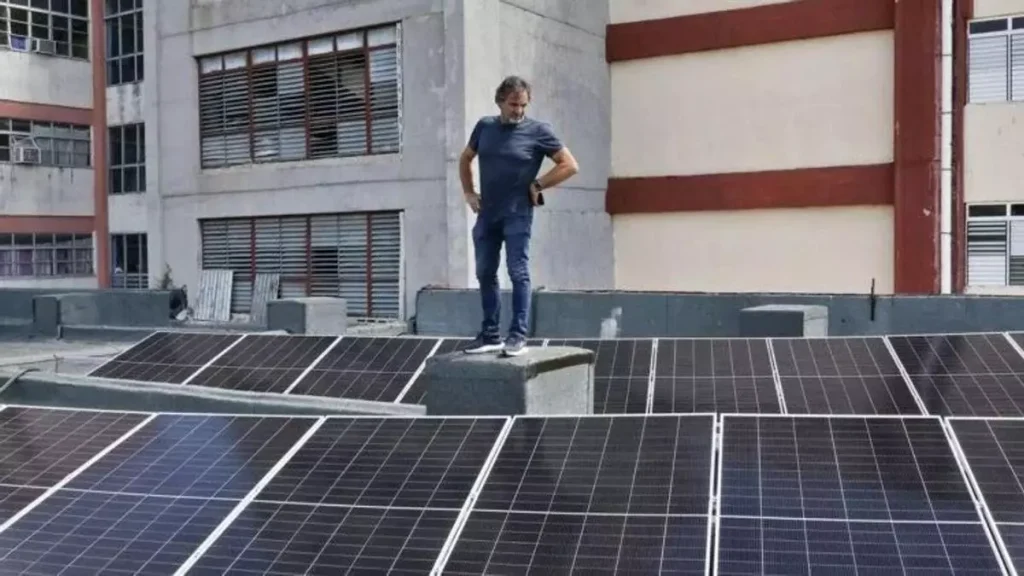
 14ymedio, October 13, 2026 – The Faustino Pérez Hospital in Matanzas is already generating electricity with 72 solar panels, but it still cannot use that power to keep its services running when the national grid fails. The equipment began to be installed in July, thanks to the Matanzas-Switzerland Group, physician Andreas Osterwalder, and mediCuba-Switzerland. In August, its director, Taymí Martínez Naranjo, acknowledged to the official newspaper Girón: “We currently do not have the capacity to store it.”
The case contrasts with the triumphal figures presented by Miguel Díaz-Canel, who stated in September that renewable energy had reached 47% of hospitals, 99% of polyclinics, 99% of maternity homes, and 89% of nursing homes and homes for the elderly.
But having solar panels does not guarantee medical care during blackouts. Complaints from patients and neighbors, and even reports in the official press itself, reveal facilities that are almost completely dark, medical tests that still cannot be performed, and systems that supply power to only some services. On top of this, some equipment is still awaiting installation.
Having solar panels does not guarantee medical care during blackouts
The lack of electricity has also prompted complaints from patients. In July, a father reported on Facebook that he had taken his son to the polyclinic in Güira de Melena in Artemisa at night and found the building almost completely dark. He compared it to “hospitals in horror movies.” According to his account, the solar panels were barely powering a few light bulbs.
The difficulties go far beyond the lack of lighting. At the Julián Grimau polyclinic in Arroyo Naranjo, Havana, blackouts were directly affecting medical care. In September, Isa Iris Arzola reported on Facebook the difficulties in sterilizing nebulizer mouthpieces and performing electrocardiograms and X-rays. Another user stated in the comments on her post that only four of the panels on the roof were connected. In Regla, also in the capital, neighbors reported in June that the polyclinic’s panels “do not work,” following a traffic accident in which the victims required medical assistance.
Faced with limitations in the electricity supply, residents of Guanabo, east of Havana, pooled their money to buy an EcoFlow power station to provide backup for the intensive care unit at the local polyclinic, although the emergency department was already using solar power. “It was the community that solved the problem,” activist María Elena Mira told CubaNet in June.
The difficulties are compounded by the risk of theft and delays in installation. In July, journalist Christian Arbolaez reported on Facebook the theft of panels from the Maternity Home in Cárdenas, Matanzas. Days later, he reported the theft of batteries from the maternity home in Santa Marta, in the same municipality, while five pregnant women and a nurse remained at the facility. There is no record of the equipment having been replaced.
Other facilities have managed to maintain essential services during blackouts, although solar backup does not extend to all their departments.
Other facilities have managed to maintain essential services during blackouts, although solar backup does not necessarily extend to all their departments. At the Manuel Fajardo Rivero Hospital in the municipality of Urbano Noris, Holguín, 28 panels and a battery system donated by the International Red Cross supply power to the emergency department, intensive care units, obstetrics, pediatrics and internal medicine wards, the delivery room, and the clinical laboratory. The installation has a capacity of 16 kilowatts, but it has not been specified whether that is enough to power the rest of the hospital.
But the solar panels have not solved the many other problems at this hospital. In July, a mother reported on Facebook a cockroach infestation, with insects crawling over the beds, walls, and floor of the ward where her daughter was hospitalized. In August, another user complained on social media about long waits in the emergency department. According to her account, close to midnight, a little girl was sleeping against a wall while her mother, who had arrived at four in the afternoon, was still waiting for care. She also recounted that a child came out convulsing after waiting more than an hour to be seen.
MediCuba-Europe’s Energy for Life campaign also financed another installation of panels and batteries at the William Soler Cardiocenter in Havana, which is already supplying power to the emergency department, although the rest of the project remains pending.
A large part of these installations also depends on foreign aid. Solar backup has also proved decisive for critical treatments. At the Juan Manuel Márquez pediatric hospital in Havana, panels and batteries donated by the Spanish organization Open Arms keep intensive care ventilators running during blackouts. According to the official press, the system made it possible to perform a 12-hour emergency operation on a little girl during a nationwide power outage.
In September, China sent another 5,000 donated systems for public facilities and homes in isolated areas
Contributions from European and U.S. organizations are complemented by China, one of the main suppliers of solar equipment to Cuba’s state sector. In September, Beijing sent another 5,000 donated systems for public facilities and homes in isolated areas, without specifying how many would be destined for healthcare institutions.
The search for alternatives to blackouts extends to other state services. The Augusto César Sandino Stadium in Villa Clara and Etecsa’s cellular base stations have incorporated solar panels, while a bakery in Artemisa replaced diesel with marabou wood to fuel its oven. In medical centers, the decisive difference is not whether equipment has been installed, but what care they can guarantee when the power goes out again.
Japan, for its part, approved $6.5 million in May to install photovoltaic systems in ten Cuban hospitals through a project implemented with the United Nations Development Program.
Japan approved $6.5 million in May to install photovoltaic systems in ten Cuban hospitals.
The limitations extend across much of Cuba’s provinces. In Las Tunas, the directors of the Francisco Caamaño Deño and Cándido González Horta polyclinics acknowledged to Granma that, although the panels make it possible to preserve vaccines, power emergency services, and resume consultations, ultrasound and colposcopy tests (examinations of the cervix) were still pending at the former facility.
The official figures also fail to reflect the differences between the systems. In Granma, authorities stated that all 28 polyclinics have photovoltaic systems, but 26 have installations with a capacity of just two kilowatts, compared with the ten-kilowatt systems at the René Vallejo polyclinic in Manzanillo and the Bartolomé Masó Márquez polyclinic. This disparity makes it impossible to assume that all of them can maintain the same services during blackouts.
At other facilities in Havana, Artemisa, Ciego de Ávila, Villa Clara, Santiago de Cuba, and Sancti Spíritus, installations have been announced or equipment delivered without confirmation that the systems are operational or clarification of their backup capacity. The gap between announcements and results appears even in official assessments: in April, Ángel Suárez Vázquez, director of the Healthcare Support Unit in Granma, reported that of the 83 systems received for healthcare institutions, 28 were still awaiting installation.
Translated by Regina Anavy
______________________
COLLABORATE WITH OUR WORK: The 14ymedio team is committed to practicing serious journalism that reflects Cuba’s reality in all its depth. Thank you for joining us on this long journey. We invite you to continue supporting us by becoming a member of 14ymedio now. Together we can continue transforming journalism in Cuba.