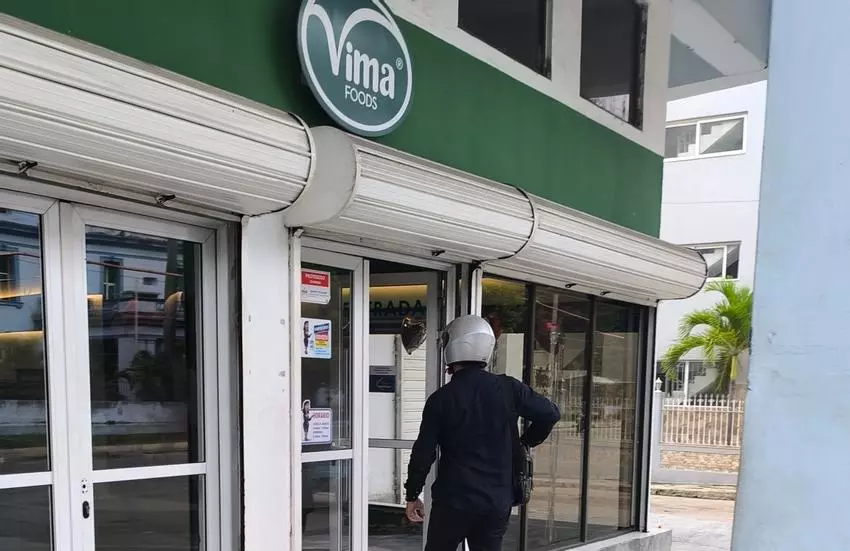
Customers who went shopping at the Vima store today were unable to make purchases and were very upset.
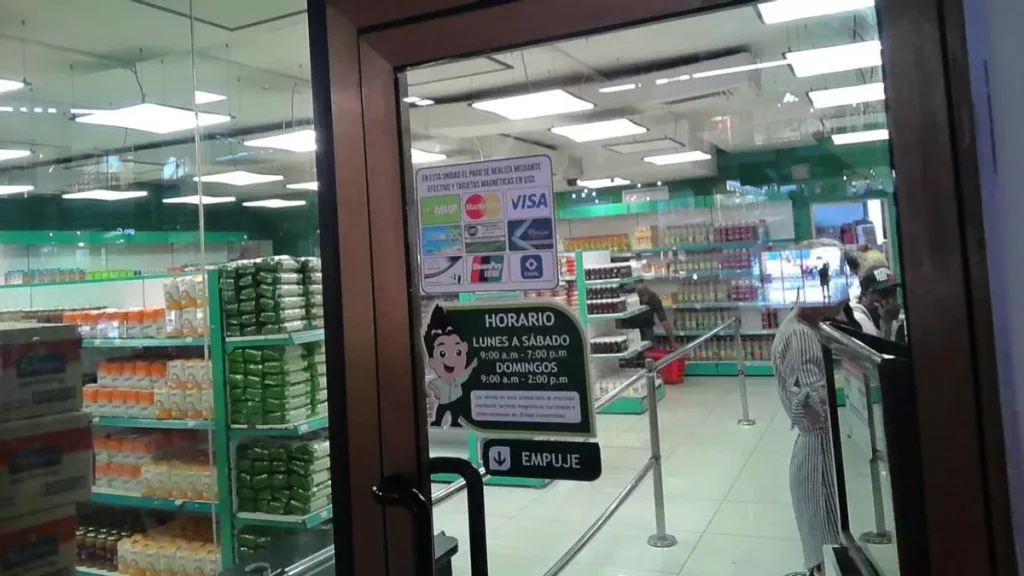
 14ymedio, Havana, Juan Diego Rodríguez, June 4, 2026 / Although the Central Bank of Cuba (BCC) announced on Wednesday that Visa and Mastercard cards could no longer be used starting June 6, stores stopped accepting them today. Fincimex announced it yesterday in a late-afternoon social media post, but the vast majority of people only found out today when they arrived at the stores.
At Vima—a partnership between the Spanish food company and Cimex—an employee said that Saturday is “when the bank withdraws,” referring to the foreign institution that authorities have never identified by name. However, Fincimex must carry out its periodic reconciliation with the foreign bank and, for that reason, “they closed operations yesterday at two in the afternoon.” In fact, he added, “when we try, the card comes up invalid; it’s not that we don’t want to accept it, it’s that we can’t.”
The explanation matches the brief statement issued by the financial arm of the military conglomerate Gaesa, which reported that, “in order to avoid possible additional economic impacts,” operations were halted at 2:00 p.m. on Tuesday. It continued: “Normally, transactions using these cards through POS terminals require 72 hours for settlement from abroad, so financial operations carried out today would complete their processing after the termination date of the agreements signed with the foreign bank and would represent financial losses for Cuba.”
“When we try, the card comes up invalid; it’s not that we don’t want to accept it, it’s that we can’t”
In this way, the statement concluded, “due to the illegitimate actions of the U.S. Government, a commercial operation that for 32 years allowed Visa and Mastercard cards to operate in Cuba according to international standards has been interrupted.”
The explanations, given without advance notice, have been of little comfort. Customers who had gone to shop at Vima today, relying on the deadline announced by the BCC, were visibly upset. “Then why do they say it starts on Saturday if you already can’t use them today?” protested one woman, pulling at her hair and wringing her hands.
At Carlos III Plaza, staff are giving the same explanation, although, unlike Vima, signs are still displayed on the doors stating that Visa and Mastercard can be used.
According to the brief BCC statement released yesterday, the reason international cards were being withdrawn from the Island was that the “foreign bank that processes transactions carried out in Cuba using Visa and Mastercard cards” ended its relationship with Fincimex on Tuesday.
That “interruption,” the statement continued, was “directly” related to the executive order issued by U.S. President Donald Trump on May 1, which opened the door to new sanctions against officials, institutions, and companies linked to the regime and which the Central Bank describes as “part of its strategy of suffocation against the people of Cuba.”
“The foreign bank announced that, beginning June 6, the date on which the Empire’s measure comes into force, it becomes unlawful and impossible to continue carrying out the agreements with the Cuban entity,” the notice stated, without mentioning whether Visa and Mastercard themselves had taken any action. It did indicate that the “100% national” prepaid cards Clásica and Tropical, as well as Russia’s Mir card and China’s UnionPay, could continue to be used, along with cash.
The BCC statement attempted to project normalcy at the end, but the list of alternatives confirmed the scale of the problem, since replacing those cards with the permitted options is far from equivalent. Visa and Mastercard are the most widely used payment instruments among European, Latin American, and Canadian travelers. Mir has limited reach and operates in the context of international sanctions against Moscow, while UnionPay has a broader global presence but is not part of the payment habits of most Western tourists visiting Cuba.
For many foreign residents, international cards provided direct access to these stores without depending on the informal currency market. A significant percentage of ordinary Cubans who shop in dollar stores also do so with cards obtained abroad by relatives.
The decision by this mysterious “foreign bank” adds to the actions of numerous companies that have been leaving the Island in recent weeks or ending contracts with the Business Administration Group (Gaesa), which has been specifically sanctioned by the United States. This Wednesday, the Spanish hotel company Meliá Hotels International confirmed its withdrawal from 15 of the 34 hotels it manages on the Island, those owned by Gaesa. Earlier, Iberostar stopped operating and marketing 12 hotels, and Blue Diamond Resorts announced the complete cessation of its operations in Cuba.
Meanwhile, Sherritt International, one of the largest foreign investors in Cuba, suspended in May its direct participation in its joint ventures on the Island and announced the repatriation of its personnel after Washington sanctioned Moa Nickel S.A., the company it shares with the state-owned Compañía General de Níquel. The multinational later paused its plan to dissolve its Cuban operations while reporting that it is negotiating with a former Trump adviser for the purchase of a majority of its shares.
Translated by Regina Anavy
______________________
COLLABORATE WITH OUR WORK: The 14ymedio team is committed to practicing serious journalism that reflects Cuba’s reality in all its depth. Thank you for joining us on this long journey. We invite you to continue supporting us by becoming a member of 14ymedio now. Together we can continue transforming journalism in Cuba.