The lowest price in TaTamania is $1,080 a month, but the law requires it to reserve 10% of the places for the “vulnerable” at a rate set by the State.
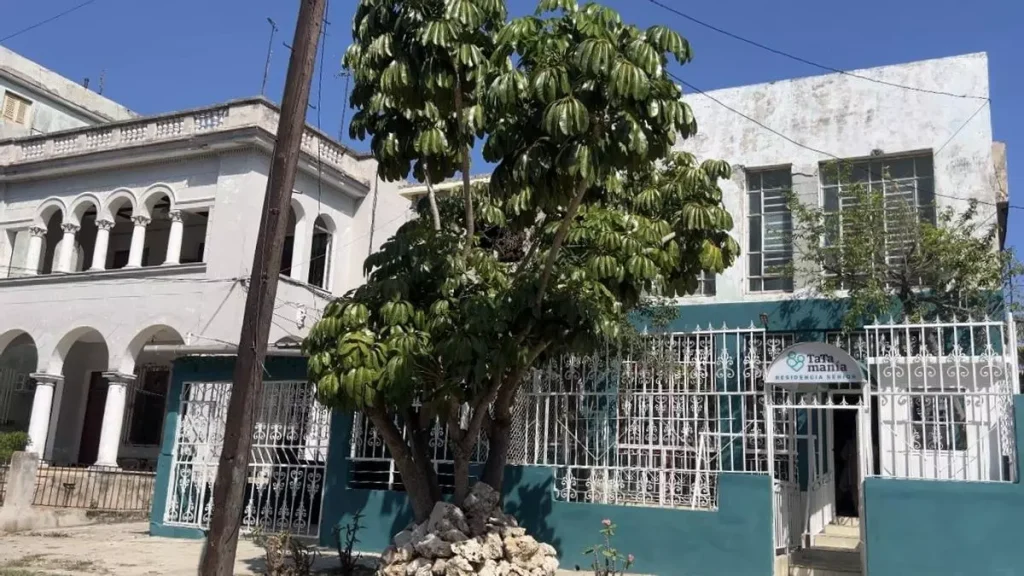
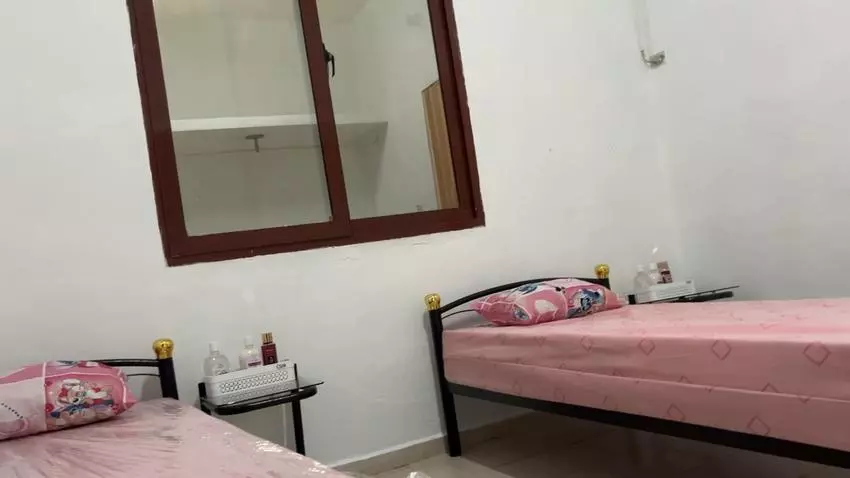
 14ymedio, Havana, Dario Hernandez, May 3, 2026 / The TaTamanía Senior Residence is a hive of activity in recent days. “I’m not going to show you the whole house, I’m going to take you to a room so you can see how we have it equipped. Each room has its own bathroom, with hot and cold water. There’s a split air conditioner and a fan, because some of the elderly residents don’t like air conditioning…,” an employee of what will be the first private nursing home in Cuba tells 14ymedio.
“We are an agency that has been operating for four years. This permanent home service is a new experience for us, because we just received authorization, but we have been working in homes and hospitals for some time. So far, everything has gone well; we have quite a few clients. We are all healthcare professionals. Those who aren’t doctors are nurses, or if not they are are physiatrists. That’s why people seek us out,” the employee adds, alluding to the company’s experience in the Dominican Republic, as they boast on their social media. In fact, TaTamanía’s contact number has a Dominican country code, and the account where they request the required fee be deposited is also in Santo Domingo.
Its founders are pediatrician Yadira Álvarez and her husband, Rolando Pérez, a computer engineer
TaTamanía arrived in that country last year, opening a branch and establishing an alliance with Saritacelestec Homes, a group of senior living facilities. However, TaTamanía was founded in Guantánamo in 2023 and was the first private micro, small, and medium-sized enterprise (MSME) to offer this service on the island. Its founders are pediatrician Yadira Álvarez and her husband, Rolando Pérez, a computer engineer. It is registered with that name and purpose in the Ministry of Economy and Planning’s list of economic actors: “to provide care services for the sick, people with disabilities, and the elderly.”
On February 26 , legislation was finally approved formally authorizing the private sector to manage long-term and day care facilities after decades of state monopoly. The law was complemented by a resolution published in April —and which comes into effect on May 21—establishing the operating and oversight rules for these services, as well as the construction, personal care, and healthcare standards they must meet.
The law specifies that 10% of the places must be reserved for people considered “of social interest due to their vulnerable status,” whose rates will be those set by the State for their own homes. If the beneficiary cannot afford the price, the Government will pay, the law states.
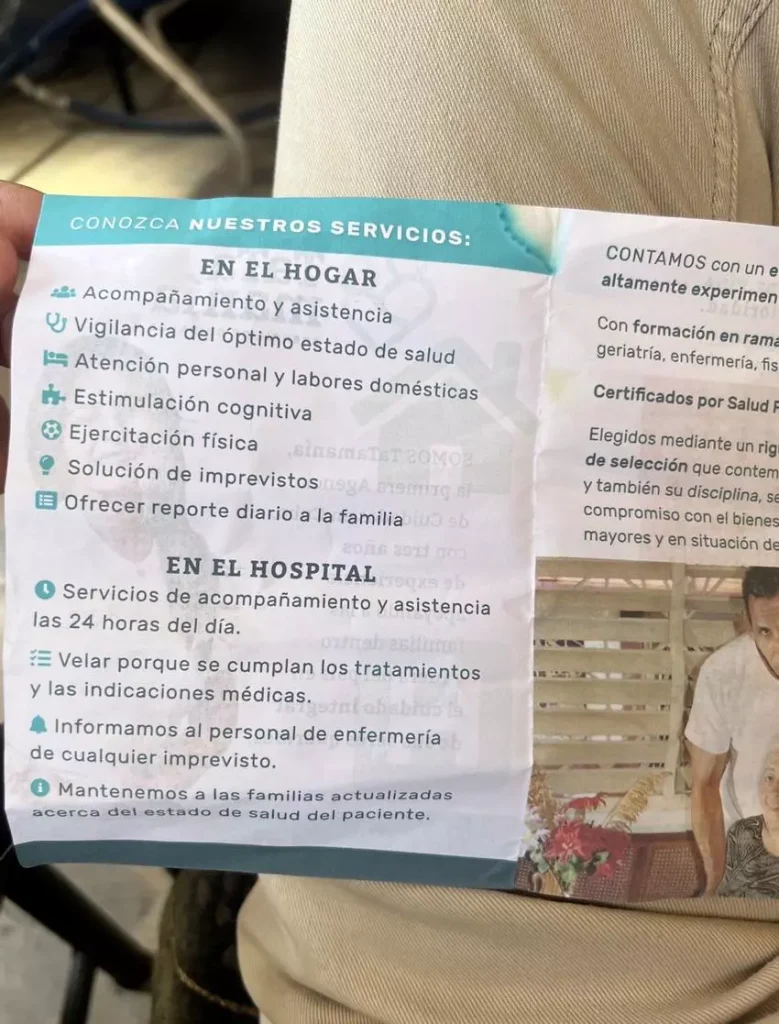
This is the Achilles’ heel of TaTamanía, whose prices are currently almost a state secret. The staff avoid answering the question of how much a private room will cost and simply hand out an advertising brochure outlining the services, which cover five main areas: accommodation, food – with adapted menus; hygiene and care – laundry, haircuts, assistance with bathing; medication and health; monitoring at the center and support outside of it; and activities – including physical and cognitive activities as well as leisure.
Finding out how much it costs is complicated, although if you search online you can eventually find the – restricted – profile that provides this information. The lowest cost is for a triple room, at $1.35 per hour, and the highest is for private rooms, at $1.75. At the Senior Residence in El Vedado, which a contributor to this newspaper visited, there are currently only double rooms available, whose price, according to this employee, is $1.50 per hour, totaling $1,080 per month if there are no additional charges.
The amount is unthinkable for any of the many elderly people living in Cuba without remittances from abroad, so the target audience can only be those with family living outside the island. Of the ten beds that TaTamanía has in its five double rooms, one would be reserved by law for a vulnerable person, who would pay the 1,260 pesos stipulated in the official rate, compared to the 535,680 pesos that — with the official floating exchange rate — the private room costs.
So far, TaTamanía has been very successful on the island. The very law that authorized the existence of private residences acknowledged in its preamble that “given the accelerated aging of the Cuban population, which demands increased care, and the need to expand the scope of social care services for older adults or people with disabilities, it is necessary to authorize the provision of such services by non-state economic actors.”
This reform has allowed TaTamanía to expand services that, until now, could only be offered at home and in hospitals. “The elderly are assessed by a geriatrician who works three times a week in different municipalities, and, depending on that assessment, she determines whether or not they qualify to start here at the center. There are three options: permanent residents, daytime residents – the hours are from 8 am to 6 pm – who come and go on the same day, and temporary residents.” The latter are for those who stay for a short period of time while their caregiver is away on a trip.
It is noteworthy that the company’s advertising highlights some of its professionals as “doctors and nurses formerly employed in the public sector.” The salary of a nurse working at TaTamanía is unknown, but various accounts published in the independent press indicate that salaries in this market can range from 20,000 to 30,000 pesos for a nurse, compared to 5,000 to 7,500 pesos in the public sector. For nursing assistants, the salary can be up to five times higher in the private sector. To obtain certification, a course is mandatory, the price of which is set by the government at 500 pesos, and which TaTamanía has been offering in recent days.
The residence in El Vedado, with its ten beds, is a start, but the needs on an island where the serious problem of aging is compounded by the massive exodus of young people overwhelms not only the state sector, but also nascent private ones with serious difficulties in growing in a context of deep economic crisis.
______________________
COLLABORATE WITH OUR WORK: The 14ymedio team is committed to practicing serious journalism that reflects Cuba’s reality in all its depth. Thank you for joining us on this long journey. We invite you to continue supporting us by becoming a member of 14ymedio now. Together we can continue transforming journalism in Cuba.