Patmos Award for Cuban Journalist José Gabriel Barrenechea

The award is also dedicated to the memory of the broadcaster’s mother, Zoila Esther Chávez, who died while he was in prison.


José Gabriel has also been active in the Patmos Institute since its founding and continues to this day. / Facebook

14ymedio biggerIndependent journalist José Gabriel Barrenechea, a contributor to 14ymedio, is the winner of the Patmos Institute’s annual award, the organization announced Friday. The award, granted unanimously “for his testimonies of genuine faith and visions of hope,” is also dedicated to the memory of the journalist’s mother, Zoila Esther Chávez, who died while he was in prison awaiting sentencing for protesting last year in Encrucijada, Villa Clara.

“The prize has once again been awarded to a Catholic (Physics) professor, currently a political prisoner since November 8, 2024, and without a sentence having been handed down to him almost a year after his arbitrary confinement,” the Patmos Institute said in a statement, recalling that the first award winner, in 2014, Amador Blanco Hernández, was also a professor, in his case of History.

With this award, the Patmos Institute states in a press release, “it closes a cycle of 12 consecutive years in which an imaginary pendulum began its swing with the award in 2014 to Amador Blanco Hernández, a professor (of History), Catholic, former political prisoner, who was active in the Patmos Institute from its founding [in 2013], until his departure from this world on April 9, 2020.”

The statement recalls that the first award winner, in 2014, Amador Blanco Hernández, was also a professor of History.

Barrenechea, the text continues, “has been active in the Patmos Institute since its founding and continues to this day, and throughout these years he has undergone a process in which, from defining himself as a cultural Catholic, he has moved toward deeper and more existential experiences of faith, especially during the difficult times of tribulation continue reading

in prison.” As an example, the organization cites the communicator’s gratitude to the Catholic Church and to the Bishop of Santa Clara, Arturo González Amador, for “his visit to me here in prison on July 7th, bringing me spiritual comfort and the word of Our Lord.”

Similarly, the statement includes the journalist’s words, sent in a personal message to the evangelical pastor Mario Félix Lleonart, also with a religious meaning: “I will carry the Cross like my Lord, the Lord of my elders, the Lord of us Hispanics. There are values ​​that give meaning to our days, and although it may be terrible for us to face defending them, it is an honor to do so.”

With this, the Institute indicates – which in previous years also awarded political prisoners, such as Sissi Abascal, Félix Navarro, Sayli Navarro, María Cristina and Angélica Garrido or Jorge and Nadir Martín Perdomo – “it is demonstrated that beyond the suffering of the prisoner there is the family, and especially if it is elderly mothers, who depend on only children who have been deprived of caring for them and even burying them.”

Zoila “departed this world, at 84 years old, in the afternoon of Sunday, May 4, without saying goodbye to her son, because the system that keeps her son imprisoned ignored her pleas.”

In the case of Zoila, Barrenechea’s mother, the organization recalls, “she passed away at 84 years old on the afternoon of Sunday, May 4, without saying goodbye to her son, because the system that keeps him imprisoned ignored her pleas.” In her final days, the text denounces, “Zoila stopped eating, consumed by the pain and sadness of not being able to see her son. Despite her delicate health, aggravated by terminal cancer, the authorities at La Pendiente prison, under the command of the repressive Yurianis Speck Rosillo (acting on orders from above), denied Barrenechea permission to say goodbye to his mother. ‘The son will see his mother when she dies,’ was the official response the family received, and so it was done.”

The statement also cites the article that Barrenechea himself sent from prison and which this newspaper published on October 14.

The award was granted unanimously “for their testimonies of genuine faith and visions of hope.” / Courtesy

Regarding his biography, Patmos highlights that the journalist has a degree in Physics from the University of Pedagogical Sciences of Villa Clara and describes him as a “very prolific intellectual,” whose texts have been published in several magazines such as Convivencia , Vitral or Hypermedia , as well as in newspapers such as 14ymedio and Diario de Cuba .

“Imprisonment is the latest phase in the system’s persecution of Barrenechea,” the statement continues, recalling the censorship he faces both in publishing in state media and in working as a professor. “In 2019, after receiving a US visa to participate in the Vista Literature Festival in Miami, he was prevented from leaving and his visa expired without him being able to use it, remaining restricted due to political interests,” they explain, adding that “prior to his current imprisonment, he had received numerous police summonses or been subjected to brief detentions.”

“In 2019, after receiving a US visa to participate in a Vista Literature Festival in Miami, he was prevented from leaving and his visa expired.”

Barrenechea was arrested a few days after participating in the cacerolazo* in Encrucijada that took place on November 7, 2024. His request to be released pending trial was rejected and he was only allowed to leave prison to attend his mother’s funeral (but not to visit her when she was already seriously ill).

The trial took place last September , and the prosecution requested a six-year prison sentence for Barrenechea, and up to nine years for one of the other two of the five defendants. According to the prosecution’s brief , the defendants—with three pots “that could not be used”—led a pot-banging protest in the town of Encrucijada, taking advantage of “the lack of electricity caused by the power crisis in the country.”

The protest, with its “incessant ringing” and “high decibel levels,” was accompanied by repeated shouts of “Turn on the electricity, we want electricity!” The prosecution argued that this “disturbed the peace” and “obstructed traffic on public roads.”

*A protest consisting of banging on pots and pans

____________

COLLABORATE WITH OUR WORK: The 14ymedio team is committed to practicing serious journalism that reflects Cuba’s reality in all its depth. Thank you for joining us on this long journey. We invite you to continue supporting us by becoming a member of 14ymedio now. Together we can continue transforming journalism in Cuba.

José Daniel Ferrer, Exiled in Miami, Is Awarded the 2025 Carlos Alberto Montaner Prize

“My commitment to freedom and democracy will always be unwavering.”

In October 2025, Ferrer left Cuba in what was defined as a forced exile, following a request from the U.S. government and formal acceptance by the opposition leader / Social Media

14ymedio bigger14ymedio, Madrid, October 29, 2025 —  Cuban opposition leader José Daniel Ferrer, currently in exile in Miami, has been awarded the 2025 Carlos Alberto Montaner Prize, granted by the InterAmerican Institute for Democracy (IID) to individuals who stand out for their defense of freedom, democracy and human rights in Latin America.

This recognition underscores the relevance of Ferrer’s political work within the Cuban dissident movement, and symbolizes international support for those who fight against authoritarianism from the diaspora.

“I am honored by the InterAmerican Institute for Democracy awarding me the 2025 Carlos Alberto Montaner Prize. My commitment to freedom and democracy was, is, and always will be unwavering. It is a priority in my life, the lives of my family, and my fellow activists,” the opposition leader wrote on social media.

This recognition underscores the relevance of Ferrer’s political work within the Cuban dissident movement.

The prize traces its origins back to 2010, when it was first awarded under the name of Francisco de Miranda. In 2023, it was renamed to honor the Cuban intellectual who presided over the IID and who passed away that year. Montaner represented a tradition of liberal, exiled criticism, opposed to the official discourse of the Cuban regime. continue reading

Previously recognized figures include Armando Valladares, Jennie Lincoln, Luis Almagro, María Corina Machado, Ileana Ros-Lehtinen and Jorge Lanata, among others.

Ferrer was a part of the group of 75 dissidents imprisoned during the Black Spring of 2003, serving a 25-year prison sentence. In 2011, he was released and chose to remain in Cuba to continue his work with the internal opposition. Over time, his leadership of the Patriotic Union of Cuba (UNPACU) made him one of the most visible symbols of citizens organized for peaceful change.

For years he has been detained, harassed, beaten, and subjected to legal proceedings on fabricated charges such as “public disorder” or “assault.” Despite this, he maintained networks both on and off the island that served to sustain criticism of the regime from various fronts.

The opposition leader was imprisoned again in 2021 when he attempted to participate in the anti-government marches of 11 July. Sentenced to four years in prison, Ferrer was released in January 2025 as part of a group of more than 500 people who left Cuban prisons on parole as a result of what the government called a “gesture” toward Pope Francis, who had declared that year a Jubilee Year. In reality, it was an agreement with the United States, brokered by the Vatican, in which Washington pledged, in exchange, to remove Cuba from its list of state sponsors of terrorism.

A week after this occurred, Donald Trump assumed the presidency and added the Havana regime back to the list on his inauguration day. In April, following the death of Pope Francis, Ferrer was returned to prison by a Supreme Court decision that found he had violated the terms of his parole.

In October 2025, Ferrer left Cuba in what was defined as a forced exile.

In October 2025, Ferrer left Cuba in what was described as a forced exile, following a request from the U.S. government and his formal acceptance. Upon landing in Miami, he was received with honors and awarded the Truman-Reagan Medal of Freedom for his service.

His exile, although painful for many within the dissident movement that insists on internal struggle, gives him a safer platform to highlight the Cuban crisis and build regional alliances with democratic institutions.

The award to Ferrer not only recognizes his past of personal sacrifice, but also reaffirms the political value of the Cuban exile community. The prize “embodies the spirit of resistance against authoritarianism, the defense of truth, and the hope for a free and democratic Cuba.”

Ferrer’s selection in 2025 picks up the thread that links his work with Montaner’s intellectual memory: two generations of dissidents who, from within or from without, insisted that the future Cuba must rest on rights, pluralism and freedom of expression.

____________

COLLABORATE WITH OUR WORK: The 14ymedio team is committed to practicing serious journalism that reflects Cuba’s reality in all its depth. Thank you for joining us on this long journey. We invite you to continue supporting us by becoming a member of 14ymedio now. Together we can continue transforming journalism in Cuba.

Marco Rubio Denies a Possible Attack in Venezuela and Questions the ‘Miami Herald’

Hours earlier, US President Donald Trump had also denied it.

The UN calls on the US to stop extrajudicial killings. / Screenshot

14ymedio biggerEFE (via 14ymedio), Miami, 31 October 2025 —  US Secretary of State Marco Rubio denied on Friday that the United States is preparing to bomb military installations in Venezuela, hours after US President Donald Trump also denied it, and criticized the Miami Herald for writing “a false story.”

“Their ‘sources,’ who claimed to have ‘knowledge of the situation,’ tricked them into writing a false story,” Rubio wrote on the social network X, alluding to the news published by the Miami Herald.

The cited media outlet reported this Friday, along with The Wall Street Journal, a possible US attack in Venezuela, citing “sources with knowledge of the situation.”

But while The Wall Street Journal clarified that “the president has not made a final decision on ordering ground bombings,” the Miami newspaper maintained that attacks from the air could occur “in a matter of days or even hours.” continue reading

The UN accused the Trump Administration of having “violated international law” with these attacks, which it considers “extrajudicial executions.”

Trump denied considering attacking Venezuela while traveling aboard Air Force One when asked about the reports published by these media outlets. “No, they’re not true,” he replied, without providing further details.

If carried out, the attacks would escalate tensions with the government of Nicolás Maduro following the military deployment in the Caribbean – which will soon include the largest US aircraft carrier – and attacks on vessels under the pretext that they are loaded with drugs and heading towards the US.

On Tuesday, Trump reiterated that he will stop drugs entering “by land” after almost two months of bombing 15 boats in the Pacific and the Caribbean, which have left 61 dead and three survivors since the 1st of September.

“We are finally waging war against the cartels. We are waging a war like you have never seen before, and we are going to win this battle. We are already winning it at sea,” the president declared in a speech to U.S. troops in Japan.

The UN accused the Trump Administration of having “violated international law” with these attacks, which it considers “extrajudicial executions.”

“These attacks, and their growing human cost, are unacceptable. The United States must put an end to them,” demanded Volker Türk, the UN High Commissioner for Human Rights.

In a few days, the USS Gerald Ford aircraft carrier, the most modern and important in the US fleet, is expected to arrive in the Caribbean, joining the rest of the naval forces that are off the coast of Venezuela.

____________

COLLABORATE WITH OUR WORK: The 14ymedio team is committed to practicing serious journalism that reflects Cuba’s reality in all its depth. Thank you for joining us on this long journey. We invite you to continue supporting us by becoming a member of 14ymedio now. Together we can continue transforming journalism in Cuba.

More Than 2,000 People Evacuated For Fear of a Dam Breaking in Cuba’s Granma Province

The number of evacuees is expected to reach 5,000 or 7,000 in the next few hours

Evacuees in Cauto Embarcadero, Granma, faced with the danger of flooding. / Facebook/Radio Bayamo

14ymedio bigger14ymedio, Havana, October 31, 2025 — Cuba’s National Civil Defense General Staff maintains an alert status for the municipalities of Río Cauto and Cauto Cristo in Granma province, unlike the rest of Granma province and Santiago de Cuba, which are already in the “recovery” phase. According to the most recent report issued this Friday, both locations “continue to experience a complex hydrological situation, and efforts to protect the population are ongoing.”

Here’s the “complexity”: more than 2,000 people residing in Guamo, Granma, and other nearby towns have been evacuated in an emergency due to the abrupt rise of the Cauto River and the possibility that the dam will overflow as a result of the rains brought by Hurricane Melissa since Wednesday in eastern Cuba.

The decision has even affected residents in Jobabo, Las Tunas, and it is expected that more people will continue to arrive throughout the day, up to 5,000 or 7,000 according to some reports. The residents of Cauto Embarcadero, Melones and Cayama will be added to those evacuated, according to the local radio station Radio Cabaniguán.

The authorities have warned the population of “extreme danger” and insist that they should not return to their homes until instructed, as some people who have tried have ended up having to be rescued. The alert will remain in effect for the next few hours because the peak water level is expected up to 72 hours after the rain stops in the river’s headwaters.

Las Tunas welcomes evacuees from Granma. / Radio Cabaniguán

This Wednesday, Miguel Díaz-Canel, dressed in olive green, visited the area. The president, who had previously been in Holguín, presented himself at the University of Granma, which has been set up as a reception center for 312 residents from various communities in the municipality of Cauto CrisEste.

José Ramón Castro Benítez, representative of the Communist Party of Cuba in the municipality of Granma, explained to the official press that 380 people, including 145 children and 159 women, were transferred to Bayamo, and another 68 are at the Simón Bolívar School of Physical Education Teachers.

“I can’t say much, because this was horrible, horrible, horrible,” a resident from Veguitas in Yara told the newspaper. “My family is fine, but there are many, many people who have lost everything, because they continue reading

did not expect it to be so powerful.” The water, he says, miraculously did not enter his house. “All of Veguitas was covered in water, for more than 12 hours.”

As phone service was restored, residents of Veguitas began sending images of the area to their loved ones. “I’m shocked to see how high the water is, how it’s flooded into the houses,” a Havana resident told 14ymedio, commenting on photos he received from a cousin. “The river was just a trickle there, and people there think they released the dam, that something broke, because the flooding was sudden.”

“All of our meat is thawing.”

In Holguín, residents lament that everything is “chaos” and going “from bad to worse.” One resident told 14ymedio that the Electric Company is not providing any information about the work being done to restore power. “There’s no electricity even in the most privileged areas,” he asserted.

The provincial government has also taken no measures to alleviate the dramatic supply situation, and with private businesses closed, “they aren’t even selling food packages or anything to the people.” He concludes: “All our meat is is thawing.”

The United Nations estimates that there are currently around 700,000 people affected—20% of the residents in the affected provinces—who will require basic support for at least three months. Various NGOs and multilateral agencies are raising funds.

Melissa’s journey through Cuba can be traced by connecting on the map the towns that suffered the most damage from the floods or remain partially submerged, with residents doubly isolated by the water and the disruption of electricity and telecommunications. These are, from south to north: Bayamo, Jiguaní, Cauto Cristo, Contramaestre, Cauto, Cacocum, Urbano Noris, and Yara.

Evacuated in Cauto Embarcadero, Granma, due to the risk of flooding. / Facebook/Radio Bayamo

The Electric Union says that some 3.5 million Cubans – the vast majority of the population of the five eastern provinces – are without electricity.

The region’s main generation units (two thermoelectric plants and one fuel-fired power plant) were not seriously damaged, but the distribution lines have suffered from broken cables and fallen poles, and their repair will take days, especially in the less accessible areas.

Damage to telecommunications is also significant, according to the Ministry of Telecommunications, which reported that 75% of mobile lines in the eastern region were left without service after Hurricane Melissa. The telecommunications monopoly Etecsa indicated that repairs have begun on some fiber optic cables severed by the floods, but that most radio base stations (telecommunications antennas) are inoperative after being damaged by the hurricane or due to power outages.

Translated by Regina Anavy

____________

COLLABORATE WITH OUR WORK: The 14ymedio team is committed to practicing serious journalism that reflects Cuba’s reality in all its depth. Thank you for joining us on this long journey. We invite you to continue supporting us by becoming a member of 14ymedio now. Together we can continue transforming journalism in Cuba.

The Zinc Sheets of Eliecer’s House Moved ‘Like a Maraca,’ but He Survived Melissa

In El Cobre, only the brick dwellings resisted; the hurricane damaged the stained glass windows of the Sanctuary of the Virgin of Charity and tore off doors and windows

The Zinc Sheets of Eliecer’s House Moved “Like a Maraca,” but He Survived Melissa.

14ymedio bigger14ymedio, Havana/ Madrid, 30 October 2025 — The Cuban Government holds its breath as populations remain incommunicado 24 hours after Hurricane Melissa passed. No fatalities have been reported so far, but Miguel Díaz-Canel, who last night accused those asking about deaths of being “vultures,” does not close the door to that possibility. “There may be some deceased and we will report it with all honesty,” he said, delivering a diatribe against those who are “thinking or looking for the people’s pain as an argument to try to demoralize, to try to disunite, to try to discredit what this country has done with its heroic people.”

The Cuban leader was at the head of a meeting of the National Defense Council, broadcast on State TV’s Mesa Redonda [Round Table] program, in which material damage was quantified. The testimonies collected in the east of the island were frightening, such as that of Eliécer, 43 years old, interviewed by the Spanish agency EFE. He had given himself up for dead several times when he saw the zinc slabs of his house in Guamá shaking “like a maraca. The house was shuddering, and I said, “Well, Lord, put out your mighty hand. You know what to do.’ If I die, at least I die alone,” he said. His company was his cat and his dog, drowned when the height of the water exceeded three feet.

His wife was among the more than 735,000 evacuees — to Santiago in this case — but he, he claims, “underestimated the hurricane. The EFE correspondent, who was able to reach the area, speaks of a devastating panorama, full of trees thrown along the road and the great darkness that hung over last night due to the lack of electricity, which complicated the reconnection of the hundreds of thousands of people who are without telephones in the affected area. continue reading

“If I die, at least I die alone,” he said. His company was his cat and his dog, drowned when the height of the water exceeded three feet.

In some cases, roofs have blown off; in others, the whole house is gone. The difficult situation of Vilma Cabrera falls into the second category of cases, whose miserable makeshift shack in the mountains, her only possession, was crushed by a banana tree in the middle of the mud that surrounded it. “My blood pressure went up early in the morning,” she says. Her home had not yet recovered from Sandy’s passage in 2012, and now this. The rest of her neighbors are in the same situation.

It is no surprise when it is known that the National Sanctuary of Our Lady of Charity of Copper, a building more robust and cared for than the precarious small houses in the area, has been “very damaged” and needs help, according to Rogelio Dean Puerta, rector and parish priest of the sanctuary. The religious leader mentioned — without details — the death of an elderly person in the area in a note made public yesterday, but has not talked anymore about victims, either to the official or the foreign press, with which he has contact, either because the death was not linked to the event or for some other reason.

The church will resume religious activity, he said hopefully, although the hurricane “damaged half of the stained glass windows of the basilica, the carpentry, tore out doors and windows… It has been a night of much pain and tension. Hurricane Melissa hit the town of El Cobre with incredible force. Elders say they have never seen anything like this before,” he said. The municipality was left, according to his words, “devastated, practically only houses with brick roofs remained undamaged.” However, rescue teams were finally able to arrive yesterday afternoon and took the neighbors to shelters.

The preliminary damage assessment was done province by province, although there are still isolated mountain and rural areas.

Generally, the hurricane left over 400 millimeters of water in six locations and over a 100 in 72 locations. The worst waves reached six meters and the winds were devastating. On its way to the Bahamas, Melissa is still raining, but conditions will improve throughout the day, said the president of the Institute of Meteorology, Celso Pazos Alberdi.

The floods have been severe in Granma, where, in the words of the first secretary of the Communist Party, Yudelkis Ortiz, “all the rivers overflowed their banks.” More than 126,000 people have been evacuated and some 50 who were trapped have had to be rescued. The worst has been in Bartolomé Masó, Guisa, Yara, Buey Arriba, Campechuela, Niquero and Bayamo, but there are up to 13 more municipalities with damages.

Beatriz Jhonson Urrutia, president of the Provincial Defense Council of Santiago de Cuba, mentioned the 17 trapped in El Cobre who were given refuge by a doctor, all of them finally safe. Palma Soriano, San Luis, Guamá and the capital city are the most affected populations, although there are serious damages to economic sectors, including coffee and yucca. Tourism was also affected, with some initial damage at the Antonio Maceo airport (now operating) and damage to the infrastructure of hotels, like the Gran Piedra.

In Holguín, which had to protect 275,572 people, more than half in family homes, and 1,900 tourists, 109 million cubic meters of water fell in eight hours of rain. A record for the province, said First Party Secretary Joel Queipo Ruiz. In Cueto there are more than 30 houses completely submerged, although the families had been evacuated.

Finally, in Guantánamo, which had 34% of the protected population (152,180 people), 85% of the reservoirs were flooded in just 12 hours. Coffee and groceries, along with problems in telecommunications and housing, are now the most affected. While Las Tunas wasn’t the worst, and although some houses and crops (banana and corn) had partial problems, the rains have almost brought relief by filling empty reservoirs.

The Minister of Energy and Mines, Vicente de la O Levy, appeared to say that there was no damage to the thermoelectric power plants in the area –Antonio Maceo, Renté, in Santiago de Cuba, and Lidio Ramón, Felton, in Holguín — and that both were reconnected. However, 3.5 million people were left without electricity and many hours of blackouts. The official was pleased with the result of protecting the solar panels, since, he says, the impact has been minimal (four in total were damaged in Las Tunas).

However, 3.5 million people were left without electricity and many hours of blackouts

Other infrastructure affected were the Etecsa lines, both fixed and mobile and fiber-optic, and it will take days to repair the infrastructure because of the fallen branches, trees, poles and towers. In total, 75% of the inhabitants of eastern Cuba are offline. Hospitals, educational centers and roads are also damaged.

The program was extended for many more minutes to address recovery, including for education, which does not yet have a timetable to resume classes. It will take many days to assess the damage and start preparing a response program that many distrust, since they have spent 13 years waiting for help after the passage of Hurricane Sandy, as did the woman interviewed by EFE, Vilma Cabrera, who now returns to square one without ever having left.

However, there was still more to come. With the satisfaction of having so far no dead to lament, the vote of the UN General Assembly on the resolution against the embargo, which again won by 165 votes in favor, 12 abstentions and seven against, was a bitter victory for the regime. Despite an overwhelming majority in favor of the resolution, it achieved its worst ever result.

“Everyone also knows how some of these votes were obtained, because there are always submissive, enthusiastic people like those who promise to make their country great again in the image and likeness of the god they have already chosen to serve and we know well who we are talking about. There are also those who are under the weight of economic needs that chose to abstain,” said Díaz-Canel. The president subsequently gave a very long speech thanking the officials involved in Civil Defense and the ministers. And he finished, of course, quoting “Fidel and Raúl, creators, builders and defenders of the Revolution that unites us and makes us proud.”

Translated by Regina Anavy

____________

COLLABORATE WITH OUR WORK: The 14ymedio team is committed to practicing serious journalism that reflects Cuba’s reality in all its depth. Thank you for joining us on this long journey. We invite you to continue supporting us by becoming a member of 14ymedio now. Together we can continue transforming journalism in Cuba.

Hurricane Melissa and the Extreme Vulnerability of Cubans

For many victims, the hurricane will be the final blow that plunges them into misery.

For many victims, Hurricane Melissa will be the final blow that plunges them into misery. / EFE

14ymedio bigger14ymedio, Yoani Sánchez, Generation Y, 29 October 2025 — Hurricane Melissa could not have come at a worse time for Cuba. The island, mired in a long economic crisis, has also experienced the collapse of its energy system in recent years and, more recently, a deteriorating epidemiological situation. Early Wednesday morning, as the storm’s winds and rains struck the eastern region, it was difficult to ignore a troubling question: Will this be the final blow to an already bleak outlook?

For decades, the Cuban regime has flexed its muscles in natural disaster management. In a militarized society where every aspect of daily life is controlled, mobilizing emergency forces, evacuating people, and preparing temporary shelters has been one of the few areas where the regime has demonstrated efficiency. Dictatorships are agile in emergencies and clumsy in normal times. Fidel Castro himself used to star in weather reports when a powerful cyclone was approaching, and, clad in his boots, uniform, and raincoat, he would supervise the the labors of the Civil Defense.

But those years, when Soviet subsidies and later Venezuelan oil revenues allowed for a swift response to hurricane relief efforts, barely leave a memory. This October, preparations for Hurricane Melissa have highlighted the limited capacity of a system materially crippled and with little capacities to assist the population. Of the more than 700,000 people evacuated in eastern Cuba, the vast majority have left on their own, staying with friends, neighbors, and relatives. continue reading

In the days leading up to Melissa’s arrival, people tried to stock up on food in a country hard hit by inflation.

In the days leading up to Melissa’s arrival, people tried to stock up on food in a country hard hit by inflation. Those with access to US dollars managed to buy canned goods, powdered milk, candles, and batteries, but many Cubans in the eastern region began the week with only a few supplies. A good part of the ration stores had barely received only meager deliveries, and the prolonged power outages of the previous days hampered domestic preparations.

Added to this is the poor condition of the housing. Deteriorated by a lack of maintenance and resources, many of the houses the hurricane encountered have flimsy roofs, some kind of structural damage, and are located in areas prone to flooding and landslides. The poorest region of Cuba has been the scene of this natural disaster, which comes on top of the damage already caused by poor economic decisions and the government’s stubborn insistence on prolonging a failed model.

The damage is already becoming apparent, the losses are being tallied, and testimonies are being heard after a hellish night. It is very likely that international aid will also support those who have lost part or all of their homes and belongings. But the main problem is that Melissa arrived in a context that was already experiencing negative indicators in almost all sectors.

For many victims, the hurricane will be the final blow that plunges them into misery.

The winds will pass, the rivers will return to their courses and, surely, the authorities will try to capitalize politically on the moment, portraying themselves as the only ones capable of managing a disaster of this magnitude. But reality tends to be obstinate. Even now, in eastern Cuba, there are people who lost their homes when Sandy struck in 2012 and haven’t even been able to rebuild a portion of them. Melissa could add another layer of vulnerability and fragility to a country already on life support.

_____

Editor’s Note: This text was originally published on Deutsche Welle’s Latin America website.

____________

COLLABORATE WITH OUR WORK: The 14ymedio team is committed to practicing serious journalism that reflects Cuba’s reality in all its depth. Thank you for joining us on this long journey. We invite you to continue supporting us by becoming a member of 14ymedio now. Together we can continue transforming journalism in Cuba.

At Least 140,000 People Are Incommunicado in Santiago De Cuba After the Passage of Hurricane Melissa

There is concern about the overflow of the tributaries of the river Sagua, in Holguín, whose flooding in previous days already claimed the lives of two people

Santiago de Cuba at dawn, after the passage of Melissa. / Luis Alberto Portuondo

14ymedio bigger14ymedio, Havana, October 29, 2025 — This Wednesday Santiago de Cuba became the gateway for Melissa, which some meteorologists have described as “the hurricane of the century,” and which still has the population in suspense. Five hours after the hurricane entered through Chivirico, a few miles from the capital city, Civil Defense began to quantify the damage. There are still 241 communities with more than 140,000 people who are incommunicado, and some 3.5 million are without electricity, according to official data.

The areas of greatest concern are Segundo Frente, Songo-La Maya and Tercero Frente, where the flow of the rivers suddenly increased, obstructing communications. In addition, Contramaestre, where strong winds were reported, also has numerous blocked roads, as do the communities of Guaninao and Ruta Martiana.

Some 284,000 people were “protected” throughout the province, especially in Aserradero and Guamá, where maximum winds have reached over 125 mph, with higher gusts. The waves are more than 13 feet high, and fear and desperation are spreading among relatives of the residents in Chivirico, who keep calling phones that can’t get a signal. “What we’re going through without knowing about our families is maddening,” said one user on Facebook, the most popular app for posting news and sharing landlines while they are in operation.

https://www.facebook.com/luis.alberto.portuondo.ortega/posts/795540766620378?ref=embed_post

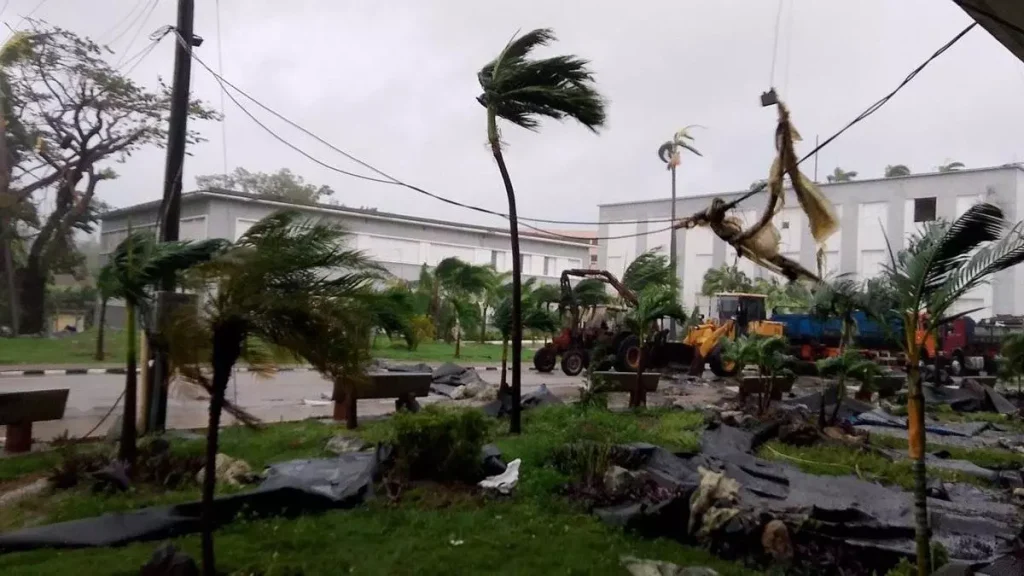
The winds and rains in Santiago “covered the entire territory,” said the head of Civil Defense. The eye was over the small towns of Palma Soriano heading towards Mangos de Baraguá, where it crossed to Holguín. The winds created flying roofs and downed telephone lines; the damage to infrastructure will take longer to assess.

In Holguín it is still early to start assessing the damage, since the hurricane has not left its territory – and the island – but the winds have hit Mayarí very hard, and the water continues to rise. After days of flooding by the river continue reading

Sagua, in Sagua de Tánamo – which left two dead – the riverbed was already at the point of overflow, which seems to have reached its tributaries. There is talk of accumulated rainfall “higher than historical records,” and it has not stopped raining.

Information is missing in Guantánamo, where winds have been around 68 mph and neighbors were talking about disasters. “In my block the water tanks are even rolling around. I think Guantánamo is falling apart.” “There is a lot of sustained wind and huge bursts, many roofs flying everywhere.” “Very strong winds. It feels like we’re on the beach and the waves are crashing. I’ve never felt this way, that outside the world is ending,” they report. Some have expressed their discomfort at the lack of prominence of their province in the morning news reports.

https://www.facebook.com/cubadebate/posts/1237029495126206?ref=embed_post

Yudelkis Ortiz Barceló, president of the Provincial Defense Council of Granma, reported that the reservoirs were still collecting water. No overflows were reported as of 7:00 in the morning, but the situation was very tense. “We ask the population once again not to despair, to remain safe. Only life will give us the chance to move forward, to get out of this situation. Strength, Granma,” she said.

The first reports, provided by the governor, Yanetsy Terry Gutierrez, show damage to a high percentage of homes and public and private institutions in Jiguaní, where the river overflowed and destroyed everything. Landslides, obstructions of mountain roads and roof losses are common in the countryside and the city while the rains persist.

Meanwhile, in Camagüey, the day has been less alarming than expected, according to 14ymedio sources. “Here it has not rained, there is no wind or anything. Three drops of rain throughout the morning. Sometimes you hear a breeze that is not even wind. The power came on for one hour at 12:30 am and went off at 10 in the morning the night before. We loaded up everything, filled the water tank and made today’s rice. Then at 5 am the power came back on but was gone at 7:30 am. So far, we are better than we thought we would be,” they told this newspaper.

At the moment, rainfall accumulations of up to 6 inches have been recorded, although the Institute of Meteorology has warned that in mountainous areas it could reach 18 inches. The recorded maximum winds reached 116 mph, although in most affected cities they range between 44 and 74 mph, with higher gusts.

The strong storm surges, with waves of up to 26 feet and “moderate to heavy flooding in low-lying areas of this coast,” will continue for a few more hours.

The official press has reported that UNICEF, a United Nations children’s organization, has started delivering humanitarian aid to people in shelters. The initial forecast is to reach 21,000 children and 6,000 adults placed in protection centers with hygiene kits to prevent diseases, water purification plants and tanks, waterproof blankets, roofs for temporary shelters and kits with games for children.

“It has been a very complex morning, with extensive damage, and hurricane Melissa is still on Cuban territory,” wrote Miguel Díaz-Canel this morning, urging the population to remain cautious.

“We have prepared for the worst-case scenario and the measures have been effective,” he said after a video conference with officials of the Communist Party of Cuba in which the damage is being assessed on a preliminary basis.

Translated by Regina Anavy

____________

COLLABORATE WITH OUR WORK: The 14ymedio team is committed to practicing serious journalism that reflects Cuba’s reality in all its depth. Thank you for joining us on this long journey. We invite you to continue supporting us by becoming a member of 14ymedio now. Together we can continue transforming journalism in Cuba.
A Russian Plane Accused of Transporting Weapons Through the US Completes the Caracas-Havana-Managua Route

Before crossing the Atlantic, the cargo plane stopped in Armenia, Algeria, Morocco, Senegal and Mauritania

The Ilyushin Il-76 has the capacity to transport up to 50 tons of cargo / Pexels

14ymedio biggerEFE (via 14ymedio), Washington, October 29, 2025 — An Ilyushin Il-76 air cargo carrier of the Russian company Aviacom Zitotrans, sanctioned by the US for participating in the arms trade and transport of mercenaries, left from Havana this Wednesday for Managua, after landing earlier in Caracas. This route among allies takes place in a climate of military tensions with the US naval and air deployment off the Venezuelan coast.

The Il-76 is capable of carrying up to 50 tons of cargo and is one of the largest cargo planes in the world, similar to the Airbus military A400M and Boeing’s C-17 Globemaster.

According to data from the website Flightradar, the Russian plane, which flew part of its route with the transponder off so as not to be identified, took off this morning from Havana. On Tuesday, October 28, it operated between Caracas and Havana, and on the 26th it landed in the Venezuelan capital, continue reading

coming from Mauritania.

The Russian plane, which flew part of its route with the transponder off so as not to be identified, took off this morning from Havana

Before crossing the Atlantic, the cargo plane stopped in Armenia, Algeria, Morocco, Senegal and Mauritania.

The Russian company Aviacon Zitotrans is accused by the US of being involved in transporting military materiel and supporting the Russian defense sector, as well as supporting the deployment of mercenaries of the so-called Wagner Group, designated by the US as a transnational criminal organization.

The US added Aviacon Zitotrans to the list of entities sanctioned in January 2023 for transporting light weapons, missiles and helicopter parts, with special emphasis on logistical support to Venezuela and military operations in Africa.

The fleet of Aviacon Zitotrans includes six Ilyushin cargo planes. The one that made this last route between Venezuela, Cuba and Nicaragua is registered RA-78765 and is one of the aircraft specifically named in the US sanctions, so it is subject to intervention if it enters the jurisdictions of the US or its closest allies.

It is one of the aircrafts specifically named in US sanctions and therefore subject to intervention

This air movement occurs in the midst of massive US reinforcement in the Caribbean and off the coast of Venezuela, where several destroyers and amphibious assault ships are already operating. In the next few days the attack group of the carrier USS Gerald Ford, the largest and most modern in the US Navy, is expected to arrive.

Analysts see this massive US deployment, which includes overflights near the Venezuelan airspace of strategic bombers, as an attempt to pressure the government of Nicolás Maduro to accept a negotiated exit. However, in public, the main reason given by the White House is its campaign to combat fentanyl trafficking.

Translated by Regina Anavy

____________

COLLABORATE WITH OUR WORK: The 14ymedio team is committed to practicing serious journalism that reflects Cuba’s reality in all its depth. Thank you for joining us on this long journey. We invite you to continue supporting us by becoming a member of 14ymedio now. Together we can continue transforming journalism in Cuba.

The Cuban Regime Obtains the Worst Result in History on Its Resolution Against the US ‘Blockade’ at the UN

In addition to the US and Israel, five other countries rejected the motion with 12 abstentions

The resolution against US sanctions on Cuba has no binding effect / X

14ymedio bigger

14ymedio, Madrid, October 29, 2025 — The resolution promoted by the Cuban Government at the United Nations, entitled The need to end the economic, commercial and financial blockade imposed by the United States of America against Cuba, received 165 votes in favor, 7 against and 12 abstentions. Although the island’s chancellor, Bruno Rodríguez Parrilla, described the result on the social network X as a “victory for Cuba,” it is actually the worst diplomatic show of support for Cuba in the history of these votes.

Since the text was first introduced in 1992, it has never received more than four votes against. On this occasion, the usual ones – the United States and Israel – were joined by Argentina, Paraguay, North Macedonia, Hungary and Ukraine. Abstentions – 12 in total – have not reached a similar figure since 1998. The countries that chose to abstain were Albania, Bosnia and Herzegovina, Costa Rica, the Czech Republic, Ecuador, Estonia, Latvia, Lithuania, Morocco, Moldova, Romania and Poland.

Although the resolution maintains a majority condemnation of the US embargo, the most significant political fact is the change in the diplomatic trend towards Cuba. Several Latin American and European states that traditionally supported Havana have begun to distance themselves from its historical position.

Since 1992, with the exception of 2020, when it was not presented because of the pandemic, the General Assembly has voted on this text almost every year, with always overwhelming results. The resolution initially received 59 votes in favor and 71 abstentions, but since 2005 support has regularly continue reading

exceeded 180 countries.

The official narrative of “blockade victim” is eroding against the evidence of more than six decades of authoritarian control

The moment of greatest consensus was recorded in 2016, when 191 states supported the resolution and none voted against it, coinciding with the rapprochement between Barack Obama and Raul Castro. However, since 2017 Washington resumed its negative vote along with Israel, reissuing the traditional diplomatic confrontation. In 2024, the resolution received 187 votes in favor, so this year’s collapse reflects a substantial loss of support for Havana in just twelve months.

This shift occurs in the midst of an unprecedented economic and social crisis on the island, with chronic shortages, blackouts, the collapse of health services and a mass migration exodus. Although the embargo continues to affect the country’s economy, the official narrative of “blockade victim” is eroding against the evidence of more than six decades of authoritarian control, repression of dissent and absence of structural reforms.

During the preliminary discussion, the delegations of Cuba and the US engaged in a bitter exchange. Rodriguez interrupted US ambassador Mike Waltz, accusing him of “lying in a rude manner” and expressing himself with a “rudeness and arrogance” inappropriate for the forum. Waltz replied that the Cuban regime “oppresses its own people” and uses the country’s resources to maintain the “elite status” of its leaders, calling the government in Havana an “illegitimate communist legislature.”

In total, the UN has adopted 33 resolutions of this kind, with a symbolic rather than practical scope. The Cuban regime has turned the “blockade” issue into a pillar of its beleaguered plaza rhetoric, which it uses to justify internal failure, solicit donations, negotiate debt deferrals and keep its diplomatic machinery active. But the loss of support in the UN suggests that international patience with Havana is running out, and that the talk of the embargo is no longer enough to cover up the deep crisis of legitimacy of the Cuban system.

Translated by Regina Anavy
____________

COLLABORATE WITH OUR WORK: The 14ymedio team is committed to practicing serious journalism that reflects Cuba’s reality in all its depth. Thank you for joining us on this long journey. We invite you to continue supporting us by becoming a member of 14ymedio now. Together we can continue transforming journalism in Cuba.

The Butterfly Returns: Promises, Ruins and Nostalgia in Havana’s Lenin Park

After years of neglect, the recreation center is trying to attract visitors with ranch-style huts, horses, and soft drinks.

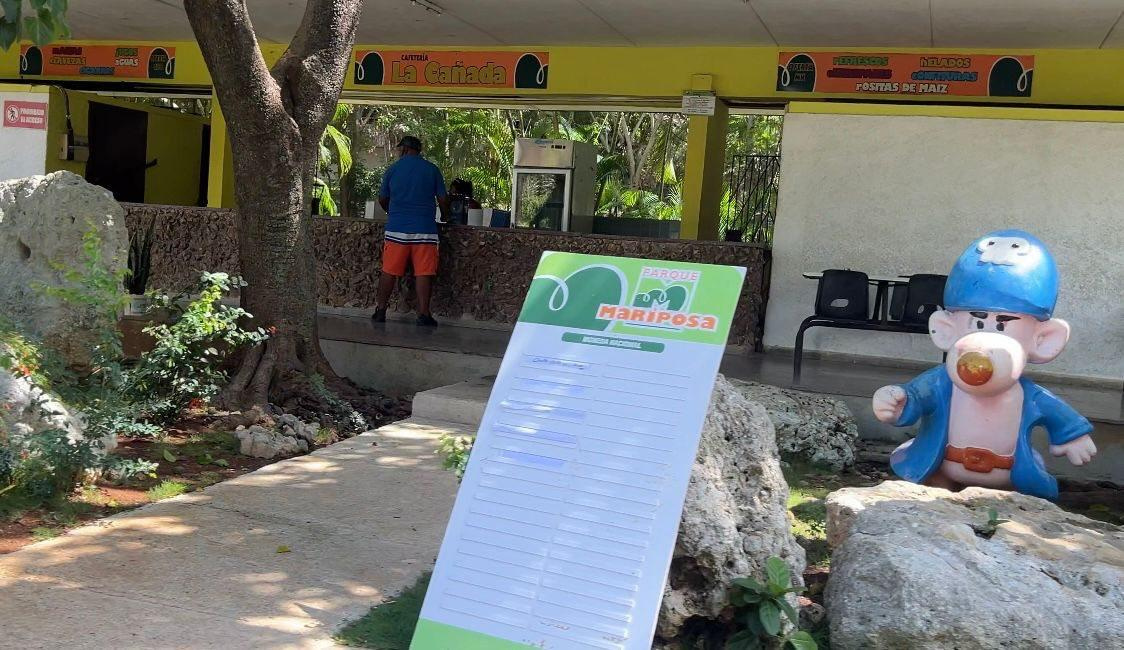
14ymedio bigger14ymedio, Darío Hernández, Havana, 27 July 2025 (delayed translation) — After several years of abandonment, Mariposa Park, one of the most emblematic areas of Lenin Park in Havana, seems to want to take flight again. Although the official reopening has not been announced, there is already a mixture of work, improvisation and distant memories on the ground.

“What they are doing for now is fixing the open-air eateries and other things like that to inaugurate the park again,” says a worker at the site, while pointing to a couple of freshly painted wooden structures. “Inside they are fixing the equipment for the holidays. They have already made enough progress,” he adds.

The image offered today by Mariposa Park is far from the hive of children’s laughter and endless queues of yesteryear. Apparatus covered by bushes, children’s figures corroded by the weather and roller coasters frozen in time draw a scene that is more reminiscent of a ghost town than a recreational center. Every now and then you remember a device that was set up in your childhood and you get a little nostalgic.

The image offered today by Mariposa Park is a far cry from the hive of children’s laughter and endless queues of yesteryear. / 14ymedio

At the side entrance – through which it is possible to sneak without great effort due to the absence of fences – you are greeted by a lackluster version of Captain Plin and Elpidio Valdés. Behind, the immense metallic star that once rotated luminous now remains motionless, rusty, without seats, a symbol of deterioration. continue reading

One of the few elements in the park that shows some life is the modest kiosk that offers jams, beers and soft drinks. “They treat you quite well,” admits a regular visitor. Even so, some employees consulted are skeptical about the alleged arrangement of the rides. “There is nothing new here. Go to Expocuba if you want to see something, there at least they are setting up playthings for the children,” said a clerk between resignation and incredulity.

In the surroundings of the park, other spaces reveal the same pattern of abandonment. Behind the area known as “the head-and-headless riders,” an ancient Chinese restaurant called El Dragon [The Dragon] survives without offering Asian food, but beer and the occasional quick meal. Later, La Parrillada and other eateries that once functioned as restaurants and cafes, are now ruins covered in rubble.

In the park’s surroundings, other areas reveal the same pattern of neglect. / 14ymedio

The bamboo forest, which used to be a magical place to hide or simply stroll, has been partially cleared out, leaving behind a picture of toppled logs and bare clearings. Silence prevails, barely interrupted by the birds or the constant buzzing of cicadas.

In the midst of this desolate landscape, the attempt to revive the space manifests itself in small details. A few children’s playthings have been installed on the outskirts of the Mariposa and eateries are being rehabilitated where families can sit down to eat. “Every weekend that passes a few more people come,” says an optimistic worker.

The horseback riding business, which has also suffered the consequences of the tourist decline, is trying to stay afloat. “We are doing well, but it has to comply with regulations. We have a contract with the head of the park, because the police require papers,” explains one of the drivers.


The Butterfly Returns: Promises, Ruins and Nostalgia in Havana’s Lenin Park

Only a few horses are available and those who rent them out must compete with their memories of a tourism that was once much more dynamic. “Now there are hardly any tourists and it is difficult to find someone out there,” laments one of the people who give rides.

Among those who offer the rides are minors, some as young as 10 or 12 years old. “There are few of us because we are the only legal ones,” clarifies the caretaker of one of the animals, while trying to convince a family to dare to ride.

The attempt to reactivate Mariposa Park parallels the state of the faded memory of the rest of Lenin Park. Its green areas continue to attract families who improvise picnics, fly kites or play soccer among the palms. In the Palace of the Pioneers, the open bars and the absence of guards turn the place into another symbol of institutional abandonment.

The horseback riding business, which has also suffered the consequences of the tourist decline, is trying to stay afloat. / 14ymedio

The new director of the Mariposa park has guaranteed certain improvements, say workers at the site. “This has been allowed to decay here because of several previous administrations. But this director has done a lot. This was abandoned, with stagnant water that rusted the devices,” recalls an employee.

“When this was working, it was good,” says one custodian wistfully. Meanwhile, two of his colleagues interrupt the conversation to ask a group of visitors to leave the area of the devices, with such moderate firmness that it suggests that they are exercising a learned routine rather than authority.

Translated by: Hombre de Paz

____________

COLLABORATE WITH OUR WORK: The 14ymedio team is committed to practicing serious journalism that reflects Cuba’s reality in all its depth. Thank you for joining us on this long journey. We invite you to continue supporting us by becoming a member of 14ymedio now. Together we can continue transforming journalism in Cuba.
As the Cuban Economy Sinks, Spanish Group Vima Increases Its Revenue on the Island

The profits, which reached €10 million, “demonstrate the weight of the Moro family’s discreet food empire.”

Vima Caribe dollar store on Infanta and Santa Marta in Havana / 14ymedio

14ymedio bigger14ymedio, Olea Gallardo, Havana, July 30, 2025 (delayed translation) — The Vima Foods group increased its profits last year thanks to its buoyant business in Cuba. Specifically, according to a report on Tuesday by Economía Digital, the conglomerate’s purchasing center, which operates from La Coruña (Spain) under the name Corporación Alimentaria Vima, increased its profits by 16%, from €8.6 million in 2023 to €10 million in 2024, as well as its turnover, from €88 million to €105.8 million.

Of these nearly 106 million, 49 million correspond to its operations with the island, its main market, which is nevertheless suffering the worst food crisis in its history.

According to Economía Digital, based on the latest accounts submitted to the Spanish Commercial Registry by Corporación Alimentaria Vima, a conglomerate founded by Víctor Moro Suárez—son of Víctor Moro Rodríguez, who died in 2021, a politician during the Spanish Transition and also head of a frozen food packaging conglomerate— Cuba is followed in importance by the Dominican Republic (33 million) and Mexico (15.4 million). The data, according to the local media, “highlights the weight of the Moro family’s discreet food empire.”

The article does not mention Spain—although it does mention other countries where Vima Foods claims to have a presence, such as China, Panama, and the United States—and rightly refers to the Coruña-based company as “a firm as little known as it is profitable.” Vima’s products, which are as ubiquitous in Cuban stores as they are reviled by their buyers—and which range from frozen vegetables to pre-cooked foods, canned vegetables, jams, and grains—are not found in Spanish supermarkets. continue reading

As an explanation for its growth, the company’s administrators stated in their most recent report that it was due to increased activity across the group as a whole

As an explanation for its economic growth, the company’s administrators stated in their most recent report that it was due to increased activity across the group as a whole: “Throughout the 2024 financial year, the company has experienced growth in turnover as a result of the product rebranding strategy initiated in previous years and the consolidation of the group’s presence in the retail and food services channels, which has led to an increase in demand from Vima Group companies at its purchasing center.”

A notable element in the report is the “new subsidiary” created by the group on the island this year, Vima Caribe, “which channels all commercial operations to a new branch, a 100% foreign-owned company responsible for the import, storage, marketing, and distribution of the group’s products in Cuba.”

This makes it clear that the “collaboration project” between Vima and the military conglomerate Gaesa (Grupo de Administración Empresarial S.A.) through its corporation Cimex, signed last January, goes beyond the mere management of several “dollarized” stores. It has involved the legal creation of a new company, which has not been reported in the official Cuban press.

This new branch,“ continues Economía Digital, ”will replace the previous one, and it is expected that its status as an importer will give it greater commercial capacity.”

The media outlet also clarifies the latest ups and downs of Vima Foods’ subsidiaries, which are not without reason referred to as “a highly dispersed conglomerate.”

The media outlet also clarifies the latest ups and downs of Vima Foods’ subsidiaries, which are not without reason referred to as “a highly dispersed conglomerate.” As a result, Corporación Alimentaria Vima “has transferred its corporate employees in Spain to a new company, CS Vima, based in Madrid, which will be responsible for centralizing all services related to leadership, operational support, and human resources provided to all companies within the group.””

The headquarters of the conglomerate, Vima World, is registered in the Spanish capital, having previously been based in Panama until March 2023. At that time, according to sources from the specialized outlet, “it completed the process of transferring its registered office to Spain and converting into a limited liability company, while retaining its legal identity.”

The group’s business prospects, according to Economía Digital, will continue to grow, focusing on “its consolidation in the food distribution segment in Central America” and “opening markets in countries where it did not previously have a presence.”

Vima continues to describe itself on its website as a “family-run company founded in 1994” and as a group “originally linked to the fishing industry in Galicia, Spain,” despite being relatively unknown in that region.

At the same time, the Moro family has never hidden its connection to the Island, and in fact, Moro Suárez’s son, Víctor Moro Morros-Sarda, held a lavish wedding in Havana in December 2023. The patriarch himself has lived in Cuba for over 25 years, where he served as president of the Association of Spanish Entrepreneurs in the country.

The Moro family has never hidden its connection to the Island, and in fact, Moro Suárez’s son, Víctor Moro Morros-Sarda, held a lavish wedding in Havana

The origins and growth of its multimillion-dollar business are more opaque. The Panama Papers, a publication of the Mossack Fonseca law firm’s database by the International Consortium of Investigative Journalists (ICIJ), revealed in 2016 that Vima World was listed among the companies registered in offshore tax havens.

According to the ICIJ database, it was founded in January 1994 in the British Virgin Islands. However, Moro Suárez himself acknowledged in a 2006 interview with the local Galician press that his business empire began in Cuba. When asked by the journalist how he had “learned” to manage “one hundred and sixty employees serving twenty million meals around the world,” the businessman replied: “I found a work niche in the Caribbean region, starting from Cuba, and that circumstance led me to organize this group of companies.”

A report published in La Voz de Galicia four years earlier confirmed this: “Vima was founded in Havana in 1994 to take advantage of the Cuban market’s opening to tourism investment and become the leading supplier to hotels and restaurants.” In 2002, the article stated that Vima World, “a distribution company based in Vigo and fully owned by the Galician Moro family,” was the market leader in Cuba, controlling 15% of food distribution and 25% of hotel supply. In 2001, its revenues reportedly reached 25 million euros. Over the course of a quarter century, the business has quadrupled, nearing 106 million last year.

How a company led by a foreigner could be founded in Cuba in the mid-1990s and reach such figures within just seven years remains one of the questions surrounding Vima, which began appearing in establishments across the Island during that very period — marked by dollarization and the desperation of the Special Period. The answer may lie in that 2006 interview, where the journalist wrote that, according to what he had been told, Moro Suárez held meetings with regime figures, including none other than Fidel Castro himself.

Translated by Gustavo Loredo

____________

COLLABORATE WITH OUR WORK: The 14ymedio team is committed to practicing serious journalism that reflects Cuba’s reality in all its depth. Thank you for joining us on this long journey. We invite you to continue supporting us by becoming a member of 14ymedio now. Together we can continue transforming journalism in Cuba.

Cubans Reinforce Their Homes, Working Against Against the Clock Before the Arrival of Hurricane Melissa

  • It remains a dangerous category 5 hurricane on the Saffir-Simpson scale, as it heads for the Island
  • “We know that there will be a lot of damage caused by this hurricane,” warns President Miguel Díaz-Canel
Cubans walk olong the sea this Tuesday in Santiago de Cuba, while Melissa advances toward the Island. / EFE

14ymedio bigger14ymedio / Havana/ Holguín, Miguel García, October 28, 2025 — “I have spent the day nailing doors and windows,” a resident of Holguín told 14ymedio. He adds that they are preparing the best they can to survive Hurricane Melissa, although they have not had time to follow the details of its trajectory due to a poor internet connection and blackouts. His house has brick walls, but he doesn’t want anything to surprise him and endanger his family.

Melissa made landfall this Tuesday near New Hope, Jamaica, with sustained maximum winds of 185 mph. A probe was able to capture a burst of 252 mph inside the hurricane. Its central pressure dropped to 892 hectoPascal, so it remains a dangerous category 5 hurricane on the Saffir-Simpson scale, as it heads east towards Cuba.

At least 7 people have died so far: 3 in Jamaica, 3 in Haiti and 1 in the Dominican Republic. Authorities fear that the number of casualties may increase as more damage reports come in.

From Jamaica, a Cuban doctor wrote on her social networks: “I tell the people in eastern Cuba: this is too much for Cuba. It is too much for you, my dear people.”

In the municipality of Palma Soriano, province of Santiago de Cuba, Katia, 51 years old, says that no one has slept at home: “We removed the mattresses from the beds and sent them to some neighbors who have a house that is stronger than ours, the same with the refrigerator,” she reports by phone to 14ymedio. The family has set two clear priorities: keeping the children safe and preserving their most valuable assets. continue reading

“We are not going to evacuate because here when people leave their homes, the danger of being robbed is high,” she says. “These walls are strong, our problem is the roof: one part is board and the other has a light cover. We’ve blocked the blinds with boards and tried to keep the water tank above the bathroom full, so it doesn’t blow away in the wind. We’re avoiding wasting the rechargeable batteries for our flashlights and mobile phones.

“Yesterday people stocked up on everything they could. There were lines in front of the MSMEs* that sell food, and trucks and tricycles were carrying boxes and large packages.”/ 14ymedio

Niurka can listen to local FM radio stations with a headphone attached to her cell phone as an antenna. “This has given us luck because we have had many blackouts in recent days and being informed has been difficult. At least we now know that the creature is coming here and has an impressive size,” she says about Melissa.

In the city of Holguín it’s hard to find something to buy this Tuesday. “Yesterday people stocked up on everything they could. There were lines in front of the MSMEs that sell food, and trucks and tricycles were carrying boxes and large packages,” says Rodolfo, driver of an electric vehicle that transports passengers and goods. He decided not to go to work today, preferring to be employed in reinforcing his home’s security.

“Luckily my little house is attached to others and that protects us,” he explains. ” I spent my life complaining about the neighbors who play their music too loud and sometimes even wake up the kid with their screaming, but today that is the greatest security I have to confront the wind.” In the event that the electricity is cut off for several days and food becomes more scarce, neighborhood solidarity will also be important.

“In previous hurricanes we improvised a pot of soup on the block and that saved us,” he recalls. This kind of support will be more important on this occasion. “There are many old people who are alone in this neighborhood. Some have been evacuated to other houses, but others have no one who can help, so we will take turns looking after them.”

Rodolfo’s sister, a newly graduated doctor, is being evacuated to the Vladimir Ilyich Lenin General University Hospital along with other health workers. “She took a couple of changes of clothes because this can last for a long time.” The tricycle with which he earns his living now occupies most of the space in the room. “Usually I keep it in an open carport outside, but this time I cannot risk it. If a tree falls on top, my way to earn a living is lost.”

“Luckily my little house is attached to others and that protects us.” / 14ymedio

His decision coincides with the advice offered on Facebook by an architect in Guatánamo with experience in natural disasters. The expert warns that winds from 155 to 186 mph are strong enough to destroy even houses made of reinforced concrete, so nobody should underestimate their power. He also explains that wood or brick dwellings with thin ceilings are extremely vulnerable, as the wind can tear off roofs and knock down structures, especially in rural areas or isolated buildings. In these cases, the recommendation is to evacuate immediately to someplace safe and not assume that thick or concrete walls will provide protection.

Only concrete dwellings with heavy roofs and in good structural condition could provide some safety if they are away from the shore. In coastal areas or where the sea is at least 656 feet high, even solid houses should be evacuated, as the waves can cause more damage than the wind, says the specialist.

On Tuesday, President Miguel Díaz-Canel, who chairs the National Defense Council, released a statement calling on Cubans to avoid deaths and serious damage in the face of the next powerful impact of hurricane Melissa on the east of the island.

We know that there will be a lot of damage caused by this storm, but we will have the capacity to recover in food production, housing, and also in the the economy,” said the president in a message broadcast on state television.

“No one should venture to swim in the swollen rivers; no one should return home from the places of evacuation when the indications for returning or going to the recovery phase have not yet been given in each of the territories,” advised the first secretary of the Communist Party, who described the preparatory work at all levels as “intensive and responsible.”

Neighborhood residents in Santiago called the Communal Services, but “they responded that the truck can’t come. There is no fuel and the ones that work are going to Guamá. / Facebook / Yaya Panoramix

For his part, José Daniel Ferrer, leader of the Patriotic Union of Cuba (UNPACU) and recently exiled in Miami, shared a video from Santiago de Cuba where you can hear “the hammering of people trying to secure their homes in order to cope with Hurricane Melissa.” Some 168,900 people have been evacuated in this province to 101 centers set up for that purpose.

Actress Dayana Figueroa, known on social networks as Yaya Panoramix, complained on Facebook that the garbage threatens to cause obstructions in the sewage system of her neighborhood in Santiago de Cuba, “a few blocks from Céspedes Park.” She says that the neighbors called the local authorities, but “they replied that the truck can’t come. There is no fuel and those that work are going to Guamá.” Aware that her neighborhood is often flooded, she concluded, “My family is in danger.”

From Yateras, in Guantánamo, official profiles defend the use of caves in the mountains to house vulnerable people. Meanwhile, Melissa is moving north-northeast and has slightly increased its travel speed by 9 mph. It is expected to lose some strength as it crosses Jamaica and arrive with a lesser category on Cuban soil between Tuesday and Wednesday.

Over the next 24 hours, Melissa should tilt its trajectory further to the northeast, gradually increasing its speed. The external bands of this hurricane are already affecting the eastern region of Cuba, generating showers and rain, which will increase in the afternoon from Camagüey to Guantánamo. Rainfall will be strong and intense, mainly in mountainous areas, with accumulations between 7.5 and 17.7 inches over the next 24 hours.

*Micro, Small, Medium Enterprises [mipyme in Spanish], generally privately operated

Translated by Regina Anavy

Hurricane Melissa Challenges “The Entire Value Chain of Cuba’s Energy Logistics System”

Not only is power generation hanging in the balance as the powerful hurricane approaches: the fuel storage network is at risk, an expert warns.

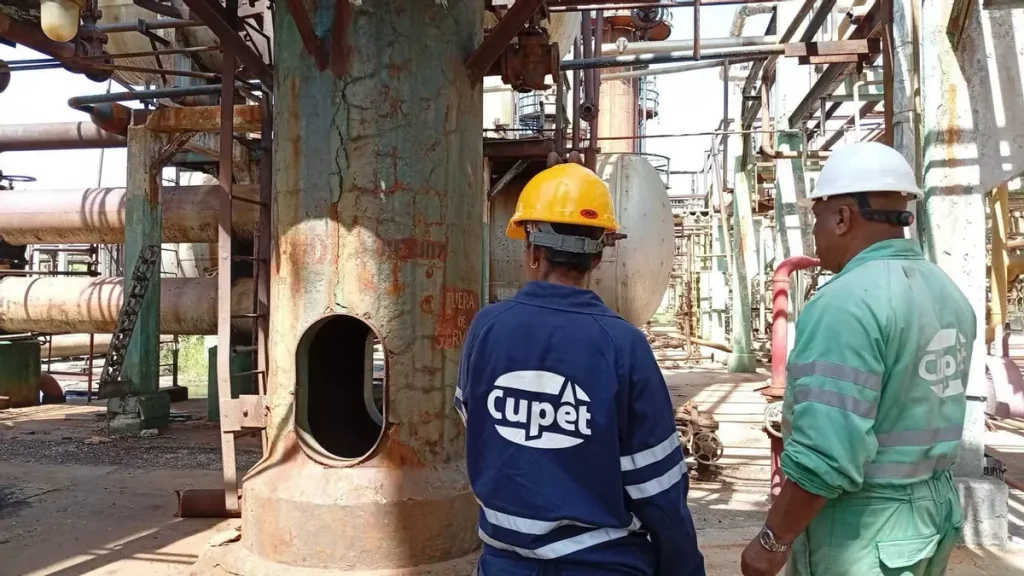
Workers at the Hermanos Díaz refinery carried out hurricane preparation tasks on Monday, Cupet said. / Cupet

14ymedio bigger14ymedio, Madrid, October 28, 2025 / Hurricane Melissa was approaching Kingston, Jamaica early this morning as a powerful hurricane, with sustained winds of 280 kilometers per hour and gusts exceeding 300 kilometers per hour, including one of 388 kilometers per hour recorded by a U.S. National Oceanic and Atmospheric Administration aircraft. Although it is expected to weaken slightly as it leaves Jamaica, forecasts indicate it will regain strength before reaching Cuba early Wednesday morning.

The greatest concern is the storm surges it will prompt on the coasts of Granma, Santiago de Cuba, and Guantánamo, which will cause flooding in low-lying areas, as well as the heavy rains expected throughout the eastern part of the country, which are dangerous in mountainous areas due to the risk of river flooding and landslides. The risk is such that the official newspaper Granma newspaper has not minced words.

“Melissa will hit with great power and cause great concern about what it could destroy in its path. But let it not be lives that are left vulnerable,” the newspaper warns. It states that, in addition to the hundreds of thousands of evacuees, “no time has been wasted in planning and implementing evacuation plans for those at risk, safeguarding resources, securing health institutions, providing rescue equipment, and updating waterworks.”

But if there is one infrastructure in serious danger, it is precisely the weakest: the national electricity system (SEN). Jorge Piñón, a researcher at the University of Texas at Austin, warned this newspaper that the risks go far beyond power generation—which will have to be halted at thermoelectric plants in affected areas when the time comes, according to the official press—and even extend to logistical capacities. continue reading

“The impact of Hurricane Melissa, a Category 5 storm, could not only be devastating for the Antonio Maceo and Renté thermoelectric plants in Santiago de Cuba, and the Lidio Ramón and Felton plants in Holguín. It could also affect 26% of the country’s power plants, with an installed capacity of 813 GW in the five eastern provinces, representing 31% of the national total,” the specialist says, citing official data.

Although the government announced this Sunday that lineworkers from across the country were already en route to the eastern region to prepare—and recover—the infrastructure, Piñón points out that there will be “thousands of kilometers of electrical transmission and distribution lines, along with their substations,” crisscrossing the areas that are expected to be hardest hit by Melissa.

The photovoltaic panels, towers, and generators at La Herradura wind farm in Holguín are also exposed. The Electric Union and the official provincial press have explained that the panels at all solar farms have been protected with strong straps tied to the foundations of the wind turbines, although the omen is not good. César Luis Sarmiento Ávila, head of investment at the Holguín Electric Company, indicated that, according to the design, the support can withstand winds of up to 200 kilometers per hour, which is 80 kilometers per hour less than the current speed of the hurricane as it is passing through Jamaica.

“But Melissa’s impact could go far beyond electricity generation. The entire energy logistics system value chain in the eastern provinces could be seriously compromised,” warns Piñón. “The Hermanos Díaz refinery, with an installed capacity of 30,000 barrels per day and an extensive fuel storage network, constitutes a strategic hub for the supply of refined products, lubricants, and liquefied gas cylinders to this region of the country,” he explains.

Screenshot

Furthermore, all of Cuba-Petroleo’s (CUPET) territorial marketing terminals have dozens of fuel and liquefied petroleum gas storage tanks that are “vital to the national economy,” and it will be essential for tanker trucks to be able to access the roads to supply generators, gas stations, and industries. “Yes, electricity is crucial, but logistics—the backbone of fuel supply—will also be put to the test in the coming weeks,” the specialist concludes.

In homes, there continues to be concern about blackouts lasting longer than 24 hours, and although applications that don’t require an internet connection have been activated and amateur radio emergency networks are operating to access hurricane information, a large part of the population lives in anguish over the disconnection.

“My mother spends more time without electricity than with it,” X, originally from Santiago, tells this newspaper. “She only told me that at the llega y pon [informal settlement] with my house, they came with several buses and took everyone away. They’ve moved everyone who might be in bad shape, that’s what she told me.” Since her house is in good condition and has sufficient food, “she’s more worried about the viruses than the cyclone,” she adds.

The arbovirus infections that have been ravaging the country for weeks face another test of fire with the hurricane, where everything could get worse. The United Nations Development Program (UNDP) has sent a donation that includes, among other things, hygiene kits and water treatment plants. “The goal is to support national efforts for early recovery and reduce the suffering of affected families,” a spokesperson reported Monday.

The donation includes 4,000 tarps for temporary roof coverings, seven electric generators, six chainsaws, 259 specialized and basic tool kits for roof repair, and more than 2,000 single-person mattresses. The United Nations also announced it has activated its Anticipatory Action mechanism, through which it plans to distribute more than 100 tons of rice and emergency supplies.

The gap between what is reported in the official press and what citizens report on social media is total. The government maintains that all preventive measures have been taken and now calls for individual discipline and responsibility to avoid any tragedy, while social media messages claim that the conditions under which this hurricane arrives are so deplorable that even the best forecasts cannot mitigate its effects.

But authorities consider the accusations a “smear campaign.” “A failed state could do everything we were doing before the cyclone, nor can it organize all the efforts being made to confront this situation and recover from it,” President Miguel Díaz-Canel said yesterday.

____________

COLLABORATE WITH OUR WORK: The 14ymedio team is committed to practicing serious journalism that reflects Cuba’s reality in all its depth. Thank you for joining us on this long journey. We invite you to continue supporting us by becoming a member of 14ymedio now. Together we can continue transforming journalism in Cuba.

A New Card and the Same Trick: Cuban Doctors in Angola Still Can’t Collect Their Pay in Dollars

The authorities advance a new payment mechanism to settle complaints, but the doctors still demand payment in dollars

Cuban doctors in Angola say the authorities have held onto their dollars for years / Cubadebate

14ymedio bigger14ymedio, Havana. Natalia López Moya, October 28, 2025 — “We are somewhat resigned, but not at all in agreement,” said Héctor, a Cuban doctor in Angola who participated in the meeting on October 23 between health workers and representatives of Antex, the Cuban company that manages the missions in the African country. The meeting, held in Luanda, served to announce a new payment mechanism through the Classic card, which maintains restrictions on access to dollars and thwarts the hopes of health workers to be able to recover their money in that currency.

The meeting took place in a tense atmosphere, albeit with fewer complaints than on previous occasions. “It’s not that we have given up, but people have now realized that these officials aren’t going to do anything; it’s like talking to a wall,”explains the doctor, using a pseudonym for fear of reprisals. According to his statement, the document read during the meeting had already been leaked days before, so the attendees arrived “more than informed.”

The official text stated that, beginning October 20, Cuban professionals in Angola and Algeria can transfer the savings accumulated in their accounts in freely convertible currency (MLC) to a Classic card, with which they will be able to buy in dollar stores, acquire a car and pay for fuel at foreign currency gas stations.

The change does not solve the main problem: the impossibility of withdrawing dollars in cash from Cuba

However, the change does not solve the main problem: the impossibility of withdrawing dollars in cash from Cuba. “This has changed nothing,” says Hector. The availability of dollars still depends on the bank, and the answer is always the same: we don’t have any.” continue reading

The measure was to be implemented in January 2026, but it was brought forward by growing unrest among the health workers, tired of collecting pay in a devalued currency. “All this prevents us from making plans for housing, investment or migration,” laments Héctor, who is about to finish his mission after more than three years. “The MLC is worth much less than the dollar, and the balance in a Classic card is also below. In the end we lose money on every transaction.”

The currency gap is confirmed by the informal market: while the dollar is quoted this Tuesday at 485 Cuban pesos, the MLC barely reaches 200, and the money in a Classic card equals 446. “We can forget about a part of our savings; that money evaporates in the many deals we have to do to get the cash,” he concludes.

For months, a number of health workers had been confident that the authorities would allow direct payment in dollars or kwanzas (Angolan currency), to later buy dollars in the local market. But the decision of the Cuban government, advanced this week, fell like “a bucket of cold water” on these expectations.

In September, the professionals received only half their monthly payment in kwanzas, about $200

The discomfort is aggravated by other failures. In September, professionals received only half their monthly payment in kwanzas -about $200- and in October the disbursement was further delayed. Some doctors have not yet been paid. ” People are demoralized, but also scared,” says another health worker in Luanda. “They have tried to divide us and scare us so that no one protests.”

The clearest warning came a few days ago from Cuba’s Ministry of Public Health, which officially called the doctors who criticize the system or report irregularities “ingrates and traitors.” It was like a direct message, says the doctor. Anyone who complains risks being sent back to Cuba and losing their savings.”

The discontent had reached such a point that a group of collaborators drafted a letter to the Cuban Public Prosecutor’s Office, on behalf of all, demanding payment in foreign currency and better working conditions. At the center of their complaints is Antex, a subsidiary of the military conglomerate Gaesa, sanctioned by the US Office for Foreign Assets Control (OFAC). Antex manages a wide range of businesses in Angola, from road construction, airfield repairs and travel agencies to managing medical missions.

The discontent had reached such a point that a group of collaborators wrote a letter to the Cuban Public Prosecutor’s Office

In July, the professionals also sent a letter to Miguel Díaz-Canel, denouncing “non-compliance with the form of payment established in the contract” and demanding access to their funds in dollars deposited on the island. There was no response. Instead of rectifying, says another doctor, “what they have done is give us another plastic card but no cash dollars, nothing.”

Most of them have lost hope of a change. “They don’t want to give up the money, says Héctor. They have kept our currency for years and will not return it, even if that costs them more complaints in the meetings.

Translated by Regina Anavy

____________

COLLABORATE WITH OUR WORK: The 14ymedio team is committed to practicing serious journalism that reflects Cuba’s reality in all its depth. Thank you for joining us on this long journey. We invite you to continue supporting us by becoming a member of 14ymedio now. Together we can continue transforming journalism in Cuba.

Cuban Roel Santos Dreams of Seeing the Island Play With Its MLB Stars

“It’s a topic that has caused a lot of controversy,” the Granma native acknowledges.

Santos has been selected for both World Baseball Classics, in 2017 and 2023. / ‘Cubadebate’

14ymedio bigger

14ymedio/SwingCompleto, Havana, Ocotber 27, 2025 / Cuban baseball player Roel Santos, who has represented Team Cuba in various international tournaments, called for Major League Baseball players to be part of the team’s roster for the VI World Baseball Classic – if Cuba finally receives permission to participate – which will take place in 2026 in the United States, Japan and Puerto Rico.

The outfielder, who plays in the Venezuelan Professional Baseball League with the Bravos de Margarita club, said in an interview with Swing Completo that he hoped Cuba “has the good fortune that its MLB players can say yes and that their teams can give them the nod. It would be a very good thing. I would love it if this could be achieved someday. That the best players in the world can participate. It will be good for both baseball and the fans, who also want that.”

The Granma native acknowledged that “it’s a topic that has caused a lot of controversy,” but that a good result for the island only depends on adding MLB players. “It’s the best event, and honestly, who doesn’t want to be in a World Baseball Classic? Being able to have major league players in a Classic is a great prospect, because the best players in the world will be facing each other,” he remarked.

“For the 2026 World Classic, if Cuba receives permission, we haven’t made the call yet.”

However, Roel Santos’s ambition seems unlikely due to the political differences between the Cuban government and the main Cuban stars playing in the MLB—like Aroldis Chapman—although he hasn’t lost hope that, at some point, this barrier will be broken: “I would like everyone to participate. There are many legends I played with on the national team, and they could participate now. It would be a very good thing for the country.” continue reading

The baseball player, who is on Team Cuba’s pre-roster for the Copa América, which will be played from November 12 to 22 in Panama, has been selected for both editions of the World Baseball Classic, in 2017 and 2023, the latter when the island reached the semifinals, where it lost to the United States.

A player who played for the Houston Astros, pitcher Julio Robaina, was recently contacted by the Cuban Baseball Federation to represent Team Cuba in the upcoming World Baseball Classic. The pitcher appears to have said yes.

However, Cuba is currently waiting for confirmation to compete in the tournament, which, as of October 22, had not arrived. Germán Mesa, who will lead Team Cuba in the Copa América, reported that “for the 2026 World Classic, if Cuba receives permission, we have not yet made the call.”

Even so, for the tournament scheduled for next March, although there’s no official confirmation, tickets are already on sale for the games in which the Cuban team will participate. The online platform Gotickets offers tickets for up to $1,345 to watch Team Asere ‘s match against Colombia in Box B of Hiram Bithorn Stadium, Puerto Rico.

____________

COLLABORATE WITH OUR WORK: The 14ymedio team is committed to practicing serious journalism that reflects Cuba’s reality in all its depth. Thank you for joining us on this long journey. We invite you to continue supporting us by becoming a member of 14ymedio now. Together we can continue transforming journalism in Cuba.