Cuban Journalist Whose Visa Was Withdrawn by Noboa’s Government Leaves Ecuador

Alondra Santiago was harshly criticised for using the Ecuadorian national anthem to make a parody of the president’s administration.


Alondra Santiago, in one of the videos of her channel, ’Ingobernables’ / YouTube/ Screen capture

14ymedio bigger14ymedio, Quito, 28 June 2024 — Cuban journalist and actress Alondra Santiago left Ecuador on Friday, where she has lived for nearly 20 years, after the government of President Daniel Noboa withdrew her visa. The decision has been criticised as an attack on freedom of expression against a journalist who is critical of the government.

Noboa’s administration informed Santiago on Tuesday that it was withdrawing her permanent residency visa on the grounds of alleged acts against national security, which was based on a “secret report” prepared by the intelligence centre.

Through her talk show Ingobernables, which is broadcast on social networks and has a wide audience, Santiago had been critical of Noboa and in the last elections had expressed her sympathy for Luisa González, the candidate of Correísmo.

Weeks ago she was harshly criticised for using the Ecuadorian national anthem to make a parody of President Noboa’s administration.

In the last few hours I have taken the difficult decision to leave my country: Ecuador. And I’m not leaving deported, I’m leaving legally first.

In fact, the government broadcast the national anthem in a national chain (message to the nation) through the media on the same Tuesday that the decision was made known, with the previous phrase “out of respect for the country”. continue reading

In a video published on social networks by her lawyer Carlos Soria, Santiago explained that she had taken the decision to leave the country before the government deported her and while waiting for the legal actions presented by her lawyers to take effect and for her to be able to return to the country. The lawyer, who did not give details of the journalist’s destination, stated that she left “on an invitation to a forum” and that her return “is in the hands of a judge”.

“In the last few hours I have taken the difficult decision to leave my country: Ecuador. And I am not leaving deported, I am leaving legally, because I will not be part of the show that the government is putting on. I will not be part of the smokescreen they are putting up to cover up their incompetence and violence against the people,” said Santiago.

“In this last week I have seen the face of authoritarianism and violence first hand. They want to silence me. Today my physical, emotional and mental integrity is compromised. Today my life is in danger because of an abuser of power”, she added, referring to the head of state.

The 33-year-old journalist said that people close to her and who “know the president very well” had asked her to put herself in a safe place.

“Because he will not stop until he stops my voice. Today it is a deportation because I spoke out, because a woman journalist told him the truth, because a song annoyed him, because I exposed his incompetence, violence and arbitrariness”, she denounced.

“What will tomorrow be? What else will they invent? What means and people will they use for their ends? Although I fully trust that Justice will rule in favour of truth, law and freedom, I do not trust a government that is capable of manipulating information and inventing it to take me away from the life I have built in Ecuador for nineteen years,” she added.

Santiago described Noboa as a “democratic accident” and a “cardboard president” and said she would return to Ecuador, but until then she would continue to speak out. “Nothing and no one is going to stop my voice or my journalistic exercise,” she concluded.

The Inter American Press Association (IAPA) on Wednesday expressed its concern about this and its president, Roberto Rock, said that “it is necessary that, given the lack of precision about the reasons for the decision, the government explain clearly whether or not the revocation of the visa is related to the criticisms made by the journalist”.

For its part, the Ecuadorian press freedom organisation Fundamedios said that “this act constitutes an abusive use of state power and violates freedom of expression”.

The Alianza de Organizaciones por los Derechos Humanos de Ecuador (Alliance of Human Rights Organisations of Ecuador) also pointed out that this episode demonstrates an arbitrary exercise of power.

In March, Noboa pledged to guarantee freedom of the press and freedom of expression in his country by signing the Chapultepec and Salta declarations after a meeting with an international IAPA delegation at the Carondelet presidential palace in Quito.

Translated by GH

____________

COLLABORATE WITH OUR WORKThe 14ymedio team is committed to practicing serious journalism that reflects Cuba’s reality in all its depth. Thank you for joining us on this long journey. We invite you to continue supporting us by becoming a member of 14ymedio now. Together we can continue transforming journalism in Cuba.

Russia Will Train Cuban Firefighters, Police and Lawyers

The certification of firefighting engineers includes training to operate drones in emergency situations

Cubans were taught about “determination, loyalty to duty and the willingness to help,” Russian authorities said. / Prensa Latina

14ymedio bigger14ymedio, Havana, 1 July 2024 — Relations between Russia and Cuba seem to return more and more to the old years of the Soviet Union, with the training of professionals from the Island in the Eurasian country. This Saturday, it was announced that a group of Cubans have just graduated as fire protection engineers.

According to Prensa Latina, the qualification includes a certification to operate drones in emergency situations. In the same vein is the announcement made by the Cuban Minister of Justice, Oscar Manuel Silvera Martínez, who last week was on an official visit to Moscow and said that Cuban police and lawyers will be trained in Russian universities.

The training of lawyers and police, the minister said, after participating in the XII International Legal Forum that took place in St. Petersburg between June 26 and 28, is part of the memorandum of understanding signed last year between the two countries. It aims to promote the development of cooperation in the field of education.

“Our Cubans will be trained in police work by you,” the minister said during his visit to Russia last week

“Police and lawyers from Cuba will be trained in Russia. This is very important to strengthen the relationships between us,” Silvera Martínez stressed, without providing more details. “Our Cubans will be trained in police work by you, and they will also learn about jurisprudence in your universities.” continue reading

The Academy of State Firefighters Service, which belongs to the Ministry of Emergency Situations, was, for five years, the institution in charge of training the 18 young Cubans who graduated as firefighters this weekend. Among the subjects taught were “theory, practice and application of experiments both in laboratories and in on-site exercises.”

Most notable among what was instilled by the Government of Vladimir Putin in this group of Cubans is the “determination, loyalty to duty and the willingness to help,” explained the director of the State Firefighters Academy, Vyacheslav Butko, who reiterated in allusion to the Cuban students that “the doors of the university will be open.”

In addition to graduating as firefighters and drone pilots for work in emergency situations, Cubans received a Russian-Spanish dictionary of words related to their specialty, as reported to the Cuban news agency by Arnaldo Bombino, who recently graduated as a lieutenant.

Cooperation between Cuba and Russia on the matter of firefighting has been a constant in recent years. For example, the Russians gave advice to the regime in the case of the Matanzas supertanker fire in August 2022, and donated fire trucks a few months later (in December 2023) .

Since Russia invaded Ukraine and was rejected by most of the international community, the old relationship between Moscow and Havana has been revitalized. This has included a series of exchanges, including the sending of oil tankers to the Island in the midst of an energy crisis aggravated by the summer, as well as the visit of a naval flotilla headed by a Russian nuclear submarine this month.

Translated by Regina Anavy
____________

COLLABORATE WITH OUR WORKThe 14ymedio team is committed to practicing serious journalism that reflects Cuba’s reality in all its depth. Thank you for joining us on this long journey. We invite you to continue supporting us by becoming a member of 14ymedio now. Together we can continue transforming journalism in Cuba.

Cuban Javelin Thrower Yulenmis Aguilar Wins a Gold Medal for Spain

The athlete had a record of 59.85 meters prior to the Paris 2024 Olympic Games

Yulenmis Aguilar showing the gold medal she won for Spain / Instagram/yulenmis_aguilar

14ymedio bigger14ymedio, Havana, 2 July 2024 — Yulenmis Aguilar, the Cuban javelin thrower won a resounding victory in the Spanish Championship with a throw of 59.85 meters, which places her as the main figure for Spain in that specialty and shows that she is in “good shape for the Olympic Games in Paris 2024,” according to Swing Completo.

Aguilar began her participation this Sunday with a throw of 50.12 meters. Her rivals, Carmen Sánchez, who was in second position, recorded a throw of 51.86 meters, while Enya Carretero was in third place with 51.43 meters.

On April 10, the athlete received the “naturalization letter” in the Council of Ministers of the Moncloa Palace, a procedure that began at the end of 2022, opening the possibility for her to represent Spain at the Olympic Games in Paris 2024.

The double-champion (2015, 2017) Cuban javelin thrower arrived in Spain at the end of December 2020

Since Aguilar’s naturalization was confirmed, the Royal Spanish Athletics Federation (RFEA) contacted World Athletics – the governing body of athletics – to make the change of nationality for the athlete to be part of its delegation. continue reading

In the other four competitions of 2024, except for the Ibero-American Rally in Huelva, where she was fourth, Aguilar won the Iberdrola League of clubs twice (60.68 and 56.21) and the José Luis Hernández Memorial in Pamplona (56.52).

The double-champion (2015, 2017) Cuban javelin thrower arrived in Spain at the end of December 2020.

Since she has been in Spain, Aguilar has had her eyes set on Paris. “My room for improvement is incredible,” she told the newspaper Relevo at the beginning of this year. “I have been watching the throws with my coach and there is a possible improvement of 30%, at least.”

Aguilar was ignored by the Cuban national team in 2018. That was the “prize” she received after obtaining the bronze medal at the Central American and Caribbean Games in Colombia. The authorities simply told her that “they weren’t counting on her for the next season.”

“I didn’t want to know anything about the sport. I went into a depression and began to gain a lot of weight”

The athlete’s sports life became “an ordeal” in which the injuries she had on her knees, shoulders and elbows pushed her to retire for five months. “I didn’t want to know anything about the sport. I went into a depression and began to gain a lot of weight,” she told La Voz de Galicia.

The Cuban contacted coach Raimundo Fernández, who directs the Escuela de Lanzadores de A Coruña and traveled to Spain. “Her first six months here were an ordeal of physiotherapists, doctors and rehabilitators,” Fernández stressed.

The athlete recovered and last year set a record for Spain in the javelin throw with 64.17 meters, which placed her as sixth in the world ranking of the discipline. Aguilar, 27, has been living in Galicia since 2020, where she arrived with a work permit.

Translated by Regina Anavy

____________

COLLABORATE WITH OUR WORKThe 14ymedio team is committed to practicing serious journalism that reflects Cuba’s reality in all its depth. Thank you for joining us on this long journey. We invite you to continue supporting us by becoming a member of 14ymedio now. Together we can continue transforming journalism in Cuba.

The Prosecution: The Case of Sulmira Martínez Pérez / CUBALEX

Cubalex, 21 June 2024 — Sulmira Martínez Pérez could face a ten-year prison sentence, according to the provisional findings of the Prosecutor’s Office, for expressing herself on social media against the Cuban regime and advocating peaceful protest.

Prosecutor Edward Roberts Campbell has requested a combined sentence of ten years’ imprisonment for the 22-year-old, currently held in the Western Women’s Prison known as El Guatao in Havana.

Does it adhere to the principles of legality and fairness?

The legal characterisation offered by Prosecutor Edward Robert Campbell to the Chamber for Crimes against State Security of the People’s Provincial Court of Havana, in the second of his provisional conclusions presented on 24 April 2024, is incorrect. The legal grounds for this assertion are set out below:

The prosecutor has legally classified the facts described in the first of his provisional conclusions as constituting the crimes of Contempt (Articles 185.1 and 2) and Against Constitutional Order (Article 119.3 in relation to 119.1) of the Criminal Code (Law 151/2022). In this regard, he said:

“(With respect to acts committed before the entry into force of Law 151. It is integrated into the offence provided for in Article 99 of Law 62, which has the same sanctioning framework)”.

The prosecutor proposed, and the court accepted, a legal position that violates the principle that criminal laws cannot be applied retroactively. This principle has an exception: it can only be applied retroactively when the law is more favourable to the accused person.

In determining which law is more favourable, the court must consider which law produces the more beneficial result for the accused person, objectively assessing the facts of the case and the laws in force at the time of the decision. It is not a matter of comparing individual provisions of the two laws, but of assessing their entire content, including the penalty, the elements of the offence and the aggravating circumstances of criminal liability. For example, if in the specific case it is possible to apply a penalty of limitation of liberty or correctional work without detention, the current Penal Code would be more favourable than the repealed one, even if it provides for harsher penalties in other respects.

The court must consider both theoretically co-existing laws, assessing which one is more applicable to the particular case, and not only which one is in force.

How should the court proceed in this case?

1. Hypothetically apply the criminal law in force at the time the crime was committed and subsequently do the same with the law in force at the time of the trial.

2. Compare possible outcomes and choose the one that is more favourable to the accused person.

3. The comparative examination should conclude with the choice of one of the two laws, the old or the new one.

It is wrong to apply provisions of both laws simultaneously, as this creates a new law made to suit the prosecutor, whose aim is to impose harsher sanctions to punish dissent, censor free speech and restrict the right to protest.

Conclusions

Sulmira, like everyone else in Cuba, is unable to exercise her right to peaceful demonstration, despite the fact that this right is enshrined in article 56 of the Constitution of the Republic. The main reason is that the Cuban government, despite its legislative promise, has not enacted a supporting law that would allow the full exercise of this fundamental right.

This omission allows the criminalisation of any citizen action of criticism, protest, disagreement and opposition to the authorities, who are responsible for the economic crisis, violence and total decadence that the island is experiencing today.

The post La acusación fiscal: El caso de Sulmira Martínez Pérez appeared first on Cubalex.

Translated by GH

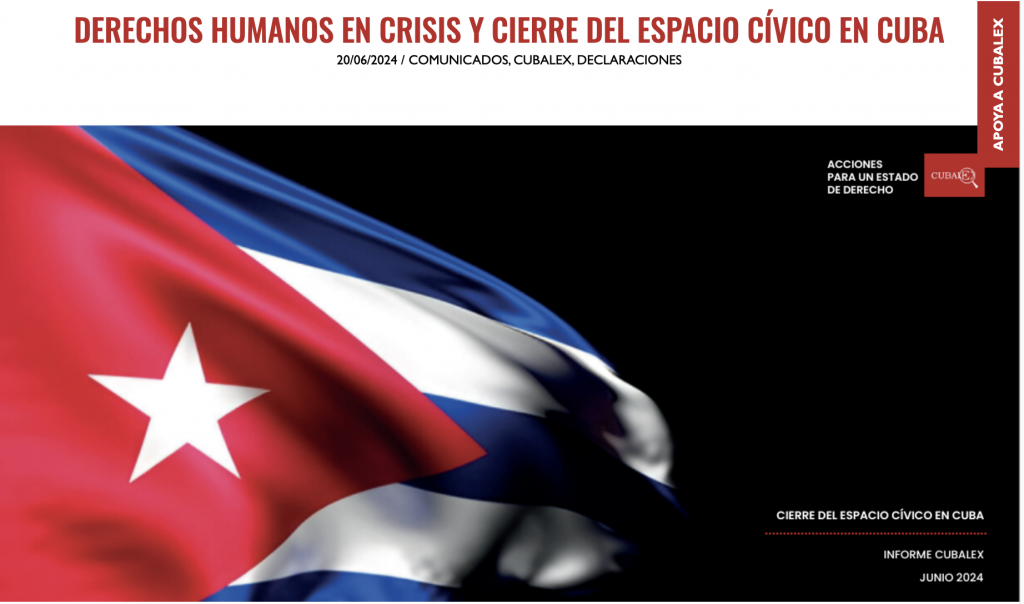
Human Rights in Crisis and the Closure of Civic Space in Cuba / CUBALEX

Cubalex, 20 June 2024– Latin America faces serious human rights challenges, including social crises, closure of civic space, criminalisation of protests, persecution of journalists, repression, intimidation and harassment of critical voices that differ from or oppose power structures. These issues, among others, are evidence of a regional emergency.

In this context, and in the framework of the 54th General Assembly of the Organisation of American States (OAS), the Latin American Human Rights Consortium (HRC) is convening the event “Human Rights as a Pillar of Hemispheric Security in the Americas”, to be held on 26 June in Asunción, Paraguay.

At the meeting, participants will analyse in depth the social, political and economic crises affecting several countries in the region, with a particular focus on Cuba, El Salvador, Nicaragua and Venezuela.

Cubalex will present the report “Closure of civic space in Cuba”, which analyses how the state has implemented a systematic mechanism of harassment against civil society, with the aim of preventing the active participation of citizens in the political, economic, social and cultural life of the country.

 See details of the Cubalex report.

The post Derechos Humanos en crisis y cierre del espacio cívico en Cuba appeared first on Cubalex.

Translated by GH

Three Baseball Players Who Left Cuba Guarantee Their Stay in the U.S. Major Leagues

Alexander Valiente was hired by the Toronto Blue Jays, while Reykelly Rubi received an opportunity with an Orioles affiliate.

Reykelly Rubi at the time of signing his contract with the Orioles / X/@francysromeroFR

14ymedio bigger14ymedio, Havana, 28 June 2024 — The baseball players Alexander Valiente and Reykelly Rubi, who left Cuba in search of a better future, have reached initial agreements with the Toronto Blue Jays and the Baltimore Orioles, respectively. With them are 21 athletes from the Island who have been “hired in the current international period” by Major League teams in the United States, reported journalist Francys Romero.

The Canadian team guaranteed Valiente, 21, a bonus of $75,000 to secure his signing. The contract will be made official on January 15, 2025. This young man was part of the Cuban U-23 team; in 2023 he asked for his leave. “I’ve decided not to play anymore for now. Please don’t ask me for an explanation,” he said at the time.

The Canadian team guaranteed Valiente, 21, a bonus of $75,000 to secure his signing

Romero attributes the departure of these athletes to the fact that baseball on the Island has become “uneven, old and without an audience.” He regrets that what used to be a game “full of brilliance now seems to be an old Development League compared to the world talent.” continue reading

Por la Goma, a publication specializing in the sport, which is considered a cultural heritage on the Island, reported last year that the loss of athletes was occurring “daily.” The massive abandonment of players is influenced by the issues of “quality [of life], remuneration and inflation.”

This Wednesday, Reykelly Rubi, who left the Island at the age of 14, received an opportunity with an Orioles affiliate. At age 18 and after a period of training at the Yuan Pino Academy in the Dominican Republic, he is considered by the talent scouts as an “intriguing arm.”

“His curveball was evaluated above the average [between 88 and 90 miles per hour], with an acceptable turning speed, which makes him a promising pitcher for the future of the Baltimore Orioles,” published the magazine Swing Completo.

This week, the 26-year-old Yosver Zulueta’s debut with the Cincinnati Reds also materialized. The athlete from Villa Clara left Cuba in October 2018. After signing with Toronto in 2019 for a million dollars, he had to undergo surgery for a knee injury that kept him away from the playing field for a year.

This week, the debut of 26-year-old Yosver Zulueta with the Cincinnati Reds also materialized

In 2022, he passed through “all levels of the Minor Leagues” to resume the pace of the game, Romero said. “In the winter of 2023 he went to the Dominican Republic with the Leones del Escogido and had a positive experience.”

Last Tuesday Zulueta debuted as part of the Cincinnati team in the Major Leagues with three strikeouts. “He was a bit nervous at first but then showed his weapons: a straight that reached 99 miles per hour and a slider (a throw that drops the ball as it approaches the batter) of 91 miles per hour.”

Translated by Regina Anavy

____________

COLLABORATE WITH OUR WORKThe 14ymedio team is committed to practicing serious journalism that reflects Cuba’s reality in all its depth. Thank you for joining us on this long journey. We invite you to continue supporting us by becoming a member of 14ymedio now. Together we can continue transforming journalism in Cuba.
Water Shortages in Havana Continue Despite Repairs

Cuba’s water crisis is affected by problems with the electricity supply

In the capital, residents fill containers to face the urban drought / Radio Habana Cuba

14ymedio bigger14ymedio, Havana, 28 June 2024 — Havana continues with an intermittent water service, like that suffered by other provinces, in a water crisis that is marked by problems with the electricity supply on the Island. This Friday, if the residents of the capital turn on the faucet, they will surely find some dribbles of water that serve only perhaps, to scrub the floor and fill some containers in order to face the urban drought. The efforts of the Havana authorities to normalize the supply have not yielded the hoped-for results.

Everything dates back to Thursday of last week, when a pipe in Cuenca Sur ruptured from a power surge.

The water shortage has been aggravated these days by the effects on the electricity service, which on Thursday finally exceeded shortages of one thousand megawatts (MW). The Electric Union of Cuba (UNE) predicts for this Friday a maximum demand of 3,150 MW for an availability of 2,160 MW, which entails a deficit of 990 MW and an impact of 1,060 MW. The Antonio Guiteras plant in Matanzas, due to a breakdown in the boiler, is not providing service today, as announced by the UNE. This is nothing new; the plant has been out of service for months, and generation problems are also frequent. continue reading

Since last week the flow of water in Havana is improved by zone every fourth day

Faced with such a scenario, the Havana authorities made the decision last week to enhance the flow of water by zone every fourth days. “We are going to guarantee the service, but it will have a marked impact on the day that the water is not flowing,” the director of operations of Agua Habana, Rosaura Socarras, explained on Wednesday in a television interview.

After a meeting held on Tuesday between Havana authorities and state officials, it was reported that the water supply has not recovered its normal volume due to multiple causes; among them, the five motorized water pumping stations out of service – the 3, 4, 15,16 and Rincón 4, said the newspaper Tribuna de La Habana. In addition, the water levels have not yet recovered and are below average despite the heavy rains recorded in recent days.

The problems with the water supply (in Cuba) are not exclusive to Havana. This same Friday, the official press reported that in Villa Clara the Government has invested more than one hundred million pesos in the installation of ten kilometers (6.2 miles) of pipes. These works seek to connect the towns of Mataguá, La Yaya and Jorobada with the Paso Bonito pumping station, located in Cumanayagua, the newspaper Vanguardia reported.

Translated by Regina Anavy

____________

COLLABORATE WITH OUR WORKThe 14ymedio team is committed to practicing serious journalism that reflects Cuba’s reality in all its depth. Thank you for joining us on this long journey. We invite you to continue supporting us by becoming a member of 14ymedio now. Together we can continue transforming journalism in Cuba.

A Senior UN Official and the Cuban Leaders Compete in Mutual Self-Hype

“Cuba is a country of great importance, not only for the Caribbean but for the world,” said Dennis Francis.

Dennis Francis, presidente de la Asamblea General de la ONU, junto a Miguel Díaz-Canel, este viernes / X/@UN_PGA

14ymedio bigger14ymedio, Madrid, 29 June 2024 — The official visit to Cuba of the current president of the UN General Assembly, Dennis Francis, shows that the Island has an undisputed ally in the organization. “Cuba is a country of great importance, not only for the Caribbean but for the world,” Francis said in one of his public speeches, where he also described the Cuban as a “great people.”

Through his official account on X, the diplomat, a native of Trinidad and Tobago, expanded his praise: “As a founding member of the United Nations, Cuba has always advocated for building a better, inclusive and egalitarian world. A world in which there is peace, prosperity, progress and sustainability for all. While we strive to achieve these objectives, I thank Cuba for its vision and leadership and I look forward to a future collaboration towards our shared goals.” Francis did not say, however, that the Island entered the UN under the presidency of Ramón Grau, in 1945, almost 14 years before the triumph of the Revolution.

Similarly, and according to the Minister of Public Health, José Ángel Portal Miranda, whom he met this Friday, Francis highlighted his “admiration” for the “achievements” of the Island in the health field and conveyed to the doctors “a recognition for keeping up the social conquests forged in Cuba.” continue reading

The three held a meeting with the Cuban Foreign Minister, Bruno Rodríguez, in which he highlighted “Cuba’s commitment and contribution to multilateralism

For his part, Miguel Díaz-Canel, with whom the diplomat also met yesterday, described the meeting as a “fruitful exchange.” The Cuban president thanked Francis through his networks “for his recognition of Cuba’s performance and commitment to the search for solutions to the challenges of the nations of the South during our presidency of the G-77 and China.”

Earlier, the three held a meeting with the Cuban Foreign Minister, Bruno Rodríguez, in which he highlighted “Cuba’s commitment and contribution to multilateralism,” according to the state agency Prensa Latina.

“In the countries of the South we know that this is the place where we are best heard and where, when we are united and act together, we can make the legitimate interests of humanity and the peoples prevail,” Rodríguez added at the meeting.

This Friday was the penultimate in a three-day visit by Francis to the Island.

During a speech on Friday afternoon at the University of Havana, he stressed that “the United Nations is in the DNA of Cuba” and that the Island has been a defender of “peace and respect for the sovereignty of all nations.”

He also thanked Havana for heeding the calls of the United Nations to send health personnel to countries such as Haiti and to regions such as West Africa during the Ebola crisis. There was, on the other hand, not a single allusion to the reports of several UN rapporteurs who described the conditions of Cuban doctors on the international missions as “forced labor.”

Translated by Regina Anavy

____________

COLLABORATE WITH OUR WORKThe 14ymedio team is committed to practicing serious journalism that reflects Cuba’s reality in all its depth. Thank you for joining us on this long journey. We invite you to continue supporting us by becoming a member of 14ymedio now. Together we can continue transforming journalism in Cuba.

The Cuba Regime Calls U.S. Report on Human Trafficking ‘Manipulative’

Díaz-Canel calls the US report an “outrageous maneuver of war” against medical collaboration

Some 300 Cuban doctors in a meeting with Díaz-Canel/Cubadebate

14ymedio biggerEFE (via 14ymedio), Havana, 25 June 2024 — On Tuesday, Cuban President Miguel Díaz-Canel described as “manipulative” the report prepared by the United States that keeps the island among the countries that do not comply with the minimum standards to fight human trafficking.

The U.S. report points mainly in the Cuban case to the so-called international missions of Havana, which for decades has sent thousands of professionals – mainly doctors – to dozens of countries.

“The empire has once again listed Cuba in its manipulative report on human trafficking. Outrageous maneuver of the open war against Cuban medical collaboration. Enough of this cynicism,” Diaz-Canel wrote on social networks.

He added that the U.S. Secretary of State, Antony Blinken, “is well aware of our policy of zero tolerance for this criminal practice.”

The United States considers Cuba, Venezuela and Nicaragua to be among the countries with the highest levels of human trafficking because they do not meet the minimum standards for its elimination and do not make significant efforts in this regard.

This is reflected in the Trafficking in Persons Report 2024 (TIP Report) released Monday by the State Department, which divides countries according to their degrees of human trafficking and places the above-mentioned continue reading

countries, which were already at the most severe level a year earlier.

In this regard, Cuban Foreign Minister Bruno Rodriguez also commented on social networks that “Cuba maintains a zero tolerance policy against human trafficking.”

“The inclusion of our country in unilateral and arbitrary reports by the U.S. government, only seeks to maintain and justify its criminal policy of economic asphyxiation against the Cuban people,” the foreign minister said.

The report calls on Cuba to ensure that “government-sponsored labor export programs comply with international labor standards, specifically that participants receive fair wages that are paid in full into bank accounts that workers can control.”

The US State Department considers that the missions of Cuban doctors abroad are “an indisputable case of forced labor.” That is why it keeps Cuba on its “blacklist” of countries that do not comply with the minimum standards for combating human trafficking.

The Cuban government considers “totally legitimate” the medical collaboration program that the island maintains in several countries and criticizes Washington for “committing a crime by trying to deny or hinder it for political reasons.”

Thousands of Cuban professionals have participated during the latter decades in missions in hundreds of countries. According to some estimates, they have become one of Cuba’s main sources of foreign exchange.

Translated by Hombre de Paz

____________

COLLABORATE WITH OUR WORKThe 14ymedio team is committed to practicing serious journalism that reflects Cuba’s reality in all its depth. Thank you for joining us on this long journey. We invite you to continue supporting us by becoming a member of 14ymedio now. Together we can continue transforming journalism in Cuba.

Sentences of 5 to 7 Years in Prison for ‘Promoting Hatred Against the Socialist System’ in Cuba

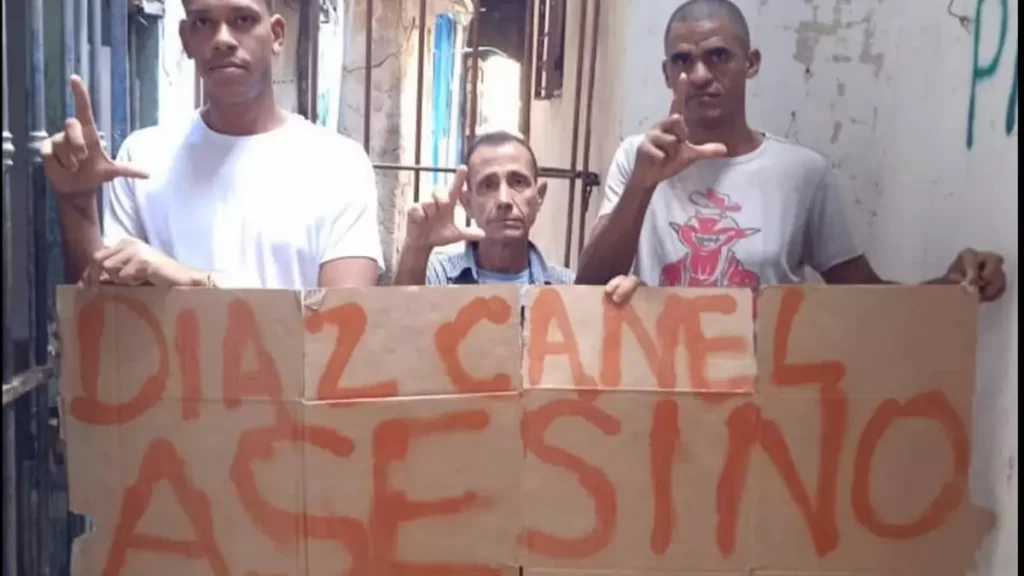
In February 2023, five activists took to the streets in Havana and displayed banners against the “failed state”

The five defendants were charged with propaganda against the constitutional order. / Facebook

14ymedio bigger14ymedio, Havana, 27 June 2024 — Five opposition activists – William Cepero García, Josiel Guía Piloto, Lázaro Romero Piloto, Alain Yosvani Cruz Suescum and Jesús Alfredo Pérez Rivas – were sentenced on June 20 by the Provincial Court of Havana to five to seven years in prison for the crime of propaganda against the constitutional order, for protesting last year against the Government, Prisoners Defenders (PD) reported Thursday.

According to the Madrid-based NGO, on February 13, 2023, the five activists, who have been members of different organizations for years, met in the municipality of Old Havana at the home of Josiel Guía Piloto, who is a member of the Republican Party of Cuba (not legally recognized). At that time, Guía Piloto asked his uncle, Lázaro Romero Piloto, to sew his lips together in protest.

Afterwards, the five men made posters with phrases such as “Cuba failed state,” “Díaz-Canel assassin” and “Homeland and life.” They took to the streets and began shouting “down with the dictatorship,” while waving the banners, which was also recorded, posted and shared on social media. continue reading

The five men were arrested by the authorities and transferred to the criminal investigation body, where they were handed precautionary measures without legal protection

According to the sentence, which discredits the protests, the five accused “planned to go out into the streets carrying posters with anti-constitutional, counter-revolutionary content in their hands, aimed to promote hatred and rejection among the population against the socialist government system embodied and approved in the Constitution of the Republic of Cuba.”

The following day, the five men were arrested by the authorities and transferred to the criminal investigation body, where they were handed precautionary measures without legal protection and were subjected to interrogations without lawyer representation, according to PD.

The crime for which they were sentenced is the same in all five cases: propaganda against the constitutional order. Cepero Garcia, 59, got 5 years in prison.

Guía Piloto was sentenced to seven years. He had previously served five years in jail starting in 2016, for public disorder and contempt. In 2019, the Inter-American Commission on Human Rights (IACHR) granted him precautionary measures* due to serious violations of his human rights in prison; that same year, Amnesty International declared him a prisoner of conscience.

This case illustrates the complex relationship between the right to protest and restrictions imposed in authoritarian regimes

Meanwhile, Pérez Rivas got a five-year sentence. He was also arrested and imprisoned in 2016 along with Guía Piloto, although in his case, he was sentenced to six years. He was also granted precautionary measures by the IACHR.

Lastly, Romero Piloto, Josiel’s uncle, was punished with seven years behind bars, and Cruz Suescum received a sentence of five years of correctional work without internment.

“This case illustrates the complex relationship between the right to protest and the restrictions imposed in authoritarian regimes,” said the organization, which stressed that these acts of freedom of expression “should be protected and not criminalized.”

*Translator’s note: Source: A precautionary measure is a protection mechanism of the Inter-American Commission on Human Rights (IACHR), through which it requests a State to protect one or more persons who are in a serious and urgent situation from suffering irreparable harm.

Translated by LAR

____________

COLLABORATE WITH OUR WORKThe 14ymedio team is committed to practicing serious journalism that reflects Cuba’s reality in all its depth. Thank you for joining us on this long journey. We invite you to continue supporting us by becoming a member of 14ymedio now. Together we can continue transforming journalism in Cuba.

The Official ‘Summer Mode’ Campaign Seeks To Hide Cubans’ Sad Reality

In the official “summer mode,” people do not stay at home with a candle or a generator to overcome the blackouts

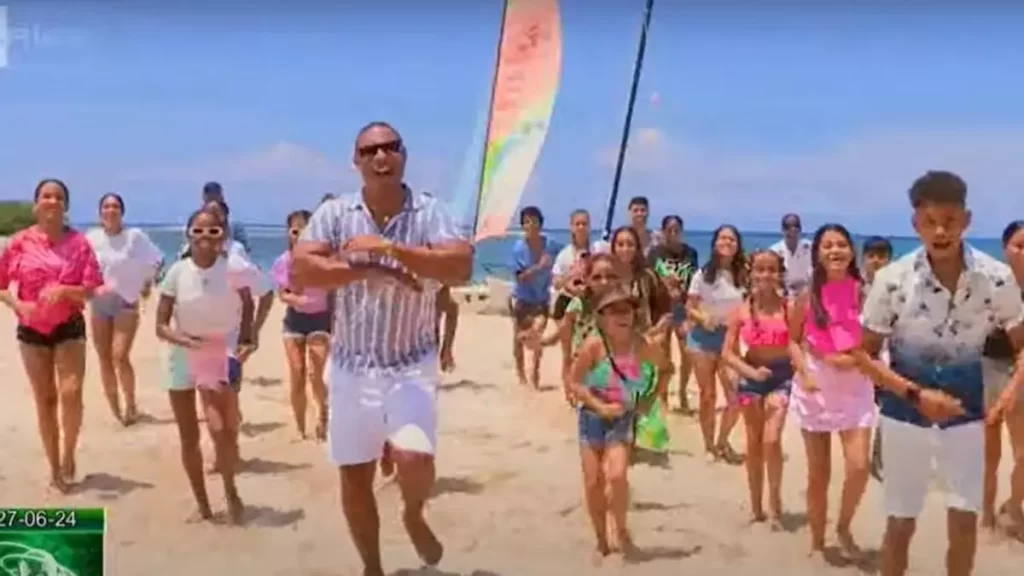
Screenshot of the video clip with which the government promotes summer in Cuba / Canal Caribe/YouTube

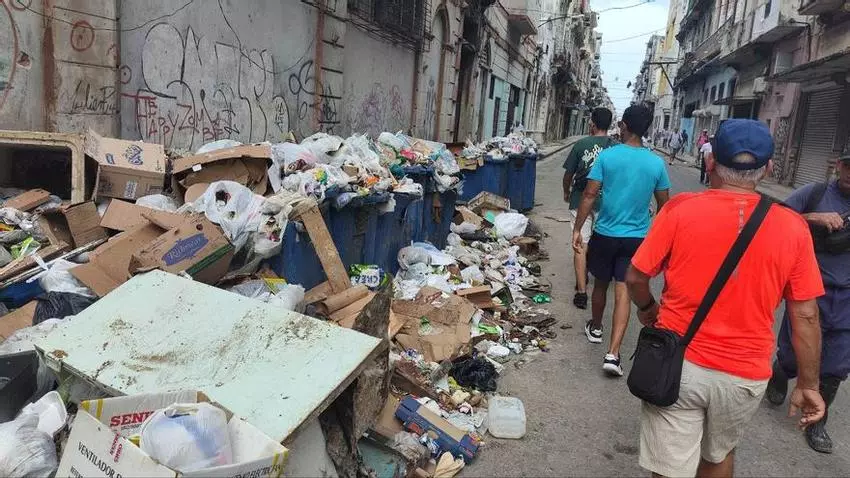
14ymedio bigger14ymedio, Yoani Sánchez, Havana, 30 June 2024 — Before everything smelled different. The aroma that reached us during the months of July and August was that of the syrups from the slushies that refreshed, the cloying fragrance of the coconut lotion to tan on the beach, and the aroma of the pork rinds in the carnival kiosks. Now, Havana stinks everywhere and not even the official “summer mode” campaign can cover up the stenche of humidity, sewage and anguish.

This Sunday, a mountain of garbage on the corner of Neptuno and Campanario streets synthesized part of the essence of a city plunged into crisis and miasmas. Among the waste that overflowed the sidewalk and forced passersby to share space with the old collective taxis that pass along the central avenue, the box of a battery-powered fan stood out, a coveted object in a country where no one is excited about the end, in the short or medium term, of unwanted electrical outages.

In “summer mode” teenagers dance without worry, although in Havana’s slums parents advise their children not to go out at night

A few centimeters from the appliance packaging, a cardboard box labeled with the Mexican brand Richmeat reminded us of one of the foods most consumed by families on this island. A “mixed seasoning” mincemeat with little nutritional value and dubious composition that has come to replace in many Cuban dishes the unattainable beef, the very expensive pork, the unstable chicken or the disappeared fish. Another empty box, which once had imported yogurts, stood out on the mound of waste and completed a painful part of our daily life: those products that can only be consumed by those who have foreign currency or family abroad to buy them.

A stench that fills everything, that sticks to our clothes, gets into our noses and we take home stuck in our hair and attached to our skin / 14ymedio

The trash diver who rummaged through the bags and remains to try to save something to resell later could not be missing from this puzzle made from stench and debris. Both the poor collector with his frayed jacket and his extremely thin body, and the neighbors who passed by and sorted through the debris of domestic life, ended up impregnated with the smell of so much filth. A stench that fills everything, that sticks to our clothes, gets into our noses and that we take home stuck in our hair and attached to our skin. continue reading

None of that stench seems to reach the idyllic scenes of sand, sea and fun that the official media broadcasts these days as a preamble to summer. In the musical theme that serves as the soundtrack to the school holidays, joy overflows, young people do not assemble a raft of disappointment to jump into the sea, the singer fantasizes about having “a good beer” on the seashore, without alluding to the fact that such an act would cost a retiree an entire week of pension, and everything exudes the perfume of hope.

Everything smells brand new in that parallel reality that they invite us to believe in

In “summer mode” teenagers dance without worry, although in Havana’s slums parents advise their children not to go out at night because “a stab wound awaits you on any corner.” In “summer mode” the national obsession is not to buy a ticket to fly to Managua, and joy fills everything, displacing the popular weariness that does not sneak in anywhere in this stage set up to deceive the naive and the uninformed.

In the “summer mode” broadcast on national television, my city does not stink, people do not use a candle or a battery pack so their homes can overcome the blackout, and a lanky man with a lost look does not explore the dirt in search of of something salvageable or a little food to put in his mouth. Everything smells brand new in that parallel reality that they invite us to believe in. It has the aroma of a baby cologne trying to cover up the stench of collapse.

____________

COLLABORATE WITH OUR WORKThe 14ymedio team is committed to practicing serious journalism that reflects Cuba’s reality in all its depth. Thank you for joining us on this long journey. We invite you to continue supporting us by becoming a member of 14ymedio now. Together we can continue transforming journalism in Cuba.