In private, the communist leader did not welcome the economic “package” of the Ordering Task, but assuming that he had nothing against the Party or Marino Murillo, who even thought that he could succeed, or against anyone among the Cuban communist regime, he was silent and just waited for what was coming. This is not a recommended attitude for someone who is supposed to be at the head of an economy in serious crisis and locked in a vicious circle from which it is unable to exit.
That is why now, three years after the Cuban economy has lost critical mass, real GDP, investments, purchasing power and international attractiveness, it is very easy to go out on television with Randy Alonso and give a speech that aims to change the pace, not having them all with him and with an evident interference from Prime Minister Marrero. Are the Economy Minister’s days numbered? We’ll see. continue reading
Undoubtedly, it was a long Round Table program, in which Gil was accompanied by Regueiro Ale, another who is worth more for what he doesn’t say than what he does, and both undertook the unfortunate task of informing the people about the foundations of the regime’s decisions to correct the main distortions of the Cuban economy and relaunch it in 2024.
It involves two consecutive actions. First, to correct the distortions. Second, to give a boost to the economy; “reboosting” is another lie.
It is interesting to start from the distortions that Gil sees in the economy. And here, once again, the situation of the war economy is mentioned, caused by, and I quote verbatim, “the pressures of the intensified blockade, which hinders all the efforts we have to make for the economic performance of the country.”
A bad start, which loses perspective by spending energy on distortions. The intensified embargo/blockade does not prevent Cuba from developing its economic model, relating economically to 192 countries in the world, obtaining investments, tourists and most importantly, remittances, 90% from the country that “embargoes” the Cuban economy. This is a poor analysis of distortions if it is intended to find the way out of the tunnel from the available economic resources.
The second wrong idea is the mantra, repeated ad nauseam, that “we have to overcome, we have to find the alternatives by designing measures in accordance with our economic and social model, inclusive in our socialism, and that allow us, with objectivity, with realism, to get ahead.” This model failed all over the world, ask Vietnam or China, and which has been in Cuba for 65 years, a magnificent age for its retirement. If the government chooses the communist model to face the complexities, boost the economy and correct the distortions that are present in the country, in a year or two the situation may be even worse. Ministers Gil and Regueiro know it, but they are silent.
Nor does the argument work that the world economy is malfunctioning and this impacts Cuba. A simple look at the Caribbean resorts in the Dominican Republic or Costa Rica dismantles this argument. The hotels are 100% full in this winter high season. In Cuba, they aren’t. Something is not right when the Germans, French and Swiss choose other destinations.
And of course, since there are no answers to the main questions, it’s interesting to talk about the second one, which has no solution: the regulated family basket.** Here the minister said that the population is against maintaining subsidies to all people equally since not everyone has the same purchasing power. This is a lie. What the population wants is to get rid of the regulated basket and be able to choose freely. As do many companies, too, because they could sell the products without dependence on subsidies, through the rules of supply and demand. The minister, on the other hand, says that he will review the basket, maintaining products at subsidized prices even if this is not an equitable distribution. The country’s imports for the basic basket cost more than 1.6 billion dollars as a result of increased prices in the international market.
The basket could be suppressed at any time and allow citizens to be free to choose. This is how Cuba worked before 1962, the date of the entry into force of the ration book that has been an instrument of social and economic control of communist design, which has increased poverty and misery in Cuba to levels not observable in other countries. Advances towards economic freedom are essential to relaunch the economy. Gil knows it, just as he knows that the Communist Party, committed to centralizing the decisions of choice of goods for Cubans, is the origin of the regulated basket. Any alternative to subsidized prices is seen as something negative.
And again he lies, when he says that “this doesn’t mean that the basket will disappear.” It won’t take long; it’s already happening.
Fuel is the second distortion, but Gil didn’t say why there is no oil in Cuba. Basically, two reasons. First, from the second half of 2019, Venezuela systematically reduced its oil shipments to the Island for internal reasons. Less subsidized oil forced the regime to resort to the international oil markets, but there it did not obtain financing because it wasn’t current on its debts. In Fidel Castro’s time that was possible, but in the time of Díaz-Canel either you pay or they don’t give you anything.
And by combining these two factors and attracting far fewer tourists to the Island, the ability to buy oil decreased significantly. And now Gil lies when he says that the population is worried about maintaining subsidized fuel prices, probably the lowest in the world compared to the prices of other countries. If the subsidized basket causes harms economically and socially, oil subsidies distort the energy decisions of all agents.
This is not an issue to review but to straighten out, as soon as possible. Without fuel, the economy and the country cannot function, and the dependence on oil makes Cuba a country with almost zero renewable energies. Blaming the absence of an internal mechanism of convertibility of currencies into national currency for fuel is not only a lie: it’s nonsense.
Third distortion: electricity. The same problem as fuel. Subsidized prices that prevent companies from obtaining profitability so that the quality of the service leaves much to be desired, and the lack of investment causes the network’s failures. Savings are not possible because, as a result of high prices, consumption levels are among the lowest in the world. It’s another area to be resolved with reforms in supply and demand. As in other goods and services, Gil now discovers that those who consume the most also affect those who consume the least, because when a blackout occurs, everyone suffers. It doesn’t discriminate between the largest and the smallest consumer. The solution of setting different rates depending on the level of consumption could be even worse.
He did not say it as such, but Gil incorporated the private enterprises into the list of distortions that have to be corrected by reciting some alleged opinions of the population that contribute little to the technical debate. Specifically, that those who want to buy a certain product have to go to the private companies. Why don’t Cubans find what they want in the State stores? Why is there rationing, scarcity, poverty? If the private businesses fill the need, although at a higher price, perhaps it is because this is the rule of the free market. By making the private companies fulfill a complementary function rather than a main function, the only thing achieved is that more merchandise is unavailable and people get hungry.
Then it was the turn of the distortion of the transport tariffs, which don’t earn enough to cover the costs of the State. If this is the scenario, the offer of services will fall and fewer goods and people will be transported as happened this year. Again, economic freedom is the solution, but the minister does not recognize it.
Gil pointed out that in the last four years “a group of measures has been adopted such as the incorporation of the non-State sector of the economy, the elimination of restrictions on the salaries in State companies and the removal of restrictions on distributing profits,” but he acknowledged his poor success. He even questioned the legal rules for non-State economic actors that, in his opinion, were carried out without having a previous experience of their operation in the economy, taking as a reference the self-employed workers, which has nothing to do with the private companies. Another miscalculation, and on they go.
A special moment of the program was when Gil explained that, in the face of versions that the measures have a neoliberal character, “all decisions start from a broad process of consultation and analysis within government institutions, with the participation of academics, the Party militants and the analyses made from popular opinion.” Well, what a pity, because Vietnam, for example, thanks to well-designed neoliberal measures, overcame famines in five years and became a world’s leading exporter of rice. And what about China?
Cuban communists are the only politicians at the international level who continue to obsessively question neoliberalism, a doctrine that has given much better results than those applied by the communist model. If instead of criticizing without thinking, they reflected on what neoliberalism represents in 2023, another cock would crow.
Gil’s agenda affects the aspects that have been a failure, such as increasing the role of the State as a regulatory entity in the economy and intervening in the foreign exchange market by slowing down privatization. This gives the State a role that it cannot play because of its dependence on subsidies. Why does he lie over and over again? The market is the main mechanism for the allocation of resources in any economy, and that is neoliberal doctrine. I hope this is the way forward.
Gil’s next lie was to point out that these measures protect the social conquests of the revolution. It’s just the opposite. It is not possible to sustain a public expenditure of the dimension of the one that exists in Cuba if more wealth, employment and production are not generated. The chosen path has confirmed this for decades; a State-centralized distribution of resources goes against the trends of the world economy.
Neoliberalism, where it triumphs, does not lead the State to neglect taxes, but to liberate the markets, deregulate and act effectively. Inclusive measures to protect the people and the vulnerable need a solid economic base. Without growth, it is not possible to distribute.
So Gil is convinced that the measures will be able to correct distortions in time, and although the transformations have risks, they have to be assumed to be favorable for the revival of the economy, which is the other side of the coin.
If the intent is to lower the deficit, estimated at 18% and considered high, it must be corrected with taxes, prices and measures aimed in that direction.
It’s an important issue. Raising taxes goes against growth. If the main purpose is to accelerate the country’s economic recovery, increasing taxes is contrary to that objective. As for prices, inflation has moderated but remains high in food, recreation and transport. The minister is silent and does not tell the whole truth by assuming measures that will not give results and are poorly directed.
Part 2 is here.
Translator’s notes:
*The Ordering Task is a collection of measures that include eliminating the Cuban Convertible Peso (CUC), leaving the Cuban peso (CUP) as the only national currency, raising prices, raising salaries (but not as much as prices), opening stores that take payment only in hard currency, which must be in the form of specially issued pre-paid debit cards, and a broad range of other measures targeted to different elements of the Cuban economy.
**The monthly allotment of rationed goods.
Translated by Regina Anavy
____________
COLLABORATE WITH OUR WORK: The 14ymedio team is committed to practicing serious journalism that reflects Cuba’s reality in all its depth. Thank you for joining us on this long journey. We invite you to continue supporting us by becoming a member of 14ymedio now. Together we can continue transforming journalism in Cuba.
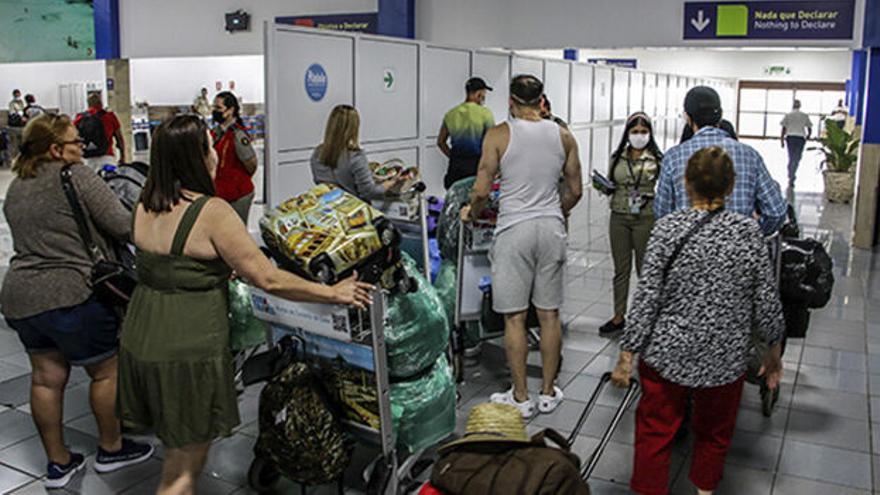
 EFE (via 14ymedio), Havana, December 31, 2023 — The Cuban authorities announced this Saturday a new extension – until March 31 – to the tariff exemption for food, toiletries, medicines and even generators that travelers can bring to the Island for non-commercial purposes.