
Calabria Contracts for 120 Cuban Doctors Despite Criticism from Unemployed Health Workers in Italy

Occhiuto gave them a “warm welcome” and admitted that the initiative had drawn criticism, but that there was now a “will to cooperate.” (Facebook/Roberto Occhiuto)

14ymedio bigger14ymedio, Havana, 5 August 2023 — A contingent of 120 Cuban doctors arrived this Thursday in Calabria, in southwestern Italy, as confirmed by Roberto Occhiuto, president of the region. “I said it and I repeat it: they are not going to steal any jobs from Italian doctors,” said the politician, given the suspicions that the hiring of the group has aroused, as it the 51 healthcare workers that have been working in the province since last January.

“They will give us great help,” said Occhiuto, who claimed that the Cubans had “great experience, widely appreciated both by the Italian doctors who worked with them and by the patients in the hospitals they treated.” The official hopes that, given the difficulties that the Calabrian health system is going through, according to Occhiuto, the island’s physicians will help “keep the departments and hospitals open.”

To the announcement, made by the Calabrian president on his Facebook profile, was added a message detailing where the Cubans are expected to work. Some 42 – he wrote – will go to the provincial health organization of Cosenza, while 22 will work in the capital of the region, Catanzaro. Seventeen will live in Crotona and the same number in Cosenza. Another 9 will work in Vibo Valentia, 2 in Dulbecco di Catanzaro and the rest in various regional offices.

OnCuba reported that the healthcare workers were received by the highest authorities of the region at the University of Calabria. For his part, Occhiuto gave them a “warm welcome” and admitted that the initiative had generated criticism, but that now there was a “will to cooperate” between Italian health workers and those who come from the island. continue reading

According to the outlet, Occhiuto had already mentioned the controversy several times and was forced to state -during the signing of the contracts with Cuba, in Rome- that the arrival of the Cubans did not affect the employment of Italian doctors and that 2,500 from the country itself had been accepted by the Calabrian Health system.

The politician also said, during a television interview, that the solution was partial and that it will be necessary to sign 2,300 new contracts in a year and a half to achieve optimum performance.

Last May, the Cuban Minister of Health, José Ángel Portal Miranda, and his Italian counterpart, Orazio Schillaci, meeting in Geneva, Switzerland, signed a memorandum of understanding for collaboration in the area of ​​health and medical sciences.

The document stipulated the strengthening of cooperative relations and contained a mention of the Henry Reeve medical brigade, which had already worked in the Lombardy and Piedmont regions during the coronavirus pandemic. At that time, there were already 63 Cuban doctors working in that country.

Italy is not the only European country that has opted to hire health workers from the island. The Government of Portugal announced that it will employ between 200 and 300 doctors from different Latin American countries – including Cubans – to perform functions in health centers health and ensures that “all rights” of professionals will be respected.

During Cuban President Miguel Díaz-Canel’s visit to Portugal in mid-July, President Marcelo Rebelo de Sousa had revealed his interest in hiring Cuban doctors after verifying the work of health workers in Italy. Initially, the service would be exercised for a period of three years.

According to the Portuguese outlet Jornal de Noticias, Rebelo de Sousa explained that the Cubans would collect their money without intervention from the Havana regime*. The president said he had asked Cuba for a “different agreement than usual” to also pay those hired directly. Supposedly, he managed to get the Cuban government to accept it, although the exact terms of the agreement are still unknown.

The medical brigades are one of the main sources of foreign currency for the Cuban government, despite being frequently pointed out as systems of forced labor by international organizations such as Human Rights Watch or Prisoners Defenders. The United States also included Cuba in the list of countries that violate human rights.

The Cuban government has also been accused of using the contingents to maintain its influence in allied countries, such as Mexico, Italy, Qatar, Brazil, Venezuela or Nicaragua. The National Office of Statistics and Information (Onei) calculated that, in 2021, the Cuban State collected 4.349 billion dollars for the export of health services to foreign governments.

*Translator’s note: The common arrangement to date has been for foreign governments to pay the Cuban government directly for each worker, and from this the Cuban government pays each worker only a portion of the total — in some cases as little as 10% — and retains the rest.

____________

COLLABORATE WITH OUR WORKThe 14ymedio team is committed to practicing serious journalism that reflects Cuba’s reality in all its depth. Thank you for joining us on this long journey. We invite you to continue supporting us by becoming a member of 14ymedio now. Together we can continue transforming journalism in Cuba.
Thousands of Cuban State Workers Have Not Been Paid for the Month of July

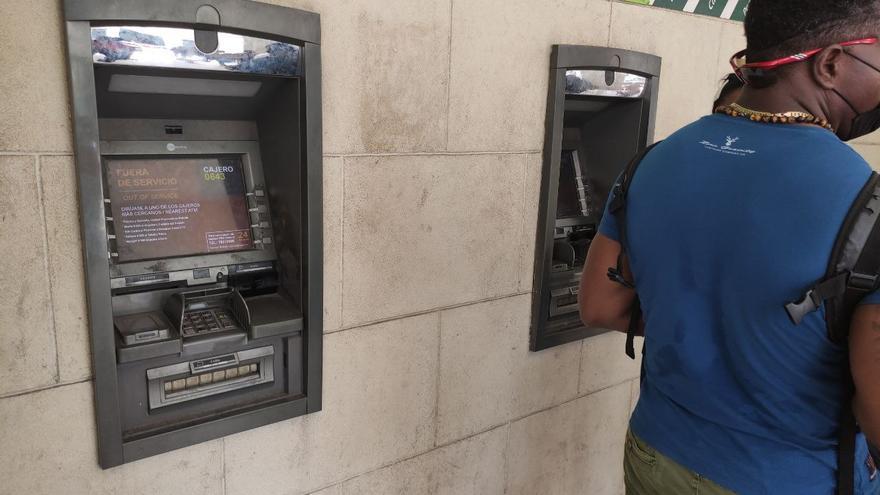
Cuba is facing a liquidity crisis, which has led the government to limit cash withdrawals. (14ymedio)

14ymedio bigger14ymedio, Havana, 4 August 2023 — The lack of cash has left thousands of state workers without the salaries they are owed for July, according to a note published this Friday by the newspaper Venceremos. In Guantanamo alone, the Central Workers Union (CTC) reports that 6,270 employees have not received payment, in addition to another 600 from the business system of forestry and construction services.

The provincial newspaper collected testimonies from employees who in recent days have had to borrow, delay payments for basic services or postpone vacations due to the cash deficit at Banco de Crédito y Comercio (Bandec). One of these cases is Milagros Savón, who, after depleting her family savings, had to borrow from three people with the “promise” of payment when she receives her July salary as a teacher.

Savón told the newspaper that the money was enough but barely for “the monthly shopping,” the payment of electricity and telephone bills, and the purchase of “a few pounds of chicken to appease the herd of grandchildren on vacation.” The teacher also referred to colleagues who lost the tickets for vacations they had bought “months ago” and “others who have not even been able to go to the park with their children.”

Yadisnay Collada González, also a teacher in the province, complained to the newspaper about not receiving the attention that, according to her, they deserve after the schools are empty of teachers due to the migratory exodus. “Only those of us who really feel love are left,” she said.

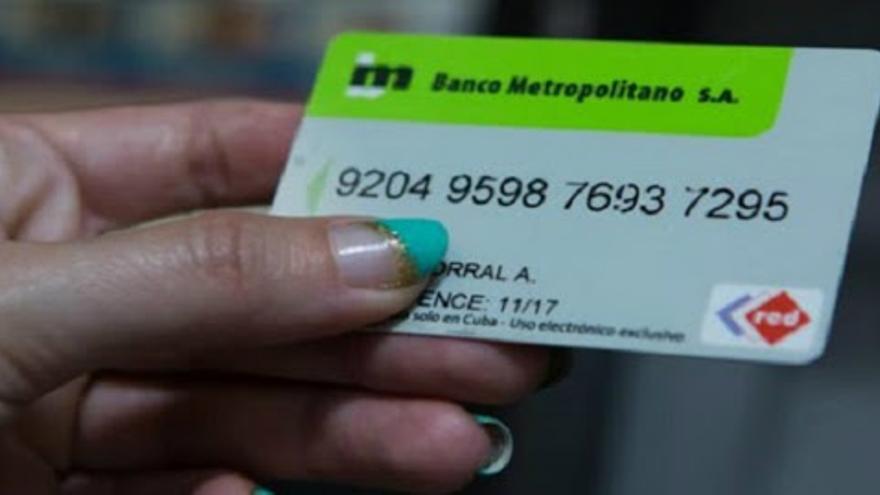
“This time the record for lateness was broken,” added a teacher, whose name was not provided, from the Emma Rosa Chui School in the city of Guantánamo. The man fears the worst when “they pay with a magnetic card.”

The cash shortage has been acute for weeks. The situation broke out this Wednesday, with the announcement of a package of measures that the Government promotes for “banking”  and that limits banking operations for all economic actors to a maximum of 5,000 pesos per day, and prohibits companies from withdrawing money from the ATMS. continue reading

“What do they tell us? That there is no money in the banks, but the explanation does not help us. People are very upset, and there are those who do not want to work,” Jorge Ferrer, an employee of Guantanamo Community Services, complained to Venceremos .

From the capital to the most remote towns on the island, the crisis affects all Cuban families. A prominent health professional in the municipality of Mayarí, Holguín, told 14ymedio annoyed that she was finally able to collect her salary, but in smaller denominations. “Do you see that bag over there? That big bundle. That’s my salary, in five-peso bills,” she said, pointing to a briefcase.

Anticipating that the crisis would worsen, another resident of the area narrated that recently he also withdrew the last 5,000 pesos that he had in the electronic account and the ATM handed out only 10-peso-denomination bills.

Idania Gutiérrez, a professor at the University of Guantánamo, is one of the few public employees who received her salary on time, but for her it is as if she had not been paid, because there is no money in the ATMs and businesses do not accept transfers either.

Emnier Savón Cotilla, a member of the Guantánamo CTC, assured that the payment of salaries “is being fulfilled little by little, depending on the cash that is entering the banks.” He assured that the delay is not due to a lack of budget, but exclusively to Bandec’s liquidity which, in addition to salaries, in July had to pay vacations in the education sector to more than 28,300 workers.

The number of employees without their salary is “constantly moving,” he said. On July 31, 5,120 educators were unpaid, and a day later it dropped to 1,200. For the Culture sector, the “relief has been a little slower” and until this Tuesday the payment to 3,000 employees had not yet been made, 62% of the 4,800 on the payroll.

Savón Cotilla recognized that payment through cards is not the solution if the worker cannot access their money. “We’d just be changing the problem,” he said.

____________

COLLABORATE WITH OUR WORKThe 14ymedio team is committed to practicing serious journalism that reflects Cuba’s reality in all its depth. Thank you for joining us on this long journey. We invite you to continue supporting us by becoming a member of 14ymedio now. Together we can continue transforming journalism in Cuba.
Cuban Government Will Suspend Private Companies That Do Not Enable Electronic Payment Within Six Months

Companies will have incentives to adapt to the plan, but also penalties if they don’t. (Cubatel)

14ymedio bigger14ymedio, Havana, August 4, 2023 — State and private companies that purchase food products –both agricultural and of animal origin, including meat, poultry, dairy products and fish products – must pay for the wholesale purchase exclusively through electronic payment and immediately. The measure, which is part of the new rules for the “banking-ization” of the country, affects other products, such as bread and sweets, cigarettes, tobacco and matches, and raw materials or preparations for sale in gastronomic establishments.

This package of news has been announced by the Minister of Domestic Trade, Betsy Díaz Velázquez, in an interview with the official newspaper of the Communist Party, Granma, published this Thursday night, in which she tries to give more explanations about the confusing government plan. According to the official, it is a proposal that is intended to “reduce the chains of non-payments” which, in her opinion, are hindering productivity and encouraging crime.

They are not the only sectors affected in a plan that will be deployed throughout the second half of the year. At the state level, electronic payment will be mandatory for a considerable list of services: the sale of construction materials, imported products “financed through access to the foreign exchange market,” fuel, accommodation, nightclubs, reservations in ground, sea and air transportation, in sports and cultural facilities, supplies – water, electricity, telephone and gas – and obituary services. continue reading

Díaz indicated that there will also be exclusive electronic payment for the leasing of private premises and that, in addition, the use of virtual stores should be the main way to promote and sell “idle and slow-moving inventories,” from wholesale sales to private ones, and leisure and transportation reservations.

The minister makes it clear what the Government’s priority is for those who do not adhere to the regulations: the suspension of the activity. The resolution of the Central Bank of Cuba indicated that establishments that repeatedly failed to comply with the provisions regarding deposits and cash withdrawals will face the closure of their accounts or suspension of banking services.

However, although it does make it clear that there will be a six-month period to adapt and implement the mechanisms aimed at prioritizing electronic payment, no type of sanction is set. The Granma note announces it as an important detail to highlight.

The text insists on the need for the program, which was approved by the Council of Ministers this Monday, due to the “already known difficulties with the extraction and availability of cash in the country,” and adds that the intention of the information is to clarify the dependence of Domestic Trade, the area that is fully affected by the regulations.

According to the note, the payment gateways will be Transfermóvil, Enzona, Remote Banking and “others that are developed.” In addition, it is noted that in order to grant the Commercial Certificate in Freely Convertible Currency (MLC) and the Commercial Authorization in pesos, it will be essential that the establishment have guaranteed conditions so that customers can use these payment methods. Those who can certify that they have a point of sale (POS) terminal “even when they are in the process of implementing payment through QR” will also be approved.

The two things affect both physical and virtual businesses that are managed by private or state companies and natural persons who carry out an authorized sales activity. This does not affect virtual stores with payments from abroad, which do not operate with Cuban banks.

The minister points out that it is necessary to create incentives for companies to join the program, including approval to create voluntary reserves for the development of electronic commerce so that businesspeople consider it an investment.

Variants are also planned to reward the consumer – among them some non-monetary ones, such as discounts or facilities to purchase tickets to different activities – and to motivate the seller, such as applying the payment for high performance and distinguishing in terms of profits, those who achieve more operations electronics.

But in addition to the incentives, “punishments” are also foreseen, such as the penalty for cash deposits for state-owned companies of local subordination, the percentage of which will increase if it is not possible to reduce at least that amount, and commissions will be charged for overcharging the box service.

In addition, Díaz announced that they are working on a training plan for both store managers and staff to promote electronic payment channels, although there are still many on the street who wonder if there will be the necessary connectivity to face a deployment of such caliber in a country where 4G is still missing too many times and barely reaches rural areas.

____________

COLLABORATE WITH OUR WORKThe 14ymedio team is committed to practicing serious journalism that reflects Cuba’s reality in all its depth. Thank you for joining us on this long journey. We invite you to continue supporting us by becoming a member of 14ymedio now. Together we can continue transforming journalism in Cuba.
Lowered Room Rates Weigh on the Bottom Line of Melia Hotels in Cuba

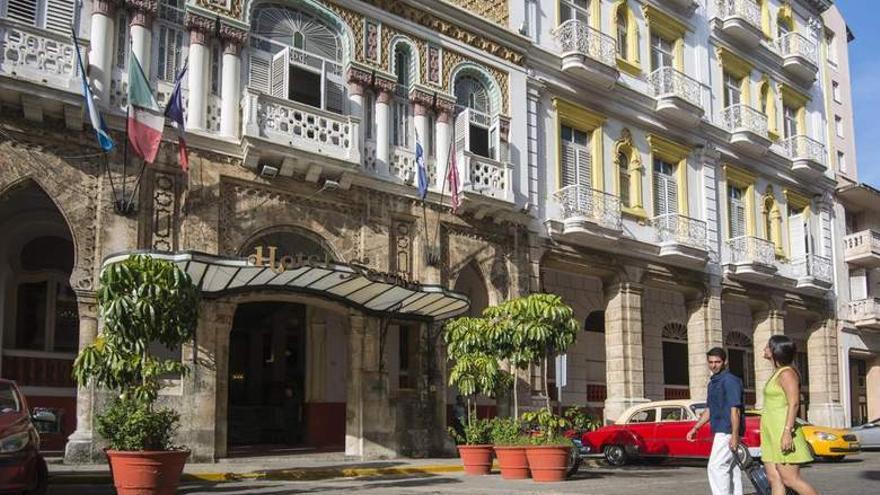
This September the inauguration of the Hotel Sevilla Habana Affiliated by Meliá is scheduled. (Meliá)

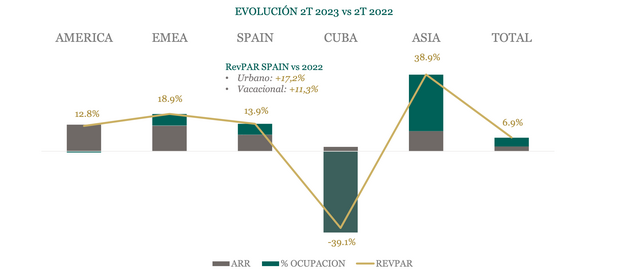
14ymedio bigger14ymedio, Madrid, 1 August 2023 — The drop in the price per room in Cuba in the first half of this year has caused a decrease in the profits that the Meliá hotel obtained in the first half of 2023. Although it is the main international hotel manager on the island and earned 46.1 million euros in this period, according to its results report, published this Monday, Cuba marks the exception and became a drag for the company, being the only one of its main markets in which revenue per available room (Revpar) fell, at 39.1% less than the same period a year ago.

Occupancy at Meliá hotels in Cuba was barely 40.9%, 7 points more than in the first half of 2022, but among the lowest in its business portfolio. Only Vietnam (32.7%) and Venezuela (26%) are below the island. The latter also contributes, together with Cuba, to weigh on the good figures of other Caribbean destinations such as the Dominican Republic (67.7%), and Mexico (64.1%). The United States is, globally, the one that registers the best occupancy data for the company, with 77%, although countries such as France or Italy, with the highest cost per room, achieve better performance.

In the case of Cuba, the average price per room this semester was only 84.9 euros, 27.8% less than in the same period of the previous year, when the price was around 117.5 euros. According to Meliá’s analysis, “Cuba has seen an upward trend in terms of international tourism, but it was affected by the contraction of the domestic market and the fall in average rates.”

Although the reactivation of flights led to the recovery of Canadian tourism, the main source of tourists for the Island, the report is devastating. “The aforementioned drop in the participation of national tourism, together with the new devaluation of the Cuban peso, implied the need to resort to offers to face the growing competition. This factor, added to the reopening of several hotels that operate in lower price segments, has caused an overall drop in average rates.” continue reading

In addition, the prospects for the hotel chain are not encouraging. “The quarter is expected to continue in the same vein as the previous one, with improvements in the arrivals of international customers but combined with the contraction of the domestic market,” the document reports, as it announces the opening of two new hotels for the third quarter of this year.

According to the report, “the second quarter confirms the return to normality in the tourism sector, with the exception of Cuba.” (Meliá)

Meliá’s expansion in Cuba has not stopped despite the bad data in this report. With the next two establishments to open – the Meliá Trinidad Peninsula, the first five-star hotel in the colonial town of Sancti Spiritus, and the Hotel Sevilla Habana Affiliated by Meliá – there are four opening this year including the Sol Caribe Beach, in Varadero, which has just started operations, and the Innside Havana Cathedral.

In addition, for 2024 there is another planned opening and after 2025, without a specific date, two new establishments. If the operation is completed according to forecasts, by that date Meliá would have 37 hotels on the Island, seven more than now, with a total of 15,515 rooms.

In this semester, however, the hotel company got rid of two establishments: the Gran Hotel Cuba, in Camagüey, with 72 rooms, and the Camagüey Colón, in the same province, with 58. Today, Meliá has 13,786 beds in its premises.

Despite the bad data for tourism on the Island, which began to decline in 2019 and sank with no sign of recovery during the pandemic – unlike in most countries where the sector is powerful – Meliá has not given up on its determination to continue improving facilities and expanding capacities in Cuba. Company CEO, Gabriel Escarrer, sanctioned by the US in 2020 after the activation of Title III of the Helms-Burton Act, has shown his confidence in the recovery of the market whenever he has been able.

On his last visit to the island, on the occasion of the International Tourism Fair (FitCuba) this May, Escarrer stated that the company intends to consolidate its position and that it trusts the forecasts of the Cuban Government regarding the increase in the flow of travelers to the country.

However, that projection has been crashing against reality for months. In the first half of the year, Cuba barely received 1,298,539 international visitors and is far from the 3.5 million target for the year. The statistics, as the Cuban economist Pedro Monreal noted, indicate that it is practically impossible to meet the target since, not even in 2018, a year with a record number of travelers, was a figure of 2.2 million travelers for the second half of the year achieved.

____________

COLLABORATE WITH OUR WORKThe 14ymedio team is committed to practicing serious journalism that reflects Cuba’s reality in all its depth. Thank you for joining us on this long journey. We invite you to continue supporting us by becoming a member of 14ymedio now. Together we can continue transforming journalism in Cuba.
Doubts and Confusion after Cuban Regime Announces New Bank Regulation

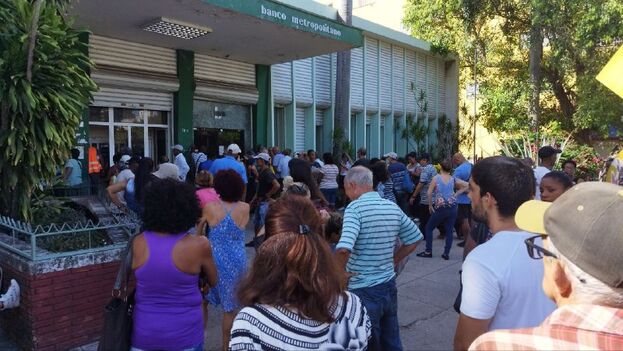
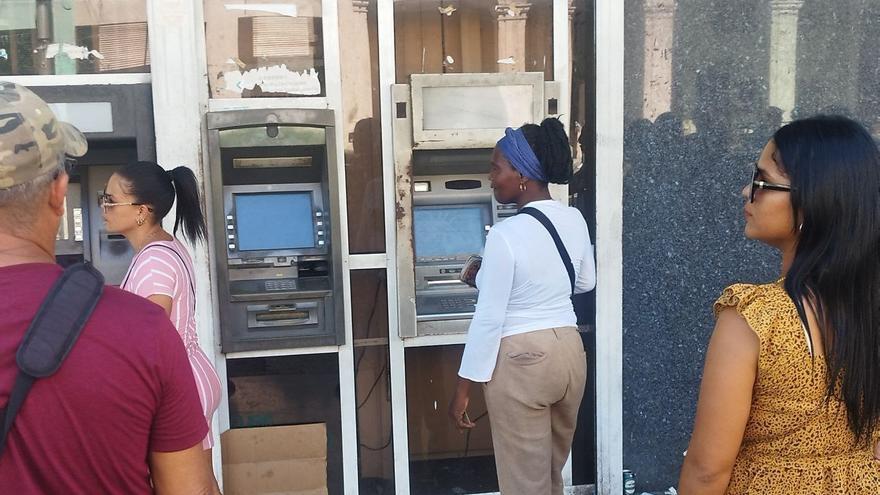
The line for an ATM at the Central Havana branch of Banco Metropolitano on Thursday. (14ymedio)

14ymedio bigger14ymedio, Juan Diego Rodriguez, Havana, 3 August 2023 — It was 10:00 AM and people in line for the ATM at the Banco Metropolitano branch on Infanta and San José streets in Central Havana were growing impatient. Their concern was not over the measure announced on Wednesday that prohibits businesses from withdrawing money in this way but rather something much more mundane: The machine was not working because there was no electricity.

It was announced in a special edition of the Official Gazette that the number of pesos a business would be allowed to withdraw from a bank on any given day — at a teller window no less — would be limited to 5,000. The news generated a wave of reactions on social media.

“You cannot withdraw more than 5,000 pesos,” explained an employee of the bank, outside of which people were still waiting because, though the lights had come back on, the ATM still had to be brought up to speed. A few blocks away at the branch on Belascoaín and San Martín streets, the situation was completely different. “We don’t have change at the moment,” an employee explained to this reporter.

A little later, at the corner of Belascoaín and Zanja, there was yet another response. “The changes take effect thirty days after publication of the measure in the Gazette,” claimed an employee. Confusion is the overriding reaction among those responsible for putting the Central Bank of Cuba’s resolution into effect. According to language in the official bulletin, the measure takes effect “three days after its publication.” In other words, on August 5. continue reading

Upon reading the actual regulation, the situation becomes clearer. The resolution limits “economic actors” — this includes individuals engaged in commercial activities — to 5,000 pesos a day in cash transactions. Any exchange that exceeds that number must be executed through a bank, specifically by electronic transfer.

The current maximum amount is 2,500 pesos, a limit set in December 2021. Cuban economist Elías Amor states that this latest move is, in his opinion, a reflection of “the monetary expansion produced on the Island by the runaway inflation,” noting that the new figure is no more and no less than double the amount approved just two years ago.

There are, of course, exceptions. If you have a bank account — the goal of the measure is to encourage this — and you need more cash to pay salaries and other compensation to workers, subsidies, Social Security benefits, alimony or to make advance payments, you may submit a request.

However, the goal is clearly for companies to be able to guarantee “their customers access and use of electronic payment channels for the acquisition of goods and the rendering of services”, as well as to pay taxes through those same means. However, it is obvious that the long-awaited “bankification” that the regime wants to carry out like a forced march lacks the telecommunications infrastructure necessary to carry it out.

The more than 340 comments on the government-run news website Cubadebate are evidence that this is one of the public’s most pressing concerns, even among those who support government control over private companies’ bank accounts. “We are not prepared for this step towards modernity,” the author of one post states bluntly. Dozens of others complain about broken or non-working of point-of-sale terminals. “So far, I have not seen or heard of a QR code at any neighborhood store and nobody has reported anything,” laments a man from Las Tunas.

The regulation provides a 30-day period for companies, in agreement with banking entities, to establish a schedule not to exceed six months for “incorporation into the banking program.” There are persistent doubts, however, that this is technically possible. “I tried to make a digital payment at a neighborhood store (in my district) that has its QR code visible but not readily accessible and it was impossible. Not even the store employees know how it works. I was in another industrial products store and at no point was the POS available. They almost never have a connection with the notary’s office,” writes one user.

Another controversial aspect of the new measure is that it prohibits cash withdrawals from ATMs. This applies to all business entities but, since state companies do not make this kind of withdrawal anyway, the only economic actors it affects are those in the private sector. Henceforth, private businesspeople will be forced to compete with the public for a place in line at the teller window, a situation that is aggravated by the fact that there are deadlines to deal with.

Employers can withdraw money to pay salaries and Social Security benefits no more than three days before payment is to be made. If they have not paid their employees within seven days, they are obliged to return the money the next business day.

“What can we expect from this sudden jolt by the regime to the private sector? Well, many businesses, especially the smallest and those least able to meet these demands, can still opt for the informal approach,” warns Elías Amor in his analysis of the measure.

On Facebook, which serves as forum for the owners of small and medium-sized businesses in Cuba, there is a tense calm. Doubts remain and people are on edge as they await more information.

Once back at the 14ymedio newsroom, it was learned that the ATM at the Belascoaín and San José branch had suffered a breakdown. The bank now had a hose stuck in the middle of the front door and its director was asking people to leave. A tanker truck had stopped at the door and was operating a thick drainage pipe. One more day that customers were left without their pesos.

____________

COLLABORATE WITH OUR WORKThe 14ymedio team is committed to practicing serious journalism that reflects Cuba’s reality in all its depth. Thank you for joining us on this long journey. We invite you to continue supporting us by becoming a member of 14ymedio now. Together we can continue transforming journalism in Cuba.
‘Here, I am No Longer Short of Breath,’ Says Announcer Yunior Morales After Leaving Cuba

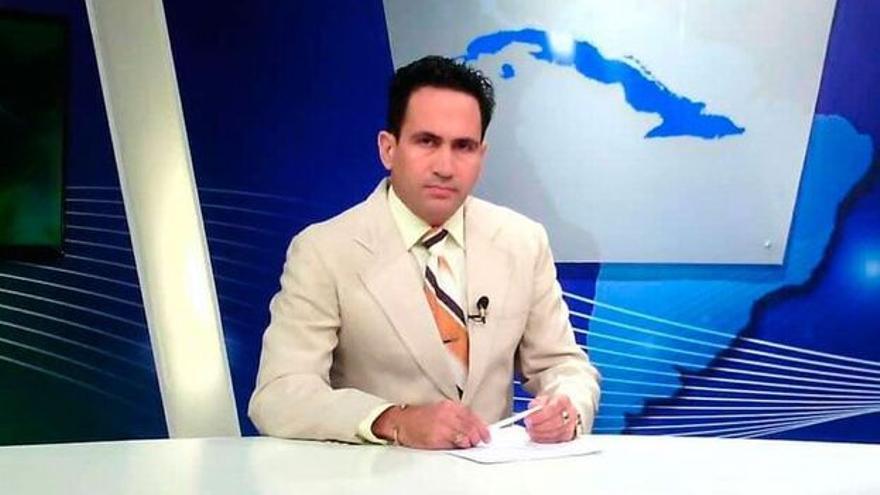
The face of Morales became one of the best known by Cubans for his hosting of the primetime broadcast of Cuban Television News. (Facebook/Yunior Morales)

14ymedio bigger14ymedio, Havana, 6 August 2023 — “I feel as if I had taken off old clothes, as if I had left my skin there, like leaving a prison.” The recognizable voice of Yunior Morales, which can still be heard in numerous Cuban Television commercials, speaks those words in an audio message. In it, this Friday, he informed 14ymedio  that he had left the island for a destination that, for now, he prefers not to reveal.

“When you manage to get on the plane, and you leave and arrive at another place, you say ‘Noooo, I left’. I noticed that I had shortness of breath at home and now I don’t have shortness of breath here. I feel much better, like I freed myself from something very ugly, horrible,” explains the presenter, famous for hosting the three news programs on Cuban Television and having been a presenter on stations such as Radio Ciudad del Mar, as well as on various entertainment programs, such as 4×4 and El Complotazo.

At the beginning of July, Morales published several posts on Facebook where he hinted at his departure from the country. “I was so positioned that I removed myself,” he wrote alongside photos of his former colleagues in the Cuban information system, “wonderful people with whom I shared dreams and fulfilled them.”

Among those photographed was the presenter  Mariuska Díaz, dismissed from her position in the “primetime” broadcast of the Cuban Television News for insisting on saying “good morning” to viewers after the death of Fidel Castro, in 2016. In addition, Morales congratulated his followers on the 4th of July, Independence Day in the United States.

14ymedio: At what point did you think of leaving the Island? That moment when you said “I had it up to here.”

Junior Morales: When my mother was left to die in a hospital, in July 2021, mainly due to the lack of medical attention. They did not give her the medicines or the necessary oxygen. The penultimate day before my mother died, I found her in the housecoat from the first day she was admitted, despite the fact that certain people knew what we were going through. I decided to leave to reunite with a part of my family and even meet the great-grandchildren that my mother could not hug. continue reading

14medio: You have spent the last few years without working in front of the camera, despite being one of the most beloved faces on national television. When did the harassment start at your job, how did it develop?

Junior Morales: The reprisals against me began on September 11, 2020, when I asked for respect for the Cuban people and that they not make a joke of giving them tons of guts and decrepit chickens without explaining where so much meat [the rest of the chicken] goes and I affirmed that the government will eat the rest. In the Roundtable [program] that day, a promotion had even come out in my voice, I was the official voice of the space in almost all the identifying messages. The next day they removed me from it and with it all the political content, but that did not affect me, and I am still very satisfied. They never allowed me to report live again, and in recent times I was recording two musical programs and ads from home.

14ymedio: Where were you and what did you do on 11J [11 July 2021]?

Junior Morales: That day my mother was sick. She suffered from arthritis, osteoarthritis, diabetes. I cared for her wounds. She was very scared and she wouldn’t even let me go get bread; I was also afraid of my [online] postings, which became more intense against the repression and acts of repudiation. I have not stopped asking for the freedom of political prisoners, and that includes the brothers on that glorious 11 July 2021, when I saw trucks pass by with soldiers dressed in civilian clothes with sticks to attack the people. My mamá passed away a few days later.

14medio: You have not been silent in publications on social networks. What consequences did these publications have? In a direct one, a few months ago, you ironically called the CIA to come and fix a leak in front of your house and then Aguas de La Habana arrived to fix the break. It must not always have had such kind consequences…

Junior Morales: I have looked for various alternatives to express myself on the basis of respect and taking care that the message is real. The same through humor, with my appearances, or with very daring directs. Those last ones about the malfunctioning of the ATMs bothered me a lot and called to me on my to show my emotions, he he. I showed garbage cans in the streets and ironically called them “still life.”

14medio: Have you received pressure, direct or indirect, to leave the Island?

Junior Morales: We had some “encounters,” and in the first one a colonel threatened me with taking possible measures and accusing me of contempt according to the infamous Penal Code. I kept wondering if I would give it visibility, until I published about the threat and it became more evident, with attacks by phone that I had been able to record and publish. Then, they made up a chat with an alleged conversation of mine that I easily dismantled. Debasement through cyberbullying. Among the questions, there was no shortage of asking whether I was planning to travel and I said yes. The idea of leaving the country was cast in messages from fake profiles.

14medio: What was the worst thing about living in Cuba?

Junior Morales:  The worst thing about living in Cuba is the bad government. Without those corrupt businessmen in power, I could travel but I would never leave Cuba. I am like all those passionate who dream of seeing their land free, prosperous and happier.

14medio: What will you miss?

Junior Morales: I will miss going by my mother’s grave and leaving her a white butterfly or a rose. I will miss my family in the countryside and the city, I will miss that Yunior Morales who was killed in Cuba.

14medio: Do you plan to return?

Junior Morales:  I have to go back to remove mami’s remains and do something nice for her with the family.

14medio: What are your plans from now on?

Junior Morales: My plans? There’s so much I don’t know. But I am clear about my desire that all political prisoners be released and that the pain of mothers and all families cease. Yunior wishes to see Cuba free for the good of all his children.

____________

COLLABORATE WITH OUR WORKThe 14ymedio team is committed to practicing serious journalism that reflects Cuba’s reality in all its depth. Thank you for joining us on this long journey. We invite you to continue supporting us by becoming a member of 14ymedio now. Together we can continue transforming journalism in Cuba.
‘Cuba Will Either Have a Free Cinema or None at All,’ Says Cuban Actor

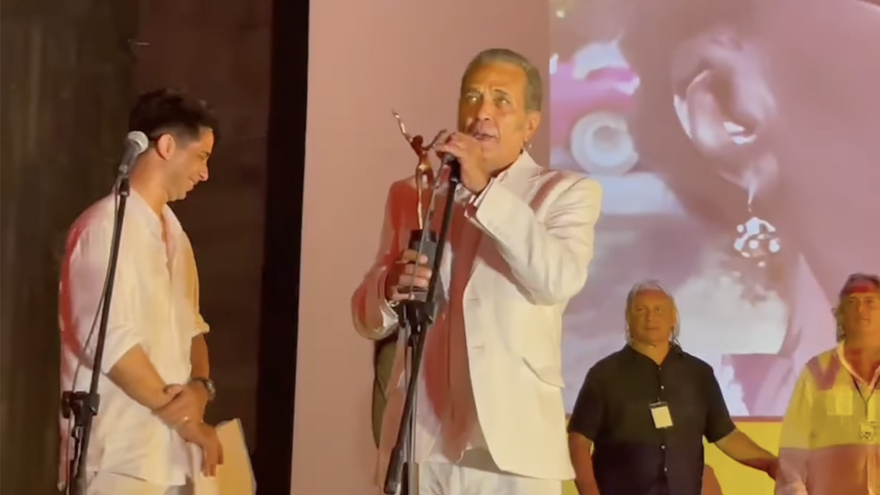
García said his young colleagues had renewed his faith and taught him how to “fight for ideas that you believe in.” (Captura/Asamblea de Cineastas)

14ymedio bigger14ymedio, Havana, August 3, 2023 — During Tuesday’s opening ceremony at the Gibara International Film Festival in Holguín province, Cuban actor Luis Alberto García dedicated his Lucía de Honor award  to the Assembly of Cuban Filmmakers. In a controversial acceptance speech, which was ignored in official media coverage of the event, the artist alluded to the ability of young filmmakers to explore utopian visions, concluding his remarks by saying, “We will either have a free cinema or none at all.”

García, who in recent decades has emerged as one of Cuban cinema’s most prominent figures, alluded to the tension between cultural officials and the Assembly, with which he has been involved since Televisión Cubana broadcast an unauthorized, censored version of Juan Pin Vilar’s documentary La Habana de Fito (Fito’s Havana). “For now, it doesn’t matter that they don’t understand it. For now, it doesn’t matter that there are suspicions, that they make us invisible. I want to share my prize with all those girls and boys,” he said.

“When you believe in something, you have to fight,” he added, saying that the organization’s young members had renewed his faith and taught him how to “fight for ideas that you believe in.” Attendees at the event reponded with applause.

“The young have an immense ability to dream and to bring utopian visions to life,” he said in reference to Humberto Solás, founder of the Gibara Poor Film Festival and director of the iconic Cuban film Lucía, for which the award was named.

Solás was only 27-years old when he directed the film, which García recalled was “barely five months after the events of May 1968 in Paris,” a reference to a series of protests led largely by students, intellectuals and artists, and which had wide cultural repercussions throughout the world. continue reading

In his speech García also alluded to several Holguín artists: the writer Guillermo Cabrera Infante — a critic of Fidel Castro who was born in Gibara and exiled in 1965 — the painter Luis Catalá and the documentarian Armando Capó, both of whom were also born in the town of Villa Blanca de los Cangrejos.

“This is  the place [Solás] chose and which, fortunately, you are keeping alive because dreams are kept alive,” he added in his tribute to the festival’s organizers. The event, inaugurated by Solás in 2003, followed the Cuban economic debacle of the 1990s and was dedicated to the concept of a “poor cinema.”

Solás, known for making “the most expensive flims in Cuban cinema,” nevertheless championed the idea of films made on modest budgets, explained Sergio Benevento Solás, the director’s nephew and current festival president.

The festival quickly positioned itself as somewhat of alternative to another film festival — New Latin American Cinema — held in Havana. Over the years it gained prominence, swapping out  “poor cinema” in its name for “international.” The local tourism industry has also benefited from the arrival of hundreds of foreign filmmakers who come to Gibara for the yearly event.

Last August, 14ymedio interviewed one of the young attendees at the event who described the festival as “an oasis in the middle of the desert in which we find ourselves.” At that time, the exodus of important Cuban filmmakers from the Island and the lack of resources impacted the festival, which has often been treated as an “official vacation” and paid for by the state.

Also receiving a Lucía de Honor award was costume designer Violeta Cooper, who worked on several Solás films including Honey for Ochún and The Century of Lights. Also honored was the actor Jorge Perugorría,* creator of the Lucía awards and honorary president of the festival, who did not attend the ceremony because he is currently working in Spain.

For its part, the Assembly of Cuban Filmmakers, which includes most notably Fernando Perez, have taken increasingly firm steps. The controversy surrounding La Habana de Fito led officials from the Communist Party and the Ministry of Culture to meet on several occasions —not without friction — with the filmmakers. The tension ultimately led to the dismissal of the president of the Cuban Institute of Cinematographic Art and Industry (ICAIC), Ramón Samada, and the revival of several of the most important positions in Cuban cinema.

*Translator’s note: Arguably, Cuba’s most famous living actor, most notably for his role in the 1993 film Strawberry and Chocolate.
____________

COLLABORATE WITH OUR WORKThe 14ymedio team is committed to practicing serious journalism that reflects Cuba’s reality in all its depth. Thank you for joining us on this long journey. We invite you to continue supporting us by becoming a member of 14ymedio now. Together we can continue transforming journalism in Cuba.
Cubans Will Have Water Before Fidel Castro’s Birthday, Authorities Promise

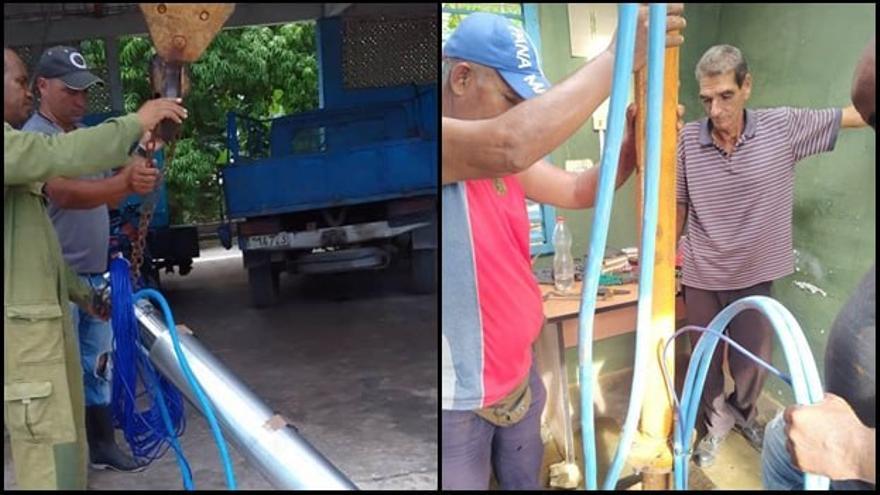
The works began this Tuesday with the incorporation of the first two pumps in the capital, and in the coming days more devices will be placed in the most affected pumping stations. (Victoria)

14ymedio bigger14ymedio, Havana, August 3, 2023 — The water pumps that Havanans eagerly awaited to alleviate the chaotic situation of this service in the capital have already arrived. In Havana, 18 will be installed, as announced on Wednesday by the National Institute of Hydraulic Resources (INRH) and reported by the official press. In addition, another four will go to the Isle of Youth. The breaks, deficiencies and failures in the system have already affected more than 80,000 people, according to the authorities.

The works began this Tuesday with the incorporation of the first two pumps in the capital, and in the coming days more devices will be placed in the most affected pumping stations, which is expected to benefit the coastal municipalities of Cojímar and Guanabacoa.

The authorities estimate that the water supply in La Lisa, Playa and a part of Marianao should also improve, for which the supply systems of Rincón 3 and Mauline are expected to alleviate the “critical state” in which the Ariguanabo basin is located, on which these municipalities depend.

Both the officials of Aguas de La Habana and the Communist Party promise that the work will be ready before August 13, “for the birthday” of Fidel Castro. They also announced the execution of several hydraulic projects in Matanzas, of which they did not give details.

As for the Isla de la Juventud, a 10 liters per second pump has already been installed to benefit the towns of Juan Delio Chacón and Comunidad 53. Equipment will also be installed – with a capacity of 20 to 30 liters per second – in La Luminous Source, Faith and Guanábana. continue reading

Given the precarious situation of the service, Luis Antonio Torres Iríbar, Party secretary in Havana, acknowledged that “the people have demanded water, as is logical,” but believes that the arrival of the new equipment in the country will bring “stability” in the supply, although “it will not solve all the problems.”

The official newspaper Tribuna de La Habana, which reported the news on Wednesday, did not specify the origin of the pieces, which were already known to come “by boat.” However, officials from the Isla de la Juventud assured that it is an “import program” that is one of INRH’s priorities to improve the situation in the country.

Another of the most affected supplies, and which cannot be solved by the authorities, is electricity. The Electric Union reported this Thursday, on its usual part, the explosion of a transformer in the Havana municipality of La Lisa and another 33 complaints pending resolution in the capital.

This newspaper recently documented the situation that Cubans are experiencing before a company that claims to have no resources even to “repair a cable.”

Stephany Novo Castro, from Centro Habana, told 14ymedio that she had contacted the Unión Eléctrica to report “a down phase” that had cut off the electricity flow to her home After the technicians arrived, they told her that the problem, which kept her without power for a week, not only was not the company’s “responsibility,” but that, even if they wanted to repair it, they did not have the materials to do so. For Novo, after hiring a private electrician and buying the necessary meters of cable, the arrangement cost her “three salaries.”

On July 24, a dozen residents of Centro Habana who had been deprived of electricity and water for days, staged a sit-in in Belascoaín and San Lázaro, which cut off traffic in the area. The rapper Eliexer Márquez El Funky , who broadcast a video of the protest on his social networks, pointed out the presence of two policemen who approached to talk with the ’plantados’.

“They don’t let anyone through, they say they have been without power for more than three days,” said El Funky, while a resident in the area replied that the problem is even greater. “It’s been 10 days and nothing and no one solves the problem for us. The food is spoiling; the children barely sleep at night. The refrigerators don’t work. The Electric Company comes and, supposedly, fixes the problem. It only lasts for 20 minutes when the electricity starts again. Enough, we are not sheep, just hard-working human beings and we need to live as people,” replied one user.

The malfunctioning of these essential services is one of the main sources of discomfort among the population, which complains about the constant failure of the services and the lack of solutions on the part of the authorities.

____________

COLLABORATE WITH OUR WORKThe 14ymedio team is committed to practicing serious journalism that reflects Cuba’s reality in all its depth. Thank you for joining us on this long journey. We invite you to continue supporting us by becoming a member of 14ymedio now. Together we can continue transforming journalism in Cuba.
Cuba: From Maleconazo to 11J, the Road From Civic Childhood to Maturity

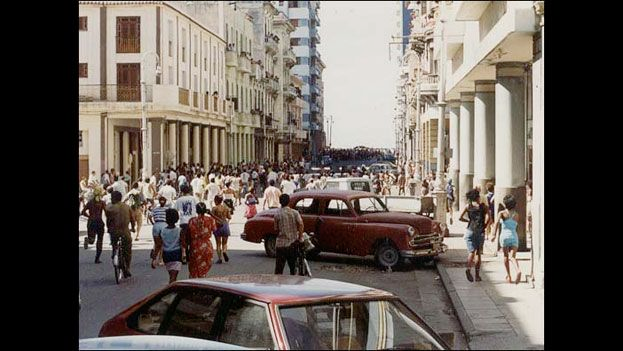
Demonstrators occupy Galiano street in Havana during the Maleconazo on August 5, 1994. (Karel Poort)

14ymedio bigger14ymedio, Generation Y, Havana, 5 August 2023 — Some were in rags, others wore masks. Some were screaming to get on a boat in Havana Bay and emigrate, others took to the streets throughout the entire island to try to change the country so as not to have to head somewhere else. In the 27 years that elapsed between the popular protest of the Maleconazo, on 5 August 1994, and the massive demonstrations of 11 July 2021 (11J), Cubans went from civic childhood to maturity. One only has to review the images of both moments to notice the tremendous change that took place in our society.

While on that morning in August the trigger was the cancellation of the trips on the Regla ferry and the impulse was given by the desire to escape the country, on 11J the cry of the streets was clearly libertarian, anti-government and socially fed up with the political and economic model imposed six decades ago. Better structured, with more consensual slogans and a democratic spirit, the protesters of two years ago were also the children and grandchildren of those who previously taken to the Malecón avenue and were beaten by the Rapid Response Brigades and by the builders of the Blas Roca contingent.

Dispersed, without leadership and overwhelmed by hunger, those who led that initial social explosion were undoubtedly more than brave. It was the first public revolt against the Cuban regime in a long time and it seemed that the indoctrination machinery and the political police had already managed to eradicate all civility from the people on this Island. It was a revolt of despair, chaotic and doomed to failure due to its lack of of organization and the mousetrap that the coastline became when the shock troops advanced on the crowd. They couldn’t do better. They didn’t know how to do better.

Despite the many differences, several common threads unite both moments. Repression was the response in both cases. While in that distant summer the oppressors disguised themselves in civilian clothes, on 11J they left modesty aside and went out to beat and arrest with all their paraphernalia of uniforms, shields and weapons. While in that cry in the middle of the Special Period it was Fidel Castro who led the crushing of citizen discontent, and only approached the Malecón when they had already managed to control the situation; In 2021, that disgraceful role fell to Miguel Díaz-Canel, who gave the “combat order” from an office and behind a desk, and unleashed the hunt for the protesters. continue reading

However, the main connection between the Maleconazo and the 11J protests is neither the behavior of the regime nor the fact that neither of the two explosions achieved democratic change on the island. Both dates are linked by something deeper and more decisive. Not only did they show Cubans’ rejection of the system, but they also evidenced the evolution of a society whose desire for freedom has not been curtailed.

________________

COLLABORATE WITH OUR WORKThe 14ymedio team is committed to practicing serious journalism that reflects Cuba’s reality in all its depth. Thank you for joining us on this long journey. We invite you to continue supporting us by becoming a member of 14ymedio now. Together we can continue transforming journalism in Cuba.
Juan Pin: ‘The Fact That There Are No Tomatoes in Cuba Has Nothing To Do With the Blockade’

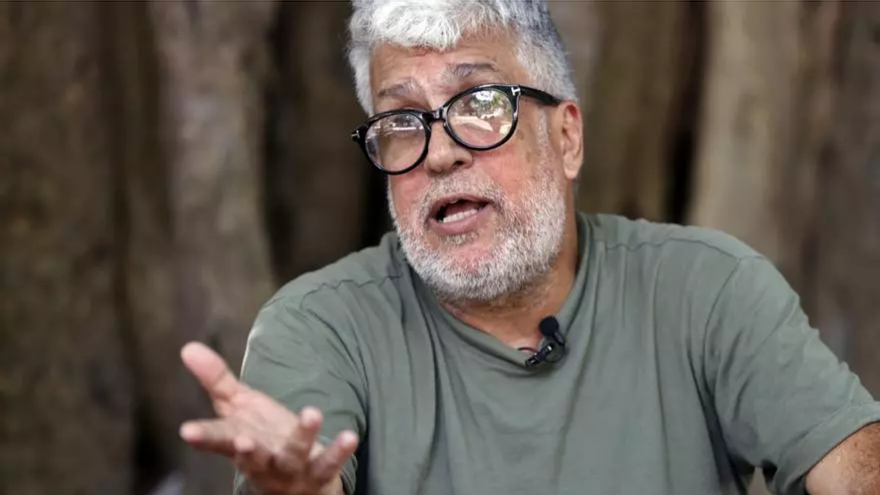
Pin Vilar speaks out against the decisions made by the cultural authorities and warns that this could even lead the country to lose a lot of money in court. (EFE)

14ymedio biggerEFE (via 14ymedio), Juan Carlos Espinosa, Havana, August 2, 2023 — The unauthorized broadcast of the documentary La Habana de Fito, by director Juan Pin Vilar (Havana, 1963), in a Cuban state television program this June it has raised a storm inside and outside Cuba and provoked a closing of ranks of filmmakers against the Ministry of Culture.

The presentation of the most recent film by Pin Vilar – its filmmakers warn that it was not the definitive version – based on a series of interviews with the Argentine rocker Fito Páez, did not come out of nowhere.

In the program that published the documentary – in which the musician touched on sensitive issues such as the death penalty on the island – state television commentators criticized the artist’s words and insisted that he is “misinformed” about the country. Months before, the screening was canceled without prior notice in a Havana theater.

In an interview with EFE, Pin Vilar railed against the decisions made by the cultural authorities – “they have made a mess” – warning that this could even lead the country to lose a lot of money in the courts (the film still does not have permission from Sony) and regretted the censorship to which the sector is subjected.

According to Pin Vilar, Cuba’s Vice Minister of Culture, Fernando Rojas, “called him an hour before” to inform him of the broadcast of the program, despite the fact that the director had not given him permission in a previous phone call with the then director. of the Cuban Institute of Cinematographic Art and Industry (ICAIC), Ramón Samada, now dismissed.

“I told him that he had to consult (…) my producer, who is in Buenos Aires, and the distributors (also in the Argentine capital) said no (…) (I) explained to them that this could interrupt the route [of the tape] at festivals (…) However, they, in their heads like little and abusive children, said: “We’re going to put it on anyway,” the filmmaker condemned.

This episode was the seed that led to the creation of an independent assembly of filmmakers, whose first manifesto was signed by hundreds of people – among them Fernando Pérez and Jorge Perugorría – and the tacit support of cultural figures historically linked to the Cuban Government, like Silvio Rodríguez. continue reading

The assembly has sought since then to dialogue with the Ministry and has pushed an agenda that aims to end censorship, give filmmakers greater creative freedom and establish a film law.

However, this did not stop a pro-government barrage against Páez – and Pin Vilar – for having been critical of the island’s leaders and, among other things, insisting in the media that the Cuban state cannot blame the US economic embargo for all its ills.

“What astonishes me is not the censorship, [but] what liars they are (…) They begin to create a narrative trying to mix me with the counterrevolution, saying that the ideas that I use in the documentary coincide with a campaign against Cuba,” he says in an ironic tone.

Pin Vilar would not take even one comma away from the critics of the author of iconic songs like El amor después del amor [Love after love] against the Government.

“I am one of the people, like Fito, who thinks that the blockade is a damage that really exists. There is a financial persecution against Cuba… but the fact that there are no tomatoes or that three idiots make that decision (to censor the documentary) It has nothing to do with the blockade,” he concludes.

Nor does he understand those who, from the pro-government circles, justify decisions like the one made with his tape, arguing that Cuba is at war with the US: “It is unacceptable for a young man with half a brain to think that we are at war.”

What happened with La Habana de Fito, as well as the reaction it has provoked from the government – ​​in recent weeks a working group was created to meet the union’s demands – does not give Pin Vilar much hope of change.

“Revolutions are made so that there are freedoms. That is why they triumph (…) Why you do it. It doesn’t matter if it’s the French, the Mexican, the Cuban, anyone. So, to the extent that those revolutions are becoming conservative, they are drifting into dictatorial States, because there is nothing more dictatorial than the conservative,” he argues.

The filmmaker also lamented the brain drain in Cuba, among other things, motivated by actions like the one he suffered with his feature film.

“The most brilliant of my generation are gone, like the most brilliant of this one. Instead of making a critical cinema and a cinema that mentions reality, [they try to make] a contemplative, silly cinema that doesn’t get anywhere,” he says.

The director is not afraid of possible reprisals for saying what he says without mincing words. Though he does admit that he has “concern” and “uncertainty.”

What leaves him calmer and more satisfied is the avalanche of solidarity that has overwhelmed him in recent weeks, especially from young people he doesn’t even know.

“It does excite me because that tells me that the solution to the problems or that the change, as some call it, is possible and probable from Cuba. Not from agendas induced from anywhere in the world, but from Cuba,” he concludes.

__________________

COLLABORATE WITH OUR WORKThe 14ymedio team is committed to practicing serious journalism that reflects Cuba’s reality in all its depth. Thank you for joining us on this long journey. We invite you to continue supporting us by becoming a member of 14ymedio now. Together we can continue transforming journalism in Cuba.
Cuba’s Director of the Classical Ballet Complains That Her Dancers Are Only Talked About When They Flee

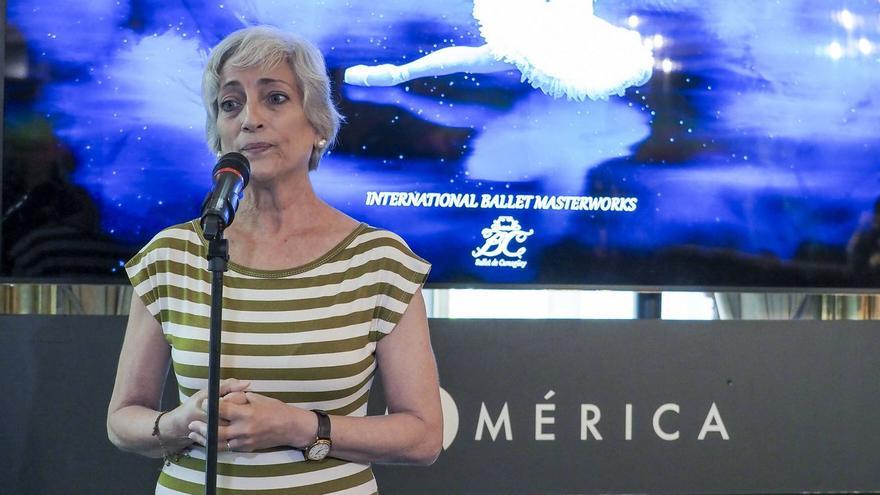
Regina Balaguer, in the presentation of the National Ballet of Cuba in Madrid. (Casa América)

14ymedio bigger14ymedio, Madrid, August 2, 2023 — There are only four days left for the Classical Ballet of Cuba (formerly Ballet de Camagüey) to finish its tour of Madrid, where it has presented Swan Lake since the beginning of July after its performances in Barcelona. The question, as in any trip of this nature, is whether the entire body of dancers will return to the Island, a question that offends its director, Regina Balaguer — also a deputy in Cuba’s National Assembly of People’s Power — who gave an interview to the Spanish newspaper El Confidencial in which she talks about the regime’s relationship with artistic discipline.

“We did a tour in 2018 and no dancer stayed behind. We all returned to Cuba. Those are things that are not talked about much. They always talk about the one who stays or the problem,” answers Balaguer, to whom the editor submitted a multitude of questions related to the policy that the official wanted to avoid. “We come to Spain and any country to show our art, to do culture, and not to talk about politics,” she reiterates.

The director of the Classical Ballet, however, is the first to mix both topics, although spurred on by questions from Ana Ramírez, the journalist, who urges her to talk about the diplomatic use of dance. “The ballet took root very soon in Cuba with the figures of Fernando, Alicia and Alberto Alonso. Since the triumph of the Revolution, Fidel himself approached them to give them all the support they needed to have a company,” she says.

The official explains that the cultural policy – which she attributes entirely to Fidel Castro – has made an art as elitist as ballet a cross-disciplinary one on the Island, thanks to the free system in which there are even vocational workshops in which there are no aptitude tests – “everyone who wants can enter.” In this way, whomever progresses, becomes professional; whomever does not, becomes a spectator. continue reading

In long passages, Balaguer exposes to the Madrid milieu – resorting to mythological remarks, such as the one at dawn when Castro appeared before Alonso with an offer of $200,000 to open the company – the characteristics of the ballet on the Island, inherited from its founders. The official affirms that femininity in the dancer and masculinity in the dancer emerge in the Cuban school, also marked by the Latino character.

This journalist consulted about it with the dance critic Roger Salas, who writes for the newspaper El País, and obtained a devastating response. “As much as the story is embellished politically, the Cuban school of ballet is nothing more than a continuation of the North American school,” he explains. The expert adds the training of Alonso in the US (with Soviet influence) and the very high American percentage (60%) of the members of the first ballet.

The interview continues to delve into the path of politics by reminding Balaguer that in 2022 she denounced the importing of Chinese shoes that were of no use to her students. “We have thousands of boxes of shoes that are not useful,” she protested on that occasion. The deputy denies that that statement, pronounced before Parliament, was a complaint. “What we proposed is that we have to be objective with the things we do. Art education is expensive, but it is free in Cuba,” she underlines.

Balaguer insists that everything in Cuba is free and stresses that, in this case, dance is an expensive discipline “and the State assumes it responsibly… I think that the Ministry of Culture and the Cuban State have been very receptive. As always, they are taking a step forward,” she praises.

But the journalist insists on talking about Chinese slippers. “Those things can happen when material is imported. But the most important thing is that we are here to show Swan Lake,” Blalaguer escapes again, not wasting the opportunity to consider that all the countries in the world have economic problems in these moments.

“Have you solved that problem with the shoes?” asks the editor for the third time. The debate closes with “Of course. Everything is discussed and little by little it is resolved” and the insistence that the will of the State is the best and the controversial shoes arrived during the pandemic, when the inconveniences were, for everything, extreme. The footwear for the professionals is manufactured in the company’s workshops – the imported ones are for schools – but the text recalls when, in the 90s, the dancers themselves mended their costumes and with great difficulty were able clean the toecaps with the bad adhesive that was sold on the island.

When Vigensay Valdés took charge of the National Ballet of Cuba — the first important company on the island — in 2019, there were 40 dancers who had requested asylum in the US and other countries, according to figures from the Cuban Classical Ballet. of Miami. Barely a year ago, in another sphere of dance, a highly commented on mass desertion took place when at the end of July eight members of the Lizt Alfonso Dance Cuba company left the delegation and stayed in Spain, after finishing the presentations of their tour of Europe.

Balaguer, however, refuses to see it. “They don’t talk about the fact that we did a tour in Spain and Switzerland, and nobody stayed.(…) I think that sometimes you don’t just have to talk about the problems, the ugly things or the inconveniences, but also the positive things.”

____________

COLLABORATE WITH OUR WORKThe 14ymedio team is committed to practicing serious journalism that reflects Cuba’s reality in all its depth. Thank you for joining us on this long journey. We invite you to continue supporting us by becoming a member of 14ymedio now. Together we can continue transforming journalism in Cuba.
Uruguayan Diplomats in Cuba Are Asked to Meet with the Opposition ‘For Reciprocity’

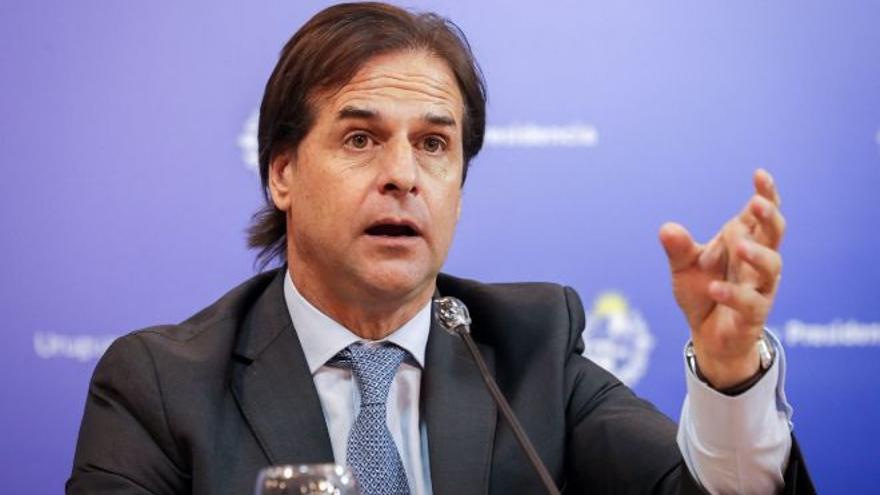
The Uruguayan president, Luis Lacalle Pou, has denounced the violation of human rights in Cuba in several international forums. (EFE)

14ymedio bigger14ymedio, Havana, August 3, 2023 — The Center for the Opening and Development of Latin America (Cadal) sent a letter on Thursday to the President of Uruguay, Luis Lacalle Pou, requesting that he instruct his diplomats in Cuba to talk with the opposition to the island’s regime. The organization also urged the president to invite a “representative group of the opposition” to his Embassy in Havana, on the occasion of Uruguay’s national holiday, on August 25.

Gabriel C. Silva, international human rights activist and general director of Cadal, proposed to the Uruguayan Ministry of Foreign Affairs that its diplomats in Cuba maintain “regular contacts” with activists and opponents throughout the island, either at their homes or in agreed upon places.

The request, says the statement, is based on the principle of reciprocity between the two nations. “Taking into account the active and public relationship that the Cuban Embassy in Uruguay maintains with political leaders opposed to the Government of Lacalle Pou, it is therefore appropriate that the Oriental Republic of Uruguay also include the opposition in its relations and ties in Cuba,” wielded Cadal.

Although the Cuban State harasses and makes its opponents invisible, considering them “illegal,” it is not the role of a democratic country like Uruguay “to extend the illegality that the one-party regime imposes on them,” it added. continue reading

According to Cadal, this type of exchange would be beneficial to address the political reality of the Island without an ideological bias imposed by the official discourse. This is what, for example, the diplomatic corps of European countries “whose standards of democratic institutions are comparable to those of Uruguay” do.

Taking these States as a model, the organization asks Lacalle to receive opponents such as journalist Yoani Sánchez, political activist Manuel Cuesta Morúa and relatives of political prisoners at his Embassy in Cuba during Uruguay’s national holiday.

The Cuban Embassy in Uruguay carries out similar activities with opponents of the Lacalle government, according to the organization. On July 27, the Uruguayan Anti-Imperialist Committee of Solidarity with Cuba and the Peoples of the World invited politicians and union leaders belonging to the diplomatic corps accredited in the country, to celebrate the 70th anniversary of the attack on the Moncada barracks, in Santiago de Cuba.

Cuban diplomats also establish frequent contact with Uruguayan activists, politicians, parties and artists. For this reason, the statement concluded, “the Government of Cuba will have to accept – according to the principle of reciprocity – that the diplomats of the Embassy of the Oriental Republic of Uruguay in Havana maintain exchanges with leaders of the Cuban democratic opposition.”

Under the Lacalle government, Uruguay has been one of the countries that has most pointed out the lack of democracy and the violation of human rights by the regimes of Venezuela, Nicaragua and Cuba. Last January, during the VII Summit of the Community of Latin American and Caribbean States (Celac), the president asked that the event not be turned into a “club of ideological friends,” since the existence in the region of “ideological friends  that do not respect democracy, institutions or human rights is clear.”

During the previous Summit, Lacalle himself starred in an altercation with the Cuban ruler Miguel Díaz-Canel by reciting a fragment of the song Patria y Vida, which became the anthem of the popular protests of July 2021.

More recently, on July 28, the Costa Rican Legislative Assembly approved a motion against the Cuban regime for the systematic violation of human rights and in favor of the release of more than a thousand political prisoners on the island. The proposal, presented by the Progressive Liberal Party (PLP), was approved with 34 deputies in favor and seven against.

Everything indicates that the regime’s efforts to launder its international image continue without bearing fruit when two of the best-established democracies in Latin America point to Cuba as a non-democratic government. Along with Chile, Uruguay and Costa Rica are two of the three full democracies in Latin America, according to the British magazine The Economist, which also included Venezuela, Nicaragua and Cuba in the list of countries with less democratic systems in the region at the beginning of 2023, placing them at the bottom of its ranking.

____________

COLLABORATE WITH OUR WORKThe 14ymedio team is committed to practicing serious journalism that reflects Cuba’s reality in all its depth. Thank you for joining us on this long journey. We invite you to continue supporting us by becoming a member of 14ymedio now. Together we can continue transforming journalism in Cuba.
NGO Reports that July 2023 is the Month with the Second Most Protests in Cuba Since July 2021

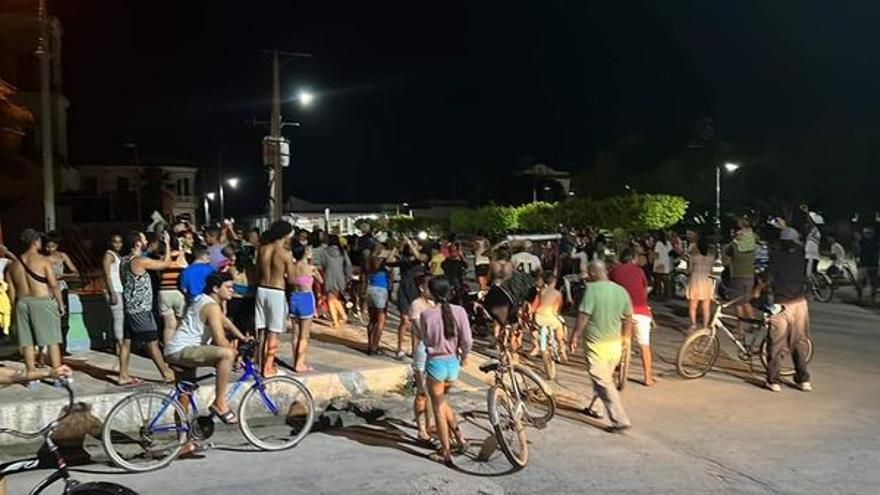
Protest in Villa Clara over the lack of electricity. (Screen capture)

14ymedio bigger14ymedio, Havana, 4 August 2023 — The Cuban Conflict Observatory (OCC) registered a total of 589 protests on the island in July. The figure, which represents an increase of 124% compared to the same month of the previous year, exceeded by 175 incidents than those counted in June of 2022. Except for the months of October (with 589 protests) and December (with 692 protests) in 2022, this month has been the month with the highest rate of public demonstrations reported by the platform since 2021.

Havana was designated as the most active territory in the country, with 216 protests, 44 more than in June. However, the OCC warned that the rates of protest had increased throughout the country, including the Isle of Youth. This pattern had already been generated in the report for the month of June, when the document reported that the presence of “expressions of protest” throughout the Island constituted a sign of general disagreement with the state administration.

Other territories with high numbers were Holguín, with 36 cases, Guantánamo, with 27, and Santiago de Cuba, with 26. All of them belong to the eastern part of the country, a region that has been presented by its inhabitants as the most abandoned by the Government and the institutions.

Of the almost 600 events, 327 (55.5%) were linked to civil and political rights, with a predominance related to cases of repression (146) against political prisoners, influencers, opponents, activists, independent journalists and ordinary citizens. Of these protests, 143 were direct challenges to the repressive authorities, which achieved that for “for the first time,” according to the platform, that this indicator was “remarkably close to that of protests for repressive acts.”

Some of the cases referred to by the Observatory were the suspension of visits to the political prisoner Maykel Castillo Osorbo in the Kilo 5 y Medio prison, the disclosure of personal calls by the independent journalist Camila Acosta on Cuban Television and the dismantling of a protest of 20 women who tried to demonstrate in the Plaza de la Revolución to demand milk for their children. continue reading

In the same category, some 46 protests involved graphic media such as memes, videos, graffiti or photographs.

Regarding economic and social rights, the demonstrations due to citizen insecurity numbered (74), disagreement with public services (68), lack of food (41), deterioration of the public health system (40), homelessness ( 31) and housing problems (10). The total number of events held for these reasons was 262 demonstrations, 43.9% of the total.

As quantified by the OCC, protests related to civil rights exceeded those calling for economic improvements by 11% this July. The previous month, however, the population reacted 10% more to violations of economic rights than to civil rights.

The report includes the “direct criticism” of some figures in the Cuban intellectual sphere, such as the economist Pedro Monreal, the comedians Ulises Toirac and Rigoberto Ferrera, and the writer Leonardo Padura, who “vented their anger after being affected by the multiple aspects of the general crisis.”

Other protests that had great visibility were the sit-in by a dozen residents of Central Havana who had been deprived of electricity and water for days, the confrontation between the Assembly of Filmmakers and officials during their meeting at the Chaplin Cinema, and the cacerolazo [protests by banging on pots and pans] during a blackout in the capital’s municipality of Diez de Octubre.

For its part, the Cubalex platform recently published a report on violations of criminal protection rights by the island’s courts since 1959.

The organization claims to have registered at least 767 cases of people sanctioned for political reasons in the last 64 years. With the testimonies, Cubalex explains that it has been able “to frame especially the stage from 1959 to 1979 to delve into the political and judicial procedure of the Cuban State regarding the history of discrimination for political reasons, the persecution of people for cataloged political crimes as counterrevolutionaries and the classification of the so-called ’crimes against State Security’.”

In turn, the organization denounces the progressive closure of legal channels that allow criminal protection from the Government of Fulgencio Batista to the present. The current Constitution, it points out, “cannot be reformed by popular initiative” either, since “it declares any action taken against the socialist system illegal, and authorizes the use of any means, including armed struggle, against whoever tries to modify that system.”

The platform warns that the results presented are partial and ensures that it is working on the individual analysis of each case, as well as on the evolution of the constitutions and criminal laws that were in force in the period, including the current Constitution.

____________

COLLABORATE WITH OUR WORKThe 14ymedio team is committed to practicing serious journalism that reflects Cuba’s reality in all its depth. Thank you for joining us on this long journey. We invite you to continue supporting us by becoming a member of 14ymedio now. Together we can continue transforming journalism in Cuba.
The Spanish Electoral Hangover Seen From Latin America

Members of the Popular Party greet supporters at the popular headquarters in Madrid after the results of the elections were known. (EFE)

14ymedio bigger14ymedio, Yoani Sánchez, Havana, 29 July 2023 –The days have passed since the voters went to the polls on July 23 in the elections for the General Courts of Spain. However, the fact that the negotiations to reach a majority to govern will continue for several weeks is keeping millions of citizens on edge on this side of the Atlantic as well. The Popular Party won, but insufficiently, and it is most likely the Socialist Party will retain power. In any case, the Iberian country, now holding the rotating presidency of the European Union and with strong ties to Latin America, is committed to a more active position with our hemisphere, but its internal fractures hinder that role.

The recent summit of the European Union (EU) and the Community of Latin American and Caribbean States (Celac), held this month in Brussels, showed that Madrid is unable to concentrate on structuring a solid and long-term strategy for Latin American countries. With a common past and a community of Spanish citizens that is growing every day in this part of the world, thanks to the Democratic Memory Law, popularly known as the new Grandchildren Law*, the European nation should play a much more active diplomatic, economic and political role in the region. However, its internal partisan fights prevent it from realizing, in all its dimensions, the importance of paying attention to what was formerly called the New World.

Faced with a presidency in the Moncloa Palace that is weak in the Latin American arena, regional authoritarianisms are gaining a voice on international stages. The EU-Celac Summit made it clear that Spanish firmness or lukewarmness is decisive for the confluence between the 27 European countries and the 33 Latin American and Caribbean countries. When Madrid is immersed in its own affairs and fails to realize the importance of its leadership beyond the seas, all of old Europe resents its links with this continent. Spain is key, and the grudges of the past — from colonialism to slavery — should not dissuade it from its leadership in America. If it does not assume that role,  China and Russia are eager to dispute it and area gaining ground. continue reading

Local dictatorships rub their hands when Moncloa becomes invisible and self-censors. Right now, while the formation of a government is unknown in Madrid and many fear that there will be a repeat of the delay after the 2019 elections, each day of indecision is a gift for those in Latin America who prefer a weak, distracted and apathetic Spain. On the list of those interested in a context in which uncertainty continues are the regimes of Nicaragua, Venezuela and Cuba. They know that while Madrid is staring at its navel to define and form a cabinet, it will not have the time or energy to denounce the violations of human rights suffered by millions of people in this part of the planet.

A weak Spain, incapable of raising its voice in international forums so that the freedoms of Latin Americans are respected, is the one that suits the great civic predators of this continent. Madrid must know, and act accordingly, the fact is that it is not just a question of diplomacy, but, essentially, of internal politics given the large number of its citizens who live in these lands. Its distractions are our pains. Its lack of leadership, our condemnation.

*Translator’s note: The law defines provisions under which descendants of Spanish citizens in Cuba and elsewhere can apply for and receive Spanish citizenship.

____________

COLLABORATE WITH OUR WORKThe 14ymedio team is committed to practicing serious journalism that reflects Cuba’s reality in all its depth. Thank you for joining us on this long journey. We invite you to continue supporting us by becoming a member of 14ymedio now. Together we can continue transforming journalism in Cuba.

Lack of Cash Makes Cubans Desperate: ‘I’ve Gone Out in the Street to Fight for Pesos’

ATM this Tuesday, August 1, in La Linea, Havana. (14ymedio)

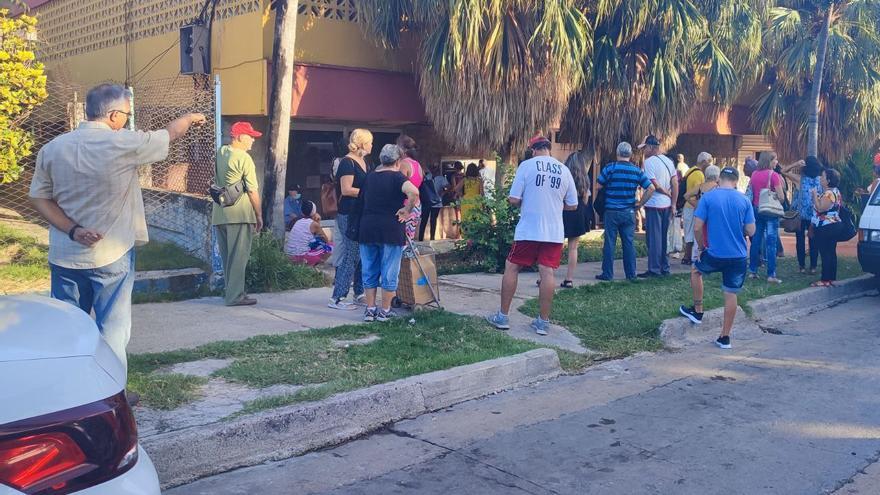
14ymedio bigger14ymedio, Juan Diego Rodríguez, Havana, August 1, 2023 — The line at the Banco Metropolitano ATM on Marino y Conill street, in Nuevo Vedado, was abuzz this Tuesday. To the number of elderly people in the neighborhood, who were waiting to be able to extract their pension payment, were added neighbors who came from Calzada del Cerro and 26th Street because the ATMs in those areas did not have cash.

The situation was not exclusive to those parts of Havana. On Línea in El Vedado the appearance of the line at the ATM was more like a mob than an orderly line. The fight for cash reaches higher levels every day in a country where electronic transactions are still scarce, both due to the size of the underground economy and the lack of  online connectivity, as well as to the population’s rejection of having their movements monitored.

“Cash is what you buy food with and buy everything you need. When you go to a small business to buy a bag of milk, if it’s worth 2,000 pesos you have to pay it in cash, because the seller doesn’t want you to do it with transfer,” laments a woman from Havana in line at the branch. “If you are going to eat in a restaurant, the same thing happens. If you are going to take a private taxi, because transportation is terrible and you have to resort to private ones, you have to pay in cash. Everything is like that.”

In Nuevo Vedado, the Marino y Conill ATM was also mobbed by people on August 1st. (14ymedio)

Among the tumult there are many who are back for a second time, because the day before they couldn’t get a penny, but Rachel can’t wait. This afternoon a vet is going to operate on her cat and only accepts payment in pesos. “I have gone out to fight in the street, after a woman I buy currency from changed my euros, and now see what I have to do to get it, what line to get into or how to resolve the bank or the ATM to be able to get it, because it’s a considerable amount that I need,” she says worried. continue reading

The currency exchange, she adds, had to be done through a bank, because the person who sold her the currency refused to exchange it in cash. Any operation that moves illegally is bound to be carried out in cash and that is where most of the island’s activities materialize. Banking operations are controlled by banks, all of them state-owned, and no one who provides services outside the law wants to be exposed to oversight of their actions.

The poor state of the ATMs, which often do not work, and the large number of areas on the Island that still do not have a 4G connection, prevents payment through electronic gateways which work from mobile applications, and ends up complicating the situation.

Although the State has done everything possible to run the economy through the banks, they have only managed to do so in the state sector where, many times, citizens do not find their needs satisfied or the quality is so low that they flee in terror to the informal market.

Customers must use electronic means of payment, chip cards, national and international magnetic strips “that operate in the country,” electronic pins through Transfermóvil, rechargeable chip cards or disposable prepaid cards. The latter, they detailed, “have undergone technological improvements,” such as the “possibility of carrying out partial and total transactions, unification at the time of the transaction of up to five cards in one, and the incorporation of the QR code both for downloading and for return, which is ensured by means of a scanner that speeds up commercial processes.”

To implement the new forms of payment, they say, Cimex “has designed an information program for its customers and training for contact personnel and sales assurance,” which shows the island’s shortcomings in this regard.

This Monday, in a meeting of the Executive Committee of the Council of Ministers, the program for the “banking-ization” of the country was approved, the details of which are still are unknown and will be expanded in the short term.

According to the official press, “work has been carried out on the subject in recent months and includes a set of measures to gradually encourage the use of electronic collection and payment channels in the national territory.” The note, published in Cubadebate, adds that more details will be given shortly “on this process of vital importance for the Cuban economy.”

But a good incentive will be needed to recover a sector that, contrary to what the authorities claim, is losing ground and is far from advancing. “As the ATMs have emptied, the sellers and merchants that until now were accepting transfers have begun to reject them, because they are afraid that their account is full of virtual money but they cannot extract it,” explains a neighbor who is racing to get his last 300 pesos while looking for an ATM to extract more.

The lack of paper money on the Island is not new. Throughout 2023, the shortage has worsened and has not been resolved and it is already notable that there are difficulties in paying salaries or extracting cash. In May, the Minister of the Economy, Alejandro Gil, admitted before the National Assembly that the galloping inflation in which the country has settled into since the Ordering Task* has led to this shortage of banknotes in bank branches. The economic situation is so precarious that it is not feasible to print new bills with higher denominations to solve the situation.

The big winners are currencies, specifically the dollar and also the euro (which exceed an exchange rate of 230 pesos in the informal market), because in the absence of pesos, many carry out their operations directly in another currency. “Many prices are already automatically changing to dollars,” adds another customer in line at the cashier. “I know of several different operations, from food purchases to hardware stores to other services, that already, in recent days, the person offers the good or service in foreign currency because it already assumes that the client will not have the cash.”

*Translator’ Note: The “Ordering Task” [Tarea Ordenamiento] is a collection of measures that include eliminating the Cuban Convertible Peso (CUC), leaving the Cuban peso as the only national currency, raising prices, raising salaries (but not as much as prices), opening stores that take payment only in hard currency which must be in the form of specially issued pre-paid debit cards, and a broad range of other measures targeted to different elements of the Cuban economy. 

____________

COLLABORATE WITH OUR WORKThe 14ymedio team is committed to practicing serious journalism that reflects Cuba’s reality in all its depth. Thank you for joining us on this long journey. We invite you to continue supporting us by becoming a member of 14ymedio now. Together we can continue transforming journalism in Cuba.