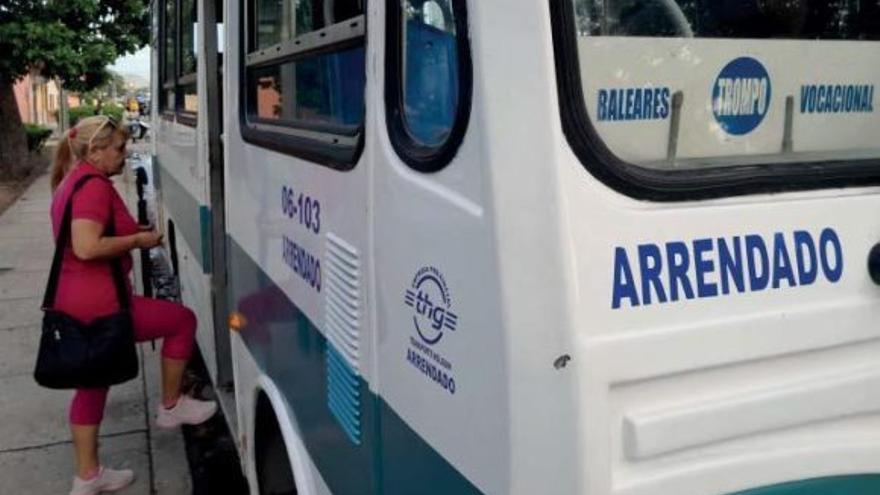

Drivers of Buses Leased from the Cuban State Ask for More Freedom to Decide Their Own Routes

Obtaining sufficient capital to cover their expenses and recover the initial investment requires, in many cases, that drivers operate out-of-contract routes. (Cubadebate)

14ymedio bigger14ymedio, Havana, August 1, 2023 — The 124 state buses leased by individuals in Holguín have managed to transport five million passengers in two years. However, the drivers, who have had to repair and condition the vehicles with their own money, lament the rigidity of the authorities, who do not allow them to make trips on their own once they have completed the required daily work plan.

After Resolution 270 of the Ministry of Transportation, which allows state entities to lease disused vehicles to individuals and companies that wish to use them for a social purpose, went into effect in 2021, the Holguín authorities decided that, of the 591 vehicles that the province had, only 179 met the requirements to circulate under this management model, according to what the province’s Transportation company told Cubadebate.

Of these, they finally ended up leasing just over 120 buses, most of them in need of minimal repairs, such as changing tires or batteries, which cannot be found in the state market, according to the company itself.

The cost of these arrangements is borne by the drivers, who also pay out of pocket for the salary of the helpers they need, the taxes required and the fuel used by the vehicle, which the State sells – in rationed quantities – at 13.99 pesos per liter. continue reading

In return, the authorities require drivers to pay the transport company between 12,000 and 15,000 pesos per month, since they estimate that each urban route bus can collect between 22,000 and 30,000 pesos. In the case of the “semi-bus” – a truck reconditioned for transport generally in rural areas – between 5,000 and 9,000 pesos must be paid, for an estimated profit of up to 14,000 pesos.

Obtaining sufficient capital to cover their expenses and recover the large investment they made to put the vehicle into operation requires, in many cases, that drivers operate out-of-contract routes, once the company’s plan has been fulfilled. However, the authorities, wary of the additional profits, have required individuals to apply for special permits whenever they wish to carry out other work.

Faced with this position, drivers have been dissatisfied and request more autonomy.

Roger Ramírez, one of the drivers interviewed by Cubadebate, appears as the owner of a Diana bus that runs the route between Mayarí and Holguín for 50 pesos a ticket. According to his account, Ramírez operates urban tours of the main city until it is time to make the return route. “All of this benefits the people. And, of course, me.” However, he does not understand the need for so many obstacles when, without his investment, the vehicle would be idle in a state garage.

The company, for its part, has argued that the lack of order has led on several occasions to breaching the terms of the contracts. And, although they understand that the lack of fuel and the obstacles have hindered the collection of the initial budget of the drivers in the expected time, they estimate that “the most important thing is compliance with the social project under which the contracts were made.”

According to the authorities, among the infractions are the absence of the drivers on days when the route must leave the route, the deviation from the route plan to carry out other “runs” and the violation of the established price of the ticket, which they consider a serious offense.

The company believes that the problems lie in the fact that many of the drivers entered the business without being aware that they are now “public servants” and thought that they would “do whatever they want.” Some of the drivers, they say, behave rudely or dress in “shorts and t-shirt,” ignoring the dress rules and the respect towards the passenger that their new role demands.

For this reason, the entity has had to cancel the contracts of two individuals who accumulated “several indiscipline, including deviating from an agreed route and taking a trip to the beach” or being absent without prior notice knowing that the vehicles have a global positioning system (GPS).

Despite the difficulties, the authorities admit that the leasing of disabled state vehicles has been a positive and has eased the transport crisis. Before the resolution was approved, there were days when “only nine or ten cars operated,” Wilmer García, director of the institution, told Cubadebate. The fact that more than 120 now operate represents a notable improvement for the 200,000 Holguin residents waiting at the stops in the province, according to the official.

____________

COLLABORATE WITH OUR WORKThe 14ymedio team is committed to practicing serious journalism that reflects Cuba’s reality in all its depth. Thank you for joining us on this long journey. We invite you to continue supporting us by becoming a member of 14ymedio now. Together we can continue transforming journalism in Cuba.
The Right to Die or How Far Individual Freedom Goes

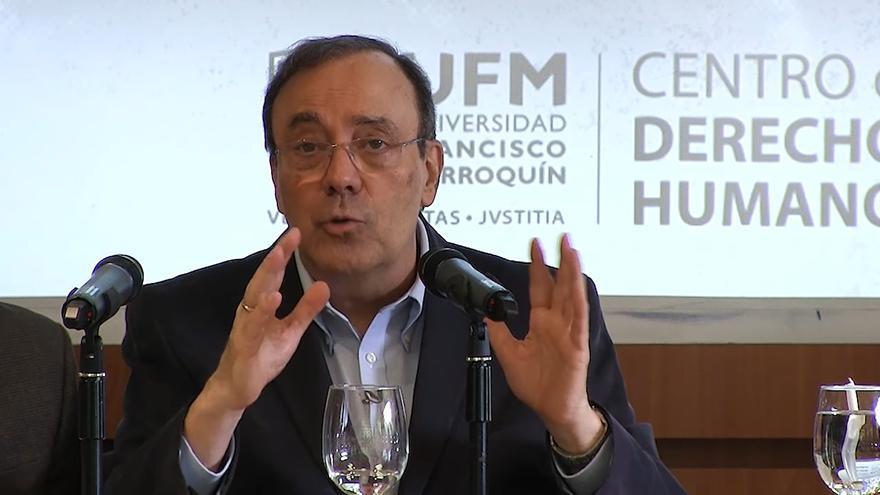
The writer and journalist Carlos Alberto Montaner during a conference in 2018. (Sergio Santillán Díaz/YouTube/Screen capture)

14ymedio bigger14ymedio, Grace Piney, Miami, July 31, 2023 — In his last text, the writer Carlos Alberto Montaner calls for a debate on the right to assisted death: euthanasia.

Years ago, we had this conversation because we had a friendship full of confidences and complicity. Sometimes it happens between a writer and the editor of one of his most intimate texts.

He promised to “warn me” and I promised to write this text.

On that occasion, in the living room of my house in Madrid, with a cup of tea in hand while we edited La mujer del Coronel [The Colonel’s Woman], he said that he had a pistol ready to use if the time came.

The edition of that text had him exultant with joy. I never saw him so fully happy! Not a person spoke in the midst of life’s potholes.

I told him, “There are more civilized ways. Imagine the scene where your family finds a body mangled by the impact of a bullet. Do you really want that?”

Arguments of a religious nature made no sense to him. He enjoyed the exchange with me especially because I am Catholic, a person of faith, committed to God and to the Church. He could be very provocative because he was a debater by nature, even after he died. continue reading

Montaner had undergone surgery and had a pacemaker; he was a cancer survivor and was keeping the possible effects of diabetes at bay. At the time, those were his ailments, which he “cherished dearly,” as he used to say.

More than ten years ago, and he already felt ready to go! He said that he was already fulfilled, that he was at peace.

He lived more intensely than you can imagine because, in addition to real life, he had the infinite world that literary creation gives us. Montaner was a man of his word(s) and commitments.

Much more is known about his work as a journalist and as a political scientist, but his true passion was narrative. He was sorry he hadn’t been able to spend more time with it.

He even lived through assassination attempts because, although he was a very public person and had many friends, he also had many (and dangerous) enemies. He knew Death and had a cordial relationship with her.

I never saw him acting on impulse and I know that he was not pushed by pride of not wanting to depend on anyone. It was more than that. It was an assumed decision: If he could decide, he would put an end to his life. He also knew that he would end his days in Spain; he trusted in Spanish healthcare and loved Madrid.

Asking for a dignified death is an act of individual freedom and respect for life, for the life lived and for the people with whom it was lived. It is an act consistent with his idea of ​​individual rights. That is the basis of his reasoning.

Dear reader: Don’t get me wrong, I’m not pushing you to suicide, nor is Montaner. Life is beautiful and you can always find reasons to live. But, when life outweighs death, deciding to touch the button that turns it off should be a recognized right as such.

Assisted dying does not apply to people who got bored with this life. Technically, it is not a suicide. And it’s not dispensed like over-the-counter aspirin.

In Spain, the application is submitted to a registered doctor. Study the case and submit the request for evaluation by a consulting physician who will probably be a specialist in the causative disease.

According to the law, approved in 2021, three conditions must be met:

The person must be a Spanish citizen or resident for more than one year in Spain; he must declare that he requests help freely, without external pressure; and the determinant: the person suffers from a serious and incurable disease or a serious, chronic and disabling condition, which must be certified by the responsible doctor.

Finally, the case is presented to a commission that appoints a doctor and a lawyer who examine the clinical history and the application.

The process can take a month and, if the opinion is positive, the person determines the day, time and place of death.

The person decides whether to drink a Pentobarbital syrup; or whether to turn the key that opens the intravenous route to a serum with the medicines; or to ask them to put you to sleep and have the medical team take care of everything.

Between two and five minutes after application, the drug begins to take effect and induces a deep coma, which leads to death. The process is safe (unequivocally causes death) and is painless.

Do you know how many suicides occur each year in developed countries? Most of them violently, entailing enormous suffering. And, apart from that, there are the unsuccessful suicide attempts, which leave sequelae with which living becomes more difficult.

I am glad that Montaner has resorted to the most civilized route.

The fact that euthanasia is not legal in the United States forced him to return to Spain “to die.”

Could you believe that there are “tourist” routes to die, that there are people who expressly go to countries where euthanasia is legal in the hope of having a peaceful… and legal death?!

In the United States, it is legal to own weapons and use them to kill in self-defense; it is the death penalty (which is carried out by injecting a cocktail of drugs) and it is abortion.

It is legal to withdraw life support when the patient is brain dead and must be approved by a family member or designee.

However, having made a suicide attempt could deny access to a method, and death by suicide nullifies the benefits that the family could receive if the deceased had life insurance.

In short, it is legal to determine the death of another but not one’s own.

The only possibility to decide is to refuse to receive cardiorespiratory resuscitation in case of accident or illness and you are conscious when you arrive at the hospital and declare this.

The United States is probably not ready for this debate. But American society has several pending issues regarding the right to life and death!

Assisted dying implies passing from life to death calmly, without pain and in peace. It implies that families prepare for the process and to get over it in a better way.

Respect for individual freedom must recognize the right to decide to die with dignity, without pain and without suffering.

I will miss Montaner for the rest of my life, as well many of his friends. But I will defend his right to die even if I disagree with his decision.

_______________________________

Editor’s Note: Another version of this text has been published by the author in El Nuevo Herald this Sunday.
_______________________________

COLLABORATE WITH OUR WORKThe 14ymedio team is committed to practicing serious journalism that reflects Cuba’s reality in all its depth. Thank you for joining us on this long journey. We invite you to continue supporting us by becoming a member of 14ymedio now. Together we can continue transforming journalism in Cuba.
New Design Law Prohibits Using Cuban Symbols Without Authorization From a State ‘Advisor’

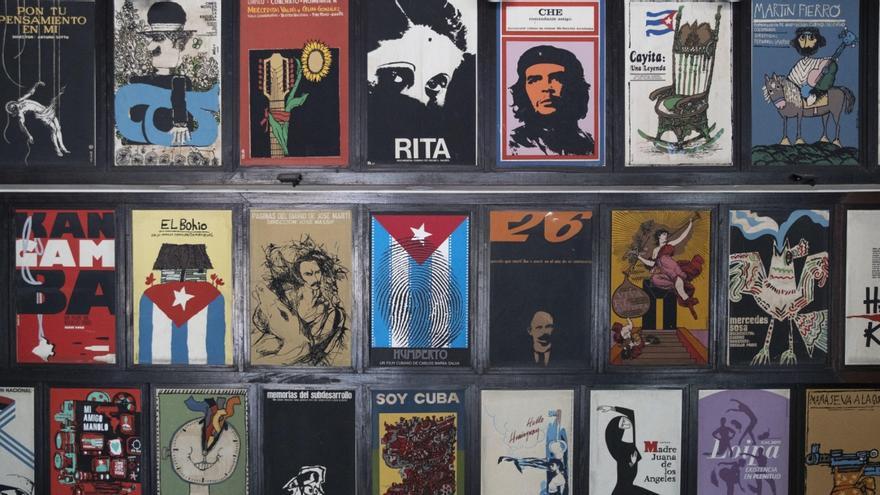
The new National System will supervise all the creation processes of any graphic or visual communication material. (EFE)

14ymedio bigger14ymedio, Havana, August 2, 2023 — Far from freeing the economy and easing state restrictions on private individuals from, the government insists on enacting laws that further control the Cuban economy. This Tuesday the Official Gazette published a decree of the Council of Ministers that regulates industrial design and visual communication in Cuba. The law, which provides for the creation of a National Design System, prohibits the unauthorized use of the Country Brand and the Cuba Image, and aspires to become a guarantor of the “values ​​forged by the Revolution.”

Although the National Design Office – the body that until now was in charge of the work of designers – will continue to be active, the new National System will supervise all the processes of creating clothing, furniture, printed or virtual publications, machinery and any graphic or visual comunication.

However, the symbols and images that the State considers to be part of the national identity may not be used in any work without the permission of an “authorized authority,” a warning already included in the controversial National Symbols Law.

Among the principles enumerated in the decree, the “preservation of the values ​​forged by the Revolution” is also insistently included, although it suggests that it will also defend “non-discrimination” against designers and their protection against “distinctions that are harmful to human dignity.” However, the document does not clarify how anyone who attempts with their designs to go against the “social project” of the regime will be penalized. continue reading

The Minister of Industries, Eloy Álvarez, attached to the decree an evaluation regulation that will allow the “advisors” of the National Design Office to require the company directors to modify or stop the production of products that they consider “not acceptable.”

The authorities will also have the last word in awarding prizes to designers, financing and international collaboration, the approval of regulations and the ease of access to certain services.

In addition, “expert” commissions will be created to control not only the products and services but also their application within the country, their value as exportable goods, prices and rates, and their quality.

Foreign companies, like national ones, will have to obey the new regulation if they intend to change their image or brand while operating in Cuba. The rule also affects small and medium-sized enterprises (MSMEs) and self-employed workers, since there are no exceptions based on the type of management.

As for design professionals, to be recognized as part of the National System they will have to first register in the National Registry of Visual Designers and Communicators. This guarantees, the document alleges, that their copyrights and intellectual property rights are respected.

With the new project, the Government puts the entire industry under its command. Despite the fact that the decree may notably affect the work of hundreds of designers in the country, the official press has not yet published its contents.

However, already on social networks some profiles related to the Government have asked that the advance of brands that, they consider, represent a “return to capitalism” be “stopped.”

Facebook commenter Diego Funes-Álvarez saw “high danger” in the fact that an old sign for the Esso gas station was hung in the middle of Calle 12, in Havana. “It is sad to think that in the popular imagination this type of banner is still considered a symbol of prosperity,” he lamented, in the middle of a diatribe against the Coca-Cola posters that some owners put up in “little bars in Old Havana.”

Funes-Álvarez concluded his publication by asking for an express prohibition of the “good propaganda” of capitalism. The new Decree on Design supports him.

____________

COLLABORATE WITH OUR WORKThe 14ymedio team is committed to practicing serious journalism that reflects Cuba’s reality in all its depth. Thank you for joining us on this long journey. We invite you to continue supporting us by becoming a member of 14ymedio now. Together we can continue transforming journalism in Cuba.

Two Hundred Cubans in Sancti Spiritus Lose Their Fixed Telephone Lines for Non-Payment

Etecsa reports an increase in customers in Sancti Spíritus who have failed to pay their bills and, therefore, are disconnected from the service. (Escambray)

14ymedio bigger14ymedio, Havana, 2 August 2023 — The numbers of disconnected users of the Cuban Telecommunications Company (Etecsa) in the province of Sancti Spíritus are revealing both of the economic crisis that the island is going through, and the emigration that does not stop. Up to 200 customers have lost their landline, Escambray reported this Wednesday, due to delays in bill payments.

Miladys González, head of marketing for the state monopoly in the province, specified that 60% of these are concentrated in the municipalities of Sancti Spíritus and Cabaiguán. Most of the cases correspond to “closed houses,” continues the official, who has not alluded to the unstoppable exodus for almost two years.

In addition, the provincial newspaper reports, there are 150 customers at risk of losing service because they are more than three months late in paying the account, the majority reported in Sancti Spíritus, Trinidad and Jatibonico.

The data is disclosed two months after a resolution went into effect that obliges Etecsa to disconnect the telephone lines, with prior notice to the owner, after 30 days from the due date of the unpaid invoice. continue reading

The rule provides that the connection can be restored 24 hours after the user pays the total debt before 180 days have elapsed since the due date.

If those six months elapse without payment being made, González continued, Etecsa proceeds to cancel the service. In this case, the norm dictates that the client be notified with a minimum of 72 business hours at the registered address through a notice that is delivered “to the person who is in the place at that time,” regardless of whether he is the owner or a representative.

If the customer wants to maintain the service, Etecsa warns that the reconnection entails an additional “cost” that will be charged on the next bill.

González acknowledged that the company is also facing a shortage of paper and other supplies that makes it difficult for it to distribute printed invoices, for which reason he calls on customers to subscribe to receive the document by email, or alternately they must contact Etecsa through its 112 call center number or in the Transfermóvil application.

Although the number of mobile lines in Cuba is approaching eight million and far exceeds the little more than a million fixed lines, cell phones have not yet completely displaced the landline, which continues to be one of the main communication channels for many families, mainly in rural areas.

To this is added that in order to contract for the ’Nauta Hogar’ home internet connection service, which is provided through fiber optics, the customer must have a fixed telephone line. Without it, the customer has to make do with surfing the web through the mobile data service, with its congestion, speed oscillations and frequent hangups.

Also in the cities and towns there are small businesses that cannot afford the cost of a mobile line. This is the case of Antonio, an upholsterer in Nuevo Vedado, the commercial center of Havana, who makes all the agreements with clients through the cable line.

Every Cuban who has experienced it in recent years has an anecdote of how “hereditary” lines have been able to be sold to the highest bidder. This is how Lucía, a resident of Luyanó, in the Havana municipality of Diez de Octubre, remembers the relief she felt when she got rid of her landline phone. She was one of two residents in the area who had the device and, therefore, “the neighbors believed that she was obliged to serve them.” With the decriminalization of the dollar, she sold the connection for 600 dollars and with that money she sent out for repairs a refrigerator that had been damaged by constant blackouts.

“We went back to drinking cold water and we were able to store food, and I also bought some clothes for my children,” she recalls to 14ymedio. Another resident of Santiago de Cuba tells this newspaper that in 2014 he sold his fixed line for 400 dollars and with that money he paid for part of the trip to leave Cuba from the island.

Given the complex process to obtain authorization for a fixed connection, a home with this service has added value and an owner can ask for more money for the property if he wants to sell or rent it. In electronic commerce platforms, it is also common for Cubans to offer telephone lines, at prices ranging from 300 to 500 dollars, as can be seen on the Revolico digital buying and selling site.

____________

COLLABORATE WITH OUR WORKThe 14ymedio team is committed to practicing serious journalism that reflects Cuba’s reality in all its depth. Thank you for joining us on this long journey. We invite you to continue supporting us by becoming a member of 14ymedio now. Together we can continue transforming journalism in Cuba.
Cuba’s Central Bank Prohibits Private Businesses from Withdrawing Cash from ATMs

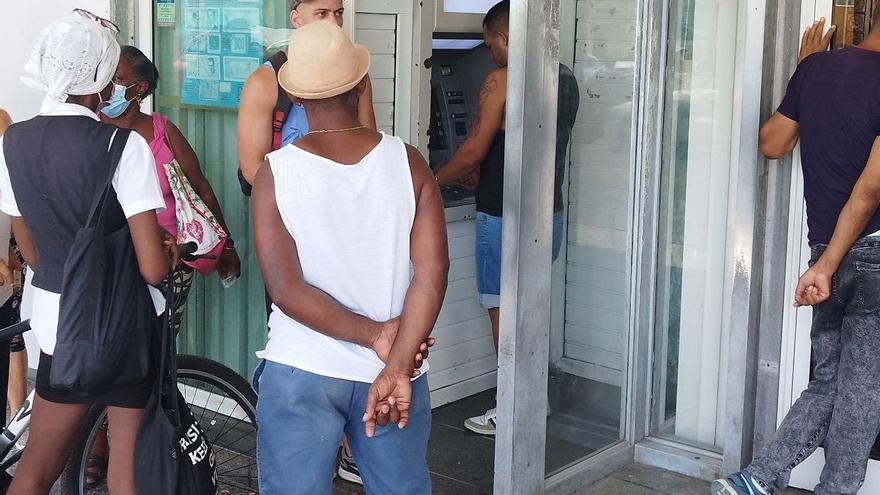
ATM at the Banco Metropolitano branch located in Belascoaín and Zanja, Centro Habana. (14ymedio)

14ymedio bigger14ymedio, Havana, August 2, 2023 — The “bankification” of the country, just approved this Monday by the Council of Ministers, reflects the lack of liquidity of the Cuban State, and will begin to take effect as of this Thursday, “gradually,” with the announcement of a group of measures by the Central Bank of Cuba (BCC).

From now on, said Alberto Quiñones Betancourt, vice president of the institution, in statements reported by the official press, “all collection and payment relationships between economic actors must be based on the payment methods established by the BCC, prioritizing electronic channels.”

Among the measures, which will also be published this Wednesday in the Official Gazette, is the prohibition on “economic actors” — that is, private companies — withdrawing money from their fiscal account. For these companies the daily maximum allowed in each banking operation is 5,000 pesos.

Only cards “associated with pensions, savings accounts, salaries, bonuses, etc.” may be used at ATMs, that is, from natural persons.

In addition, the obligation is established that all businesses that provide goods and services have “electronic means of payment” and that private companies have contracted “the services of the payment gateways or POS.”

One of the premises of the new measures, they concede, is “to encourage the use of bonuses.” For example, this Wednesday, before the BCC issued its statement, the telecommunications monopoly, ETECSA, announced a 10% savings “by paying for telecommunications services through Transfermóvil.” continue reading

Similarly, this Tuesday, the state corporation Cimex reported that from September 1 to October 31, it will “gradually” eliminate cash payments at gas stations in the country.

Quiñones Betancourt, without referring to either the scarcity of cash or the size of the underground economy, limited himself to saying that “this process of progress and duality is determined by the experiences accumulated in Cuba and from the existence of a group of conditions that allow progress.”

“These channels allow for safer, faster operations, and it is important that they provide an economic benefit for the population,” insisted the vice president of the BCC, who did not mention the lack of connectivity, the frequent power cuts that prevent the terminals from operating at all, and something getting more and more under the skin of Cubans: the rejection of having their movements controlled.

Although the official assures that they are “accelerating a process adhering to international standards, since electronic payments are a daily part of the lives of the citizens of any country,” what Cubans fear is that this will mean the freezing of their accounts.

Before the Council of Ministers on Monday, in recent weeks, there have been numerous testimonies received by 14ymedio from citizens who have not been able to collect transfers in foreign currency. For this, the usual system is to make a “cash reserve” with the bank branch, which involves signing up for a list and being called when the money is available.

A retiree from Centro Habana has been trying for two weeks to collect what her son sends her from Madrid and, in response, her bank repeats that they “do not have” euros. Another resident of the Havana municipality of Playa, with two children in Italy, was told that “this option” is “on hold until further notice.”

A resident of Varadero, Matanzas, tells this newspaper in detail that when he went to withdraw money from his account in euros at the Banco Popular de Ahorro, the employees told him that “they were not allowing cash to be withdrawn from the foreign currency accounts, not even for ’reserve balances’.”

When asking for explanations, the staff assured him that “it was not a problem of availability, that there were euros in the bank,” that it was “a general measure of the Central Bank that prevents foreign currency from being extracted in cash from the accounts.”

“The conclusion I draw is: despite having money, they are not going to give it to me,” laments the man from Matanzas. “Of course I was very upset with this situation, since that money is mine. It has arrived from abroad as a remittance. I have not invented it from the air. What I receive in that account is euros, and on my MLC [‘freely convertible currency’] cards* I receive dollars from abroad.”

The worst thing for him is that he can only withdraw from that account at the Varadero branch itself and cannot use it to buy at the stores that only take payment in MLC, that is in foreign hard currencies. “The only way I have to withdraw from that account is at that branch, so if they don’t let me withdraw it, then they have kidnapped my money,” denounces the man. “This is a robbery, without a doubt, they do not want the people to get their money.”

*Translator’s note: The ‘fine points’ of currencies in Cuba are too complex (and ever changing) for this footnote. Briefly, however, an entire network of state-run businesses in Cuba only take payment in ‘MLC‘  (moneda libremente convertible),  ‘freely convertible currency’. This foreign currency comes to Cubans as remittances from abroad, which they can collect at cadecas — currency exchanges. However, Cubans do not collect paper dollars or euros; they can only collect it in the form of debit cards, and the balances on the debit cards can only be ‘spent’ at the MLC stores. In addition, unspent balances cannot be recovered or converted into Cuban pesos.  In this way the Cuban state takes control of all the remittances sent from abroad, keeping the balances until they are spent, and assuring that when they are spent they are only spent in State-run businesses.

____________

COLLABORATE WITH OUR WORKThe 14ymedio team is committed to practicing serious journalism that reflects Cuba’s reality in all its depth. Thank you for joining us on this long journey. We invite you to continue supporting us by becoming a member of 14ymedio now. Together we can continue transforming journalism in Cuba.

Prices for Illegal Satellite Dish Services in Cuba Skyrocket

Satellite dishes give Cubans access to a variety of foreign TV channels. (Sincable)

14ymedio bigger14ymedio, Natalia Lopez Moya, Havana, 30 July 2023 — Inflation continues to take its toll on Cuban pocketbooks. In addition to increases in the cost of transportation and food, the fees families pay to watch foreign television programs via illegal satellite dishes are also going up, doubling in some Cuban neighborhoods to as much as 1,000 pesos a  month.

“I can’t afford it so I told the boy who installed the cable to take it out,” says Maritza, a retiree in Central Havana’s Cayo Hueso neighborhood who has been enjoying the service for more than a dozen years thanks to wiring hidden in a fake water pipe leading to her house. The densely populated borough has one of the capital’s highest concentrations of satellite dishes.

“One day I learned the price was suddenly going from 250 pesos, which I had been paying, to 500 pesos.” Maritza complains. “I can’t afford something like that on my 1,400-peso monthly pension.” The service gave her access to variety shows, soap operas and “all the things having to do with Cuba such as the news programs on channel 41 [America TeVe].”

Costs are skyrocketing even more for suppliers whose cables are apt to be cut, stolen and resold on the black market, a growing practice on Havana’s rooftops. To replace their stolen wiring, satellite owners must shell out hard currency or turn to friends and family members overseas willing to use their Visas or Mastercards to buy it from online stores that ship to the island.

In Luyanó, an area in the Tenth of October borough, prices have risen even more. “There are packages that cost 800 pesos a month and others that cost 1,000 depending on the number of channels you choose,” says Dayron, a young man who acts as a broker between local customers and the owner of two powerful satellite dishes. “Everything has gone up and so everything costs us more,” he explains. continue reading

He points out that, in addition to maintenance costs, there are costs for the electricity needed to operate the devices, for DirecTV activation cards and for the cables that deliver the programming to customers. If owners of satellite dishes do not want to be reported to the authorities, government inspectors must also be paid to “turn a blind eye.” And to keep the most politically extreme neighbors from “wagging their tongues,” they are provided the service for free.

Though satellite dishes have been in the censors’ crosshairs for decades, efforts in Havana to root them out them have decreased significantly in recent years. After mass protests on 11 July 2021 (’11J’), however, the Cuban regime redoubled its efforts to crack down on the devices in order to prevent images of anti-government demonstrations from being disseminated.

Police operations aimed at finding the devices became so frequent that, in large areas of the city, satellite dish owners decided to suspend operations and wait for conditions to improve. Little by little, they reconnected customers and brought back their schedule of miniseries, movies, and reality shows.

These antennas are most commonly found amid Central Havana’s crowded streets and densely packed rooming houses. Among the first high-tech devices, they changed the way media was consumed on the island in the 1990s. They were followed by the paquete [’weekly packet’], the USB memory stick and, for nearly the last five years, the mobile phone internet connection.

More recently, however, satellite dishes have faced a new competitor: streaming services such as Netflix. Many Cuban emigrés subscribe to the service overseas and share their access codes with family members on the island. In some cases, the relatives in Cuba have a Fire TV device, or something similar, that allows them to enjoy a wide range of programming options on their televisions.

But connectivity problems, the high cost of web browsing and slow internet speeds limit the possibilities for watching movies or miniseries using these devices. In the poorest neighborhoods, satellite antennas still reign supreme because of their reliability and low cost, a situation that could change with the current rate increases.

“The greatest demand is for programs from Miami from [broadcasters such as] America TeVe, Telemundo, Spanish-language CNN and others that offer miniseries, documentaries and soap operas,” says Dayron. “Most of customers have told us they want to continue with the service even though it will cost more. “They’re already hooked and what they really don’t want, above all, is to go back to watching Cuban television.”

____________

COLLABORATE WITH OUR WORKThe 14ymedio team is committed to practicing serious journalism that reflects Cuba’s reality in all its depth. Thank you for joining us on this long journey. We invite you to continue supporting us by becoming a member of 14ymedio now. Together we can continue transforming journalism in Cuba.
Thieves Decimate the Ration Stores in Sancti Spiritus with the Complicity of Cuban Officials

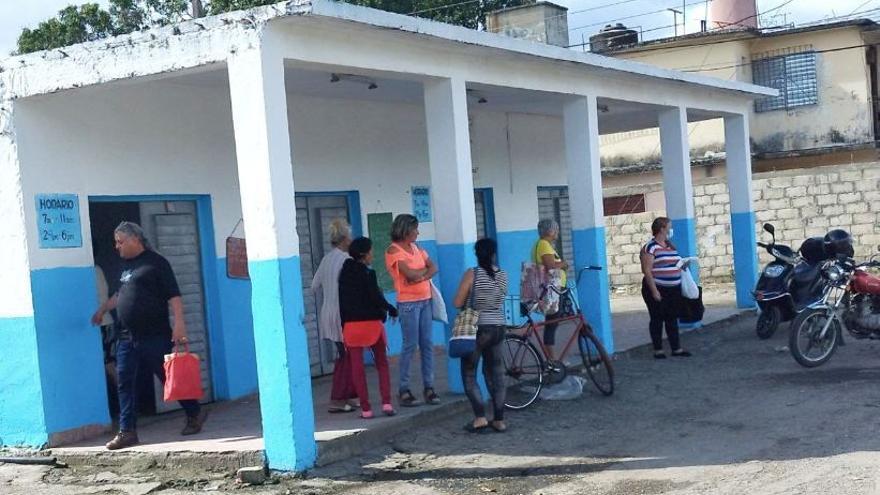
The thieves managed to get into the ration stores by breaking through doors, ceilings and windows. (14ymedio)

14ymedio bigger14ymedio, Havana, August 1, 2023 — Some ten bodegas (ration stores) in the province of Sancti Spíritus have suffered violent robberies, while in another five – in addition to a food processing center – cases of corruption have been detected so far this year. The stolen products affected the delivery of the “basic basket” to the population, whose complaints led to inventories and checks after which the crimes came to light.

The thieves managed to enter the bodegas by breaking doors, ceilings and windows, Ariel Fernández, director of the Commerce business group in the province, told the local press. Pojabo – a town to the southwest of the provincial capital – Yaguajay, La Sierpe and two areas of Trinidad – Limones Cantero and Condado – have been the most affected by the crimes.

The thieves are targeting, above all, food: rice, grains, sugar, coffee, oil, meat and other supplies that depend on the production of each municipality. At the moment, the Police have only captured three of the criminals involved.

Regarding the corruption of the Commerce workers themselves, Fernández was blunt: “Being fired from the entity is applied as a measure,” he assured. In addition, managers who failed in their responsibility to keep strict control of inventories were forced to repay the missing money. Others face proceedings for “embezzlement of basic products for the people,” he said.

The serious “lack of control and ethics of the civil servants who were in charge of the entities” are the true cause of the crimes, lamented the official, who did not give more details about the robberies to the local press. continue reading

During the accountability sessions of the Cuban Parliament, last July, the Minister of Internal Commerce, Betsy Díaz Velázquez, revealed that 361 bodegas had been broken into to commit robberies between January and May 2023. The official explained that what the criminals overwhelmingly seek is rice, beans, powdered milk, soap and cigarettes, which are then resold in the informal market where rice – she exemplified – already reaches up to 200 pesos per pound.

In the same meeting, the Camagüeyan deputy Lurdelis Cárdenas denounced that in each crime there is usually a component linked to corruption, which facilitates theft. However, at the local level, the accomplices are sanctioned by being transferred to another position, “moving the problem from place to place” and generating discontent in the population.

The Parliamentary Committee on Constitutional and Legal Affairs, for its part, considered the situation one of “great complexity” and pointed out that the Cuban Prosecutor’s Office did not have enough personnel to process all criminal acts with the required efficiency and speed.

Ruben Remigio Ferro, president of the Supreme Court, mentioned that drug trafficking, theft and slaughter of cattle, tax evasion, theft of state assets, and family and gender violence were also part of the criminal panorama on the island.

In addition, he confirmed that 1,273 people were tried for illegal cattle slaughter, 360 for crimes associated with drugs, 249 for embezzlement, 4,666 for crimes against property, 52 for illegal economic activity, and 154 for speculation and hoarding.

____________

COLLABORATE WITH OUR WORKThe 14ymedio team is committed to practicing serious journalism that reflects Cuba’s reality in all its depth. Thank you for joining us on this long journey. We invite you to continue supporting us by becoming a member of 14ymedio now. Together we can continue transforming journalism in Cuba.
A Hot August is Coming in Cuba

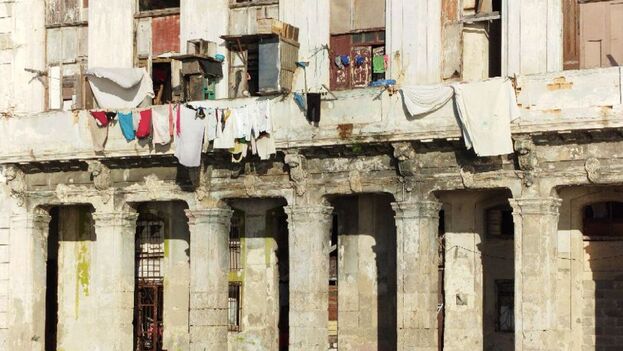
In Cuba, those who did not plan to emigrate are already beginning to pack their bags. Our building is getting emptier and emptier. (14ymedio)

14ymedio bigger

14ymedio, Yoani Sánchez, Generation Y, 1 August 2023

Access to the internet barely functions.

The ATMs are almost out of cash.

The Electric Union announces an increase in blackouts.

It is better not to go near the hospitals because there are no serums for hydration.

Bus stops have become places for long waits.

There are neighborhoods where garbage has not been collected from the streets for weeks.

Thousands of residents in this city have not received water through their pipes for more than a month.

One cannot go out on the street after certain hours because between the lack of public lighting and crime, there is no safe place.

The Cuban peso is worth less and less and food costs more and more.

Those who did not plan to emigrate are already beginning to pack their bags. Our building is getting emptier and emptier. Even the seasoned militants of the Communist Party and the most frenzied members of the Committees for the Defense of the Revolution have headed north.

The political prisoners are still behind bars and the alleged negotiations for their release are in the realm of speculation.

Independent journalism is left, every day, with fewer reporters on the street on the Island.

Activism is undermined by exile and repression.

The leaders of the Communist Party have less and less shame and demand “creative resistance,” where the people must put up the resistance while they continue “creating” large profits for their pockets and those of their family clans.

Fear spreads but anger too.

August, our cruelest month, starts hot, hot, hot.

________________

COLLABORATE WITH OUR WORKThe 14ymedio team is committed to practicing serious journalism that reflects Cuba’s reality in all its depth. Thank you for joining us on this long journey. We invite you to continue supporting us by becoming a member of 14ymedio now. Together we can continue transforming journalism in Cuba.
A Motorcyclist Collides with the Mercedes Benz of Cuba’s Deputy Prime Minister Ramiro Valdes in Havana

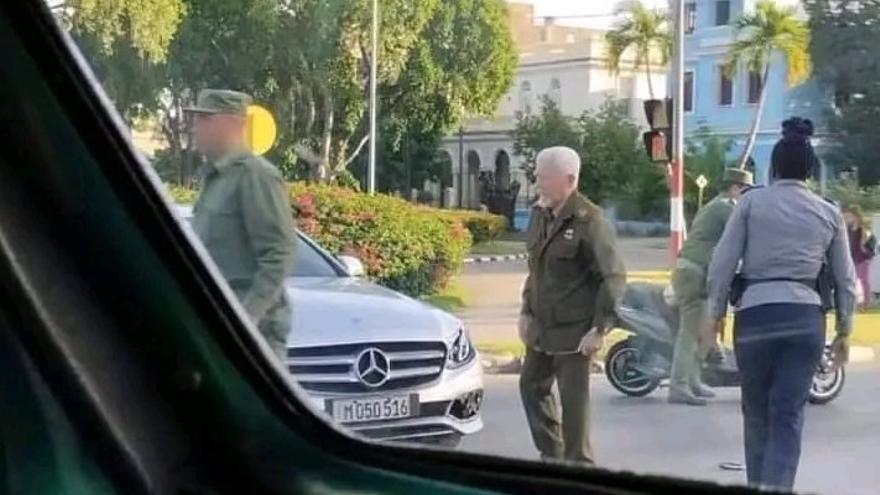
The image of Ramiro Valdés, between a luxurious Mercedes Benz car and a motorcycle that was being inspected by an agent, taken from another car, went viral. (Facebook/Mauro Torres Page)

14ymedio bigger14ymedio, Havana July 31, 2023 — The news spread like wildfire this Sunday first on social media: the car in which Ramiro Valdés, Cuba’s deputy prime minister, was traveling had collided with a motorist at the intersection of Paseo avenue and 23rd street, in El Vedado Havana. The image of the senior official, between a luxurious Mercedes Benz car and a motorcycle that was being inspected by an agent, taken from another car, went viral. Shortly after, it was published by the pro-government Página de Mauro Torres, which reported on the events, praising the attitude of the high-ranking official.

According to a post on this Facebook wall, the incident occurred at 7:30 a.m. on Saturday. Based on “witnesses to the event,” the driver of the electric motorcycle “did not notice the signs of the police officer and it was then that the car in which Commander Ramiro was traveling was impacted.”

A resident of the place corroborates this version to 14ymedio, with an additional detail: “What happened was that the traffic light at 23rd and Paseo was green and the motorcyclist did not see the policeman who was stopping traffic on that street.”

The deputy prime minister’s caravan was going along Paseo, the same source refers, in the direction of the Plaza de la Revolución, where the Council of State and various ministries are located. For this very reason, it is a route frequently used by high-ranking officials –and, also for this reason, one of the best maintained in the capital – to go to the seat of Government from exclusive neighborhoods such as Miramar and Siboney.

It is usual, when a procession of these characteristics passes, for the Police to cut off traffic in the adjacent streets, but not for an accident of this type to occur. continue reading

La facebook page of Mauro Torres ponders that “in an act of deep shock and concern for the injured person,” Valdés rushed to help the motorcyclist, who was injured with a fissure in the fibula.

“Everyone saw that, the man got out of the car and participated with his escort in helping the one on the motorcycle. There was another person who also helped to put him in a vehicle that would take him to the Calixto García Hospital,” says the same page citing a resident of the area.

The post also includes statements by a nurse from the same hospital, who assured that “the injured man apologized while he was being treated, but the policeman who was with him told him not to worry, to be calm.”

“You can be the greatest Hero in the world, that if the life of a human being is in danger, the most logical thing is to look after his health, and the Commander of the Revolution Ramiro Valdés did it,” concludes the official page, in an educational and bombastic tone. “In Cuba, lessons in humanity are given every day. In other parts of the world, I don’t know if a leader of any country, faced with an event like this, has the courage to do the same.”

____________

COLLABORATE WITH OUR WORKThe 14ymedio team is committed to practicing serious journalism that reflects Cuba’s reality in all its depth. Thank you for joining us on this long journey. We invite you to continue supporting us by becoming a member of 14ymedio now. Together we can continue transforming journalism in Cuba.

Lifeless Body of the Man Shipwrecked in Artemisa is Found

The body of the last crew member of the boat was found on the coast of Punta de Gato, in Consolación del Sur. (The Artemisian)

14ymedio bigger14ymedio, Havana, July 30, 2023 — The lifeless body of the crew member who disappeared during the sinking of the Pura María boat , which occurred last Monday off the coast of Artemis , was finally found early this Saturday morning.

The provincial press indicated that the native fishermen of the area notified the authorities that they had discovered a corpse floating on the coast of Punta de Gato, in Consolación del Sur. A note from El Artemiseño reports that the friends and relatives of the crew member, whose identity has not been provided, had undertaken a desperate and intense search to find his mortal remains.

“Those closest to him will now be able to give a dignified burial to those who, according to their blood relatives: died in the place he loved the most,” says the newspaper.

The man had been missing since Monday when the accident occurred on Majana beach, 70 kilometers south of Havana, around 10 p.m. The first survivor rescued, 57 years old, was transferred Tuesday at 5:00 pm to the Ciro Redondo García General Teaching Hospital after receiving first aid from health personnel on the beach. continue reading

According to Niurka Larrionda Valdés, director of the medical center, the patient was in a state of moderate but stable dehydration. This survivor told the authorities that “they swam little by little, that one of his companions almost died in his arms and another was still missing.”

The man, whose identity was also not released, was released after his test results indicated that everything was “in order.”

A second crew member of the boat was also rescued in the “afternoon-night hours” of Monday, according to El Artemiseño. “The diver” made landfall after being helped by a ship in the sea and after swimming “approximately 10 hours.”

The authorities have not yet confirmed whether the boat had the intention of leaving the country. Initially, a user on social networks, who claimed to be a relative of the owner of the boat, argued that the victims were fishing, although that version is questioned by other Internet users.

____________

COLLABORATE WITH OUR WORKThe 14ymedio team is committed to practicing serious journalism that reflects Cuba’s reality in all its depth. Thank you for joining us on this long journey. We invite you to continue supporting us by becoming a member of 14ymedio now. Together we can continue transforming journalism in Cuba.

The Best Novel by Reinaldo Arenas and an Anthology on the ’11J’ Protests Among Cuban Books of July

Covers of ’The Hallucinating World’, by Reinaldo Arenas, ’Oriental Motifs’, by Vasili Rozanov and the ’Cross Correspondence’ between Casal and Moreau. (Collage)

14ymedio bigger14ymedio, Xavier Carbonell, Salamanca, July 30, 2023 — After the success in bookstores of Antes que anochezca [Before Night Falls], the heterodox autobiography of Reinaldo Arenas reissued in 2022, Tusquets offers readers El mundo alucinante [The Amazing] World, considered by critics as the best Cuban novel The deranged memoirs of the Mexican friar Servando Teresa de Mier, exiled and misunderstood, were written as an “adventure” story by a 23-year-old Arenas.

Conversations with Bolívar and the poet Heredia, nods to Lezama and multiple trips and imprisonments – one of them in the gloomy Havana prison of La Cabaña – fuel the adventures of Fray Servando, who lived between the 18th and 19th centuries. In the friar’s vocation of heresy and the nonconformity, Arenas is plotting his own youthful portrait and, somehow, predicts the no less amazing life that awaited him.

The epistolary exchange between the Cuban poet Julián del Casal and his “much idolized teacher,” the painter Gustave Moreau, was published this month by the Spanish publishing house Linkgua. Correspondencia cruzada [Crossed correspondence] accounts for the idolatry of Casal by the French artist, to whom he dedicated several poetic compositions collected in Mi museo ideal  [My Ideal Museum]. The letters were translated by the Parisian academic Dominique Fernandez and the Cuban Roger Herrera, deputy director of the Paris Academy of Fine Arts. continue reading

Havana professor Jorge Brioso examines from philosophy, in Al modo de Narciso (Casa Vacía) [In the Mode of Narcissus], the work of various authors – Homer, Poe, Mallarmé, Borges – and visual artists. “One recommends to the reader that, abandoning the calculating reason, they let themselves be carried away by the force of Brioso’s mythical prose and accompany him in his revelations,” says Javier Gomá in the back cover note.

In translation by Jorge Ferrer, Casa Vacía also publishes Motivos orientales [Eastern Motives], by the Russian critic and philosopher Vasili Rozánov. For Ferrer, the writer is “a great reactionary, a graphomaniac, a man straddling two worlds and running at a gallop towards the one he wanted to invent.” As for the book, he assures that it is composed “with the most delusional carpentry of delirious Russia.”

Martí, uno y muchos a un tiempo (Verbum) [Martí, one and many at a time ], by Leonardo Depestre Catony, brings together several articles that aspire to form a “journalistic biography” of the Cuban national hero. It also deals, according to the editorial presentation, with other aspects of Martí’s life, “traditionally controversial and previously ignored.”

The story of a writer during the Special Period is the plot of Límites y escombros, [Limits and ruins], a novel by Arturo Arango. With his notes, the protagonist intends “to not forget and to understand what we are experiencing.”

Cuba 11J: Perspectivas contrahegemónicas de las protestas sociales (Marx21.net) [Cuba 11J: Counter-hegemonic perspectives of social protests ], an anthology by historian Alexander Hall on the demonstrations of 11 July 2021. A multiplicity of signatures – of very diverse ideological signs – explores “the motivations of so many Cubans who screamed for freedom.” Among the participants are Alina Bárbara López, Roberto Zurbano, Ailyn Torres Santana, Julio Antonio Fernández Estrada and Julio César Guanche.

____________

COLLABORATE WITH OUR WORKThe 14ymedio team is committed to practicing serious journalism that reflects Cuba’s reality in all its depth. Thank you for joining us on this long journey. We invite you to continue supporting us by becoming a member of 14ymedio now. Together we can continue transforming journalism in Cuba.