Rubén Breña acting in a drama on national television. (ICRT)
14ymedio, Havana, 23 March 2023 — Cuban actor Rubén Breña passed away this Thursday in Havana at the age of 70, official media reported. The artist died after spending several days in intensive care at the Hermanos Ameijeiras Hospital due to complications from erosive gastritis.
This Wednesday, and after several postings on social networks by friends close to the artist who denounced the lack of medicines to treat Breña, the official press published a note, something unusual in the health system of the Island, by the Hermanos Ameijeiras Hospital saying that the hospital had “everything necessary for his care.”
“From the first moment the patient had all the treatment required for erosive gastritis with the application of 20 mg of Omeprazole according to the protocols,” said the note, which caused outrage among Cuban Internet users for the severe shortage of drugs that the Island’s health system has suffered for more than two years.
According to the note, the actor had arrived at the hospital “in shattered health.” continue reading
“Incredible, but true: Rubén Breña is in intensive care at Ameijeiras. He needs Omeprazole and vitamin K (not orally) and there is none,” complained the actor and television director, Rolando Chiong, a few hours before the official publication.
Breña, known mainly for his diverse characters in dramatized series on Cuban television, was born in Pinar del Río in 1953. In the early 1970s he graduated from the National School of Theatre Direction of the Ministry of Culture and became part of the Zafarrancho and Trotamundos theater groups. In addition to theater and television, he worked in film and radio.
On television, his performances are remembered in dramatic works such as Tierra brava, Historias de Fuego, Cuando el agua regresa a la tierra and Salir de noche. According to the official media Cubadebate, Breña “was a self-taught painter and was fond of music and poetry.”
“Rest in peace, friend, man and great actor. Someday, someday. The good ones die, the fucked keep being fucked and living. That’s why, damnit, every day I don’t regret what I say,” actor Erdwin Fernandez wrote on Facebook, from the United States, when he learned of Breña’s death.
Among the official recognitions that Breña received in life, the Actuar Award for Life Work awarded by the Artistic Agency for the Performing Arts in 2019 stands out.
Translated by Regina Anavy
____________
COLLABORATE WITH OUR WORK: The 14ymedio team is committed to practicing serious journalism that reflects Cuba’s reality in all its depth. Thank you for joining us on this long journey. We invite you to continue supporting us by becoming a member of 14ymedio now. Together we can continue transforming journalism in Cuba.
To carry out the theft, screws from the pipes were removed, and piping networks were connected that led to the fields of local farmers. (Vanguardia)
14ymedio, Havana, 24 March 2023 — The Villa Clara Police discovered 13 illegal connections and nine leaks in the Hanabanilla, a 15-mile system of pipes that supplies water to a large part of the central provinces of the Island. The farmers of the area had made multiple punctures in the pipes to divert the water to their agricultural fields.
The Hanabanilla, which takes its name from the reservoir that feeds it in the Villa Clara municipality of Manicaragua, extends from Jíbaro, in Sancti Spíritus, to Zapatero, in Villa Clara. The greatest damage occurred, according to the official newspaper, Vanguardia, between the towns of Porvenir and Biajaca, where the drainage left 10,000 people from the towns of Mataguá, La Yaya and Jorobada without a water supply.
To carry out the theft, screws from the pipes were removed and piping networks were connected that led to the fields of local farmers.
The authorities will apply sanctions to those involved and promised to carry out a “program for the suppression of leaks,” which are also common in the system. The official press also says that these water thefts also occur at the Paso Bonito-Barajagua pumping station, in Cienfuegos, but states that the Villa Clara Police “has no jurisdiction to act” there and that they have already informed the neighboring province to “take similar measures.”
According to the local newspaper Vanguardia, the authorities have been trying to contain the illegalities in the area for months. They assure that they have renewed the electrical panels that generate the pumping capacity in Hanabanilla, but that the illegal drainage decreases the pressure of the network and makes it impossible to supply the area. continue reading
The newspaper also points out the population density of the territory and says that, despite this circumstance, the police will go “house to house” to find the offenders. The newspaper says that an “official warning” would be a matter of interest to the inhabitants of Manicaragua and that, “in case of recidivism,” the fines and penalties will increase.
The loss of water in the area — in the midst of a drought that has affected, above all, the central part of the country — has been a blow to the cost of the tanker trucks that deliver water, for which large amounts of fuel are needed and often impossible to get, due to the “energy contingency.”
The illegalities, the price of getting water to mountainous and remote communities and the incompetence of Cuban hydraulic resources companies were not mentioned, however, in the speech given this Thursday at the United Nations Conference on Water by Cuban Vice President Inés María Chapman.
Chapman dedicated her speech to celebrating the Regime’s management and to complaining that due to the US blockade, the Island was not able to have better results.
Translated by Regina Anavy
____________
COLLABORATE WITH OUR WORK: The 14ymedio team is committed to practicing serious journalism that reflects Cuba’s reality in all its depth. Thank you for joining us on this long journey. We invite you to continue supporting us by becoming a member of 14ymedio now. Together we can continue transforming journalism in Cuba.
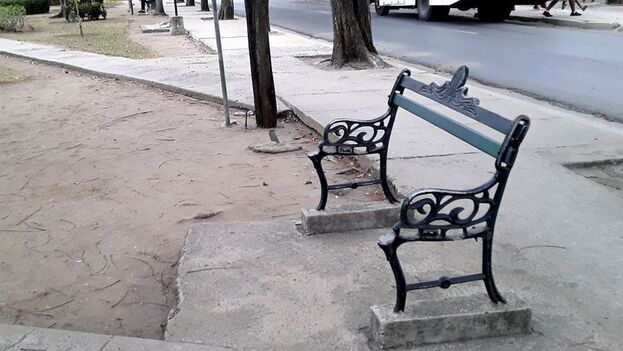
Almost all the benches in Plaza Calé have lost their slats. (Newspaper 26)
14ymedio, Juan Izquierdo, Havana, 7 March 2023 — Based on the robberies and vandalism, the inhabitants of Las Tunas are “dismantling” the city’s public spaces. The list of “reprehensible” acts, as the official press called them this Monday, is extensive: garbage dumps, destruction of buildings, theft of furniture and corruption in state establishments.
The most alarming situation is going on at the provincial hospital, which, according to its directors, treats more than 7,000 patients daily. “The light bulbs, the screws for the window panes and the panes themselves have been stolen,” denounced Carlos Pérez Santiesteban, deputy clinical-surgical director of the center.
The people who accompany the patients take advantage of their stay in the hospital, according to the doctor, to get hold of what they find, from a piece of metal to the chair braces. To make matters worse, the doctor complains, “stretchers and wheelchairs are abused, mattresses are unprotected, food is eaten on the beds and liquids are spilled.”
Pérez, who describes the ability to control the situation as “difficult,” also regrets that people steal or destroy the installation’s switches, and that they intentionally dump waste in the corridors, bathrooms and gutters of the building. In addition, they habitually scratch the walls, smearing them with grease and damaging the paint. continue reading
According to the press, the “fury” of the people from Las Tunas has an explanation: they behave “as if they were bothered” by the good condition of public spaces. It is no longer a question of neglect, but of vandalizing what cannot be transported to homes, such as park benches or the walls of a building.
“In a bakery, for example, flour and oil are stolen and sold in the same neighborhood.” Nobody has scruples when it comes to “taking advantage” of public goods
Las Tunas, the report states, “has large bills” related to “collective property,” and attributes it to a “a training problem” to young people that later in life affects their adult behavior. However, it does not mention at any time the deficiencies and shortages – common throughout the country but exacerbated in the eastern provinces – that have triggered crime rates in Cuba, although they]se do not justify other behaviors such as dirtying and vandalizing hospital facilities.
There are people who even steal marble pieces “to make a grinder for spices and meat,” an astonished citizen of Las Tunas said. He was recently interviewed by the official press, which also publishes photographs of the “ragged sites” of the city. Almost all the benches at the Plaza Calé are missing their slats, while the metal railings of the Colón Street bridge –whose potholes are a danger to traffic– have been sawn off and stolen.
The fence of the Hermanos Ameijeiras Airport is in the same sorry state, whose wires and poles, already damaged by rust, have been cut and “recycled” in homes.
“Everyone here ‘struggles’, cautiously states one of the interviewees in the official report. “In a bakery, for example, flour and oil are stolen and sold in the same neighborhood.” No one has scruples when it comes to “taking advantage of” public goods, it doesn’t matter if they are food or construction materials –rebar, stones, bricks– that are already part of some structure. That notion, he admits, is even “accepted.”
Another problem is the city’s state of hygiene, to which the local newspaper has referred on other occasions. The amount of garbage in the streets, the puddles of urine in squares and parks, and the fact that almost all the garbage transportation of the waste depends on horse-drawn carts – for which Community Services pays little and late – increase the population’s discomfort.
The “latest fashion,” the newspaper claims, is breaking bottles and leaving the glass shards on the streets, which are already littered with excrement, paper and potholes. At the height of the problem, the text devotes several paragraphs to giving lessons in “socialist morality” and civility to the people of Las Tunas, whose attitude cannot be explained and who will end up, he insists, by leaving only “bits and pieces” of the city.
Translated by Norma Whiting
____________
COLLABORATE WITH OUR WORK: The 14ymedio team is committed to practicing serious journalism that reflects Cuba’s reality in all its depth. Thank you for joining us on this long journey. We invite you to continue supporting us by becoming a member of 14ymedio now. Together we can continue transforming journalism in Cuba.
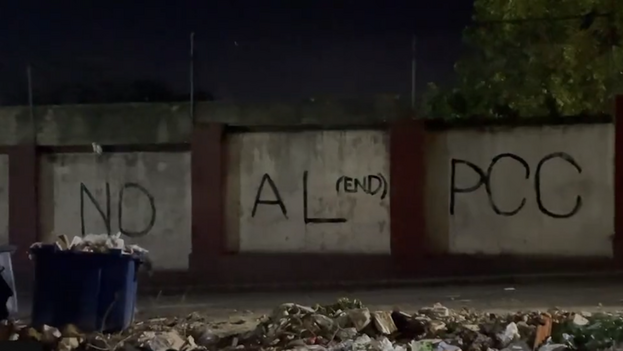
The protest sign against the Cuban Communist Party on a wall in Aguirre Park, in the Havana district of Revolution Square. (Screen capture)
14ymedio, Juan Diego Rodríguez, Havana, 23 March 2023 – A new protest sign against the dictatorship caused surprise among Havana residents on Thursday. This time it had the words “No to the PCC” (Cuban Communist Party), written in giant capitals on the wall at the back of Aguirre Park, in the Revolution Square district.
The action took place in the early hours, judging by videos posted on social media by an organisation calling itself The New Governing Body, which alludes to the University Student Governing Body (DEU) which confronted Gerardo Machado in the Cuban republic of the 1930’s.
During the morning, 14ymedio confirmed that the protest sign was still there, as there was no means of instantly cleaning it off, like there had been on previous occasions. What was present though was an enormous State Security operation, with dozens of Interior Ministry motorcycles visible or concealed between the bushes.
“They must be on the lookout for anyone taking pictures”, said a local woman through clenched teeth, as she passed by, surprised. “Don’t get your phone out, not even to make a call, because they’re everywhere”.
A new protest sign against the dictatorship caused surprise among Havana residents on Thursday.
This kind of action, unprecedented in the history of the dictatorship, became frequent after the mass protests of 11 July 2021. In February 2022 an enormous sign appeared in Calle Gervasio / Enrique Barnet (Estrella) — also in central Havana — which read “Patria y vida” (Homeland and Life). That one also appeared during nighttime hours and was removed in the midst of a massive police presence.
COLLABORATE WITH OUR WORK: The 14ymedio team is committed to practicing serious journalism that reflects Cuba’s reality in all its depth. Thank you for joining us on this long journey. We invite you to continue supporting us by becoming a member of 14ymedio now. Together we can continue transforming journalism in Cuba.
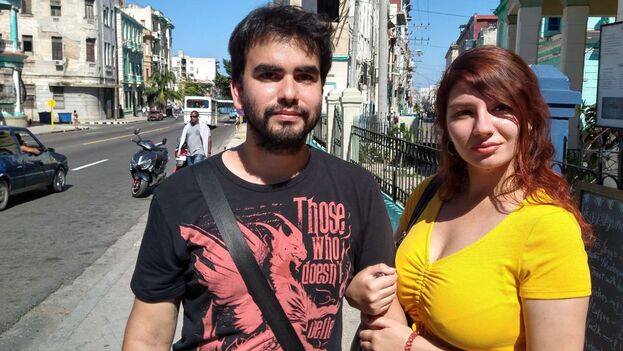
Cuban citizen Carlos Jiménez, and his Russian wife Daria, pictured in a Havana street. (14ymedio)
14ymedio, Reinaldo Escobar, Havana, 24 March 2023 — Before being forced to escape from Russia because of the threat of his being recruited to fight in the war in Ukraine, the Cuban Carlos Jiménez was living a quiet life with his wife Daria in Kushelevskaya Doroga, St Petersburg.
They met whilst studying philology at the hydrometeorological University in Russia which, although it sounds odd, has a prestigious program of language and literature studies. Carlos already spoke the language because as a child he lived in Moscow for five years when his father worked at the Cuban Embassy.
These days he is an admirer of Russian culture, amongst other things Russian, because of the influence of his wife. Through her he got to know the writer Mikhail Bulgakov (The Master and Margarita), the works of Dimitri Yemets, a children’s writer whose books are the most Russian that he has ever read in his life, he says. Through Daria he got to know the Russian rock group bi-2, which has become his favourite, and he has seen the best of Russian theatre and cinema and also Soviet cinema.
The young couple are currently in Havana. She is very scared of what could happen to him. He is very scared of what could happen to her. The nightmare began in Russia and has kept going for them all the way to Cuba.
One afternoon, two armed men banged heavily on the young couple’s door in St.Petersburg, looking for men to fight in the Ukraine war. “At that moment we knew we couldn’t stay in Russia”, says Carlos. We took out all of our savings, sold everything that we owned, which wasn’t much, and set off towards Armenia. We couldn’t ask for help from my wife’s family because being a foreigner I wasn’t well received there”. continue reading
It wasn’t a matter of choice, Armenia was just the first destination possible for them because Russia had already cancelled almost all flights to other countries. There they found that the cost of accommodation rose massively because of the sheer numbers of Russians that were emigrating and because of this there was no other option for them than to travel to Havana — at the beginning of January of this year. Havana is where Carlos is officially allowed to stay, in his parent’s house. He knew that staying there would be difficult because of their differences in ideology, but he had no other option. Daria was also not well received by Carlos’s parents.
“On the morning of the 8th of March a uniformed guy came into our room, accompanied by my father. He didn’t even bother to knock this time. He was an ’immigration official’. He said that my wife had been in the country longer than was allowed for foreigners, but this was a lie because we had only been there for 55 days and you are allowed 90 days. He was very strange and aggressive. He couldn’t explain the actual objectives of his visit and kept changing his story, saying that there had been complaints about noise, but without explaining who had made the complaints. Finally he set a date for a meeting for a different day at the immigration office in East Havana. For the whole time he refused to even speak directly to my wife”.
One hour after this supposed immigration official left the house, Carlos got a telephone call commanding him to turn up at the police station.
“At this station, where we had to wait for more than two hours, they took me to an office where the presence of my wife was ’not allowed’. There, three armed men lectured me about my poor conduct, and the most surprising thing was that they said they had witnesses! The door opened and then in came my parents, who lied! — so much about me and about Daria. But they could not even look me in the eyes”.
The couple still have to attend a meeting of the 9th of March, presumably to clarify Davina’s status as a migrant.
“That was not an immigration office nor even a police one. There, they shouted at us they insulted us, they threw chairs and banged on the table and did everything to intimidate us and humiliate us. They tried to frighten us in every way possible. They interrogated me about our motives for leaving Russia and about my contacts — about friends I have here in Cuba who they take to be troublemakers”.
“They also even argued that our marriage was not legal because we didn’t get married in Cuba and because of this my wife could not live here with me. They wouldn’t even allow me to interpret for her, and she hardly knows any Spanish. When I tried to explain to her what was happening they told me to shut up, saying that only they had the right to speak”.
After hours of interrogation they gave us another meeting arrangement, this time at the central immigration office, and they left us with the threat that we would ’pay’ for our insolence.
The first thing that occurred to Daria was to contact the Russian Consulate in Havana to ask for help. Because she’d always heard that Cuba and Russia were friends and brothers, she supposed that everything would be okay, that it had all been a misunderstanding.
With the help of Carlos as a translator Daria told this newspaper “We called the consulate and explained my situation, then a man told me that there was another number that I should call. When I dialled this number a few moments later the same voice came back at me not even trying to hide his laughter; this made me realise that here they would not help us so-called ’traitors’”.
When finally they got to speak to the actual Immigration Office they were spun yet another tale: they were told that the real problem was Daria’s economic insolvency. Also a complete lie.
“They told us we have to leave the country immediately. But we don’t have any ticket to travel anywhere, because we don’t know where we can go! We are in a terrible situation. We can’t stay in Cuba because the secret police are after us and neither can we go back to Russia because there’s no security for us there either”.
She says something in Russian which Carlos doesn’t translate straightaway. They take each other by the hand, and at length he says: “We’re so scared that something terrible could happen to us”.
Translated by Ricardo Recluso
____________
COLLABORATE WITH OUR WORK: The 14ymedio team is committed to practicing serious journalism that reflects Cuba’s reality in all its depth. Thank you for joining us on this long journey. We invite you to continue supporting us by becoming a member of 14ymedio now. Together we can continue transforming journalism in Cuba.
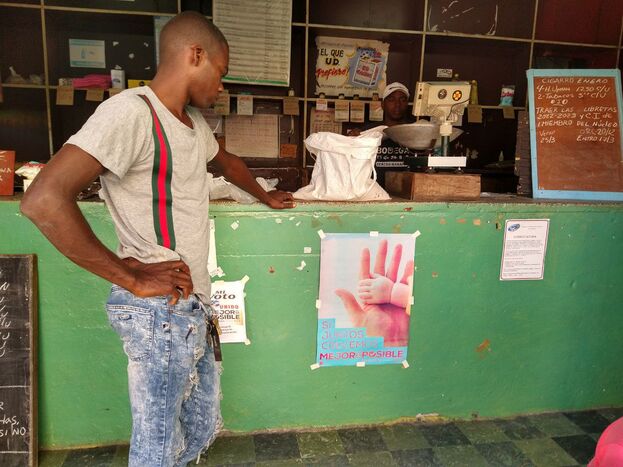
On Infanta Street this Wednesday, a young man in a ration store looked at one of the many official posters which, in these last weeks, promote a united vote for the parliamentary candidates.(14ymedio)
14ymedio, Natalia López Moya, Havana, 23 March 2023 — To vote or not to vote in the elections for Cuba’s Parliament, on March 26, is a dilemma in the face of which many Cubans have already taken sides. The economic crisis, lack of hope and little confidence in state institutions favor abstention in a country where not attending the polls is considered a political statement and can involve reprisals.
Among those who are overcoming fear and say that they will not vote are retirees whose pensions don’t go far enough, young people who have not known anything but scarcity since they were born and potential migrants who set their sights outside the Island. The dissatisfaction and mistrust that lay beneath the surface of Cuban society could materialize in an increase in abstentions this coming Sunday.
On Infanta Street this Wednesday, a young man in a ration store looked at one of the many official posters that in recent weeks promote a united vote for the parliamentary candidates. The colorful advertising stands out in the store, which has only a couple of products on display. On the counter, a small blackboard announces that allocation of cigarettes and cigars for the month of January are now being sold.
“I don’t even plan to go out that day, and I’m going to close the windows so they don’t bother me to go vote,” clarified another young woman who arrived at the bodega (ration store) to ask about the arrival of salt. “Two years ago I turned 16 and am on the electoral roll, but I’m not interested. I didn’t go to vote for the Family Code [in September 2022], and I’m not going to go this time either,” she says bluntly. continue reading
The reason borders more on indifference than on rebellion. “It’s not going to change anything if I go or not,” she tells 14ymedio. “My mother has been attending all those processes for 40 years and what does she have now? Nothing. A half-collapsed house, four old rags to wear and some children who only think about leaving this country as soon as they can.”
While she is speaking, an old woman arrives but doesn’t join the conversation. She makes a gesture of denial when she hears the young woman’s words. It is in the elderly where the official propaganda of the united vote and the attendance at the polls as a sign of support for the system penetrates with greater depth. They are the ones who are most afraid of change or have spent more years of their lives supporting the Government.
Maurín, 21, lives in the Havana neighborhood of San Pedro in the municipality of El Cotorro. In front of the door of his house extends a street that years ago lost some of its asphalt. Garbage accumulates on the nearby corner, while the line for the only kiosk that sells food in the area almost reaches his window. “How am I going to go to vote if they haven’t even fixed the basics?” the young man asks, indignant.
With an engineer father and a nurse mother, Maurín questions the role of the delegates of the National Assembly of People’s Power in his neighborhood and the ability of parliamentarians to improve the lives of citizens. “In San Pedro we have been demanding [from the delegates] for years and years in the Accountability meetings that they fix our streets, improve the quality of the bread and open new stores to buy food, but none of that has been resolved.”
Disbelief has taken over many of the residents in the area, a phenomenon that is repeated throughout the country. To try to arouse enthusiasm in recent weeks, the Cuban ruling party has launched a campaign that includes meetings with voters, an avalanche of advertising in the national media, the reduction of annoying blackouts, and agricultural fairs to sell food at prices a little cheaper than in private markets.
However, the ideological offensive does not seem to be bearing fruit among a population that is tired of so many daily difficulties. For Maritza, 64, until recently employed by a branch of the Ministry of Culture, it is striking how people in the streets no longer hide that they will not vote on Sunday.
The Government of Miguel Díaz-Canel seems to fear a growth in abstention, which for decades remained below 10% but has experienced a significant increase in recent years. In last November’s municipal elections it reached an all-time high with 30% of voters absent. For the ruling party, attendance is measured as a sign of support for the system and the Communist Party.
“In the line at the bank I heard two employees who were talking and saying that they were not going to vote on Sunday. For me it is unprecedented that in a state work center people talk so openly in frank defiance of the system,” she tells this newspaper. “Before, that was unthinkable, and it shows that between fear and defiance, many are choosing defiance.”
Cuban dissidents have also raised the tone in the calls for abstention as the electoral date approaches and, for the first time in a long time, they have agreed on the “I don’t vote” premise, which has been joined by activists of various political stripes.
In Santa Clara, Ignacio, 47 years old and self-employed, has also decided to abstain. “The deputies will not solve any problem because they are the gears of this machine but not its essence. They are mostly a group of puppets without voice or vote because everything in Cuba has always been planned in that manual of ’continuity’,” he says.
Ignacio recognizes that others will go to the polls but says their attendance is not exactly because of a belief that the National Assembly will help improve life on the Island. “One of the saddest things is the political apathy of these people and the hopelessness that leads them to vote or take any decision dictated by the Government, such as voting for everyone,” he emphasizes.
Others, such as Jorge, a 23-year-old university student and resident of Camajuaní, Villa Clara, recognizes that he will go to vote on March 26 because he feels that attendance is “practically mandatory.” He does not want to stand out publicly and prefers to avoid teacher retaliation that could result from not going.
However, he recognizes that no candidate for parliament represents him “because the politics they defend has nothing to do” with his way of thinking. “The election process will solve absolutely nothing. All leaders follow the same ideology and do not change anything once they are elected,” he concludes with skepticism.
There are also those who seem impervious to the official campaign for the March 26 elections and say they are not even aware that voting will take place. “I don’t care about that; I just want to survive every day and wait for my sister to find me a sponsor to go to the United States,” acknowledges 19-year-old Jean Marcos. “The only place I’m going to go is to the airport when I have my flight.”
Jean Marcos’ friends share his position. Given the choice between the ballot or the ticket, they all seem to opt for something that gets them out of Cuba as soon as possible.
Translated by Regina Anavy
____________
COLLABORATE WITH OUR WORK: The 14ymedio team is committed to practicing serious journalism that reflects Cuba’s reality in all its depth. Thank you for joining us on this long journey. We invite you to continue supporting us by becoming a member of 14ymedio now. Together we can continue transforming journalism in Cuba.
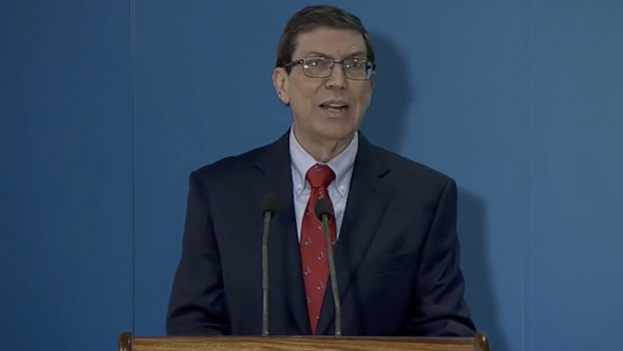
Bruno Rodríguez believes that the position serves the United States “for its criminal policy of economic suffocation.” (Screen capture)
EFE (via 14ymedio), Havana, 24 March 2023 — The Government of Cuba affirmed on Thursday that the United States never intended to remove the Island from the list of countries sponsoring terrorism because it “is convenient.”
Foreign Minister Bruno Rodríguez declared on Twitter that the North American country has no plans to “correct Cuba’s unfair classification” since “it is convenient for its criminal policy of economic suffocation.”
Rodríguez echoed the statements this Thursday by the US Secretary of State, Antony Blinken, in which he said: “We are not planning” to remove the Island from the list.
During an appearance before the Foreign Relations Committee of the House of Representatives, Blinken said “if there is a review, it will be based on the law and the benchmarks it establishes, which, as I said, have a very high bar.”
The Cuban head of Foreign Affairs stated that Blinken “confirms, in fact, that the State Department’s qualifying lists are nothing more than tools of political and economic coercion, totally divorced from such sensitive issues as terrorism, religion, human rights, drug trafficking, corruption and other things.”
The inclusion of Cuba on the list in January 2021 was one of the last decisions made by the Trump administration before leaving office. continue reading
The United States then justified the measure, which entails several sanctions, alluding to the presence on the Island of members of the Colombian ELN guerrillas, who traveled to Havana to start peace negotiations with the Colombian government.
The Island was taken off the list in 2015, during the rapprochement promoted by US President Barack Obama. It was put back on by Trump, who during his term redoubled the sanctions against Cuba and paralyzed much of the “thaw” stimulated by his predecessor.
The current Biden Administration has made some gestures towards the Island, such as the elimination of the remittance limit for Cuba, but it is still far from Obama’s rapprochement.
Translated by Regina Anavy
____________
COLLABORATE WITH OUR WORK: The 14ymedio team is committed to practicing serious journalism that reflects Cuba’s reality in all its depth. Thank you for joining us on this long journey. We invite you to continue supporting us by becoming a member of 14ymedio now. Together we can continue transforming journalism in Cuba.
According to Huete, Sub-lieutenant Raunel Castillo Milanés’s defense and that of Sergeant Eudys Jiménez Matos claim that “there was not excessive use of force.” (Captura)
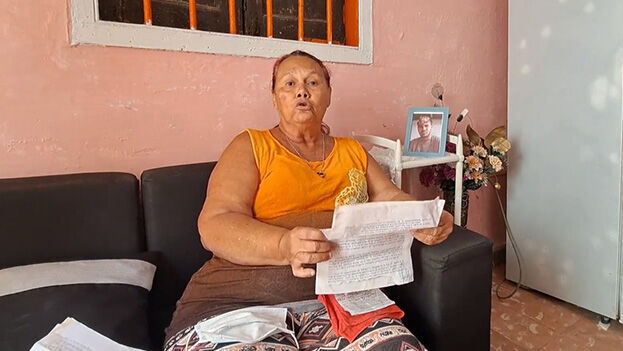
14ymedio, Havana, 23 March 2023–The Territorial Military Tribunal in Havana absolved two police officers accused of killing Exduyn Yoel Urgellés Huete in the municipality of La Lisa on October 7th. Milagros Huete, his mother, maintained her silence all these months for fear of reprisals, but on Tuesday she confronted the officers during an interview with independent news outlet Cubanet, “You killed my son!”
According to Huete, Sub-lieutenant Raunel Castillo Milanés’s defense and that of Sergeant Eudys Jiménez Matos claim that “there was not excessive use of force.” The young man’s mother believes the opposite: both agents, she says, ignored the vital signs and the correct application of the containment technique, a maneuver which aims to immobilize the person who is detained.
Her son and one of his friends, called Yunieski, who dedicated themselves to the illegal sale of air fresheners, witnessed a police operation to arrest a thief who stole a gold chain in La Lisa, the woman said. When they arrived at the scene, they found a group of people who took off running and, instinctively, Urgellés also took off running because two weeks earlier he had been fined 2,000 pesos for his informal business.
Urgellés had a daughter who is a minor and the sale of air fresheners was the only means of subsistence he’d been able to find, said his mother. “I understand it is wrong, but it was his job,” she said. continue reading
Agent Castillo caught up to him and sprayed him with pepper spray. “They handcuffed him and threw him on the ground,” narrated Huete who is sure that, having consulted the court documents, Officer Jiménez joined the interrogation. They asked him why he stole the chain, but Urgellés declared that he did not know anything about that and attempted to explain why he had run off.
Not listening to his story, said Huete, the policemen put her son in a patrol car with his head down and had a conversation about the containment technique. When his partner asked, Jiménez responded that he didn’t know how to implement the technique and Milanés proceeded to show him how to apply it.
He placed his left arm between the arms of a handcuffed Urgellés and moved his head forward and back. After the “demonstration,” Jiménez attempted to apply the technique himself in the “same conditions and without using force,” because, they declared, the detainee remained “calm and communicative.”
Subsequently, in the patrol car they headed to the Aleida Fernández polyclinic looking for the victim of the robbery which had resulted in his presence there, presumably to take a statement, but the person had already been discharged. Once again, the car headed to the police station in La Lisa.
Upon reaching the station, one of the agents noticed that Urgellés was foaming at the mouth. “Immediately” they removed the handcuffs, stated the court document consulted by his mother, and they took him to the Cristóbal Labra polyclinic two kilometers away where “they arrived a few minutes later.”
Urgellés arrived in cardiorespiratory arrest, in a cyanotic state and without positive vital signs. For 30 minutes they tried to resuscitate him, but he was finally declared dead due to “asphyxia.”
During the trial, which Huete attended, military prosecutor Gabriel Pérez Lázaro disregarded the arguments of the young man’s lawyer, Pedro Roberto Valdés, who said that none of the two agents nor the patrol car driver had been arrested, “they had to attend to” other things unrelated to Urgellés’s “detention.”
“The result of the trial was freedom for both police officers,” stated the frustrated mother, who at that time lashed out at Castillo and Jiménez who had murdered her son.
Exduyn Yoel Urgellés Huete used to work as a baker in La Lisa until, according to his mother, he was assigned to oven duty. After falling asleep several times and burning the bread, he began to have problems at work, and he finally resigned. Soon after, faced with the impossibility of finding legal work, he and his friend Yunieski began selling air fresheners, said Huete.
Urgellés’s widow, Yuraimy Galdo Pérez told CubaNet that the young man was “an excellent father.” “The girl, since dad lost his life, is sick every month,” she said and added, “It is another case that goes unpunished.”
Translated by: Silvia Suárez
____________
COLLABORATE WITH OUR WORK: The 14ymedio team is committed to practicing serious journalism that reflects Cuba’s reality in all its depth. Thank you for joining us on this long journey. We invite you to continue supporting us by becoming a member of 14ymedio now. Together we can continue transforming journalism in Cuba.
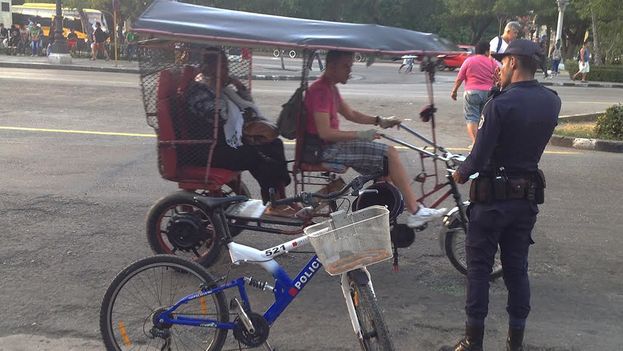
A police checking the papers of a pedicab driver in Havana. (14ymedio)
14ymedio, Elías Amor Bravo, Economist, 22 March 2023 — They don’t want to admit it, but if they want to get somewhere with transport in Cuba, they have to turn to the private sector. There is no other choice. In fact, one of the sectors of the Cuban economy that suffers a true crisis because of communist ideological measures is transport. And this, despite the fact that it is a fundamental sector for the proper functioning of the national economy in which the public and private must cooperate.
Unfortunately, none of this was mentioned at the annual evaluation meeting of the Ministry of Transport, Mitrans, held a few days ago and chaired by the Prime Minister, Marrero. In these meetings, the directors of the department talked about actions to stop road deterioration and begin its recovery, consolidate the development of computerization and strengthen the link with universities. The same thing every year. All this, according to the official press, to “achieve a robust transport system in 2023.” And to start over. It can be as robust as they want, but it won’t go anywhere.
And, as surprising as it may seem, there was only one reference in passing to adopt measures for prices in passenger transport, and this, despite the fact that, in February, the transport component of the consumer price index registered a year-on-year increase of 15% with an intense acceleration in the first two months.
It’s all the same. The Minister of Transport emphatically announced that this year, “the indication is to achieve the integration of all sectors of the industry to improve the quality of services.” The same “indication” of every year that later is never fulfilled. Integration and collectivism, the two vectors that prevent the sector from prospering.
At the meeting, with a large participation of officials and senior leaders of the communist party, not a moment was lost in blaming the embargo/blockade, the global economic crisis and the complex international situation for the lack of results. As a novelty, the minister insisted on “the need to eliminate the self-blocking and the limitations that many impose on themselves, with the aim of moving forward and looking for alternative solutions,” but without indicating which ones. A maxim since the times of the guidelines, which continues to be repeated like a scratched disc. continue reading
In his speech, Marrero surprised the attendees by pointing out that the most economical solution for the transport of goods “must be shipping,” and, a little surprisingly, he affirmed the need to “maintain performance with the support of state cars in public transport.”
Next, he said that a proper implementation of the recent Decree 83 on the transfer of ownership of motor vehicles, trailers and semi-trailers, their marketing and import (which seems to be a failure in view of the results) must be achieved; and they must raise the coefficients of technical availability of the vehicles with closed financing schemes (in the most absolute gibberish of the regime) and, from innovation, recover spare parts and added values (the scrappers’ business).
Next, he referred to the dissatisfactions with the work of the freight forwarding companies (dedicated to the distribution of international and state parcels, that is, dependent on it), which, in the case of Mitrans, are the entities Aerovaradero S.A. and the Freight Carrier Company (Transcargo). He concluded by saying that “Roads are one of the most complex issues facing the Island and, to guarantee productive activity, a solution must be found and the issue of road safety must be analyzed.” Traffic accidents are increasing significantly.
When talking about the transport of goods, Mitrans’ Director of Cargo of pointed out that the participation of various economic actors in the management must be increased. Work plans must be organized objectively to optimize resources, as well as the use of rail and shipping for the transport of cargo over long distances. It was the only reference to the private agents who offer their services in the sector.
In the case of Operation Port-Transport-Internal Economy (OPTEI), the Brigadier General at the head pointed out that it is necessary to maintain as a style of work the most agile transport groups at the beginning for extraction in the ports and final delivery to the client.
The director of passenger transport for Mitrans, pointed out that, although 2023 will be difficult, the measures adopted will allow the gradual recovery to begin. He insisted on the need to set objectives to meet the transport plans of the main services: taxis, school, urban, intercity, workers and rural. All this, without taking into account the February price increase in these services.
The general director of the Union of Railways of Cuba stressed that part of the actions for this year are focused on achieving the recovery of discharged equipment, including the manufacture of railways and on increasing efficiency, the quality of services and strengthening preventive work to avoid rail accidents. But it cannot prevent the use of the railway from being marginal for both passengers and goods.
At this point, Marrero ended by requesting the use of “carahatas,” a word that has no definition in the dictionary but that the prime minister said are small motor cars, alternatives for transport in rural areas. He also asked to conclude the work at the Central Railway Station of the capital and analyze the use and operation of urban trains.
For his part, the director of the Port Maritime Business Group (Gemar), said that within the projections is the launching of the ferry service and the floating dam, which Marrero said was a priority for the country, although curiously, he did not say anything about the transport of goods by shipping.
Finally, the president of the Corporación de la Aviación Cubana S.A. (Cacsa), spoke of improving the quality of passenger service and aircraft and achieving the sustainability of technological systems with a great impact on air activity, among other aspects. He also reported that work is being done on repairing the runways of the airports of Cayo Coco, Havana and Santiago de Cuba, as well as the expansion of Terminal 3 of the José Martí International Airport, which must be completed this year.
The vision that the authorities of the communist regime have of the transport sector does not go beyond the design of state policies, which leave aside the marginal private initiative that tries to survive on the Island. Good proof of this are the few 190 SMEs [small and medium-sized enterprises] authorized by the regime for transport, which are barely 4% of the total. That scarce participation of private activity says a lot about the grip that the regime has on the sector, preventing its development.
Translated by Regina Anavy
____________
COLLABORATE WITH OUR WORK: The 14ymedio team is committed to practicing serious journalism that reflects Cuba’s reality in all its depth. Thank you for joining us on this long journey. We invite you to continue supporting us by becoming a member of 14ymedio now. Together we can continue transforming journalism in Cuba.
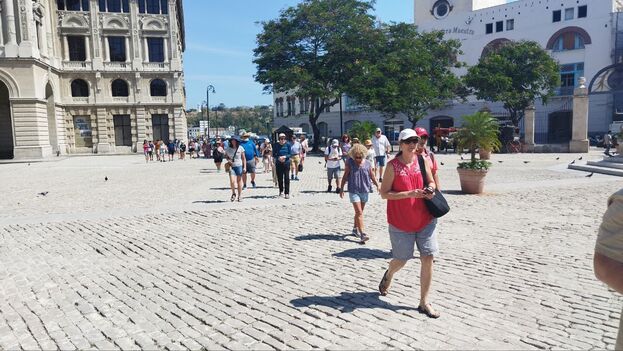
The new recommendations for Spanish travelers from their foreign ministry are not very encouraging for the promotion of tourism. (14ymedio)
14ymedio, Madrid, 23 March 2023 — The updated recommendations of the Spanish Ministry of Foreign Affairs for tourists going to Cuba, released this week, are not very encouraging for the promotion of tourism. Despite the fact that the official website indicates that “there are no specific restrictions” for trips to the Island, it dictates “special precaution regarding possible thefts from tourists, dengue disease and the hurricane season.”
The most relevant novelty is the warning that, if a Spaniard intends to go to the United States after having visited Cuba, even if it is on a separate trip, he will be obliged to apply for a U.S. visa to enter that country. Therefore, the presentation of the electronic authorization (ESTA), the simple requirement in force under normal conditions, will not be enough.
Likewise, tourists to Cuba have to apply and pay for the “tourist card” that serves as a visa, either at a Cuban consulate in Spain, or at any travel agency that offers Cuba as a destination. This visa “allows a single entry into Cuba and entitles the holder to a maximum stay of 90 days, extendable only once for the same period.”
The Island’s fame as a peaceful place for foreigners is beginning to collapse with these recommendations. Spain concedes that Cuba is “generally a safe destination, especially when compared to most of the countries in the region,” but warns that “with the recovery of tourism, robberies have been reported that can sometimes be committed through the use of violence.”
The document describes as “frequent” the “theft of bags and other personal belongings on the beaches” and mentions that “burglaries can occur at gas stations, mostly in cases of rented vehicles with ’T’ (tourist) plates and on the roads to the Keys.” continue reading
The Ministry advises against picking up hitchhikers in any case, “especially outside the cities or near the beaches.”
Another common problem on the Island mentioned in the report is that of health. “Health care in Cuba is not comparable to European standards,” the text states. “There may be a shortage of certain medicines and a lack of equipment in hospitals.” For those who need a specific medication, they suggest “taking it with you and not to trust being able to find it on the Island,” as well as “a minimum first aid kit (analgesic, disinfectant, dressings, etc.) and, in the current circumstances, medications necessary to treat diseases with high incidence in the country.”
Health recommendations continue to warn of the cost of medical care for foreigners: “In the most important cities, tourists are cared for in the best hospital centers. The invoice must be paid in cash, at high prices and, frequently, in advance.”
The document even mentions what those exclusive centers are: the Cira García Clinic and the CIMEQ Hospital, in Havana. And they warn: “The Cuban authorities prohibit foreigners from leaving the country as long as there is an outstanding debt for health care.”
It will be mandatory, they also instruct Spaniards, to present proof “of having taken out travel insurance with medical coverage that includes possible contagion by COVID-19 and the repatriation of the corpse in case of death regardless of the cause.”
Another serious warning is about “the important rebound” of dengue fever and, especially, of hemorrhagic dengue, for which they recommend using insect repellent on the skin “especially at dawn, dusk and during the night.”
Given the risk of contracting this disease, they suggest traveling with oral rehydration salts and paracetamol.
As for the measures against COVID-19, the page includes the link that leads to the health form that must be completed to enter Cuba, with a QR code downloaded, and to remember that no negative PCR is required, no vaccination certificate, no quarantine upon arrival and no masks (except in hospital centers).
Finally, they warn that the hurricane season begins on June 1 and ends on November 30 and specify that the “most problematic period” usually occurs between August and October, coinciding precisely with the summer holiday season of the Spanish people.
“The Cuban authorities will, if necessary, evacuate the affected areas, and depending on how the hurricane evolves, they will adopt measures as needed. In such circumstances, all Spanish citizens who are in Cuba are recommended to follow the recommendations of the Civil Defense, which are widely disseminated by the Cuban media (mainly radio and television) and by the hotels where they are staying, as well as the tourist agencies that have organized the trips,” they say, while referring, for more information, to the page of the National Hurricane Center of the United States.
Translated by Regina Anavy
____________
COLLABORATE WITH OUR WORK: The 14ymedio team is committed to practicing serious journalism that reflects Cuba’s reality in all its depth. Thank you for joining us on this long journey. We invite you to continue supporting us by becoming a member of 14ymedio now. Together we can continue transforming journalism in Cuba.
This type of meeting has been taking place since 2016, as part of an agreement on health matters. (Archivo)
EFE (via 14ymedio), Havana, 24 March 2023 — Health officials from Cuba and the United States met in Havana to strengthen their cooperation in the fight against infectious diseases, including COVID-19, the Ministry of Public Health of the Island reported on Thursday.
The meeting was part of what was agreed in the Memorandum of Understanding signed in 2016 by the Cuban Ministry of Public Health and the U.S. Department of Health and Human Services (HHS), according to a statement.
Cuba reported that both parties agreed to “continue working on the implementation of the Memorandum.”
Specifically, they advocated “promoting technical exchanges related to research on arbovirosis (a group of diseases caused by viruses transmitted by arthropods), experiences of COVID-19 and other related topics.”
The visitors, members of the HHS and the National Institute of Allergy and Infectious Diseases (NIAID), met with specialists from the Pedro Kourí Institute of Tropical Medicine (IPK) of Cuba, as well as directors and scientists from the Center for Genetic Engineering and Biotechnology (CIGB) and the state pharmaceutical group BioCubaFarma. continue reading
The meeting was attended by the Deputy Minister of Public Health, Carilda Peña García, and the director of the Global Research Office of the IAID, Joyelle Kalei Dominique, according to the official report.
Despite the fact that Washington has on numerous occasions cooled the expectations of the Cuban side for a reissue of the thaw, the technical meetings have not stopped being held. They even continued during Donald Trump’s term.
At the beginning of March, the trip of Cuban officials to the United States unleashed a wave of protests among Republican politicians who rejected these meetings for security reasons. However, the Administration argued that the meeting was part of the International Port Security Program and that they have taken place in recent years, including, most recently, in 2019.
In November 2022, US officials traveled to Havana to hold a meeting on immigration, during which the Cuban side “highlighted areas of successful cooperation on migration, while identifying problems that have been obstacles to meeting the objectives of the Agreement.”
Translated by Regina Anavy
____________
COLLABORATE WITH OUR WORK: The 14ymedio team is committed to practicing serious journalism that reflects Cuba’s reality in all its depth. Thank you for joining us on this long journey. We invite you to continue supporting us by becoming a member of 14ymedio now. Together we can continue transforming journalism in Cuba.
The warehouses of Granferretero, a Spanish-Cuban joint venture, are located near the port of Havana. (14ymedio)
14ymedio, Madrid, March 20, 2023 — Doubts are growing after the announcement by Cuba’s state-run media that the first five wholesale businesses to be financed with foreign capital will begin operations in the country in April or May. Little else is known about a plan that officials hope will lower inflation but which economists view more skeptically.
Nor is much known about the five companies themselves, though apparently two of them — Grupo Sur from Argentina, and Emifoods from the United Arab Emirates — are in the food service sector. Another company, Camacho, founded 30 years ago in Catalonia, is involved in cleaning and personal hygiene. Farmavenda Ibérica, a Spanish company founded in Asturias in 2017, is a wholesaler in an unspecified field.
Lastly, there is Granferretero, a public-private partnership created to provide Cuba with hardware supplies. The Spanish partner, based in Madrid, is Gurea Industrial & Automotive Equipment S.L., about which more can be found on its website, which launched a few months ago.
State media reported that the deal is now in the final phase: “legal documentation, operational flow, warehouses and stores that will sell food, clothing, household items, cleaning and hygiene products and other items in high demand.” Alejandro Gil, minister of Economy and Planning, and Betsy Rodriguez, minister of Domestic Trade, touted the impact all of the companies will have in “reviving national industry” despite the fact that they are aimed at the wholesale market.
This assumption is strongly rejected by Elías Amor, a Cuban economist based in Spain. “This policy of attracting foreign capital to sectors of the economy before first stimulating and growing the domestic market is a strategic design flaw. Foreign capital is not for getting an economy up and running from ground zero but to support and stimulate it once the foundations have already been laid for its development,” he wrote in his blog, Cubaeconomía, on Monday.
According to Amor, the entry of these companies represents a victory for Rodrigo Malmierca, minister of Foreign Trade and Foreign Investment, over those of his colleagues Gil and Rodriguez. He exerted pressure to get approval for foreign capital to enter the wholesale market, a sector that has not traditionally been an area of economic opportunity. The first projects, however, are more to the liking of the minister of Economy, who — as Amor believes — wanted to limit the range of products wholesalers can sell.
The first unknown involves the exchange rate, says Amor, who is convinced that a rate of 24 pesos to the dollar would not attract the interest of private companies, which are used to operating at very high margins. Nobody will be interested in meeting the needs of Cuban consumers if the numbers do not add up. continue reading
“An increase in the wholesale supply does not have an automatic anti-inflationary effect,” adds the Cuban economist Pedro Monreal, who has also analyzed project. “It is unclear how a small handful of suppliers would not lead to a market monopoly. In addition to supply, two other factors are important in setting consumer prices: the exchange rate and overall demand, which is difficult to control when there is a high budget deficit, as is the case today.”
For Monreal, the currency exchange rate is a key issue but there is an additional factor. “It’s reasonable to assume they will expect to be paid with hard currency. Imports are a key component of these businesses’ sales and acquiring those imports entails having to spend foreign currency. That would have an impact on the country’s balance of payments. On the other hand, imports tend to be ’subtracted’ [when calculating] GDP,” he adds.
Monreal believes foreign capital is necessary but, if these projects are going to stimulate domestic production, it would require a “level of investment that would allow an underfunded agro-industrial manufacturing plant to produce goods for the domestic market.”
“Foreign capital is vital and deserves attention but not under these conditions,” says Amor, who believes the Cuban economoy must fundamentally change if it wants foreign capital to work.
Regardless of what the economists think, the reaction from other Cubans has been one of distrust, with many on social media responding to the news with a sense of despondency. Expectations were that 2023 would be a year of recovery, yet not only have things not improved during the first quarter of the year, they have actually gotten worse. “When will people start seeing the benefits? Do I have to wait till 2030 to buy my son some shoes?” asks one online commenter.
“If you can only pay for things in hard currency, nothing will change. I think it will be years before things are priced in pesos. Inflation will keep soaring, I don’t know how high,” notes another. Someone else responds, “Do you think a foreign business is going to come to our country and sell things for pesos? That will happen only when the Cuban peso has real value and is truly convertible. Then you’ll see that currrent prices are a joke.”
Though the news has generated widespread debate, there are those who still have unshakeable faith in the system. “Let’s trust the solutions they come up with. I know the country’s leadership wants to solve the problems. The prices of some products are already beginning to drop somewhat. If there are more things to buy, they will either lower prices or lose sales,” reads one comment. Others provide a reality check: “Give us just one example, sir, of a product that has dropped in price. You must have dropped out of the clouds.”
____________
COLLABORATE WITH OUR WORK: The 14ymedio team is committed to practicing serious journalism that reflects Cuba’s reality in all its depth. Thank you for joining us on this long journey. We invite you to continue supporting us by becoming a member of 14ymedio now. Together we can continue transforming journalism in Cuba.
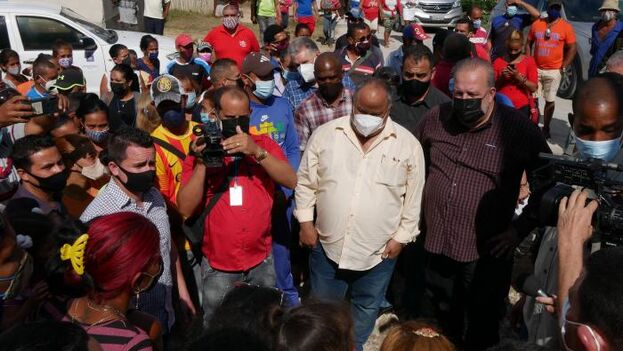
Cuban Prime Minister, Manuel Marrero (on the right, wearing a plaid shirt and a black mask), at a ceremony in the street. (Granma)
14ymedio, Havana, 23 March 2023 — Some of the country’s top leaders met this Wednesday to confirm evidence: the indicators of the economy are bad. What’s the reason? The embargo. The forecast? The same, 3% growth. Solutions? “Organize a government in the street.” That was one of the suggestions of the Prime Minister, Manuel Marrero, who summarized his call to “unite all collective intelligence and achieve unity to find solutions.”
Although Marrero wants to “change things,” if the meeting was characterized by anything it was for the usual mentions, including the stubbornness of Alejandro Gil, Minister of Economy and Planning, who maintained his tourism projections last year until October, when the numbers were clearly irreversible. This year he does not plan to move the growth forecast either, which in December 2022 he calculated at 3%. The calamitous data of 2022 could help him, in this case, to get it right. Or not, just like tourism.
They will bet on the tourism sector again, both leaders said at yesterday’s meeting, although the priority will be to “advance in the macroeconomic stabilization of the country,” a point to which abundant words were dedicated that did not clarify too much.
The plan will include, he said, a “fiscal reform, the recovery of monetary equilibrium, macroeconomic planning and coordination, the development of markets and monetary-commercial relations, the increase in the inflow of foreign exchange, the de-dollarization and convertibility of the national currency and the mitigation of social impacts.” To paraphrase Marrero, these are goals, not solutions.
To this vagueness, Gil added something more concrete: the creation of a new law for companies and fiscal stimuli for those who want to import, but the “socialist enterprise” will be maintained, as always, as the main actor in the production of goods and services. From what was said in yesterday’s meeting, one can sense that the private sector, even when it’s not evident, will continue to support the state. continue reading
Among the evils that afflict the country, Gil mentioned the partial dollarization of companies in the non-state sector, inflation, centralized access to the currencies of exporters, the lack of “effective insertion” of the private ones — for which they plan to create an Institute and a General Directorate — and the poor results of the state business sector that, despite the diagnosis, they insist on privileging.
However, Marrero did not attribute those bad results to an inefficient sector or government measures, but, once again, to external agents. “We cannot fail to recognize and denounce that, among all the occurrences that have led to the situation in the country, the blockade* has had a definitive impact,” he complained. And his lament was followed by Gil’s who, in addition to the embargo, cited the pandemic as the cause of the lack of hard currency.
In the midst of the hackneyed speech, there was also no mention of responsibility for inflation. The Minister of Economy said that prices are abusive and have a direct impact on the population, but he didn’t offer a single solution.
While dozens of countries affected by inflationary rates infinitely lower than those of Cuba — where food already costs 73% more than a year ago, without taking into account the prices in the informal market — have been trying different measures to control prices for months, the top managers of the Island are limited to mentioning the problem as if it were a natural force.
One of the possible materializations of the fuzzy words of Marrero and Gil is the “experiment” — as the provincial newspaper Vanguardia refers to the measure — that will be carried out in six state companies in Villa Clara. Foreign currency will be sold at a rate of 1 dollar for 120 pesos to buy supplies and raw materials destined for the manufacture of products that will be marketed in national currency.
It will be a privilege because, although before the rate was officially 1 for 24, the possibility of obtaining foreign currency was almost nil by legal means. At the moment, the concession is for the Porcine Company of Villa Clara ($700,000); the Fisheries of Caibarién and Villa Clara, Pescavilla, ($500,000); the National Production Industry of Domestic Utensils 1st of May ($700,000), and the Textile Company Luis Turcios Lima ($200,000).
With those amounts approved, the entities will have to increase their production of meat, fish, pots or blankets, as the case may be, all of which are scarce in the country. Finally, Minerva Cycles also has an amount assigned or in process, but not yet indicated.
“This is the result of one of the ideas aimed at making 2023 a better year, meeting the needs of the people and combating the scourge of inflation through the production of goods and services, which constitutes the most feasible economic mechanism,” said the governor of the province, Alberto López Díaz.
*Translator’s note: Cuban officialdom routinely refers to the U.S. embargo as “the blockade.”
Translated by Regina Anavy
____________
COLLABORATE WITH OUR WORK: The 14ymedio team is committed to practicing serious journalism that reflects Cuba’s reality in all its depth. Thank you for joining us on this long journey. We invite you to continue supporting us by becoming a member of 14ymedio now. Together we can continue transforming journalism in Cuba.
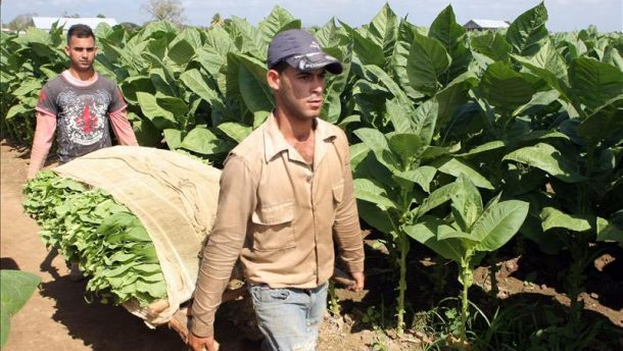
The main tobacco cultivation areas are located in Vueltabajo, in the province of Pinar del Río. (EFE)
14ymedio, Havana, 23 March 2023 — Pinar del Río has not produced even half the tobacco that was planned. The main Cuban export will now have, without a doubt, what the official newspaper Granma describes as “the smallest [harvest] in history” in an area that produces between 60% and 70% of the national production.
While 27,675 acres were planned for planting in Vueltabajo, the total barely reached 12,730, or 46%, and there are just days left to finish this step.
As a consequence of the disaster, of the 4,556 farmers who were going to start planting only 3,456 have done so, while some 1,100 have not, and the number is not expected to increase.
Osvaldo Santana Vera, coordinator of the Tabacuba group in Vueltabajo, explained to the official newspaper Granma that the plan has been readjusted twice since the impact of Hurricane Ian last September destroyed 90% of the province’s tobacco drying sheds, more than 10,000 of the total 12,000.
“Given the impossibility of rebuilding them all again in a matter of a few months, in time to protect the leaves of the current harvest, the Tabacuba Business Group decided to prioritize the highest quality plantings to ensure export demands,” the article explains.
But even so, it has not been possible to salvage the situation, and the lack of wood has had repercussions. Of the 3,977 curing sheds that are needed, and with readjustments based on the planting, more than 1,400 still need to be built. continue reading
All this led to a reduction of the plan to 15,793 acres, but that amount was excessive, so it was reduced again to 14,275 acres, extending the plan by 50 days. The figure is still remarkably far from what is needed.
To this must be added the farmers who have refused to sow because the State still owes them money, according to 14ymedio sources in San Juan and Martínez. Tobacco producers in the province told this newspaper that there have been several meetings to try to convince the farmers to plant by stating that the payment would be made as soon as possible, but many are suspicious and have reverted to the cultivation of flowers, peanuts and fruits of shorter cycles or that need fewer resources.
Granma’s version, however, attributes the crisis of the sector to the climate and the “demolishing blow that nature dealt” to the producers, and the article ends with a call for epic resistance, although they will have to wait another year. “The men and women who produce the best tobacco in the world claim that this is just a skirmish (…) and say that another cock will crow in the next harvest.”
The passage of the hurricane and the destruction of the drying sheds meant that tons of tobacco leaves had to be sent to other provinces to try to safeguard them. About 6,000 tons were transferred to Matanzas, Sancti Spíritus, Villa Clara and Cienfuegos, in addition to “about 11,000” that were already in the dryers and, after getting wet from the rain, had to undergo a new process or be discarded.
Just a week ago, a dryer in Jovellanos, Matanzas burned more than 11,300 bundles of freshly harvested tobacco. The firefighters were able to put out the fire and prevent it from spreading, but the loss is one more nail in the coffin of the sector.
Translated by Regina Anavy
____________
COLLABORATE WITH OUR WORK: The 14ymedio team is committed to practicing serious journalism that reflects Cuba’s reality in all its depth. Thank you for joining us on this long journey. We invite you to continue supporting us by becoming a member of 14ymedio now. Together we can continue transforming journalism in Cuba.
Díaz-Canel goes along under pressure, from platform to platform, taking advantage of anything, even if it’s a defeat in baseball with a score of 14 to 2. (PL)
14ymedio, Yunior García Aguilera, Madrid, 23 March 2023 — Next Sunday the Cuban regime will hold “elections” where 470 candidates for Parliament will “dispute,” nothing more and nothing less than 470 seats. When you try to explain this process to any citizen of a democratic country, their brain usually short-circuits. But that’s the scheme, as absurd and brazen as it sounds. The people choose absolutely nothing; they simply ratify a decision that has already been made previously by the single party.
To carry out this esoteric trap, they resort to the “united vote.” The Government itself will be in charge of spending millions of resources on propaganda to convince you that you should vote for everyone, as if it were a combo. If in Stalin’s USSR the ballots presented a single candidate, then in the Cuba of the Castro brothers they save paper. Just put a jumble of names on a ballot and add a circle on top of it that summarizes them all. By the way, you also save ink.
Fidel himself expressed in February 1993 that the ’united vote’ was not a technical issue, but a political issue, that it was “the strategy of patriots, of revolutionaries.” In reality, it was simply his strategy to play at voting, once every five years, without risking absolutely anything.
No candidate, obviously, can be suspected of having divergences in official thinking. All have passed through several filters to reach the final list and will continue to be watched with a magnifying glass, in case they present any ideological deviation along the way. They will be allowed to have some corrupt behaviors, of course. Cuba is a country where corruption is called “fight” and everyone knows “how bad it is.” But State Security will keep in its drawers any material that can compromise them, just in case they have to “be ruined” to make an example of them, as they did with Carlos Lage and Felipe Pérez Roque.
When I lived in Cuba, I was close to several deputies, and the truth is that the vast majority are indistinguishable. They dedicate themselves to attending endless meetings; they will unanimously approve any decision that comes from above, and they will enjoy some privileges that the position affords them. continue reading
That’s why the electoral campaigns are superfluous. There is no need to have or present any project. All you need is a poorly printed biography showing your photo, the morning assemblies at school in which you participated during your childhood and the mass organizations to which you belong. Hardly anyone will stop to read this nonsense, which is usually identical. That is also why the ballot boxes are guarded by children. After all, what could go wrong?
But Cuba is no longer the place where people used to vote like automatons, to “get it over with.” On recent occasions, the number of abstentions, canceled and blank ballots has increased dramatically. Díaz-Canel goes along under pressure, from platform to platform, taking advantage of anything, even if it’s a defeat in baseball of 14 to 2. What does it matter? He and his bosses (generals with more stars than principles) know perfectly well that this March 26 could break the mold: the rejection of a rigged, grotesque and undemocratic model.
Even seeing it from the perspective of those who sympathize with the Revolution, this management has been, by far, the worst in decades! They have not fulfilled any of the projects that were drawn up (like that plan of 1.7 homes a day); inflation rises at a quadrangular rate; hunger lurks in every corner of the country; repression is more guaranteed than the bread of the quota; the blackouts are a joke; the young people leave, and the violence expands in an alarming way.
To make matters worse, the visible figures of the system could not be more gray or unpleasant. Díaz-Canel and his “wife who works at her work” (as he himself called her) have shone in the art of cantinfleo (with the pardon of Cantinflas*). I’m not sure if they try to emulate Maduro, but their clumsiness is about to set a Guinness world record.
What should we Cubans do? Regardless of everyone’s ideology, we have to be honest with ourselves. It would be enough to look around and understand that the night cannot be eternal. This Sunday we can show them and the world that this obsolete and decadent system does not have our support. We can leave them alone in their circus, without being able to boast of a power that is completely unpopular.
Translated by Regina Anavy
____________
COLLABORATE WITH OUR WORK: The 14ymedio team is committed to practicing serious journalism that reflects Cuba’s reality in all its depth. Thank you for joining us on this long journey. We invite you to continue supporting us by becoming a member of 14ymedio now. Together we can continue transforming journalism in Cuba.
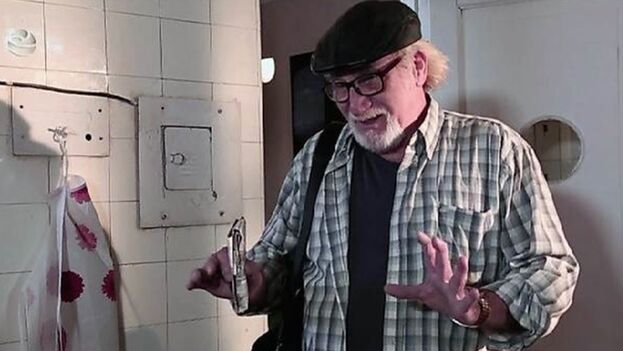
 14ymedio, Havana, 23 March 2023 — Cuban actor Rubén Breña passed away this Thursday in Havana at the age of 70, official media reported. The artist died after spending several days in intensive care at the Hermanos Ameijeiras Hospital due to complications from erosive gastritis.