Cover of the magazine ’Vocablo’, of the Association for Freedom of the Press. (APLP)
14ymedio, Havana, 2 March 2021 — The magazine Vocablo of the Association for Freedom of the Press (APLP), which stopped printing in 2015, has been published again, this time in PDF format and with a selection of the best of the Cuban free press.
To prepare this first issue of the second stage, its current coordinator, Julio Aleaga Pesant, summoned various independent journalists so that each one could choose a text published in 2020. From now on the magazine intends to publish a monthly issue and maintain the system of selection by the authors.
The collection, presented with a sober design, brings together articles featuring analysis and opinion, chronicles, interviews and humor published in various independent media.
José Antonio Fornaris, president of the APLP and director of the magazine, told 14ymedio: “We thank those who have sent their work for the trust placed in us and we reiterate that it does not matter whether the collaborators are within or outside the country. If someone is willing to allow us to publish their articles, we will welcome them. Everyone is welcome to this party.” continue reading
Since its foundation in 2006, the Association has been subject to pressure and threats from State Security. In 2018, the organization’s headquarters suffered a police search that resulted in the seizure of two computers, two external hard drives, twelve USB sticks, three printers and dozens of documents.
In February of that same year, four members of the APLP, who were going to Trinidad and Tobago to participate in a journalism workshop, were informed they could not leave the country because they were ’regulated’. In addition, they were threatened during interrogations with the aim of having them abandon their work.
The Association for Freedom of the Press (Asociación Pro Libertad de Prensa) is a non-profit, non-governmental organization that helps promote freedom of the press and expression on the island. In December 2017, the group sent a report on freedom of the press in Cuba to the United Nations Human Rights Council.
____________
COLLABORATE WITH OUR WORK: The 14ymedio team is committed to practicing serious journalism that reflects Cuba’s reality in all its depth. Thank you for joining us on this long journey. We invite you to continue supporting us by becoming a member of 14ymedio now. Together we can continue transforming journalism in Cuba.
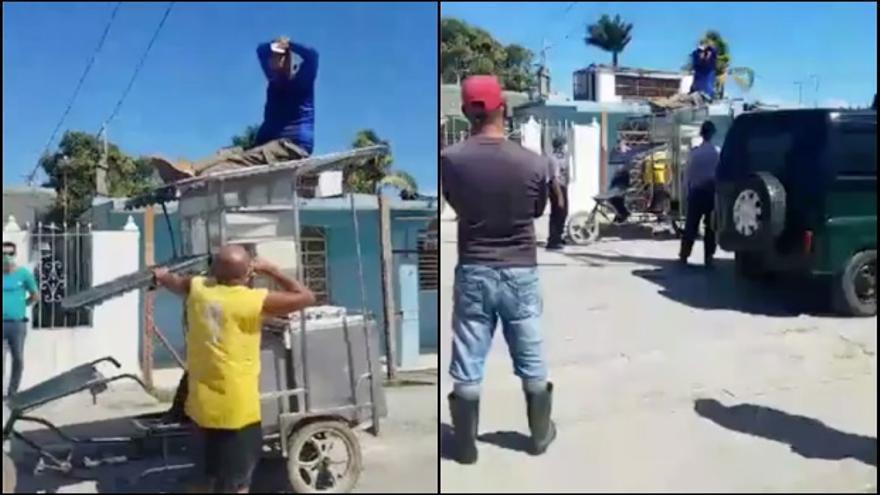
“Cancel the fine,” demand several voices. “Abusers,” say others who also repeat “Enough abuse already.” (Collage)
14ymedio, Havana, 27 February 2021 — A sweet seller staged a protest this Saturday in Caibarién, Villa Clara, after being fined 2,000 pesos. The man climbed on the roof of his sales cart, in the middle of a public road, and around him dozens of people from the locality gathered showing their support for the self-employed seller, as reported by Yeko Rodríguez.
In a live broadcast via Facebook, made by Rodríguez, the man is seen perched on the roof of a three-wheeled vehicle adapted as a point of sale for sweets and trinkets. “That man who is up there has just been fined 2,000 pesos for selling sweets, sweets that are not available in the stores,” says the young man.
“He sells cupcakes and meringues,” adds Rodríguez as dozens of people approach, shouting at the authorities. “Don’t get off. Homeland and life,” a passerby is heard saying. Shortly after, several police vehicles with uniformed men arrive at the scene and try to make the seller get down. No success so far. continue reading
“Cancel the fine,” cry several voices. “Abusers,” we hear others say, who also repeat “Enough abuse already.” “The only thing that man does is work and they make him out to be an enemy,” adds Rodríguez. “I’m not going to get off,” insists the private worker while the solidarity around his sales cart increases.
The vendor begins to distribute his sweets to the crowd for free and the broadcast cuts out.
A litle while later, Yeko Rodríguez reappeared in a live broadcast on Facebook denouncing that his account had been hacked and the two videos of the protest deleted. The young man identified the seller as “Miguel” and insisted that many asked him about what finally happened with the seller of sweets. “I do not know, as I understand a government official said that they were going to cancel the fine.”
“Maybe I can’t broadcast more today. From what I see on the networks and the repercussion this has had, at any moment someone comes and quotes me and I will go, because all I have done is show the truth,” said Rodríguez in a short video.
As of January 29th, the Cuban authorities established fines of up to 15,000 pesos and the confiscation of their merchandise as a punishment to merchants who contravene the new rules on prices and rates published in the Extraordinary Official Gazette.
The decree-law establishes different penalties, ranging from 5,000 to 7,000 pesos for not having a display board with the products and prices they offer; penalties from 8,000 to 10,000 for “withholding, reserving, postponing or not putting up for sale the products meant for retail marketing”; and from 12,000 to 15,000 if they do not comply with the ordered measures, for what is considered “abusive prices” and “speculative prices.”
The measure was published amid a growing shortage in the country’s agricultural markets, where many products have disappeared from the market stands to plunge into the informal market.
A few hours later a video filmed by another witness was released in which the crowd is seen gathering around the police car to prevent the arrest of the seller. When the patrol car leaves the scene, several dozen people follow the vehicle. “We are going to the Government,” shout some who are heading towards the headquarters of the People’s Power in the municipality.
A local source confirmed to 14ymedio that several representatives of the local government left the building to inform the crowd that the self-employed person had been released and the fine had been withdrawn.
____________
COLLABORATE WITH OUR WORK: The 14ymedio team is committed to practicing serious journalism that reflects Cuba’s reality in all its depth. Thank you for joining us on this long journey. We invite you to continue supporting us by becoming a member of 14ymedio now. Together we can continue transforming journalism in Cuba.
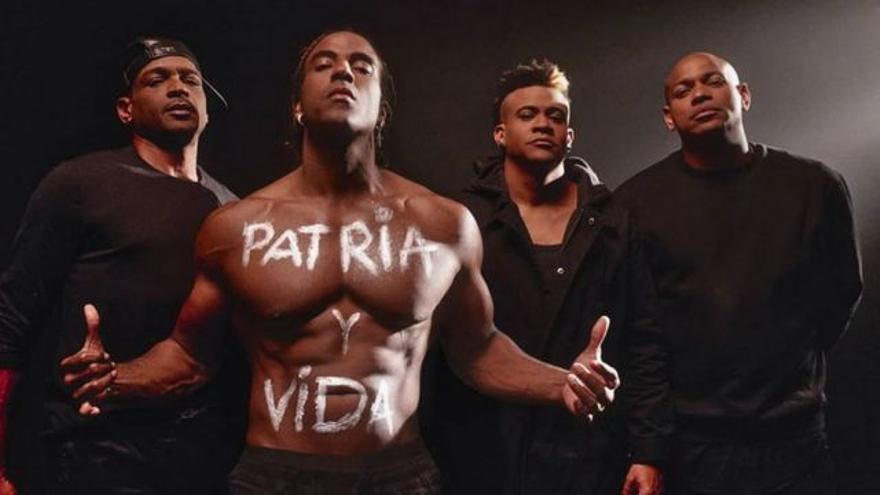
Moment from the video clip of ’Patria y Vida’ (Homeland and Life). (Screen capture)
14ymedio, Asiel Babastro, Havana, 26 February 2021 — [Note: Asiel Babastro, director of the video clip for the song Patria y Vida [Homeland and Life] presented the following text this Friday at an event of the European Parliament sponsored by Vice President Dita Charanzová and MEP Leopoldo López Gil, the Renew Europe Group and the European People’s Group, and organized by Cuban Prisoners Defenders. Led by one of the creators of this song that has goe viral, Yotuel Romero, the meeting was attended, live and in an unprecedented way, by the Venezuelan Juan Guaidó, the activist and academic Anamely Ramos, the writer Wendy Guerra, the scientist Ariel Ruiz Urquiola, the actor Alexis Valdés and the musicians Arturo Sandoval and Willy Chirino, as well as Maykel Castillo Osorbo through video, among others.]
I am Asiel Babastro. I was born in 1989, the year of serious faces*. I grew up with my index finger covering my mouth. As I left the parades I picked up little Cuban flags from the ground and put them in a book. I also repeated slogans.
I come to talk to you about my land and it would not be fair without mentioning its diaspora: the almost three million Cubans scattered around the world. Cuba is also the people who did not fit in, who could not and cannot. I do not speak for them, but I do name them.
Triumphalism is a coward, a sensationalist. My land is an island that has obeyed for 62 years. But there are other compatriots who have been waiting for something for 22,630 days, whereas while many things happened in the world, few things happened in Cuba, almost nothing. continue reading
And the regime does nothing more than postpone dreams. What homeland is the power proposing? It is still a mystery. How many years will the country we want cost? Who helps Cuba in its disaster? These are questions that I ask myself often. Because freedom is always small.
It is terrible how badly revolutions age, said a teacher. And the Cuban women grew old with their leaders in power, with the poetry of the past invoking a dead person who still governs. Communism, when they talk about the future, changes the conversation.
There is no land in sight, nor a transition to democracy. The dictatorship practices the culture of cancellation. The independent press is not recognized. They are watched, attacked, deprived of their rights, prohibited from leaving their homes. There are also testimonials.
Patria y Vida [Homeland and Life] gave Cuba back a pulse. But the regime has few words to mention the differences: “scums,” “traitors,” “worms,” “stateless,” “whores,” “opportunists,” “little blacks.” With those words there is no dialogue or speech.
In Cuba there is racism. I have seen it, I have felt it. That is the aftermath of slavery. Although ideological blindness denies it, there is racial subordination. The exclusion of the black individual through jokes, phrases (“advance the race,” “do not bring him to my house”). The attacks are very sneaky and difficult to detect.
What can minorities do against majorities, against false unanimity, self-censorship? What do we do against acts of repudiation? What is the number of permissible errors? Social and economic situations can condition the value of a right.
The Revolution has cost us the Homeland. Article 4 of the Constitution says: “The defense of the socialist homeland is the greatest honor and supreme duty of every Cuban. Treason is the gravest of crimes. Those who commit it are subject to the severest sanctions.”
This Constitution makes a mistake: it says that the country is socialist. That is ideological rhetoric and it contradicts the Apostle, José Martí. And I quote him: “I want the first law of my country to be the worship of the full dignity of man.”
Translator’s note: 1989 was the year of the fall of the Berlin Wall, the precursor of the collapse of the Soviet Union and the Eastern Bloc in Europe, ultimately leading into the Special Period in Cuba.
____________
COLLABORATE WITH OUR WORK: The 14ymedio team is committed to practicing serious journalism that reflects Cuba’s reality in all its depth. Thank you for joining us on this long journey. We invite you to continue supporting us by becoming a member of 14ymedio now. Together we can continue transforming journalism in Cuba.
14ymedio, Yoani Sanchez, Havana, 2 March 2021 — He alternates his gaze between the road and the camera recording him. He smiles. He flaunts the luxurious vehicle that he drives at high speed and tosses phrases at a spectator he assumes must be salivating at such luxury. The protagonist of this scene could be any Parisian, New York or Berlin influencer, but he is a young Cuban who was born cocooned by the most powerful surname on the Island. He is Sandro Castro.
Few are surprised by the opulent Mercedes Benz driven by the grandson of the one who imposed on us, by force of slogans and economic offensives, austerity as a standard. Nor is the speedometer needle surprising, as it marks the excessive speed with which the tires cover the asphalt. None of the obscene attributes of power that the young man boasts about are shocking to a people who, for a long time, have known that the sacrifice their leaders proclaim from the platform are an entirely different thing than the wealth of their palaces.
The most unprecedented thing, then, is not the car nor the speeding, but the way the bully speaks behind the steering wheel. Each phrase he pronounces shows him to be a person consumed by consumption, fascinated by the material, with very little education, a minimal vocabulary, and a great need to flaunt his wealth. Is this the “New Man” incubated in the same clan that sent us to schools in the countryside, treated us like serious soldiers, and forced us to renounce our individuality? Is he the son of the son of the man who always loved us humble and obedient?
Este video de Sandro Castro llega mientras el hambre pulula en Cuba, después de #PatriaYVida y de la carta de los militares.
Was everything they took from us dedicated to raising these arrogant beings, who have not even used their wealth to read books, to cultivate or expand their narrow referential horizons? Are the grandchildren of those who came down from the Sierra Maestra continuing to be like their great-grandfather, the peasant from Birán – despotic and conceited – but now with mansions in Havana, absolute impunity and privileges unattainable for other Cubans? Have they spent part of this country’s resources to support these capricious and rude brats? Was it all for this?
Children should never have to pay for the guilt of their parents, much less their grandparents, but each person exhibits in their behavior much of the ethical and moral values taught to them by their family. A person’s home is noticeable in the first sentences, the education received – whether from the poorest of bricklayers or the most devoted of seamstresses – sprouts from every pore. What emanates from Sandro Castro allows us to see, as in a detailed X-ray, the skeleton of the Cuban regime, and it reeks.
The lineage that should have been the model to follow, proclaimed every day as the example, has only borne rotten fruits: empty-headed pimps.
____________
COLLABORATE WITH OUR WORK: The 14ymedio team is committed to practicing serious journalism that reflects Cuba’s reality in all its depth. Thank you for joining us on this long journey. We invite you to continue supporting us by becoming a member of 14ymedio now. Together we can continue transforming journalism in Cuba.
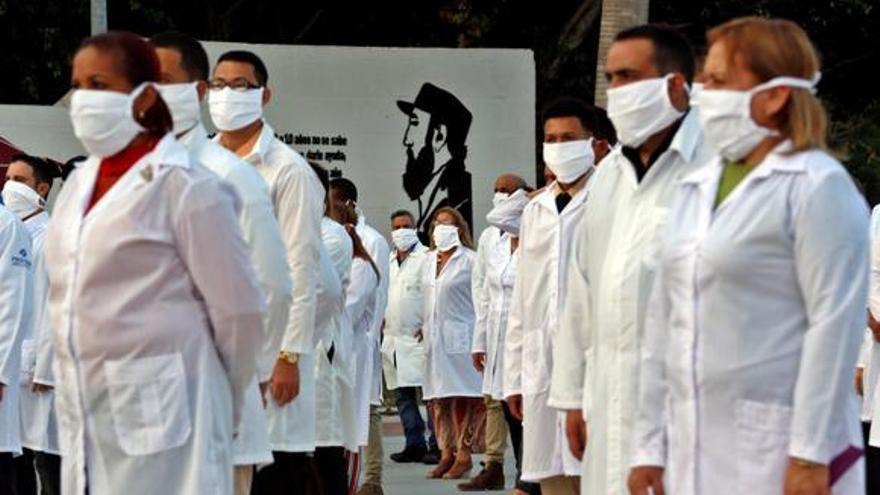
The real Cuban health system, the one for ordinary Cubans, is far from being what is sold to the world, and it is nothing more than a sham that does not overcome the scarcities suffered by the population. (EFE)
14ymedio, Rodolfo Santacruz Castillo, Camagüey, 20 February 2021 — A few days ago, I attended one of those useless union meetings that, as a dogma, we have converted into a common practice in the workplace, where supposedly we have to discuss non-conformities and talk about something as sacred and at the same time as outrageous as the collective agreement. Meetings that have lost their essence and are the ideal platform for the bureaucrats to direct, fight and order their workers to continue on and end up praising the Revolution as always.
I decided to listen and try to interpret that row of words that came out in order, almost perfect, almost copied, almost real, almost thought for themselves by someone who, from the comfort of a desk, and with air conditioning, directs the miracle of production.
Making uncomfortable jokes, the official gave us her perception of the events of the San Isidro Movement and the youth of 27N [27 November]. “We will not let the conquests of the Revolution be taken away from us,” she said, surely alluding to the usual cliché: that we have free health and education. The truth, however, is that every day there are more of us who observe things differently.
The daily shortages in all areas invite us to reflect: seeing ourselves in the 21st century suffering from these ills, in a land as rich as Cuba, can only be a symptom of bad administration, of a total lack of progressive economic actions. continue reading
Madam director, executive, civil servant, boss, and however many names can be obtained, let’s talk about healthcare, free healthcare: do you know how many countries in the world that are not socialist have a public, free and quality health system? There are many. If you go out onto the streets of Cuba today, try to find, in that conquest of the Revolution, various medications for conditions as normal as a headache or an infection. “There is nothing,” accompanied by a shrug, will be the answer from behind the pharmacy counter.
In how many dental clinics is the care provided to the population suspended due to lack of water? In how many hospitals in Cuba are elective or not so urgent surgeries suspended for this same reason? Or for lack of gloves, tape, sutures or because important equipment is broken and the part to fix it are delayed, or for thousands of reasons that all of us at some point have heard and even suffered firsthand.
The current physical state of hospitals, polyclinics and medical offices is dire, the feeding of admitted patients leaves much to be desired, getting an appointment for specific tests that use advanced technologies is so complicated and time consuming that it can be classified as lacking humanity.
Is that the revolutionary conquest that you show off to the world, offering a service this mediocre for free, full of deficiencies, badly set, badly directed? I am not talking about the healthcare that appears in the news, which ordinary Cubans cannot access (the Cimeq, the Clínica Internacional Cira García, the Censam Marine…)..
The communist double standard is a latent fact, since it promotes what is convenient for it. The hidden face of these achievements is a people who pay the astronomical salaries of those who neither produce nor are capable of making a better society. It may be that this is a conquest, forgive me, Madam Chief.
The real Cuban healthcare system, the one for ordinary Cubans, is far from being what is sold to the world, and it is nothing more than a sham that does not address the scarcities suffered by the population. A huge percentage of competent doctors need to go to another country to look for what they cannot acquire in their own country, and for a few years they have been compulsively training new doctors, discarding the standards and skills for a profession as dignified as this, giving space to mediocrity and the possibility of being a doctor to people who shouldn’t be one.
And that is the other famous achievement of the Revolution, education. With the desire to make everyone a professional, we find a society that has thousands of mediocre people who believe they have a degree, who shame those who did deserve it and made an effort by the correct means, and at the same time they cannot lower themselves to work the land.
Real teachers have disappeared from education, and a television set tries, during the pandemic, to replace the irreplaceable. The schools in every municipality are falling apart and the children learn half of what they need to know, because doubts cannot be resolved by unmotivated new teachers, who simply chose that career in many cases so as not to spend two years in military service.
And what about the current status of boarding schools in pre-university study centers (those that still have boarding schools), or the housing conditions in Cuban universities, or the food of the country’s future professionals? If seeing it is despicable, living it is more painful than can be explained in a simple publication.
The greatest achievements of the Revolution are, today, its great shame. Even so, we try to cover the sun with a finger. It is sad that because what you fought for and suffered so many nights of insomnia over does not provide you with a dignified life, it does not give you what you need to start a family and rejuvenate the aging Cuban society. It is painful to see that your efforts are slowed down by deficiencies and, on many occasions, by those achievements that the senior management wants to continue defending.
Cubans, there are no such achievements, they are only the facades of an incapable, immoral, corrupt and overwhelming system, a conglomerate of pirates and criminals that has been violating and subduing a suffering people for years and that is losing its essence. We continue with our heads down, standing in line for everything, trying to survive and fighting, while at the top they observe us like feudal lords, disguising with the word socialism or communism a useless ideological monstrosity that has never worked and never will work.
____________
COLLABORATE WITH OUR WORK: The 14ymedio team is committed to practicing serious journalism that reflects Cuba’s reality in all its depth. Thank you for joining us on this long journey. We invite you to continue supporting us by becoming a member of 14ymedio now. Together we can continue transforming journalism in Cuba.
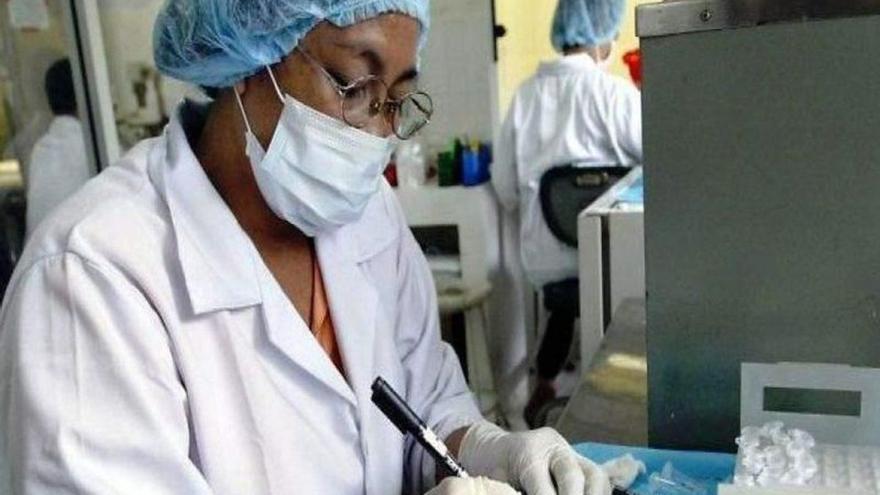
Cuba’s Soberana 02 Covid vaccine will not start the third phase of trials until March 1st, when all other nations on the continent will have already started immunizing their populations. (EFE)
14ymedio, Havana, 25 February 2021 — Fabrizio Chiodo, the only foreign researcher involved in the development of Cuba’s Soberana 02 vaccine for Covid, reported to the international press this Wednesday on the promising development of the vaccine candidate, which will pass to phase 3 of clinical trials this coming Monday. This announcement confirmed that Cuba will be the last country on the continent to begin immunizing its population.
The researcher could not say how long this final stage would take, as it is foreseen that it will also take place in Iran, thanks to the established collaboration between the Finlay Institute and the Pasteur Institute of Tehran. Mexico may also participate in the study, according to a statement from the Mexican Ambassador, Marcelo Ebrard, advancing conversations between the Cuban laboratory and the Ministry of Health.
Regardless, even the countries the furthest behind in inoculating will have already received doses from various laboratories by the end of the week. Cuba, on the other hand, has yet to complete the most important step toward an approval that, in any case, is assumed to be a given because of the vaccine’s success in previous stages. This caboose of vaccinating countries is formed by Uruguay, Nicaragua, Guatemala, and Honduras. continue reading
Uruguay, the last to vaccinate in all of South America, will receive the first doses from Sinovac, the Chinese laboratory that has produced more than 1.7 million units, this Thursday night. Furthermore, the arrival of almost half a million acquired from the German-US lab Pfizer and the reserve of 1.5 million financed by the COVAX (COVID-19 Vaccines Global Access) initiative is expected.
Guatemala and Honduras are another two at the end of the line that are receiving a small donation from Israel today. The Mediterranean country, which is the global leader in vaccinations, is sending 5,000 doses from the US Moderna lab to each of the two Central American countries, which have noted a delay in receiving the doses from COVAX.
Guatemala should have received more than 800,000 doses from the British lab Astro-Zeneca in the middle of February (overwhelmingly the largest contributor of vaccines to COVAX) and awaits a shipment from Pfizer in April with a special fund of 1,500 million quetzals (around 195,000 dollars) authorized from the government for this purpose.
Honduras, for its part, has bought 70,000 units of the Russian Sputnik V that is close to arriving, and 1.4 million from AstraZeneca that are not expected to arrive before May. From COVAX, 24,000 units planned to arrive in February, have not yet arrived.
Nicaragua has also not yet received vaccine doses from the international fund. However, a shipment of Sputnik V arrived at its airport this Wednesday, although the opaque Daniel Ortega administration has yet to announce the quantity.
The rest of the countries of the continent have already been vaccinating for days, including small territories such as Trinidad and Tobago, Guyana, and Jamaica, with Chile leading with over three million immunizations, 16 percent of its 19 million inhabitants.
This situation puts Cuba in a delicate position. The medical power that has spent months promoting its vaccines will be the last to start the process with almost total security, even though it is certain that, once it is approved, the country will be able to act swiftly. As the vaccine is nationally produced, distribution will not require transport, delays, or dependence on foreign laboratories, although it will depend on the provisioning of complementary materials.
Cuba has had a difficult time accessing direct purchasing of those vaccines most utilized in the west, such as Pfizer, Moderna, or AstraZeneca, and its lack of liquidity complicates the acquisition of those developed by friendly countries, like Russia (Sputnik, already in use in Venezuela) or China (Sinovac and Sinopharm). Regardless, it could have accessed the COVAX mechanism and submitted to it. Despite the delays, the majority of the doses acquired via this route are or will be available in a few days, while Soberana continues onto a pending phase.
The rollout process is of prime importance. Medical personnel, who have been the first to be vaccinated in the majority of countries, could have benefited from doses acquired from COVAX, allowing them to continue facing the uptick that they face on the island in optimal conditions. The irony is that Cuban doctors in Venezuela have already received the Sputnik vaccine, while those still on the island continue to wait.
Once Soberana is ready to be distributed to the population, it will be necessary to know the Government’s plans for the vaccination process. Global health recommendations, in general, advise starting with medical professionals and the eldest (in Europe, where many deaths from the first wave were in rest homes, vaccinations started with rest home residents).
In Venezuela, a vehement outcry was unleashed when the Government of Maduro decided to start vaccinations with the 277 members of the National Assembly rather than medical professionals.
In the case of Cuba, it remains to be seen who will be the first to benefit, although Chiodo revealed something unusual this Wednesday. Soberana 02 will be administered to people between 35 and 80 years of age. So, what vaccine will the old guard of the Communist Party use?
Translated by: Geoffrey Ballinger
____________
COLLABORATE WITH OUR WORK: The 14ymedio team is committed to practicing serious journalism that reflects Cuba’s reality in all its depth. Thank you for joining us on this long journey. We invite you to continue supporting us by becoming a member of 14ymedio now. Together we can continue transforming journalism in Cuba.
In the most elementary courses of Marxism-Leninism one learns that in society there are antagonistic contradictions that can only be solved through the violence that generates a revolution. (Minrex)
14ymedio, Reinaldo Escobar, Havana, 26 February 2021 — Many find it hard to believe, or understand, how it is possible that the ideas of such cool and sexy thinkers as Marx and Engels can be used to justify such decadent (cheas) attitudes as repressing young creators, holding rallies of repudiation or prohibiting the free exercise of professional activities and the independent dissemination of information and opinions in journalism.
Where does the deep justification come from; to what philosophical concept can be anchored the unbridled repression whose most “subtle and sophisticated” expression is articulated in national television programs where those who think differently are grossly denigrated, without the right to reply?
In the most elementary courses on Marxism-Leninism, after studying the three fundamental laws of dialectics, one learns that in society there are antagonistic contradictions that can only be solved through the violence that generates a revolution.
According to that dogma, an antagonistic contradiction is only resolved when one of the contenders achieves the extermination or annulment of the adversary. continue reading
It should be noted that in the original texts of Marx or Engels this apothegm is not found, not as it appears in the previous paragraph. Dialectics of Nature was an unfinished work of Engels that only saw the light in 1925 when it was edited by the academics of the Central Committee of the Communist Party of the Soviet Union, right in Stalin’s time. It was they who systematized, in order to simplify them into manuals, Engels’ philosophical sketches scattered in notes and complementary notes.
Three years later, forced cooperativization took place in the USSR, and it is no coincidence that that horror, which gave continuity to the “red terror” implemented by Lenin, appeared later in the hackneyed manuals as an example of a solution to an antagonistic contradiction, whose purpose was the definitive extermination of the kulaks. Many of these texts are available today on the Internet.
The decision of a small group of people to implement a socialist system in Cuba was in contradiction with the existence of private owners of the fundamental means of production. In less than a decade the owners were dispossessed by violence, and those who resisted ended up in exile, were imprisoned or died in combat.
The owners disappeared but socialism did not appear. At least its fundamental laws of “satisfying the ever-growing needs of the population” and “eradicating the exploitation of man by man” were not fulfilled.
Such plundering to exterminate the antagonistic owner was of no worth. The “blood spilled on the sands of Playa Girón [the Bay of Pigs] to repel the bourgeoisie who came to recover what had been confiscated” was worthless; the militiamen in the Escambray Mountains killing peasants who had risen up because their lands had been taken away from them were worthless.
All those supposed victories ended in an economic defeat because the socialism of the books failed to establish itself as a system in reality, and finally the rules of the market had to be recognized. It was also an ideological defeat because the desire of Cubans to be owners and to express themselves freely never disappeared.
In present times, this is the most acute contradiction that comes to the surface. It is no longer the one, artificially sustained under the concept of class struggle, which was solved in the material sphere by confiscating properties. What the Government is trying to do now is to put a brake on those who promote the proposal to expand the productive forces against the backdrop of maintaining a planned economy as the last redoubt of the frustrated “socialism.”
The “philosophical question” is whether this is an antagonistic contradiction and whether the idea of the extermination of the opponent as the only solution to antagonism is still valid.
Those who aspire to change things in Cuba, who are the most dynamic element of this contradiction, are divided between those who aspire to the violent overthrow of the dictatorship and those who believe in a gradual, bloodless change, the result of a dialogue.
The bad news is that the only thing that those in charge in Cuba understand is that they must annihilate their counterparts, radicals and moderates, put without distinction in the same bag, because they see in each and every one of them their future exterminators. In order to put into practice what they have learned in theory, they are willing to limit, with all available violence, the freedom of expression of their citizens, interpreting that any discrepancy should be considered as complicity with imperialism.
It is a task for the present and for the future to answer the question of whether Marxism was perverted by politicians or whether all this theoretical scaffolding constitutes a perversion of thought.
Beyond this subtlety of a definition of contradictions, the fruit of the subversion of Hegel’s dialectic, it is easy to find in Marx unfounded statements such as the belief that by implementing the dictatorship of the proletariat not only would the class struggle end, which would result in the disappearance of the State, but also that the aspiration to be owners would be erased from the minds of men, and all this he deduced from his study of the 72 days that the Paris Commune lasted.
The saddest thing is that, possibly behind the repression that subjugates Cubans in the 21st century, there are not even vestiges of elevated thought that can be considered the force of reason, but simple ambition for power backed by the reason of force.
Translated by: Hombre de Paz
____________
COLLABORATE WITH OUR WORK: The 14ymedio team is committed to practicing serious journalism that reflects Cuba’s reality in all its depth. Thank you for joining us on this long journey. We invite you to continue supporting us by becoming a member of 14ymedio now. Together we can continue transforming journalism in Cuba.
Several professionals signed a statement in which they ask the Cuban Government to remove both architecture and engineering from the list of 124 private activities that were recently prohibited in Cuba. (14ymedio)
Carlos Manuel’s grandfather was the owner of a funeral home in the middle of the last century; his upstairs neighbor founded a law firm in the 1950s; and his mother started out as a dentist in a private clinic. However, this 48-year-old from Havana will not be able to carry out any of these labors outside the control of the State. He had to live in a Cuba with greater restrictions for the self-employed worker than the one his ancestors knew.
For several days, a disturbing list has been circulating around the Island. The list contains the 124 occupations that the Government has vetoed from being exercised in the private sector. In most cases, these are professions linked to sectors that are a state monopoly and range from the private extraction of crude oil, to making sugar, to practicing as lawyers, architects, doctors and journalists on one’s own.
Carlos Manuel has kept his civil engineering degree in a drawer for a long time. He had the illusion that, with the deep economic crisis that Cuba is experiencing, the authorities would raise the flag and allow him to work privately in the profession that he is passionate about. Together with an architect friend and another designer, they fantasized about creating a company, medium or small, to offer their services in the construction and remodeling of hotels, private businesses and homes. continue reading
But instead of the expected opening, the three graduates were stunned when reading the list that excludes them from receiving a self-employment license to dedicate themselves to the trade they love. “In a country where it is urgently necessary to recover the architectural beauty of the cities, we have been excluded from being able to contribute with our own effort,” he wrote to a friend, as soon as he read the list. That same night, he called his brother who lives in Uruguay to tell him that “at the slightest opportunity” he would emigrate. Another professional who escapes, unable to fulfill his dreams here.
Several colleagues of Carlos Manuel have joined and signed a statement with the title “Independent architecture should not be ignored in Cuba”, in which they ask the Government to eliminate both architecture and engineering from the list of those 124 expressly prohibited activities. by the Ministry of Labor and Social Security. But they harbor little hope that the Plaza of the Revolution will back down from that decision.
In short, the list of prohibited occupations summarizes the fears of a regime that is known to be disadvantaged in offering its workers attractive wages, good working conditions and freedom for innovation or for the free expression of opinions within its institutions and companies. It senses that an independent lawyer will not tacitly accept the violation of his client’s rights; that a free publisher will not allow himself to be censored or that an independent reporter will not sweep uncomfortable news under the rug for power.
The Government also fears that allowing the private exercise of certain professions will not only unleash an exodus of employees from the state sector, but would mean a significant loss of political control over thousands of Cubans. They are not just people with degrees who will gain autonomy, but over whom the power will cease to have influence in such a decisive way as it does now.
COLLABORATE WITH OUR WORK: The 14ymedio team is committed to practicing serious journalism that reflects Cuba’s reality in all its depth. Thank you for joining us on this long journey. We invite you to continue supporting us by becoming a member of 14ymedio now. Together we can continue transforming journalism in Cuba.
14ymedio, Havana, 28 February 2021 — Camagüey priest Alberto Reyes has once again issued harsh criticisms of the situation Cubans are currently experiencing. In a text published this Sunday on his Facebook account, the priest warns that “this people has been giving signs for a long time that it does not want continuity.”
Reyes describes the Cuban population as tired “of this sterile ‘spirit of revolution’, of an absurd ‘resist and win’, of ‘doing more with less’, of ‘battles of ideas’, of ‘no one surrenders here’, of ‘socialism or death’, and even of ‘homeland or death’.” He also regrets that the Island has been mired for “years and years among slogans of war, while we long for times of peace.”
“I do not see a people eager to give their lives to build a revolution, but a people desperate for the so-called ‘revolution’ to give them breathing space to build their lives,” adds the priest who has gained notoriety in recent months due to his periodic reflections published on social networks. continue reading
In a part of his text, the priest addresses the Cuban authorities. “You, who hold the reins of political power on this Island, don’t you see this people crying out for a change? Aren’t you going to have the courage and intelligence to initiate those changes, so that a peaceful transition can be achieved, and in the end we can all come to an accord from peace? ”
For that longed for economic and political change, Reyes considers that “the best, the most sensible, as well as the most elegant, would be a proposal from the power structures. Because when the rivers overflow, they only leave destruction and death in their wake.”
In the texts that he disseminates through Facebook, the priest has previously questioned that in Cuba there can only be one ideology, a single party, a single way of educating, and has denounced the “great theater” that the Island is today, “where we lie to each other as part of a play that no longer needs to be rehearsed.”
“Don’t you see? Don’t you listen? Don’t you understand that we cannot continue like this, and that in a country that is adrift no one is safe, neither you nor your children?” Reyes continues to question in his most recent publication. “Don’t you see that nobody trusts that we are on the ‘right path’ anymore, or that we will be able to build a happy and prosperous society?
“And if we all become a little more humble, and recognize that we need a change of course, a new space in which everyone has a place?” proposes the Camagüeyan and, in just a few minutes, his reflection had already accumulated dozens of supportive comments. “Cubans are not a spiteful people, and they have shown it. The tone of the demands from this people is still that of dialogue and inclusion.”
“We do not want violence, we do not want shouting, we do not want disqualifications, we do not want acts of repudiation. But we do not want to submit more, we do not want to turn our life into a lie, we do not want to continue insulting our intelligence,” he says.
Reyes concludes his text by recalling some verses by Pablo Neruda: “They will be able to cut all the flowers, but they will not be able to stop the spring.” A quote to which he adds: “I deeply believe that the spring of a new Cuba is coming, and that it is unstoppable.” Furthermore, he describes that moment as one of “harmony, color, light, joy, peace.”
Last year one of the chronicles published by Reyes caused a great impact because it asked the people to stop being afraid, not to fall into divisions, and it addressed the Catholic bishops, whose “silence” they suffered. “This country needs a change, it needs a transition, it needs to live and stop dragging its existence, and at this moment, in my opinion, only the Catholic Church is in a position to lead a dialogue and propose a transition,” he declared then.
His criticisms earned him an attack in the official Cuban press that questioned that some priests of the Catholic Church used “the pulpits to launch strong questions at the Cuban Revolution, blaming it for the economic crisis that the country is going through, without touching who is truly responsible, the United States.”
____________
COLLABORATE WITH OUR WORK: The 14ymedio team is committed to practicing serious journalism that reflects Cuba’s reality in all its depth. Thank you for joining us on this long journey. We invite you to continue supporting us by becoming a member of 14ymedio now. Together we can continue transforming journalism in Cuba.
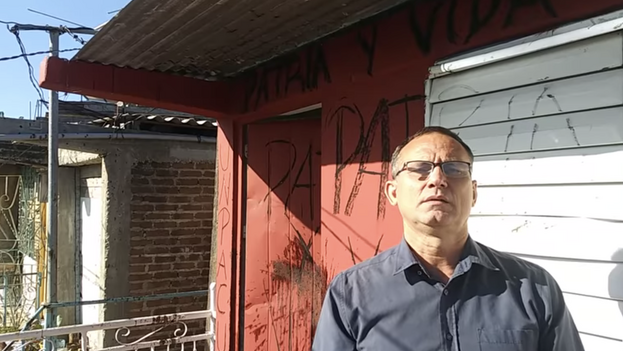
José Daniel Ferrer, leader of Unpacu, at the door of his home, also the organization’s headquarters, in Santiago de Cuba. (Capture)
14ymedio, Havana, 28 February 2021 — José Daniel Ferrer, the leader of Unpacu, denounced this Saturday that his house in Santiago de Cuba, headquarters of the opposition organization, continues to be besieged by State Security, which prevents the residents from circulating in the area.
“The communists, the henchmen, the instruments of tyranny remain here, from acts of repudiation,” the leader of the Patriotic Union of Cuba denounced in a video published on his social networks, after being detained for a few hours this Friday, after which his home was raided by several plainclothes officers.
Friday, according to Ferrer, was “historic.” “They invaded with more than 180, almost 200 agents,” in addition to trucks and water trucks with hoses, he said, with the excuse that they were going to “sanitize the block because there is Covid-19” and they were going to paint the facades of all the houses. “A lie!” the opponent cried: “It turns out that they just ended up painting, with a disgusting paint that we are going to erase as soon as possible, the facade of the Unpacu headquarters.” continue reading
On that wall, the activists had written in large letters the slogan “Homeland and Life”, which has gone viral from the song of the same name by Gente de Zona, Yotuel Romero, Descemer Bueno, Maykel Castillo Osorbo and El Funky. When it was being erased, says the leader of the Unpacu, the activists rewrote the phrase with charcoal.
“Here nobody is afraid, here nobody is intimidated, here nobody is scared,” emphasized Ferrer, who explained that the attack “was with the intention of seeing if they can put an end to what we do here for the elderly, for the sick, for alcoholics, for people living in extreme misery.”
“Not even by killing us can they stop our work,” said the opponent. “Not even by killing us can they put an end to our fight for freedom, for democracy and for a better future.”
José Daniel Ferrer has been under house arrest since April 2020, after spending six months in preventive detention, for the crime of assault that several international organizations consider “prefabricated.”
____________
COLLABORATE WITH OUR WORK: The 14ymedio team is committed to practicing serious journalism that reflects Cuba’s reality in all its depth. Thank you for joining us on this long journey. We invite you to continue supporting us by becoming a member of 14ymedio now. Together we can continue transforming journalism in Cuba.
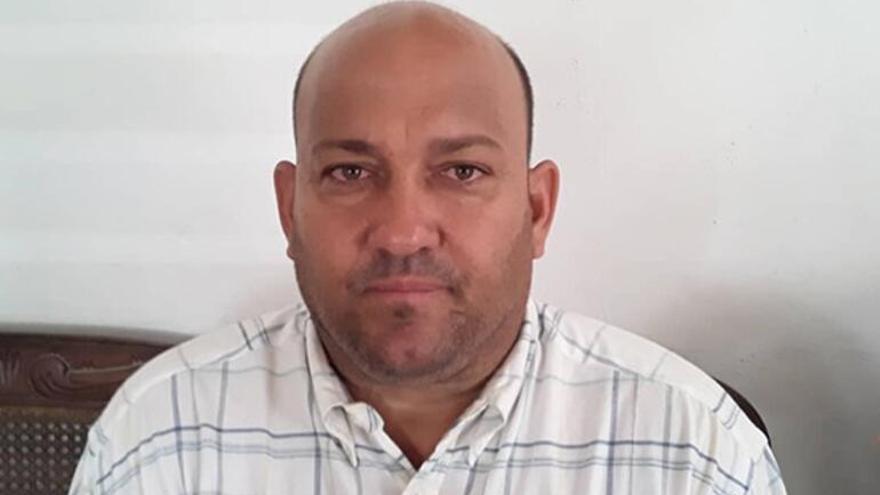
Armando Trujillo González was sentenced to three years in prison for the false crimes of “robbery with force” and “disobedience”. (CPD)
14ymedio, Madrid, 17 February 2021 — On Tuesday, Cuban Prisoners Defenders (CPD) denounced the situation of prisoner of conscience Armando Trujillo González, who is serving a three-year sentence in the Agüica maximum security prison in Matanzas.
Trujillo, an activist of the Movimiento Independiente Opción Alternativa (Independent Movement Alternative Option), has been held incommunicado since his admission to prison on July 4, 2019, states CPD, and his health “is very, very deteriorated with a coronary problem for which he does not receive medical attention or medicine.” He is also not allowed to receive food, clothing or medicine from his family.
In a legal report, which it submitted to the UN, the Inter-American Commission on Human Rights and the European Union, the organization based in Madrid, demonstrates that Trujillo was arbitrarily convicted of a false crime of robbery with force, and disobedience. continue reading
In prison, CPD claims based on internal sources, “he is harassed, threatened and coerced through psychological and physical torture to leave human rights activism and betray his organization,” trying to force him to record a video that “will serve as social blackmail in case he is released from prison.”
In addition, Prisoners Defenders says that the political authorities of the prison instigate the most dangerous inmates to “rape him in exchange for perks for themselves,” with the aim of “undermining his morale” and “creating a state of constant physical and psychological torture,” in order to “ensure that Armando, to defend himself, may at some point be charged with some additional crime so they can increase his sentence.”
Recently, CPD denounced that prison authorities use “severe torture, beatings and isolation at unusual levels” which, coupled with tempting offers, seek to get prisoners to agree to film compromising videos in which they “confess to being mercenaries and accuse the leaders of their groups.”
The recordings would be used against them if they resumed their human rights activism, the organization said.
COLLABORATE WITH OUR WORK: The 14ymedio team is committed to practicing serious journalism that reflects Cuba’s reality in all its depth. Thank you for joining us on this long journey. We invite you to continue supporting us by becoming a member of 14ymedio now. Together we can continue transforming journalism in Cuba.
 14ymedio, Havana, 2 March 2021 — The magazine Vocablo of the Association for Freedom of the Press (APLP), which stopped printing in 2015, has been published again, this time in PDF format and with a selection of the best of the Cuban free press.