Will There Be a New ‘Special Period’ in Cuba? / Ivan Garcia

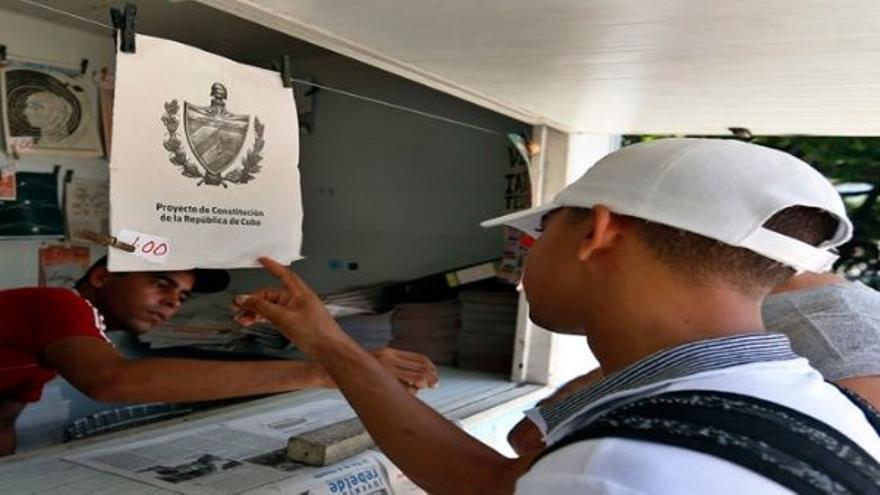
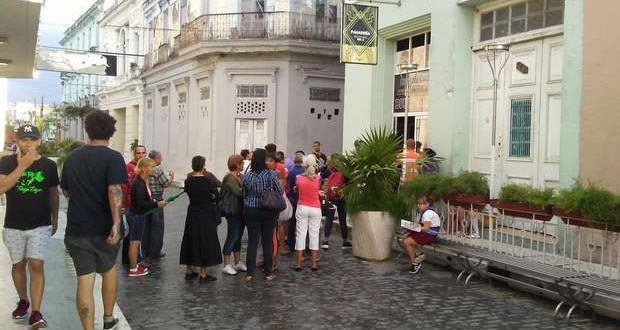
Lines like this, to buy bread in Santa Clara, have been seen throughout the island. Because they have more inhabitants, the longest lines are those in Havana. And not only to buy bread, also eggs and pork, among other products with shortages and with higher and higher prices. Image by Laura Rodríguez taken from Cubanet.

Ivan Garcia, 20 December 2018 — Even in the best stage of Fidel Castro’s Revolution there was always something missing. In the 1980s, thanks to the blank check circulating from Moscow, the ration book distributed half a pound of beef per person, drinking a glass of milk was not a luxury and jams, juices and wines and other products from the Soviet Union, Bulgaria, Albania and other socialist countries of Eastern Europe were sold on shelves in the parallel market.

The daily life of the people was tied to the olive-green State up to levels that bordered on delirium. A house on the beach, a black-and-white television or a simple alarm clock was bought as a bonus for an outstanding worker awarded by the union.

Celebrating Christmas, listening to American music or wearing cowboy-style Levi’s were symptoms of ideological diversionism. The regime was never able to manage an efficient transport service on the iland, or sell quality footwear or build with good taste. continue reading

There have been stages worse than others. But it always returned to the starting point: inefficiency, low harvests, shortage of food and long lines to acquire them. Castroist socialism was noted for being more political than economic. Now, not having generous sponsors, such as the former USSR and the Venezuelan wallet of Hugo Chávez, Cubans live in a perpetual economic crisis.

Alina, a retired teacher, says that in the environment she perceives a new ‘Special Period‘. “There is nothing in the hard currency stores. I can make a list of things that are in short supply. The government has dismantled the sales posts that were in all neighborhoods and due to the transportation crisis, it is more difficult to go to Centro Habana, Vedado or Miramar to buy food, clothing and toiletries. And in the markets in national currency forget it. By medical prescription I must take yogurt and yogurt bags only arrive by the few on Tuesdays.”

Diego, an economist, considers that although there are similarities, the situation is different. “The economic crisis that took place after the [failed] Ten Million Ton Sugar Harvest in 1970 was a typical case of inflation. The population had money, but the stores were empty and prices skyrocketed. In the decade of 1980s the economy stabilized, but in 1990s, when we could no longer count on the subsidies from the European socialist camp, the country was led to the ’Special Period’. It has been the most difficult stage in these 60 years. Today the Cuban economy is bad. When you check the different production indices, you notice that the majority decreases or hardly grows. Growth in the food sector does not meet demand. The fall is so dramatic that these small growths are like a drop of water in the ocean,” he says and predicts:

“It is probable that in 2019, if the government does not carry out urgent and large-scale economic transformations, we will reach a scenario of deeper economic crisis. A large segment of workers, who receive only symbolic salaries would be even more affected, as would be retirees. Those who have access to  hard currency or own prosperous private businesses may not be so affected. That crisis is around the corner and can be tackled with proactive measures of an economic nature, although always some sector will be affected.”

Yoandry, a musician, thinks that “you do not have to be an economist to see that next year it will be a bad one. Brother, they are missing essential products for the poorest. From bread and rice for free to medicines. Add to that the prices of root vegetables, pork and vegetables have grown between 10 and 20 percent compared to five years ago. And salaries do not grow along with that silent inflation that Cubans are experiencing.”

Diana, an engineer, confesses that “I do not want to relive the nightmare of the Special Period, but that possibility is latent. The shortages in hard currency stores and in national currency stores are alarming. The prices of articles increase every year. Even on the black market, it is becoming increasingly difficult to get quality fish, shrimp or beef. And there is no longer anywhere to escape. Obama threw out the wet foot/dry foot policy and people who decide to emigrate can only try their luck in Uruguay, Chile or another South American country.”

Leydis, a graduate in art history, parked her diploma in a drawer and decided to try her luck as a mule. “I was a girl during the Special Period, but I remember the blackouts and they started selling Chinese bicycles. If the government does not change its economic policy, it will be very hard years, so it should stop tightening the screws on the self-employed, who are the only ones who grow up in Cuba and, in addition, are our main clients, who buy from us the bulk of the little things that the mules bring.”

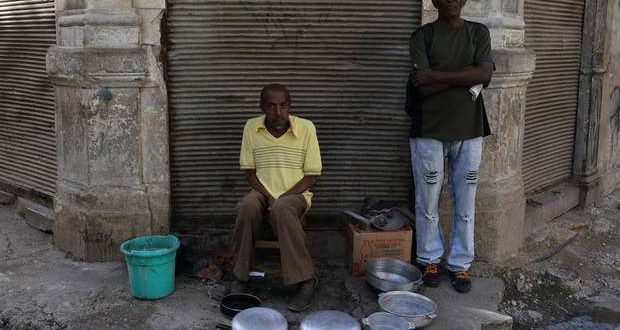
José Antonio, unemployed, says that in the country there is a large number of people who, like him, have to live off ‘invention’. “To find me some pesos, I go to the stonemason, I carry debris, and I go to the dump on Calle 100 to find among the trash things that I sell later. However bad the thing gets, the poor adapt to the situation. If a new economic crisis erupts, at least I will not be the worst off. Those who suffer are the rich, those who live in good houses and eat breakfast and lunch every day.”

In a portico near the Plaza Roja of la Víbora, south of Havana, José Antonio expects to earn twenty or thirty Cuban pesos from the sale of objects found in the trash. Breathe a little fresh air, from a dirty backpack he takes out a plastic bottle and a stew of distilled alcohol, the drink of the forgotten.

For many in Cuba, including José Antonio, the Special Period has never ended. And again ordinary Cubans will not be able to celebrate Christmas Eve, Christmas and the arrival of a New Year (which in 2019 coincides with the 60th anniversary of the Castro Revolution) as they wish, with enough money and food to enjoy it with family and friends.


14ymedio Faces of 2018: Doctors Repatriated from Brazil by the Cuban Government

The doctors arrived home from Brazil afterCuba broke with the Mais Médicos program. (Granma / Juvenal Balán)

14ymedio bigger14ymedio, Havana, 28 December 2018 — At the center of an intense political dispute in recent weeks have been the 8,471 Cuban doctors who served in the Mais Médicos (More Doctors) program in Brazil. Since the Brazil’s newly-elected president, Jair Bolsonaro, demanded new conditions for their stay in the South American country, the accusations between Havana and Brasilia have risen in tone.
For five years Cuban doctors worked in Brazil through an agreement signed between Havana, the government led by then Brazilian president Dilma Rousseff, and the Pan American Health Organization (PAHO).  Approximately 20,000 of these collaborators, deployed in 3,600 municipalities, passed through the country before the electoral victory of the right-wing Bolsonaro last October.

Bolsonaro demanded that the Cuban doctors must undergo tests to measure their knowledge, and in addition must be given the right to have their families with them in Brazil, as well as to receive their full salary, of which they were only paid 30% with the rest going to the Cuban government. The rightist called the doctors “slaves” of a “dictatorship,” and also questioned their qualifications. continue reading

In response, Cuban authorities ordered the withdrawal of their doctors on November 14, of which about 90% returned to the island, some 7,635, according to official figures. The rest decided to stay in Brazil and will not be able to enter the Island for eight years, the penalty imposed by the Cuban Government on those it calls “deserters.”

Some families of doctors who did not return to Cuba have denounced acts of discrimination against them by official organizations. Last November, a group of them who escaped to the United States sued PAHO, alleging that the entity benefited from what they consider a forced labor scheme.

The end of the Cuban participation in Mais Médicos is contributing to the gloomy forecasts facing the national economy. In the midst of Cuba’s liquidity crisis, the country will stop receiving about 300 million dollars a year that came through this program.

From a multiplicity of specialties, ranging from Comprehensive General Medicine, through pediatrics to cardiology, thousands of physicians depart from all over Cuba, after going through a strict selection process in which they assessed for their labor skills but also their ideological affiliation to official organizations, such as the Communist Party and the Young Communists Union.

On their return to the Island the Government has the obligation to place each of these doctors in a workplace and to give them access to the money from their salaries, in Cuban pesos, that was deposited in their bank accounts in Cuba while they served abroad. Each doctor also receives a magnetic card with which they can buy, at preferential prices, some merchandise in hard currency stores.

 See also: 14ymedio Faces of 2018

___________________________

The 14ymedio team is committed to serious journalism that reflects the reality of deep Cuba. Thank you for joining us on this long road. We invite you to continue supporting us, but this time by becoming a member of 14ymedio. Together we can continue to transform journalism in Cuba.

I Am Voting No / Somos+, German Gonzalez Rodriguez

Somos+, Germán González Rodríguez, 5 January 2019 — Compatriots:

If you do not want your family or partner to have to migrate for personal and professional fulfillment.

If you do not want to have to leave your country and your family to fulfill yourself personally and professionally.

If you are a worker and want a decent salary that allows you to live honestly.

If you are retired and you want a pension that allows you to live with dignity.

If you are a Cuban emigrant and the discriminatory and excluding Foreign Investment Law prevents you from legally investing in your native country.

If you have family or friends who have emigrated and the discriminatory and excluding Foreign Investment Law prevents them from investing in their native country honestly.

If you want to enjoy universally recognized rights in your Homeland.

If you are an emigrant and you want to enjoy the universally recognized rights in your native country.

If you want to start and develop your own business without bureaucracy and persecution.

If you want to stop being a discriminated against in your own country, exploited by foreigners who predominate over Cubans.

If you are convinced that to achieve all the above the first thing is to enjoy freedom of information, opinion, the means to express it and be able to choose your rulers:

The reasons are overwhelming FOR NO on the Constitutional Referendum

I am voting NO, on that fraud they are putting before us.

The True Path is Not to Weaken the Oppressor but to Strengthen the Oppressed

The ‘boteros’ (self-employed taxi drivers) drove empty during their ’strike’ on the 23rd street in Havana and did not stop for passengers, as a sign of protest. (Courtesy)

14ymedio bigger14ymedio, Ariel Hidalgo, Miami, 21 December 2018 — The tug-of-war between a government leadership accustomed to impose its will like an absolute monarch and the sectors of the citizenship that are beginning to energetically claim their rights through peaceful resistance as actors of an emerging civil society, has come to the fore in recent months, especially in December of 2018, a year that, when it concludes, will mark sixty years of the same group in power. These days of protest show conclusions and lessons that we can not fail to point out:

1. The offensive of government restrictions such as the paquetazo* and Decree 349, is a clear indication of the concern of the Party-State leadership, and in particular of the hard-line sector, over the development of civil society in recent times: independent galleries, alternative theaters, private recording studios, blogs, the unbridled growth of the self-employed market, in particular the paladares (private restaurants), the private transporters and an infinity of micro-businesses with a wide variety of services. continue reading

This is something reminiscent of the growth of the Third State on the eve of the French Revolution in the face of the excessive obstacles of the feudal monarchy. In this case, it is a living and creative force, both economically and culturally, against a political-military superstructure that slows down its development.

2. The power has made a serious mistake in imposing such unpopular measures less than three months from the date chosen to carry out the popular consultation on its proposed constitutional reform, probably because of its confidence that it can continue to benefit from the consent of the population.

Either because of indolence or fear, or, in the later instance, because they feel they can manipulate the results of the referendum to their benefit without unfavorable consequences, as has been done on previous occasions, or because they underestimate the response capacity of civil society, including the protests of well-known personalities which, until now, have distinguished themselves by their support for that leadership.

The result has been a malaise that the opposition could exploit in favor of the campaign to vote NO on the constitutional reform.

3. The granting of access to the Internet through cell phones on the same day, December 6, when the restrictions announced against artists and self-employed workers came into force, shows that their main objective was to divert the attention of the population to better weather the storm of protests. The internet access had been delayed by the fear of unleashing the “untamed wild colt” of the internet on the population with their computers and cell phones.

The new telecommunications technology undermines all centralized structures, mainly totalitarian models, as it breaks the monopoly of government information, dissemination and propaganda, enables rapid communication between citizens in different locations, and facilitates the recording of the outrages of the authorities and a rapid international dissemination through mass communication networks.

The oppressors, especially those who hide behind Marxist ideology, know very well how the changes of social regimes take place, a theory embodied by Marx himself in “A Contribution to the Critique of Political Economy,” where he wrote “the productive forces” (read: technology) “when reaching a certain stage of development (…) are in contradiction with the relations of existing production” (read: the economic-political structures of the oppressors) which generates a deep crisis of the system, “and thus opens an era of social revolution,” that is, a time of profound changes.

4. The fact that after the start of the protests the regime reacted by reversing some of the announced restrictions means that citizens (that is, those nominally without power) do exercise power when they become aware of their rights and express, publicly, their willingness to change.

5. The opposition must take note of the magnitude of the protests in general that far surpassed the most numerous of its political demonstrations and adjust, accordingly, its steps and its demands. Instead of urging the population to join them, they must unite themselves with that population in their demands and support them as much as possible, focusing on their immediate needs.

To the extent that they give their support to these spontaneous initiatives, they will achieve the sympathies and support of the people, they will gain prestige, and even, in this way, they will be able to call on them when they need to reach more far-reaching goals.

*Translator’s note: A package of restrictions tightening the conditions of self-employment.

____________________________

The 14ymedio team is committed to serious journalism that reflects the reality of deep Cuba. Thank you for joining us on this long road. We invite you to continue supporting us, but this time by becoming a member of 14ymedio. Together we can continue to transform journalism in Cuba.

History A La Carte / Fernando Damaso

Busts of Martí and Maceo at the entrance of a state company on Calle Colón in Havana’s New Vedado district.

Fernando Damaso, 8 December 2018 — When the political leaders have lost their past, have no present and have no future, they take advantage of history, with the aim of legitimizing their actions, protected by the founding fathers. Then we hear absurd phrases such as, “We would have been like them yesterday and they today would have been like us,” very difficult to verify. In a lurch they place themselves next to Cuba’s heroes of old: Cespedes, Agramonte, Gomez, Maceo, Marti and others, though they lack any real merits for it

To do so, they use the “charlatans” (today called “laptoperos“) of the time, always abundant among historians, writers, journalists and intellectuals, who sell themselves to power for a few crumbs. Their work floods the official communication media and provokes repudiation between people with an ounce of common sense. continue reading

The practice of physically burying today’s dead next to yesterday’s illustrious leaders continues, with the idea that the “newcomers” will benefit from past glories. Allegorical songs appear, along with art works, dances, installations, books and other cultural products, signed out of submission and cowardice.

However, despite how they may represent themselves today, their future is condemned to oblivion.

14ymedio Faces of 2018: Lis Cuesta, the ‘First Lady’ Who Doesn’t Speak

First Lady Lis Cuesta has accompanied Miguel Díaz-Canel to various events and on trips. (EFE)

14ymedio bigger14ymedio, Havana | 27 December 2018 — The assumption of the presidency by the engineer Miguel Díaz-Canel also meant the return of a first lady, a figure who disappeared from the Cuban political scene from the time of the 1959 Revolution. At 47, Lis Cuesta Peraza has appeared in the headlines of the foreign press from her new public role as the wife of the ruler, although Cuba’s official media hardly mention her.

After graduating from the Holguin Pedagogical Sciences Institute, Cuesta worked at the Book Institute and at the Paradiso Travel Agency, which belongs to the Ministry of Culture. They met when Díaz-Canel was appointed secretary of the Communist Party in the province of Holguin, a position that catapulted him into one of Raúl Castro’s men of confidence. continue reading

Cuesta has attended numerous official receptions throughout the year, welcoming Nicolás Maduro and his wife Cilia Flores to the Palace of the Revolution, as well as on the trip to New York she made with the president last October on the occasion of his participation in the General Assembly of the United Nations. In spite of her public prominence, her voice has not yet been heard in the national media, nor has she been seen performing activities on her own.

Last April, a few days after Díaz-Canel’s inauguration as president, an image of the first lady showing a fragment of a tattoo on her back in the shape of a fleur-de-lis was disseminated through social networks. The tattoo generated an immediate comparison between Cuesta’s new style and that of other female figures close to Cuban power, such Raul Castro’s late wife Vilma Espín, who had a much more conservative aesthetic.

Cuesta’s public appearances also contrasts with the secrecy that for decades surrounded Fidel Castro’s private and family life. His wife and the mother of five of his children, Dalia Soto del Valle, was only seen in the last years of the ruler’s life and during his funeral.

For the time being, although she does not speak to the national media or have an agenda of her own, the Cuban first lady is contributing to giving a more modern and human image to her husband’s mandate, perhaps an official strategy to bring the president closer to the population, which did not know him before Raúl Castro appointed him as his successor to the presidency.

See also: 14ymedio Faces of 2018

________________________________

The 14ymedio team is committed to serious journalism that reflects the reality of deep Cuba. Thank you for joining us on this long road. We invite you to continue supporting us, but this time by becoming a member of 14ymedio. Together we can continue to transform journalism in Cuba.

Families of the "Deserter" Doctors Are Having a Hard Time in Cuba

The doctors who have stayed in Brazil aspire to find better opportunities there, even though, for the moment, they are separated from their families.

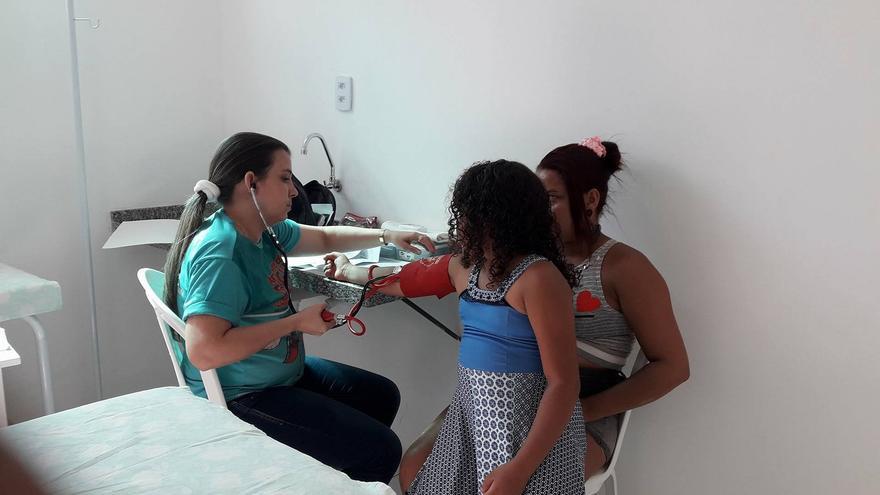
14ymedio bigger14ymedio, Gaby Hidalgo, Santa Clara, 14 December 2018 — “My mom told me that at school the teachers won’t call on my son, as if he had a contagious disease, they mark him as the son of the ‘doctor who stayed’,” says a doctor who left her son in her hometown of Sagua la Grande (Villa Clara) when she went to work in Brazil as a member of the Mais Médicos (More Doctors) program.

After Cuba left the program, she decided to stay in the state of Sao Paulo and, although she fears that some consider her a bad mother, she insists that she has made the decision to “defect” for her child, who has now become the son of a “traitor.” continue reading

“My decision was not taken lightly, it was something I had already discussed with my family,” she says. “Everyone should be free to decide what they want to do with their life. In Cuba the simplest thing becomes a conflict as it has now happened with the boy, not that they mistreat him but they talk about it in his presence, as if it were something terrible,” says the young doctor, saddened, who prefers to remain anonymous so as not to harm her family.

The families of the Cuban doctors who left the Mais Médicos mission to stay in Brazil are beginning to experience the repercussions of the decision on their loved ones. Contacted via the Internet and through social networks, the healthcare workers are not oblivious to what happens to their parents or their children, but they say they are sure that they have made the best decision.

M.B., also from Villa Clara, believes that “opportunities are presented once in a lifetime” and that in Cuba what she earned was not enough to cover her basic needs. “Everybody knows what you have to do to eat or dress there and I got tired of living on the mercy of my patients. My brother is in his fifth year of Medicine and, as soon as he finishes his studies, I will bring him with me, although I know that the government can put obstacles in the way of the paperwork to travel,” he says.

The Mais Médicos program was created in 2013 during the mandate of then Brazilian President Dilma Rousseff (2011-2016) with the aim of guaranteeing assistance in the most remote and humble regions of Brazil. However, last November, the Government of Cuba announced its decision to withdraw its more than 8,300 health workers from the Mais Médicos program in response to the intentions of the new Brazilian Executive to modify the terms of the agreement.

Cuban doctors began to return to the island almost immediately and on Wednesday the last plane carrying workers from the mission landed in Havana and was received by the Communist Party leadership with former President Castro at the head. However, many of the professionals have chosen to stay in Brazil. Although there are no official figures, the latest data provided by the Government indicates that 5,853 doctors had returned. After that number was reported only one more plane arrived, which indicates that almost a quarter of the contingent may have decided to settle permanently in Brazil, despite the consequences.

Medical deserters, as the government calls them, can not return to the island for eight years, but there are other, lesser-known consequences. General practitioner Leugim Espinosa knows this very well, having not been paid for the last month he worked, and having in Cuba his mother, already retired, and his grandmother who is 89.

“With their pensions they can not live, barely two hundred and fifty Cuban pesos (roughly $10 US) are not enough for food. As soon as my flight departed and they found out that I had not left, they withheld the money from the last month of my work here in Brazil, time that I had already worked and they also appropriated the savings [they had deposited for me] in banks in Cuba,” he laments.

C.A., a native of the coastal town of Isabela de Sagua, is one of those who have decided to return, although only for the moment. The doctor, who arrived in Brazil at the beginning of the program, is married to a Brazilian woman.

“When, on November 14, they announced that Cuba was leaving Mais Médicos, I assumed that I would not have any difficulty.” The state coordinator told me that I should travel on the plane with my wife, so that we would not overload the first trip home of my colleagues,” he said.

However, his idea is to return to Brazil as soon as possible. C.A. acknowledges that in Brazil Cuban doctors care for extremely disadvantaged sectors of the population, but points out that in Cuba poverty is general and there are no options for improvement. “When we were there our families suffered from distance but enjoyed economic privileges that they would not otherwise have known, now they take it out on the relatives of those who stayed behind.”

Recently the Brazilian press leaked a call from a Cuban official to Dr. Dayaimy González Valón, from the Máis Médicos program in Brazil, who had decided not to return to Cuba. In the conversation, the official resorts to intimidation by insistently pointing out to the professional that she risks facing eight years without being able to enter the country.

“If, unfortunately, something happens to someone in your family, you will not be able to enter Cuba,” says Leoncio Fuentes Correa, the state coordinator for the brigade in the Brazilian state of Mato Grosso. The official assures the doctor that with her decision not to return to Cuba she is “distancing [herself] from [her] family, which is the greatest thing that a human being has.”

 ______________________

The 14ymedio team is committed to serious journalism that reflects the reality of deep Cuba. Thank you for joining us on this long road. We invite you to continue supporting us, but this time by becoming a member of 14ymedio. Together we can continue to transform journalism in Cuba.

A People Tamed by a Prolonged Repression

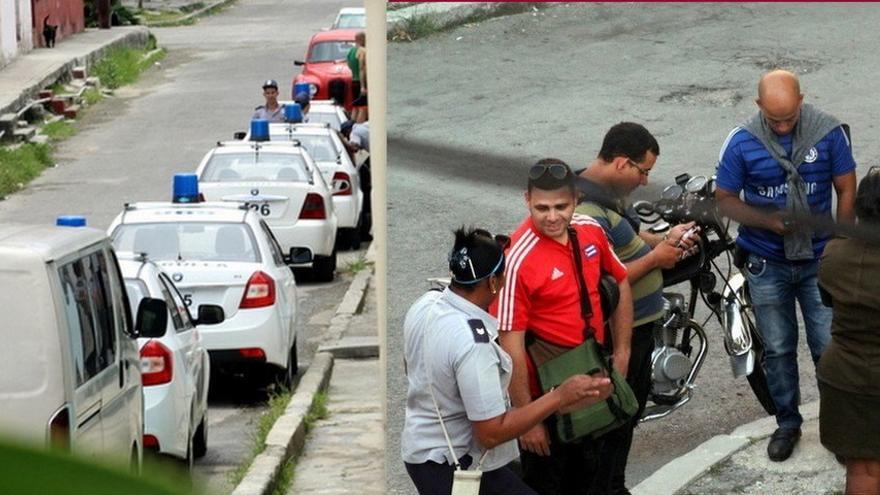
Police siege this Sunday in front of the headquarters of the Ladies in White in Lawton, Havana. (Twitter / Berta Soler)

14ymedio bigger14ymedio, Havana, 10 December 2018 — Every December 10, International Human Rights Day, demands an annual review of the situation in Cuba. It is a day to audit, take stock and see where the inhabitants of this island are with regards to recovering their spaces and civic capacities.

The obligatory question on this date is whether the respect for these rights has improved, worsened or remains in a situation of stagnation. It is of particular interest to measure certain indicators since the engineer Miguel Diaz-Canel was named president, the first president in almost 60 years who does not carry the surname Castro.

Any quantitative analysis based on statistics could yield a slight positive result. The death penalty continues to not be applied and the number of political prisoners has been reduced, while arbitrary arrests, beatings or repudiation rallies remain, but have not suffered an alarming upturn, such as the Black Spring of 2003 or in the days after the death of activist Orlando Zapata Tamayo in 2010. continue reading

Some international observers conclude that the application of repressive methods of less intensity is an index of improvement. They are the same ones that point out that, although many activists are prevented from leaving the country, opposition meetings are prohibited, arbitrary arrests continue and independent journalists have their work tools confiscated, there are no disappeared or human beings found with traces of torture thrown in the ditches.

This is, perhaps, the most distorted reasoning possible on the subject of Human Rights in Cuba and one that has allowed various international actors to complacently evaluate the situation of the country in this regard. It is the same perverse logic that leads us to congratulate Saudi Arabia because its authorities allow women to drive cars and congratulate the North Korean regime because it authorizes men to cut their hair in new styles.

The tamer no longer lashes the lion in front of the public to force him to jump through the hoop, because the terror has been inoculated into the beast in a long and meticulous process of successive punishments.

At least two generations of Cubans have been born hearing in school and in the media that it is right for there to be only one political party, accepting without question that there is an institution called State Security that acts outside the law, and that it is normal to live with the whistleblowers who write reports and with the intolerant who have the ability to close the path to a good job or a university career.

The vast majority of citizens, at least as of December 2018, see in the official media sponsored by the Communist Party the only source for finding out what is happening in the world and the country.

The idea of organizing a political party, a professional guild, a student association, an independent union or a club of friends is something that has been left out of the healthy intentions that a “normal Cuban” can have.

The criminalization for decades of these and any other options common in any democracy has instilled in the population the prejudice that these are practices alien to our traditions that can only respond to the evil interests of US imperialism that seeks, by these means, to seize our national riches and subjugate our people.

The situation of human rights has not improved in Cuba, it does not even remain stable. It has worsened and is getting worse every day as the harmful effects of prolonged repression accumulate.

There is even the risk that the almighty tamer called The State dares to leave open some door of the cage to show to the world his prowess of having tamed an entire people. How many will dare to cross that threshold?

 _______________________

The 14ymedio team is committed to serious journalism that reflects the reality of deep Cuba. Thank you for joining us on this long road. We invite you to continue supporting us, but this time by becoming a member of 14ymedio. Together we can continue to transform journalism in Cuba.

Cuba 2018: Neo-Castroism and an Economy in Hibernation / Ivan Garcia

Juan Suárez from the Havana Times.

Ivan Garcia, 3 January 2018 — There is no better country in which to find a surrealist atmosphere than Cuba. In October of 2017, when the hurricane winds of Irma ruined whatever was in their way, a photo that went around the world explained the political nonsense and citizens’ indifference.

The waters of the Atlantic Ocean jumped the wall of the Havanan seawall and in association with the Macondian* downpours flooded the poor neighborhoods of the capital such as Colón, San Leopoldo, Jesús María, Belén and Los Sitios.

Havana collapsed, people ransacked the hard currency markets and at a table in the middle of a street flooded with dirty water, four imperturbable men played dominoes and drank rum, while a part of the island collapsed. That photograph is so similar to our reality that it’s scary. continue reading

Two months after the passage of the cyclone, in January 2018, in an imitation of elections, the 168 municipal assemblies, by sheer citizen resignation, elected 605 candidates** for deputies to the Cuban parliament.

On April 19, the National Assembly of Peoples Power chose the future president. Abroad, the news was that the new ruler did not have the surname Castro. But, to our disgrace, the day after being proclaimed, Miguel Mario Diaz-Canel Bermudez promised more Castroism, economic planning and ironclad state control in every part of civic life.

That morning, after being proclaimed president, Díaz-Canel, somewhat embarrassed and shy, read the worst speech in memory from an elected president. “I promise nothing,” summed up in his disastrous presidential strategy. And he declared himself a fervent follower of Fidel Castro and “compañero Raúl.” More transparent and sincere he could not be.

Born in Placetas, Villa Clara, on April 20, 1960, Díaz-Canel never sold himself as a reformer or a high-caliber statesman. In any case, he is a figurehead. A guy without complexes, he says that every morning he receives advice from his political manager, Raúl Castro. He is a pragmatic politician. He is very familiar with how the ship sinks.

But trained by the old Fidelist school of resisting until the last breath. He will not proclaim major economic and political changes if the people do not demand it. Castroism is not an ideology, it is not even a political theory. It is a brotherhood of officials, soldiers and bureaucrats who benefit most if they renounce democracy.

If Castroism has not worked in 60 years, the neo-Castroism or late Castroism represented by Diaz-Canel is very unlikely to work. Castro I’s style of government was characterized by his inability to decentrally administer public service, produce food, economically develop the nation and bring prosperity to the citizens. But if something stood out it was in the management of diplomacy, in social control and the repression of opponents.

In the first eight months, Díaz-Canel was in exploration mode. He showed up at the place where a passenger plane crashed in Havana and visited the Batabanó municipality after a storm caused flooding. He often dissects the dissimilar structural problems of the peculiar Cuban system and his only promise, which sounds like a bluff, has been to ensure that in ten years he will solve the housing deficit in the country. We will have to wait and see.

For ordinary people, Diaz-Canel is opaque and his speeches are boring. On his tours of different cities and municipalities of the Island he shows himself as an indistinct bettor on the populism that used to be carried out by Fidel Castro.

In present-day Cuba, investments in public infrastructure are minimal. If anything, money is spent on improving water networks and a cheap coat of paint in hospitals. The construction of children’s centers, new health and educational centers is not planned. Transportation is chaos.

It is difficult for an institution administered by the State to have a passing grade. What works best in Cuba comes from the private sector. Restaurants, bars, hairdressers. But since the summer of 2017, the regime has reversed the reforms of self-employment. Why? A municipal party official we will call Óscar offers the answer.

“Self-employment was always seen as something conjunctural. If economic reforms were implemented in 2010 and self-employment expanded, it was for the simple reason that the State needed to get one and a half million people off the employment rolls. But only half a million left. It was thought that with the fiscal siege and the control of the inspectors, private work would not grow too much. But it was shown that when working for his or her own benefit, the individual is able to overcome any barrier. Self-employment has managed to overcome the shortages and lack of a wholesale market with creativity, circumventing tax rules and importing under the table. Today nobody dines in a state restaurant, they go to a paladar (private restaurant). And in other sectors they also offer strong competition to the State,” says the source and he concludes:

“Obama’s political strategy of importing and granting credits to self-employed people has intimidated the government. If that sector continued to grow at the stroke of dollars, in a short time it could cause economic changes of greater depth, and even political. The State sees them as a Trojan Horse. An enemy rather than a friend. Thousands of professionals have left their careers to become private entrepreneurs, which worries the government and that is why it seeks greater control over self-employment.”

The Cuba of 2018 was pure gatopardismo***. Make changes, without anything changing. The economy is still in recession. The optimistic television presenters announce productive growth that never lands on the table of Cuban families. Food prices rose between 10 and 25 percent. Hard currency markets are more undersupplied than ever. Recent statements by Alejandro Gil, Minister of Economy and Planning, suggest that there is no possibility of reversing the situation in 2019.

Between October and November, Miguel Diaz-Canel and his wife Lis Cuesta, on official visits, toured China, Russia, North Korea, Vietnam and Laos with a brief stopover in London. Nobody opened their wallets. Putin coiled himself in the same position: invest ten percent of debt forgiven to Cuba in the railroad and power plants and sell arms. China prefers to wait. He sees no short-term return. Publicly he offers the discourse from his fellow travelers, although the money is still at home. North Korea and Laos were ideological visits. Vietnam pushes him to the market economy, but Castroism thinks about it.

The olive-green autocracy desperately seeks foreign investment. In October 2018, Cubadebate reported that the Mariel Special Development Zone attracted 474 million dollars, the largest amount of investment in five years. Emilio Morales, president of the Havana Consulting Group, estimates that this figure is five times lower than the investments of the mules that travel to buy goods from Russia, Haiti, Mexico or Panama, which they then sell on the Cuban black market.

It is evident that the Havana regime lives in another dimension. Díaz-Canel wants to promote electronic government and create computerized mechanisms so that the population can exchange with state officials and manage their problems with immediacy. He announced the opening of a government website and a channel on You Tube. And he asked that all ministers open accounts on Twitter and be active on social networks.

“In what country does ‘Canelo’ live? One hour of internet in any wifi zone costs one convertible peso and mobile internet data, the cheapest available, costs seven CUC. He believes that people will spend a third of their monthly salary to chat with ministers and officials who resolve nothing. It’s ridiculous. If you want to interrelate with the people, let the ministers get out of their cars and without warning, walk around the streets and learn about the problems of the people. Let them get down and dirty with the people, not that staging they put on when a leader visits a place,” says Camila, a university student.

The worst thing about the Cuba of 2018 is not the shortage of bread and eggs, or that the price of pork rises steadily or how difficult it is to buy milk powder in hard currency stores. No. What scares people the most is the lack of a future. There are no solutions in sight.

If you travel through the poor and mostly black neighborhood of Los Sitios, in the heart of Havana, you will hear full-fledged reguetón blasting through the phones and observe the habitual passivity of Cubans who specialize in the art of waiting. There, between houses in danger of collapse and street hawkers, Yosvany Sierra Hernández, alias Chocolate MC, was born, an aggressive and defiant reguetonero who, despite the bans and prohibitions of the Ministry of Culture and state media, is heard openly throughout the Island.

Without spending a dime on advertising, Chocolate is more popular than Miguel Díaz-Canel. It’s the Cuba that nobody understands.

Translator’s notes:
*A reference to the fictional town of Macondo in Gabriel Garcia Marquez’s novels.
**There were 605 names on the ballots for the 605 positions.
***”Everything changes so that everything remains the same.” See “The Leopard,” a novel by Lampedusa

Salvador Redonet, a Teacher Outside the Mainstream

Salvador Redonet dedicated a good part of his research to the narrative of Cuban youth. (Margarita Mateo)

14ymedio bigger14ymedio, Ernesto Santana, Havana, 30 December 2018  — When he died 20 years ago, barely over 50, Salvador Redonet was younger than many of his protégés at that time and many beginning writers that he made known. Almost all those “newest ones” that he promoted so tirelessly are as old or older than he was when he died. But for all of them the teacher is still second to none.

Salvador Redonet Cook was anything but a typical academic. His friend and colleague Margarita Mateo has spoken about his rejoicing when someone was surprised because he had quoted the lyrics of a popular song in an analysis of a Cuban short story and accused him of “mixing semiotics with chatter.” The humble Dr. Redonet was not ashamed to live in Buena Vista.

As a critic and literary researcher, he did not leave an extensive work, unfortunately, although he published several anthologies and wrote countless prologues and essays on the work of narrators whom nobody knew, to which he gave the wide — and later much discussed — denomination of the “novísimos (newest),” after years of traveling workshops and literary events throughout the island’s provinces. continue reading

Although he claimed very seriously that he “lived from the story,” and Vivir del cuento was a title of his, El Redo, as everyone called him, actually lived for the story, to study, x-ray, criticize, systematize and reveal the life of that multiform and little studied creature, the Cuban story. He delved so deeply in his investigation that he brought to light a whole generation of storytellers who changed the face of the controversial literature of the Revolution.

The “novísimos” brought, more than a breath of fresh air, a great slap in the face: the tremendous revelation that, under the triumphalist and hypocritical disguise of all that epic narrative that glorified the heroes who had drowned in the heat of History with a capital H, there was a vast raw reality, cruel and even dark, where people struggled desperately to survive far removed from the mythical “New Man” and the obedient android produced in series.

Already in life, El Redo had become a kind of legend in the School of Letters. The most rigorous and entertaining of teachers. The ‘marginal’ PhD. Alejandro Álvarez Bernal describes his astonishment when he saw a skinny black man with soft manners come into the classroom with a gold tooth. One only has to remember that his kindness, his wisdom and his honesty were able to survive, and even to infect others, in the intellectual and academic environment of those dreary years.

It is impossible to say too little of the chaotic, black, poor, gay and stubborn grandmaster, who made everyone feel special and appreciated from his enormous heart, which grew so much, literally, that it killed him in the end.

His library was a small platform at the bottom of the humble house where he lived and, according Angel Santiesteban, as it was behind a tenement, the neighbors, when they were playing dominoes and discovered the light on in his ‘library’, tried to speak softly because “the teacher is studying.”

A researcher of stories, he had an aura of a thousand stories, anecdotes and funny sayings behind him. There were those who claimed that, although he could ordinarily could appear drunk — he spoke brokenly and moved erratically — when he drank he became more and more sober, until he reached the supreme lucidity that characterized him.

Some of us remember how, after one of the strokes that he suffered, going through therapy in which he had to relearn many things, such as the domain of speech, El Redo tried to convince the doctors that, if he could not pinpoint what things were, north and south or right and left, it was not because he had not yet recovered his cognitive capacity, but because he had never been trained in such complicated data.

Ronaldo Menéndez remembers him as “negrito humibrí.” Álvarez Bernal as a kind of Juan de Mairena, that teacher created by Antonio Machado who was his favorite character. To everyone, he was the best of friends and the owner of the judgment that could not be appealed, but he also avoided a focus on himself because there was always something else more important.

One of the many merits of Salvador Redonet was to have been one of the scholars who most brought to light Virgilio Piñera when he was still kept in the shade. And the importance that this writer had for what happened in Cuban literature from those early ’90s will never be overestimated, while the country plunged into the abyss of socialist failure.

Ena Lucía Portela, José Miguel Sánchez (Yoss), Daniel Díaz Mantilla, Raúl Aguiar, Karla Suárez, Rolando Sánchez Mejías, Rogelio Saunders, Ernesto Pérez Chang, Jorge Alberto Aguiar, Ricardo Arrieta, Amir Valle, Alberto Garrido… It is impossible to remember every one of the writers who began publishing in that dark decade and who were somehow discovered or promoted by him.

But that noble work was not his only obsession, the fever that made everything turn pale for him. Ronaldo Menéndez tells how he surprised him once when he confessed: “Look, mine are Miguel Hernández, Antonio Machado, Dostoyevsky … The newest ones are to entertain me.”

Today there is a literary workshop, a university chair, a library with his name. But, as Luis Marimón wrote, “I regret it viscerally for the students who will not have the opportunity to know the lean body and the feverish agitation of Salvador Redonet.”

In spite of his narrative passion and, like academia, his narrative structure, El Redo got to perpetrate poems and even received mentions in poetry contests. When Dennys Matos reminded him, surprised, the teacher shrugged his shoulders: “Nobody is perfect,” he replied.

As someone has already noted with regret, he, who wrote the verse I always arrived late everywhere, was the first to leave. But, speaking one day about “transcendence,” El Redo insisted that some friends will “remember me while they live.”

And we do, Redo.

____________________________

The 14ymedio team is committed to serious journalism that reflects the reality of deep Cuba. Thank you for joining us on this long road. We invite you to continue supporting us, but this time by becoming a member of 14ymedio. Together we can continue to transform journalism in Cuba.

"The Fight Against Decree 349 Will Continue," Insists Amaury Pacheco After Being Released

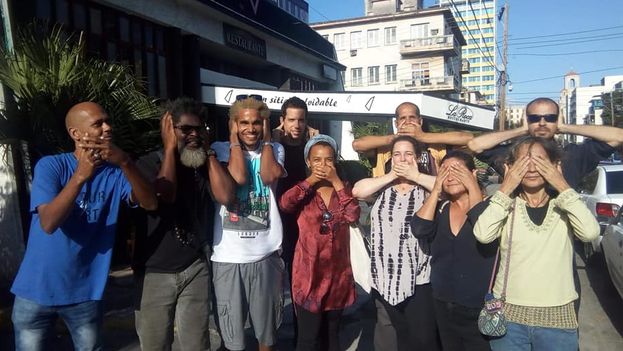
Group of artists who promote the campaign against Decree 349. (Courtesy)

14ymedio bigger14ymedio, Luz Escobar, Havana, 5 December 2018 — On Wednesday, around eight-thirty in the evening, Yanelys Núñez and Luis Manuel Otero were released, according to what they told 14ymedio when they left the Vivac de Calabazar Detention Center after protesting Decree 349.

“First we were in the eleventh unit of the San Miguel de Padrón police station, there we spent Monday night and on Tuesday they took us to Vivac (the State Security detention center), and when we arrived they did not want to accept us because Luis was on-strike and they returned us to the unit but in the night they accepted us (at Vivac) and we stayed there until they let us go. During the interrogations they told us that if we protested again in front of the Ministry of Culture they would accuse us of illegal association and demonstrating without permission.”

Núñez explained that Luis Manuel Otero, after leaving prison after more than 48 hours on hunger and thirst strike, had taken a soda. continue reading

On the other hand, on the night of Tuesday, the artists Amaury Pacheco and the producer Michel Matos were released, according to Pacheco himself, speaking to14ymedio after being released

Both were detained in the midst of a repressive wave by State Security against a peaceful sit-in in front of the Ministry of Culture (Mincuult) headquarters as a part of the campaign against Decree 349. Pacheco explained that his hunger strike will be maintained “as long as any artist is in prison” and he will return this morning to the Ministry of Culture if Yanelys Núñez and Luis Manuel Otero are not released during the night.

Pacheco said that when he arrived at the Ministry of Culture on November 3, both he and Matos were detained and that they spent most of their time in the police unit of the municipality of Regla. “Michel was taken first to Guanabacoa but then they brought him to the same jail where I was in Regla, there they interrogated us and told me that if I went back to Mincult I would be imprisoned for one to three years,” he said.

This newspaper was also able to speak with artist Tania Bruguera after she was released on Tuesday night after her third arrest, including her first arrest at the beginning of the protest. “They held me from nine in the morning until nine at night but they did not take me to a unit, they left me inside the car until three thirty in the afternoon at La Puntilla and then they took me to a house that is beyond Lenin Park, by way of Calvario,” explained the artist.

She says that at every moment the agents told her they would take her home but when she expressed her desire to return to the Ministry of Culture, that proposal was postponed until finally at nine o’clock in the evening they left her at the door of her house. During the detention in the house where the artist was taken, they offered her water and food, even though she had told her captors that she was on a hunger and thirst strike.

“They took me to a room with a table covered with food, I told them I was not going to eat, then they gave me a cold water bottle but I told him to keep it and later they also offered me ice cream but I also refused,” says the renowned artist.

“You know how I react when someone is imprisoned because it happened in 2014, I will talk with no problems when no one is being held prisoner,” Bruguera told the agent.

The musician Sandor Pérez Pita, from the reggae group Estudiantes sin Semilla (Students without Seed), was also released in the afternoon.

The artist Amaury Pacheco had affirmed that he maintained his hunger and thirst strike until they released the rest of the artists and that “the fight against Decree 349 continues.” In a video posted on his social networks he said this entire battle is being fought “for art, for freedom of expression.”

In conversation with 14ymedio, Tania Bruguera said that the intention was to return on Thursday to the Ministry of Culture to demand again the release of Yanelys Núñez Leyva and Luis Manuel Otero Alcántara to establish a dialogue with the institution and to ask for a response.

Artists from several countries have mobilized since Tuesday in favor of the release of the group of artists who oppose Decree 349. The director of the Tate Modern gallery in London, Frances Morris, expressed on Twitter that these arrests clearly illustrate the threats many artists around the world are facing.

Also this Wednesday afternoon a public session was held in the Turbine Hall to say “No to Decree 349” and provide support to detainees through an open microphone to those who wish to participate.

The Bureau of Human Rights, Democracy and Labor of the US State Department wrote on its Twitter account that “the Government of Cuba continues to criminalize freedom of expression while besieging artists and journalists to discourage protests against Decree 349.”

Meanwhile, Silvio Rodríguez wrote a comment on the blog Segunda Cita that “Decree 349 may have very good intentions but I’m sure it would be better if it were discussed with the artists.” He added that “it was something cooked up among the few” and that in his opinion “a disposition of this scopes must have a more democratic origin, and a purpose.”

“Perhaps there should be a moratorium on the decree, until an acceptable modification is discussed and resolved, and I do not know whether I will be able to work abroad as I have been doing, starting next year. I began to work on my own in the face of the very inefficient state contracting and coordination mechanisms,” the troubadour wrote.

Deborah Bruguera, Tania’s sister, wrote: “While on the phone with Tania Bruguera, Lt. Col. Kenia took her in a car, right at the corner of the MINCULT.” The artist sent a public statement “of the artists who have called for the sit-in at the Ministry of Culture of Cuba,” that her sister shared on social networks.

We reproduce the text in its entirety:

We have decided to make a call to sit peacefully and respectfully to camp, meditate, read poetry, dance, paint or perform any artistic activity in front of the Ministry of Culture because:

1: The artists of all the demonstrations, have carried them out in an organized way and through institutional channels to request the repeal of Decree 349 and its subsequent drafting with the assistance of the artists.

2: Even though these groups have met with leaders of the Ministry of Culture, the promises that they have made to respond have not been met and, failing that, a technical article was published in the Granma newspaper on November 30, justifying the validity of the current Decree 349, along with a bombardment on national television of programs with explanations in favor of 349 in its current format. This seems indicative to us that Decree 349 will not be repealed because this seems to be an action with the purpose of setting the population against our demands.

3: [The government] has commented that regulations and corrective rules will be made for the implementation of Decree 349. This seems insufficient because, given that the Decree has serious errors of representation and puts artists in a state of vulnerability, by criminalizing them and their works, we do not believe that it is appropriate to proceed with how to implement the Decree, if not the Decree itself.

4: December 7th is approaching, the date on which Decree Law 349 will become effective. We are asking for a meeting open to all with the Minister of Culture to inform us what has been the result of the meetings held with the artists and what will happen with Decree 349.

We want to receive from the Ministry of Culture the same respect towards us that we have had towards them. We will continue presenting ourselves to the Ministry of Culture to ask for our right to a response and open meeting with all the artists.

____________________

The 14ymedio team is committed to serious journalism that reflects the reality of deep Cuba. Thank you for joining us on this long road. We invite you to continue supporting us, but this time by becoming a member of 14ymedio. Together we can continue to transform journalism in Cuba.

Two Deadly Sins / Fernando Damaso

Fernando Dámaso, 28 December 2018 — In democratic systems, Constitutions are drafted by a Constituent Assembly, formed by the most prepared representatives on the subject,from the different political parties that participate in their elections, whose number depends on the votes obtained according to the projects presented. The election, as is to be expected, is made by citizens according to their political, economic and social criteria.

In the current constitutional reform project in Cuba, the preparation was in the hands of a 33-member Commission, chaired by the First Secretary of the Communist Party of Cuba and made up of members of the pParty and of different State institutions, all committed to the socialist project and its implications, without any type of citizen participation in the choice of it.

This is the first deadly sin. continue reading

To try to present an impression of citizen participation, it was decided to submit the project, once approved in the first instance by the National Assembly of People’s Power, where the vote on everything is always unanimous, to the citizen consideration, through Assemblies, where everyone could give their personal opinion and this should be recorded in the corresponding minutes, but without submitting the proposal to a vote among the participants.

The trick is easy to detect: no matter how many citizens might agree or disagree with it, only one proposal was recorded since, once an opinion had been expressed, the repetition of it was not accepted.

This is the second deadly sin.

If the proposals had been put to vote and the number of votes for and against registered, a real indicator of the citizen opinion would have been obtained and not the figures of squalid percentages, made known by Señor Homero Acosta, in the session of the National Assembly where it was approved, also by the unanimous vote of the members.

This same gentleman pointed out that “This is the Constitution of the Revolution,” and he is absolutely right: it is the political testament of a phenomenon in extinction. Furthermore, it is not the Constitution of all Cubans, but that of the Communist Party, whose selective militancy does not exceed 0.7 percent of the eleven million Cubans living on the island and the almost three million Cubans residing abroad.

Although I do not question or stigmatize, as some representatives of the regime are already doing, the vote of every Cuban in the next referendum, on seeing violated many of the political, economic and social rights of citizens, with impositions and arbitrariness, my civic duty is to vote “NO.”

Is Fraud Possible in the February 24 Referendum?

The suspicion of a possible fraud has a demobilizing effect among the promoters of “No” in the Constitution referendum. (EFE)

14ymedio bigger14ymedio, Reinaldo Escobar, Havana, January 2, 2018 — The possibility that some type of fraud could be committed to distort the results of the constitutional referendum, which will take place on February 24 in Cuba, is one of the most frequent worries in conversations among activists.

The suspicion of a possible fraud has a demobilizing effect among the promoters of “No.” The most effective antidotes to cancel out this paralyzing pessimism are: assume that possibility as a reasonable risk or trust that fraud will not be committed.

The most effective vaccine to keep this threat from dissuading voters from visiting the ballot box to vote “No” is arriving to the understanding that little is risked and much can be gained. continue reading

After all, what is being risked (in addition to wasting a few minutes in vain at the ballot box) is that the Government is able to show the massive participation of citizens as a great success and that the “No” vote remains defeated in face of the crushing majority of the “Yes.” But those who propose abstaining, in order to not play into the hands of the feared fraud, should reason that it is much simpler to doctor the figure of participation than the number of negative votes.

Articles 116 and 117 of the current Electoral Law introduce an element that favors the lack of transparency in information of voting results. In both paragraphs the law obligates the members of the electoral tables, after finalizing the count, to place in the public view “a sample ballot” with the result of the vote count that exhibits how many votes each candidate received. The ballot does not have space for other information.

It is at least as striking that in a country where models and plans proliferate for any procedure, it has never occurred to anyone produce a document to dump all the information resulting from the suffrage. As a consequence of this “paper saving,” the data about how many voters attended each polling place and how many abstained did not remain in public view, nor did the number of canceled or blank ballots.

Only those voters who are present at the moment of the vote count in each polling place will be able to know those numbers. But after that process it is no longer possible to visit all of a municipality’s polling places with the intention of collecting data and being able to contrast it with the official information that is usually offered at the end of the process, broken down by municipalities and provinces. Those who do it will only find a ballot put up, probably on the door of the place, with the numbers obtained for either “Yes” or “No.”

The possibility of manipulating these data at the provincial or national level thus remains in the hands of a reduced group of people of the utmost trustworthiness to the Government.

In the electoral processes carried out for district representatives and members of the National Assembly, it’s unlikely that the result of the vote count will be the product of a fraud committed in the polling place.

The image of members of an electoral table shamelessly marking blank ballots, or changing what the will of voters reflects in the presence of witnesses, is difficult to believe. The massive complicity necessary to carry out an act of this nature in the almost 25,000 voting sites that could be authorized on February 24 requires a number of discreet and absolutely trustworthy persons that the Government does not currently have in its ranks.

The citizens who carry out the work at the election sites at a basic level can be docile, obedient, and absolutely convinced that socialism is what is best for the country; they can be “Fidelistas” and vehement admirers of the current president, but that doesn’t automatically make them into a multitude of inveterate cynics lacking ethics and decency.

That type of fraud does not seem to have occurred to date in the elections for representatives and assembly members, among other reasons, because it has not been necessary. For this something more sinister was invented: pre-fraud consisting of the intimidating nomination process which is carried out by a public show of hands for candidates for district representatives and the existence of the Candidacy Commissions that make up the list of names that will appear on the ballot for members of Parliament, with one name appearing for each open position.

When those tricks were not sufficient, then the activists of the neighborhood met to discredit “uncomfortable” candidates and, if persuasion was not enough, then the agents of State Security came out from their quarters to arrest the most dangerous.

The Government’s propagandists contrast these elections, guarded by young pioneers — that is elementary school children — with those from before 1959 which, they say, had to be guarded by armed men to prevent a party from assaulting a polling place with its supporters and stealing the ballot boxes.

If in the next referendum the results of the count are put up outside each polling place using one of the remaining ballots, the real number of absentees will never be able to be collected, nor will the blank or nullified sheets — it will only say how many votes for “Yes” and for “No.”

With a little perseverance and a minimum of organization, if the activists cover on foot or by bicycle the polling places of each municipality and leave graphic proof of public information, it will be very complicated for the Government to doctor the sum of votes obtained in each municipality. They would only be left with the ability to change the mathematics if they intended to distort the provincial and national data.

Is it perhaps impossible that fraud be committed? No, it is not impossible, but the risk that it would be discovered is enormous and it is unlikely that they dare to carry it out, even in the absence of independent observers.

It was they who created a mechanism of voting and counting practically armored, based on the popular belief that every civic act is useless and that they have it entirely under their control.

It’s enough for each nonconformist voter to have the minimum courage required to mark a vote for “No” in the intimacy of the voting cubicle. Obligating them to commit a shameless fraud would also be a victory.

Translated by: Sheilagh Carey

______________________

The 14ymedio team is committed to serious journalism that reflects the reality of deep Cuba. Thank you for joining us on this long road. We invite you to continue supporting us, but this time by becoming a member of 14ymedio. Together we can continue to transform journalism in Cuba.

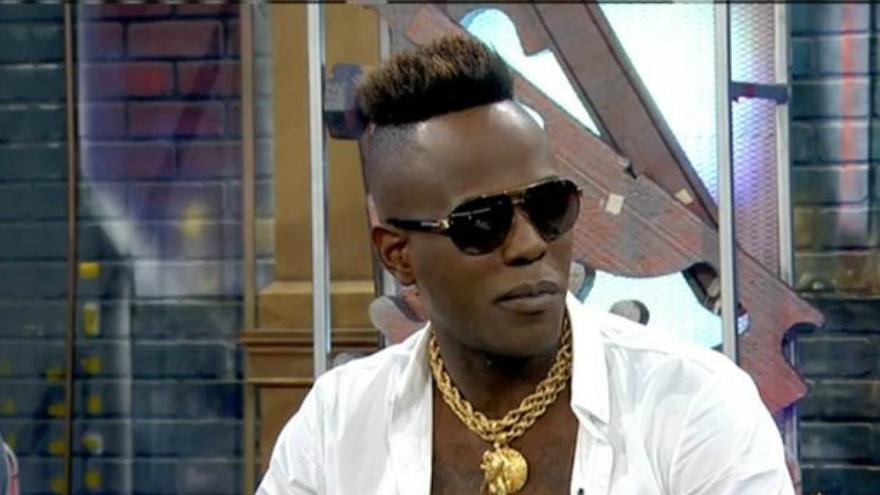
14ymedio Faces of 2018: Chocolate, The Most Heard and the Most Hated

Chocolate,  Cuban reguetonero.

14ymedio bigger14ymedio, Havana, 30 December 2018 — The songs of Yosvanis Sierra Hernández, better known as Chocolate MC, leave no one indifferent: either they hate him or they adore him. Among the Cuban people, the author of songs like Guachineo and Palón Divino has been this year’s most listened to performer, whether at family parties or playing in the shared taxis or urban buses as they travel the streets.

Born in the neighborhood of Los Sitios, in Centro Habana, from the age of 13 he had to “put his body in the street,” as he said in an interview, to support his mother and sister. Also known as the king of the barrio, the singer of the urban genre has managed to climb to number one in alternative music despite not being broadcast on national radio or television.

One of Chocolate’s most recent songs of is called Bajanda and has become a hymn among the youngest Cubans. The lyrics speak of cats, rats, mice and, with its catchy rhythm, it has sneaked into the slang of the street.

His latest song, released on November 30, is called El Corral and, like most of his releases, was produced through an audio with a fixed image on his YouTube channel.

In the transcript of a meeting of a group of artists with authorities of the Ministry of Culture in which they expressed their rejection of Decree 349, the name of Chocolate appeared 16 times as an example of a very successful singer despite not having a musical company to support him.

His figure has also been touched with scandals. In 2017, in Miami, he spent several days in prison after an indictment by his partner for domestic violence and was released on bail after paying bond of 170,000 dollars.

He took up residence in Miami last year and has offered several concerts in the United States. Since then he has not returned to the Island.

See also: 14ymedio Faces of 2018

__________________________

The 14ymedio team is committed to serious journalism that reflects the reality of deep Cuba. Thank you for joining us on this long road. We invite you to continue supporting us, but this time by becoming a member of 14ymedio. Together we can continue to transform journalism in Cuba.

Brazil Freezes Export Insurance to Cuba due to Default

Brazil made million-dollar investments through BNDES to modernize the port of Mariel and to build the Mariel Special Development Zone (ZEDM). (14ymedio)

14ymedio bigger14ymedio, Havana, 28 December 2018 — The Brazilian government froze providing credit insurance to new exports to Cuba due to default, after taking the same steps in connection with Mozambique and Venezuela, as published by the Brazilian newspaper Folha de São Paulo.

The National Bank of Social and Economic Development (BNDES, by its Spanish acronym) has financed nearly $880 million worth of exports from 33 Brazilian companies to Cuba since 1998. The balance due by Havana is $597 million.

The current dispute concerns the arrears incurred by the Island on a $17.4 million payment of its debt in installments past due in June, July and August. continue reading

Out of the $10 million which Cuba should have paid by the June deadline, it barely paid $4 million. To cover the remaining balance, the Treasury must spend an amount equal to $6 million within the next few days to repay BNDES, which is insured by the Export Guarantee Fund (FGE, by its Spanish acronym).

According to Folha de São Paulo, Brazil will spend nearly 387 million in 2019 to cover the defaults by Cuba, Venezuela and Mozambique, and there will still remain a shortage of funds to provide insurance to new export credit operations.

Therefore, Cofig (Committee on Financing and Export Guarantees) decided not to provide insurance for new operations until budgetary coverage is assured by the forecasts to cover an eventual default.

“Historically, the dynamics of budget forecasting does not contemplate a budget for new insurance operations,” stated the Treasury.

“When the budget available for the financial year is lower than the expenditures forecast for the period, new operations are not approved for safety reasons.”

The cancellation will affect medium and small-sized companies, as large-sized companies have a larger negotiating margin and contracts with more extended periods of time.

________________________

The 14ymedio team is committed to serious journalism that reflects the reality of deep Cuba. Thank you for joining us on this long road. We invite you to continue supporting us, but this time by becoming a member of 14ymedio. Together we can continue to transform journalism in Cuba.