
The Stain of the Torches

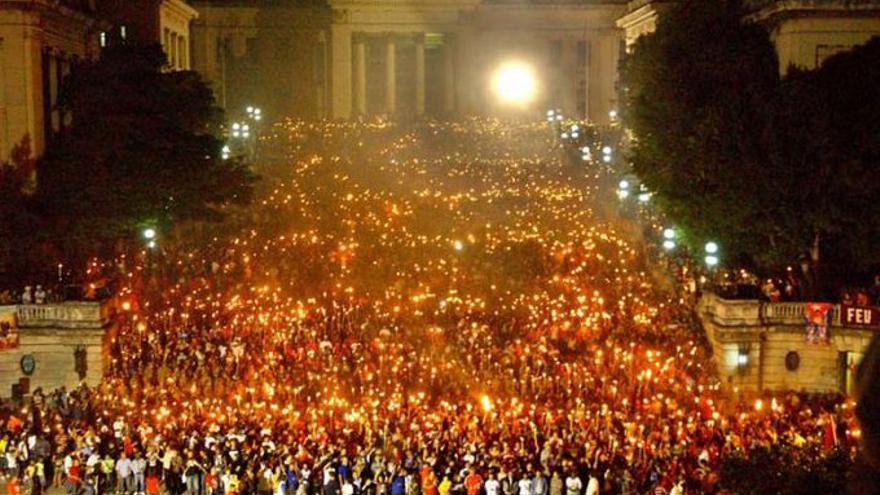
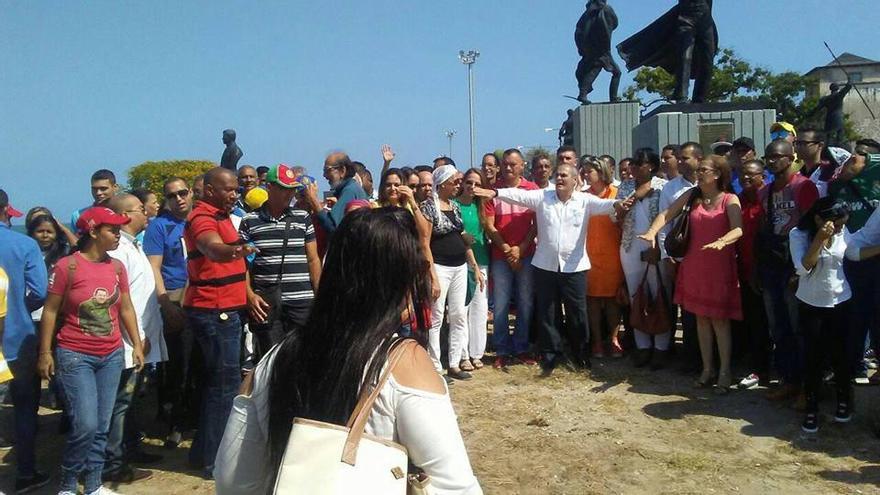
Official government march yesterday, for the birth of José Martí. (MiguelDiazCanelB)

14ymedio bigger14ymedio, Henry Constantin, Camagüey, 29 January 2019 — I did not believe it, I could not believe that they were capable of such selfishness. Our unelected government began its annual torch march in Havana, one day after the tornado had passed.

It is not a march to pick up debris, nor to bring help to people who lost their belongings in the tornado (although they tried to apologize by promising that they will do it, not today, but the next day); it is not a march of solidarity and compassion with the Cubans who today are sleeping in anguish: it is a march of insensitive politicking. And it is not for José Martí, don’t try to deceive us, he would never have prioritized his birthday nor the cult to himself or any deceased caudillo (Fidel Castro) over the tribulations of his people. continue reading

The march serves to remind us that in Cuba politicking is still the priority of the higher-up officials, to the point that they prefer to maintain an expensive parade (how many official vehicles are currently burning the people’s fuel? how many security agents needed to protect the well-known, how much electricity used so there is light and sound for the choreography?, how many press teams are active to cover a ritual that, in the end, doesn’t even touch the edge of the heart of almost anyone in Cuba?).

A few kilometers from the march there are dozens, hundreds of families having a terrible time, without electricity, with injured relatives or destroyed property, surrounded by debris and shortages, and half of those with torches and the wasted resources would have helped them quite a bit. If not to recover their lost belongings, at least to have faith yes, which is the essential thing that people need to make it to the next day.

I admit that yesterday I had to keep quiet. Diaz-Canel immediately appeared in the affected areas, I do not know if it was heartfelt or because it is stipulated by his job responsibilities, God knows. But the image of a leader in pain seeing the suffering of his people did not last long.

Now he is posing among the scenes of the march, by obedience or insensibility, or maybe both; the unelected president with his also unelected boss, and the two freshly-bathed, recently having dined, with their unaffected homes, their happy families and their quiet smiles, because they lost nothing. It is true that, in the end, they do not owe anything to those people the tornado affected: none voted for them for president or anything else.

Let’s see if the people who are suffering find out about it, that Cubans are not worth much to those who are on top — and if they are worth it, it is not when they are in trouble, but when they march obediently — and hopefully they will make it clear in the circus-like referendum of February 24, with anything but the false Yes vote that many plan to mark on the ballot with the same inertia with which they marched today [on Monday] for Martí and the other one (Fidel), then go marching the following day for a visa or to cross a frontier.

If the tornado does not make those still in charge prioritize Cubans in their agenda, at least it will help us to give back to them the lack of importance they give us. Because at the end of a day of pain in so many Cuban homes, what the authorities have done in Havana is not a march. It’s a stain, and one that is not easy to erase.

Translated by Wilfredo Díaz Echevarria

___________________________

Note from 14ymedio: This text was originally published in La Hora de Cuba. We reproduce it here with the permission of the author.

The 14ymedio team is committed to serious journalism that reflects the reality of deep Cuba. Thank you for joining us on this long road. We invite you to continue supporting us, but this time by becoming a member of 14ymedio. Together we can continue to transform journalism in Cuba.
The European Parliament will Recognize Guaido as President of Venezuela this Thursday

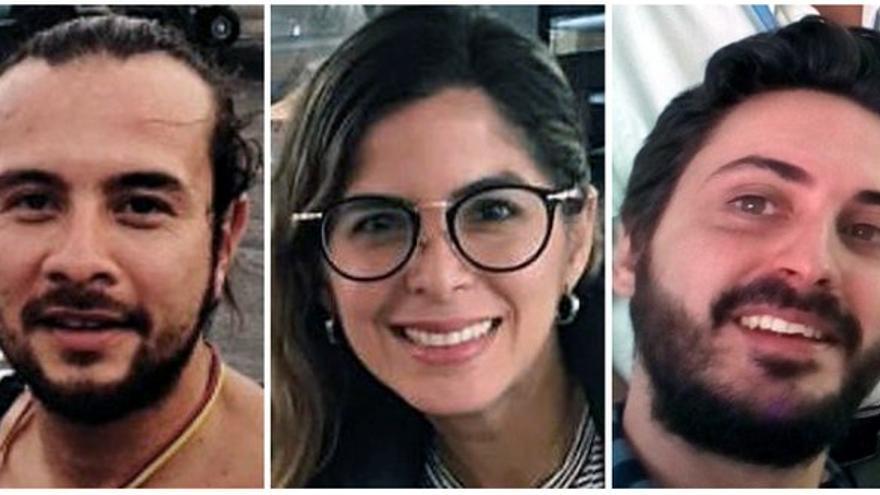
Mauren Barriga and Leonardo Muñoz, and the Spaniard Gonzalo Domínguez, detained in Caracas. (EFE)

14ymedio bigger14ymedio / EFE, Brussels / Caracas | January 31, 2019 – The European Parliament will vote this Thursday on a resolution recognizing Juan Guaidó as president of Venezuela after noting that Maduro “has publicly rejected the possibility of holding new presidential elections” following the European Union’s (EU) request.

Sources from the popular and socialist parties in the European Parliament, the two major parties, confirmed to EFE that they will vote in favor of this resolution, thus giving it sufficient support to pass among the parliamentarians.

“The European Parliament recognizes Juan Guaidó as the legitimate interim president of the Bolivarian Republic of Venezuela according to the Constitution of Venezuela (…) and expresses its absolute support for his road map,” the Parliament said in a resolution that will be voted on Thursday to which EFE obtained access today. continue reading

The resolution drawn up is also enjoined by the parties of conservatives and reformers (ECR) and the liberal group (ALDE), although liberal sources suggest that some members of parliament from this group may not join.

The text also urges the head of European diplomacy, Federica Mogherini, and the EU member states to recognize Guaidó “until new and free, transparent and credible presidential elections can be held to restore democracy.”

The resolution condemns the violence and repression in Venezuela and rejects “any proposal or attempt that may involve the use of violence to resolve the crisis.”

Likewise, it also reiterates that the National Assembly is “the only legitimate democratic organism in Venezuela” and stresses that its powers “must be restored and respected,” including “the safety of its members.”

The resolution urges Mogherini to “contact the countries of the region and other key actors to create a contact group that can mediate to reach agreement to request presidential elections based on an agreed timetable, equal conditions for all actors, transparency and international observers

Meanwhile, in Venezuela, an EFE team of reporters has disappeared in Caracas after being arrested by the authorities ant, according to the president of the agency, Fernando Garea, find themselves the offices of Sebin (Venezuelan intelligence services). It concerns Colombian photographer Leonardo Muñoz, the Spanish Gonzalo Domínguez Loeda and the Colombian Maurén Barriga Vargas.

The three are part of a team that traveled from Bogotá, Colombia to cover the crisis in Venezuela.

According to EFE journalists in Caracas, members of the Bolivarian National Intelligence Service (Sebin) came tonight to the Agency’s offices, where they arrested Barriga and Dominguez and said that Muñoz had been detained by the Military Counterintelligence Directorate (DGCIM by it spanish acronym).

The Sebin agents ordered Dominguez and Barriga to accompany them to the hotel where they were staying in the Venezuelan capital in order to, according to the agents, collect their belongings, and took them away under arrest for questioning.

The director of EFE in Caracas, Nélida Fernández, along with a lawyer followed Domínguez and Barriga to the Sebin offices to try to clear up the situation with the Venezuelan authorities and obtain their release as soon as possible.

The EFE team traveled to Caracas on January 17 to help cover the Venezuelan crisis and upon arrival at the Maiquetía airport they identified themselves as journalists, upon which the intelligence, immigration and customs authorities allowed them to enter without restrictions after subjecting them to several security background checks of nearly three hours.

However, when photographer Muñoz was heading this morning to cover demonstrations against the Nicolás Maduro regime in the Caracas neighborhood of Petare, contact was lost with him and the driver who accompanied him, the Venezuelan José Salas.

For that reason, the Government of Colombia requested on Wednesday the “immediate release” of Leonardo Muñoz, whose whereabouts until recently were unknown.

The “Government of Colombia rejects the arrest in Venezuela of the Colombian national Leonardo Muñoz, photographer of the EFE Agency and demands his immediate release. We demand respect for the life of our countryman,” said Colombian Foreign Minister Carlos Holmes Trujillo on Twitter.

When they traveled to Caracas, the three EFE journalists had plane tickets to return to Bogotá on February 7.

Fernando Garea, in an interview with Spanish Television, has expressed concern that the time difference resulted in no news in the last hours about the situation concerning the reporters and has assured that the intention of the Venezuelan regime is to prevent witnesses from seeing what is happening

Translated by Wilfredo Díaz Echevarria

_______________________

The 14ymedio team is committed to serious journalism that reflects the reality of deep Cuba. Thank you for joining us on this long road. We invite you to continue supporting us, but this time by becoming a member of 14ymedio. Together we can continue to transform journalism in Cuba.
Guaido’s Envoy in the United States Rejects Maduro’s Dialogue Offer

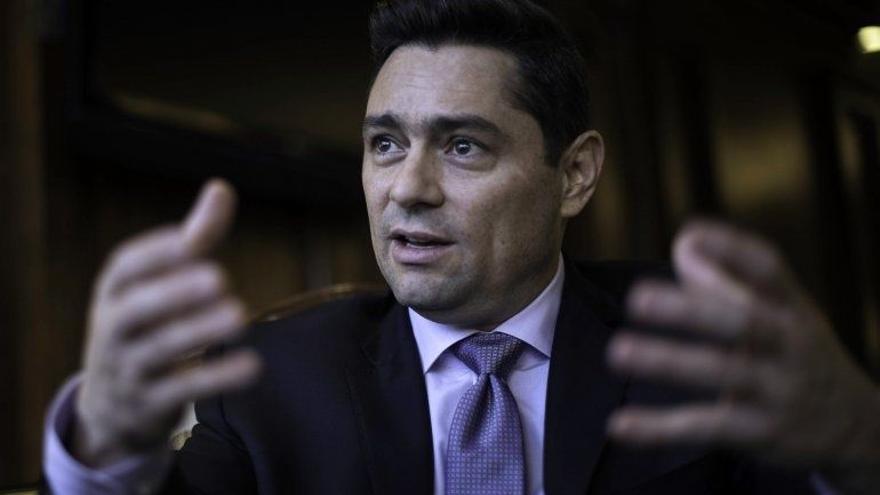
Carlos Alfredo Vecchio maintains that previous attempts to negotiate with Maduro have been futile. (EFE)

14ymedio bigger14ymedio / EFE, Caracas, Washington, Brussels | January 30, 2019 – Carlos Vecchio, Juan Guaidó’s highest representative in the United States, rejected on Wednesday the offer of dialogue by the president of that country, Nicolás Maduro, considering that he seeks to “manipulate” the international community and gain “space” to continue “repressing.”

“His dialogue always seeks to manipulate, deceive, seek space, stop the political momentum and then repress. We do not agree with a dialogue that is made to deceive,” Vecchio said during a debate on Venezuela at the Atlantic Council think-tank in Washington. continue reading

Vecchio said the opposition is not “willing” to participate in the dialogue on the “terms” of the Chavista authorities and that “the only thing” they are willing to discuss is the “agenda” of Guaidó to achieve the “exit” from power of Maduro, occupant of the president’s office of Venezuela since 2013.

As justification for his response, Vecchio referred to the failure of previous attempts at dialogue, including the one that took place in 2014, after days of violent protests, and the one initiated in 2017 in the Dominican Republic with the participation, among others, of the former president of the Spanish Government José Luis Rodríguez Zapatero.

“We are not performing an abstract analysis (…) one cannot be manipulated again by the dictatorship,” said Vecchio.

This was the initial response of the Venezuelan opposition to the offer of dialogue made by Maduro today in an interview with the Russian agency RIA Nóvosti.

Russia is prepared to participate in “international formats” of mediation to try to resolve the current situation in Venezuela, said Foreign Minister Sergey Lavrov.

“We are ready to participate in international efforts (mediation) in those formats that are acceptable to the Venezuelan parties”, the head of Russian diplomacy told a joint press conference with his Iraqi counterpart, Mohamed Ali al Hakim.

Maduro said he was willing to sit down with the opposition to dialogue with an open agenda about “peace and the future” of Venezuela; and also opened the door to dialogue with US President Donald Trump, in “private, in public, in the United States, in Venezuela or wherever he wants, with an open agenda.”

But the president of the United States, Donald Trump, is far from considering any proposal of this type and this Wednesday reiterated, via telephone call, his “full support” for Guaidó, the parliamentary leader explained in a message on Twitter.

“I appreciate the call of the president of the United States, Donald Trump, who reiterated full support for our democratic work, commitment to humanitarian aid and the recognition of his administration of our presidency (in charge),” Guaidó wrote on his Twitter account.

US President Donald Trump had boasted shortly before that Nicolás Maduro was “willing to negotiate” with the opposition thanks to “US sanctions” on oil revenues. The leader recommended that US citizens not travel to Venezuela “until further notice”.

“Maduro is willing to negotiate with the opposition in Venezuela after US sanctions and the reduction in oil revenues,” Trump wrote in his Twitter account about the measures taken by Washington on Monday against Venezuelan state oil company PDVSA.

On the verge of a demonstration today called by the opposition, a new diplomatic front has been opened to Chavismo by the president of Chile, Sebastián Piñera, who demanded Wednesday the “immediate release” of two journalists from the National Television of Chile (TVN) who were arrested on Tuesday night in Caracas. “Our Foreign Ministry is taking all the necessary steps. Freedom of the press is another of the victims in Venezuela. The peaceful solution is free and democratic elections, now,” Piñera signaled in his Twitter account.

According to TVN, journalist Rodrigo Pérez and cameraman Gonzalo Barahona were detained in the vicinity of the Miraflores presidential palace, headquarters of the Venezuelan Executive.

The National Syndicate of Press Workers (SNTP by its spanish acronym) of Venezuela denounced that, along with the Chileans, Venezuelan journalists Maiker Yriarte and Ana Rodríguez of the VPI online channel were also arrested, although these two were freed Wednesday morning.

It is believed that the journalists were covering  the vigil in defense of ruler Nicolás Maduro convened by the United Socialist Party of Venezuela (PSUV by its spanish acronym) last week.

Chilean chancellor Roberto Ampuero said that Roberto Araos, charge d’affaires at the Chilean embassy in Caracas and head of the diplomatic mission in Venezuela, has been working all night to obtain the release of the press team.

Ampuero said on his Twitter account that he expects an “early release” of the detainees and added that the situation should be clarified “in the shortest possible time.”

Chile is one of the countries that has backed the president of the Venezuelan Parliament, Juan Guaidó, as the ruler in charge of Venezuela since his proclamation on January 23. On Tuesday, the government recognized Guarequena Gutiérrez, the diplomatic representative appointed by Guaidó in Chile, and welcomed him.

In Europe, where several leaders headed by the Spanish Prime Minister asked Maduro for elections within eight days, one of its main institutions, the European Parliament (Legislative) has recognized Guaidó as “sole interlocutor”, according to President Antonio Tajani

“I have spoken on the phone with President Guaidó, our only interlocutor, to assure him of the support of the European Parliament,” Tajani said at the start of the plenary session of the European Parliament held this week in Brussels. The institution cannot remain “silent”  before the latest developments in the Latin American country, said the Italian politician.

Translated by Wilfredo Díaz Echevarria

______________________

The 14ymedio team is committed to serious journalism that reflects the reality of deep Cuba. Thank you for joining us on this long road. We invite you to continue supporting us, but this time by becoming a member of 14ymedio. Together we can continue to transform journalism in Cuba.

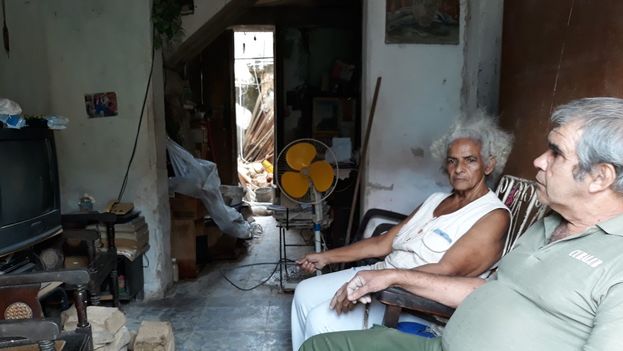
"When We Left We Had No Ceiling in the Living Room, and No Walls"

Neighbors desperately wonder how they will resolve things from now on, after the destruction caused by the tornado. (14ymedio)

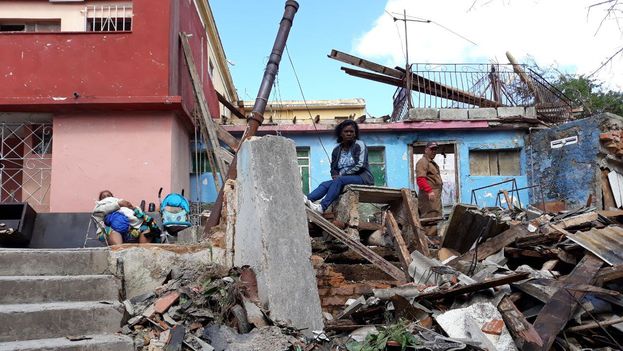
14ymedio bigger14ymedio, Luz Escobar, Havana, 29 January 2019 – The sun invades every last corner of the houses after the tornado took everything: ceilings, walls, electric poles, street lamps, warehouses, pharmacies, schools, markets …

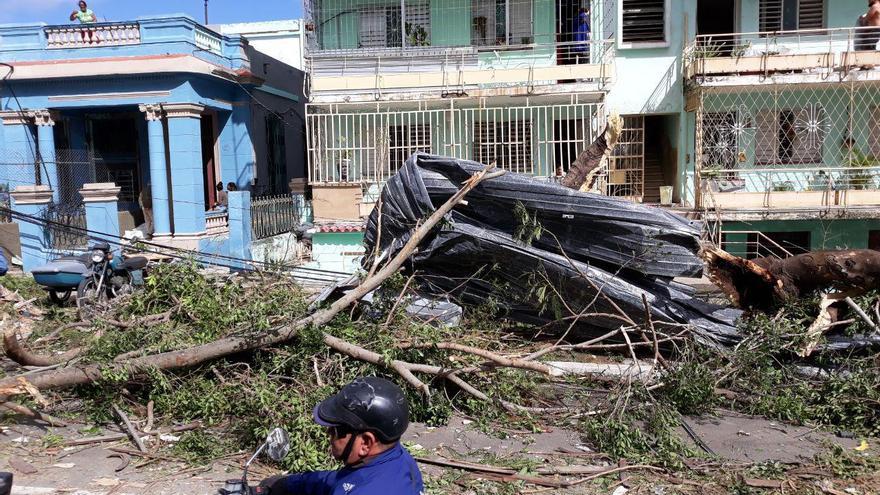
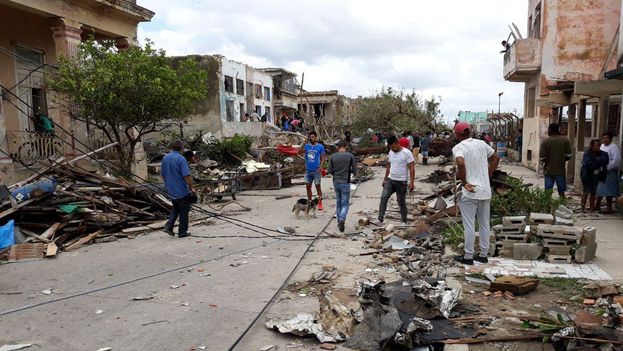
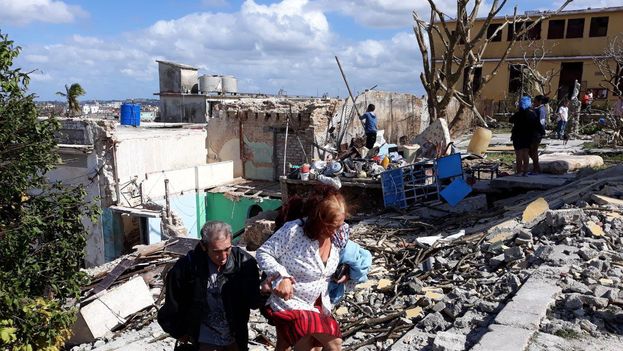
Entering from Luyanó Road and turning into Teresa Blanco one arrives at a disaster area. The street full of debris, water tanks, pieces of zinc covers, trees, a television, a record player, a car with a tree trunk on top, another further up overturned with the wheels facing the sky. But the tires are gone. continue reading

Rubble is thrown down from roofs and the neighbors try to delineate a safe area on the sidewalk and give a warning every time they toss down a rock. Lucinda was leaving through the front door at the same time that her neighbor was tossing a rock the size of a soccer ball off the roof. She was saved from injury by mere seconds.

The man stopped short just as he raised the stone over his head to throw it when he saw Lucinda taking short hops from her doorway to the street and heard all the neighbors scream:! Luciiiiiiiiinda!, who continued along oblivious to what might have occurred.

Entering from Luyanó Road and turning into Teresa Blanco one arrives at a disaster area. (14ymedio)

In the main streets there are policemen, ambulances, brigades from the phone company Etecsa, electricians raising utility poles, work crews cutting trees and collecting debris, but in the side streets of the affected areas of the 10 de Octubre (10th of October) municipality there was no such hustle and bustle.

Elaine sweeps the street because she does not know what else to do, she says that when she looks at her house she dies of sadness. “My father does not stop crying, he can’t get rid of the fright from last night. We were eating when everything started and, the moment we understood that the noise we heard was not from an airplane, he put us all in the bathroom. When we left we had no ceiling in the living room, and no walls,” she recalls.

The horror is evident in her facial expression. The sidewalk is full of rubble but she insists on removing the dust that falls ceaselessly from among the ruins that surround her with her broom. “We rescued the neighbor from under the wall that had fallen on top of him. After everything happened we heard a little voice saying: ’help, help’, and between my sister and I, together with other neighbors, we got him out. Luckily he did not have any injuries.”

People removed the debris from their homes in boxes one after another and threw them out on the sidewalk. (14ymedio)

Elaine takes off her handkerchief and places it back on, she puts her hands on her head and starts crying. “Now I just found out that my cousin’s husband is in a very serious condition in the hospital. He called my cell phone. He said that last night, when he was getting out of the car here on the road, a utility pole fell on his head. They already operated and everything, but he is not well”, she says while she cries relentlessly. She puts her hands on her head, she uses her handkerchief, puts it back, and continues sweeping.

From a hallway a young woman emerges holding her son by the hand, the mother carries a black bag full of clothes and the child a small basket full of plastic toys. “I’m going to my mother’s house, there’s nothing left here, I am not  picking up anything else,” the woman said as she walked down the street stopping every now and then to rest. At midday, a helicopter was flying over the area, but nobody paid attention to it.

“You’re a journalist? Come look, come in. Take a photo of my patio, my roof, everything was destroyed, this is the only part where one can stay,” and points to the ceiling. In the bodega (grocery store) on the corner nothing is left, the blue wood walls are bare. The gocer opens his arms and shows what was left of the store while opening his arms.

A school on Pedro Perna Street was left without a roof and without walls, only the bust of José Martí remained intact on one side of the courtyard. “This was Pedro Perna, now you can’t tell what it is”, responds a young man who took pictures and took notes in a notebook.

On Remedios Street, between San Luis and Delicias,  is the house of Bárbaro Ravelo Fernández.

“When the newscast was over, a very strange noise began to get louder. Luckily I was at my neighbor’s house and his daughter said: ’It must be the car that is parking.’But forget that, it was a very strange noise that grew louder. In seconds there was a roar and I went without thinking to close the window, but something threw me backwards. My neighbor had part of the ceiling fall on his arm and now it is injured and I have a blow to the head because part of the false ceiling fell on me.

“I stayed there with them, and that’s what saved me. It did not last very long, look I have seen tornadoes out in the country but never in the city. It had a very high pressure, it was very strong, in a few seconds it razed everything. My neighbor’s house is gone, mine too, Look how it smashed my television, and my record player. It busted everything, now we’ll see what happens here in order to resolve things,” he says pointing to a pile of rubble.

A mixture of solidarity and tension floats in the air. Suddenly, in one of the street corners, a group of people screams while looking at the roof of a house. It’s a quarrel between two men because the owner of the house almost killed his daughter when he was tossing debris from the roof.

They shove each other, they argue and punch while the people down below provoke them with shouts of: “hit him, punch him”. The youngest stand on the stricken cars out in the street, the elderly stand on tiptoes to look or climb up the neighboring houses.

The small houses near the church all lost their roofs, the neighbors are outside, young people playing music with their portable speakers, mothers with children in their arms, parents looking for bread and water for their children. “The church lost its cross,” one child tells another as they play ball on the esplanade in front of the church of San Juan. “Yes, look, and the horses came out to eat,” replies the other child, pointing with his finger at the grazing animals.

On the 10 de Octubre road, the destruction was also enormous. There were crews that erected utility posts, but the danger was still present on each block. The poles that remained standing swayed and sometimes seemed ready to fall. The neighbors removed the rubbish in boxes from their houses and threw them on the sidewalk, where tree limbs and broken objects were piled up.

On Monday, none of them went to work or school. No bus passed either on Luyanó road, or on 10 de Octubre. Getting in and out of there was only possible by walking.

Translated by Wilfredo Díaz Echevarria

________________________

The 14ymedio team is committed to serious journalism that reflects the reality of deep Cuba. Thank you for joining us on this long road. We invite you to continue supporting us, but this time by becoming a member of 14ymedio. Together we can continue to transform journalism in Cuba.
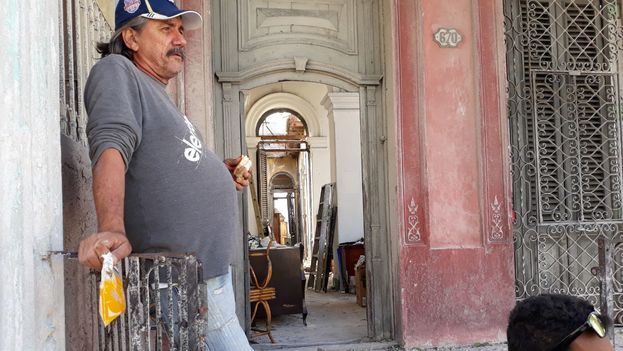
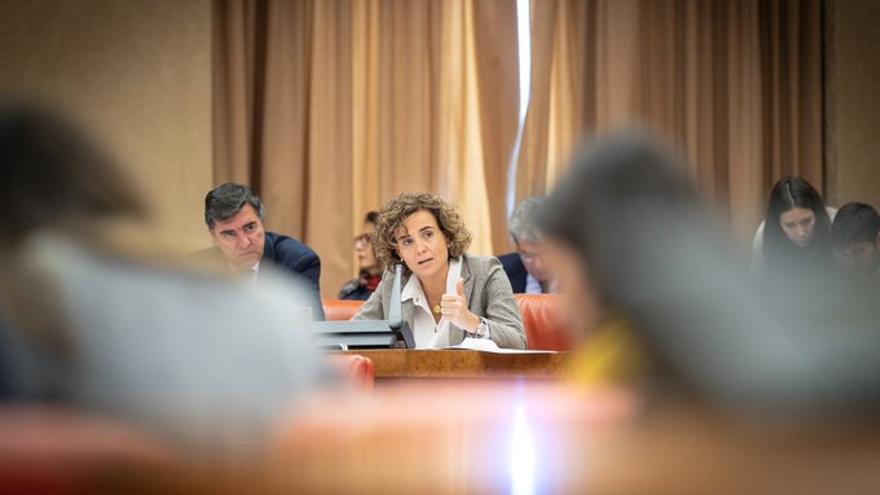
The Popular Party Asks Spain To Facilitate Political Asylum For Cuban Doctors

The spokeswoman of the Popular Party in Congress and ex-Minister of Health, Social Services, and Equality in Spain. (GPP)

14ymedio bigger14ymedio, 29 January 2019 — The representatives of Spain’s Popular Party (PP, opposition) this Tuesday presented a parliamentary initiative in which they requested explanations on “the possible evidence of modern slavery” in Cuban medical missions abroad.

In a non-legislative motion that will be debated in Congress, the PP invited the Cuban government to repeal the “impediment to enter the country” from the doctors who left the missions and asked the Spanish government to apply “measures of political asylum” for those professionals. continue reading

According to a source close to the new president of the Popular Party, Pablo Casado, “it’s a proposal that is part of the line taken by the leadership of the PP of keeping pressuring on the (socialist) Spanish government so that it doesn’t give in to Cuba even more and that it put human rights before commercial agreements.”

The initiative, which appeared signed by the spokeswoman Dolors Montserrat and the representative Carlos Rojas García, is based on another motion for a resolution presented in the United States Senate on January 10, 2019 affirming that the Cuban government’s medical missions abroad constitute human trafficking.

In the US Senate’s report are detailed several restrictive measures suffered by the Cubans serving abroad, among them restriction of movement, retention of passports, prohibition from having their families with them, and threat of imprisonment for abandoning the job or not returning to the island after completing it.

It also denounced that “the Cuban doctors received approximately 25% of the amount that was charged for their work in said agreements, with the government of Cuba retaining approximately 75% of the payment received for said work.”

The PP explained in its motion to the Spanish parliament that, after reading the resolution of the United States Senate, it considered “that all of the mentioned assertions, as well as the rest, are scrupulously truthful” and then included other elements that were produced by their own investigations that added arguments to the decision.

As a consequence, it proposes that the Congress of Representatives urge Spain’s government to demand that Cuban authorities explain “the denounced facts constituting human trafficking and modern slavery” and that it recommend the modification or elimination of a set of current legal instruments that violate internationally recognized labor rights.

The initiative of the conservative Parliamentary group proposes that, from confirming the facts or a significant part of them, the Spanish government “commit itself to considering the allowal of measures of political asylum and entry into the labor market (in Spain) to the Cuban doctors around the world who find themselves in this situation.”

The text recognizes that the work of these doctors “has been extraordinary and, without a doubt, has helped save thousands of lives. However, in recent years we have discovered that that tool of diplomacy, that supposed solidarity of the Cuban government, in reality was the front for a source of income that subjected Cuban professionals to subhuman situations.”

The proposal will be debated in the Spanish parliament in the course of the next few weeks. Non-legislative motions generally have a political character and seek to formulate proposals before the chamber that do not have the character of a law, but rather urge the Government to carry out some concrete action or express the feeling of the Congress regarding a particular subject.

Translated by: Sheilagh Carey

_________________________

The 14ymedio team is committed to serious journalism that reflects the reality of deep Cuba. Thank you for joining us on this long road. We invite you to continue supporting us, but this time by becoming a member of 14ymedio. Together we can continue to transform journalism in Cuba.
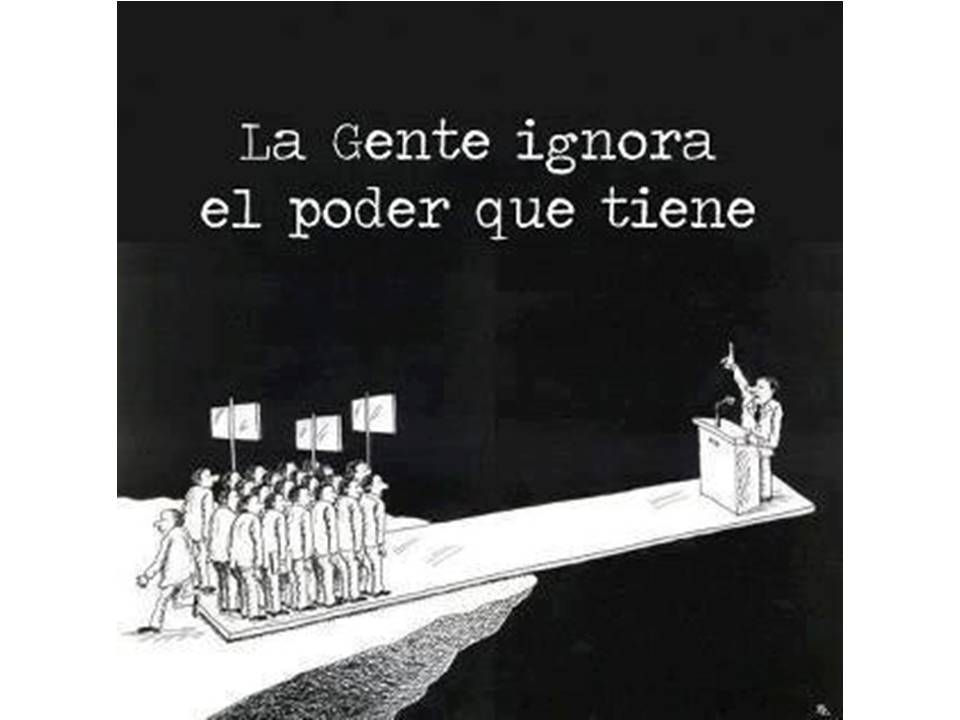
Reprogramming for Change / Somos+

People don’t know the power they have.

Somos+, from a special friend and collaborator from Germany.

A friend was telling me recently (commenting on the recent events in Venezuela and the consequences that this change could bring for Cuba) that “the Cuban people don’t have the necessary courage to rise up against the dictatorship.”

These two countries, although they have gone through many similar things and the dictators have practiced the same style of government, through repression and fear, have completely different contexts. In my opinion the Cuban people have plenty of courage, what’s lacking is the information to change all the concepts they have instilled in us since we were born. continue reading

Cuba has lived 60 years with the same rulers — that’s three generations — on whom they have changed the chip and they keep injecting one single idea, one single source of information.

Information that tells you: This idea is the best in the world, look how the other countries are, even though we are blockaded we have education and healthcare, if you go out to protest we will take you prisoner, because the only ones who don’t agree with this system are mercenaries, who are paid to destroy us, they are enemies.

The Cuban has always been in check and on the front line. Before it was necessary to prepare oneself for the defense of the country because the yankees would come, then they had to create an army of computer specialists to win the media war, now the danger is the mercenaries paid by the empire.

We cannot let them take away the little that we have gained, our achievements have to be defended, first by José Martí, then by Fidel, after it will be by Raul… All those concepts have stuck in the mind of the Cuban and it is difficult to debate on any subject without some repeated slogan coming out, stripped of common sense.

Information has to arrive right now to our families in Cuba, we have to reprogram the chip, because otherwise we will not manage to change our country.

Now let us imagine the scene of my aunt Josefa, who only has access to the news and novelas from el Paquete [the Weekly Packet]. This aunt of mine was born two months after the triumph of the Revolution, she saw how her father (my grandfather) went to the hills to teach the poor illiterate peasants how to read and write.

Josefa watched the many relatives who emigrated in the ’80s leave and not come back, because “they didn’t want to live in a just system, they were gusanos (worms).” That aunt who lost her husband in Angola, and was never given details of how her companion and father of her only son perished, but she know that “he was a hero because he went to free the African people.”

That aunt, a teacher by vocation, went to Venezuela to support the novel education plan “Yes I can,” leaving behind her only son and serving that government “that gives us everything: free healthcare, free education, a basic basket that resolves [the problem of food], a salary that isn’t enough but, how can you ask for more from a blockaded country?”

Now my aunt lives alone, at almost 60, with an emigrated son, who works honorably to support his new family and his mother in Cuba.

In one of my last visits to Cuba I was speaking with this aunt of how important would be the people’s call to change the government, in order to have a better life, for her and for young people, those who have to go abroad in search of their dreams.

Only questions existed in the head of my aunt, questions like: how to fight against something that is good, just, and positive? How to take initiative to demand my rights, if I already have them? More rights don’t exist, I don’t know about them. Let us remember that the world is an unjust and difficult place where the rich, those heartless people, are those who dictate how to live and take advantage of poor people like my aunt.

How to tell my aunt that nobody pays me to say what I think? How to explain to her that the United States doesn’t want to make war with Cuba? How to explain to her that the people of Cuba are neither more nor less capable than the people of the country where I live, where there are independent unions that fight for better salaries for the workers they represent? How to explain to my aunt that rulers are there to represent the interests of a people and not the other way around?

How can you explain so many things and reprogram an almost 60-year-old chip? Just so, explaining it, speaking without raising one’s voice, without insults, with respect for a life full of sacrifices and losses, a life without hopes and full of conformity, but a life, a life that is worth living until the end with dignity.

For my aunt Josefa, and for many thousands, millions of Cubans like my aunt, it’s worthwhile arming ourselves with patience and “teaching to read and write” once again, our people. It’s time to leave apathy behind and give our little grain of sand, not for Marti, not for Fidel, but for ourselves, for our personal freedom.

It’s not true that from outside Cuba we cannot do anything, we can do a lot. Cubans abroad, we have to be like my grandfather who went to the hills to give what he knew to those who didn’t have it, not only because it is just, or correct, but because we owe it to that entire generation that fought so hard for their children to be something in life, that generation who since the ’60s was indoctrinated in a utopian system that doesn’t work.

That generation used for so many marches, the one that was given a bait and switch and made to believe that they came out the winner. Let us do it for our grandparents who perhaps died without seeing that better world, for our parents who live with disappointments and without hopes. Let us do it for our children and for the generation to come, so that they feel proud of their parents like my aunt Josefa once felt proud of her father. Let us instruct our Cuba and return to it that courage and strength that they have had stored in their chips for 60 years already.

Translated by: Sheilagh Carey

Independent Cuban artists say NO to Decree 349 / Ivan Garcia

Photo: Iván García

Iván García, 7 December 2018 — Luis Manuel Otero, an independent artist, the day before his 31st birthday, walks hand in hand with his wife  Yanelys Núñez, an art historian, aged 29, along a dark narrow street going to an art gallery in an old cinema which showed porn movies in the Chinese district in Havana.

For about twenty minutes they look at the exhibition and talked to various artists. Then they return to Yanelys’ home at Monte and Ángeles. The couple live in a jerry-built Soviet style building, put up to alleviate the acute housing problem in the capital. continue reading

In their fourth floor apartment, Luis Manuel Otero and Yanelys Núñez get the Diario Las Americas newspaper. Their main interest is discussing the demo being planned by 50 independent artists starting on Monday December 3rd opposite the head office of the Ministry of Culture in Second Street between 11th and 13th, Vedado.

The living/dining room is furnished with a sofa, two armchairs and a metal table. Up against the wall, is a bookcase which could collapse at any moment from the weight of all its books and documents. In a wooden multipurpose piece of furniture there is an old Chinese cathode ray tube tv.

At the side of the sofa is a little table with candles, photos and a glass of water with a metal cross. On the floor, a couple of bottles of moonshine. It is Yanelys’ mother’s altar. In Cuba, the Afro-Cuban religion protects people who are in danger or in need of good luck.

And the group of independent artists who are defying the government of President designate Miguel Díaz-Canel are going to need to have a lot of luck.

Forty-eight hours before the protest starts, Luis Manuel and Yanelys look calm, thinking about the procession. They don’t know what will happen Monday. Amaury Pacheco, Iris Ruiz, Michel Matos and Raz Sandino get together with Luis Manuel and Yanelys to analyse different possibilities.

“These people (the State Security) are unpredictable. They will lock us up, like El Sexto (graffiti artist), or keep us in the Vivac (prison in South Havana) until after the 7th. Anything can happen. They will obviously detain us. But we have no choice. If we accept Decree 349 we are signing our death warrant as artists. This legal monster is a bullet straight to my head. So, we are going to fight. I am a hero” indicates Amaury Pacheco, the oldest of the group and father of six children.

Decree 349 tried to tiptoe by. The same day that the autocrat Raúl Castro  anointed his successor,  Díaz-Canel’s first act as leader was to sign the retrograde law, which without any doubt threatens the autonomy of the artistic and intellectual sector in Cuba.

“Although it was signed on April 20th, it appeared in the Official Gazette on July 10th. Most of us independent artists didn’t appreciate the small print of the regulation. We were alerted to it by a call from a journalist on Radio Martí . When Luis Manuel was able to calmly read the decree, he understood that its intention was to eliminate artistic freedom. So we decided to organise a campaign against it using all the tools at our disposal, from social media to the independent overseas press on the island”, explains Yanelys, and adds:

“We always try to act within the law and act in a peaceful manner. On August 1st and 2nd we organised a public debate in the MAPI gallery (Museum of Politically Uncomfortable Art) where nearly 100 people turned up. Before that, on June 26th, we delivered a letter to the Sainz Brothers Association, the Ministry of Culture, UNEAC, and the Plastic Arts Council, denouncing the danger posed to artistic freedom by that decree. As we had no response from the official agencies, we decided to set off on the road of civil protest”.

On July 21st, opposite the Capitolio in Havana, by way of protest, Yanelys smeared her body with faeces. Various artists, including Luis Manuel Otero and Amaury Pacheco, were detained by the police.

This independent group, brought into being by Decree 349, is a caleidoscope of intellectuals, playwrights, theatrical artists, producers, writers, art critics, photographers, musicians and plastic artists, among others.

Yanelis emphasised that there were other usually less anti-establishment groups of artists in Cuba who had, in one way or another, joined in the condemnation of Decree 349. “José Ángel Toirac, National Plastic Arts Prizewinner, is one of the signatories to a letter condemning 349.

Most people in the cultural sector are against this regulation, because with this legal instrument the state can limit and censure any artistic work. Independent artists are pretty well put out of business. I have to point out that we have received the inestimable support of lawyers inside and outside the country, especially from Laritza Diversent, an exiled dissident Cuban lawyer in the United States”

If finally on December 7th they implement Decree 349, self-taught musicians of the calibre of Benny Moré, Compay Segundo and  Polo Montañez would not have a look in.

Luis Manuel Otero recognises the danger posed by the regulation: “All the world knows we live in a dictatorship. I”m not under any illusion. We are fighting a state which has all the resources it needs to shut us up. But our group is determined to confront these and other injustices”.

The special services are trying by whatever way possible to force free artists into obedience. Iris Ruiz comments that “MININT officials who run children’s services went to my office to get signatures from neighbours to take my children from me. Nobody signed. The Security also put pressure on other artists via their families. They are trying to demotivate and divide us”.

Amaury Pacheco says that “right now a rapper known in the arts world as Maikel el Osorbo is locked up, and they are trying to accuse him of a common crime. The kid had sewn up his mouth in protest against state abuse and Decree 349. We are not supermen. We just want to live and create a  free society”.

Cuban independent artists know that all sorts of things can happen in the coming days. Nothing positive. But fear also has its limit.

Translated by GH

Amid the Chaos in Venezuela, Cuba has No Plans to Evacuate Its Doctors

Cuban doctors during an event in the state of Carabobo, Venezuela. (Facebook)

14ymedio bigger14ymedio, Mario J. Pentón / Luz Escobar, Miami / Havana, 29 January 2019 — Kept quartered in some states and working in others, the thousands of doctors that the Cuban government maintains in Venezuela await the outcome of the conflict between the president-in-charge Juan Guaidó and ruler Nicolás Maduro, without evacuation plans.

“Since Guaidó assumed office as president, they told us that we should continue working as if nothing was happening. We are scared because nobody is guaranteeing our security and the situation is deteriorating rapidly,” says a Cuban professional, who, like the rest of her colleagues, is prohibited from speaking with the press. continue reading

Several doctors who spoke with this newspaper under condition of anonymity said they were afraid of finding themselves in the middle of a crossfire if tensions lead to a civil war. “The Venezuelan army is waiting for an invasion from the United States and the criminal gangs move with total freedom,” said a general medicine specialist in Tachira who was speaking by telephone.

“In the state of Bolívar, they looted a CDI [Comprehensive Diagnostic Center] and they took all the medical equipment.” In other offices, doctors have been forced to provide emergency services to criminals and motorizados* [Chavista paramilitaries], illustrated a third doctor .

In Caracas and some other cities the doctors were ordered to remain “quartered” while the the protests last in the country. The entire mission is strictly forbidden from going out on the streets after 4:00pm and thay have been asked to limit their contact with the opposition.

Cuba maintains a contingent of 21,700 health professionals in Venezuela which will be joined in the coming days by another 2,000 doctors that Havana had taken out of Brazil after the electoral victory of Jair Bolsonaro. In return, Venezuela subsidizes the oil it sends to the Island, which has been reduced to 30,000** barrels per day, according to Reuters, although other sources say it is 40,000. In addition to the doctors, Cuba has thousands of teachers, technicians, military advisers, electricians and construction workers in Venezuela.

The work of the doctors provides the Island with more than 10 billion dollars annually, according to official figures. Several countries have denounced this work as “slave labor”. The US Senate has asked the State Department to reactivate a special program to grant Parole (refugee status) to doctors fleeing missions while in Spain the Popular Party (opposition) urges the Socialist government of Pedro Sanchez to grant political asylum to Cuban doctor “deserters”.

On Friday, those responsible for the medical mission in Venezuela asked the coordinators to carry out “special mornings” to demand from the doctors “discipline and firmness” in the current situation, as was made known to this newspaper by three sources. In addition, courses of “reflection and debate” were held to discuss the situation in the country.

“They have kept some of the doctors quartered in the capital for fear of reprisals. Thus far they have not informed us of a plan to withdraw if Maduro leaves power,” said one doctor, who also recalled that Cuba had maintained all their staff in Venezuela even during “the coup against Chávez in 2002”.

The interim president of Venezuela, Juan Guaidó, said on Friday that Cubans “are welcome” in the country,” but demanded that they end their interference in “the armed forces and decision-making positions.”

On the island, relatives and friends of the Cuban professionals say they are worried because they have no information about what is happening in Venezuela.

“The only thing we know is what is seen in Telesur and what is said on Cuban television, that there is an attempted coup d’état and that the collaborators are doing fine,” said Joanna, daughter of a “collaborator”, via telephone from eastern Cuba.

Doctors in Venezuela also lack information about what is happening in the country.

“The internet is lousy, extremely slow, in the mission we are only allowed to view Telesur and the newscasts from Cuba. I have bought few things, in case we have to flee, but until now we have not been informed of any contingency plan” explains one of the doctors interviewed in the state of Carabobo.

Translator’s notes:
*”Moto” (from motor[cycle]) is a word for a motorbike or motorcycle; “motorizado” (“motorized”) is a reference to the paramilitaries who ride them.
**Down from a previous 100,000 barrels

Translated by Wilfredo Díaz Echevarria

_________________________

The 14ymedio team is committed to serious journalism that reflects the reality of deep Cuba. Thank you for joining us on this long road. We invite you to continue supporting us, but this time by becoming a member of 14ymedio. Together we can continue to transform journalism in Cuba.
Cuban State Sells Food to Tornado Victims

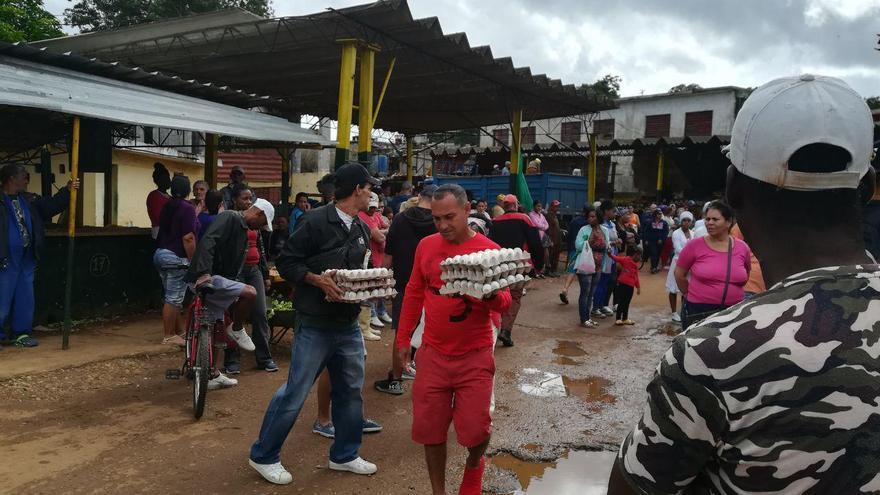
Several State stores sold eggs and cookies to the tornado victims this Monday. (14ymedio)

14ymedio bigger14ymedio, Marcelo Hernández, Havana, 29 January 2019 — After the devastation left by the tornado that hit several Havana municipalities on Sunday night, many of the affected families have nothing to eat and nowhere to cook their food. Without electricity, storing any food is an illusion and some have lost every last penny in cash, crushed, under the ruins of their homes.

In the midst of this scenario it was assumed, and it should be expected, that the State would immediately create the conditions to deliver cooked food to these people free of charge. Instead, the official stores arranged a special sale of eggs and cookies in State markets. The “special” does not refer to discounted prices, but to the very fact of selling products that have virtually disappeared from the stores. continue reading

Some people, who in the town of Regla stood in a long line to buy eggs, commented that they were seeing people there who were not from the neighborhood. “Surely they were told to resell them in Havana,” suspected a distressed resident who lost the roof of his home. “It would be the last straw,” replied a man who appeared to be a retiree.

Beyond suspicions of those who might have come from unaffected neighborhoods to buy a products missing from the shops for weeks, what most bothered Regla residents was the sale of food, not its free distribution. Those who still had some money ate that night, the others either appealed to a friend or slept with an empty belly.

 _____________________________

The 14ymedio team is committed to serious journalism that reflects the reality of deep Cuba. Thank you for joining us on this long road. We invite you to continue supporting us, but this time by becoming a member of 14ymedio. Together we can continue to transform journalism in Cuba.
Proposals to Get Help to Havana’s Tornado Victims

The State is responsible for taking measures and decisions that help donations and contributions become effective as soon as possible. (14ymedio)

14ymedio bigger14ymedio, Yoani Sanchez, Generation Y, 29 January 2019 — How to help? This is one of the first questions that arises when, Monday at dawn, we see the images of the destruction left by Sunday night’s tornado that affected several areas of Havana. The campaigns for the collection of resources and food have begun, there are neighbors lending a roof so a family that lost everything can sleep in safety, and citizens who look for the most suitable ways to offer this solidarity from within and outside of Cuba.

Now, the State is responsible for taking measures and decisions that help these donations and contributions become effective as soon as possible and benefit the greatest number of victims. Here are some proposals for the Plaza of the Revolution to facilitate the arrival of aid and speed the recovery:

  • The State must start distributing, as soon as possible and free of charge, food, water, blankets and flashlights for families who have lost everything and those who live in the most affected areas; not selling them, as it did this Monday in the neighborhoods most affected, such as Luyanó and Regla.
  • The General Customs Office of the Republic has to decree a moratorium on its strict regulations limiting imports for personal use, extend it to private businesses so that not only the affected families can receive aid in the form of food, clothing, medicines and construction materials, but also so that small home repair businesses can stock up on supplies.
  • Allow ‘natural persons’ to import vehicles of all types and sizes to replace those destroyed in order to provide a vehicle fleet to support reconstruction and mobility in the affected areas.
  • Eliminate the 10% tax on the dollar so that remittances received from abroad, especially from the United States, grant the benefitting families the maximum purchasing power.
  • Substantially reduce the prices of basic products such as oil, flour, milk and eggs throughout the domestic trade network, at least in Havana.
  • The Telecommunications Company of Cuba must offer, as soon as possible, a significant reduction in the price of calls abroad and within the Island, especially for its customers in the Cuban capital, to facilitate communications and interaction between those affected and their families.
  • This reduction should also extend to the 3G data connection service from mobile phones and wireless connections in wifi zones.
  • Suspend taxes for the self-employed (the private sector) in the damaged neighborhoods and approve loans on favorable terms for the reconstruction of their businesses.
  • Allow non-governmental organizations and international organizations to enter the country to assess the damages and help those most affected. Guarantee that the Catholic Church and other religious institutions can carry out, without obstacles or restrictions, their humanitarian work.
  • Allow a recovery campaign on the part of civil society, ordinary people, Cuban emigrants and international organizations, ending the government’s monopoly on solidarity and aid.

In the next few days we will be able to verify if the State’s priority is the recovery of the people or the exclusive control of the aid to play politics with the catastrophe.

_____________________________

The 14ymedio team is committed to serious journalism that reflects the reality of deep Cuba. Thank you for joining us on this long road. We invite you to continue supporting us, but this time by becoming a member of 14ymedio. Together we can continue to transform journalism in Cuba.
Rescuing Jose Marti from His Kidnappers

Part of the image from the cover of the book The One and Only José Martí: Principal Opponent of Fidel Castro.

14ymedio bigger14ymedio, Ariel Hidalgo, Miami, January 28, 2019 — Photographs of José Martí were never missing from the offices of any of the Cuban presidents. It didn’t matter if their actions contradicted the ideas of that great master who would have pronounced these words from the prophet Isaiah with respect to the Castro regime’s leaders: “This people honors me with their lips, but their hearts are far from me.”

They considered Martí “the intellectual author of the attack on the Moncada Barracks,” and although many of those who fought and died in that action felt truly committed to those ideals — The Centennial Generation, they called themselves — they were all betrayed when that leadership not only prolonged the wrongs against which they had fought by not restoring the Constitution or holding free elections. continue reading

It deepened with the installment of a military dictatorship with absolute powers and institutionalized the violations of fundamental rights and freedoms, something that they want to reaffirm now with the approval of a spurious Constitution.

Much repeated is this phrase: “Martí promised it to you and Fidel fulfilled it for you.” In my opinion this is the worst mockery and the worst calumny that can be thrown against any honorable man. Now, to top it off, this thing that they call “Revolution” is described as “Marxist, Leninist, and Martí-ist.”

Under this regime the Seminars for Martí Studies are held each year, and a center for the study of his thoughts was created. Although more than a few intellectuals hide behind Martí to make a covert complaint against Castroism, his appropriation by the oppressors was carried out with the pretext of his Latin American and anti-imperialist ideas.

It is true that Martí advocated the unity of the peoples of Our America, for what he conceived as a great homeland (“From the Rio Grande to Patagonia there is no more than one people”), and that he opposed the expansionism of the United States (the “seven-league giants”). But he himself had expressed that he loved “the land of Lincoln” just as he feared “the homeland of [Augustus K.] Cutting,” two interests at odds still today.

These aspects of Martí thought were taken advantage of by the group installed in power with the intention of gathering the support of the Latin American peoples and of maintaining, in the international arena, the idea that the Cuban problem was summed up in the contradiction between a small country that was supposedly fighting for its sovereignty and the aims of a large empire that was trying to subjugate it, to conceal the real contradiction: a group that has turned an entire country into a large fiefdom and a people subjected to the most humiliating conditions.

Many thousands of Cubans have passed through prisons without having attacked or insulted anybody, without destroying even a lightbulb, only for having expressed ideas different from the policy dictated by the ideological secretariat of the governing party, be it under the cause of “enemy propaganda” or that of “contempt,” something diametrically opposed to the ideology of Martí.

In Martí’s conception of democratic revolution, the right to free expression is sacred. This key principle in his thought, which is an insurmountable wall between him and that leadership, can be read repeatedly in his Complete Works. “Respect for liberty and different thought, even of the most unhappy entity, is my fanaticism: if I die, or they kill me, it will be for that,” he wrote. Or: “I feel as if they kill a child of mine every time that they deprive a man of his right to think.”

Another type of Martí’s thoughts that the authorities try to sidestep are those that refer critically to ideological aspects that touch them closely. Of those, the one that they have most dared to cite is that of Martí’s reservations about Marx, because along with the criticism there is some praise, like this: “Profound observer of the reason for human miseries and the destinies of men and man eaten by the yearning to do well.”

But he also declares: “He went in a hurry and a little in the shadows, without seeing that children who have not had a natural and laborious gestation are not born viable, neither from the womb of the people in history, nor from the womb of the woman in the home,” which seems to indicate that Martí reflected upon the importance of a development process of civic consciousness in order to achieve, peacefully, a just social order, which he reiterates when he says: “Shameful the forced turning of some men into beasts for the benefit of others, but a way out of indignation has to be sought, so that the beast ceases without getting out of control and frightening.”

Martí, it is necessary to clarify, was not only an apostle for independence but also of social justice, but he didn’t stop harshly criticizing those who, in the name of that justice, intended to raise themselves up and lord over humble people.

In the article Future Slavery, about an essay by the English philosopher Herbert Spencer, Martí refers very clearly to the model known as state socialism, later incubated in the gloomy Russia of Stalin and which Cubans have been suffering for 60 years.

In these societies where all riches would be under the control of the state, he warns, “the number of public employees [would increase] in a terrible manner. With every new function, a new stock of officials would come.” He adds: “From being his own servant, man would pass to become the servant of the state. From being the slave of capitalists, as they call him now, he would go to being the slave of officials.” And he concludes: “The servitude will be lamentable, and general.”

Another text is the letter to his friend Fermín Valdés Domínguez in 1894. The latter had communicated his participation in activity for May 1 along with socialists and anarchists, and Martí warned him about “the dangers of the socialist idea.” Among them “the arrogance and furtive rage of the ambitious, who to raise themselves in the world begin by pretending to be, to have shoulders on which to rise, fierce defenders of the helpless.” But at the same time he warns him that such objections do not mean the abandonment of the ideal of social justice, because “of how nobly must be judged an aspiration: and not for this or that wart that human passion puts on it.”

Today, when the citizenry is expected to approve by referendum the constitutional institutionalization of the violations of their fundamental rights and liberties, it’s necessary to rescue Martí from those kidnappers with the same bravery with which Agramonte rescued Sanguily in the middle of the scrubland. To make very clear that the emblematic image of those rights and liberties is that of Martí, and that, as a consequence, we, defenders of those guarantees, have more right than they to claim it.

If all those groups opposed to that sacrilege meet in a place of cyberspace in a campaign to vote No on the Constitutional referendum on 24 February, and declare themselves in permanent convention, even to face the tasks that duty will set for us after the referendum, that cause itself must carry the name of José Martí.

No image brings together more Cubans than his does. Martí unites. Martí includes. As far as I’m concerned, that convention in honor of Martí not only must be created, but must not be dissolved until those rights and liberties have achieved a definitive victory.

If its members claim that name before global public opinion and do not respond with insults to their offenders, nor resist arrest before their oppressors, it would be a great victory if the international media reports that the followers of Martí, only because of their being that, are being persecuted and harrassed in the homeland of Martí.

Translated by: Sheilagh Carey

_____________________

The 14ymedio team is committed to serious journalism that reflects the reality of deep Cuba. Thank you for joining us on this long road. We invite you to continue supporting us, but this time by becoming a member of 14ymedio. Together we can continue to transform journalism in Cuba.
Cuba’s Political Police Threaten the Organizers of an LGBT "Kiss-In"

Despite police pressure, on Sunday some activists arrived in front of the church. (Cortesía)

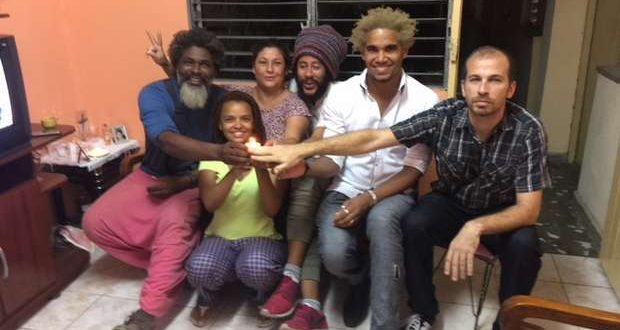
14ymedio bigger14ymedio, Havana, 21 January 2019 — A “Kiss-In” organized by the LGBT community last Saturday, in front of an evangelical church on 25th and K streets in Havana, ended with several activists and independent journalists threatened by the political police, according to reports that reached the editorial office of 14ymedio.

State Security threatened to expel Jancel Moreno, a medical student and one of the activists who launched the call on social media, from the university if he attended the public action. “I was threatened with my career, telling me I could be arrested,” he explained.

On Friday night, two State Security officials told the 19-year-old that the counterrevolution was looking to “put on a show” with the Kiss-In and that he could end up being arrested if “the police arrive and pick up everyone.” continue reading

Other activists and a journalist from this newspaper also received threats from the political police to not approach the place of the event. “If you go, you’ll spend all day at a police station,” a State Security official assured the reporter.

The Kiss-In is part of a campaign to reject the actions of various religious denominations against same-sex marriage in Cuba. Evangelical groups have organized marches and distributed propaganda of support for the “original design of the family.”

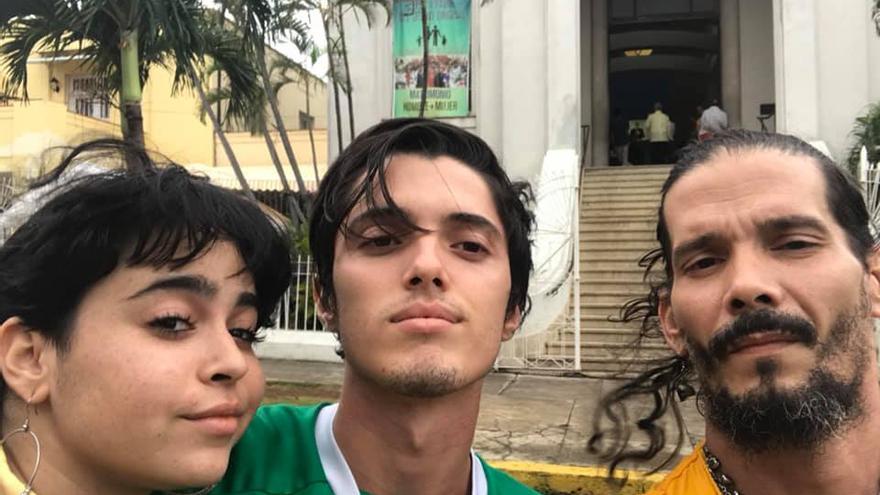
Despite police pressures, on Sunday some activists arrived in front of the church. Among them was the designer Roberto Ramos Mori, who took a photograph with two other friends a few meters from the entrance. “There was a police operation and a lot of cars, but no one messed with us,” he told this newspaper.

A police operation was maintained throughout the weekend in the vicinity of the church and, as told to 14ymedio by some neighbors, the atmosphere “was tense.”

The trigger for this initiative was the publication in social media of a music video produced by the church with a strong homophobic aspect. The audiovisual was denounced on Facebook by LGBT groups that consider its content as inciting hatred.

Ramos Mori believes that when the song calls to extract “evil, yes, but by the root” it promotes violent actions, a message reinforced because “while stating that phrase the singer runs his hand across his neck as a threatening sign.”

Towards the end of last year, on the eve of the National Assembly approving the draft of the new constitution, a score of Protestant churches came together to sign a document where they stated their position on marriage between people of the same sex.

The evangelicals affirmed in their declaration that “the family, as the word of God teaches, is a divine institution through marriage as the exclusive union between a man and a woman.” They also alleged that “equal marriage is totally incompatible with the thinking of the Fathers of our country.” Finally the religious group managed to collect 180,000 signatures in opposition to Article 68 in their places of worship.

The National Assembly did not approve the inclusion of the controversial Article in the proposal for the new constitution, yet another reason that LGBT activists have found to mobilize before a scenario they consider unfavorable for that community.

Translated by Wilfredo Díaz Echevarria

____________________

The 14ymedio team is committed to serious journalism that reflects the reality of deep Cuba. Thank you for joining us on this long road. We invite you to continue supporting us, but this time by becoming a member of 14ymedio. Together we can continue to transform journalism in Cuba

The Tornado Has Come and Gone but How Long Will it Take to Fix This

The Luyanó neighborhood, one of the most affected by the tornado. (14ymedio)

14ymedio bigger14ymedio, Havana, 28 January 2019 — As soon as the first rays of the sun appeared, the inhabitants of Havana began to understand the magnitude of the damage caused by a tornado that crossed several areas of the capital and so far has left three fatalities and more than 170 injured. Havana is paralyzed and without electricity. Complete neighborhoods are cut off from access to roads.

In the year in which the 500th anniversary of the founding of the town of San Cristóbal de La Habana will be commemorated, the tornado wind gusts have caused considerable damage to the homes in Regla, Guanabacoa, Luyanó, Lawton and other areas of the municipality October 10th. All these neighborhoods stand out for the deteriorated state of their buildings, some dating from the nineteenth or early twentieth century. continue reading

In many parts of the city fallen trees have cutoff access to streets and sidewalks.(14ymedio)

Evelio, resident of Maia Rodríguez Street, in La Víbora, woke up in the middle of the night because of the noise made by the wind. “When I looked outside, everything was chaotic and my car was heavily damaged by a branch that fell on it and other objects that flew and broke the windshield and several side windows,” he told this newspaper.

He fears that the insurance on the vehicle won’t cover the damage caused. “It’s an insurance that reimburses in national currency and everyone here knows that to repair a car you have to use convertible currency,” he says. The car is valued in the informal market at 25,000 CUC (roughly equal to $25,000 US), but Evelio fears that, if the insurance does pay something, “it will not be enough to even buy a new tire.”

In the social media, several Cubans living abroad have asked the General Customs Office of the Republic to allow more flexibility in the rules regarding personal importations in order to send aid to affected relatives and friends on the island. Others have demanded the Telecommunications Company of Cuba (Etecsa) lower the price of calls so that the citizens of Havana can speak with their relatives abroad.

In Luyanó neighbors have joined forces to start clearing the rubble from the streets. (14ymedio)

However, so far the authorities have not articulated a position on these demands and  neither has there been a call, from the Government, for a collection of aid for the victims.

Luyanó, in the municipality of 10 de Octubre (10th of October), took one of the worst hits in the destruction left by the tornado. A helicopter was flying over the neighborhood at noon on Monday, where neighbors were trying to clean up debris inside homes, on the rooftops and on the roads.

Numerous wooden facades, typical of the area, had been reduced to pieces and in the streets many people waited for the arrival of aid, especially water and food. According to the Institute of Meteorology, the extratropical low that reached the western region of the island Sunday had wind gusts of over 100 kilometers per hour and was accompanied by hail.

Tons of rubble and tree limbs fill the streets of Regla. (14ymedio)

“This is the most terrifying thing I have lived through in my 82 years,” says Lidia, whose house was damaged by the fall of a tree limb that broke the water tank on the roof and broke off a window. Now the main concern of the retiree is “to have water and food, because all the bakeries were closed in the morning and I have not been able to even eat breakfast”.

The Cuban capital has experienced a severe shortage of basic products such as flour, oil and eggs in recent weeks that has complicated the domestic economy. Now, with the devastation left by the intense storm, fear has spread among the inhabitants of the capital city that the situation could get worse.

Leonor, another resident of Luyanó, recalls Sunday night as one of the worst of her life. “We were watching the news, coincidentally the weather report, when we felt a noise like an airplane and some yellow lights,” she tells this newspaper. The woman tried to close the doors and windows but was unable to due to the the force of the wind.

“The tornado has come and gone but now how long will it take to fix this,” she asks herself, relieved and worried at the same time.

Doris, a resident of San Jose Street, between Remedios and Quiroga, described the noise that the tornado produced “like a train crash.” In her house “everything shook and the doors of the display case shut by themselves,” she now recalls in one of the areas most punished by the wind gusts.

In Doris’ block several neighbors rescued a man whose house collapsed. “We took him out from under the rubble with the back of the chair around his head” and, although he was hurt, his injuries were not serious. The woman explains that the pipeline that supplies gas “broke but they have not disconnected the service” and, despite several calls to the state company, nobody has arrived to repair the problem.

In Regla, at the end of Havana Bay, the neighbors this morning crowded the polyclinic of the area to take advantage of electricity, supplied by a group of generators, to charge their mobiles and communicate. Several state stores disposed of the last of their merchandise for fear that the lack of refrigeration would damage the products.

The main damages are in the peripheral districts of Regla, with many trees and downed power poles. All the testimonies collected by this newspaper assure that the tornado lasted less than a minute and that it did not allow time to react.

Throughout the day the neighbors have shown their solidarity with the victims, helping to repair the damages without anyone having to ask them to mobilize.

The lines to buy food extended out in front of the few shops that are open in town, especially to buy bread, crackers and eggs. In the streets there is a large presence of police, along with the frantic movement of trucks and motorized equipment for removal of the debris.

Matilde, a neighbor of the La Colonia quarter, tells 14ymedio that she was already in bed when she heard a noise “like the howl of a monster”. She went out to look and immediately heard a noise behind her because her house had collapsed in the wind. She is now out on the streets and some neighbors have helped her with a little coffee and words of encouragement.

This is one of the worst natural disasters that Havana has suffered in recent years.

Translated by Wilfredo Díaz Echevarria

________________________

The 14ymedio team is committed to serious journalism that reflects the reality of deep Cuba. Thank you for joining us on this long road. We invite you to continue supporting us, but this time by becoming a member of 14ymedio. Together we can continue to transform journalism in Cuba.
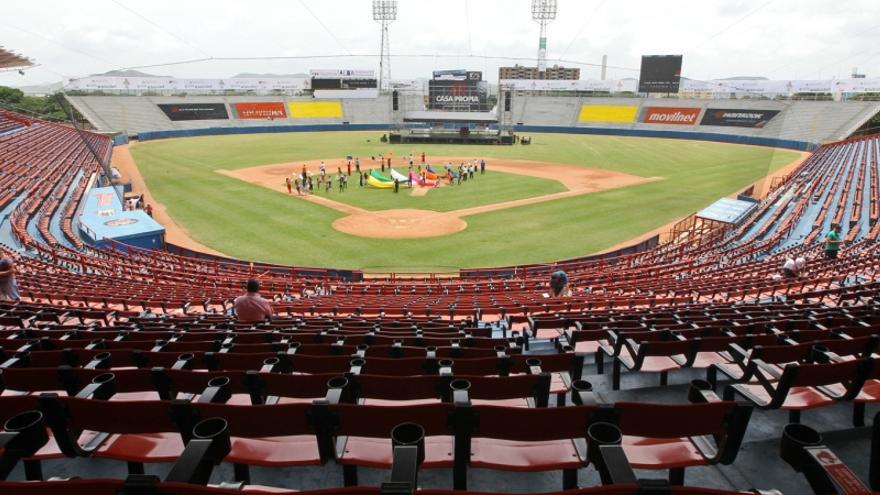
Venezuela Will Not Host the 2019 Caribbean Series

The Caribbean Professional Baseball Confederation will announce in a few hours the new site for the tournament, which will be delayed by two days.(Efecto Cocuyo)

14ymedio bigger14ymedio, Havana, 28 January 2019 — The 2019 Caribbean Series, which was to be played in Barquisimeto (Venezuela) next week, will be held “in an alternate venue.” The decision was made by the Commissioner of the Caribbean Professional Baseball Confederation (CBPC by its Spanish acronym), who reported on Sunday that the resolution is “official” and irrevocable.

Three of the four full members of the CBPC voted to withdraw the series from Venezuela, with the only opposing vote cast by the Venezuelan Professional Baseball League (LVBP by its spanish acronym). continue reading

The organization based the decision on three reasons, the first of which is the information provided by the Venezuelan executive, in which a state of “usurpation of powers” as well as “acts of a foreign enemy, hostilities and coup d’etat” is being experienced. These facts, the CBPC argues, “are outside the control or influence” of the LVBP and the organizing committee of the event.

Another of the reasons given by the Confederation is the rupture of relations between Venezuela and the United States, which makes it impossible to “obtain visas to Venezuela for US citizens who  form a major part of the teams that will eventually participate.”

Finally, and also as a consequence of the above, the recommendation that Major League Baseball (MLB) officially made to its affiliated players “not to remain in Venezuelan territory, compromises the participation of a large majority of players,” the statement said.

The organization recognized the “enormous effort” the Venezuelan league and the organizing committee have made to date, and said they did not make this decision before conducting “the deepest analysis of its impact and consequences” for professional baseball in Venezuela and all the leagues that are members of the Caribbean Confederation.

The organization also confirmed a slight delay with respect to the dates of the tournament, now scheduled for February 4-9, instead of the originally scheduled  February 2-8. The Venezuelan champions of the 2018-2019 season, the Lara Cardinals, will be unable to play in the sporting event on their home turf.

The new venue for the event and details of the game dates, the competitors and the schedule format will be announced in a few hours at a press conference. Some of the options under consideration are Mexico, Dominican Republic, Colombia or Panama.

The announcement coincides with the one made by the Cuban baseball authorities, which offered Sunday to host the Caribbean Series venue in 2020 or 2021, if it achieves approval as a full member of the CBPC.

During the act of presenting the flag to the group of players that will represent the Island in the upcoming 2019 Caribbean Series, the president of the Cuban Baseball Federation (FCB by its Spanish acronym), Higinio Vélez, said that after attending as an invited guest five editions of the event Cuba will reiterate its request to join the CBPC.

Velez said that there is no longer any impediment for Cuba to gain membership at the next meeting of the CBPC after the signing of the agreement between the FCB and the Major League Baseball on December 19.

Cuba was one of the founding nations of the Caribbean Series in 1949, when its club, Almendares, was crowned champion, the first of eight titles, seven in the period from 1949 to 1960, and another in 2014 after its return to the series as a guest nation.

This year, the Island will participate in the Series with a selection made up of members of the Leñadores de Las Tunas (Las Tunas Lumberjacks) team — winner of the just concluded national championship — reinforced with players from other squads.

Translated by Wilfredo Díaz Echevarria

_______________________

The 14ymedio team is committed to serious journalism that reflects the reality of deep Cuba. Thank you for joining us on this long road. We invite you to continue supporting us, but this time by becoming a member of 14ymedio. Together we can continue to transform journalism in Cuba.
Hundreds of Emigrants Protest in Front of Cuban Consulates In Several Countries

“The Protest for all the Prohibited” promoted slogans like #YoVotoNo (I’m Voting No) to the Constitution and the hashtag #Ni1+ (Not One More) in reference to the years that the Cuban regime has gone on.

14ymedio bigger14ymedio, Havana, 26 January 2019 — Between Friday and Saturday thousands of Cuban emigrants have protested in front of consular centers for the Island in at least ten countries. The unprecedented demonstrations have focused on denouncing the migratory obstacles, the lack of citizens’ rights, and the new text of the Constitution that will be put to a referendum on February 24.

What began as a spark ended up igniting a vast array of dissatisfactions, complaints, and questioning that for decades has been accumulating in the Cuban exile. Initially the march was going to occur only in front of the Island’s embassy in Washington, but emigrants in other places joined the initiative. continue reading

“The Protest for All the Prohibited” promoted slogans like #YoVotoNo (I’m Voting No) to the Constitution and the hashtag #Ni1+ (Not One More) in reference to the years that the Cuban regime has gone on. Although it also accommodated other demands.

In the American capital, despite the temperatures below 5 degrees Celsius this weekend, more than 400 Cubans answered the call from the Somos+ (We Are More) movement and participated in the march, after spontaneously coordinating the move.

The initiative, promoted by the leader of the movement Somos+, Eliécer Ávila, was also supported by several exile groups, along with the campaign Cuba Decides. Initially it demanded the right for Cubans to “enter and leave” the country “without restrictions, or blacklists.”

Among the organizers of the march in the United States were also, among others, the presenter Alex Otaola, the exile Amaury Almaguer or “Siro Cuartel,” author of the political satire blog El Lumpen (The Underclass). The actor Jorge Ferdecaz also joined the initiative.

Other cities where protests also occurred were Madrid, Sao Paulo, The Hague, Barcelona, Quito, Montevideo, Geneva, Holland, Santiago de Chile, and London. In total hundreds of Cubans protested against the new constitutional reform and demanded “to have a passport at a price accessible for everyone,” the “existence of marriage equality,” a direct vote for the presidency of the country, and the “end of the dynasty.”

The event had a wide impact on social media where its call circulated with the hashtags #NoMasProhibidos (No More Prohibited), #YoVoteNo (I’m Voting No), and #Ni1+ (Not One More). At the meeting point near the diplomatic headquarters in Washington, participants held a symbolic vote that produced 413 No votes for the new Constitution.

For the activist Eliécer Ávila, “Today’s great protagonists were the Cubans and their families who traveled for hours, many 20 hours to be here, many young people, 90% of whom were around 25 or 30 years old,” he explained to 14ymedio.

“It was a huge message of hope and optimism,” added the leader of Somos+. The dissidents called on people to “not let languish” initiatives of this type and “every month do something bigger and we propose that this 2019 Cuba enter a phase of social pressure that brings about a political response.”

Among those joining the march were actors, musicians, and creators like the artist Geandy Pavón, who recreated his performance Nemesis on the facade of the Permanent Mission of Cuba in front of the UN in New York this Friday night.

Massiel Rodríguez, a Cuban who has lived in Spain for a year, told 14ymedio that at the Cuban Embassy in Madrid they sabotaged the activity from the diplomatic headquarters playing music on full blast toward the exterior of the building. “They mostly put on Silvio Rodríguez but between blocks you could hear La Guantanamera and Carlos Puebla.”

The emigree explained that all along the sidewalk there were police officers posted to guard the area to prevent the demonstrators from getting close to the embassy. Inside the embassy there were many older people who as far as it was known were celebrating the birthday of José Martí and the 60 years of the Revolution, she said.

“We hugged each other, there was a lot of cordiality and respect, it was really nice and we made contacts to organize to do this type of thing, that link was good so that there can be an action group for whatever is needed,” Rodríguez said. “There were people who arrived organized in groups that came from other towns, but also some didn’t notice.” The dissident Rosa María Payá, leader of Cuba Decides, joined the action.

In Sao Paulo, several demonstrators reported that upon arriving in front of the consulate they bumped into groups from the Brazilian Communist Party, who with flags and slogans took the place. “They became aggressive and more than 200 people fell upon us to hit us,” an emigrant who participated in the protest told this newspaper.

So far the official Cuban press hasn’t published anything about the demonstrations, which happened a few hours after the Cuban government confirmed that emigrants and temporary residents abroad will not be able to vote in the constitutional referendum unless they return to the Island. Polling places outside the Island will only accept those working on an official mission.

Translated by: Sheilagh Carey

__________________________

The 14ymedio team is committed to serious journalism that reflects the reality of deep Cuba. Thank you for joining us on this long road. We invite you to continue supporting us, but this time by becoming a member of 14ymedio. Together we can continue to transform journalism in Cuba.