When A People Unites, No Dictatorship Can Prevail / Somos+

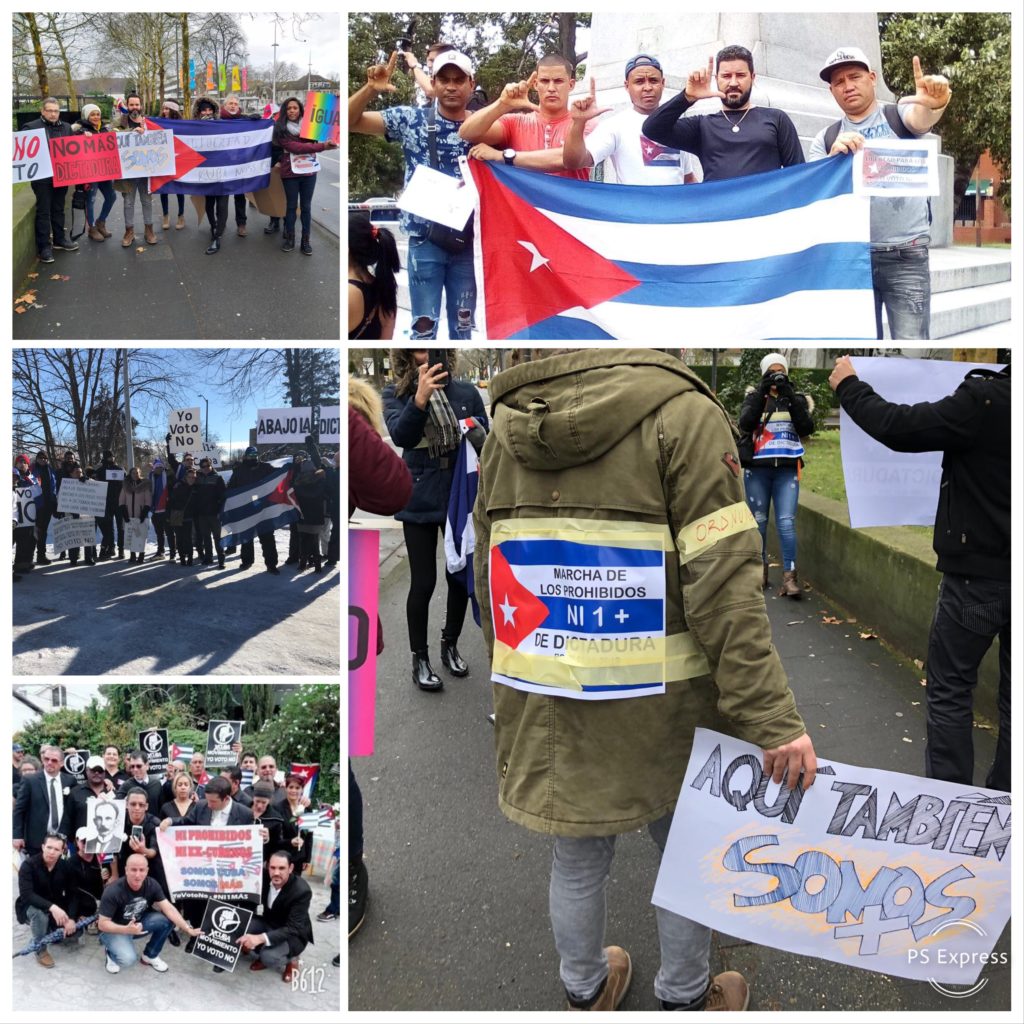
Making the sign of “L” for “Libertad,” Cubans abroad demonstrating for the right to vote in the Constitutional Referendum scheduled for 24 February.

Somos+, Richard Shirrman, 27 January 2019 — This January 26 we watched as thousands of Cuban citizens and lovers of liberty and democracy came together with one voice demanding our rights, it was more than one march or protest against that dictatorship that robs us all alike of our liberty, that subjugates, and that represses our people and dissidents who protest peacefully. It was a unanimous cry of NO!! Of Enough already! Not one year more!

All those of us who do not forget our country, we feel proud of each Cuban who raised his voice. It set a standard in the fight for the freedom of Cuba, and it said to the ruling regime on our Island what we Cubans have carried guarded in our hearts for 60 years. This 26th of January history was made, we managed to gather thousands of Cubans in the world and it was shown that united, we can do anything. continue reading

But this doesn’t end here! We will keep working with all our brothers and sisters who want with all their hearts to see our Mother Country free and prosperous, this rebellion is the beginning of the path to follow, because when a people lets itself be defeated by tyrants, any dream and longing for liberty will perish, let us not allow ourselves to be intimidated by lack of faith in ourselves and by external agitators, it’s necessary that every Cuban who loves his Mother fight for the liberty, democracy, and prosperity of our nation.

That is why we ask for the union and cooperation of all for the good of all and to fight until the end of the dictatorship that robs us of our most elemental rights and the peaceful coexistence between our different ideologies, creeds, and positions on life.

The enemy is only one, my friends, it is that criminal and murderous regime that has killed our dreams, our future, and our human dignity. There are never words to persuade when one is fighting for a just and true cause. Let us all unite as children of the same mother! Because if we don’t do it, the dictators and politicians will do whatever they feel like with us.

Cubans, brothers and sisters, José Martí fought in exile for many years until achieving the objective that was always the light in his thoughts, an inheritance that leaves us the path toward liberty, that thought and path that the murderers and vile, ambitious men of power have covered up so that we do not see it, and have placed stones in our path so that today the people of Cuba lives without decency and human dignity.

And today on the eve of the birthday of our greatest Cuban of all time, I dedicate to all those Cubans who protested against the vile and cruel dictatorship that has oppressed us for more than 60 years. And quoting José Martí:

…Thus we want the children of America to be: men who say what they think, and say it well; eloquent and sincere men.

…A man who hides what he thinks, or doesn’t dare to say what he thinks, is not an honorable man. A man who obeys a bad government, without working for the government to be good, is not an honorable man. A man who complies with unjust laws, and permits men who mistreat the country where he was born to tread its soil, is not an honorable man.

…There are men who live content although they live without decency. There are others who suffer as in agony when they see that men live without decency around them. In the world it is necessary to have a certain quantity of decency, as one must have a certain quantity of light. When there are many men without decency, there are always others who have within themselves the decency of many men. Those are the ones who rise up with terrible force against those who rob the people of their liberty, which is to rob men of their decency. In those men go thousands of men, goes an entire people, goes human dignity. Those men are sacred.

Long live free Cuba!

José Julián Martí y Pérez

National Hero of the Republic of Cuba

God, Homeland, and Liberty!

Translated by: Sheilagh Carey
Venezuela: Six (And A Half) Men and One Destiny

“It’s very difficult to fear or respect a character who speaks with birds,” says Montaner (@NicolasMaduro)

14ymedio bigger14ymedio, Carolo Alberto Montaner, Miami, 26 January 2019 — Maduro will have to go peacefully, or he will die as a consequence of an attack by his own group, as happened to Maurice Bishop.  Let’s look at the conflict’s six key factors.

Juan Guaidó, President of the National Assembly and acting President of Venezuela until elections are held.  He has the backing of the OAS (Organization of American States) and of 20 important nations.  Among them, the biggest or most accredited democracies: Canada, United States, England and Switzerland.  Also Brazil, Colombia, Argentina, Chile, Peru, Educador and Paraguay.  Not only are some of his own group against him, but some of them, secretly, would like to become candidates and win elections against Chavismo.  For them it would be reassuring if Guaidó were to announce primaries in which he would not participate.  Since he is a young man, he has plenty of time and opportunities to become president. continue reading

Nicolas Maduro has a well-earned reputation as an idiot.  That is very serious for his allies.  The Prince is feared or respected.  Maduro is neither feared nor respected, in spite of the violence that usually accompanies him.  And Venezuelans also have good reasons for that.  It is very difficult to fear or respect a character who speaks with birds.  Inflation is the unceasing lightning.  It has pulverized wages, food, medicine.  Water and electricity are missing; phones and internet fail.  Sometimes even oil is missing.  The country is broken and falling apart.  Sixty-four percent of Venezuelans lost 11 kilos in 2017.  More than 24 pounds.  Faced with this scenario that has caused the exodus of more than three million desperate Venezuelans, Maduro responds with economic “tricks” like the petro, a useless virtual currency.

Luis Almagro, secretary-general of the OAS, is the greatest ally of Juan Guaidó and of free Venezuelans.  He has thrown them on his back, like Christ and the cross, with the intention of saving them from their political sins.  He proceeds from the left, and that is convenient.  He is Uruguayan.  He comes from a small and decent country that, unfortunately, has aligned with Maduro, which will cost him votes in the presidential elections to the carnivorous left that governs in Montevideo.  No one in his right mind will accuse Almagro of selling out to Wall Street or Yankee imperialism.  Nevertheless, his former comrades expelled him from the sect without even listening to him.  Never have so many owed so much to one person.

Donald Trump is no saint to me, but there is no doubt that on the Venezuelan topic he has acted as a statesman committed to democracy and human rights, and that is something to be appreciated.  It is true that the Trump administration’s Venezuelan policy has been drawn up by Senator Marco Rubio, Secretary Mike Pompeo, Congressman Mario Diaz-Balart and Vice-President Mike Pence, but without Trump’s backing it would all be useless, and the Chavistas and their accomplices could assassinate or jail members of the National Assembly.  In short:  If Trump stays firm in his support of Guaidó, the National Assembly has everything to gain.

Raul Castro and Miguel Diaz-Canel (the half man) know that it is a matter of time, little time, before the collapse of the Maduro regime if they don’t do something urgently.  The two — and almost the whole Cuban power structure — have a terrible opinion of Maduro as a statesman.  He seems to them a good but stupid boy.  Havana is panicked at a confrontation with the United States and seeing itself dragged into the conflict because of the colony’s incompetence.  They still remember what happened to them in Grenada in 1983 when they faced the Marines.  There were 800 Cubans who ran quickly.  Now there are almost 100,000, including the doctors, health personnel, and thousands of counter-intelligence workers.  Although “the Cubans” know that their best option is to continue exploiting the Venezuelans, they are prepared for an orderly retreat in the face of the possibility of clashing with the Americans.

Vladimir Putin has jumped into the Venezuelan crisis in support of Maduro and has threatened the United States.  That blunder guarantees that Trump cannot abandon Venezuela without suffering a serious loss of credibility.  Therefore:  He will stay.  In reality, Putin wants to restore the prestige of the Russian Federation and cover the debts contracted by Venezuela, but without coming to a confrontation with Washington.  Russia has the economic structure of a third world country.  It exports gas, oil, wood and imports manufactured products.  It is one of the planet’s biggest countries, with 144 million inhabitants, but with a per capita GDP like that of Costa Rica.  The US GDP is almost 20 trillion.  That of Russia is approximately that of South Korea (more or less 1.6 trillion).  It is a poor country.  Maduro begged him to come scare the Americans.  He will not be able to.  He is a false bodyguard.

_____________________________

Translated by Mary Lou Keel.

The 14ymedio team is committed to serious journalism that reflects the reality of deep Cuba. Thank you for joining us on this long road. We invite you to continue supporting us, but this time by becoming a member of 14ymedio. Together we can continue to transform journalism in Cuba.

Sixty Years On From Fidel Castro’s First Trip To Venezuela

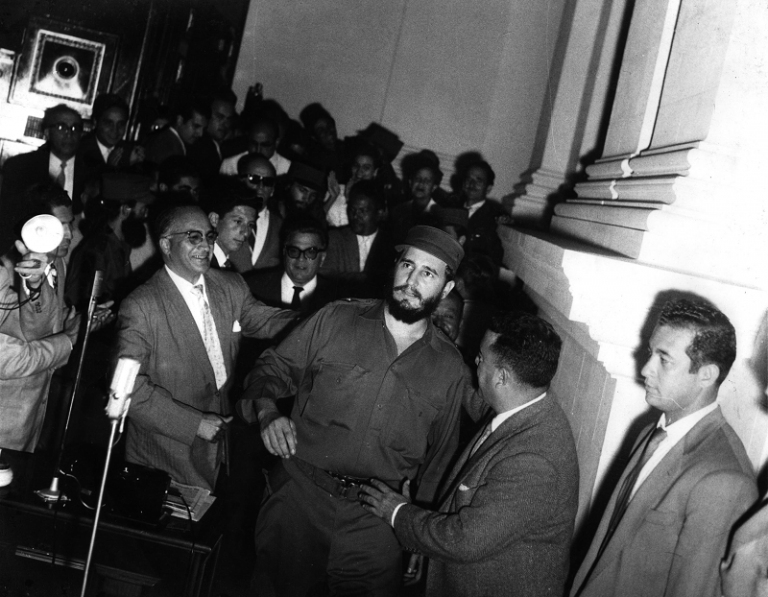
Visit by Fidel Castro to Caracas in 1959 (Archive photo)

Cubanet, Luis Cino, Havana, 23 January 2019 – Right around this time, 60 years ago, Fidel Castro was making his first visit to Venezuela, in what was also his first official foreign trip as ruler.

Fidel arrived in Caracas on 23 January 1959, accompanied by a large delegation. It was only 15 days since the revolutionary leader’s entry into Havana a week after the dictator Fulgencio Batista fled from the country.

Absorbed in what he called “Operation Truth,” Fidel Castro — self-proclaimed prime minister as well as commander-in-chief — was trying to convince the world that reports about the summary trials and executions of hundreds of soldiers and police officers of the former regime were tall tales spun by the international (especially the American) press. continue reading

The visit to Venezuela ended up being a success, despite the bad omen of a tragic accident on the Maiquetía airport runway, when Francisco “Paco” Cabrera — a commander of the Cuban rebel army who was hurrying nervously to take his place as Fidel Castro’s bodyguard — was utterly decapitated by the airplane’s propeller.

In Venezuela — where exactly one year before, on 23 January 1958, a civil-military movement had overthrown the dictator Marcos Pérez Jiménez — the Cuban revolutionary leader was welcomed as an idol. A fascinated crowd listened, unwaveringly and enthusiastically, to the bearded revolutionary’s seven-hour-long speech.

Fidel Castro’s itinerary in Caracas was exhausting. But more exhausted were those individuals charged with protecting him, who — despite the warmth evinced by the Venezuelans — thought they detected potential assassins at every turn.

As can be seen in some photos taken by Raúl Corrales of the Cuban delegation, the Comandante’s bodyguards — all of them bearded and with a wild look about them in their slovenly, olive-green field uniforms, with weapons always close at hand — turned the Cuban embassy in Caracas into a replica of the guerrilla encampments of Cuba’s Sierra Maestra.

Some years later, after Fidel Castro would include his old host, President Rómulo Betancourt, in the list of his most hated enemies, the Venezuelans would again see Cuban soldiers — clean-shaven this time and on the warpath — landing around Machurucuto to penetrate the Falcón, Yaracuy and Lara mountains, where Arnaldo Ochoa, later executed by his Cuban bosses, earned his appointment as Deputy Commander of the General Army Staff of the Revolutionary Armed Forces

Who could have imagined that half a century after the disaster, Cuban military and security types, by the thousands, would be all over the place in Venezuela, providing consultation in the repression of dissidents, to shore up the shamelessly illegitimate regime of Nicolás Maduro?

Nobody could have known what Fidel Castro was referring to, in that seven-hour speech in Caracas, when he thanked the Venezuelans for the welcome they gave him and the weapons that Admiral Larrazábal had sent to the Sierra Maestra when, in turn, they had received nothing from him.

Forty years later, they would receive — besides subversion and guerrillas — they would receive his adoption of Hugo Chávez, who would turn Venezuela into the replacement for the Soviet Union to subsidize the Casto regime at its most critical moment.

Hugo Chávez’ ascent to the presidency following a failed coup attempt — and thanks to Venezuelans’ fatigue with the politicking and corruption of the Democratic Action and Copei partisans — was the consummation of Castroism’s conquest of Venezuela, which begin on 23 January 1959, when a smiling and friendly Fidel Castro stepped foot on the runway of the Caracas airport.

Translated by: Alicia Barraqué Ellison

The Rigor of Hell: Prisoners in Cuba / Ángel Santiesteban

Ángel Santiesteban, Havana, Cuba, Thursday, October 25, 2018 — Whoever commits a crime in Cuba should be certain that it won’t be enough to complete the punishment that the court decides for him, that isolation and prison will not be sufficient. One who breaks the law on this island has, beforehand, the certainty that the guards will put all their effort into making him feel like he is in a Hell in which the character of a uniformed Lucifer recurs.

The common prisoner also pays dearly in his stay in that diabolical underground, almost as much as he who goes to prison for “political reasons.” There any human rights are not respected, although the official discourse tries to show the opposite and brags of the virtues of Cuban prisons, and even seems to embrace theUnited Nations Charter of Universal Human Rights. That figure known on the island as a common prisoner is used as slave labor, and those who receive some economic benefit know very well the treatment that the military dedicates to them. continue reading

Beatings are commonplaces in those spaces of confinement, insulting the prisoner is the dish that the guards cook best. The beatings never have justification; beating is a right given to them by a government accustomed to repressing and pounding since it seated itself on the throne. A prisoner can be beaten with impunity becaused the uniformed don’t recognize the rights of the inmates. Their frustrations and ignorance are viciously taken out on the convicts.

Didier Cabrera Herrera is now thirty-nine years old and serving a sentence for a homicide he committed in self-defense. Didier was attacked in his own house. Didier used to make yogurt and sell it in his home, until a delinquent from the neighborhood asked him for a tube and later refused to pay for it. The assailant took out a knife and, making a show, attacked the vendor, and from the show passed to a more real aggression, to unforeseen violence. The criminal intended to thrust with the knife; first at one point, then another, without counting on Didier’s dexterity.

Then would come the struggle in which Didier was more skillful and managed to grab the knife from his aggressor and use it in self-defense. Didier defended himself, stuck the attacker with the sharp point, but didn’t compromise any organ, but a blow fractured a rib that damaged some vital organ, according to the determination of the pathologist. Thus Didier went to prison to serve a sentence of five years.

Traveling to the prison with the prisoner were the certified doctors, those who warn that this man suffers from a “personality disorder of emotional instability of a moderate intensity, and of an organic base,” that had already prevented him from fulfilling the obligatory military service. The medications to keep him calm are: Carbamazepine, Sentraline, and Clonazepan, but they are not always administered with the regularity prescribed by his doctor, despite the fact that authorities are aware that the patient attempted suicide before entering prison.

The first prison that received him was “Combinado del Este,” where he kept good discipline, despite how irregularly he was returned to his medication when they moved him away from his mother. Doctors attributed the carelessness to the lack of those medicines, even though they didn’t accept those that his mother, Iris Josefina Herrera López, with many pleas, tried to give them.

Didier was then sent to a prison in Manacas, in the province of Villa Clara. His mother traveled there for each visit, negotiating all the obstacles of the island’s bad transportation. And many were the pleas of this woman for authorities to permit her son to return to Havana or a closer place. She asks and asks at the National Directorate of Prisons at 15 and K, in Vedado, but so far she hasn’t managed to bring her son closer, like Leonor Pérez did achieve in the 19th century, when the Governor General of the island, following the “plea of the mother,” responded to Leonor’s entreaties.

This man is still here, so far from his mother, suffering humiliations in punishment cells and even rape attempts from “Calandraca” and “Calabera,” two dangerous prisoners who scour the prison displaying knives without receiving any punishment. Who was punished was this sick man, who was transferred to Guamajal prison, on the outskirts of the city of Santa Clara, where he spends his days in the atrocious imprisonment of another punishment cell, in which two guards beat him with so much force that his left eye was affected.

To top it all, and despite so much abuse, Major Cepero just informed the mother that he had been denied parole for a year, without letting her know the cause, although she supposes the reason is the many telephone calls her son made saying that they were not giving him his medication. Thus survives this sick young man, faced with the apathy and injustices of the authorities of the law and of Cuban “justice” that isn’t interested in putting right those effronteries that could put an end to the life of Didier Cabrera Herrera, a very sick young man.

Translated by: Sheilagh Carey

Nicolas Maduro Clings to Power With No Concern for the Cost to the Country

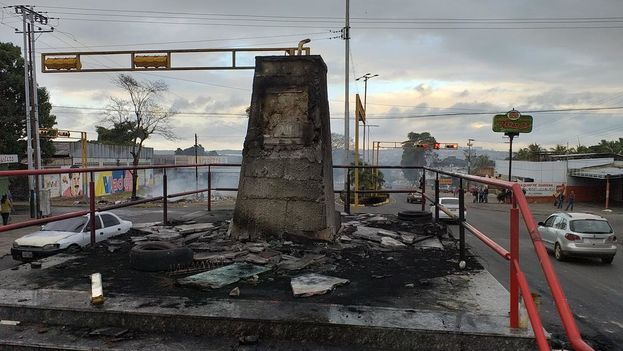
On the second night of protests this January, in San Felix in Bolivar State, the demonstrators set fire to the statue of Hugo Chávez. (Cocuyo Effect)

14ymedio bigger14ymedio, Yoani Sanchez, Havana, 26 January 2019 – If the populists share something, in addition to believing that they embody an entire nation, it is their inability to cede power when their project is exhausted. The decision to cling to the helm, no matter what the cost, has been shared by numerous caudillos in Latin America, but Nicolás Maduro in Venezuela is the most recent and dramatic case.

Repudiated by a good share of Venezuelans, designated as a dictator by a large number of governments, and proven incapable of getting his country out of an economic quagmire, the successor of Hugo Chávez ignores all signals. Maduro is wedded to power more to save a ruling elite than to seek the wellbeing of more than 30 million people. continue reading

He believes that if he remains in the presidential chair, Venezuelans will end up wearing themselves out and that exhaustion, together with the repressive blows, will pacify the popular protests that have shaken the South American country in recent days. He is playing the card of not accepting that his time has passed, and of baring his teeth to anyone who advises to him to get out of the way, call elections or seek asylum.

In part, he clings to the presidential chair to avoid the judicial process that awaits him for plundering one of the richest nations in the world, for having pushed hundreds of thousands of Venezuelans into exile, and for having ordered the armed forces to use their weapons against ordinary people. But while trying to delay the judgment of his compatriots, Maduro leaves Chavism with no chance to escape the judgment of history.

Every day that he remains in the position of president, a position he usurped after an election riddled with irregularities, he destroys what, in the collective imagination, could still be his predecessor’s legacy. Neither opponents nor right-wing governments in the region have been as effective as Maduro in dismantling the myth of Hugo Chávez.

It’s no wonder, on the second night of protests this convulsive January, that demonstrators in San Felix, in the state of Bolivar, set fire to the statue of Hugo Chavez, the one-time commander of a Parachute Battalion who managed to install himself in the Miraflores Palace. These flames were directed at the entire Chavista myth which, at the end of the last century, installed the first bars of the cage that Maduro tries to keep shut today.

By proclaiming himself interim president of Venezuela, the young politician Juan Guaidó, who as of this month is president of the National Assembly, has not only managed to bring the Venezuelan issue to the center of international attention, but has forced all those who supported the eccentricities of that soldier who sang in his speeches and believed himself a reincarnation of Simón Bolívar to look in the mirror. Not a few of those fervent followers have hastened to chant a belated mea culpa in recent days.

Today Nicolás Maduro is Chavism’s main gravedigger, the most effective resource to dismantle a whole system which, in the beginning, attracted applause from millions of followers all over the planet.

However, along with that ideological funeral, every day in which the Venezuelan ruler remains in charge, the tragedy of the country deepens. Until last Thursday, the non-governmental organization The Venezuelan Observatory of Social Conflict (OVCS) estimated the total number of deaths in protests against Maduro at 26. The economy is paralyzed and thousands of citizens are escaping across the borders every day.

The stubbornness of a handful of Boliburgueses – the new rich ‘bourgeoisie’ of Chavez’s “Bolivarian Revolution” – has spread the uncertainty about where the country is headed and fanned the specters of a bloodbath. The support they enjoy from the military leadership could bring this bloody scenario closer, because – like all populists – they prefer to drag down the country they once claimed to represent before acknowledging that they failed.

It is up to the international community to guarantee that, in the historical abyss into which Nicolás Maduro is plummeting, there is room only for the gang that governs Venezuela and for the authoritarian Chávism that elevated it.
_________________________________

The 14ymedio team is committed to serious journalism that reflects the reality of deep Cuba. Thank you for joining us on this long road. We invite you to continue supporting us, but this time by becoming a member of 14ymedio. Together we can continue to transform journalism in Cuba.

Cubans Who are Abroad for Personal Reasons Will Not be Able to Vote in the Referendum

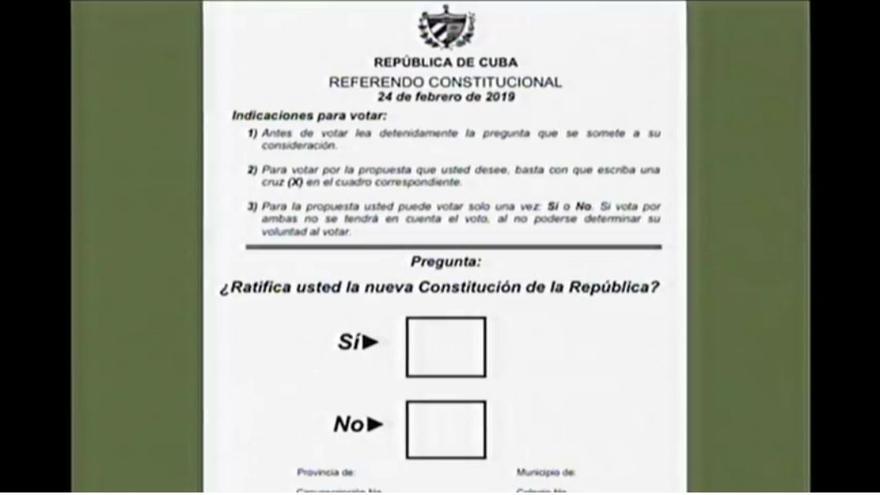
The February 24th referendum ballot was shown on Thursday in the television program Mesa Redonda (The Roundtable). (14ymedio)

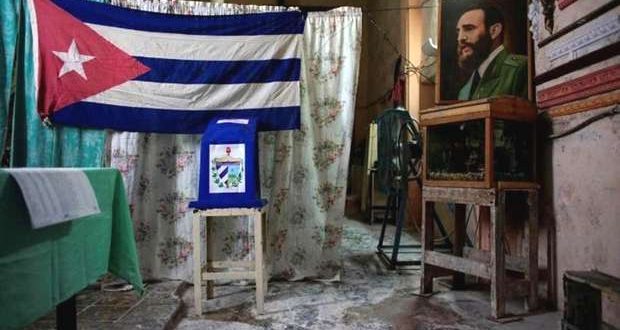
14ymedio bigger14ymedio, Havana, 25 January 2019 – Cubans residing on the Island who are away from the national territory on February 24 will not be able to exercise their right to vote in the constitutional referendum, unless they are fulfilling an official mission of the Government, according to several officials who confirmed it this Thursday in the Cuban television program Mesa Redonda (The Roundtable).

“For the individuals who are fulfilling an official mission abroad, it is impossible for them to travel to Cuba and vote in their places of residence, as this would mean that they would no longer perform the functions for which they were appointed,” said Marcos Fermín Rodríguez Costa, President of the Special Electoral Commission of the MINREX. continue reading

The Minrex has organized 122 Electoral Commissions Districts that will manage the process in each country where Cuban personnel work and 1,051 polling stations will be deployed. The process will be carried out in advance, on February 16 and 17, to guarantee the countng of these ballots on the same date as the voting on the Island.

Alina Balseiro, President of the National Electoral Commission (CEN by its spanish acronym), stressed that in the electoral stations abroad specifically “Cuban diplomats, all Cuban collaborators abroad, Cuban scholars in those countries and citizens who are fulfilling official missions” will vote.

Significantly, she reiterated the scenario that Cubans residing in the country who are traveling abroad for personal reasons can only exercise their right to vote in Cuban territory on February 24. She was referring to the thousands of citizens who have left Cuba after February 24, 2017 and who, having not exceeded the 24 months established by the immigration law, keep intact all their rights as Cuban citizens.

These restrictions make it impossible to vote for those Cubans who are studying abroad apart from the national education system, those who have left to buy goods overseas or those who are receiving medical treatment abroad.

A protest march of Cuban citizens living outside the island proposed for January 26 in front of the Cuban embassy in Washington and other countries will demand the right to participate in the referendum.

Translated by Wilfredo Díaz Echevarria

__________________________________

The 14ymedio team is committed to serious journalism that reflects the reality of deep Cuba. Thank you for joining us on this long road. We invite you to continue supporting us, but this time by becoming a member of 14ymedio. Together we can continue to transform journalism in Cuba.

Papua New Guinea Prepares to Receive the Assistance of Cuban Doctors

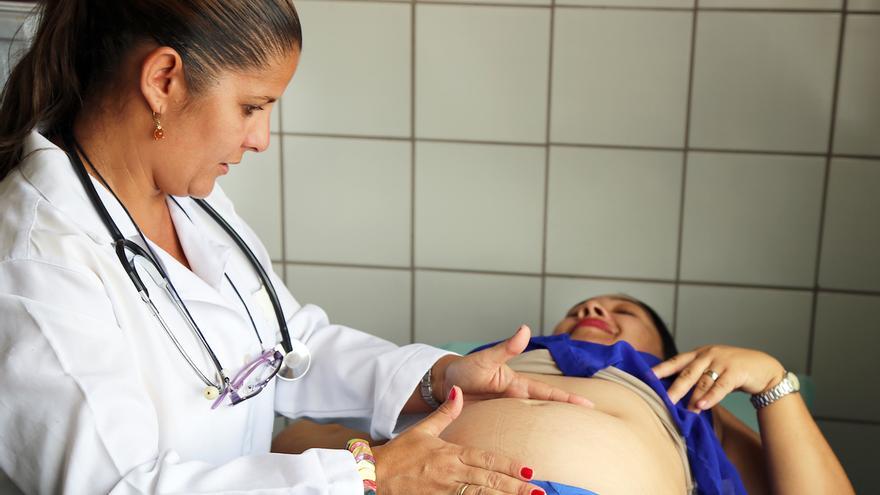
A group of Cuban doctors will travel to Papua New Guinea, one of the nations in the Pacific region with the most precarious infrastructure. (OPS)

14ymedio biggerEFE via 14ymedio, Sydney, 25 January 2019 — The Prime Minister of Papua New Guinea, Peter O’Neill, said a group of Cuban doctors will arrive in his country to help improve the health services systems, in an interview published this Friday.

“The diseases are not confined to a single area or a region, we need doctors all over the country,” O’Neill told the Papuan newspaper, The National, specifying that the Ministry of Health’s approval of the recruitment process is pending. continue reading

The arrival of the doctors is contemplated by virtue of a memorandum of understanding signed in 2016 between O’Neill and the former president, Raúl Castro, to provide assistance in training, medical research, technology and medical tools, financing, infrastructure, among other matters.

Papua New Guinea, a nation that gained its independence from Australia in 1975 and currently has more than 8 million inhabitants, has the most precarious infrastructure in the region, as well as a fragile healthcare system that must deal with a high incidence of polio, malaria and tuberculosis.

Its infant mortality and malnutrition rates are among the highest in the Pacific region, in addition to having little access to water sources, sanitation infrastructure and hygiene services, among other problems.

Translated by Wilfredo Díaz Echevarria

_____________________________

The 14ymedio team is committed to serious journalism that reflects the reality of deep Cuba. Thank you for joining us on this long road. We invite you to continue supporting us, but this time by becoming a member of 14ymedio. Together we can continue to transform journalism in Cuba.

Cuban Dancer Carlos Acosta Named New Director of Birmingham Royal Ballet

In addition to the good news about his new position, dancer Carlos Acosta has been nominated for the Goya Awards Best Actor for his role in the film ’Yuli’ (EFE)

14ymedio biggerLondon/Havana, EFE/14ymedio, 15 January 2019 — Cuban dancer Carlos Acosta was appointed as the new director of the Royal Ballet of Birmingham today, according to the company, one of the most prestigious in the United Kingdom.

Acosta, 45, who will assume the post in January 2020, was selected in a competition overseen by a group of international experts, the Royal Ballet of Birmingham said in a statement.

The tenure of the Cuban will begin after the current director, the British David Bintley, announced his retirement for next July, at the end of the season. continue reading

With regards to this new responsibility, Acosta declared that it is “a great honor and a privilege” to have been appointed to head the Birmingham Royal Ballet, which has its headquarters in the Hippodrome theater of that city, a building tailored to the needs of dance.

“I am a great admirer of its heritage and what David Bintley has done to establish the company as one of the leading classical ballet companies, following the wonderful foundations established by Sir Peter Wright. My desire is to build on its classical traditions, expand its repertoire and reach new and more diverse audiences,” he added.

The dancer wants to define what it is “to be a leading ballet company in the world in the 21st century.” He also reaffirmed his commitment to Acosta Danza and the Carlos Acosta International Dance Foundation, which he says “remains unshakeable.”

“I believe that my appointment as the Director of the Birmingham Royal Ballet can only improve and develop the opportunities I can provide to both, and that, in turn, that experience will help me develop the Birmingham Royal Ballet,” he said.

Added to this good news at the beginning of the year is his nomination for best actor in the Goya Awards for his role in the film Yuli, directed by Spaniard Iciar Bollain. The film was presented at the Havana Film Festival, although the book which inspired the film has not been sold on the island.

In his autobiographical book, No Way Home, Acosta denounces the racism he suffered within the National Ballet of Cuba and especially from its director, Alicia Alonso. The Cuban edition titled Sin mirar atrás was to be published by the Arte y Literatura publishing house but it was rejected because of the criticism towards the prima ballerina, according to the writer Jorge Ángel Pérez.

Acosta also wanted to promote the rescue of the buildings of the Dance Faculty at the University of the Arts (ISA) in the Cuban capital, which in recent decades have suffered from lack of maintenance, but still retain the architectural beauty of their origins.

_________________________

The 14ymedio team is committed to serious journalism that reflects the reality of deep Cuba. Thank you for joining us on this long road. We invite you to continue supporting us, but this time by becoming a member of 14ymedio. Together we can continue to transform journalism in Cuba.

Viengsay Valdes to Direct National Ballet of Cuba

Viengsay Valdés has been The National Ballet of Cuba’s prima ballerina since 2001. (Facebook / Carlos Villamayor)

14ymedio bigger14ymedio, Havana, 22 January 2019 — The National Ballet of Cuba (BNC) has a new artistic deputy director, Viengsay Valdés, who since 2001 has been its prima ballerina. Alicia Alonso maintains, nominally, the position of general director although, at 97 years old, she is not engaged the regular work of the company. This means, in practice, that Valdés is the leader of the prestigious artistic institution.

According to Cubanet, the decision was made last Friday after a meeting of the Board of Directors with the Vice Minister of Culture Fernando Rojas. Participating in the meeting were Redento Morejón (executive deputy director), Miriam Vila (chair of Dance), Giovanni Duarte (orchestra director), Mauricio Abreu (press and publicity), Dayron Darias (general secretary of the Union of Young Communists), Daylis Moya (legal advice), Heriberto Cabezas (public relations), Salvador Fernández (technical deputy director), María Elena Llorente (head maître) and Miguel Cabrera (historian of the BNC). continue reading

At the meeting, the Board of Directors was informed of the forthcoming creation of an Artistic Committee headed by the new deputy director and in which the decisions about the company’s work will be made.

According to sources cited by Cubanet, the decision has set off some turmoil in the bosom of the National Ballet of Cuba, where Valdés is considered a person of strong and individualistic character, although “everyone has always recognized her extreme seriousness, her great capacity for work and her high professionalism, apart from the ‘in group’ and power management, concentrating only on ensuring that what she does has the highest possible quality,” the newspaper said.

It remains to be seen what direction the BNC will take now, not only in the artistic field, but also in matters of major importance from the point of view of civil rights, since the management is responsible for deciding who travels abroad on a tour, for example, a decision that has not always been based strictly on performance criteria.

The artistic institution has suffered, on the other hand, numerous defections. Since 2007, about 40 dancers have applied for asylum in the US and other countries, according to the figures from the Cuban Classical Ballet of Miami. The artistic director of the company, Pedro Pablo Peña, who died in 2018, insisted that the incessant leak of desertions shows “the absolute discontent” of the artists with the Cuban regime.

In 2014 nine dancers fled in San Juan, Puerto Rico, where they were participating in the show The Magic of Dance. Two years later, three more dancers left for the USA, where they debuted just a month after their departure a performance of Giselle, under the direction of Peña.

Valdés has been the National Ballet of Cuba’s prima ballerina since 2001, after a 15-year career that began at the Alejo Carpentier Provincial Ballet School. During the so-called Special Period after the fall of the Soviet Union and the loss of its financial support for Cuba, this young girl with an exotic name, which in the Laotian language means “victory,” graduated with a ‘Golden Title’ from the National School of Art.

Valdés has been a guest star with the most prestigious ballet companies in the world, such as the Marinski Theater Ballet of St. Petersburg; the Bolshoi Ballet of Moscow; the Royal Danish Ballet and the Royal Ballet of London. In 2016 she stood out especially during her performances in the 25th edition of the International Ballet Festival of Havana, held between October 28 and November 6.

An extensive tour of Vietnam, Laos and Cambodia completed her 2016 schedule, a year in which she also played the character of Kitri during a season of the classic Don Quixote. The critics said that it was the most emblematic role of the dancer’s wide repertoire.

For all these achievements, 14ymedio chose her one of its 2016 Faces of the Year.

 _____________________________

The 14ymedio team is committed to serious journalism that reflects the reality of deep Cuba. Thank you for joining us on this long road. We invite you to continue supporting us, but this time by becoming a member of 14ymedio. Together we can continue to transform journalism in Cuba.

Pure Burlesque Theater / Fernando Damaso

Fernando Dámaso,24 January 2019 — Around the vote “Yes” campaign in the upcoming referendum, the government has unleashed demented propaganda, which tries to influence citizens to comply with their wishes. The absurdity reaches the point that, even when it is assumed that the vote “is individual and secret”, the “characters” interviewed and presented in the official media declare without equivocation and without the slightest shame that “they will vote Yes”, leaving aside these rights. In addition, the vote in the referendum, which should be Yes or No for the Constitution, has turned it into the vote “for the Homeland”, “for socialism”, “for the Revolution”, etc., changing its meaning completely.

We know that the referendum, like the Constitution approved “unanimously” by the National Assembly of People’s Power, constitutes a farce, one of the many that we have by now grown accustomed to, to keep us entertained and make us believe that the “system” is irrevocable and eternal, which constitutes sovereign nonsense negated by history, which shows that everything changes sooner or later. continue reading

This referendum replaces the carnival celebrations that were traditionally celebrated during February, which were moved to July by the work and grace of the “supreme maker” since disappeared [Fidel Castro], although the official media ridiculously pretends to keep him alive.

It seems 2019 will be lavish in the works of this theater of the burlesque, taking into account the string of laws that will have to be elaborated and approved, to apply what is already established in the Constitution.

Of course, in terms of economic development, of solutions to the problems that have piled up during six decades and in the improvement in the standard of living for the citizens, it will be even more disastrous than in 2018.

Translated by Wilfredo Díaz Echevarria

A Microbus Route in Search of Passengers

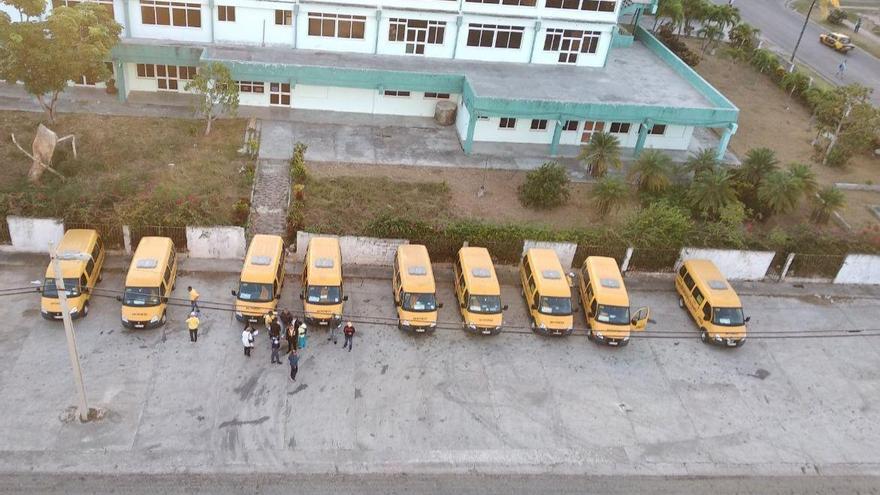
Stop for the new microbuses at Calle 5B between 164 and 164A, in Alamar, a municipality of East Havana. (14ymedio)

14ymedio bigger14ymedio, Luz Escobar, Havana, January 24, 2019 — “Come on, get on because we’re leaving…” Thus the microbus driver addresses the only client who this Tuesday morning is at the stop at 1st and 70th street in Havana. The news of the recently inaugurated Route 15 doesn’t seem to have yet reached the inhabitants of the capital, where for decades getting from one point to another has been a headache.

Immaculate, the seats without a spot of dirt, the new little buses arrived from Russia, are the Government’s latest bet in its attempts to get private transport off of Havana’s streets. In the domain of the almendrones [classic American cars, mostly from the 1950s, typically used as private taxis] and the pisicorres [vans or trucks adapted to transport passengers], these 12-seat vehicles stand out and provoke more than one prediction. continue reading

On the route, which begins in Playa and ends in Alamar via Avenida Carlos III and the Monumental, a few passengers get on. The majority ask loudly how long this new experiment will last: “We’re going to see in six months how they are,” is the sentence most repeated by the incredulous riders.

At the stop in the Playa municipality, only one stand with the information for the routes gives away the beginning of “operation microbus,” as some jokesters have nicknamed the new routes. With only one passenger, the driver starts up before the curious glances of passersby.

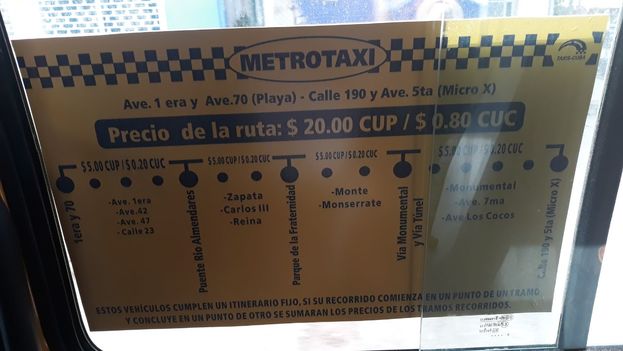
The passenger, somewhat astonished to be traveling so comfortably inside the vehicle, spends part of the journey reading all the posters inside with the details of prices for stretches of routes, streets through which the microbus travels, and the stops it makes. “That’s so that everyone knows what they have to pay and nobody is ripped off,” thinks the rider while a mother and child get on at a stop.

“It smells new, Mommy,” lets out the boy as soon as he smells the aroma of recently-opened merchandise that still fills the microbus. “We’ll see how it smells in a few months,” responds the mother. The skepticism turns into the “stone passenger” along the majority of the route, as if riders would prefer to not to get too hopeful.

Inside the microbus is all the information on the route and the prices to pay for each stretch. (14ymedio)

Made by the Russian company GAZ, the vehicles run between 6:30 am until 10:00 pm and share stops with almendrones whose owners, a few self-employed drivers, have decided to accept the new rules of the game.

In December the government approved a package of measures to regulate the work of private drivers. Among the new measures is the obligation to establish stops, travel on determined routes, and buy fuel with a magnetic card that allows a greater control on spending and consumption*.

The new rules generated a great dissent among the drivers, who pressured authorities with a strike for several days. As of that moment the flow of private taxis hasn’t stablized again and the Government has kept up the battle of wills with them by importing and putting into service new state vehicles.

The confrontation has challenged the entire city, where an average of almost a million and a half people move about each day, of which a million do so on State-owned buses. With an evident decrease in private drivers, Havanans had an end of the year “where everything collapsed at the same time,” the mother with her son on the microbus laments this Tuesday.

“The lack of flour and eggs, the rise in prices, and also the problems getting around,” explains the woman. “Now we have these microbuses but there’s no chicken anywhere,” she adds with an annoyed look. “It’s like we can’t have complete happiness, either we can get around or we can eat.”

At the top of Calle 42, the microbus now carries six people. A lady with a box full of onions, two young people who only take photos of the interior to put them on Instagram with sepia- and rose-colored filters, the passenger who got on at the beginning of the route, and the mother with her son, who at this point breathes on the window to draw little circles with his finger.

Next to the driver, the conductor is tasked with charging for the passage, which varies according to the stretch traveled. “To travel the entire route, you pay 20 pesos,” exclaims the elderly lady with the onions. “I thought that there was going to be a real reduction but prices are still very high for people.”

After the fascination of the first moment and the happiness of traveling in a clean and new bus passes, the passengers dedicate themselves to complaining about the prices of life.

The driver tries to calm the mood by saying that the advantages of the equipment cannot be denied. “These cars just arrived, I took the plastic off these seats and you all are using it for the first time,” says the driver at the top of Puente Almendares.

A young resident of Alamar recognizes that until then he had to take three cars to get to his grandfather’s house in Playa, but he doesn’t believe he could be a steady client of the microbuses because “you can’t spend 20 or 40 pesos every day on transportation.” He also complains that the initiative still wasn’t well organized and in East Havana he had seen a line of vehicles that were going out “one after another instead of doing it in a staggered way so that it would be more efficient.”

A yell from the lady with the onions interrupts him: “Stop!” she orders the driver. “I’m getting off here, I see that they [the stores] have oil.” With the sudden stop, some onion skins fall on the impeccable upholstery of the seats, and the door opens to return to a reality without novelties.

*Translator’s note: In other words, it prevents drivers from buying fuel on the black market because their purchases from the government are tracked on the card and inspectors can check if they bought enough fuel to operate the miles traveled.

Translated by: Sheilagh Carey
________________________

The 14ymedio team is committed to serious journalism that reflects the reality of deep Cuba. Thank you for joining us on this long road. We invite you to continue supporting us, but this time by becoming a member of 14ymedio. Together we can continue to transform journalism in Cuba.

Yusnel Bacallao and Lisandra Ordaz Will Not Participate in the National Chess Tournament

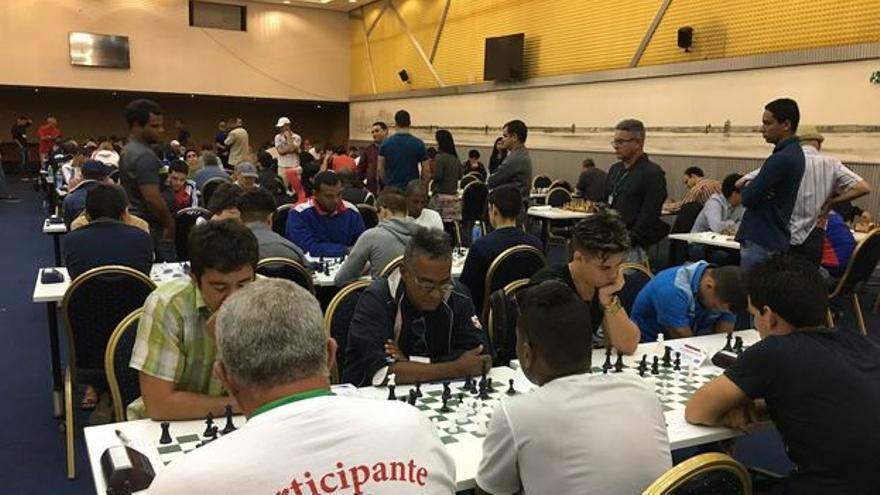
Participants in the 53rd edition of the Capablanca Memorial International Chess Tournament in Havana. (14ymedio)

14ymedio bigger14ymedio, Havana, 22 January 2019 – Cuban Grandmaster (GM) Yuniesky Quesada Perez shared on his Facebook account information from journalist Osmany Pedraza on the decision of Matanzas GM Yusnel Bacallao and Pinar del Río GM (absolute International Master) Lisandra Ordaz to not participate in the final stage of the national chess championships.

Automatically eligible, the two chess players, members of the national teams who participated in the last Olympiad of the scientific game in Batumi, Georgia, neither one has stated the reasons why they will not attend the domestic tournament. continue reading

As in the prior cases, once again it was Carlos Rivero González, president of the Cuban Chess Federation, who stated that they declined to participate due to personal reasons.

The information mentions that the women’s tournament begins in Holguin on January 28, while the men will begin to move the chess pieces on February 2 in Santa Clara.

Yuleisy Hernandez from the capital city will also not participate, although nothing has been said about this.

In the case of the Grand Master from Pinar del Rio, Lisandra Ordaz, many experts consider her among the three best Cuban chess players of the current century. Although she has never won a national tournament, she was the first to surpass the 2,400 ELO classification points hurdle and became the first Cuban to be recognized as an International Master, regardless of sex.

Bacallao, on the other hand, was called to occupy a greater leading role after the departures of Leinier Domínguez, Yuniesky Quesada and Lázaro Bruzón. The first days of January brought him a second place in the Zicosur 2019 chess tournament, which was won in Antofagasta, Chile, by the Peruvian José Eduardo Martínez.

Lisandra Ordaz is listed in 67th place among the first 100 women in the world rankings and is the first Latin American on the Elo list updated on January 1st.

Translated by Wilfredo Díaz Echevarria

________________________________

The 14ymedio team is committed to serious journalism that reflects the reality of deep Cuba. Thank you for joining us on this long road. We invite you to continue supporting us, but this time by becoming a member of 14ymedio. Together we can continue to transform journalism in Cuba.

Lumberjacks Achieve the Throne of the National Baseball Series

The champions, Las Tunas, already have to start preparations to go to battle in the Caribbean Series in Barquisimeto. (Granma/Ricardo López Hevia)

14ymedio bigger14ymedio, Ernesto Santana, Havana, 18 January 2019 — With four victories against one loss in the final, the Las Tunas team has just made their debut at the top of Cuban baseball against the orange Leopards who neither gave nor asked for a truce, and won 9-4 in the third encounter and lost by scores of 13-6 , 8-4, 7-5 and 8-4, in the first, second, fourth and fifth games, respectively.

After prevailing in their home at Mella stadium, the Lumberjacks arrived at Sandino stadium where the public pondered the defeat. After the start of the duel, Freddy Asiel Álvarez vs. Yoanni Yera, and an inning in which the Tuneros scored four runs against the orange starter, he righted himself and his teammates made a historic comeback. Afterwards Pablo Guillén ended things, striking out six of the ten men he faced to seal the victory. continue reading

The second game in Santa Clara was eminently tactical, with many emotions and controversial decisions. Alain Sánchez and Leandro Martínez started and again the Leopards fought hard, but the lockdown pitching by Yudier Rodríguez and Yoelkis Cruz — the great starters converted by wise decision into great closers — allowed the success that put the home team on the edge of elimination.

The final match at the Sandino was worthy of the grand final. If the Leopards opened by biting fast, the Lumberjacks used that deadly method that has become their hallmark: the epic comebacks every time the opponent takes the lead. The hero of the game, Jorge Johnson, defined the triumph driving in a run in the seventh to make the score 5-4, but, just in case, in the ninth he connected with the hit of the championship, a three run homer. Although Villa Clara threatened by loading the bases with one out, they could not pull it off.

The 39-year-old veteran Yoelkis Cruz-who participated in all five and saved four games- again shone in closing with the victory going to Yadián Martínez, who was credited with the last two wins in Las Tunas.

Although with their gold medal Las Tunas fulfilled the predicitions of many throughout the season, they also broke the supposed curse that the leader in the qualifying round never wins the championship in the end. Either way, this crown is the greatest collective sports success in the 42-year history of the province.

That’s what the “family-team” of manager Pablo Civil was aiming for since he took the field on August 9 to fight for each game as if it were the decisive one, with cohesion and function in all aspects, fast and powerful, where even the last man could be the first, without improvisation, with a heart called Danel Castro (“Without Danel there is no championship!”, the Tuneran fans shouted and sang from the beginning) and a captain like Yosvani Alarcón.

The designated hitter, who is as old as his province, was joyful: “This is big, big, I was a champion with Villa Cara, but with Las Tunas it’s something else. It was what I was dreaming about for my sports career. Now I am enjoying this and we will see what happens next year. I’ll have to think about whether I’ll retire or not. ”

For their part, the Sugarmakers returned along with their leopard mascot to the elite of Cuban baseball, improving with silver medal from their eighth place finish in the previous series and thus achieving its tenth subtitle in the national classic. Eduardo Paret could not make a better debut. Sancti Spíritus, bronze, deserves the most repeated praise.

While the statistics speak for themselves, they do not sufficiently explain the crown for Las Tunas. Although their success was seen coming since 2017, it is based on  very long, patient and focused work, which began prior to Pablo Civil and his excellent body of physical trainers. Suffice it to remember that Ermidelio Urrutia, who played with them, and later managed them also feels happy today with this laurel.

Along the way back to their home territorry, the Lumberjacks have been cheered by admiring crowds, including by their recently defeated Villa Clara and Avilanian rivals. In Camagüey, of course, the celebration was huge, since Dariel Góngora and Alexander Ayala are from there, two of the architects of the triumph. In Las Tunas, of course, who knows how long the fun and madness will last.

But the athletes can’t celebrate too much, because after a short break, they have to start preparing to go to battle in the Caribbean Series in Barquisimeto, Venezuela, between February 2 and 8, against Puerto Rico, Mexico, Dominican Republic and the hosts. Some hope that Las Tunas, reinforced with other good players from the championship series, will help raise at this time the self-esteem of the depressed nature of our national baseball.

Translated by Wilfredo Díaz Echevarria

_______________________

The 14ymedio team is committed to serious journalism that reflects the reality of deep Cuba. Thank you for joining us on this long road. We invite you to continue supporting us, but this time by becoming a member of 14ymedio. Together we can continue to transform journalism in Cuba.

The March of the Prohibited: #I Vote No / Somos+

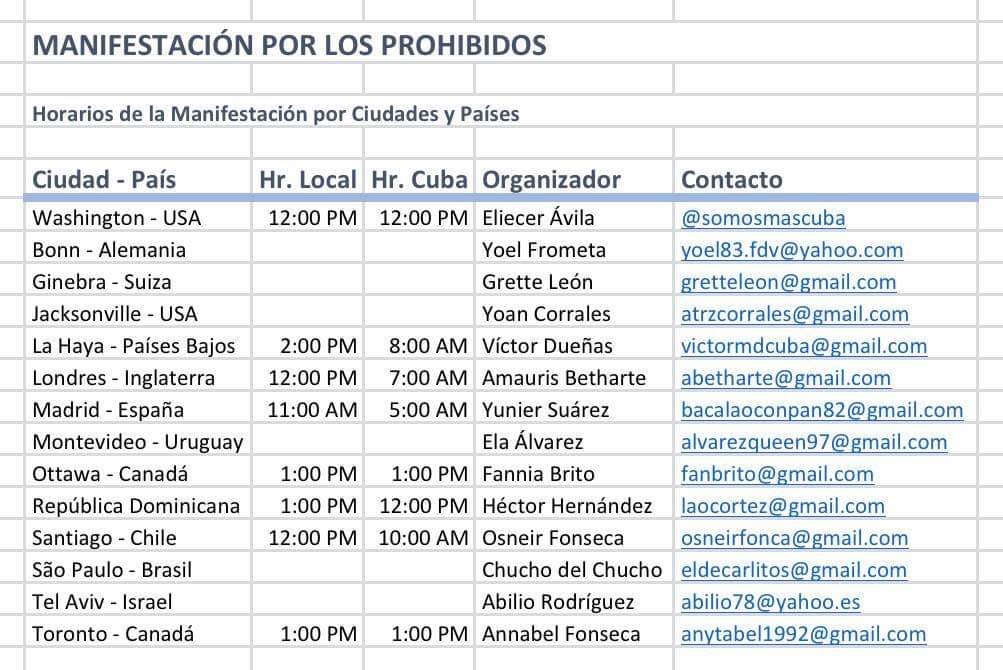
List of March Coordinators, by Country

The March of the Prohibited

Somos+, 17 January 2019: This coming February 26th will be transcendental for all Cubans abroad, who will answer the call to responding NO to the unacceptable proposal of the constitutional reform that the Cuban government has launched.

Cubans from all over the world will demonstrate against this constitutional project that enslaves Cuba to a single party (the Cuban Communist Party, PCC), and therefore to a communist dictatorship, for life.

Somos+ summons all Cubans who want to support this initiative to join the protests. Contact the coordinator of your country and inform yourself of the exact time and location of the march.

Translated by Wilfredo Díaz Echevarria

Those Who Vote Yes and Appear to Support the Cuban Regime / Ivan Garcia

From Cubanet.

Iván García, 18 January 2019 — He always believed in God or in some deity from the Afro-Cuban list of saints. He never read Marxist literature nor did he like the soporific war films of the disappeared USSR. Germán, 51, is who he is. A midlevel official of the Ministry of Internal Trade with a communist party card that has made money and carved out a privileged status, looting with more or less pretense the state warehouses of provisions.

He’s the owner of a 1958 Chevrolet, updated and impeccable to the detail. He’s a fan of Made in USA products, from an iPhone to Guess jeans. Through El Paquete [The (Weekly) Packet] he follows American television series and Major League Baseball. With religious punctuality, every day he plays 200 pesos in the illegal lottery known as el bolita [little ball]. He drinks more alcohol than is recommended. He has two lovers and he likes to visit with his buddies in a rented house at the beach, where they don’t lack for fried pork and young women. continue reading

In the two decades that he has been an official (manager) he has learned to have his cake and eat it too. The complicated system has allowed him to have a comfortable house with air conditioning and he never lacks food. He doesn’t get his quality of life by means of his salary. No. He maintains it profiteering and operating like a financial expert he covers it up with accounting tricks.

Cubans, experts in rearranging the Spanish language to their taste, use different metaphors to camouflage a word as cutting as “stealing”: striving, inventing, being in the “tíbiri tábara* “…Over and over, when the tide rises and the olive green regime begins to audit the state’s businesses, Germán goes into hibernation mode.

The nets of corruption that have been woven in six decades of Castroism are vast, functional, and methodical. Germán himself says that “in the barters between companions money never plays a part. For example, I get ahold of a leg of pork and three cases of beer for an official from the municipal party and, in exchange, when I need it, the guy arranges a house on the beach for me or supports me for a promotion within Internal Trade.”

That dissipated existence has an inviolable point: “When the Party or the Revolution needs you, one has to take a step forward.” That means you must participate in the marches called by the government, vote in favor of whatever electoral fakery, shout insults at whoever, whether dissident or not, tries to bring about a change in the country. The profile of Germán is repeated on the Island with different stories and strategies.

These imperturbable bureaucrats, who may add up to one or two million people, move within all of the institutions of the State. In return for silence, convenience, or simple opportunism, as if they were a cancer, they metastasize in the economic, social, and political structures of Cuban society. They aren’t ministers or high-ranking leaders. They’re the screws and pawns that allow the system to function. Like parrots they repeat the slogans of the moment and make up a caste that supports the leaders and back the national economic disaster.

From that singular class, similar to that of other totalitarian systems, the black market stays supplied and gasoline flows for private transport. In return, loyalty to Fidel, Raúl, and irrevocable socialism.

Thanks to them, the regime is assured of some 20% of the votes for support of its cause. The managers of the system represent another similar figure: ministers, advisors, officials of the Revolutionary Armed Forces (FAR) and the Ministry of the Interior (MININT), leaders and officials of the first level and their family members, who detest democracy because they would have to be transparent, account for themselves, and wouldn’t be able to unlawfully hold power indefinitely.

Another class are the indifferent, people who justify their apparent support for the government with endless sophistry. “At the polling places there are cameras that capture the vote of each person. If I don’t go to vote I stand out at my workplace and if I vote No, I can cause problems for my son who studies at university,” they say. In general, they are men and women who work in hotels and companies with foreign capital.

And there are the revolutionaries, although far fewer than before. Cubans who continue believing in the Revolution and are going to vote Yes in the February 24 referendum. They are the so-called “comecandelas**,” Cubans between 60 and 80 years old who don’t need favors in exchange for loyalty. They live badly, eat worse, and their homes are threatening to fall down. They’re already in extinction, like the duck-billed platypus, but for those who remain, their neighbors brand them as crazy, sclerotic, old grouches.

Almost all of them are heartfelt communists and have read Lenin and Marx. They were or still are militiamen and some fought at Playa Girón (Bay of Pigs), Ethiopia, Angola. It’s difficult for them to believe that now they are useful fools. When you show them photos of the children and grandchildren of the main leaders, eating seafood, sailing on yachts, vacationing in Europe, and dressed in brand name accessories from the “imperialist enemy,” they affirm that it’s part of a CIA conspiracy.

It’s these, essentially, who for one reason or another maintain the olive green autocracy. Excepting the high civil and military posts and a small sector of bullet-proof Castrists, the majority of the population applauds the official narrative without questioning anything. For 60 years, the survival instinct has forced them to pretend.

It’s those people whom Cuba’s opposition has to convince if we want to take the first steps on the path to democracy.

*Translator’s notes:
*A Cuban expression that appears to have many dueling meanings (and so is not translated here!).
**Literally “fire-eating,” or in English “fire-breathing” a word that conveys a total revolutionary commitment.

Translated by: Sheilagh Carey