
A Type of Dengue That Disappeared Four Decades Ago Returns to Cienfuegos

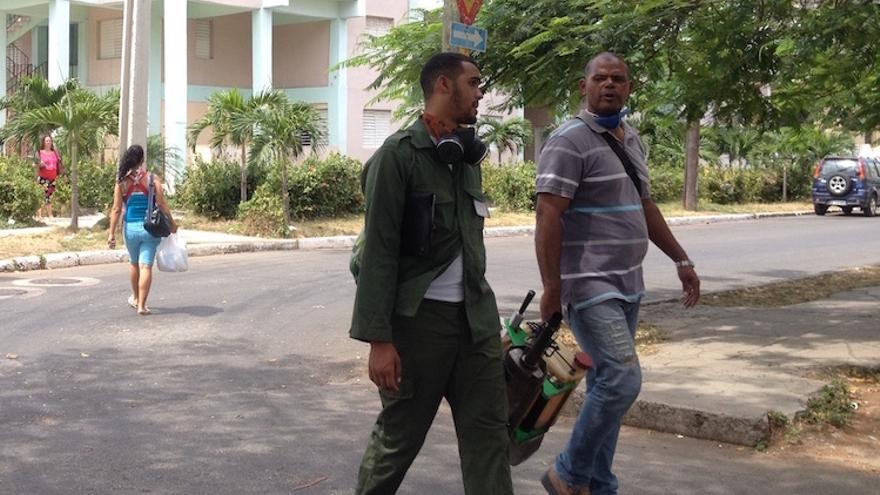
Soldiers work in the fumigation campaign against the Aedes aegypti mosquito. (14ymedio)

14ymedio bigger14ymedio, Havana, 30 November 2018 — The circulation in Cienfuegos of a “serotype of dengue” from which no outbreaks had been reported since 1977 has forced extreme emergency epidemiological measures in the province, according to the local newspaper 5th of September. Authorities have warned that this variety, specifically Type I, “may cause the death” of the patient.

“A new wave of the dengue epidemic has emerged with signs of alarm and clinical repercussion and, fortunately, no deaths have been lamented to date,” explained provincial health director Salvador Tamayo Muñiz at a meeting of the highest authorities of the territory called to analyze the situation.

In addition, he added that given this scenario the transmission needs to be stopped in no more than fifteen days. “To achieve this goal, it is necessary to isolate the cases in the authorized centers and eliminate the Aedes aegypti mosquito, the transmitting agent of dengue,” he said. continue reading

The local newspaper asks the Cienfuegans to understand the seriousness of the matter and go to the health services if they experience any symptoms such as fever, vomiting, headaches and abdominal pain, bleeding, or any other warning signal, in order to receive a diagnosis and timely treatment.

Lydia Esther Brunet Nodarse, a member of the Central Committee and first secretary of the Communist Party of Cuba (PCC) in the province, emphasized the importance of monitoring from home. “You must act with great urgency,” she said.

For her part, Mayrelis Pernía Cordero, president of the Provincial Assembly of People’s Power, warned of the need for families to be informed of when their homes or outdoor areas will be fumigated.

Dengue is an infectious disease caused by a virus of which four serotypes (1, 2, 3, 4) are recognized, and which is transmitted by mosquitoes of the genus Aedes Aegypti. According to researcher Jorge Arias, in Cuba “the four serotypes responsible for the disease,” have been found.

The last cases of serotype 1, before the current outbreak, were detected in 1977 in Santiago de Cuba and the number of infested on the Island totalled 553,138. These patients were part of an epidemic that affected several countries of the Caribbean Central America and the part of South America belonging to the Caribbean Sea Basin.

The other major epidemic in Cuba occurred in 1981, with 344,203 cases of dengue, of which 10,312 were dengue hemorrhagic fever (the most dangerous variant), which caused 158 deaths.

In recent weeks and after a rainy season with very abundant rainfall, the authorities have redoubled inspections to detect foci and carried out fumigations in several areas of the country, especially the most populated cities.

In Havana, the inspection forces affiliated with the Ministry of Public Health and the fumigation brigades have increased their presence. In municipalities such as Centro Habana, Cerro and San Miguel del Padrón, inspections of homes are accompanied by doctors and nurses to confirm that they are carried out.

Over the summer, several provinces in the center of the country reported the presence of hemorrhagic dengue. In 2017, according to figures from the Ministry of Public Health, cases of this disease on the island were reduced by 68% compared to the previous year.

This last year, dengue was present in two municipalities and 11 health areas in the provinces of Holguín and Ciego de Ávila, while other diseases transmitted by Aedes aegypti, such as Zika, were identified in 38 health areas of Havana, Mayabeque, Villa Clara, Sancti Spíritus, Ciego de Ávila, Camagüey, Las Tunas and Holguín.

According to the World Health Organization, all dengue serotypes have affected the Americas. In several Latin American countries the different types circulate simultaneously, creating a serious risk of epidemics.

__________________________

The 14ymedio team is committed to serious journalism that reflects the reality of deep Cuba. Thank you for joining us on this long road. We invite you to continue supporting us, but this time by becoming a member of 14ymedio. Together we can continue to transform journalism in Cuba.
Cuba Risks a Christmas Without Rice on the Table

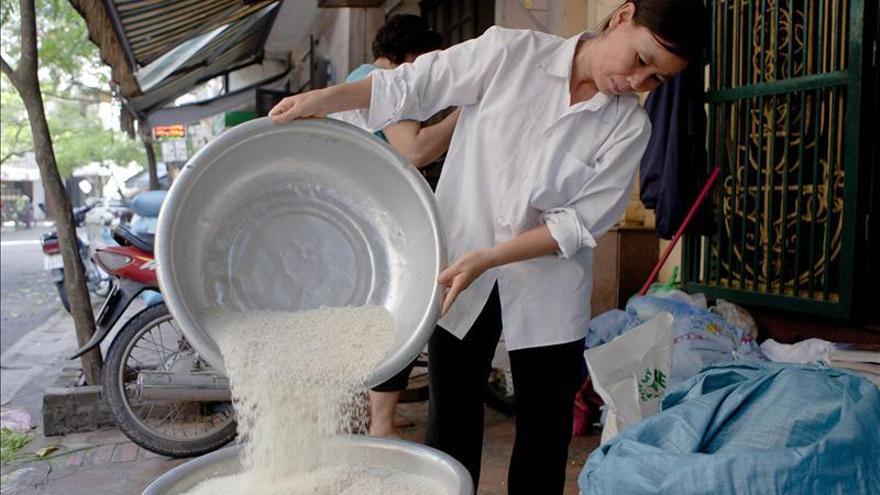
The rice imported from Vietnam is not popular among Cuban consumers (EFE)

14ymedio bigger14ymedio, Marcelo Hernandez, Havana, 30 November 2018 — The end of the year is approaching and families are setting aside provisions for the December festivities. Beans, pork and salad can not be absent, but the most essential of all products is rice, the distribution of which in recent weeks has shown signs of an alarming shortage in supplies and a fall in quality.

With an annual national consumption that exceeds 700,000 tons, this essential ingredient is sold in three types of markets: the bodegas of the rationed system, stores that sell products for Cuban pesos (CUP), and the hard currency stores that only sell products in Cuban convertible pesos (CUC), each of which is worth 25 Cuban pesos. Shortages currently are affecting the latter two options and the customers are complaining about the poor quality of the rice that is available.

“We have had cuts in supplies and now consumers don’t like the rice that is being sold,” admits Suanny, a grocer in a market on San Lazaro Street in Havana, where imported rice costs 5 Cuban pesos a pound (roughly 25¢ USD). “People come by and ask if it is Brazilian, but when they find out it is Vietnamese, they do not want to buy it.” continue reading

In the midst of an escalation of accusations between Havana’s Revolution Square and the Planalto Palace in Brasilia, over the Mais Medico (More Doctors) program staffed by Cuban doctors who are being recalled to Cuba, Cuban consumers fear that the diplomatic chill will affect the arrival of the highly-valued rice. Even television comedians allude to its counterpart, the food of Asian origin, as “the worst nightmare” of the coming Christmas Eve.

Vietnam is the main exporter of rice to the Island because the national harvest covers barely a third of what is consumed on the island. According to official data, more than eleven million Cubans residing in the country eat an average of 11 pounds a month, more than 130 pounds per person per year. The vast majority of diners will say they have not eaten if there is no rice on their plate, both at lunch and dinner.

Suanny explains to this newspaper that the reasons for the rejection of the Vietnamese product are varied. “Many of the grains are broken and the smell it has, even if it is washed several times, is not pleasant,” he says. “Besides, it’s a type of rice that does not cook up with individual grains, but rather is sticky, and we don’t like it that way here.” Similar opinions are heard in all the markets, with the exception of stores in convertible pesos where the origin of the rice is different.

“We mainly sell one kilogram packages from Spain and Brazil that are well accepted,” explains Yaima, administrator of a small store in Vedado. While in the rationed market and in places that sell in the local currency there is only one variety and for a price up to six times higher, “of a type that is very good for making yellow rice, paellas and even risotto, as well as others of long grain of the variety basmati and the jasmine.”

Yaima explains that the main buyers of this variety are the private restaurants (paladares), the foreigners residing in the national territory and “the so-called ‘pots’ (new rich) who want something of higher quality.” In the last month in several stores, including Yaima’s, they had to “ration the sale of rice packages to five per person because the supply is not stable.”

With the increase of the private sector in recent years, especially in the restaurants with extensive menus for foreign tourists, “the purchase of this type of rice [sold in CUC], which previously sold very slowly, has grown a lot,” says the worker. “Now it’s among the products we sell the most, after chicken, sausages and oil.”

Some of those interviewed consider that Cuban rice is barely sold in convertible peso stores due to “quality problems” and “presentation.” Also because of the obstacles that the State still puts on the private farmers before they can place their goods on the shelves of stores in the internal trade network.

Domestic rice does not enjoy customers’ favor either. In agricultural markets, its price remains at 4 CUP, cheaper than imported rice. “It’s second because it’s very dirty with small stones, seeds and also grains with husks,” explains Wilfredo del Toro, who manages a market stall in a plaza in Marianao.

It is common for consumers to spend between 20 minutes and half an hour selecting, washing and “picking” the national or Vietnamese rice before they can cook it, a time that is prolonged if the grain comes from the fields of the Island, due to the lack of sorting machines that clean the product before it reaches the markets.

“It’s not just about harvesting more quality rice in the fields, but about achieving a better finish,” explains Josué Amorín, an agricultural engineer who has been dedicated to rice harvesting in Artemisa’s Güira area for a decade. “The selection and packaging are unaddressed issues in the sale of national rice, in that almost nothing has been achieved in recent years.”

“In the end, what the buyer takes home is a product that can not compete with the one sold in stores in convertible pesos, neither in quality nor in cleanliness,” says the engineer.

The rice is moved in hoppers or bags throughout the transport chain from the fields to the markets. Once at the market stalls it is also sold in bulk, which contributes to the addition of particles and dirt to the product. In the rationed market it is common for employees to add small stones or other objects to increase the weight, which leaves them a surplus to sell in illegal networks.

Currently, with the problems of shortages that are affecting several areas of the country, the practice of adulterating the national rice has also exploded. This November the planting for the cold season has started and the problems with the quality of the seed already foretell that the goal of planting 139,000 hectares can not be met.

“The grain we have is a variety that demands a lot of water and is quite fragile,” a rice grower explains by telephone to 14ymedio from the  Aguada de Pasajeros area in Cienfuegos, who prefers anonymity. “In the technological package (a module that the State sells to the producers) we have distributed a rice for sowing that is very deteriorated.”

The farmer points to the problems with irrigation systems, “in very poor condition given the years and lack of maintenance,” together with the difficulties of drying and transporting the grain once it is harvested, as the main brakes suffered by the sector. “Getting bags [to package it in] is a headache,” he says.

The Rice Development Program, managed by the State but with a majority of producers located in cooperatives and private farms, aims to reach a production of 400,000 tons by 2020. But the forecast, according to several specialists consulted by this newspaper, seems too optimistic and even counterproductive for the country’s economy.

In the opinion of Israel Lugo Hernández, technical-productive director of the Rice Technology Division, reaching these figures depends not only on seeds and machinery, but also on how the rains behave in the coming years, especially over the territories of Granma, Camagüey and Sancti Spíritus, the regions where the grain is most sown.

For engineer Josué Amorín such a forecast is a “pure dream.” Rice production “demands water availability that is impossible to guarantee throughout the process in a country that has had serious drought problems in recent years and that, according to forecasts, may worsen in the future.” The specialist believes that “we must concentrate not on increasing the production numbers too much, but on the quality of the rice that is arriving at the tables.”

In his opinion “an appropriate combination of national production and imports would be more advisable than trying to grow everything here.”

 _________________________

The 14ymedio team is committed to serious journalism that reflects the reality of deep Cuba. Thank you for joining us on this long road. We invite you to continue supporting us, but this time by becoming a member of 14ymedio. Together we can continue to transform journalism in Cuba.
Cuba Keeps Betting On the Past and Fidel Castro / Iván García

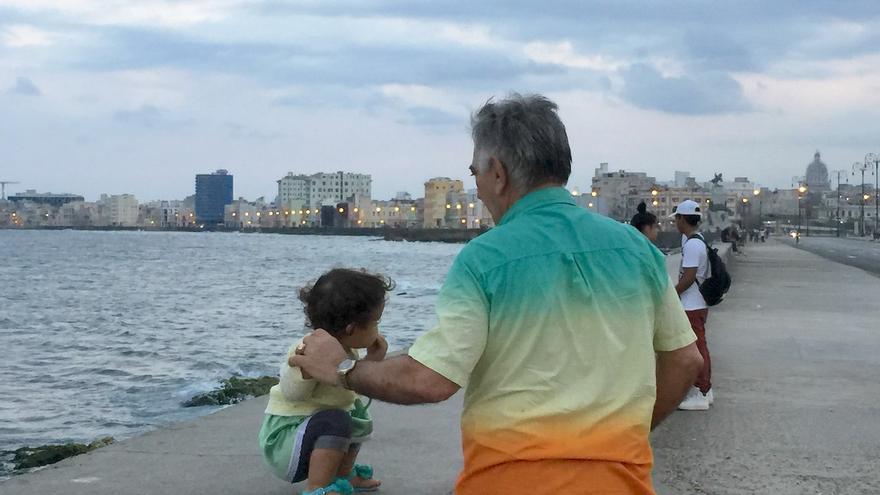
Old Havana. Selling photos to tourists of Fidel Castro and the writer Ernest Hemingway. Taken from Al Día

Iván García, 29 November 2018 — A group of Swiss tourists walk through the gray marble corridor of the old Havana Yacht Club, in the Flores district, west of the capitol building, while the guide shows them old black and white photos hanging on the wall of what once was a meeting place for the most illustrious of the Cuban bourgeoisie.

In perfect German, the guide tells them the anecdote that the club was so elitist that ’even the dictator Fulgencio Batista was not allowed to enter’. After having lunch in a restaurant next to the beach, the Swiss continue with an itinerary designed exclusively to emphasize the recovery of the Cuban republic.

Nostalgia and the past is for sale in any hotel, bar or restaurant in Havana’s tourist circuit. Sloppy’s Joe bar, next to the Hotel Sevilla, has a collection of photos of a city that was once cosmopolitan, and it has even invented a drink that evokes the American actor Errol Flynn, a regular patron of the place. continue reading

Foreign visitors are struck by the architectural diversity of Havana, which despite the state’s neglect, the soot and the ruins of its facades, still shows its former opulence.

Let’s call him Joel, the  architect of Eusebio Leal’s project aimed at rescuing areas of Old Havana, who recognizes that “the intention is to highlight old customs among tourists and foreign visitors and underscore the splendor of a memorable city that had an incredible nightlife.” And he adds:

“It starts with the music, continues with the tradition of making cigars by hand, the viewing and riding in cars from the 1950s, and highlights the lifestyle and architecture of the time. I suppose that is because Havana, after the Revolution, has little to contribute from the architectural point of view. Many works built after 1959 are marked by clumsiness and horrible designs. They should be demolished.”

A year before the 500th anniversary of the founding of Havana, the government of handpicked president Miguel Díaz-Canel has implemented a broad plan to remodel some areas of the city. “Especially those that the yumas [Cuban slang for Americans] tour,” says René, who lives in a rooming house in the marginal neighborhood of Colón, across the street from where the majestic Iberostar Grand Packard luxury hotel at Prado and Cárcel has just opened.

The other Havana, that of Mantilla, Atarés and La Cuevita, three neighborhoods of the many that in the capital cry out for a thorough repair, have their houses fixed with a coat of emulsified paint while their principal streets have to settle for a thin layer of asphalt.

Diana, a housewife, prays every night that the roof does not fall on her. Twenty years ago her large ramshackle house was declared uninhabitable by housing officials. “But where am I going to go, mi’jo. The State shelters are dens of inequity. The neighbors have written letters to all levels of the government. But they do not solve anything. It is evident that the Cuba shown on television only functions in the news broadcasts”.

Alcides, custodian of a highschool, sarcastically describes Díaz-Canel’s management and tourism. “There are good Diaz, bad Diaz and Diaz-Canel. This is something that no one can fix. For thirty years they have bet on tourism and the annoying story that it will be the engine that will bring development to the country. But nobody in the city sees a penny of the tourist money. Raúl Castro and ’Canelo’ are only interested in investing in works that provide money to military companies. Now they come up with the story of solving the housing problem in ten years. A lie. If they have not solved it in sixty years, they will not solve it in a decade. Pretending holds up everything.”

For Norge, a Political Science graduate, the “current economic and political structures do not work. The government is incapable of managing public services with a minimum of efficiency. What people ask for is change. But the regime is committed to papering reality with false promises. Not counting on a politician of stature, the strategy is to bet on the symbolism of Fidel Castro. Since they do not have new ideas, they choose to rehash his speeches.”

Two years after the death of the autocrat, the main culprit of the disaster that is now Cuba, the regime tries to sell smoke and mirrors. There is no Plan B. What’s left is to market nostalgia and the past on the back of Fidel Castro’s corpse, a communist and staunch enemy of capitalism. Paradoxes of destiny.

Translated by Wilfredo Díaz Echevarria

Taking Care of Children and Then Grandchildren

The role played by older people increases when one of their children emigrates. (14ymedio)

14ymedio bigger14ymedio, Marcelo Hernández, Havana, November 29, 2018 — Preparing snacks, picking up the girls after classes, and staying on top of keeping the school uniforms clean. A good part of the daily routine of Clara Rojos, 74, is focused on her two granddaughters, aged 10 and 11, who she has taken care of since their mother emigrated to Miami. From there she is trying to bring them over via a family reunification process that has taken more than five years.

Clara Rojas is “mother and father” to the two girls, as she explains to 14ymedio. In parks, outside schools, and in the vicinity of childcare centers, it is common to see these gray-haired heads accompanying minors. Sometimes they do it to help out the rest of the family, but in other cases they are the only support these children have.

According to an investigation conducted by the Law Faculty of Marta Abreu University, in Villa Clara, currently Cuba includes “more grandparents in the raising of grandchildren, now that, in general, both parents have a lot of work and social activity, and they spend little time with their children.” The role played by older people increases when one of their children emigrates. continue reading

For Clara Rojas, being in charge of her two granddaughters brings her many advantages and a “mountain of problems.” “I get up every day and I have the energy to go on because I can’t leave them alone,” she says. A study carried out in Germany indicates that elderly people who on an occasional or permanent basis take care of their grandchilren “tend to live longer than the elderly who don’t take care of other people.”

However, the diligent grandmother recognizes that she is a little old to share with the girls certain passions, like using new technologies, “listening to reggaeton, or helping them with their math homework.” She calculates that in the next three years, when the girls reunite with their family in Florida, she will have time to dedicate to herself and “do a bunch of unresolved things” that right now she can’t do because she doesn’t have the time.

Translated by: Sheilagh Carey

_____________________________

The 14ymedio team is committed to serious journalism that reflects the reality of deep Cuba. Thank you for joining us on this long road. We invite you to continue supporting us, but this time by becoming a member of 14ymedio. Together we can continue to transform journalism in Cuba.
First Ladies: An Untapped Potential in Latin America

After more than five decades in which the power had hair on its chest and only used skirts as a secondary support, a woman accompanies the president on his international engagements. It is a serious problem that she does not say anything.

14ymedio bigger14ymedio, Yoani Sanchez, Generation Y, Havana, 27 November 2018 — In times when there is so much talk of women’s demands, of campaigns with #MeToo-style labels, and of questioning the treatment of women in the media, it is worth reflecting on the figure of the First Lady in so many governments in Latin America.

In contrast to some European nations, and of specific moments in the administrations in the United States, in this part of the world that ranges from the Rio Grande to Patagonia, the person accompanying the president has barely used her influence and media exposure to bring messages of renewal to a female audience. She has been, rather, a “beautiful adornment” that follows the president to his public speeches, to the signing of agreements or on international tours, but she has been far from carrying herself as someone with a voice of her own who addresses the nation.

What if she used her position to influence something beyond clothes or hairstyles? The Latin American first ladies should break the mold of a beautiful face that assents to everything her husband does and throw themselves into promoting new roles, demanding spaces and launching those life stories that help the women of this region shake off disrespect and violence. continue reading

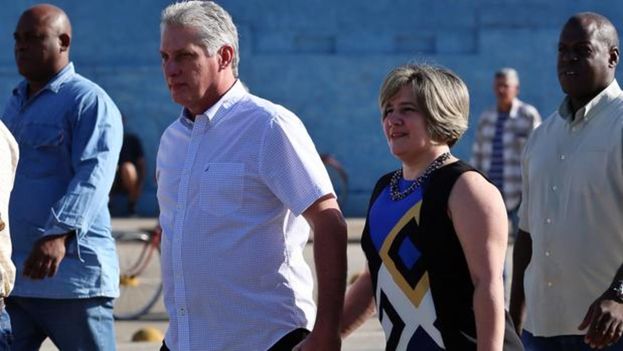
There are very gray cases, such as that of the recently premiered first lady of Cuban Lis Cuesta, the first female name that is officially linked to a president in more than half a century. After more than five decades in which power had hair on his chest and only used skirts as a secondary support, we see a woman who takes the president’s hand and accompanies him on his international engagements. It is a serious problem that she does not say anything, but we do not know if it is because of her own desire for “invisibility” or because she is prevented from doing so.

It matters little whether she shares spaces with the highest Chinese authorities or walks through the streets of London, the big problem is that we Cubans do not know the tone of her voice or what she thinks about the most critical issues of the nation.

In other Latin American countries the problem would be one of media over-exposure or the banal use of the figure of the first lady by the gossip media or fashion press to discuss the inches of her hemline or the quality of her makeup. However, in countries like this island where I live, the voice of the ruler’s wife seems to be suppressed as her very existence is shown as a “weak” diversion of the ideology in power, a “mannered” gesture of authority.

It is already time for this person who accompanies the highest office in the country to stop being pure decoration. She should not be presented like a flowery curtain that does not speak, like a beautiful vase and – much less – like an artificial flower that should always look fresh and perfumed, even in the worst moments.

A first lady must be the mirror for many Latin American women to see their potential reflected, a powerful call to realize projects and a reflection of what will come in the future. Will the ladies of the Palace be willing to subvert their wardrobes for real influence, to exchange heels for social endeavors? We all hope so.

_______________________

Note: This column was originally published in the Latin American edition of the Deutsche Welle chain.

The 14ymedio team is committed to serious journalism that reflects the reality of deep Cuba. Thank you for joining us on this long road. We invite you to continue supporting us, but this time by becoming a member of 14ymedio. Together we can continue to transform journalism in Cuba.

Through its Doctors, Cuba Influences Global Health Programs

Cuban doctors equipped for emergency missions. (EFE)

14ymedio bigger14ymedio, Miriam Celaya, West Palm Beach, 21 November 2018 — Perhaps never before has a Latin American leader been able to raise such a stir before his inauguration as the newly elected Brazilian president, Jair Bolsonaro, has done. His proposal is to grant work, with full salary and permanent residence for them and their families to the doctors who work in the Mais Médicos (More Doctors) program, after they revalidate their credentials in Brazil, has provoked a drastic response from Havana, which has announced the departure of Cuba from the program and has ordered its health professionals to return to Cuba.

The fate of Cuban doctors in Brazil has become one of the most prominent issues in numerous media and social networks. It has, once again, focused on the many dark stains of the humiliating exploitation system that has been systematically applied by the Cuban Government to these professionals, and it has also stirred passions between the critics of the Castro regime and some of the faithful who – in spite of all the evidence – still justify and defend it.

Thus, while a growing chorus calls for the doctors’ insurgency, urging them to defect and to continue offering their services in the communities where they have been working so far – this time receiving all the advantages offered by the new Brazilian president – certain voices of the radical left regret what they consider a low blow to a program that has brought primary health care to the most impenetrable and poor places in Brazil where it did not exist before. continue reading

The questionable decision of the Cuban regime to withdraw the doctors has exposed the true interests behind the Castro pantomime of solidarity, altruism, cooperation and Latin American brotherhood. The fate of millions of poor Brazilians who receive basic care thanks to Cuban professionals is completely irrelevant to the Palace of the Revolution.  Their concern is the irreparable loss of the more than 300 million dollars it has been receiving annually, lifted from the doctors’ salaries.

The questionable decision of the Cuban regime to withdraw its doctors has exposed the true interests behind the Castro pantomime of solidarity

The loss of such lucrative income constitutes a devastating and possibly irreparable blow for the Castro regime. And for greater injury, the Island masters would also lose a good part of the supply of skilled workers in conditions of semi-slavery that have brought them so much wealth over the years.

In the middle of the political tug-of-war from this or the other side, the future of doctors and patients gets decided. On November 19th, the Pan American Health Organization (PAHO), the new specialized agency of the inter-American system, the intermediary between the Mais Médicos program promoted in 2013 by Brazilian President Dilma Rousseff and the Cuban Government, launched a statement that reflects an identical instrumental perception of Cuba’s medical personnel and reinforces the customary congratulatory position towards the Cuban authorities. At the same time, it distances itself from the conflict and avoids committing itself to the free hiring of Cuban doctors, by clarifying that “the Organization has agreements with the governments of both countries (Cuba and Brazil, in this case) for Mais Médicos, but it does not enter into contracts with doctors…”

“Cuba has the highest number of physicians per one thousand inhabitants in the world, 7.5,” said the note, pointing out where their sympathies are by mentioning that the lack of doctors in Brazil motivated the signing of the agreement, since Cuba has “extensive experience in providing doctors.”

Nothing else is needed. It is clear that PAHO needs the Cuban dictatorship as medical personnel guarantor to cover the programs of the organization. The fact that Havana uses its doctors as semi-slave labor, both in this and in other international programs in which it participates, in open violation of the International Covenant on Economic, Social and Cultural Rights of the International Bill of Human Rights created to watch over the guarantee, among others, also of the labor rights of these doctors and other Cuban health professionals, is only a minor detail for PAHO, despite its being a body affiliated with the World Health Organization (WHO)

It becomes clear that PAHO needs the Cuban dictatorship as guarantor of medical personnel to cover the programs of the organization

Thus, and without detracting from the importance of the existence of agencies that promote cooperation between countries and governments in favor of primary health care for all, and the undeniable ability of these to promote general policies aimed at preventing epidemics and chronic diseases, develop vaccination programs and reduce child mortality among the most vulnerable population groups, among other commendable functions, both PAHO and WHO have left their serious limitations exposed.  By applying the maxim “the end justifies the means” they manage to fulfill their functions with relative success, and justify their own existence, but they violate important legal instruments established by the UN and become accomplices of a long dictatorship.

Thus, the essential remains in the background. The Mais Médicos program was created, at least on paper, to provide medical services to millions of people from the poorest social sectors of Brazil, not to fatten the coffers of the Cuban dictatorship. Therefore, both international organizations, PAHO and WHO, in their roles as coordinators, should not be limited to being just intermediaries between the party that pays for the services (Brazil) and the one that provides the labor and benefits from the highest gains (Cuba), let alone take sides with one of these parties and, consequently, political interests that have nothing to do with the health of vulnerable populations.

Perhaps this is a good time for both organizations to reconsider their commitments and assume a more coherent vision in the future between the fulfillment of their programs and the basic principles that justify the very existence of the United Nations. Perhaps it is time for the competent organizations to remind Cuba that the UN Covenants on Economic, Social and Cultural Rights are still waiting to be ratified by the Cuban government.

There is no doubt that Bolsonaro’s proposal has been more effective and forceful than the US embargo itself

In the case of the crisis of the Cuban doctors in Brazil, the ideal would have been if, from the current crisis, they had established a new contract in which Cuban doctors were acknowledged with the sacred labor right to collect their salaries in full and, in return, fully carry out their duties in places needing their services. But the PAHO statement has closed that door. The bureaucrats coordinating world health know that wherever financial resources appear to apply the health programs that justify their own existence, qualified manpower is usually scarce to carry them out. Hence, they tip the scales in favor of Havana.

Only Cuba, possessing an army of poor and poorly paid physicians, subordinate to the will of political power in exchange for ridiculous salaries, can guarantee the necessary human capital for such missions. International organizations try not to irritate the owner of the only resource they lack with uncomfortable demands or suggestions.

And so it is that we will have to continue the saga until the curtain falls on this new soap opera that is capturing the attention of the regional public. Meanwhile, and in spite of the accolades, the Cuban regime continues fanning the flames. There is no doubt that Bolsonaro’s proposal has been more effective and forceful than the US embargo itself, and that 2018 is probably proving to be the worst year endured by the Castro regime since the fall of the Soviet Union and the disappearance of the Eastern Europe socialist bloc.

Translated by Norma Whiting

____________________

The 14ymedio team is committed to serious journalism that reflects the reality of deep Cuba. Thank you for joining us on this long road. We invite you to continue supporting us, but this time by becoming a member of 14ymedio. Together we can continue to transform journalism in Cuba.
Panama, the New Eldorado for Cubans / Iván García

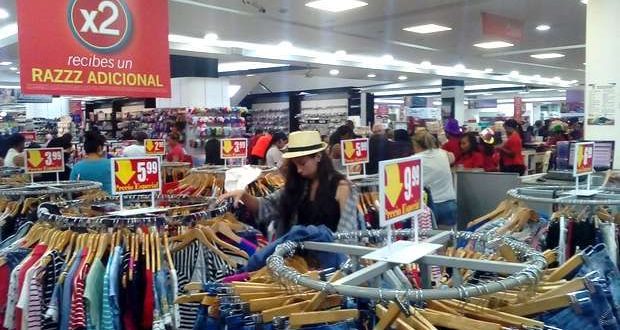
Store in Panama, a country where it is estimated that in 2017 Cubans spent around $100 million dollars in purchases. Taken from On Cuba News

Iván García, 12 November 2018 — Life always offers you an opportunity. When the father of Hector, a 31-year-old industrial engineer, died that afternoon in May 2015 in Miami, his family in Cuba began suffering material shortages.

“The old man would wire 300 or 400 dollars every month and he would send us clothes and appliances through mules*. The wages of my mother, my wife and mine together amounted to $80. With the money that my father sent, we were able to repair the house and feed ourselves better. When he died, we asked ourselves what do we do now? We could sit idly by or plan some business to get ahead. We opted for the latter”, Hector recalls.

The first thing he did was invest $1,700 that his father had sent to buy a motorbike and then determine how he could import smartphones, flat-screen TVs and name brand clothing from Panama or Mexico. continue reading

“Not having a US visa, I opted for the Mexican and the Panamanian ones. With the first purchases I made, including the cost of airfare, lodging, food and customs taxes in Cuba and Panama, I earned $350. I resigned my job and I dedicated myself to ‘muling’,” says Hector.

The migratory regulation approved in the winter of 2013 by the regime of Raul Castro opened a range of initiatives for a broad segment of Cubans. According to official statistics, more than half a million people travel abroad each year. Between 70 and 80 thousand of those travelers dedicate themselves to regularly importing goods into Cuba. It is a buoyant business. All they need is a legal framework. The current status is an authentic legal limbo.

Ana, who travels to Cancun and the Colon Duty Free Zone in Panama 10 times a year, explains the particulars. “The State allows us to travel and import only personal items once a year. All the people who dedicate ourselves to muling transgress the regulatory norms in Cuba. We have triumphed thanks to the inability of the government to supply goods at affordable prices. Look, most of the time we buy in retail markets abroad, sometimes in places as distant as Moscow, we pay the customs duties and even so we sell everything at lower prices than the State, with more variety and quality.”

A recent study by the consulting firm The Havana Consulting Group concludes “that Cuban entrepreneurs took out of their country around $2.39 billion in 2017, more than nine times the foreign capital invested in the Mariel Special Development Zone that year and a figure similar to what the communist government says it needs to revitalize the island’s economy.”

The study details how these funds are distributed: $426 million for airfare, $472 million for lodging, transportation and food, $1.08 billion for purchases and between $52 and $58 million for the agencies that pack and then take care of the logistics to send the goods to Cuba.

That amount of money would place it as the fourth largest national industry behind the export of medical services, family remittances and tourism. Economically it benefits those who are engaged in the movement of goods and also a growing percentage of avid local buyers.

Nicolás, an economist, believes that “due to the lack of wholesale markets, extremely high sales prices and poor quality of the products offered in state stores, I calculate that three to four million Cubans buy items from the mules directly or through e-commerce portals like Revolico. To this must be added the mules that sell wholesale to intermediaries who then market the merchandise at a higher price and, in a new development: sell on installments plans, a mechanism that does not exist in state stores.”

A notable segment of private entrepreneurs order their merchandise from the mules. “I bought the tableware, cutlery, lights and bar equipment from an acquaintance who regularly travels to Panama. The State does not have any institution that offers these services to the self-employed,” says Osmany, owner of a bar south of the capital.

Every year, individuals who import pacotillas (miscellaneous items highly valued in Cuba due to their scarcity) are more creative. Carla, a university student, says that there are people “who sell clothes, toiletries and hair products purchased directly from Amazon.” Perhaps that is the case with Liana, a mule with five years of experience that “thanks to the boom in these sales, I took advantage of the fact that I have a multiple entry visa to the United States; I opened a bank account and I can use a credit card that allows me to buy goods from Amazon and other digital sites and afterwards sell them in Cuba.”

Leonel, also dedicated to the mule business, thinks that “it is a good measure the government of Panama took in granting that travel card valid for thirty days. My concern is that the government considers us illegal. And it tries to stop us with high tariffs and prohibitions that prevent importing large quantities of merchandise. But beginning with that measure, and knowing that thousands of Cubans import products from Panama, they can decree criminal sanctions or high fines for those of us who are dedicated to muling.”

According to diplomatic sources located in Havana, Mexico soon plans to expedite visa procedures. In 2017, El Financiero wrote about the boom of Cuban tourists in Mexico: “The number of registered travelers with the nationality of that Caribbean country totaled 100,251 in 2016. Armando Bojórquez, president of the Confederation of Tourist Organizations of Latin America, explained that they are seeing many Cubans engaged in tourism to shop, in Mexico there are good products and international brands that can be bought in Mexican pesos and that helps.”

Odalys, who has specialized in importing athletic clothing and footwear from Cancun, is of the opinion that “these measures can help curb the growing wave of corruption that exists to obtain a visa at the consulates of Mexico and Panama. Just to get an appointment you have to pay $300 or $400 dollars to an intermediary.”

The inability of the olive green autocracy to raise those billions of dollars that escape abroad is notorious. In Cubadebate, an official website, a commentator with the pseudonym of Liborio Bobo de Abela complained:

“How many millions does the Cuban economy lose because of the blindness of the decision makers? Could not CIMEX, TRD, etc., with more reasonable prices capture the foreign currencies that flow to the Panamanian economy? Can it be that it is cheaper to buy from those who mule from Panama due to the nonsensical 240% tax in the foreign currency stores and an obsolete and absurd pricing policy. Is our economy in a position to disregard this enormous potential? Today it is practically more profitable to buy anything in any place (Haiti included), paying for the passage, the visa, lodging, food and the customs tax than buying in the stores here. Has anyone among so many illustrious brains thought about these issues”, the commentator argued.

Everything seems to indicate that no “illustrious brain” has thought about these issues.

*Translator’s note: Cuban slang for those that travel overseas to buy goods scarce and/or expensive in Cuba to then resell upon returning to the Island.

Translated by Wilfredo Díaz Echevarria

Black Friday Arrives in Cuba in the Hands of Private Businesses

Websites selling products that can be shipped to Cuba try to motivate users to join Black Friday. “Free delivery for orders over $100!” (Screen Capture)

14ymedio bigger14ymedio, Zunilda Mata, Havana, 23 November 2018 — Without long lines outside stores or massive orders via Amazon or store windows decorated for the occasion, we have Black Friday in Cuba, a practice that has come  with the private sector and that this year has featured extensive offerings in the informal market.

“If you send text message with the #BlackFriday hashtag, we discount 20%,” says an ad spread across several websites offering purchases and shipments to Cuba. Benefitting from the sales are both Cuban emigrants who send products to family and friends in Cuba, as well as self-employed entrepreneurs who order the merchandise to sell on the Island. The offers are included range from dishes, through mobile phones to food supplements. continue reading

“It’s about motivating people to join this practice of Black Friday that is increasingly spreading to more countries,” says Yusimí, 40, an informal saleswoman of toiletries, cosmetics and vitamins. “This year we have had many orders and we have also offered special combos for the date.”

Originating in the United States, “Black Friday” marks the start of the Christmas shopping season and is characterized by its significant reductions in prices. Custom now dictates that  Cyber Monday is celebrated on the following Monday. Its original intention was to boost digital sales that had once taken place on “Black Friday” in physical stores, but today these borders do not exist and “Cyber Monday” focuses on selling technological products at tempting prices both on-line and in street-front stores.

As a practical matter, Cubans living on the island cannot make online purchases because very few have a credit card. For this they depend on emigrants, and thanks to them and to the sites that ship to Cuba they can take advantage of these offers. “Sales and gifts, free delivery,” read an email sent to thousands of people and intended for Cuban emigrants. The discounts were only valid until 23:59 on Friday.

Nobody is surprised by these options because, little by little, certain festivities and traditions that come directly from Cuban emigrants in the United States have entered the island reality. “We are taking advantage of the two-day opportunity because Thursday is Thanksgiving and Friday is Black Friday,” explains Duaney, a merchant who specializes in footwear and appliances.

Although the state stores, the only ones that legally exist in the country, did not show a single sign that this Friday was commercially special, the private sellers filled that absence. “Two for the price of one,” “spend your black Friday here, so you do not miss the sales,” “it’s not Monday and it’s not Tuesday … it’s Black Friday,” were some of the improvised slogans of a sector of sales that officialdom limits.

Since the authorities banned self-employed workers from selling imported merchandise at the end of 2013, the inspectors persecute those who market these goods. But instead of disappearing, merchants have retreated to the black market and now widely use classified sites to place their products. A mobile phone number placed in an advertisement is the primary link to contact the sellers.

Instead of an automatic recording, José Luis, 38, repeats in his own voice the Black Friday sales every time an interested party calls. “If you want an appliance, the rebates are up to 15% this Friday and if you are looking for clothes, shoes or perfume we have discounts up to 35%,” he says on the phone to everyone who calls.

“We have to take advantage of this day when people have more desire to buy,” explains this young man who was born and raised in a Cuba where the government harshly stigmatized words such as “business,” “profits” and “merchant.” Part of a wide network of people who do not study or work in state-run workplaces, José Luis defines himself as “a great servant, who serves the clients what they need.”

However, he also takes advantage of the pull of consumption to peddle products that sell better accompanied by others or that
move slowly,” as he calls them. “We have good cologne, shaving foam and perfumes for men,” he explains and “for children there are backpacks with Wonder Woman and Spiderman.”

Others reject the arrival of these commercially focused dates of foreign influence. “We have reached a point where Halloween is celebrated more than Mother’s Day and where Cubans in Miami dictate to the family here that they should eat turkey instead of pork,” a retiree complained on Thursday, as he stood in line at a Western Union office on 3rd street in Havana’s Miramar district.

Most of those waiting to collect their remittances sent by relatives from the United States had a plan to celebrate Thanksgiving, more to please their families across the Straits of Florida than becuase of their own desires. Some also thought to set aside some of the money to spend on Black Friday.

The compulsion to buy that characterizes this Friday in other regions of the planet is still limited in the island, where in recent months the shortages of products have worsened in the network of official stores. So it is not uncommon to find “two-door refrigerators” for sale on the black market while state markets post a sign saying “out of salt.”

Black Friday has also coincided with the days dedicated to second anniversary remembrances of the late leader Fidel Castro, a bitter enemy of consumption. “With him in the Government, none of this would have been possible,” speculates José Luis, the seller. While in state markets posters with the face of the Commander in Chief are seen, the young merchant’s small illegal shop offers brands such as Adidas, Nike, Huawei and Dolce & Gabbana.

___________________

The 14ymedio team is committed to serious journalism that reflects the reality of deep Cuba. Thank you for joining us on this long road. We invite you to continue supporting us, but this time by becoming a member of 14ymedio. Together we can continue to transform journalism in Cuba.
An Indecent Proposal / Fernando Damaso

Fernando Damaso, 26 November 2018 — Now that the 500th Anniversary of the founding of the Villa of San Cristóbal de La Habana will be celebrated next year, with the aim of helping the city recover its identity, it would be healthy to restore some of its avenues, streets, roads, theaters, cinemas, health and education centers, parks, shops, businesses, museums and other public places, to their original and traditional names, which were changed in times of ideological disease and political opportunism.

Thus the original Carlos III and Dolores avenues; the Jesús del Monte road; the Blanquita theater; the Warner, Radiocentro, Rodi and Olympic cinemas; the Normal School park; the La Covadonga, La Benéfica and La Dependiente hospitals; La Balear, the Baldor, Trelles and Marist schools — La Salle, Belen and Escolapios; the Edison Institute; La Estrella, La Ambrosía, Tropical, Polar and Hatuey factories and dozens of other places and commercial centers would reclaim their historical names. continue reading

The changing of the original and traditional names under which they were known, in addition to an attack on the identity of the city, shows a lack of respect for the residents of Havana.

The new names, logically, should have been used for new constructions or installations of different types, but never to supplant the original designations, deeply held by the citizens.

The Queen’s Road (Reina), although officially called Simón Bolívar, was, is and will always be Reina. The same will happen with Monte, although it is officially called Máximo Gómez, and with many other roads, avenues, streets, establishments, and so on. The force of custom, converted into tradition and identity, is much stronger than any bureaucratic decision. Our authorities should know that. The only one who has respected the identity of the city has been Dr. Eusebio Leal, Historian of Havana.

By the way, Havana was founded, built and developed during the 440 years corresponding to the colonial period and that of the Republic: in the last 60 years of tropical socialism it was destroyed and became the ruin that it is today. That is more clear than filtered water!

Translated by Wilfredo Díaz Echevarria

The Chicken Will Also be "Cubañol"

Currently, most imported chicken in Cuba is from the US or Brazil (14ymedio)

14ymedio bigger14ymedio, Marcelo Hernández, Havana, 26 November 2018 — Chicken is the food that stars on Cuban tables, beyond the traditional pork, the longed-for beef or the scarce fish. With the product shortages  having intensified in recent years, the legs and thighs of these birds have become the main source of animal protein for many families, a market that will now be entered by a Spanish production company.

The Cuban government is in negotiations with the Spanish company Kodysa to create a joint venture that will supply three out of every ten chickens consumed on the island, according to an announcement during the recently concluded official visit of Pedro Sánchez, president of the Spanish Government.

Kodysa is a construction and engineering company that also has an agri-food sector among its business areas. The multinational has poultry complexes in Andalusia and a company dedicated to the preparation of poultry products. continue reading

The first step was the signing of a memorandum of understanding to launch a 50 million euro project through which a mixed capital company will produce 400,000 fresh chickens a week for the Cuban market, a product with a broad demand which, today, is mostly imported from Brazil and the United States.

Kodysa chicken production

The Cuban poultry industry is going through a bad time, hit last September by Hurricane Irma and last May by the subtropical storm Michael, which damaged numerous chicken farms along the northern coast and in the western part of the country, although most of them were dedicated to egg production.

“We have very little production of chicken for meat consumption because of the issue of feed for growth and fattening, which is not easily achieved,” explains Luis Abreu by phone to 4ymedio. Abreu, 53, works on a poultry farm near the community of Las Terrazas in Artemisa. “Here we are dedicated to laying hens but right now we are below half of our capacity.”

Problems with the roofs of farm buildings, the supply of water to keep the hen-houses clean and the delicate issue of feed, makes it difficult for the animals to enjoy “the minimum conditions to lay all the eggs they could, much less to raise a chicken to a certain weight in a short period of time,” Abreu laments.

At the farm, a group of sorters reviews the newly hatched chicks and separates out the females, which will go to areas with special lighting to supply them with heat and later to the laying sheds to use for egg production. Those classified as males “go to feed the pigs,” says the employee.

The depressed local industry forces Cuba to import more than 80% of the food consumed on the island, including more than 120,000 tons of chicken meat. In 2017, Alberto Ramírez, president of the Cuban Society of Poultry Producers (SOCPA), confirmed to the official press that “the [national] production of meat is practically nil.”

Under the agreement with Kodysa, chickens could cover up to 30% of local demand, which includes not only domestic consumption, but also a portion of the needs of hotels and private businesses, a sector hit hard by the shortages.

The Spaniards are committed to guaranteeing the supply of animal feed, the weakest point of Cuban industry, and one that must be watched with greater zeal. “One of the main problems of meat production in Cuba is the diversion [i.e. theft] of resources from state companies to the informal market,” said Maritza Rojas, a Villa Clara native who worked for two decades as an accountant on a poultry farm, speaking to this newspaper.

“Private producers are sold barely any feed, so this product sells very well on the black market,” she explains. “Any place where chickens are raised, we have to watch the feed more than the birds, because it disappears little by little.” The accountant thinks that “it is still too expensive to produce chickens in Cuba” because of “the lack of infrastructure and so much theft.”

In the last two decades, the United States has been the greatest supplier of chicken to the Island, especially the so-called “dark meat” (thigh and leg-thigh). In November of 2017, after several months of  Donald Trump’s tenure in the White House, more than $21 million in agricultural products and food was sold to Cuba, almost $17 million of which was frozen chicken.

However, Havana must pay cash for the these products, as established by the Trade Sanctions Reform and Export Enhancement Act, which the US Congress approved in 2000.

Brazil also supplies much of the whole chicken that ends up on Cuban tables, particularly the companies Frangosul and Perdix, JBS and BRF, although political relations between Cuba and Brazil have deteriorated. Havana has a debt with the Brazilian National Development Bank of more than 600 million dollars that it has committed to settle, although this year alone it needs to renegotiate arrears in the amount of 110 million dollars for 2018.

Local production of chickens would alleviate the spending on imports and bring a fresher product to Cuban tables, but the agreement with Kodysa still has no firm date to go into effect.

*Translator’s note: Cubañol: a combination of Cuban and Spanish (español)

____________________

The 14ymedio team is committed to serious journalism that reflects the reality of deep Cuba. Thank you for joining us on this long road. We invite you to continue supporting us, but this time by becoming a member of 14ymedio. Together we can continue to transform journalism in Cuba.

Cuban Government Offers Customs Advantages to the Doctors in Brazil

14ymedio bigger14ymedio, Havana, 17 November 2018 —  The Cuban doctors in Brazil will have customs advantages to import their belongings, according to a note from the authorities of the Ministry of Public Health, to which 14ymedio had access. The flexibilization has been accompanied by pressure on their family members to convince the doctors to return to the island.

The announcement comes a few days after the Cuban government announced the withdrawal of the more than 8,300 doctors who are working in the Mais Medicos (More Doctors) program in Brazil, after the president-elect of that country, Jair Bolsonaro, offered these health professionals political asylum if they decide to avail themselves of it.

“To support them and reduce expenses, we decided that for everyone who sends unaccompanied cargo to Cuba by different means, that cargo will be considered as Household Items, which implies not paying the duties in any currency,” explains the Medical Mission’s communication. continue reading

Even doctors who had already traveled on vacation to the island will be allowed to import additional products paying in the national currency, an exception to the strict Cuban customs rules that require payment in hard currency after the first annual importation.

However, for many of the professionals these measures are not enough. “It costs money to send our equipment to Cuba. What are we going to come with if they announce the end of the mission from one day to the next?” says one doctor under the condition of anonymity.

The other option that the authorities have given is for the doctors to sell everything they have and bring the cash. “I’m trying to sell everything I have. But what I can’t sell I will take to Cuba. I do not know if I can take a container on the plane, but what is certain is that I’m not going to leave it here,” said a doctor in a voice message sent to the directors of the mission through WhatsApp.

Another doctor regretted that they were only allowed to carry 40 kilograms (88 pounds) on the plane home. “I’m taking my air conditioner with me,” he said. “Look for two planes because I’m taking everything, doctor. Look for two planes because all I can get for an AC is 100 reales and I will not sell it because it cost me 2,200 reales. I do not know if they are going to find me a separate plane,” he added in a voice message to the directors of the Medical Mission.

Doctors are dismayed by the authorities’ recent visits to their relatives on the island to pressure them to return. “They went to visit my daughters. They are minors, they are girls. However, they went there and asked them if their mother had told them that she was going to stay in Brazil and that they should tell me not to stay, to return to the country,” lamented one doctor in communication with this newspaper.

Another doctor denounced the visits they made to his mother on his Facebook profile. “As my house was empty they went to my mother’s house. For the first time, she had the pleasure of seeing the family doctor who had never visited her despite her having suffered a heart attack and having blood pressure problems. They went to threaten her with measures in case I stayed in Brazil,” said the doctor.

In the official media, the campaign against Brazilian President Jair Bolsonaro has also been strong. “Puppet of imperialism, fascist, far right” are the descriptors used by Cuban Television.

In a recent interview, the provincial director of the Ministry of Public Health in Guantánamo, Roilder Romero Frómeta, insisted that “there will be no reason for the desertion of health personnel” in Brazil.

Romero, former coordinator of Mais Medicos, said that those returning from Brazil will not be “regulated” — the official term used to describe the act of banning individuals from traveling outside the country — and may emigrate if they wish, but threatened those who break the contract and take refuge in the asylum offered by Bolsonaro with the application of the law that prevents them from returning to Cuba for any reason for eight years. “Health professionals in an official mission who have left have may not enter the country for eight years. There is no reason for them to defect,” he said.

On Friday, the president-elect of Brazil, Jair Bolsonaro, said that the situation of Cuban doctors is “practically slavery” and reiterated his promise of asylum for those wishing to leave the Cuban medical mission. Bolsonaro also considered it “unfair” and “inhumane” to assign the medical attention of Cuban professionals who have “no guarantee of quality,” to the poorest Brazilians.

The statement refers to Cuba’s refusal to have its doctors take the necessary examination for any foreign doctor working in Brazil. According to the president-elect, the government of Brazil has never had proof that the professionals sent by Cuba are competent.

Bolsonaro’s demands for Cuba’s continued participation in the Mais Medicos program, include requiring Cubans doctors to take the Brazilian examination for the revalidation of their credentials; requiring the full salary paid for each doctor be paid directly to the doctor (currently the Cuban government keeps 75% of the payment); and the right for the doctors’ family members to live with them in Brazil for the full period of their mission.

_______________________________________

The 14ymedio team is committed to serious journalism that reflects the reality of deep Cuba. Thank you for joining us on this long road. We invite you to continue supporting us, but this time by becoming a member of 14ymedio. Together we can continue to transform journalism in Cuba.

Retaliation Against Prisoner Who Reported Terrible Conditions of Forced Labor / Luis Felipe Rojas

Kilo 7 Prison, in Camagüey. See link below to interview in Spanish.

Luis Felipe Rojas, 4 October 2018  — The common prisoner Vidal Valentín Antúnez Díaz denounced that he was transferred from a correctional center in Sancti Spíritus to the Kilo 7 prison in Camagüey after advocating for better living and working conditions in the manufacture of charcoal.

The prisoner explained in a telephone call that shortly after denouncing the terrible conditions in which he lives and works, the reprimand by authorities was immediate.

“Lack of water, mattresses chopped in half, terrible nutrition and the worst conditions for a person who, according to authorities, collaborates for the economy of this country,” Vidal said.

“Here you can’t say whatever you want to,” the guards warned.

Click here for interview in Spanish.

Translated by Wilfredo Díaz Echevarria

Prisoners or Paramilitaries? Testimonies From Cuban Prisons / Luis Felipe Rojas

See link to interview below.

Luis Felipe Rojas, 1 October 2018 — The recruitment of violent inmates inside Cuban prisons is a method used to reduce the need for officials to maintain internal order, the ex-political prisoner Virgilio Mantilla Arango denounced from Camagüey.

Mantilla Arango said that, “to get rid of their responsibility,” the prison officials “have given a type of authority” to the inmates he calls “paramilitaries,” since “they are more guards than the guards themselves,” he affirmed.

In an interview with Radio Martí, Mantilla Arango, leader of the opposition group Unidad Camagüeyana (Camagüeyan Unity), explained that he lived his narrative in the flesh in the prison known as Kilo 9.

“They (the violent prisoners), loyally, as if they were soldiers, are those that direct us to line up, those who put us firmly in place, those who take the prisoners to the dining room (…) and they are going to pay them 200 pesos, inside the prison, for this work,” said Mantilla Arango.

Click on this link (interview in Spanish).

Translated by Wilfredo Díaz Echevarria

Doctors Continue Returning From Brazil While Revelations About the ‘More Doctors’ Program Are On-Going

Doctors continue arriving from Brazil after the Cuba’s break with that country’s Mais Medicos (More Doctors) program. (Granma/Juvenal Balán)

14ymedio bigger14ymedio, Havana | November 26, 2018 — Vice-President Salvador Valdés Mesa and the Minister of Public Health, José Ángel Portal, welcomed the second group of Cuban doctors to return to the Island following the Government’s decision not to continue with the Mais Médicos (More Doctors) program. The contingent, made up of 203 doctors from Brazil, arrived Sunday morning at the José Martí International Airport in Havana.

The deputy minister of the department, Luis Fernando Navarro, directed a few words to the doctors, whom he distinguished for their solidarity and commitment to travel to the most remote places in Brazil where the population has less access to health care.

Meanwhile, in Brazil, details of the creation of the Mais Médicos program with Cuban participation have become known. The leaks of telegrams that reconstruct the negotiations carried out between the governments of Havana and Brasila have revealed details until now unknown such as the length of the talks, which began at least a year before the program was announced, or Cuba’s request for payment of $8,000 monthly per doctor. continue reading

In March 2012 a Cuban mission visited Brazil and made proposals ranging from “sending doctors and nurses” to consulting “for the construction of hospitals” and for the development of health systems”, at advantageous prices, according to Alexandre Ghisleni, in charge of business on the Island

On April 4, representatives from the Federal Council of Medicine, the Brazilian Medical Association and the National Federation of Physicians went to Planalto Palace (the official seat of the president of Brazil) to protest against these agreements, then still in the shadows, but then Brazilian President Dilma Rousseff did not confirm them, although she did not deny them, either.

In June 2012, the Ministry of Health organized a visit to Havana to address the creation of the medical program for providing health professionals in remote areas of the country. For the embassy, the project was “initiated in a reserved way, in view of the concern about repercussions from the Brazilian medical community due to the entrance of the doctors.”

The delegation was led by Secretary Mozart Sales of the Ministry of Health, and included Alberto Kleiman, then international adviser of the portfolio and now the current director of international relations and associations for the Pan-American Health Organization (PAHO).

“The Brazilian side proposed payment $4,000 ($3,000 for the Cuban government and $1,000 for the doctor),” states one of the telegrams. “The Cuban side, for its part, said that it had assumed $8,000 per doctor and made a counter offer of $6,000 ($5,000 for the government and $1,000 for the doctor).

The Cuban authorities demanded that the evaluation of the doctors take place in Cuba and that Brazil limit itself to “familiarizing the doctors, above all, in the language and the procedural and administrative practices of the legislation”.

The papers document the Brazilian suggestion that the payment to the Cuban government be made through what they called a “compensation system” to settle the debts of Havana with the National Economic and Social Development Bank (BNDES), which financed the large works of construction in the port of Mariel, among other projects.

Given Cuba’s refusal and Brazil’s fear of having to request the approval of Congress, it was decided at the last minute to triangulate the business by making payment to the PAHO, which would contract with Cuba, which would in turn hire the doctors.

Translated by Wilfredo Díaz Echevarria

__________________________________

The 14ymedio team is committed to serious journalism that reflects the reality of deep Cuba. Thank you for joining us on this long road. We invite you to continue supporting us, but this time by becoming a member of 14ymedio. Together we can continue to transform journalism in Cuba.

Latin American Despair

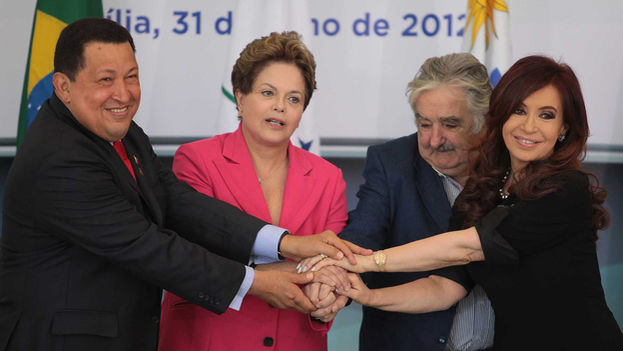
The leaders of the left, Hugo Chávez, Dilma Rousseff, José Mujica and Cristina Fernández. (Twitter)

14ymedio bigger14ymedio, Carlos Alberto Montaner, Miami, 24 November 2018 — Guy Sorman is a notable French thinker. He recently published an article in ABC de Madrid entitled “The future recedes in Latin America.” It is a brilliant and desperate text. Well meaning, but desperate.

He goes on to say that in Latin America we have tried everything, and everything, uselessly, we have pulverized. Liberalism in Argentina, originating with Alberdi and Sarmiento. The enlightened despotism of Mexico with Porfirio Diaz and his “scientists.” The statism with the Mexican Revolution of 1911. The military dictatorships of Pinochet and Stroessner, and the civilian dictatorships with Somoza and Fujimori. Communism with the Castros, with Chavez and Maduro, with the first Daniel Ortega (the second Daniel Ortega is Somoza revived, but with more homicidal furor).

The strange thing about our culture is that, instead of correcting what is wrong, we renounce our successes and insist, periodically, on our mistakes. It still reverberates, from time to time, the old Maoism at the hand of a wounded but not buried Shining Path, although Mao does not exist in China, beyond a rhetorical reverence. continue reading

It is amazing to hear Pablo Iglesias, the leader of “Podemos” in Spain, be envious of what is happening in Venezuela, as if he were willing to repeat in his own country the terrible devastation that occurred in the once prosperous oil paradise.

I remember a young woman from Guayaquil screaming at me, incensed, that “in Ecuador we need a couple of Tirofijos.” She was referring to the Colombian bandit who caused so many losses to his native country. The incident took place at the Catholic University of Guayaquil. The appearance of the truculent girl – blonde, beautiful, green-eyed, well-dressed – was bourgeois.

Why did the Argentines interrupt the impetuous road to development and prosperity they had followed until Hipólito Yrigoyen was deposed by a fascist military coup in 1930? In Argentina there were problems, but none prevented the country from being part of the First World in almost all aspects, and especially in education. That coup was the prologue to Peronism and the total collapse of the Argentine miracle that had begun with the liberal Constitution of 1853.

Why was Fidel Castro not able to understand, in 1959 – when he, his brother Raúl, Che and another small group of communists clung to the Soviet model and chose the path of totalitarianism – that there were enough indications (for example, the German and Austrian miracle) that demonstrated the superiority of “liberal democracy” instituted by the economist Ludwig Erhard?

Such was Fidel’s ideological blindness that he was not even able to understand the example of his own father, Angel Castro, a humble Galician peasant, astute as a fox and laborious as an ant, who, when he died in 1957, bequeathed to his family capital of eight million dollars, an agricultural company that gave jobs to dozens of people, a school, and even a cinema run by Juanita Castro, a contemporary of Raúl, who has been exiled in Miami since the 1960s.

Sorman, who knows in depth the bloody history of Europe, rightly alleges that “in Europe the ancient nations, very different from each other for centuries, are gradually coming to an agreement on the best possible regime, liberal democracy.” While in Latin America “everyone cultivates their uniqueness, learns nothing from their neighbor and the exchanges are practically nonexistent.”

We are not able to perceive the leap towards modernity and development Chile has been given, today a country on the threshold of the First World through a fortunate combination of markets, private property, control of public spending, and national savings – thanks to the reviled pension plan created by the economist José Piñera – and freedoms.

Why do not we correct the shortcomings and adjust what is worth saving instead of undoing everything and moving to the other direction of the pendulum, as president-elect Andres Manuel Lopez Obrador promises to do in Mexico, to the terror of investors?

The United States, which unwittingly created “liberal democracy” after 1787, when it promulgated the country’s first and only Constitution, grew little by little, modifying the course with each election, wise to the extraordinary importance of placing everyone under the rule of law.

Will the example of Chile catch on? I don’t know. I hope so, but when one sees the destructive vocation of the left and the extreme right, what happens to Guy Sorman happens to you: you are overcome by total and absolute despair.

___________________________________

The 14ymedio team is committed to serious journalism that reflects the reality of deep Cuba. Thank you for joining us on this long road. We invite you to continue supporting us, but this time by becoming a member of 14ymedio. Together we can continue to transform journalism in Cuba.