A man reading the official daily Granma. (EFE / File)
14ymedio, Havana, 22 September 2016 – “It’s on the penultimate page,” the employee of the newspaper kiosk in Havana’s Cerro district tells a young woman who is buying two copies of the newspaper Granma this Wednesday. The terse note from the Cuban Volleyball Federation about the five- year prison sentences for rape handed down in Finland to visiting Cuban athletes sparked particular interest among Cubans, when it appeared in the official organ of the Communist Party, although citizens had to look hard to find the information.
“If it had been a group of athletes from the United States who had raped a Finnish woman, the news would have been on the front page,” said one of the buyers of the official newspaper on hearing the vendor say where to find the article.
At the “sports rock” in Havana’s Central Park – a site of informal, but loud and vigorous, daily debates about everything sports, popularly known as “The Hot Corner” – baseball still stars as the most discussed topic. But today the poor showing of the local team, the Industriales, in the National Series has to share time with a lively discussion of the trial of the Cuban volleyball players in Tampere, Finland. continue reading
The sports fans complain about the lack of coverage in the official press about what happened and the lack of details about the judicial process.
“They don’t say hardly anything and you have to hear about it from the antenna (the illegal satellite dishes hidden around the city) or on the street,” explains Samuel, a follower of the sport who was sharing his opinions on Wednesday with the other regulars of the “rock.” “I found out because my aunt gets the signal in her house with the news from Miami, because here they have just given us drabs and drabs,” complained the young man.
Some of those assembled lacked confidence in the conclusion of the Finnish court. “This is a bed (a conspiracy) that they set up for these boys in order to harm Cuban sports,” insists Victor Zuñiga, a retired welder who remembers having seen “a lot of humbug like this against our people.”
No women participated in the “Hot Corner” debates this Wednesday, where the sports talk is traditionally engaged in by men. “It if were my daughter that had happened to, it wouldn’t matter whether they were top-flight athletes, I would want justice and would want to see them behind bars,” says Gretel, 49, who was nearby.
The Cuban Volleyball Federation merely communicated in an official note, in which it made no assessment of the facts. 14ymedio tried to contact the body, but in all calls made as of this writing it was only possible to communicate with an answering machine.
Mika Ruotsalainen, Minister-Counselor of the Finnish Embassy in Mexico, which handles consular affairs for all the Caribbean countries, told this newspaper that there are no extradition treaties between the Republic of Finland and the Republic of Cuba.
The diplomat said the Cuban athletes will have to serve their sentences in a Finnish prison.
The Pinkanmaa court imposed sentences of five years in prison for Rolando Cepeda Abreu, Abraham Alfonso Gavilán, Ricardo Norberto Calvo Manzano and Osmany Santiago Uriarte Mestre, and three and a half years for Luis Tomás Sosa Sierra.
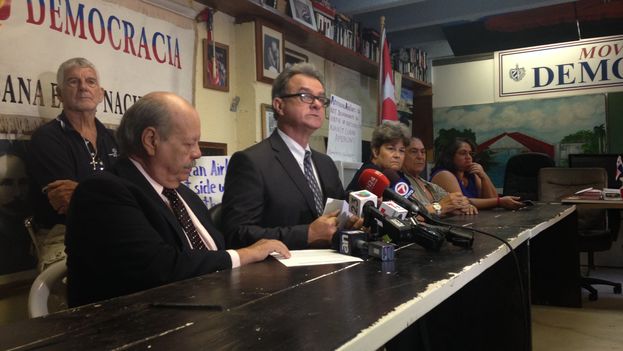
Ramon Saul Sanchez, president of the Democracy Movement. (14ymedio)
14ymedio, Mario Penton, 20 September 2016 — Ramon Saul Sanchez, president of the Democracy Movement, said on Tuesday at a press conference in Miami that if American Airlines does not change, within 24 hours, its “policy of apartheid” against its Cuban-American employees, the organization would take action against it ranging from protests in the street to possible lawsuits.
“The Democracy Movement rejects apartheid on the part of AA by virtue of nationality against Cuban-American workers whom the regime will not allow to enter Cuba, and and other nationalities with American citizenship,” said Sanchez. continue reading
A Cuban exile himself, the president stressed that his organization has nothing against flights to the island. “This is not a campaign against the flights to Cuba, which we support and we believe are useful for family reunification,” he said, but he argued that the Cuban law preventing Cuban-Americans from entering the island on their United States passports is the real problem.
“We believe AA as a prestigious company, which should not discriminate against people simply because the government of Cuba does,” noted Sanchez.
With flights to Cienfuegos and Holguin on 7 September, the company began direct service to the island. These were the first of 12 daily flights to Cuba. The problem arose when, on a flight to Varadero, the crew needed to stay overnight in Cuba and the Cuban authorities refused Cuban-American flight members permission to do so because they did not have Cuban passports, according to the Miami Herald.
The company’s response was to withdraw the Cuban-American employees from the flight, although they were paid for the day. Ramon Saul Sanchez made clear that although AA decided to bear the cost of the paperwork required for Cuban-Americans to enter Cuba, so as not to upset the Cuban government, the campaign would continue.
Cuban law does not recognize the dual nationality of Cubans living abroad, and requires those who want to travel to the island to first obtain an expensive passport (about $450) that must be renewed every two years at a cost of $200. In addition, the Cuban Government reserves the right whether to admit its nationals to the island, which is enforced through an entry permit called a habilitación, which also must be paid for.
For the Democracy Movement, maintaining this law is a way to maintain its excessive charges to penalize the Cuban exile. “We are asking American Airlines to open a constructive and friendly dialog among everyone working to overcome this discriminatory practice,” said the movement’s president.
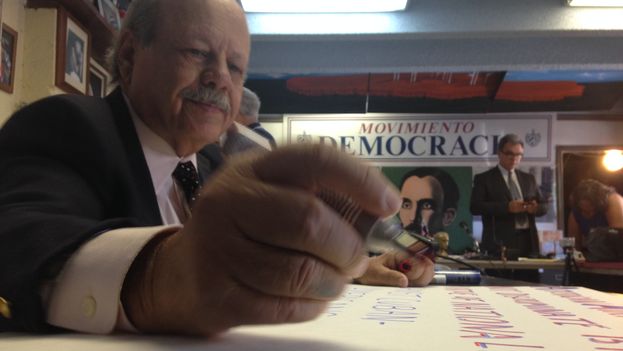
A Democracy Movement activist prepares posters for the protest against American Airlines. (14ymedio)
As a part of the actions the organization has already begun it sent a letter to Doug Parker, CEO of the company, in which it expresses its dissatisfaction with the measure. Sanchez said his movement has already planned a protest for Saturday in front of the AA Arena in Miami and will continue the pressure until the policy is changed.
“We know that the main discriminator is the Cuban government. To associate itself with the policies of apartheid by virtue of nationality that the Government of Cuba practices against its own citizens puts a shameful stain on the image of the company,” said Sanchez.
Last April, Democracy Movement organized a demonstration outside the headquarters of the shipping company Carnival for a similar reason. The cruise company did not allow Cuban-Americans to book passage to Cuba because of a ban by the Cuban government on their entering the country by sea.
“At the time Carnival Cruises said they would not continue service to Cuba if Cubans were not allowed to enter. We urge American Airlines to cancel their trips to the island if the Cuban government does not change its policy,” Sanchez added.
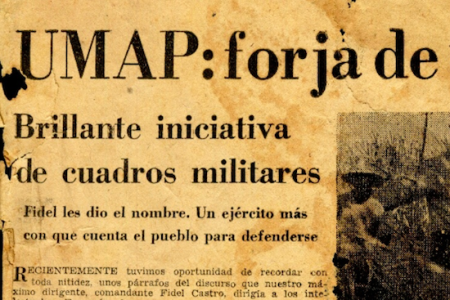
Ernesto Hernández Busto, Penultimos Días, 13 September 2016 — It seems that in Cuba one can now talk about UMAP, the notorious Military Units to Aid Production (in Spanish: Unidades Militares de Ayuda a la Producción), internment and forced labor camps where the Cuban government imprisoned homosexuals, the religious, intellectuals, dissidents and any other “suspicious elements” between November 1965 and July 1968. Gradually, people have begun to speak about the camps, to admit things and individual cases, to collect testimonies, and to make visible this sad episode.
The psychologist Carolina de la Torre, a professor at the University of Havana, is about to publish the fictionalized story of her brother, Benjamin de la Torre, who committed suicide in 1967, just after leaving one of these camps. In a recent interview she recounted the difficulties in “finding out and writing about this episode in my own country.” In effect, for too long any investigation into this thorny episode in Cuba’s history has been avoided, while the importance of information and witness accounts that came to light off the island was called into question. continue reading
The topic has always been “suspicious,” and this situation only began to change after official recognition from the victimizer: in an interview with the Mexican newspaper La Jornada, on 31 August 2010, after some hesitation and rhetorical circumlocutions, Fidel Castro declared publicly: “I am the one responsible for the persecution of homosexuals we had in Cuba… We did not know how to judge… Systematic sabotage, armed attacks, were happening all the time; we had so many and such terrible problems, problems of life and death, you know, so we didn’t pay enough attention.”
In fact, there was an excess of attention. For the young Cuban historian Abel Sierra Madero, UMAP cannot be understood as an isolated institution, but as a part of a project “oriented to social and political control. That is, as a technology that involved judicial, military, educational, medical and psychiatric mechanisms.” In recent research published in the magazine Letras Libres, and later, in an expanded version for Cuban Studies, Sierra Madero, using a relentless collection of testimonies, lucidly analyzes the Castro regime’s ideology that supported these supposed “academies to produce macho men.”
It was not just a question of a homophobic or exclusionary discourse that proposed, for example, to expel from higher schooling “counterrevolutionary and homosexual elements,” and to prevent their entry into the university. The process of “purification” was more complex and took place at all levels.
Once the purges of the universities were finalized, young people who stood out for a wide range of reasons – which included everything from long hair to being Jehovah’s Witnesses, listening to “the enemy’s music” or not being “incorporated” (not having fixed work or belonging to mass organizations) – remained “exposed and at the mercy of the State.”
The Committees for the Defense of the Revolution (CDRs) were charged with conducting a census to identify the “disaffected”, informing on them was encouraged through a National Information Center, and all this data ended up being shared with the Ministry of the Interior and Revolutionary Armed Forces, which were charged with forced recruitment.
Quite simply, there was no escape. Rather than a “lack of attention,” it was the most attentive Orwellian machinery that was set in motion to concern itself with those who did not fit into the mold of the “New Man.”
Sierra Madero’s research focuses on this concept, associated with “a broader ideological camp of social homogenization in which fashion, urban practices of sociability, religious creeds and an attitude toward work were key elements in harmonizing with a normative official vision.”
The testimonies collected – including those of the various psychologists who consulted in the camps – trace a hellish scenario: from forced hormone therapy treatments to an enormous plan of “Revolutionary hygiene” that turned the internees into an almost slave labor force, or subjected to them to behavioral and reflexological experiments, in which they came to use electroshock treatments. Other witnesses speak of tortures using electrodes and treatments that involved insulin-induced comas.
Recently, the government magazine Temas (Themes) dedicated an article by its director, Rafael Hernández, to “the time of the UMAPs.” In it, he affirms that there were more than 25,000 internees “among the more than 70 camps, scattered across the plains of Camagüey.” The number is very conservative but there is no way to contest it.
In a last year’s interview in El País, famous Cuban singer Pablo Milanés talked about his own experience in UMAP and mentioned “40 thousand” internees. Two former Cuban intelligence agents quoted by the scholar Joseph Tahbaz (Dartmouth College) in the most comprehensive study about this subject, Demystifying las UMAP: The Politics of Sugar, Gender, and Religion in 1960s Cuba, have estimated approximately 35,000 UMAP internees.
Last November, the journalist José Jasán Nieves reported about a meeting between several former inmates of the camps, now associates of the Christian Reflection and Dialog Center, and their guards, who at the time were young Revolutionaries convinced they were carrying out an important “task of the Revolution.” One of the guards, a former sergeant, has been a pastor in the Brothers of Christ Church for more than 25 years. And he cries out, of course, for forgiveness.
It appears, however, that on this issue there are different ideas about memory and forgiveness. Last December, after seeing a documentary on Mariela Castro and “The Revolution of Homosexuals in Cuba,” the LGBT activist Jimmy Roque published in the on-line newspaper Havana Times, an article asking Raúl Castro to apologize and accept his responsibility for the internment of homosexuals in the UMAPs. “Now is the time to ask forgiveness for this act of penalization, exclusion and punishment to which thousands of homosexuals and Cubans with ‘improper conduct’ were subjected,” the activist wrote, quoting the title of Néstor Almendros and Orlando Jiménez Leal’s famous documentary about this subject –from 1983.
In his article, Roque also referred to a supposed investigation into the matter that CENESEX, directed by Raul’s daughter Mariela Castro, had been pushing since 2011: “Where is this investigation? How many people have been interviewed? Who is performing it? When and where will the partial results be presented (along with those from now until the end of the study)?”
Two months later, in February, another Cuban activist, Yasmín Portales Machado, dared to quote a fragment of Roque’s article in his blog Proyecto Arcoiris (“Rainbow Project”) which deals with sexual diversity and is hosted on the Cuban government’s platform Reflejos. The text was censored and the blog closed after a succinct explanation about how it had violated “the norms of participation on the site” with a text “defamatory to the Revolution.”
In closed forums, or in publications with no real or large impact within Cuba, people then began to talk about the issue, but always quietly. They recognize that something was wrong. But there is still censorship and zones of silence. There is no mention, yet, about the origin of UMAP – and of many other similar “experiments” that seem inseparable from the construction of “a new society”: the devastating power that has been exercised by the Cuban State against all forms of dissent. The way in which one life is suddenly reduced to nothing, no longer matters, is no longer accounted for, and all violence then becomes legitimate, “natural,” exempt from responsibility. Because if we go there, how can we ignore the current repression against the dissidents, and the monopoly of the political voice and the systematic violation of human rights on the island?
Behind the “UMAP phenomenon” there was not, as one analyst recently recovered from several decades of amnesia said, a “perfect storm” of circumstances specific to the ‘60s, but the idea that any behavior that did not fit into the mold of ideological unanimity was not only reprehensible but punishable: it deserved to be suppressed, isolated, subjected to the worst humiliations we could imagine. The same way of thinking erupted again in 1980, with the events of the Mariel Boatlift, and survives today as the ideological basis of the repressive forces.
I hope we don’t have to wait another 50 years for the day when some digital publication, not greatly read in Cuba, comes to think that this beating of dissidents that goes on today wasn’t a good thing either.
The troubadour is passing through Havana to record a disc in the EGREM studios in Miramar, along with several songwriters.(Courtesy)
14ymedio, Luz Escobar, Havana, 31 August 2016 — Passing through Havana to record a CD in the EGREM studios in Miramar, along with several singers, the troubadour Roland (Roly) Berrio spoke with 14ymedio about the beginnings of his career and health of Trova in Cuba.
Luz Escobar. Together with other troubadours you are currently working on an album that pays tribute to La Trovuntivitis project. How did that project arise?
Roly Berrio. The city of Santa Clara was left quite bereft in terms of music in the hard years of the Special Period, so it all began with the desires of students to do something on a stage with many shortcomings. So at that time there was a flourishing of projects, peñas – weekly shows – and the troubadours.
We started singing in several places in the city until one night El Mejunje opened its doors for us alone, we were five or six troubadours: Diego Gutiérrez, Alain Garrido and the Enserie trio. We are all included in La Trovuntivitis, which is a generic space for our own music, for music that has certain pretensions, social, aesthetic, risky. We have been singing there for 20 years now. continue reading
Escobar. In other provinces troubadours do not have their own spaces.
Berrio. Santa Clara has had the good fortune to have leaders, both political and cultural, who have given a lot of freedom and support to the projects of young people. Without much hesitation, without fear. This has helped this movement to exist, but also in fine arts, in literature and in almost all its manifestations. Unlike in other provinces, where there are musicians and artists with talent, but when it comes to joining together and having institutional support it has been difficult to create a movement.
Of course, we also had a very bad stage in terms of political and cultural leadership. That led to a falling-out and artists rebelling. It was a moment of rupture.
Escobar. What role did Ramón Silverio play in the birth of La Trovuntivitis?
Berrio. Everything. Like our Bartolome de las Casas. He has been the doer, an example of freedom and inclusion. A project he presents, he understood the project as his own.
Escobar. What was the effect on you of your time with the Enserie trio?
Berrio. The trio was part of my beginning, my musical and intellectual training. I continue to compose songs in three parts. I bring three ways of addressing the theme that I’m dealing with, three ways of looking at it, three ways of presenting the song.
Enserie was unusual because the composition was made among three people, the lyrics and music. It was a kind of workshop, we didn’t know the rules, it was entirely empirical. We wanted to give strength to a song that experienced the most critical years, in the nineties the media in the country – and therefore much of the public – completely dismissed the singer-songwriter.
Escobar. Are you planning a concert in the coming months?
Berrio. On September 10 I will appear at the Museum of Fine Arts with themes from an upcoming album of single songs. It still has no name and I am going to record it France.
Roland (Roly) Berrio. (Courtesy)
Escobar. Do you feel that you are a chronicler of reality?
Berrio. Art can achieve awareness without having to dictate a sentence that says what you have to do. Some of the rejections to the music of the Nueva Trova movement were, in my opinion, very judgmental. There was a lot of “thou shalt do this” or “you have to be the New Man.”
My song seeks pick up the pieces that were broken and that are still somewhat scattered in the society, in the country.
Escobar. How do you assess the health of Trova?
Berrio. Trova has not had, beyond the moments it had in the eighties, much impact on the broader plane. What happened is that people like an individual of some genre, and not the genre as a whole. In the eighties, whether or not you knew the person who was going to sing, if Trova was announced the venues were full and people came to know there was a curiosity that then began to disappear.
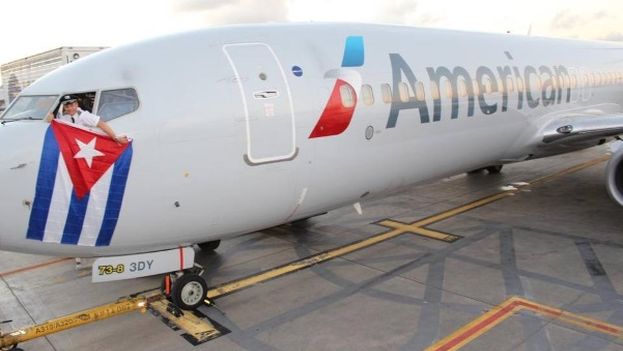
American Airlines launched its scheduled flights to Cuba on Wednesday 7 September. (AA)
14ymedio, 20 September 2016 — The Democracy Movement called a protest against American Airlines (AA) for Saturday 24, in response to the company’s apartheid towards its Cuban-American employees
The airline, according to information published in recent days, does not allow its workers who emigrated from Cuba after 1970 to serve on the crews of its flights to Cuba, because the Cuban government is requiring that they present, along with an American passport showing that they are US citizens, the Cuban government’s own paperwork that authorizes them to enter the country.
Ramon Saul Sanchez, president of the Democracy Movement, in statements to Diario Las Americas, said that this exclusion is applied to Cuban-Americans “with the deliberate intention [by the Cuban government] of receiving an additional income of 400 or 500 dollars [the cost of the paperwork] for each person traveling to Cuba.” continue reading
The leader of the organization said it has requested permission for the protest, to be held in front of the American Airlines Arena in Miami, since the airline “is allowing the Cuban government to practice a kind of apartheid against its own employees who are Cubans nationalized as Americans.”
Last April, the Democracy Movement organized a demonstration outside the headquarters of Carnival Cruises for a similar reason. The cruise company did not allow Cubans to travel on its ships because of a ban from the Cuban government on their entering the country by sea.
“Many voices joined the campaign, and Carnival changed its position. In the end, the company said that if it could not carry Cubans it would not sail to Cuba. That led the regime to overturning the old policy,” said Sanchez.
The exile told the media that their lobbying strategy includes dialog with the airline’s management in the coming week, the protest scheduled during a Disney event at the American Airlines Arena, and possible legal actions being studied by the organization’s attorneys.
“We are also asking AA to adopt the Sullivan Global Principals [whose aim is that companies and organizations of every size, and a broad spectrum of industries and cultural entities, work to achieve common objectives in human rights, social justice and economic opportunity] which worked in South Africa, and that they not associate themselves with the apartheid practiced by the Cuban government,” he added.
The Democracy Movement is not opposed to commercial flights to Cuba, “because they have brought a drop in prices and tariffs and now the Cuban regime earns less because of the competition.”
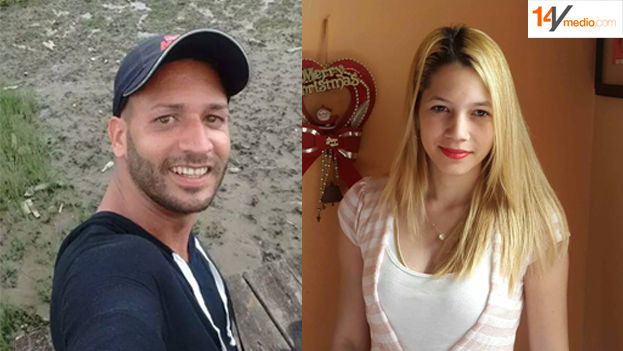
Dunieski Eliades Lastre (left) and Edelvis Martínez Aguilar (right), Cuban migrants killed in Urabá, Colombia. (Courtesy)
14ymedio, Mario Penton, Miami, 18 September 2016 — “With the money from the sale of my mother’s house, we bought the death of my brother.”
Spoken with indescribable bitterness, these were the words of Edgardo Nordelo Sedeño, brother of Dunieski Eliades Lastre, age 25, murdered in Colombia on 8 September along with the young woman Edelvis Martínez. Both were Cubans and were trying to sneak through the jungles and borders that separated them from their goal: the United States and their dream of a free life.
Although Forensic Medicine has ruled out for the moment the alleged rape of Edelvis Martínez, the prosecutor has revealed gruesome details in the tragic ends of these young migrants trying to reach the United States. continue reading
Edelvis Martinez Aguilar was an accountant for a paladar, a private restaurant in Havana. She left with her boyfriend Liover Santos Corria, 35, heading to Guyana. After crossing Venezuela and Colombia they met up with Eliades Dunieski who apparently traveled to Capurgana to get to the Darien jungle. That day, two of them were killed in a Colombian swamp.
“We can not say that Martinez had been raped, at least there is no macroscopic evidence of that. Forensic Medicine did the research, collected samples from the body and are undertaking a conclusive analysis of the issue,” an official with the Columbian Attorney General’s office told 14ymedio, who asked to remain anonymous.
“We have found clear signs of torture in both victims before the murder,” he added.
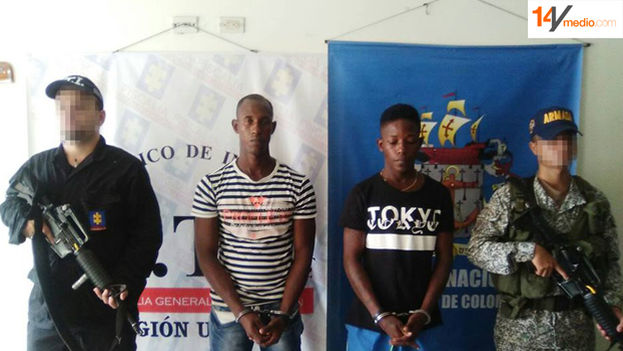
The alleged perpetrators were identified as Johan Estiven Carreazo Asprilla, alias ‘Play Boy’, age 20, and Carlos Emilio Ibargüen Palacio, age 26. According to Santos, the only survivor, the Cuban migrants paid $1,500 to be taken to Panama, but once they arrived at the Gulf of Uraba the smugglers demanded more money. When the Cubans explained that they had no cash, the boaters murdered them with knives and hid their bodies tied to a tree trunk at the bottom of the Matuntugo Swamp. Santos saw his girlfriend beheaded after she was raped, he says, but he was able break loose and escape from the crime scene.
“The young man is under protection on a Navy ship because we fear for his safety,” said the source in the Colombian Attorney General’s office. According to the investigator, it is very likely that there are more people involved in the murder of the Cubans so it is necessary to protect the main witness.
“The boatmen pleaded not guilty, but the prosecution has sufficient evidence to incriminate them,” the source explained.
Following the arrest of suspects involved in the crime, a search of the travel backpacks of those killed found cell phones, cash and clothes. Also seized were a firearm, a smoke grenade, several pieces of clothing related to the crime scene and a wooden boat in which was one of the shoes of the murdered woman.
The alleged murderers of the two Cuban migrants in Colombia. (Colombian authorities)
The identity of those murdered was corroborated by Cuban authorities. According to what this newspaper has been able to confirm, the United States embassy in Colombia has taken up the issue and expressed interest in granting asylum to the survivor.
Although the Cuban consulate in Bogota declined to comment on the matter, the Colombian Foreign Ministry said they have been in contact with the relatives of those killed through diplomatic representatives in Miami to advise them on the procedure to claim the bodies.
“Colombia will provide all the help needed for repatriation, but this is a matter for the family or the Cuban Embassy. Family members can delegate power to the embassy or manage the process independently,” said the Foreign Ministry.
14ymedio spoke with the relatives of the victims in Cuba and in the United States. For Maria Isabel Aguilar, the mother of Edelvis Martinez, her main concern is that so far she doesn’t know what the process is for repatriating the body of his daughter.
“We went to MINREX (Ministry of Foreign Affairs) but there they told us to wait for the authorization of the Colombian government to bring the bodies. We don’t know how to bring my daughter. I only want her here with me,” she said.
Dunieski Eliades Lastre’s brother, Edgardo Nordelo Sedeño, said that the cost to repatriate the bodies is around $3,000 each. The family members who had to privately arrange the trip to MINREX explained via a telephone call that although the Cuban government authorized the entry of the bodies, they will not pay for the costs of bringing them home.
“Dunieski was my younger brother, my mother’s delight. So much so she wanted to sell her house to be able to pay for the ticket so he could have a better life,” explained Nordelo, who arrived in the United States last February by way of Ecuador.
“I don’t understand the motive for the murder. The other boy … told me that my brother told them, ‘Don’t kill me, I’ll give you the number of my brother in the United States so he can send you money. It wasn’t for money. I don’t understand why they did it,” he said.
Eliades Lastre managed to make the crossing from Guyana to Turbo in one week. According to his relatives he had a good trip until he reached the Colombian coast.
“Because of the bad weather they couldn’t take them to where the other coyote was. They returned to the home of a guide and a few minutes before leaving the house where they were hiding, he wrote me to tell me. That was the last time we communicated,” recalls Edgardo Nordelo.
“The blame for the death of our family members belongs to those who pushed them to the jungle and made them seek out coyotes to achieve their dream of freedom,” he said.
Moment of approval of the Declaration of Margarita, at the conclusion of the Non-Aligned Summit in Venezuela. (@MNOAL_Venezuela)
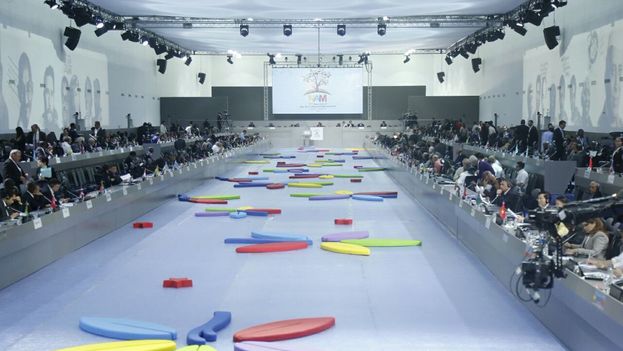
14ymedio, Reinaldo Escobar, Havana, 19 September 2016 – The summit of the Non-Aligned Movement (NAM) ended this Sunday on the Venezuelan island of Margarita with commitments to the sovereignty of each country and a call for unilateral corrective measures. The work of the meeting urged the elimination of “weapons of mass destruction” but avoided admonishing North Korea for its recent nuclear tests.
With little political influence in the international arena, the NAM has crossed the threshold of six decades of existence with its importance in check. Born at a time of strong geopolitical and ideological conflicts, in the midst of the Cold War, the bloc has failed to maintain its intended neutrality and several of its nation members have ended up developing economic and political alliances with more than one “superpower.” continue reading
However, the biggest setback for the organization, which includes half the world’s population, is having turned a blind eye at several transcendent moments in its history. The most notable of these was not strongly condemning the Soviet Union’s armed intervention in Afghanistan, which joined NAM in 1961, early in its existence.
This oversight was most striking during the 6th Summit, held in Havana in 1979, when Fidel Castro was named president of the movement. The presence of occupation troops from the Kremlin continued to 1989, but the leader of the organization never made any gesture of disapproval.
This September the silence has been repeated, in complicity with one of NAM’s most fractious members. At the summit, held in the Venezuelan Caribbean to which 120 member countries were invited, no pronouncement was made on the nuclear test recently conducted by the Pyongyang regime.
The Non-Aligned Movement has not only looked the other way as famine and lack of rights has affected the North Korean people, but has also been silent about the danger posed by the more than 20 nuclear bombs and almost a thousand ballistic missiles of different types that have reached the hands of Kim Jong-Un. The Movement did not make a forceful statement against the only country that has tested weapons of mass destruction in this millennium, though it dedicated considerable time demanding “peaceful settlement of disputes and refraining from the threat or use of force.”
NAM now proposes a “refounding” of the United Nations that seeks to expand the Security Council and to transform of the workings of the international organization. But with such oversights and its history of double standards it is difficult to promote a more democratic global and effective entity.
Instead, it could bring to the United Nations the same convenient blindness that it has been practiced for decades.
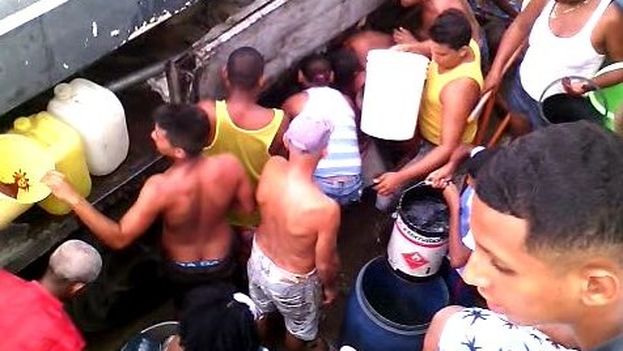
Many Cubans have become accustomed to relying on water tankers for their water. (14ymedio)
14ymedio, Marcelo Hernandez, Havana, 19 September 2016 — A sign announces the sale of an apartment in Havana and stresses, in capital letters, that the “water never runs out” in the area. Not far away, another sign alerts neighbors of a multifamily building: “Starting today, the water-pump will only operate for one hour.” In the last three years, Cubans have lived with drought and water shortages, and forecasts suggest that the situation will not change in the coming months.
According to a recent report released by the engineer Abel Salas García of the National Institute of Hydraulic Resources (INRH), 48 of the country’s sources of supply are completely dry. Another 200 show partial affects, which means that more than 790,000 people receive water right now on a different cycle than what they were used to, and more than 50,000 receive their supply through tanker trucks. continue reading
To talk about the cycle “they were used to” alludes to the fact that in many places citizens have become accustomed, as a normal situation, to water only flowing to their homes every other day, or sometimes only three times week.
The areas with the highest cumulative rainfall between January and August were Artemisa, Isla de la Juventud, Pinar del Rio and Havana. At the other extreme, the least favored regions are Santiago de Cuba, Ciego de Ávila, Villa Clara, Sancti Spiritus and Cienfuegos.
In the specific case of Ciego de Avila, as detailed in the INRH report, of the 14 groundwater basins in that largely agricultural province, six are in critical condition.
In January, the reservoirs were filled to around 53% of their volume and, although up to August rains were close to the historical average in the three regions (eastern, central and west), at the end of August this rate was only 52%. In absolute terms, the country had 653 million cubic fewer meters of stored water than is usual for August.
According to experts, rainfall in the Cuban archipelago has been decreasing by around 1.6 inches annually, which they attribute to climate change and other environmental factors caused by the hand of man.
A lack of water caused by erratic rainfall is exacerbated in Cuba by wasteful leaks in the pipes, in over-wide pipes that bring more water to leak out, and in unstoppable domestic drips caused by lack of maintenance in homes where, given the high price of faucets and plumbing supplies, people find it cheaper to let the water flow uncontrolled than to fix the plumbing.
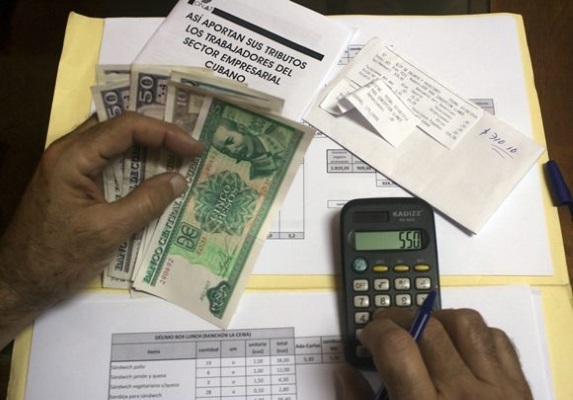
Cubanet, Miriam Celaya, Havana, 7 September 2016 — In recent days, the Cuban official media announced the implementation of a tax on personal income for workers in the State’s business sector, as well as an extension of payments called Social Security Special Contribution (CESS) – that workers at the so-called “perfecting entities” were already paying into.
The new measure will take effect on October 1st of this year and will involve over 1.3 million workers who will “benefit” from the Business Improvement System (SPE) along with those receiving payments for results and profits. Such an arrangement “confirms the redistributive function of tax revenues and allows a decreasing participation of the State budget in the financing of public expenditure,” according to officials quoted by the official press. continue reading
The payment of taxes will be deducted directly from State company workers’ income by the State company, which will forward it to the State Budget. That is, workers will collect their a salary after deductions are taken by their State employer for payment to the State.
Contrary to what might happen in a moderately democratic country, where workers can join together in free trade unions and make demands against measures that affect their wages and income, in Cuba there have been no demonstrations, strikes or insubordination in the labor groups affected by this arrangement. Nor is this expected to occur. Against the grain of what some imaginative foreign digital media may claim about “over one million angry workers,” to date no event in the Cuban scene justifies such a headline.
Actually, Cuban State workers, deprived of such a basic right as free association, have developed in recent decades other peculiar ways of processing their dissatisfaction with government actions that harm them, such as being less productive and increasing theft and “diversion” of resources to round up their depressed wages with additional “profits” from such diversions; or emigrating to the private sector – which has been becoming more frequent and expeditious – or permanently leaving the country to seek prosperity away from the costly “protection” of the Castro regime.
For its part, the Central de Trabajadores de Cuba (CTC, Cuban Workers Center), the only “union” legally recognized in Cuba, not only has failed to fulfill the functions it supposedly was created for, and – on the contrary – is developing a whole strategy of support for the government, holding meetings at the grassroots level so that union leaders may enlighten workers about the need to contribute to the State Budget as a way of contributing to the fabulous social benefits they are enjoying, especially with regard to health and education.
For this purpose there have been commissioners who, either due to their lack of mental capacity, out of sheer perversity, or for both reasons, mention among these “freebies” the public’s use of battered highways and roads, the calamitous sewer system or even the precarious and almost nonexistent system of streetlights.
However, implementation of the new tax measures should not surprise anyone. Since the 2011 Sixth Congress of the Cuban Communist Party (PCC), the Guidelines framed on Fiscal Policy announced that “higher taxes for higher incomes” (Guideline 57) would be established, and that the tax system would gradually “advance widely to increase its effectiveness as an element of redistribution of income.”
In that vein, on November 2012, Law 113 (of the Tax System) was approved, repealing Law 73 of August 1994, establishing a special provision that reads: “Personal Income tax on salaries and other qualifying income, in accordance with the special rules and Property Tax on Housing and vacant lots to Cuban-born citizens and foreign individuals permanently residing in the national territory, will be required, if economic and social conditions warrant its implementation, which will be approved by the Budget Act of the corresponding year.”
In April 2016, the VII Congress of the PCC once again took up the issue of the need for the population to develop a tax culture, stressed the inability of the State to continue assuming the costs of social benefits and announced that it was studying the implementation of a system of personal income tax… when suitable conditions existed.
In light of today, it becomes obvious that these “conditions” did not refer specifically to an increase in workers’ purchasing power, which is still insufficient despite the much vaunted 54% increase in the average wage in the State business sector from 2013 to the present, which places the wage at 779 Cuban pesos (about US $31) according to official figures. Rather the “conditions” are the State’s increasing inability to ensure the already deficient social security by itself, plus the budget deficit, which the government’s own media places at 1.2 billion Cuban pesos, which must be covered by the treasury.
As officially reported, the State budget for 2016 is 52.4 billion Cuban pesos, of which 5.7 billion (more than 10% of the total budget) went to social security.
Hence Resolution #261 of 2 August 2016, by the Ministry of Finance and Prices, which sets out in detail the tax rate aimed at complementing Law 113 of the Tax System. This should have been applied starting in the second half of the year, but – apparently – nothing could be allowed to mar the Ex-Undefeated One’s 90th birthday celebration in August, so, during the last regular session of the National Assembly of People’s Power it was agreed to postpone the implementation of the resolution until the fourth quarter, starting with September’s income.
Of course, in a “normal” society, an increase in social benefits coincides with a rigorous compliance with a realistic tax policy. The problem is that Cuba does not have either of these two premises: it is neither a “normal” country nor does it have a “realistic” tax burden, but quite the opposite.
In fact, Cuba’s own laws demonize prosperity, limit and discourage production capacity, and discourage and penalize the “accumulation of wealth.” At the same time, there is colossal inflation and a deviant monetary duality: the country operates with two currencies, the Cuban peso (CUP) and the so-called Cuban convertible peso (CUC). For the most part wages are paid in the first currency, while a large portion of the necessities of daily life are sold only in the second. With an exchange rate of 25 Cuban pesos for 1 CUC, this creates an unbridgeable gap between Cubans with access to hard currency, CUCs, and the always insufficient living wage in national currency, CUPs, creating a distortion between official projections, real wages and workers’ cost of living.
Other accompanying factors to the tax culture of a nation, not reflected so far in the government’s plans, are the economic freedoms of those who produce the wealth – the taxpayers – and a necessary transparency in financial figures. Both the source of funds of the State Budget and the destiny of the revenue that feeds State funds through fiscal policy are occult matters of science, under the management of only a small group of anointed ones.
There are certain benefits of collateral privileges for some sectors, which are also not in the public domain. For example, the population does not know what percentage of the national budget is allocated to the cost of the Revolutionary Armed Forces (FAR) and the Ministry of the Interior (MININT), although both ministries were the first to apply the SPE, while their employees enjoy higher wages, as well as prioritized plans for housing construction and free or irrationally cheap vacations at resorts with prices that are prohibitive for the pockets of common workers. They also get guaranteed transportation services, the largest motor home park in the country, preferential access to food products and a long list of freebies.
In addition, there has been no information on the relationship between the tax and the pensions that retirees get. That is, how many State workers should pay taxes to cover the pensions of all retirees, and what are the projections in this direction for a population that is aging at an alarming rate, and that is, in addition, being hit by the growing and constant exodus abroad of its labor force.
At the moment, workers – suddenly converted to taxpayers without economic rights – have not been liberated of their patriotic obligations such as the “donation” of a day’s pay for the National Militias Troops, a shell entity which nobody sees or belongs to, but with a fixed quota, or of the union fees for an association whose primary function is to defend management. Cuckolded and beaten.
What is uncontested is the efficiency of the State in sharpening its pencils and doing its math. It is known that 1736 State-owned businesses have average salaries in excess of 500 Cuban pesos at which the tax goes into effect; therefore, their workers will begin to take on the new tax burden that will make their incomes dwindle. The bad news is that, presumably, many State workers will give up their jobs to look more promising ones elsewhere. The good news is that Daddy State will stop bragging about so many expensive freebies.
The “gains” made by the workers through half a century of “Revolution” are quickly blurring.
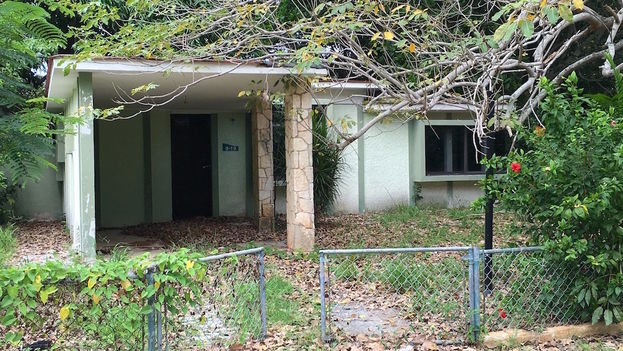
An abandoned house in the Tarara district. (14ymedio)
14ymedio, Luz Escobar, Havana, 17 September 2016 – “This was my house,” says Elena, a Cuban-American who returned to the island this week and visited the place where she spent her childhood. In Tarará she took her fist steps, but the place barely resembles the residential neighborhood of her memories. In five decades it has passed from being an enclave of rich people to hosting a teacher’s training school, a Pioneers camp for schoolchildren, a sanatorium for children affected by radioactivity, and a tourist’s villa.
In the town, located east of Havana in a beautiful coastal area, the city’s crème de la crème settled in the middle of the last century. None of the residents of the 525 houses of this little paradise could imagine that soon after the titles of their homes were released, only 17 families would remain there and the rest would emigrate or lose their property after Fidel Castro’s coming to power. continue reading
“My father bought the parcel with great enthusiasm, he always said that he would live his last years here,” recalls Elena now. She walks around the house that has lost all the wood of its doors and windows. Weeds have taken over the terrace area and on the floor of the main hall there is evidence of the many bats that sleep in the room every night.
A man sweeping the street asks the newcomer if she passed through “the entry gate” control where visitors must pay for access to Tarará. For five convertible pesos Elena has returned to the place of her nostalgia, with “lunch included” in a solitary cafe by the sea.
She heads in that direction, but not before crossing herself before the lonely church dedicated to Santa Elena, which had gotten its cross back a few years earlier, after its having been removed during the decades when the most rabid atheism ruled the place. “They baptized my littlest sister here,” recalls the woman in front of the chapel.
In the bar of the local restaurant the waiter tells her that during elementary school he spent several weeks in Tarará. Although they swap stories about the same piece of Cuban earth, they seem to be talking about opposite poles. “I liked coming because they gave us yogurt at breakfast and lunch, and in one of the houses I saw a bathtub for the first time,” explained the man who is now over 40.
His memories correspond to the days when the once glamorous villa had been converted into the José Martí Pioneers City. The camp hosted thousands of school age children every year, “they were like vacations except we had to go to school,” explained the man.
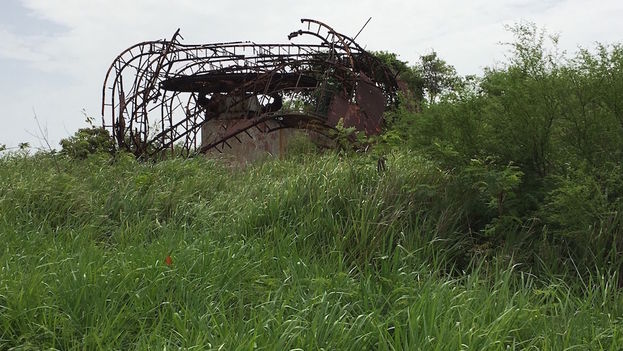
The Soviet subsidy supported the enormous complex which included a cultural center, seven dining rooms, five teaching wings, a hospital, an amusement park and even an attractive cable car crossing between the two hills over the Tarará River, which is now a mass of rusted iron.
The cable car has become a tangle of rusty iron. (14ymedio)
Elena, meanwhile, recalls the backyard fruit trees, the squash court, and the softball field that filled with families on the weekends. However, her fondest memories relate to the drive-in theater located at the entrance to the village, which is now converted into a parking lot. Between her memories and the waiter’s are 30 years, and a social revolution.
“Now the only people who can enter are those with reservations in the few houses rented to tourists in this neighborhood,” explains the employee. They belong to the families who resisted leaving despite all the pressure they received. “Overnight the village filled with young people who came to the countryside to study dressmaking,” he explains.
The few residents who didn’t leave “went through hell” the sweeper says. “They had to travel miles to find a store and all around the houses were places for dancing and checkpoints,” he recalls.
A few years ago the state-owned tourist corporation Cubanacan rehabilitated 274 houses and another state-owned entity, Cubalse, did another 223. However, the projected tourist center hasn’t taken off. “This place lost its soul,” commented the sweeper while gathering up leaves from a yagruma tree that have fallen on the sidewalk. The plaque marking the pier where Ernst Hemingway docked his yacht can barely be discerned in the midst of the undergrowth.
In the nineties, Tarará was the epicenter of a program sponsored by the Ministry of Public Health for children affected by the Chernobyl nuclear accident. They came from Moldovia, Belaruss and Ukraine, shortly after the economic crisis – sparked by the loss of the Soviet subsidy after the breakup of the Soviet Union – had put an end to the Pioneers camp.
The official press explained, at the time, that Cuba’s children had donated their “palace” to those affected by the tragedy, but no one remembers a single meeting at the school announcing the transformation the villa would undergo.
Early in this century 32,048 patients from Central and South America and the Caribbean passed through Tarará in the noted Operation Miracle, funded by Venezuelan oil. They came with different eye diseases such as cataracts and retinitis pigmentosa. They found a haven of peace in the place where only Cuban personnel working with patients and the few remaining residents were allowed to enter.
A decade ago 3,000 Chinese students came in turn to study Spanish and a police school was established in the neighborhood; its classrooms are often used to hold members of the Ladies in White when they are arrested on Sunday after leaving Mass at Santa Rita Church, on the other side of the city.
“This looks like a ghost town,” says Elena loudly as she walks the streets. Successive “programs of the Revolution” that filled the neighborhood have ended and now all that’s left is a development of numerous abandoned houses and others were a few tourists take the sun on the terraces. The beach where the visiting Cuban-American found her first snails is still there “as pretty as ever,” she says.
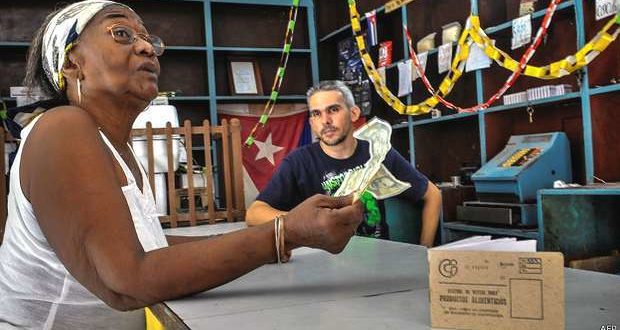
Woman with money and her ration book in a state ration store. Source: Panamerican World
Ivan Garcia, 12 September 2016 — In the best of times, when there were two ration books, sixty-year-old retiree Juan Alberto was happy. One was for food, which allotted you half a pound of beef every fifteen days, and one was for “manufactured goods,” which allowed you to buy a pair of domestically produced shoes once a year.
During that period, neighborhood stores carried condensed milk and Russian canned fruit, employees could buy oranges at their workplaces and regime supporters could afford to throw cartons of eggs at the “scum” who were trying to leave the country from the port of Mariel. Juan Alberto admits, however, there were more restrictions and censorship and less freedom than there are now. continue reading
“It has always been a dictatorship but, in the supposedly happy 1980s, believing in God, being a Jehovah’s Witness or watching pornographic films could get you into trouble. You couldn’t stay in hotels, travel overseas or sell your house. And if you left the country permanently, the state would confiscate it,” says Juan Alberto, who is thinking of emigrating to the United States in a few months through a circuitous Central American route.
Carlos, a sociologist, notes that, when comparisons are made between the two eras of Cuban communism, “something is always missing in each. Before, the ration book meant people were guaranteed a certain amount food and clothing. More products were available in the free or parallel market, you could have milk in your coffee for breakfast and salaries had real purchasing power. But it was illegal to possess hard currency or buy home appliances in hard currency stores. And social control was much more strict. Now, because of social pressures and new technologies, there is a certain amount of personal freedom. But not enough freedom to change the current situation, bring about serious reform or participate in government.”
Official academics will not admit it but the role played by the peaceful opposition and alternative press has been a silent lever, strong enough to prod timid but necessary reforms from the regime.
All the changes carried out under Raul Castro’s presidency (2006-2016) were intended to address the demands of opposition groups from the 1980s, 1990s and 2000s. These included unrestricted internet access, the use of mobile phones, the elimination of apartheid-like practices in tourism, the ability to buy and sell homes and automobiles, and the relaxation of laws on emigration.
Are there differences between the Cubas of Castro I and Castro II? Of course.
Both rulers are autocrats but Fidel Castro was a strongman with delusions of grandeur. Under the guise of volunteerism or on a whim, he concocted schemes for agriculture, housing and highway construction, coffee and banana farming. And during hurricanes he became a meteorologist.
He ignored rules and regulations and even the constitution itself. He created a parallel government with companies like CUBALSE and CIMEX and managed the nation’s treasury as he saw fit.
Fidel Castro handed himself a blank check and ruled as though he were a landowner and the country were his farm. The anthropological damage he caused the nation is legendary.
Perhaps future studies will demonstrate that the state and its media created polarization within society by attacking people for just thinking differently. Or for believing that the political experiment was nonsense. Or that Marxist ideology and totalitarianism destroyed the social fabric and the economy of the island.
There should also be studies done on the “collateral damage” to Cubans themselves, such as the harm caused by encouraging denunciation, snitching, monitoring of neighbors and creating family divisions over simple political disagreements.
If a future military regime decided to build a more pluralistic and democratic society — one with a market economy, small and medium-sized businesses operating under an appropriate legal framework, independent business cooperatives and citizen involvement in government decisions — the Cuban economy could reach the level of the so-called Asian tigers: South Korea, Hong Kong, Singapore and Taiwan. But it would take two or three generations to re-instill key human values.
There are fewer restrictions now, private business owners have more options (though under the gaze of authorities), intrusions into people’s private lives have diminished, and the long speeches and tiresome political portraits have largely disappeared. But in the ten years of Raul Castro’s presidency, there has still been no significant improvement in the quality of people’s lives.
The housing shortage, which affects more than one and a half million people and forces three generations to live under the same roof, is worse now than during the rule of his brother Fidel. The proliferation of impoverished neighborhoods is striking. In Havana alone there are more than a hundred slums where residents have no potable water and live crammed into huts with tile roofs and walls made of cardboard or aluminum.
Education and public health have fallen apart. Thousands of cattle die annually from hunger and thirst. The livestock industry is half what it was in 1959. The sugar, agricultural and fishing industries are shrinking or not expanding fast enough. Orange juice as well as snapper and shrimp are luxuries in Cuba.
The prosperous and sustainable socialism that Raul Castro promised is only a slogan. Material conditions today are insufficient to support strong economic growth.
His government’s biggest achievements have been in the international arena. It reestablished diplomatic relations with the United States, brokered a peace accord between the Colombian government and the FARC rebels and negotiated a significant reduction of the national debt with the country’s creditors.
He also approved an investment law which, despite limitations such as not allowing local business owners to invest in their own country, is intended to serves as an enticement to international investors. But due to concerns about a judiciary that is not independent, a form of capitalism that is controlled by the Cuban military, a system which does not allow employers to pay their workers directly and the uncertainty about the nation’s future after Raul Castro’s retirement, the law has not generated sufficient investment to jumpstart the economy.
In Cuba life is too much of a burden. As soon as you get up in the morning, there is something you already ack, whether it be water, electricity or coffee for breakfast. You venture outside and mass transit is chaotic. And the food shortage remains a big headache.
Fifty-six years after Fidel Castro seized power, the overall sense is that Cubans are tired of everything. That is why so many are deciding to leave. They see no solution in sight.
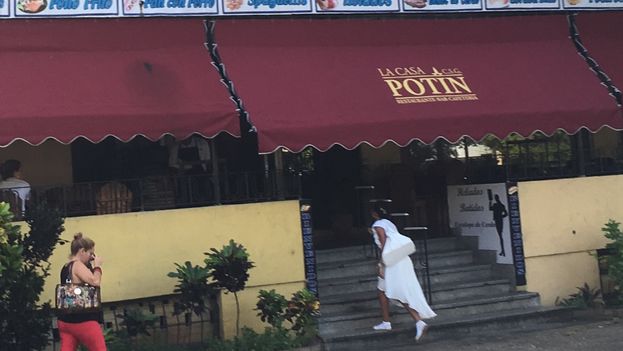
Casa Potín passed through several stages since its days of excellence in the middle of the last century. (14ymedio)
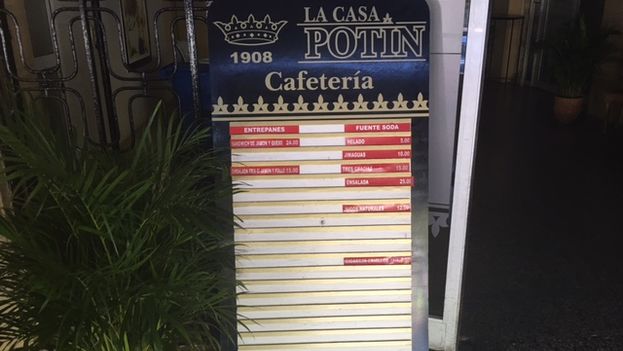
14ymedio, Zunilda Mata, Havana, 15 September 2016 — At night the corner is illuminated and the new awnings surprise passersby. The Casa Potín restaurant, for decades, embodied the decline of state services, but now it is experiencing a rebirth in the hands of the cooperative. So far, as a cooperative, it has managed to increase the prior monthly salaries of 300 Cuban pesos (about $12 US) by ten times. However the managers of the establishment feel that the lack of a wholesale market and the high costs of renting the site are obstacles to the development of the business.
Located on the corner of Linea and Paseo Streets in Havana, Casa Potín has passed through several stages since its days of excellence early in the last century when it was privately run. Many years after being nationalized, and with the arrival of the so-called Special Period, the place declined due to limited menu, lack of hygiene and the poor professionalism of its employees. continue reading
Three years ago, when it was converted into a non-agricultural cooperative and received bank credits equivalent to one million CUPs, it began to climb out of that hole. Most of the money was invested in refrigeration equipment, furniture and restoring the premises. In addition, the members of the cooperative worked to form a unique opportunity to try to recover the singular menu and the lost prestige.
The centrally located establishment is one of the 189 dining cooperatives that have been approved in recent years in Cuba. At least 80 of them are already operating and the rest are in the midst of making repairs and applying for credit before opening to the public.
“This place has changed, there was a time when it was in trouble and had a very limited menu,” says Ramon, 72, a neighbor of Casa Potín. The retired engineer is a self-confessed “devoted customer” of the place, which he has seen transformed from “disaster to glory.” However, he believes that the prices “are not within the reach of many pockets and continue to be high.”
“When we took over the management of this restaurant through this new method [government permission for non-agricultural cooperatives], the place had been closed for months because the previous management had accumulated a debt of half a million [Cuban] pesos and we had to assume that,” said a member of the cooperative who requested anonymity. The woman is optimistic and added, “If everything continues as it is now, we will pay off the debt at the end of this year.”
The reason for the large amounts of imported products consumed in the restaurant is the absence of a wholesale market where the products can be bought, according to Casa Potín’s managers. “We were very excited when the Zona+ wholesale market [owned by Cimex, a government entity] opened in Miramar, but in reality there is no difference between the costs of buying there and at the other market,” said a waitress at the restaurant.
The centrally located La Casa Potín restaurant is one of the 189 dining cooperatives that have been approved in recent years in Cuba. (14ymedio)
The legislation allows this state entity to raise the prices of some products sold in the dining network cooperatives, a sword of Damocles under which they must work. Similar measures applied to the agricultural markets and private transport have contributed to shortages and loss of quality in goods and services.
“We have had problems the whole summer with supplies from the Beverages and Soft Drinks Company,” says one of the cooperative’s employees, “so we can’t guarantee a stable supply of domestic beers or malts.”
Cooperatives have the prerogative to import equipment for commercial purposes through the Cimex Corporation, something that is still closed to self-employed workers.
Not only is it an uphill battle for the managers of Casa Potín to get basic supplies. Of the 18 initial workers who initially became part of the cooperative, only three remain at the forefront of the management of the restaurant-bar.
“People think that this is something where you don’t work very much and earn a lot, but that is not the case, we sweat it every day, making the numbers at the end of the month is not easy,” adds the employee, who acknowledges that when the place was managed by the state many products from the warehouse “were lost” and “there was a lot of diversion of resources.*”
The transformation into a cooperative has not changed the ownership of the property which remains with the state and each month the Havana Restaurants Company charges about 13,000 Cuban pesos (CUP) for rent. “It’s hard, very hard, but we have more autonomy and many customers are returning to Casa Potín.”
*Translator’s note: “Diversion of resources” is an all-encompassing term used in Cuba for what is generally theft by employees.
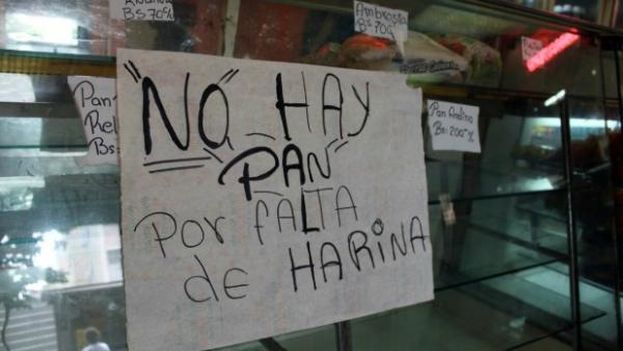
”There is no bread for lack of flour.” Commodities that are scarce in Venezuela are sold illegally on the Petare black market. (Twitter)
14ymedio, Rolando Polea, Caracas, 15 September 2016 — It’s 6:00 am on June 28, I drive slowly along the Panamerican highway, my view lost before the long line of people in shelters between the fog, the drizzle and hunger. Pressing up against each other as if for warmth. Almost a mile separates the last person in line from the entrance to the supermarket. It is the same image as the previous day. Everyone is waiting for the store to open so they can buy any regulated product that arrives, no one knows what, nor do they know how many they will be able to buy, much less if any product will show up at all.
And the agents of Venezuela’s “Bolivarian” National Guard have arrived, dressed in their usual olive-green uniforms and some Robocop protectors, who with rifles, helmets and shields, monitor the line. continue reading
I step in front of the closed door of the supermarket, flanked by the big truck of the anti-riot troops, only to notice that on the other side, extending for about 700 yards, is another line made up of the elderly. Many young people among them, these are the “liner-uppers,” family members, grandchildren, children and people who hold other people’s places.
It’s hard to get rid of that metallic taste left by the “shedding” of dignity.
Suddenly my mind, which strives to focus on the road and the radio to forget the tastelessness, is dejected by a call to the radio station, a complaint, from a lady who speaks, more words, less words, warning about the irresponsible favoritism of the officials charged with the sale and control of regulated products, allowing certain categories of public officials – like firefighters, doctors or security agents – to go ahead of the other public employees, a situation that doesn’t seem fair.
Almost immediately a “public official” calls the radio station, specifically a firefighter, to call the lady’s attention to the fact that his work saving lives and the long shifts make it impossible “to stand in line for 10 hours” to buy the regulate products of the basic market basket, and he demands that the woman complaining have some “understanding and civility.”
In the space of hardly a breath, the newscaster takes another call in which a “public employee” takes the firefighter to task, insisting he recognize that the difference between “officials” and “public employees” is governed by an internal scale in the government structures, but that eventually “everyone has the same right”…
The diatribe ends with the silence of the newscaster, and then a brief, “There you have a complaint for the authorities to consider,” followed by music, just music. What more can be added.
I think that in the midst of this whole string of unhappy complaints it’s worth remembering the public employees who, while a firefighter, police office or even a Bolivarian National Guard, work long and arduous shifts, whether saving us or repressing others, they simply, for the most part, “suck lives.”
Amid the government inefficiencies, there are some few employees or officials whose mystique and honesty are shrunk in the morass of corruption and bureaucracy. My acknowledgement, congratulations and honor to those heroes who survive that oasis in a desert of the convinced.
How far did the class struggle go… destroying the historical materialism of Marx and the classes in the productivist terms of Max Weber, the founding fathers of modern sociology, they should be appalled, the war of the proletariat.
What was heard had to have deep roots in the thinking of modern Venezuela, the misery of the totalitarian state, in which, after the ruin and disappearance of virtually all private initiative, is all that’s left standing.
Its inefficiency has plunged the country with the largest oil reserves in the world, one whose oil industry was considered one of the most efficient in the world, into a war economy, and achieved an equalization of misery, using the control of hunger and terror as weapons of social dominance.
While launching international campaigns to sell the wonderful utopia of “21st Century Socialism,” we Venezuelans die of poverty and famine.
At last, I have arrived at my job. The everyday job, the one that pays taxes, creates employment and whose productivity is seen in the results. The effort of private initiative, the only kind not stopped after the presidential decree, a decree that reduced the working hours of public employees to a half day, from 7:30 AM to 1:00 PM starting in late February this year, in order to address the energy disaster caused (for the second time) by the El Niño phenomenon, for which they never made provisions.
I am part of the private effort that continues to work a full day and that doesn’t shorten the workweek to two half-days, which the parasitic government decreed at the end of April this year, with its announcement that public employees would work only on Mondays and Tuesdays.
I’m part of one of the lowest classes in “21st Century Socialism.”
The society is divided into two blocks, consisting of castes:
Those Above:
Bolibourgeois: The highest framework of political, economic and military power, privileged and amalgamated under a corrupt system in which one has to have to have “wet hands” to belong and not represent a danger to the rest. For them there is no humanitarian crisis nor shortages and they are the ones who do not understand why those below “don’t eat cake, when there is no bread.”
Businessmen survivors: Simply entrepreneurs who are committed to working in Venezuela, whose lives abroad are assured, as are their possessions and in many cases their families. However, they are still here and on them depends a large number of direct and indirect jobs and they support virtually the entire weight of the low production and taxes.
Political opposition: Formed by the union of old and new leaderships, which are determined to return the democratic spirit of the nation through constitutional means. Enemies of the status quo, traitors to the “Bolivarian” ideal, political prisoners.
Those below:
Public officials: Those whose activities cannot be cancelled. Important people in the areas of healthcare, control, repression or “protection.” They are the first to get food…
Public employees: Those employees whose activity can be cancelled without stopping the running of the country. I offer as proof, months of no activity and everything is working. They are second in line for food.
Elderly: Older adults, some pensioners, other survivors, must stand in line or they simply don’t eat.
Bachaqueros: (a word derived from bachaco, a voracious ant-like insect) A criminal class that plays on the hunger and health of its peers, new proprietors whose networks are fed by the bolibourgeois, the “connected,” the corrupt or the Local Committees of Supply and Production. I don’t know exactly where to put them because they move like mafiosos, in the shadows.
Paramilitaries and Colectivos: Criminal fiefdoms, charged with extrajudicial state security. Official paramilitaries susceptible to extermination when they try to take private initiatives. Generally, they are the best armed in the country. They gather in mega-bands with specific territories and strategic alliances.
Us: Those of us who continue to work every day, who sign, validate, provide the masses for the opposition marches, the nonconformists, those who have no time to stand in line because if we don’t work the country stops, the employees of small initiatives, small businesses and merchants, artisan producers, service-oriented microenterprises. Those of us who use the weekends to get whatever food we can find.
Others: Survivors, the needy, those who rise at midnight to get two bags of rice and two packages of flour, to feed seven or eight people, because they cannot afford produce, those who die of scarcities because they can’t get or can’t afford medicine. Those who die in a hospital for lack of a catheter. Those who stand in line with their children who no longer attend school because they can’t feed or clothe them properly. Those who go through the trash of the supermarkets looking for an onion or a tomato they can eat. Those who are angry because they feel cheated. Those tossed out of the public administration because they were denied their right to claim indemnization on penalty of losing their money forever, or who don’t have the power to work in a public institution. They were fired for signing petitions against the government or for having different political preferences, simply because being a public official or employee requires submission to the one-party government.
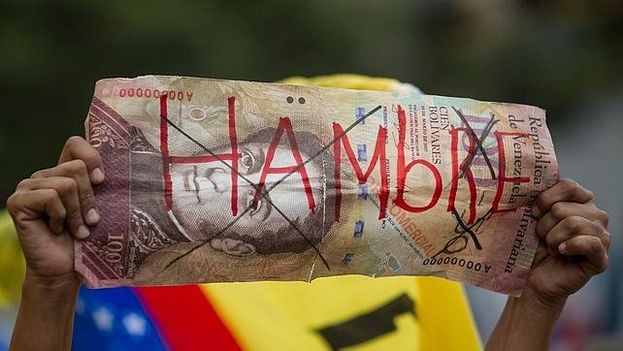
Venezuela has one of the highest inflation rates in the world. (EFE)
The Others are the growing rage of a society devoid of values. The Others are the silent society, the timebomb of a savage revolution, without ideology or principles. Because they are the ones with their education and their human condition snatched from them, the ones who fall back on their instincts, return to the jungle.
I should also mention, without downplaying their importance, those who left, escaped, found asylum, dreamers and hopers who survive, the majority, in a diaspora spread across the planet. They are the displaced, part of a refugee and nomadic humanity, so much in vogue these days.
And to think that the food and medicine that is still gotten and shared is produced by the surviving Businessmen and by Us.
I should also mention without downplaying Those, those who left, escaped, asylees, and hopeful dreamers, who survive, most in diasporas spread across the globe. They are displaced, part of a refugee and migratory humanity, so fashionable has set.
And to think, that food and medicines and still get spread, are produced and carried by survivors Company and Us.
Venezuela is more than this. We Venezuelans must be more than this. But the mass seems to prefer eating crumbs forever, rather than rising up and changing, to make a change.
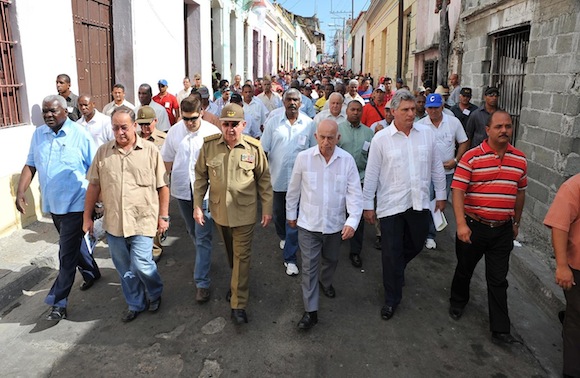
Raul Castro front row center with capo and sunglasses, walking with senior Cuba leadership and others.
Carlos Raúl Macías López, 15 September 2016 — Starting in the second half of the twentieth century, the world has witnessed a phenomenon without parallel in the history of mankind, one which has been strengthened by the fall of the Berlin Wall and the end of the Cold War, and has increasingly expanded to encompass virtually all strata of society. We are talking about globalization, whose significance has upset politics, economy, technology, culture, trade, bringing a gradual increase in communications and greater interdependence among the world’s different countries.
Human beings’ most basic rights have not escaped the advent of this trend, where international institutions have joined their best efforts and resources to ratify what is inherent and essential for every person, regardless of race, sex, gender, ideology, religion, etc. continue reading
Outside from these realities, the the official government discourse in Cuba has employed with tragic repetition the term “political isolation” to refer to the treatment that the United States government has applied, from almost the very triumph of the Revolution, to “try drown the Cuban people in hunger and need, and to generate in this way, discontent and destabilization.”
According to this line of reasoning, it would seem that the only source of dissatisfaction that the Cuban people might experience in their daily lives, comes from outside (imperialism), and never from the poor governance within. Undoubtedly, the government conveniently has known how to take advantage of this doctrine, and with impunity to undermine attention to such an extent that there are still a few of the ideologically blind (intentional or not), who blame all the ills that afflcit us on “the Americans.” Confirming the saying: “There are none so blind as those who will not see.”
If we objectively stick to the facts, we can not deny that in foreign policy the Americans have made their lamentable “blunders” and miscues (the embargo/blockade), since after 57 years of this policy the same priestly caste remains in power in Cuba. Even the current occupant of the White House, as part of recent bilateral negotiations, acknowledged that “it was time to reconsider the methods and to change them.”
None of this negates the fact that in Havana there is a regime that rules a hard and rigid hand. Events conclusively demonstrate that the true and most fearsome isolation plaguing us is not coming from Washington, but from the capital of all Cubans. Given this argument, I can not but hold that for things to move forward as they should, the dialogue should be primarily between the government and its own people, and not primarily with our northern neighbors. Because, what does it serve us to get along with those who live next door to our house, if we are at odds with those living inside it? Unlikely coexistence.
In order to shed light on the subject at hand, I must point out that human rights, the Cuba case is controversial and appeal internationally. International organizations such as the Inter-American Commission on Human Rights (CIDH), Human Rights Watch, Amnesty International, the World Organization Against Torture and others have repeatedly submitted information and reports, with abundant evidence of violation of human rights.
Moreover, the defenders of the Castro government appeal to the fact that in developed countries human rights are violated, in a much more critical way, arguing further that in 2007 the United nations removed Cuba from its list of states that violate rights humans, and that in most of the Antilles the human Development Index (HDI) is among the highest in the continent, comparable even with developed countries in the first world.
This last parameter (HDI) includes health, education, culture, which are ultimately second generation or social human rights, but the crux of the matter is that, for years, the great ruler, and then his brother, have spoken boastfully that these human rights are often raised as trophies of socialism, but ultimately a nation cannot overstate the human rights of second generation, to the detriment of the first generation, or to put it another way, it is improper to base the existence of certain human rights as a justification for desecrating others.
This has been our pathetic reality. To accept this thesis, would be like consenting willingly to be slaves, because we enjoy certain rights, because our master supplies us with food, a place to sleep, books, and heals us when we get sick, but at the same time prevents us from going where we want to go, speaking and associating with whom we want, writing about the subjects we want, etc …
What I find even more disturbing is the fact that, in order to justify certain abuses, the Cuban political system is organized on the basis of the lordship of state power over the basic human rights being breached, violated, transgressing these rights capriciously, on behalf of the government’s own interests and to the detriment of a completely vulnerable individual at the mercy of it. A simple scrutiny of the Cuban Constitution shows that the interests of the socialist state, as casually defined by the system itself, are above all else. See Article 62.
The questionable phrase “the decision of the Cuban people to build socialism and communism” is simply a euphemism for sidestepping the truth: the government’s ideology is above individual rights and guarantees, since it deprives the individual in the full exercise his or her freedom, and catalogs as a punishable offense the mere attempt to change this decision. As noted, it is not an objective, comprehensive, fair and impartial law but a law dyed with an ideology, therefore, unjust, biased, diffuse, which ultimately depends on the willingness of whomever has the power to decide what it believes is “best for the people.”
The the question asked in the title of this article — “Who violates the rights of whom in Cuba… Washington of Havana?” — the evidence points only in one direction: the Cuban government.
The US contractor Alan Gross on Tuesday at the Cuba Internet Freedom in Miami. (14ymedio)
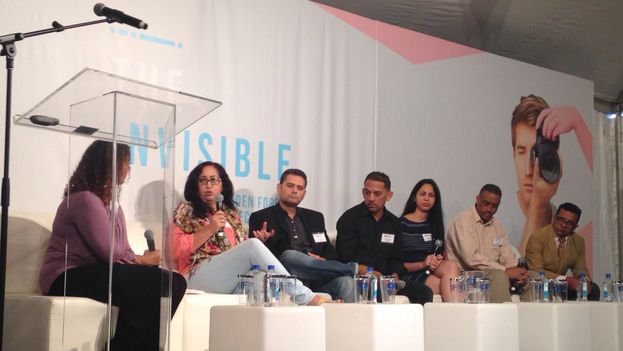
14ymedio, Mario Penton, Miami, 13 September 2016 — The last day of Cuba Internet Freedom Forum (CIF), which is meeting in Miami this week and was attended by dozens of experts in the use of networks, explored the importance of recognizing internet access as a fundamental human right and analyzed trends in the digital market on the island and the landscape of independent journalism, among others. The event, organized by the US Office of Cuba Broadcasting (OCB) and the first of its kind in history, seeks to promote new ways to increase connectivity in one of the countries with the worst internet access index in the world.
Among the most relevant events of the day was the Internet Freedom: Fundamental Human Right workshop, which involved the US subcontractor Alan Gross who spent five years in prison in Cuba for “acts against the territorial integrity of the state.” continue reading
Gross’s first words were “¿Qué bolá?, asere” – what’s happening, dude. Gorss said that “information is food for the brain” and, therefore, should be considered a human right.
The former prisoner, cigarette in hand, also noted the island’s need to “land” in the 21st century. “If we believe that the Cuban government says about the the need for exports to improve its economy, we have to think that it would facilitate contacts between producers and foreign markets, and that can only be done through the internet,” he added.
In the panel on trends in the digital market in Cuba, the founder of the site Apretaste, Salvi Pascual, explained the results of a survey conducted through this new initiative, which allows information to be collected through Nauta email. The results show that the majority of those consulted on the island want internet, although they would have to pay a fixed monthly fee. The survey also showed that a high percentage of the inhabitants on the island want the government rationing system to be maintained.
“Internet is a universal human right and that is why the Castros fear it,” said Cuban-American Senator Marco Rubio in a video message addressed to the public forum.
In another panel, dedicated to independent journalism on the island, the analyst Miriam Celaya recalled the background of this phenomenon. Other participants such as Rolando Lobaina, Ivan Garcia and Ignacio Gonzalez also addressed the issue from the plurality of independent sites and the awakening being observed in other media in which official journalists participate, such as El Estornudo, OnCuba and El Toque.
Lobaina raised the challenge of organizing an event of this kind on the island, but said government repression towards the independent press “would probably prevent it.”
The Internet Freedom Forum Cuba closed its doors Tuesday in Miami. (14ymedio)
The event presented the work of the digital site Martí Noticias, which has about six million visits to its website and an average of more than nine minutes of time spent on the site.
“It is an excellent opportunity for an exchange between those of us on the island and those in exile. The future of the internet in Cuba we are going to guarantee for everyone,” Joanna Columbié, a member of the Somos+ Movement (We Are More). The activist added that this type of event has a real impact on ordinary Cubans, because it provides tools to facilitators who, once in the country may continue the educational work there.
According to Rachell Vazquez, a freelance journalist who contributes to 14ymedio, it is increasingly necessary that the information produced in Cuba not only reflect the reality of the capital, but also the interior of the island.
“Freedom, both of expression and on the internet, is fomented when people of a neighborhood or a municipality see their lives, their concerns and their hopes reflected in the work we do. That’s the best way to contribute to the change of mentality in Cuba,” she said.
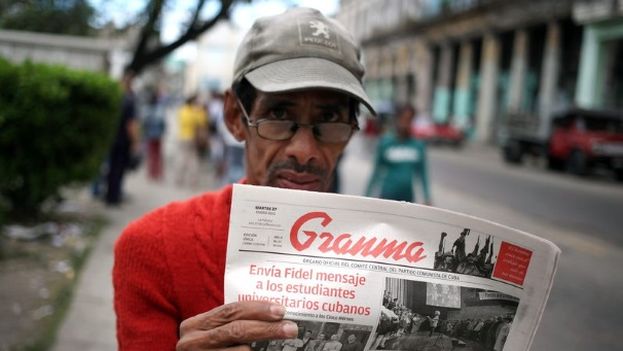
 14ymedio, Havana, 22 September 2016 – “It’s on the penultimate page,” the employee of the newspaper kiosk in Havana’s Cerro district tells a young woman who is buying two copies of the newspaper Granma this Wednesday. The terse note from the Cuban Volleyball Federation about the five- year prison sentences for rape handed down in Finland to visiting Cuban athletes sparked particular interest among Cubans, when it appeared in the official organ of the Communist Party, although citizens had to look hard to find the information.