
Tania Bruguera: “Cuba needs massive civic literacy in the streets” / Diario de Cuba

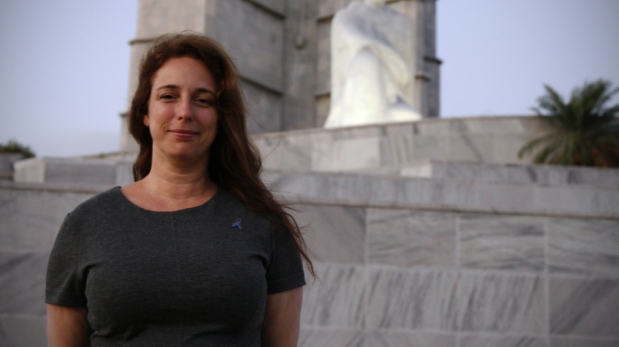
Tania Bruguera in the Plaza of the Revolution in Havana (NPR)

diariodecubalogoDiario de Cuba, Joan Antoni Guerrero Vall, 4 October 2015 — After being held in the country for eight months by the regime, in punishment for attempting to bring her performance Tatlin’s Whisper to the Plaza of the Revolution, Tania Bruguera refuses to give in. She recognizes that even when she was put in the cells at Vivac with Cuba’s repressive machinery fuming to put an end to her freedom of expression, she was happy because she felt herself to be free. She acted according to her principles, despite any action the regime took against her.

In a conversation with Diario de Cuba from New York, the artist recounts these days, speaks about the present and future of Cuba, and considers that the Cuban people have a lot to learn: “We need to help people to understand the happiness produced by things you believe in.”

After eight months in Cuba, what are the lessons you take away from everything that happened? 

I’m still processing a lot of things. I learned that the image of the Revolution is one thing and how it is sustained is something else all together. There is an extraordinary dichotomy between the image of the Revolution and living with it. I also learned that the words we use, such as “solidarity” and “camaraderie,” have lost all meaning. The Revolution has used them indiscriminately and they have been emptied of their emotional functionality, in terms of humanism and activism. continue reading

And what meaning have these words taken under the current system?

I think I had the good fortune to understand solidarity and camaraderie: to believe in the truth of your own principles. In Cuba, we spend our lives saying slogans that we repeat and that have no meaning. They are like a rhetorical construction. They are not even constructions to call to action, in fact they don’t want you to really think about them.

What did the attempt to stage Tatlin’s Whisper in the Plaza of the Revolution teach you?

In this work I’ve done nothing more, and it what I am most satisfied with, that it presents a revolutionary ethic and attitude. I have activated all the concepts and slogans to become part of history, the whole idea of having principles, everything they tell us that, in reality, they don’t let us act on.

In this sense I learned that words are not actions. We Cubans have the right to participate in the history of Cuba. It is a right that has been taken by the Government. This learning is a personal process all Cubans pass through.

What brought about the change?

I came to Cuba knowing what freedom is because I live in freedom. At the beginning, when I left Cuba, it was a huge lie. Because on leaving Cuba everything is a lie: you have to lie about your feelings, your ideas, lie about what you really want in life.

To speak the truth in Cuba is dangerous. It cost me great personal labor and great discipline to understand the value of truth, of experiencing saying it. I still have to be careful, although I have spent hears being a person who doesn’t lie and talking to people who don’t lie.

Because of this I stopped talking to State Security agents. I would like it if people in Cuba could experience how good it feels when you are doing things you believe in, being honest, speaking the truth for once in your life.

Was it difficult being in jail?

It was very difficult, but at the same time I had no problem because I had a much stronger sense of happiness because I said what I thought instead of what they tried to make me do. It is a very rare thing. I learned that injustice has a physical manifestation. You feel it in your body. So I believe that the Cuban body is numbed by the injustice it has had to bear for years. The blood is numb, it is something that is passed down from parents to children. Fear in Cuba is in the social DNA and that is what we must eliminate.

And how can that be done?

We have to make people understand the happiness that comes from doing things you believe in. My emotional spectrum is much broader now: I learned things that I still don’t know how to explain.

I learned that the country has to change and that it can’t continue like this. The Cuban government has the custom of projecting Cubans as a happy people. And how do they demonstrate this happiness.  Because there is a lot of sex, beaches and laughter. But this isn’t happiness, without know that one is honest with oneself. This is what is missing in Cuba.

I want to continue working for it. I learned that art can be a part of history and of participating in an event on a higher scale, beyond the exposition. I greatly enjoyed how everything happened.

Has your perception of the country changed? Any disappointments or surprises?

I always tried to understand who benefitted most from what I did. I was under a lot of pressure to speak badly of artists who didn’t support me. If my project is about freedom of expression, I don’t have the right to judge other artists. If I advocated for the coexistence of differences, I can’t judge those who think differently.

I harbor no anger against absolutely anyone, I have no personal problem with any Cuban artist, whatever position they take. I believe this is a very complicated issues, from many points of view, and nor does political art in every country support it.

I also realize that, being in Cuba, there was a lot of underground work, pressuring me to speak ill of the artists.

By whom?

It could be a Government strategy to support them in isolating my community even more. I know that my separation from the artists’ union was orchestrated by State Security. There were people who received visits from State Security. They told them I was working for the CIA and that if they went to the Havana Biennial and someone asked them about my case, they should say they didn’t know anything about what was going on with me.

They told every person a different story. I have faith and I know it will change. I know Cuban artists are going to join the fight for freedom of expression because art is finding personal freedom. Under all the pressure that came from State Security, the curators, the director of the biennial, there were a lot of people who supported me, perhaps not all of them publicly and person a person helps you by offering you their shoulder, they can help you see the light about something that you’re doing that they think you shouldn’t do.

I love artists very much and they sit down to share ideas with me. I know I’m not alone and that the community of artists in Cuba supports and respects me. Everyone has their time. I think that we have to respect the personal process of each person. I don’t think it’s healthy to force anyone to make a decision when they’re not prepared to make it.

Is Tatlin’s Whisper already a closed action? Are you finished with it with your departure from Cuba? Is it possible there will be new attempts and you will continue challenging the authorities of the island from art?

That depends on State Security, not me. For me, Tatlin’s Whisper is a work of art of conduct. The significance fo the work is in how people conduct themselves. The fact that some people were in the Plaza is a part of the work.

The Cuban Government wants to appropriate for itself all authority through State Security. It is what they always do. Many people say I already knew what would happen. What I knew is that it was a historic moment. In those moments things didn’t function in the same way as always, things could change the meaning. People were outside their comfort zone and reacted in unexpected and different ways. I had this element in my favor.

As an artist, the Plaza of the Revolution seems to me to be a place that is exhausted, an ugly place in the sense that its meaning is very closed. I had thought of a Plan B, of doing it in other places. But after everything that happened around asking permission and I saw everything develop all around me, the art work set aside and the entire Cuban system of repression and control of the masses put on full alert. Then the Plaza of the Revolution took on another significance: it is not a people’s place, it is the center of power, the buildings surrounding it are places where they create the strategies of repression. So it was the place to stage the performance. In that moment I thought it was the place I had to do it.

Throughout the months you have been in Cuba the “thaw” process has continued. There is an evolution toward models of authoritarian capitalism. Do you believe the Government will manage to insert itself into the international community with these “particularities”?

The problem we have in Cuba is the arrogance of the people who are in power. They believe they are the only ones who have the answers to what happens in the country and the only ones capable of fixing what is happening. This is the first problem we have in the country.

The second is that we are going through a transition in which the people are not given a chance to participate, they are converted into receptors of orders. It’s like what you would say to a small child, “This is best for you.” Well, maybe not.

In the model they are following in Cuba — capitalism, feudalism, or what they are inventing — they are giving a disproportionate priority to the economy as the solution to the human problems we Cubans are suffering. I have heard many people, in the opposition and others, who agree that private businesses and creating a strong middle class will resolve the problems. I don’t agree with this.

Yes, there should be an economic blossoming, because the people deserve it, but I believe that the middle class, without a civic education, could be as reactionary a caste as the leaders of today’s Cuba are. Why? Because what it happening is that the egotism of those who have power will be spread a little more.

The Cuban people are a traumatized people, abused, they don’t know what they feel because they haven’t escaped from it. The first thing that has to happen is a massive civic literacy program in the streets so that those who know how to read and write learn to understand what they feel and to express themselves. The second is the Constitution: it has to be changed, but by whom. The new Government? A group of intellectuals?

What has to change is the people. I would love to see a system like in Iceland, where the people were directly involved in the changes. I think it is very dangerous to transition from ideology as truth to money as truth. Now the Cuban people deserve explanations, not orders, they deserve the ability to ask questions have the right to get an explanation and to have their doubts about this explanation and to be respectfully responded to.

How do you see Cuba today and the role of self-employment which some consider the germ of other changes?

With everything that is going there, there has been no improvement in democracy in Cuba. The owners of the new businesses are reproducing in the most intense way the social injustices of the Government. There is no protection for workers in private businesses, there is a reproduction of the mistreatment… you have been abused and now it is your turn to abuse.

I don’t know to what extent the middle class has a social and national conscience, or if it is rather a logical response to this spiritual and economic hunger that they have had for 50 years.

Another question is who can start these businesses, people who have family in the Government or family abroad. It is false that businesses in Cuba are free, they are blackmailed politically.

And what does this context portend for the world of art. We recently saw the censorship of The King is Dying

The strategies of artists from the ’90s, speaking their demands obliquely and metaphorically and using displaced geographic examples to make a connection and to speak about their immediate reality are exhausted. Artists have the opportunity to present what is happening but not to question the cause of everything we are experiencing. No one can make a movie that explores the reasons for the problems.

Their treatment of Juan Carlos Cremata was abuse because it would have been enough to censor his work. But I think it is very important to understand why they took away his institutional right to do theater. They have such a huge fear that they are going to lose control in this transition that they can’t stop and they can’t fix. They are doing what they can to maintain control. They are looking for scapegoats so that the rest of the artistic community will get the message. They are afraid.

Do you think there will be obstacles for you to return to Cuba? On your departure you had a visit with an agent in the airport…

I did everything I needed to do so they would let me return to Cuba. It took me a month and a half to get them to give me a letter where it says my case is dismissed. They do everything illegally. Within six months they closed the case because after that they have to ask for special permission from the Ministry of Justice to continue with the investigation. They took it to the limit.

According to all the lawyers I saw, they have not one single reason not to let me enter Cuba. My only passport is Cuban, I have not renounced my residence in Cuba and I have never engaged in illegality. If when I decide to return to Cuba the government of the United States is still negotiating issues of human rights with Havana, I think they will let me enter to demonstrate that I was wrong and that I had an unfounded fear and to show the Americans that they are not so bad.

If they want to know something. if they need to find something out through an interrogation, that is another reason to let me in. When I return I have no intention of speaking to State Security again because on this trip they came to my house trying to change the way I think. I am taking advantage of this interview with Diario de Cuba — because they read it — to tell them that I am not going to speak with them again because they lied to me, they told me they would free El Sexto on 24 August and he is still a prisoner. And I have said that I do not speak with liars.

Another thing that can happen is that if when I return they feel secure and that they have gotten what they want from the United States, they might not let me enter.

Finally, what would be the best actions to advocate for an inclusive and democratic Cuba?

First, a massive civic literacy campaign. People have to learn that they have something to give and that things can change. What has to happen then is that the Government releases all the political prisoners.

We should enter into an absolutely democratic process where people express the vision they have for the country and hold a kind of referendum about where the Cuban people want to go. Of course, all this derives from a constitutional change.

I would also support a Truth Commission, so that people recognize what was done and as a process of social “clean up.” We have to face the difficult things we’ve experiences, but without condemning people, without revenge.

In addition, it would be good the for a few generations no Castro could be in power. I do not want a third Castro in power. Out of decency and respect for the Cuban people, the descendants of the Castro family can help the people, through foundations, but they should not meddle in politics.

Out of respect for the people and because they are not better than anyone.
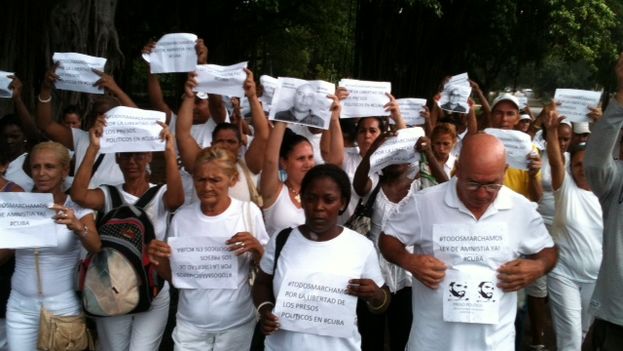
“Wave of Political and Social Repression” in September, according to CCDHRN / 14ymedio

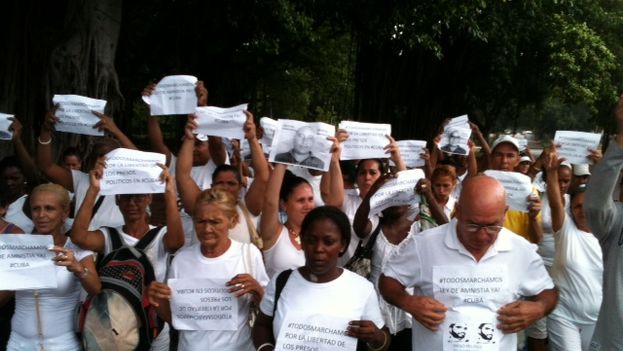
Ladies in White during their march this Sunday (Angela Moya)
Ladies in White during their march this Sunday (Angel Moya)

14ymedio bigger14ymedio, Havana, 5 October 2015 – This September there were at least 882 arbitrary arrests for political reasons, according to a report by the Cuban Commission on Human Rights and National Reconciliation (CCDHRN). The figure is the highest in the last 15 months, says the independent entity which also warns about an increase in “physical assaults against peaceful opponents by police agents and their collaborators.”

The cases of physical violence reported and verified y the CCDHRN reached 93, “while there were 21 in August.” The Commission, chaired by human rights activist Elizardo Sanchez, points out that “September did not lack many acts of harassment and vandalism, either.” These include “house arrests and extrajudicial bans on movement,” says the text of the report.

As “a true wave of political and social repression” there were “353 arrests of peaceful dissidents to prevent them from participating in massive gatherings” with Pope Francis.

The opposition sector was not the only one that suffered police raids, and the CCDHRN reiterates that “an undetermined number of beggars, panhandlers and other homeless people who seek alms on the streets or search for food or anything else in trash dumpsters were interned without judicial order.”

The case of the three from the Patriotic Union of Cuba (UNPACU) who “managed to breach the police cordon and approach Pope Francis” in Havana’s Revolution Plaza, is singled out with interest in the report. Zaqueo Baez, Maria Anon and Ismael Bonet “have been jailed for 15 days, under subhuman conditions, in the hands of the secret political police, without access to defense attorneys and without formal charges.” The CCDHRN “is prepared to propose that they be internationally adopted as possible Prisoners of Conscience.”

Translated by Mary Lou Keel

Independent journalist Roberto de Jesus Quiñones Arrested in Guantanamo / 14ymedio

Independent journalist Roberto de Jesus Quiñones.

14ymedio, Havana, 5 October 2015 — At six in the morning on Monday, a group of 15 Interior Ministry troops stormed the house of lawyer and an independent journalist Jesus Quiñones Haces, in the city of Guantanamo. The troops conducted a thorough search and took the reporter, without specifying the reasons for his arrest or his final whereabouts.

According to his mother, Maria Haces, 77, among those who participated in the operation were men in olive-green uniforms and others in blue and black, plus individuals in plainclothes. The entire search process was filmed with a small camera and they ultimately seized a computer, several disks and documents. The arrest occurred in the absence of the Quiñones’s wife, who is traveling in the United States.

The reporter is also a member of the Corriente Agramontista association of independent lawyers. His reports on events in his province are published by the agency CubaNet and one of his last works denounced the poor state of the road known as La Farola, in the Nipe-Sagua mountain range of Tánamo-Baracoa.

Before turning to independent journalism, he was a member of the National Union of Writers and Artists of Cuba (UNEAC) and collaborated with the official press on reviews of the cultural life of his city.

No references of any facts that led to the police action, as it is not the exercise of their professional activities. An official present in the operation said the mother of the detainee no later tonight or tomorrow, Tuesday would be released.

The arrest occurs within hours of the Inter American Press Association (IAPA). during its meeting in Charleston (South Carolina, USA), expressing its concern about the situation of the press in Cuba and repression against independent reporters.

Two Lies and One Meddle / Rebeca Monzo

Rebeca Monzo, 5 October 2015 — Cuba’s government continues imposing three conditions to continuing the restoration and normalization of relations with the U.S.: the return of “illegally occupied” Guantanamo; the lifting of the blockade; and the end of Radio and TV Marti. These are two lies and one impertinence that could even be considered meddling.

First, it is good to clarify that Guantanamo Bay has never been illegally occupied by the United States, but that it is the product of an agreement between governments, signed in 1903 and ratified in 1934. The misnamed “blockade” is nothing more than an embargo, which has been weakening since the Carter days and that the Obama administration has further eased in recent years in Cuba’s favor, except for some portions of it such as those relating to bank loans. As for the requirement that Radio and TV Marti disappear, it is a broadcast station (like many others that exist in different countries, including our own) whose disappearance or continuation depends solely on internal decisions of the U.S. government.

These silly demands seem more like roadblocks imposed by the island regime to buy time so they don’t have to answer to the Cuban citizenry and the world for the absurd measures and the imposition of laws and decrees that plunged Cuba into a complete political and economic disaster, which the current president also participated in is responsible for.

It would be healthy to courageously confront our own successes and failures, to turn that page once and for all and not continue blaming others, to be able to advance the restoration and normalization of relations, which would greatly benefit the country and its citizens, preventing the stampede of escaping Cuban young people.

Translated by Tomás A.

Transition in Cuba: Real or Imagined? / 14ymedio, Miriam Celaya

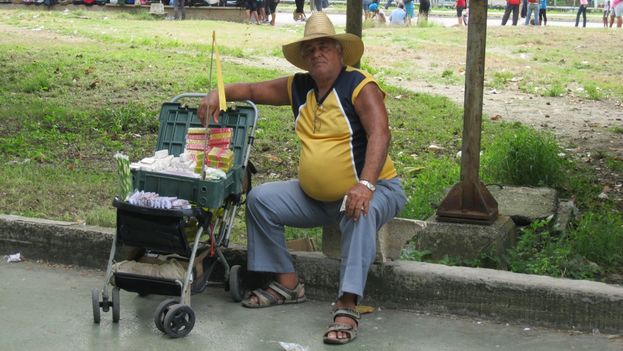
A sole proprietor sells peanuts and sweets in Havana streets, but he is far from opening a store and growing his small business. (Luz Escobar)

14ymedio, Miriam Celaya, Havana, 3 October 2015 — Halfway between analysis and opinion, and not having responded clearly to his own initial question, journalist Carlos M. Álvarez recently addressed a controversial issue: the transition in Cuba, or to put it more accurately, as posed by the title of his work: Can a transition in Cuba be discussed?

In principle, we must give credit to Álvarez for his courage: to declare that we are experiencing a transition in Cuba may be total heresy for many, beyond their political positions, or likes or dislikes of the government or of the opposition. In particular, it is taboo for those who have communed with the official power; but also, as he points out, it is something denied by many Cubans who are not at all into politics, by a sector of the domestic opposition and by the most intransigent groups in exile. continue reading

In the case of the opposition, the author could not, or did not, wish to avoid the temptation to appeal to an imagined number of sources to validate the information, which assumes that “the bulk of the opposition” seems “caustic before a Cuba that’s stretching out from a slumber.” We hope that, in future journalistic deliveries, Álvarez might disclose statistical sources that led him to reach such a conclusion, beyond his personal impressions. Meanwhile, allow me to question the accuracy of his claim.

We are in a process of economic transition, extremely slow and strictly controlled by official power

On the other hand, the transition issue is far from being a novelty among us, at least not to a significant part of independent journalism and to some opinion groups in Cuba and the diaspora, which have been noting as transition signs certain perfectly perceptible changes, ranging from the official discourse following the departure from the public stage of ex-president F. Castro, to certain changes in the economic and social order, or legal reforms, such as the January 2013 immigration and travel reform.

These are really inadequate changes, both in their proposals and in their depth and scope, but, somehow, they open some loopholes to new areas – inconceivable just a few years ago — which, in spite of the ruling elite and their hired applauders, break through the stagnation that characterized the previous decades.

It might have been appropriate to give the term transition a surname, because, though in its simplest and most literal meaning, it generically means the passage from one state or mode to a different one, in the case of Cuba, it should be clear that we would need to state precisely that we are facing an extremely slow economic transition, strictly controlled by the official power, in which a self-proclaimed socialist State with a closed and vertically centralized economy has been mutating to State capitalism, with an economic monopoly controlled by the hands of the same political power.

Which is to say that we in Cuba are not witnessing – at least until now — a political transition consistent with a step towards democracy after more than a century of autocracy, but, at most, a process of transferring political power from the octogenarian elite to its heirs, after having secured guaranties for its economic power, a process which, in addition, has been demonstrating alarming signs of dynastic style, so we would be facing a political succession rather than a transition.

We are witnessing a process of transfer of political power from the octogenarian elite to its heirs

And this is not something that happens “just like that,” as the writer of the referenced text seems to be asserting, but because the Castro regime has concentrated such power and made sure of having dismantled so deftly the entire institutional framework of Cuban civil society. The regime has time and enough resources to even dispense quiet economic changes according to its own interests, without social mechanisms to question decisions made from the heart of power, let alone to push effectively towards more profound transformations.

Returning to Adam Michnik, whose quote proves to be unfortunately out of context and out of place in Álvarez’s article, it is true that we are in the midst of uncertain times in Cuba, but not because the power is not “strong enough to sweep the political and economic forms emerging, and vice versa” — which, on the contrary, it is — but because the uncertain and primitive economic forms that have emerged were promoted by that same power, while alternative political forms have not yet surfaced, or are too weak and fragmented to be erected on alternatives. Such is the peculiarity of the fragile and uncertain Cuban transition, whether we like it or not.

Thus, answering the essential question of the article by Carlos M. Álvarez for BBC World, a process of economic transition is taking place in Cuba that today, due to the particular circumstances of our socio-political reality and other factors of a historical and cultural nature, is being promoted and controlled from the same power. So far, it’s only been confirmed that the economic scenario, on a so-called “experimental basis,” is showing clear signs of fatigue. Perhaps this cumulative process of half-changes and simulations directed mainly at the preservation of the political power might lead to a point where events rush towards a new stage, as unpredictable and different as the current one. For now, the Government continues to seize the baton fiercely and, in the short term, we cannot catch a glimpse of a complete and positive Cuban transition.

Translated by Norma Whiting

Cuba and Mick Jagger’s Kiss / 14ymedio, Yoani Sanchez

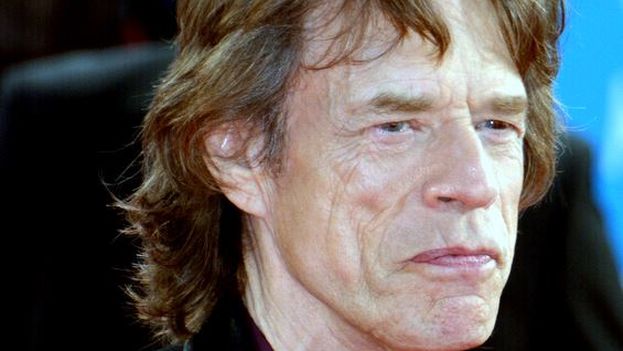
Mick Jagger in Deauville in 2014. (Georges Biard / Wikimedia Commons)

14ymedio, Generation Y, Yoani Sanchez, Havana, 5 October 2015 – We never got to hear Michael Jackson and Whitney Houston on our national stages. Freddie Mercury died without touching down in Havana, and when The Beatles broke up, we were a country where English music was considered ideological diversionism. We followed the career of Elvis Presley from a distance and the charismatic Amy Winehouse slammed the door on life without stepping foot on this island. However, now we are about to regain part of what was lost: Mick Jagger’s emblematic mouth is here, the eternal youth of The Rolling Stones has arrived.

While the analysts debate, looking for signs of change in the Cuban political or diplomatic scene, transformations are capricious and take another direction. This country is not going to change itself into a new nation because John Kerry visited, nor because of the third visit by a pope in less than two decades. But Cuba is changing when people like this British rocker, icon of good music and of the greatest possible irreverence, touch down in Havana. continue reading

The vocalist, 72, has made his way through the streets of Havana leaving a trail of incredulity and beating hearts. It is not, admittedly, the excitement provoked by Beyoncé or Rihanna with their escapades in this theme park of the past, but Jagger’s visit has more profound connotations. For several generations of Cubans he represents the forbidden, an attitude toward life that was denied us by an obsessive police control.

For a political system that tried to form the “New Man,” with a Spartan spirit, “correct” and obedient, this skinny guy with his turbulent life signified the anti-model, what we must not imitate. However, the laboratory man hawked by the pedagogical manuals didn’t work out… and Mick Jagger won the battle against the prototype of the militant boy, hair cut short and willing to denounce his own family.

A friend close to seventy came out into the streets this Sunday with the energy of girl celebrating her fifteenth birthday. “Where is he?” she asked the guard at Hotel Santa Isabel, where the official news reported the idol of her youth to be staying, but the man gave her no details. Like an obsessed schoolgirl, she walked all the streets around the hotel looking in the windows, to try to see the lean figure of the leader of the Rolling Stones.

Mick Jagger won the battle against the prototype of the militant boy, hair cut short and willing to denounce his own family

The lady displayed none of these reactions toward the American secretary of state, nor before the Bishop of Rome. For her, all these exalted visitors were in the range of the possible, no longer surprising nor moving. But Jagger… Jagger is something else. “I don’t want to die without seeing him,” she told me on the phone, with the conviction of one who will not tolerate leaving this world without “closing an era,” putting the capstone on her “best years,” she told me.

My friend infected me a little with her enthusiasm, I must confess. No sermon in the Plaza of the Revolution, no speech to open an embassy, caused my stomach to jump this way, a sudden feeling of living in historic times. A nervousness that will last until we see the legendary British band play next March at the Latin American stadium, in front of a crowd that will try to recover its lost years.

Jagger is much more than the living legend of rock and roll presented by the media. This beanpole, all mouth, all energy, all life, embodies a time that they snatched from us, an existence that we could have had and that they took from us.

It seems a shame to me that the political analysts don’t realize it: the future Cuba could start with the Rolling Stones in Havana.

Incident at the Airport Yesterday / Somos+, Eliecer Avila

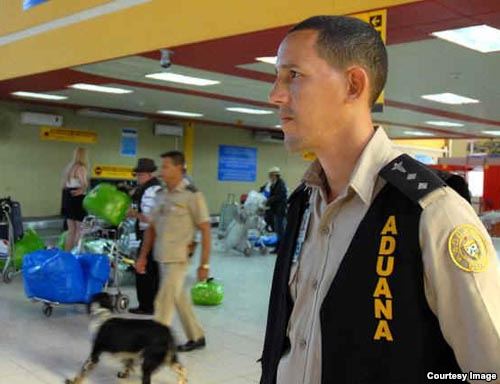
Somos+, Eliecer Avila, 5 October 2015 — Everything appeared normal until I got to the immigration desk. There the official meeting me had a sign on his screen with the word “CONTROLLED” flashing in red. With more or less discrete gestures, the young official started dialing code numbers to his superiors to come to the booth to “deal” with me. In three minutes his boss appeared who indicated I should follow him and who took my passport.

After about half an hour a different official appeared who accompanied me passing through immigration and told me to collect my things… As usual, many people waited about an hour for their bags from the Madrid-Havana flight because they arrived in dribs and drabs… When my suitcase finally appeared, I’d just picked it up when two other officials, this time from Customs, indicated I should accompany them for a “routine control.”

Knowing these things and how they work, I tried to advise my wife who was desperately waiting outside but they told me I could not use my phone. Nevertheless I managed to tell her, “things are looking bad.” continue reading

First I passed the suitcase, the little hand luggage and the laptop through another special X-ray machine, and then they brought me to the tables prepared for this purpose and began to minutely search my luggage with the meticulousness of a surgeon performing brain surgery.

They noted everything, at the same time asking me questions about my trip. With special interest they set aside four books, four journals and blog notes. Also 8 flash memories I’d been given by the Spanish think tank Foundation for Analysis and Social Studies (FAES), which they gave to all the Cubans.

The titles of the books were: Digital Citizenry, European Union – Latin America, Autobiography of Gandhi, and Letters to a Young Spaniard by J.M. Aznar.

They read several fragments of all of these, and especially Aznar’s book, which had a large photo of him on the cover. The customs officer asked me, “Is he a writer?” I told him no, he’s the president of Spain.

They also spent a long time examining a magazine that talked about Australia and its great human development. The problem with the magazine is that it attributes the success to three factors: Democracy, Market, and Transparency. For those responsible for censorship in Cuba today there are certain words that will trigger an alert that something must be confiscated from a passenger, and the two most dangerous of these are “Democracy” and “Human Rights.”

This time, fortunately, after three different people pawed through my tests, they came to the conclusion that they were not “materials to spread counterrevolutionary propaganda.”

They then decided to seize the flash memories, because according to the “regulations” I only have the right to bring in two. I explained that I had two for my own personal use, and that these 8 are ones I had brought as gifts for family and friends because I promised my grandmother I would bring her some Christian music, others are for my sisters for their schools, etc… but they weren’t having it, “It’s not possible” to let me keep any of them.

At this point it’s been more than three hours and the worries of my wife, family and friends who are waiting for me are growing by the minute. However, now begins the weightiest part, the paperwork to seize the flash memories…

They bring a green bag in which they fit the suitcase, throw in the little memories, and begin to fill out forms and describe the characteristics of each object in question: color, aspect, brand, capacity, status… circumstances… what I said, what they said… my data… their data… all that while I am standing and watching passengers from two planes that arrived after mine leave the airport.

At this point, the only thing that interests me is getting it over with. When they finally tell me I can leave, I say goodbye and rush to the door.. and on leaving see that I have dozens of missed calls and messages. An army of friends inside and outside of Cuba are ready to be my voice everything if they had decided to keep me longer.

I don’t hold a grudge against the young soldiers who perform this demeaning task. the truly perverse are at a much higher level. Looking for the cameras and pulling the strings of an apparatus that if you don’t bow down, makes you stronger.

To dignify the work of a whole generation of soldiers, not only with better wages but with better training to protect our borders from the real dangers and respect everyone’s human rights, will be a priority in the future we are going to build together, them and us.

Thanks to everyone for your concern and solidarity. My best hug.

Eliecer Avila, Engineer

The Ladies In White Face Another Sunday Of Repression In Havana / 14ymedio

Ladies in White during the pilgrimage this Sunday. (Angel Moya)

14ymedio bigger14ymedio, Havana, 4 October, 2015 – Fifty-nine Ladies in White and 20 activists gathered this Sunday in Gandhi Park in Havana’s Playa district, despite the arrests previous to their traditional Sunday peregrination. After a summary of their weekly activities, the dissidents were detained, according to a report from witnesses at the scene.

From the early hours, the regime opponent Martha Beatriz Roque denounced the arrests of 12 human rights activists who had traveled to Santa Rita parish. Among those arrested with the mother and siblings of Zaqueo Baez Guerrero, one of the members of the of the Patriotic Union of Cuba (UNPACU) who had approached Pope Francis in Havana’s Plaza of the Revolution.

Others arrested on Sunday included the regime opponents Antonio Gonzalez Rodiles, Ailer Gonzalez and Felix Navarro. The latter lives in the town of Perico, Matanzas, and traveled to the capital to show his support to the human rights movement.

Blogger Agustín López Canino denounced his arrest and reported that he was handcuffed at the corner of 5th and 30th streets, in the Playa district, together with two other colleagues. The activists detailed that he was “taken to the outskirts of Havana” to prevent his accompanying the Ladies in White during their Sunday march.

Meanwhile, in Colón, Matanzas, independent journalist Ivan Hernandez Carrillo reported ten Ladies in White marched in Colón, Matanzas, for the release of the political prisoners.

The leader of the Ladies in White movement, Berta Soler said that Yaquelín Boni, an activist detained since Thursday during a protest outside Combinado del Este prison and accused of “disobedience,” has now been released.

Cuban Phone Company Authorizes Internet Refills From Abroad / 14ymedio

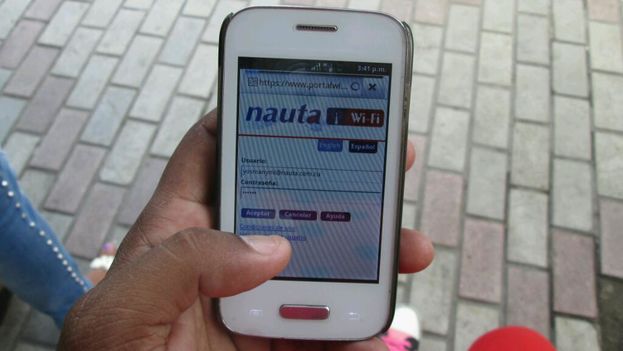
A young man connects wirelessly in Cuba via his mobile phone. (14ymedio)

14ymedio bigger14ymedio, 4 October 2015 – Starting October 6, Cubans on the island can have their “Nauta” internet access accounts refilled from abroad with 10 CUC (Cuban convertible pesos, about $11.30* US). The measure, announced this Saturday in the newspaper Granma, will be introduced by the Cuban Telecommunications Company (ETECSA) and requires users to have a permanent Nauta account.

Right now, this option does not include the “double minutes” or bonus options frequently available for recharges from abroad for cellphone service.

The official Communist Party newspaper said the new service will encourage users to sign up for permanent Nauta accounts, as many netizens still prefer to use temporary navigation cards, despite their higher prices.

The long lines outside the offices to open permanent internet access accounts, the lack of recharge bonuses associated with them, and the anonymity of navigation (without an account) are some of the reasons given by customers for continuing to use the temporary accounts.

Every day the island’s Wifi points are hosting 55,000 connections, 8,000 of them simultaneously. Although the connection price remains high at 2 CUC an hour (over $2.00 US in a country with an average monthly wage of less than $20.00), the opening of 35 wireless access points has created a social phenomenon with thousands of people congregating in those places.

*Translator’s note: The Cuban CUC officially trades at par with the US dollar, but a 10% “penalty” is added for exchanging US dollars, along with a 3% exchange fee.

“The Family Unit in Holguín Is Very Damaged” / 14ymedio, Fernando Donate Ochoa

Marcos Pirán Gómez, parish priest of San José Church in Holguín
Marcos Pirán Gómez, parish priest of San José Church in Holguín (Photo Fernando Donate/14ymedio)

14ymedio bigger14ymedio, Fernando Donate Ochoa, Holguín. 21 September 2015 — He shares both his faith and Argentine citizenship with Pope Francis, yet Father Marcos Pirán Gómez is not on Cuban soil for just a few days. He has been living on the island for fifteen years, and since 2012 has been the parish priest of San José (Saint Joseph’s) Church in Holguín.

A few hours before the Bishop of Rome travelled to this land of mountains, heat, and seas, Father Marcos met with 14ymedio to discuss his parishioners’ expectations, the difficulties besetting his community, and the role of the Church in finding solutions.

14ymedio: What did you feel when you heard that Pope Francis was coming to Holguín?

Marcos Pirán Gómez: I felt an enormous thrill because of the joy another Papal visit would mean to our people; the third one in just 17 years, such a short period of time. This is a significant event not only for the life of the Church, but also for the Cuban people. Each one of the previous Papal visits have left its mark. continue reading

Pope Francis is an exemplary and admirable person for the way he thinks, for what he does, and for his beliefs, which are consistent with how he lived in Argentina. I remember what he was able to generate around him, especially in Buenos Aires where we were neighbors living in the same area, and where we had more contact with each other. I know a lot of things from back then that are now known in the public square.

14ymedio: How will this Papal visit to the island be different?

Marcos Pirán Gómez: This third visit is also linked to the resumption of talks between the Cuban and American governments. This time stands out because it hopes to keep alive the first step taken on December 17th of last year.

Pope Francis has closely followed the history of the Cuban people. He wrote a book about John Paul II’s trip to Cuba, which undeniably signaled a before and after. It not only did so as far as the relationship between the Church and the Cuban government is concerned, but the relationship between religion and the government as well.

14ymedio: Is there special interest for Cuba in the Vatican?

Marcos Pirán Gómez: Interest and worry for these people. Cuba has undergone a political and social experiment unlike that experienced by most of Latin America’s people. It’s different in the fact that Communist ideology takes precedence in Cuba, so theres a very different attitude towards religion here than in most other countries.

Starting with John Paul’s visit, an effort was made to initiate a new type of relationship (between the Church and the State) in which there would be an official recognition of the of religiosity of individuals and of our people as a whole.

14ymedio: What do believers in Holguín expect from this visit?

Marcos Pirán Gómez: On the one hand, the people of Holguín hope this visit will help them regain their enthusiasm and hope. There’re many people who due to different difficulties, such as the frustrations of life, the breakdown of families, the scarcities, have lost their will to forge ahead. The Pope can help reverse this because his message aims to break apathy and indifference.

14ymedio: Do you sense a lot of apathy?

Marcos Pirán Gómez: Yes. People are apathetic because of their incapacity to react to situations they don’t agree with. When an individual stops demanding or voicing his concerns, whether it is out of fear or because he thinks it would be useless, that is worrisome, because it shows an attitude of apathy and indifference. I hope, and many others do as well, that the presence of Pope Francis will help bring about a reawakening.

14ymedio: So you are excited about the visit?

Marcos Pirán Gómez: Very excited. I’ve been especially impressed by people who don’t practice any religion but who see the (Papal) visit as a very positive thing. People are hopeful this visit will bring something that’ll make them better persons.

14ymedio: The authorities have conceded that violence, drug addiction, suicide, and other social ills have increased in Holguín. Is there a spiritual crisis in Holguín?

Marcos Pirán Gómez: The family unit in Holguín is very damaged and divided. There’re a lot of difficult situations, and that affects the social order.

Family units are fragmented because of financial difficulties, and because a lot of people emigrate, and that brings suffering. People don’t know how to discuses issues, how to accept one another, how to collaborate, or how to promote solidarity within the family setting. When this starts happening to the family unit, it resonates throughout society at large, while adding to the already existing personal crises in each individual’s life.

14ymedio: The Cuban government pardoned 3,522 before the Pope’s arrival. What can you say about this?

Marcos Pirán Gómez: Some have reacted happily, while others were disappointed because they thought they met all the conditions for a pardon but weren’t. The announcement (of the prisoner release) states that those convicted of “crimes against State security” would remain incarcerated. That’s why in this case it is a matter of opinion if those still being held are political prisoners or not.

14ymedio: Are there political prisoners in Cuba?

Marcos Pirán Gómez: This isn’t conjecture. The government itself has admitted there are political prisoners. Several years back, the President mentioned them. I don’t know how many there are, because there’s a lot of information I don’t know or have any access to. That’s why I can’t say for certain how many political prisoners there are, or where they are.

14ymedio: Has the Church in Holguín, or you, received a request from the opposition to meet with Pope Francis?

Marcos Pirán Gómez: Up until now, that hasn’t happened. However, we have received letters from people directed to the Pope, asking him to intercede in support of freedom for their relatives serving prison sentences. Still, I don’t know if these cases are political prisoners.

14ymedio: Has the relationship between the Church and the State in Cuba been strengthened?

Marcos Pirán Gómez: The preparations for the Pope’s visit have opened the way for some dialog. Catholics in the Papal visit’s organizing committee note there have been important changes when compared to eighteen years ago while preparing for John Paul II’s visit.

Also, for some time now we have been noticing that the government has somewhat stopped pressuring mission houses or small (parish) communities from opening. Today, these houses do exist, but there was a time when the government wouldn’t allow people to gather in homes to celebrate the Word, to pray together, or to exchange ideas. The result of this is an increase in the social ills we’re now facing. When you keep something from growing over a long period of time, that has negative repercussions.

14ymedio: The Catholic Church in Cuba does not have at its disposal a radio station or a television channel. Doesn’t that limit your pastoral work?

Marcos Pirán Gómez: Nowadays, having access to the media is very important. I don’t like things that are just Catholic. I’d like more diversity in the Cuban media. I don’t need to have my own radio station, TV channel, or newspaper, because that in itself is exclusionary. I’m not interested in that way of thinking. What I do wish is that there be space for other voices, other ways of thinking, and other messages that contribute to the common good, within the media that already exists.

Translated by José Badué

General Raul Castro’s Plastic Bag at the Papal Mass / Juan Juan Almeida

At the bottom right of the photo the general-president’s plastic bag can be seen.

Juan Juan Almeida, 22 September 015 — When, before a crowd gathered in the Plaza of the Revolution in Havana, Pope Francis celebrated the first of three Masses on his visit to Cuba, in the first row was the elegant Lorena Castillo de Varela, first lady of Panama, and next to her General Raul Castro, and on his other side the president of Argentina Cristina Fernandez de Kirchner. And, in the row behind, between the legs of the famous bodyguard and grandson Raul Guillermo Rodriguez Castro, almost hidden in a corner, the inseparable representation of Cuban culture, la jaba — the plastic bag.

Perhaps no foreigner noticed this detail. Reasonable, for the Royal Academy of the Spanish Language defines la jaba as: a dark stain on the lumbar region with which some children are born; a box specially made for carrying bottles, china or other fragile objects; a kind of basket made of woven reeds or palm leaves; and/or a bag of cloth, plastic, etc. to be carried in the hand. Of course, the scholars cannot imagine that the word jaba, in Cuban, has a special dimension, almost solemn, representing much more than any of its forms. continue reading

When the paper bag died for lack of paper back in the ’70s, la jaba became an indispensable part of the life of every Cuban, so much so that today it deserves a monument. It is a necessity that cannot be associated with a race, nor a sexual orientation, nor a gender, creed, ideology or level of intellect. Walking out without a plastic bag is like walking alone, like listening to an Andalusian tune without good company, like drinking non-alcohol beer or smoking nicotine-free cigarettes.

For some it is synonymous with poverty; for others, status, opulence and progress. An old and redundant joke says, “The body of any Cuban is not divided into three parts, but rather four: head, trunk, extremities and jaba.”

The plastic bag is used by everyone. It is the perfect addition: for errands; to protect your shoes in the rainy season; as an automotive sealant; as a hairdresser’s accessory (for making highlights); as well a form of payment [with goodies in the bag] for some workers in the system of state-owned businesses.

And, as shown in the photo, it can hide a Coca-Cola, the essence of Cuban change. General Raul Castro, putting himself on the level of the humble, has asked his bodyguards to bring his snack in a jaba.

El Sexto: He Who Laughs First, Laughs Twice / 14ymedio, Yoani Sanchez

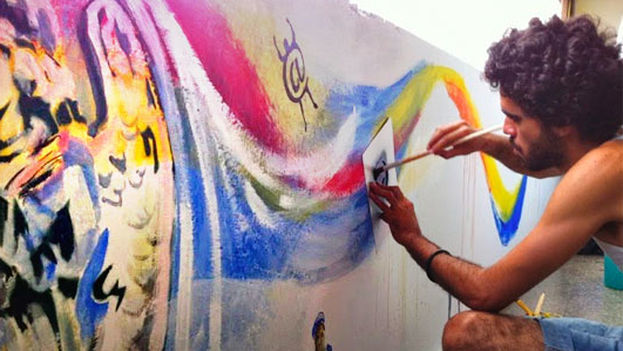
Danilo Maldonado, "El Sexto," painting the balcony wall of Yoani's apartment
Danilo Maldonado, “El Sexto,” painting the balcony wall of Yoani’s apartment

14ymedio bigger14ymedio, Yoani Sanchez, Havana, 3 October 2015 — There was no mistaking it. It was the same face that smiles defiantly from some paintings in which it resembles an unrepentant Christ. I had seen the signature of El Sexto at bus stops, followed his ironies on Havana’s walls, and wondered if this young man really existed, putting so many dreams, so many screams into his midnight strokes . But there he was, standing in front of me, in a T-shirt with a spray can.

“You cross out my stuff, I cross out yours,” said some of the artist Danilo Maldonado’s first paintings. It was when the police were using pink paint to hide his graffiti. Walking down Linea Street you could guess that behind those colorful patches in the middle of a wall that had gone decades without maintenance, the irreverent artist had left a drawing.

So when I stumbled upon El Sexto, thin, rebellious, talented, it seemed I had rediscovered a well-known face from my family photos, someone I had shared colorful nocturnal moments with, insolent and clandestine. With time I discovered that I was also facing a man who would not give in to fear and who would use his own body as a canvas for disobedience. continue reading

He declared himself “El Sexto” – The Sixth – of the “heroes” and shamelessly demanded “give me back my five euros,” in a mocking allusion to the official demand for the “five heroes” to be returned to the island.

When we were drowning in the Castro regime’s longest campaign, demanding the release of the five Cuban spies in prison in the United States, Maldonado confronted this hemorrhage of slogans and billboards. He declared himself, at his own risk, “El Sexto,” The Sixth of the “heroes” and shamelessly demanded “give me back my five euros,” in a mocking allusion to the official demand for the “five heroes” to be returned to the island.

The nickname stuck, although the former prisoners – sent home from the United States last December – are now fat and bored in their endless national tours and public events. And so the graffiti artist went from being “the sixth hero” to being the only hero of this story. A few days ago Amnesty International declared him a prisoner of conscience. This same restless boy who launched flyers all over Havana, inviting people to tear up and destroy their own fears.

But it would be the playful side of El Sexto that most annoyed the prudish Cuban officialdom. The capacity for laughter, to ask an apparently naïve question that infuriates the repressor trying to interrogate him. The mischief of turning a traffic signal into a work of art. El Sexto made us big in his hands, although many of us were still watching him like a friendly and playful child who was beginning to leave his signature in the city.

Has there been anyone in Cuba as devoid of comic timing and the capacity for merriment as Fidel Castro? Probably not. And so the system created in his image and likeness reacts with self-consciousness and intolerance to sarcasm

But the authoritarians lack humor. To them, laughter is an offense. Any joke plunges into their chests like a knife and hits them in the face like an embarrassing slap. Has there been anyone in Cuba as devoid of comic timing and the capacity for merriment as Fidel Castro? Probably not. And so the system created in his image and likeness reacts with self-consciousness and intolerance to sarcasm.

The two piglets El Sexto was preparing to release in Havana’s Central Park last 25 December, painted with the names Raul and Fidel on one side, were the straw that broke the camel’s back. Every day of his long confinement in Valle Grande prison, they had to make him pay for the great audacity of that performance which he titled “Animal Farm.” But they don’t realize that he who laughs first laughs twice, and Danilo Maldonado has always been the one who initiated the fit of laughter in this story.

Danilo was born when many Cuban children were saying goodbye to their parents as they left for the war in Angola. He put on the neckerchief, recited at every morning school assembly that slogan we proclaimed, “Pioneers for communism,” concluding with the commitment “We will be like Che.” What when wrong with the process to tame his clay?

Poverty and exclusion shaped his life. In the letter he wrote from his cell, during the hunger strike that he carried out for 24 days, he wrote, “My family is very humble; I lived in Arroya Arenas from the time I was four; in Chafarinas, Güira de Melena; in Covadonga, Las Tunas: a village still without electricity; Guáimaro, Camagüey and Arroyo Arenas, La Lisa.” He wore Cuba on his skin before he painted it.

He worked for several days, filling the place with the smell of sweat and paint. Over his colorful rainbow of plurality, an angel asks for silence and a police inquisitor still looks out at us with reserve.

Then he knew the pain of police handcuffs when they tightened them around his wrists, the cell where they locked him up when Benedict XVI visited Cuba and that time he was detained for almost four days to make him confess that it was he who had painted those arabesques and rubrics. That sequence of clashing with reality forged the artist, in a more authentic way than the academy does other professionals of the brush and canvas.

I’ve never had a Christmas tree as beautiful as the one this young man, born in Nuevitas, Camagüey, painted on a cardboard box for a group of bloggers and independent journalists to celebrate the coming of the new year. It was rangy, beautiful and he did it in a stroke, without even taking a breath. Because if something springs from El Sexto’s every pore it is this capacity to turn the ugly and forgotten into a work of art.

One day we offered him the wall of our own home. The one that separates our apartment from the abyss, on the balcony fourteen floors up. He worked on it for several days, filling the place with the smell of sweat and paint. Over his colorful rainbow of plurality, an angel asks for silence and a police inquisitor still looks out at us with reserve.

Every morning I look at that wall as a daring orange sun rises over it. I imagine the cell where Danilo Maldonado is now, the mattress they give him to sleep for barely five hours a night, the heat and the overcrowding. There are no spray cans there, no colored pencils nor oils. But who knows if after he is released, in some corner of the prison, they will find one of his graffiti made with the metal of a spoon or a piece of coal. El Sexto will be laughing then, for the umpteenth time, at his jailers.

Diversity Visa Lottery for Emigrating to the United States Begins / 14ymedio

US Embassy in Havana. (14ymedio)

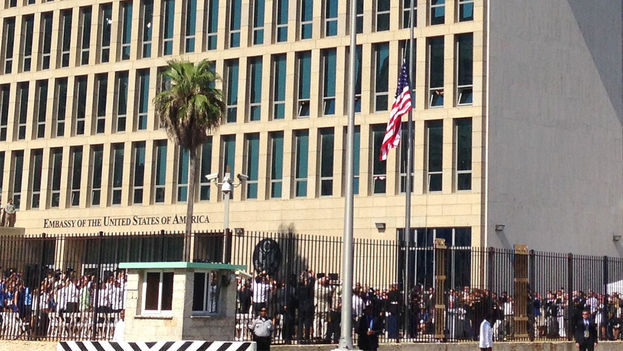
14ymedio bigger14ymedio, Havana, 2 October 2015 — The anguish is over. After months of speculation, it has been confirmed that the recently begun United States Diversity Visa program for 2017 maintains a quota for Cubans, according to a statement from a consular official from the US Embassy in Havana at a press conference Friday.

Rumors in recent months pointed to a reduction or cancellation of the program for natives of the island due to the reestablishment of relations between Washington and Havana. However, the official – who did not give her name – told the national press that “as in prior years, Cuba is included in the program to support a safe, legal and orderly migration.” continue reading

The press conference was attended by official media, such as the newspaper Granma, the Cuban Television and the National Information Agency (AIN), along with other media such as OnCubaCubaNet and 14ymedio. The press conference took place in a room inside the newly opened US American Embassy in Havana’s Vedado district.

The consular official specified that each year, “55,000 visas are granted to people who meet the eligibility requirements,” and detailed the registration process, emphasizing that it is free of charge. The application to join the program must be made ​​through the web site www.dvlottery.state.gov and once completed the form will receive an electronic confirmation.

There are six geographical areas from which people can participate and no country can receive more than 7% of the total visas available in a single year. The applicant must also meet competency requirements, having completed high school or having at least two years of work experience within the last five years.

When asked by 14ymedio whether the embassy would offer times in their navigation rooms for Cuban citizens to enroll in the program, the official responded with a definite no. She further recommended “that applicants enter their own information and don’t use the help of an unknown person.” The deadline for applications ends this coming 3 November at noon.

The IAPA Does Not See Progress In Press Freedom In Cuba / 14ymedio

Lazaro Yuri Valle Roca has been threatened and detained for documenting repression. (14ymedio)

14ymedio bigger14ymedio, 2 October 2015 — Within a few hours of the opening of the 71st General Assembly of the Inter American Press Association (IAPA), scheduled between 2 and 6 October in Charleston (South Carolina), regional reports from the Commission for Freedom of the Press and Information were made public. According to the organization, ten months after the beginning of reestablishment of diplomatic relations between Cuba and the United States, journalism on the island continues to be “dogged by censorship in the Cuban Communist Party monopoly over the national media.”

The report details that in Cuba there are still no signs of “economic improvement,” nor an increase in the respect for “human rights, greater freedom of expression, association and the press,” derived from the process of diplomatic rapprochement that both countries are experiencing.

With special alarm, the text includes the threats and arrests made this summer by State Security against the reporter Lazaro Yuri Valle Roca, when he tried to document in videos and photos the repression suffered by the Ladies in White. The independent journalist denounced the repressive methods against the exercise of the unofficial press, including detentions for “several days without records of arrest nor of the seizure of our belongings” and the “confiscation of the tools of our work.” continue reading

The case of the artist Danilo Maldonado Machado, known as “El Sexto,” was also highlighted by the IAPA as evidence of the lack of freedom of expression on the island. Nine months after his arrest for planning a performance, the Graffiti artist remains in prison without having been brought to trial. This week Amnesty International named him as a prisoner of conscience.


The IAPA report also denounces “the censorship maintained on digital sites, as is the case of sites like Cubaencuentro, Martinoticias, and the digital newspaper 14ymedio, as well as other sites that address the Cuban issue from a perspective critical” of the authorities.

Raul Castro’s government maintains a tendency towards “paramilitarization” of the repressions, with physical and verbal violence but without leaving legal footprints, says the report. This method was demonstrated during Pope Francis’s visit in mid-September, “particularly with the detention of the opponent Martha Beatriz Roque and the independent journalist Miriam Leiva, when both were traveling to accept an invitation from the Aposolic Nunciature to greet the pontiff at Havana Cathedral,” it says.

Civil society wins spaces

Among the achievements of Cuban civil society, IAPA enumerates the first Encuentro de Pensamiento (Meeting of Ideas) for Cuba, hosted by the independent think tank Center for Coexistence Studies in the city of Pinar del Río and the magazine of the same name. Founded in 2007, the publication has already published 45 issues and addresses issues ranging from culture to citizenship.

The opening of 35 WiFi points to connect to the internet also found space in the report, although the text reminds us that Cuba remains one of the least connected countries in the world, with only 5%, which is reduced to 1% in the case of broadband.

Half of Latin Americans Have Internet Access, But Only 5% of Cubans Do / 14ymedio

The reports comments on the parole granted to the writer Angel Santiesteban and transfer to a minimum security prison mid-year of the journalist Jose Antonio Torres, a former correspondent for the Party newspaper Granma, accused of espionage.

The report made special mention of the illegal compendium of audiovisuals and alternative information, known as the “weekly packet.” The IAPA said that the weekly packet “has continued to gain ground among the Cuban population and is causing great concern in the ruling party,” while the official press continues to be characterized by self-censorship and the absence of “a journalism of investigation, that puts pressure on government entities to have greater transparency about their internal workings.”

During the 71st General Assembly of the Inter American Press Association, there will be seminars run by the Press Institute that will focus on current issues under the title “Beyond the Digital Transformation.” Other panels will address the growing contribution of women in the media, value added and copyrights, according to information from the organizers.

The meeting will feature Literature Nobelist Mario Vargas Llosa, who will participate in a special session and be interviewed by journalist Andres Oppenheimer.

An Unconvincing Achievement / Fernando Damaso

Fernando Damaso, 30 September 2015 — In the face of failure of many countries to achieve the 2015 economic and social objectives established by the UN in 2000, the Cuban government has unleashed its current campaign, presenting itself as an example of a success, “despite the criminal blockade.”

First things first: it is not the same to achieve the objectives in a country of ten million people, that it is in the one of forty, a hundred, three hundred million and more, because in those the needs and costs to resolve them are vastly superior. In addition, and something that is not said, is that at the end of the decade of the fifties of the previous century, Cuba presented indicators in the economy, healthcare, education, social security and many others much higher than those of countries in Latin American, Asia and Africa, and in some areas higher than some European countries. Just check the statistics. continue reading

Therefore, with much less effort and expense than the governments of other countries, Cuba could achieve these results: during the Republic it had laid the necessary groundwork and had produced the development which had it been continued, in January 1959–had it not committed so many mistakes and setbacks–would have allowed the country to have a better economic and social situation now.

It is true that, at least statistically, the objectives were achieved, but the housing stock is in crisis and thousands of Cubans live in deplorable conditions, the lack of public hygiene and rampant epidemics, the health and educational services are not that good, the sidewalks are broken, the water and sewer services are collapsed in many places, public transport is the worst, wages are insufficient to cover minimum needs, access to information is restricted and that which is permitted is ideologically manipulated. The list of unmet needs could be endless.

In this case the situation is similar to when Havana was declared an Urban Wonder of the World: Who cares?