González Urrutia considers it an “act of revenge” that his son-in-law has been detained for a year
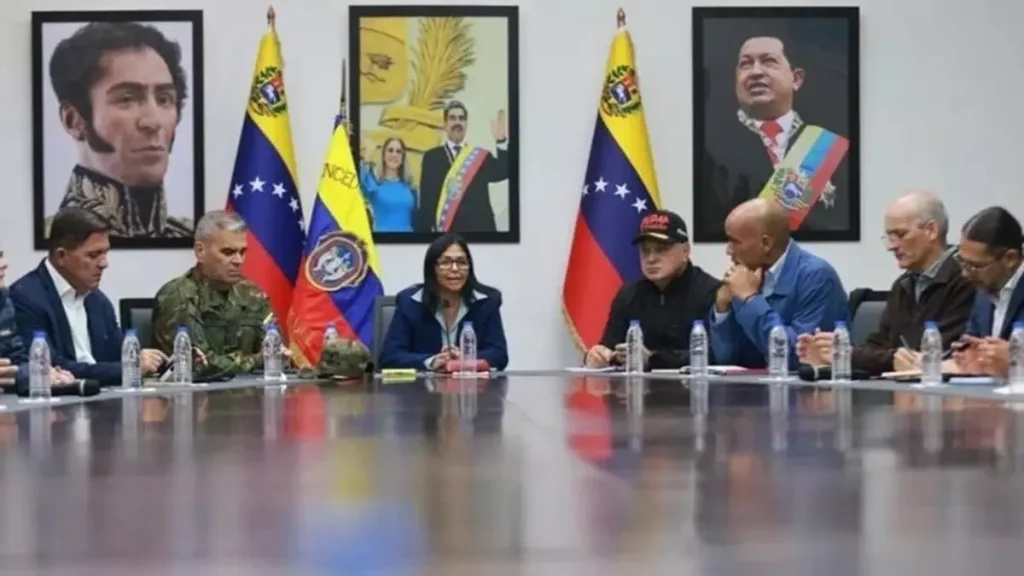
 14ymedio/EFE, Washington, January 7, 2026 –The Organization of Venezuelans Persecuted Politically in Exile (Veppex) asked the U.S. government on Wednesday to intercede for the “unconditional” release of all political prisoners in Venezuela and to put an end to the influence of Interior Minister Diosdado Cabello, following the capture of the ousted president, Nicolás Maduro.
“We respectfully request that the U.S. Government, within the framework of its policies toward Venezuela, prioritize and act decisively on these two points: the unconditional release of all political prisoners (and) effective measures to prevent Diosdado Cabello from continuing to wield de facto power to block democratic change,” the group said in a statement.
Veppex added that the situation “is complex,” but argued that these two requirements are “basic and urgent” to build confidence and move toward the country’s democratic normalization.
If Cabello, the second power in Chavismo, is not neutralized, the organization warned that “any transition will be extremely fragile and reversible.” It also accused Cabello of participating in “drug trafficking activities, corruption, and serious human rights violations.”
Over the weekend, the group of Venezuelans in exile had called for the arrest of several high-ranking officials of the Venezuelan regime in addition to Cabello, including Defense Minister Vladimir Padrino López, interim president Delcy Rodríguez, and the president of the National Assembly, Jorge Rodríguez.
“Right now what we want is to fix the oil, fix the country, bring it back, and have elections”
The issue of political prisoners in Venezuela has been sidelined, at least in public statements, in the new chapter that Caracas and Washington appear to have opened in their relations, marked by the interest of U.S. President Donald Trump in the South American country’s oil.
After the attacks on Venezuela and the capture of Nicolás Maduro and his wife, Cilia Flores, Trump said that political prisoners are a secondary issue: “We haven’t gotten to that. Right now what we want is to fix the oil, fix the country, bring it back, and have elections,” the Republican said on Monday.
The president said on Tuesday that the Venezuelan government, now led by acting president Delcy Rodríguez, is willing to deliver between 30 and 50 million barrels of oil for sale on the U.S. market, and that he would control the proceeds from the sale “to ensure,” he said, “that it is used for the benefit of the Venezuelan people and the United States.”
Earlier, during a speech to Republican lawmakers at the Kennedy Center in Washington, Trump described Maduro as a violent man who, he said, “tortured” people.
“They have a torture chamber in downtown Caracas that is now being shut down, but it tortured people,” Trump said without giving further details. Although Trump did not name it explicitly, some Venezuelan NGOs assumed he was referring to El Helicoide, the Caracas headquarters of the Bolivarian National Intelligence Service, which has been identified as a torture center.
After Maduro’s capture, Trump said that political prisoners are a secondary issue.
However, this Tuesday there were no reports in Venezuela of releases or pardons. While Trump did not explicitly name it, some Venezuelan NGOs assumed he was referring to El Helicoide, the Caracas headquarters of the Bolivarian National Intelligence Service, which has been identified as a torture center.
The NGO Justice, Encounter and Forgiveness urged the Venezuelan government on Tuesday to release all detainees if the closure of that center is confirmed.
The organization Foro Penal, which leads the defense of political prisoners, counts 863 cases in the country, 86 of them involving people of another nationality.
On Christmas and New Year’s Day, Venezuelan authorities announced the release, under precautionary measures, of 99 and 88 political prisoners, respectively. However, local NGOs have not been able to verify all the cases.
So far, Maduro’s executive branch has claimed that the country is “free of political prisoners” and that those labeled as such are imprisoned for the “commission of terrible criminal acts.”
The International Criminal Court opened an investigation into Venezuela in 2018 for alleged crimes against humanity committed since 2017.
The government of Nicolás Maduro repeatedly attempted to halt the case, arguing that its judicial system was carrying out internal investigations, but the Court rejected that position in 2023 and authorized the resumption of the inquiry.
“I took it from the beginning for what it really is: pressure being put on me, and he is paying for being Edmundo González’s son-in-law”
Separately, opposition figure Edmundo González Urrutia said on Wednesday that it is an act of “revenge” against him that his son-in-law, Rafael Tudares, has been detained for exactly one year, a detention that occurred three days before Nicolás Maduro’s inauguration, after the latter was proclaimed reelected president in what the opposition and international observers say was a fraudulent process.
“This is more revenge than justice,” González Urrutia said on his X account. In this regard, he stated that the charges against him, stemming from an investigation and an arrest warrant in Venezuela, were “transferred” to Tudares, who was sentenced to 30 years in prison for the crimes of “forgery, conspiracy, terrorism, association, money laundering, and financing.”
“I took it from the beginning for what it really is: pressure being put on me, and he is paying for being the son-in-law of Edmundo González, the presidential candidate who won the election and whose victory this regime stole,” the opposition leader said, referring to the July 2024 presidential election.
He also reiterated that his son-in-law is in a situation of “enforced disappearance,” noting that his daughter, Mariana González, does not know his whereabouts or the place where Tudares has been held for the past year, a period González Urrutia described as “marked by the absence of information, legal guarantees, and justice.”
“Rafael has not been afforded respect for due process guarantees, access to private defense counsel, adequate medical care, dignified detention conditions, and effective judicial oversight, quite the opposite,” the opposition figure denounced.
He further argued that Tudares’s case “is not isolated,” but rather “part of a pattern that affects hundreds of people in Venezuela, including women and children, subjected to arbitrary detention, enforced disappearances, and systematic deprivation of rights.”
“As long as these practices persist, it will not be possible to speak of peace or democracy, or guarantees for anyone. Venezuela needs truth, justice, and freedom for all,” concluded the opposition leader, who claims the presidency from exile, asserting that he defeated Maduro in the 2024 presidential election.
Mariana González also said on Wednesday, in a message on X, that a year has passed without her husband: “One year without answers. I have no more words. Just truth, justice, and humanity. That is all we ask,” she said.
Tudares was detained on January 7 of last year, when human rights defender Carlos Correa, since released, and former opposition presidential candidate Enrique Márquez, who remains in prison, were also arrested.
Translated by Regina Anavy
____________
COLLABORATE WITH OUR WORK: The 14ymedio team is committed to practicing serious journalism that reflects Cuba’s reality in all its depth. Thank you for joining us on this long journey. We invite you to continue supporting us by becoming a member of 14ymedio now. Together we can continue transforming journalism in Cuba.