The businessman tells ‘El País’: “What Trump did with Venezuela was good for Venezuela, but it won’t work in Cuba, because it’s a failed state.”
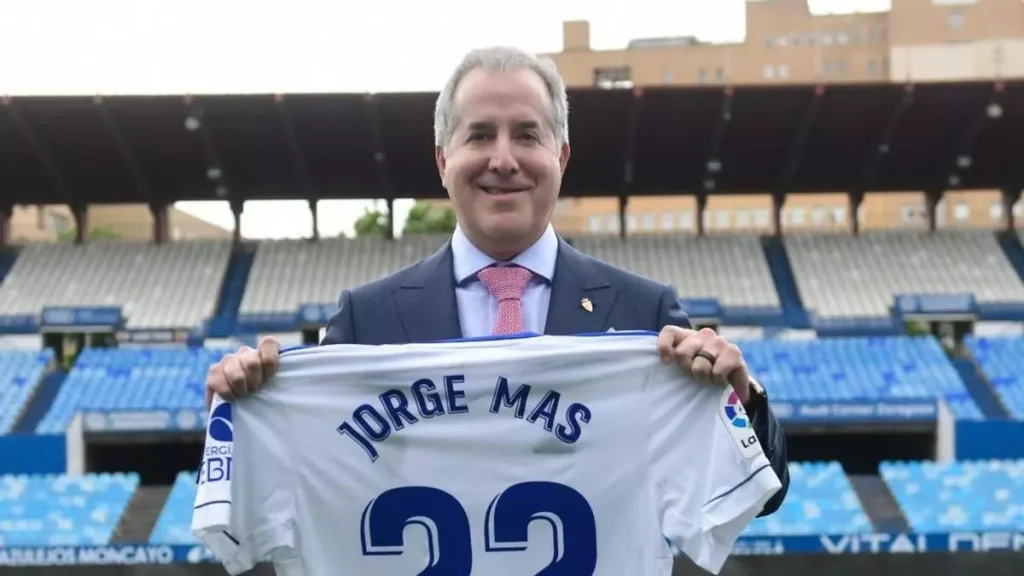
 14ymedio, Madrid, May 17, 2026 / Jorge Mas Santos, president of the Cuban American National Foundation and one of the most important figures in the Cuban exile community in Miami—son of the historic Jorge Mas Canosa —asserted in an interview with the Spanish newspaper El País that “the capital needed to rebuild Cuba is not difficult to raise” and that the exile community will play a decisive role in any eventual transition. “If 40, 50, 60, 70, or 80 billion dollars are needed, whatever the figure, it won’t be a problem,” he stated.
Mas Santos is known for his business and sports profile—he owns Inter Miami and is the main shareholder of MasTec—and as a leader in exile, he stated that he is aligned with Washington regarding a possible change on the island. “Everything is happening very quickly. We’re talking about months,” he said regarding the transition. “I estimate before the end of summer. Maybe not even then. We’ll see changes in weeks.”
He asserted that Cuba’s economic reconstruction must be preceded by the establishment of the rule of law. “We have to start practically from scratch, because the system and the political structure are not working,” he said, adding that there is capacity outside the island to contribute to the reconstruction. According to Mas, it would be “super easy” if there were a legal framework favorable to the market and foreign investment.
He argued that the Cuban exile community has sufficient capacity to finance this transformation and downplayed the economic challenge of rebuilding the country’s infrastructure: “With the exile community alone—and here I speak for myself, as I own a fairly large company—raising the necessary capital to rebuild Cuba is not difficult. Whether it takes 40, 50, 60, 70, or 80 billion, whatever the figure, it won’t be a problem.”
With the exile alone – and here I speak for myself, as I own a fairly large company – is not difficult to raise the capital needed to rebuild Cuba.
When questioned about the need for a US military intervention, he replied: “That is not for me to decide, or to opine on, but I believe that no option can be ruled out regarding what can or cannot be done in Cuba.”
Mas dismissed the possibility of a transition like Venezuela’s on the island. “What Trump did for Venezuela worked out well for Venezuela, but it won’t work for Cuba, because Cuba is a failed State,” he affirmed, arguing thatthe island lacks functioning institutional structures or forces. “A complete change in leadership is needed, and that change can come from within.”
Although he also asserted that there are opposition figures comparable to María Corina Machado, these figures are not in Cuba because “they cannot speak to the people freely without endangering their lives.”
“The best thing that could happen to Castroism is for it to be buried like a dinosaur of the past,” he stated, endorsing the possible indictment of Raúl Castro for the downing of the Brothers to the Rescue planes in 1996, and asserting that his leadership has worked to bring justice to the families of those killed in that incident. “In any case, it’s a decision for the U.S. Department of Justice. We’ll see.”
The best thing that could happen to Castroism is for it to be buried like a dinosaur of the past.
The businessman and opposition leader also shared two documents with the Spanish media outlet outlining a possible transition on the island. The first, titled “Roadmap for a Prosperous, Democratic, and Free-Market Cuba,” proposes modernizing the banking system, eliminating income tax, offering tax breaks to companies with Cuban capital participation, and investing in sectors such as the pharmaceutical, military, and heavy industries.
The second is a draft Fundamental Law for Democratic Transition, written together with the Cuban-American Lawyers Association, with a Constitutional structure: 28 pages, 115 articles and nine transitional provisions.
Mas Santos explained that his “Fundamental Law for Democratic Transition” does not intend to restore pre-1959 Cuba, but rather to serve as a provisional legal framework to facilitate foreign investment, guarantee human rights, and lead the country toward free elections and a new Constitution.
The businessman defended the idea of a “technologically advanced” Cuba, with an open economy and a “democratic and pluralistic” political system, closely linked to the United States as its main market and economic partner. “I am talking about Cuba’s economic miracle, of a country unlike any of its past, a country that looks to the future,” he asserted.
I am talking about Cuba’s economic miracle, about a country unlike any of the past, a country that looks to the future.
“Those of us who are outside can contribute knowledge, effort, work, and economic resources,” he also said, referring to the role of exile in that transition, and stressed that this future goes beyond “building hotels and doing beach tourism,” pointing out the importance of rebuilding infrastructure, as well as civil power in the cities and “getting the health system working.”
When asked if he imagined a private healthcare system for Cuba, he replied that it would be “a combination of models”: that it could be a private system, but without cost to the citizen, suggesting that access to the healthcare system would be through vouchers paid for by the State. “We all know that the US [healthcare] system doesn’t necessarily work,” he stated.
He considered it “premature” to talk about Cuba as a possible 51st US state – an idea that Trump has recently floated regarding Venezuela: “I don’t rule it out, but the future has to be determined by the Cuban people. We have to give them that option and others through the ballot box.”
Finally, the businessman asserted that he had never seen the Cuban exile community as coordinated as it is now and mentioned his constant contacts with figures such as Rosa María Payá and Orlando Gutiérrez-Boronat, amidst what he considers “the final stretch” of Castroism.
Although he acknowledged that the exile community has experienced successive disappointments for decades – from the fall of the Soviet Union to the death of Fidel Castro – he stated that he had never perceived such an imminent change as the current one, an expectation he attributed directly to the leadership of Donald Trump and Marco Rubio.
______________________
COLLABORATE WITH OUR WORK: The 14ymedio team is committed to practicing serious journalism that reflects Cuba’s reality in all its depth. Thank you for joining us on this long journey. We invite you to continue supporting us by becoming a member of 14ymedio now. Together we can continue transforming journalism in Cuba.