In the province of Camagüey, 19 schools were closed to “optimize resources” due to the massive exodus of teachers.
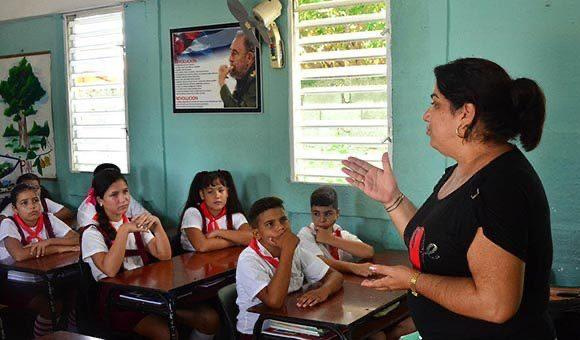
 14ymedio, Havana, August 24, 2025 — Aware that they are in the final stretch of the summer, parents have one last week of despair looking for everything necessary so that on September 1, when school begins in Cuba, their children can enter the classroom with everything ready. The State, on the other hand, is unable to follow its own timetable and is still behind in the sale of uniforms. Above all, many classrooms are without teachers.
In Sancti Spíritus, one of the most affected provinces in the country, teacher coverage is barely 68.2%, a figure that reflects a worrying shortage. The Minister of Education herself, Naima Ariatne Trujillo Barreto, during a recent visit to the province, acknowledged that completing school staff is the “greatest challenge” facing the territory.
The minister called for “exhausting all possible alternatives” to attract more teachers but did not propose a concrete plan. Although the press does not mention it, the reasons — no matter how many teachers graduate from pedagogical schools — for the teacher shortage is clear: mass exodus, low wages — less than 6,000 pesos — and poor working conditions.
Many, after graduating, don’t even teach. “My niece graduated as a history teacher and left school straight away. She didn’t think twice,” Eliany, 36 years old and living in Placetas, Villa Clara, tells 14ymedio.
With a daughter in fourth grade and another child about to enter first grade, the mother has also become an expert on “school mishaps.”
With a daughter in fourth grade and another child about to enter first grade, the mother has also become an expert on “school mishaps.” According to her, the previous school year was a headache for the family. Her daughter’s school has few pupils, no more than 20 per classroom, and teachers are “even rarer” than students. “Every day her father and I sat down with the girl to help her with homework, especially math, because she went two months without a teacher until a new graduate was hired at the school,” she recalls.
Eliany is not only concerned about the quality of the classes that her daughter receives, but she also fears having the same headaches again this year and twice as much, since “my boy also starts primary school, and as far as we know, there are no first-grade teachers.”
The problem is repeated to a greater or lesser extent in all the provinces of the country. In Camagüey, which has 716 schools and 98,000 students, the situation is not encouraging either. Teacher coverage is 75.5%, with a deficit of 2,468 teachers, reported the local press.
To address this gap, authorities have announced the hiring of more than 1,000 teachers who will be paid per hour of work, and schools were also reorganized and merged, resulting in the closure of 19 institutions to “optimize resources” and improve teacher coverage. However, there is still a shortage of staff specializing in key subjects such as mathematics, physics, English and political culture.
Only Santiago de Cuba, with a staff almost 99% covered, seems to be an exception in the middle of the teacher crisis.
In Havana, Prime Minister Manuel Marrero Cruz headed an Extraordinary Council where the municipalities of El Cerro, La Lisa, Boyeros, Diez de Octubre and Guanabacoa were identified as those most affected by lack of educational coverage, especially in secondary and pre-university education.
Only Santiago de Cuba, with nearly 99% of staff covered, seems to be an exception in the middle of the teacher crisis. However, neighboring Holguín has a shortage of 20% of the teachers it needs to offset the deficit and plans to incorporate senior pedagogy students into classrooms. According to the authorities, secondary and technical education as well as mathematics and English are particularly affected.
Although it is undoubtedly the most worrying issue, the lack of teachers is not the only problem of education. The delays in the sale of uniforms is another point criticized by Eliany. According to her, the whole process of making and marketing uniforms should start earlier, so that parents have time to “find a seamstress” or mend their own uniforms, “which, no matter how good the fit, are never well made.” But Education has other plans, and at least in the case of Eliany, she has received only some of the pieces that she needs for her children, and the rest “will be delivered later.”
The sale of uniforms to preschool, fifth and seventh graders remains a pending issue in Sancti Spíritus.
Meanwhile, the mother received some shorts -now too small for her son- from a neighbor and bought white sweaters for her son to wear instead of shirts. As for her daughter, “a skirt is the hardest thing to get. The girl still has the one from last year and can use it for a while, but when she grows a little more she’ll burst her buttons.”
Sancti Spíritus also experiences a “complex” situation with the uniforms, to use the favorite word of the official press. The sale to preschool, fifth and seventh grade students remains an outstanding issue. A director of Commerce, Odelys Domínguez Valdivia, explained to the Escambray newspaper that marketing has only started in some municipalities, and that the sizes and available parts are insufficient, which has generated discomfort among families. The lack of fabric and blackouts in clothing workshops, which happens every year, are the main obstacles.
Translated by Regina Anavy
____________
COLLABORATE WITH OUR WORK: The 14ymedio team is committed to practicing serious journalism that reflects Cuba’s reality in all its depth. Thank you for joining us on this long journey. We invite you to continue supporting us by becoming a member of 14ymedio now. Together we can continue transforming journalism in Cuba.