Marti Theater, Much More Than a Stage Set / Angel Santiesteban

Reopening of the Marti Theater

Since we were kids we dreamed of this space full of magic and history, where a great part of Cuban culture was staged and presented for our enjoyment. Timeless works were presented there: “Cecilia Valdés,” “Amalia Batista,” among others, without forgetting that in this space in 1900 the Constituent Assembly was held, and that a year later Generalissimo Maximo Gomez, surrounded by the great generals, presided over a gala celebrating the victory over Spain and the ultimate decolonization.

For decades we’ve suffered the ruins of that majestic place, in silence imaging the beginning of its functions.

On several occasions I’ve approached it — from outside — penetrating it with my gaze and recreating those sublime figures who represented culture at the height of their era, and those who fought for freeing and shared their lives. The first, learning to be the artists of their time, and joining in the social clamor with a vernacular theater and slapstick comedy, the people saw reflected in those characters their desires. They also recreated society with political satire, that cold irony that made us laugh and think.

The historian Eusebio Leal Spengler recalled the example of the Father of the Nation and founder of the Cuban nation, Carlos Manuel de Céspedes: “In a few days we will remember his great sacrifice. High above the mountains, in a place called San Lorenzo, he gave his life, laying the foundation, the example and at the same time, the bitter lesson that disunity would only postpone the chances of achieving the great objectives.”

Such immense words for that man who agreed to let go of power knowing how much he had done, and he did it, rather than divide our forces. Quietly and immediately he began to prepare the files to give to his successor, and with his hat over his heart, he received him at the entry of his camp. A great man until the last moment of his life.

Would that Fidel Castro had learned that lesson. Today our country wouldn’t be in ruins, like the Marti Theater has been for decades, our families divided. Nor would we have sacrificed so many brilliant lives, nor would the nation be bleeding from its wounds of political repression.

The difference would be a place won for each person. Carlos Manuel de Céspedes will always be remembered for his sacrifice, putting his country before his personal interests. Fidel Castro and his brother Raul will be remembered for the opposite.

Blessed history!

Ángel Santiestaben-Prats

Prison Settlement of Lawton, March 2014

3 March 2014

The Circle of Lazaro Farinas / Angel Santiesteban

I recognize the sin it is to read the Cuban press, but really we should give ourselves the entertainment, in good humor. In these newspapers, we find topics to write stories about, with themes that border on the absurd.

A great character among those that lend themselves to a demented and evil personality, of the worse strain, whom we doubt could have been born of woman, is Lazaro Fariñas, inflator of realities, misinterpreter at his convenience, impossible to explain further as he lives in the United States, from where he criticizes and attempts to convert, or at least make people believe, that Cuba is a paradise. But so lucky is he that his office of satrap and calculator is carried out from the land of freedom, that he could never do otherwise.

In his last article, from 21 January, he raises the alarm with an immense ingenuity not characteristic of him, about the closure of the busiest bridge in the world , the George Washington, which links Manhattan with the city of New York, because of an issue between politicians in that area.

The most laughable part is when he says that Cubans won’t be able to believe it. It was the peak of ecstasy, I laughed myself sick, imagining how they used little children to close one of the busiest streets in Havana, First Avenue and 60th in Miramar, which leads to the National Aquarium, using the children as shields to try to prevent the opposition from holding the First International Conference on Human Rights, which demanded the ratification of the UN Covenants, organized by the independent State of Sats project.

Under the guise of a cultural activity they diverted traffic — and it wasn’t a partial closure like on the George Washington Bridge, but a complete closure to cars and “untrusted” people, not to mention public buses.

When the Ladies in White meet at their headquarters in Neptune Street, before dawn, they don’t allow traffic or pedestrians to reach that street and they  detain dissidents who approach to participate, beating them and taking them to nearby police stations.

How is it possible that this gentleman thinks we Cubans can’t believe something that we experience every week. Our most fundamental rights are violated every day. I’d like to see him on the front page of some newspaper of this country and see him survive on the salary they would pay him!

He does his work without any scruples at all. He dedicates himself to scaring Cubans who don’t walk in his footsteps: do what I say and not what I do. Accept the vineyard of the Lord.

Ángel Santiesteban-Prats

Lawton Prison Settlement. January 2014

The Havana Regime, With a Seat on the UN Human Rights Council, Shows its Make-up Again / Angel Santiesteban

In new demonstration of the impunity with which the Cuban Regime does and does not practice justice, using it solely as an instrument of punishment against the dissidence, proving clearly that in Cuba justice is NOT independent and is simply an armed arm within the monstrous repressive apparatus of the dynastic dictatorship, now in the hands of the younger son Raul, they have sanctioned Ameila Rodriguea Cala — attorney for Angel Santiesteban, Gorki Aguila, Sonia Garro and the Ladies in White among many other opponents persecuted and imprisoned for political reasons — to six months of not being allowed to practice her profession.

We understand that with the infamous accolade that have members of CELAC, Mr. Inzulsa and Mr. Ban Ki Moon have given to the dictator Castro, and thus, to the dictator Maduro as well, repression and violation of human rights in Cuba has steadily increased since January because it has been supported and rewarded, not to mention the way the government of Venezuela, led from Havana, has unleashed the most brutal violence and repression against young students asking peacefully, among other demands, for security.

Everything that happens in Cuba and Venezuela is the responsibility of the concert of nations and leaders who reward a military dictatorship with a seat on the United Nations Human Rights Council, and who open a “frank” dialog caring for nothing but business relations at the cost of freedom for Cubans.

From here, we hold Raul Castro responsible for the physical integrity of Angel Santiesteban, for all the prisoners and those politically persecuted by the regime, and ask for a small show of decency and that he fulfill his promises to “reform” his government for the better.

Free Justice from the political power and comply with the laws and the Constitution.

Respect the rights of Angel Santiesteban and “allow” Justice to carry out Justice. In the long-term the most harmed will be the government, if it continues to violate rights and repress the people.

As you already know, we in the free world are watching if there is the slightest dignity and if you fulfill your responsibilities and as a first proof of “goodwill” SIGN NOW the UN Covenants.

The Editor

Attorney for the Opposition Can’t Practice / by Lilianne Ruiz

Read the article here.

21 February 2014

Abuses at the Border / Rosa Maria Rodriguez

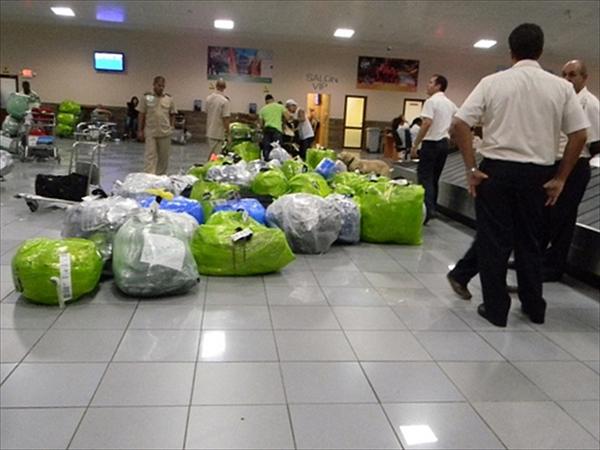
Image from Kubafotos

On March 7th I returned to Cuba from Miami and they seized seventy pounds of food from me. I doesn’t matter that I bought the ticket at the travel agency, sent the money and packages to my Country through “Go Cuba,” which is rumored to belong to the Cuban government and that currently offers 100 pounds free of charge. It was a traumatic flight on a Gulfstream Air Charter, for which we checked in to the terminal in Miami at 9:00 AM and left for Havana twelve and a half hours later.

Even before the new travel and immigration law went into force in January last year, for an ordinary Cuba to face the predators at customs, is not a setback when it comes time leave for abroad. The problems arise when you come home with the “junk” and other material needs to relieve some personal and family shortages with some of the “enemy’s money” in your purse.

The foreigners and Cubans living abroad run into the same luck when they travel to Cuba. It’s the government of my country that has converted the capital’s Jose Marti Airport into a stress chamber, psychological torture and extortion border for many travelers coming to this country.

I imagine the same happens with the other air terminals around the country. You have to face the arbitrariness, helplessness and caprice of a raw crude tyranny, where the law is an exhibitionist who walks naked through the streets and the airfields, nothing more. A return with the excitement of a reunion and here they seize our things with enthusiasm.

I returned melancholy about the family I was leaving behind, but compensation by the reunion with the family I founded almost 32 years ago: my two sons and my husband anxiously awaiting my return, who had announced they would be picking me up. I was among the first to get off the plane and also to collect my bags when they were spit out from the belly of the plane.

As I was going through the last control they announced the seizure. The food that my mother and sister, people with low resources living in Miami, had collected for months, was stolen by the Cuban border officials with their complex cheating Chinese-style thievery. Is it true that the authorities make laws so convoluted in order to facilitate the corruption of their officials, or were they “sent to kill” by the political police? And if so, why?

What did I do or say that upset them so much that they took reprisals on my arrival in Cuba? I told them everything humanly possible based on what I’d been told by General Customs of the Republic in New Vedado, whom I consulted repeatedly prior to leaving and whose telephone number is 881-9723.

I replied, but I couldn’t insist too much to avoid their taking reprisals and making it worse. It seems that the customs laws are one thing and those at the airport are something else. Even so, they tried to coerce me into saying I’d brought a router, which is simply prohibited to Cuban citizens to import.

Before my argument–which showed evidence of computer skills– that it was a wireless car, they chose to remain silent without consulting a specialist to confirm my explanation. Or is it, that thought I was meek and were pressuring me to upset me and get even more advantages? The other lady they also took things from that night broke into tears at the announcement of the confiscation. As she was an elderly lady, the attended to her quickly and gave her special treatment to avoid a medical emergency. She is living in Miami, and like me, was not allowed to pay for excess baggage.

However, behind us the people on the same plane went through the door laughing with their carts piled higher than ours, leaving behind officials who had attended them with smiling faces.

The sent me off to a corner of the terminal and punished me by making me stand there for three hours. They ignored that I’d been traveling since 9:00 AM in the Miami airport. When the airport emptied of passengers, the chief came with a gentleman with a green sack into which they threw all my mother’s and sister’s food. Looking at the color of the bag I could only think that it was a messages. I left there about one o’clock in the morning.

It wouldn’t surprise me if in a short time they make widespread the pillaging of the suitcases which weigh a certain amount when the tourists leave home and weigh “a few kilos more” per capita when they land at Cuban airports.

In addition to the confiscation, they fined me 1,450 pesos and to told me that I had a month to claim it. I decided that despite my indignation, I’m not going to challenge the customs authorities, because in Cuba there is not a State of Law. Nor will I put myself in the orbit of the bureaucracy and complicity with the entities in the industry, because all that happens when you engage with such machinery is that you wear yourself out. Also because the situation can occur that “winning” the case sends the wrong message about my commitments and loyalities.

This new setback only reaffirms for me that I’m on the right track when it comes time to fight and denounce the arbitrariness of a dictatorship that’s teetering. My appetites are freedom, democracy and social justice for Cuba, which contrasts with the petty and unjust greed of those who, like the customs workers, symbolize the “boogeyman,” stealing the pants off the trapped travelers through questionable and abusive legal figures. Bon appetit!

20 March 2014

Exploring the Design District in Miami / Rebeca Monzo

Ignoring the anti U.S. propaganda on my planet, I come to Miami with an open mind, thanks to my sporadic contacts with social networks and myself. Yesterday I had a wonderful meeting with someone I’d met a few times in Cuba as teenagers, and who I hadn’t seen since 1959, but with whom I have maintained communication through my blog and FaceBook. It was as if our mutual feelings had invisibly mended a rip made in our sentimental fabric.

We spent a marvellous day visiting places new to me, and thanks to the skill of her husband as impromptu helmsman, we were able to discover some corners of Miami together.

The Design District made an impression, now just for the beauty of its graffiti, but for the genius of converting a rundown area into marvelous art galleries, stores, studies, all decorated with beautiful examples of such popular art.

I could not but evoke with sadness a comparison of those places of once dazzling architecture and functions, converted now into ruins, “by work and disgrace” of the mis-governance of my country.

The truth about the “Cuban economic miracle” that they hid from us for so many years, due to the lack of information and the impossibility of traveling outside our borders, thanks to the Internet has emerged from the totalitarian darkness imposed on it.

And so, like meeting my friend again, I have borrowed this technology, but I’m still looking (on the unfamiliar keyboard) for the accents. Excuse me.

13 March 2014

The Right to Play and Rest / Dora Leonor Mesa

By Lic. Dora Mesa Crespo* and Lic. Odalina Guerrero Lara **

*Coordinator for the Cuban Association for the Development of Infant Education

**Attorney for the Cuban Law Association

ARTICLE 59 of the Preliminary Plan of Labor Law [1] (CHAPTER V. SPECIAL PROTECTION IN THE WORK OF YOUTH OF FIFTEEN AND SIXTEEN YEARS) regulates the working day for working teenagers 15 and 16 years old.

ARTICLE 59: The working day of youths of fifteen (15) and sixteen (16) years of age cannot exceed seven (7) hours daily, nor forty (40) weekly, and they are not allowed to work on days of rest, save that the work carried out for reasons of exceptional social interest or force majeure.

We have expressed with priority, that we consider that the ARTICLE 59 stipulates that “the youths of fifteen (15) and sixteen (16) years of age for reasons of exceptional social interest or force majeure can work on days of rest” infringes Conventions of International Rights, starting in Article 3 and Article 31 of the Convention of Child Rights [2], that treats respectively the superior interest of the children and their right to play and to rest.

The fundamental Article 3 of the Convention expresses: “In all measures concerning children that use the public or private institutions of social welfare, the tribunals, the administrative authorities or the legislative organizations, a fundamental consideration that they will attend to will be in the superior interest of the child”.

If the teenage workers work for social interests in their days of rest, this interest overrides the greater interest of the child and so violates Article 3 of the Convention and Article 13.1 b) that regulates the prohibition of outstanding hours of work for the teenagers in the Convention number 138 of the International Organization of Work (OIT). [3] [4]

When the workers younger than 18 years old work as an exception for force majeure according to the OIT, [5] they were particularly exposed to risks and to enter direct contact with them, which is improper according to the same Article 60 of the Preliminary Plan, the Article 32 of the Convention of Child Rights and Article 40 of the Constitution of the Republic of Cuba.

For well-founded reasons in the same legislation, we consider that ARTICLE 59 of the Preliminary Plan of Labor Law should adjust the national and international norms, principles, and rights. For this reason we recommend a new draft that guarantees the respect of the working day and the rest in all labor activities and economic sectors of the workers under the age of 18, not just those who are 15 and 16. People under 18 years of age, being a population especially vulnerable, have a right to a more specific protection.

From our point of view, it should regulate the hours of the working day of adolescents from 15 to 18, shouldn’t expose them to risks, and should always adopt the flexibility and observance of the law needed to accept other proposals of the employers that can be acceptable for the minor, with subject of right and for the competent authority of the Minister of Labor and Social Security of the Republic of Cuba.

According to the Panamerican Organization of Health (2010) it can be said that the leisure or weekly rest (OIT), from a global approach, is a human right, a resource for personal development, an area of human experience, a source of health and of prevention of physical or mental illness, and an indicator of the quality of life loaded with an enormous economic potential.

The Cuban youth, for their dependence and vulnerability, are protected by national and international law. In this manner, they benefit from established protection in all instruments of human rights, and above all in the International Convention of Child Rights and the International Human Rights. The inexcusable respect of the rest of the working adolescents is a basic standard for humanity.

[1]  http://www.trabajadores.cu/wp-content/uploads/2013/07/Anteproyecto-Ley-Codigo-TRabajo-Cuba-2013.pdf

[2] http://www2.ohchr.org/english/bodies/crc/docs/co/CRC.C.CUB.CO.2_sp.doc

[3]  www.ilo.org/ilolex/spanish/

[4]  http://www.ilo.org/public/spanish/support/lib/resource/subject/yestandards.pdf

[5]  http://www.ilo.org/global/lang–es/index.htm

 Translated by LW

1 November 2013

S.O.S. Another Brave Man is Dying / Angel Santiesteban

Alcibíades Guerra Marín is in a hunger strike after being sentenced to a year in prison for demonstrating in public against totalitarianism. He was charged with the supposed crime of “CONTEMPT”. His wife, who is also a Lady in White approached the place where they have me imprisoned, asking me for help, and asking me to fight for his rights.

“For me it is an honor to cry out for the Cuban patriots, it is my duty.”

She told me, his family was waiting for him at home, his only son. After the sixteenth day (on strike), she was allowed to see him, along with another Lady in White accompanying her. Alcibíades could not feel his legs anymore. He had to be carried over from his solitary cell to the visitors area.

He assured that he will continue his hunger strike until his civil rights be restored. The dictatorship expects his health to worsen in order to move him to a hospital inside Combinado Del Este Prison; in the meanwhile, he remains in a dark and stinky hole where authorities try to break his spirit.

Every Cuban is an accomplice in his suffering if he remains in silence.

Angel Santiesteban-Prats

Prison Settlement of Lawton, March 2004

The activist Alcibiades Guerra remains on hunger strike

5 March 2014

By Roberto de Jesús Guerra Pérez / Hablemos Press.

HAVANA, 5 March 2014. Political prisoner Alexis Osmany Palmero, incarcerated in Valle Grande Jail, reports activist Alcibíades Guerra Marín is on hunger strike because of his unfair sentencing.

Marín was detained on February 27th while protesting his wife’s arrest, the activist Melkis Faure Echevarría.

The activist was sentenced on the 28th to a year in jail accused of Contempt for the figure of Fidel Castro, after he cried out ¡Abajo Fidel!  (Down with Fidel).

He began the strike in the holding area of Valle Grande Prison, located in La Lisa municipality, Havana, where he was transferred on the 28th, right after the trial.

Follow this link to sign the petition for Amnesty International to declare Angel a prisoner of conscience.

Translated by: Rafael

19 March 2014