US Renews Partial Suspension of Helms-Burton Act But There Will be Exceptions

Mike Pompeo, announced Monday that Title III of the Helms-Burton Act will remain suspended for one month. (EFE)

14ymedio bigger14ymedio/EFE, Havana, 4 March 2019 — The Donald Trump Administration announced Monday that it will allow trials in US courts against those companies sanctioned by Washington that operate in Cuba and that are included in a “black list,” according to statements by Secretary of State Mike Pompeo.

However, for the rest of the companies, the US has renewed the suspension of Title III of the 1996 Helms-Burton Act and will not allow, for the time being, suits before the courts for doing business with the properties confiscated after the takeover by Fidel Castro in 1959.

The US black list includes entities that are “under the control” of Cuban intelligence services and the Armed Forces, as well as personnel that establish “direct financial transactions” that could harm the Cuban people, as explained by the Department of State on its website. continue reading

This includes the ministries of the Revolutionary Armed Forces and the Interior, as well as a large number of hotels, such as the Cuban chain of Gaviota tourist establishments and the facilities of that group, such as the Varadero Meliá Marina, managed by a Spanish company.

Since its creation in 1996, Title III of the Helms-Burton Act has been suspended by all US administrations every six months; but, in January, when it was time to extend this situation, the Trump Administration set off all the alarms when renewing the suspension for 45 days instead of the usual six months.

On Monday, Washington has renewed the suspension for only 30 days, until April 17, but has decided to create some exceptions and apply Title III of the Helms-Burton to some companies now.

These exceptions could affect Russian and Chinese companies that have invested in Cuba.

“Cuba’s role in usurping democracy and fomenting repression in Venezuela is clear. That’s why the U.S. will continue to tighten financial restrictions on Cuba’s military and intel services,” White House National Security Advisor John Bolton said on Twitter on Monday.

Cuba’s Ministry of Foreign Affairs reacted on the social networks to Washington’s announcement. Foreign Minister Bruno Rodríguez wrote in his Twitter account: “I strongly reject the State Department’s announcement to authorise lawsuits under Title III of the Helms-Burton Act against a list of Cuban companies arbitrarily sanctioned by the Trump administration.”

All US presidents have frozen this provision in the last 23 years, partly to avoid opposition from the international community and also out of fear of an avalanche of cases in the United States judicial system.

The complete lifting of the ban could allow billions of dollars in lawsuits to advance in US courts and probably face opposition from European partners and Canada, whose companies have significant stakes in Cuba.

The measure is a blow against the attempts of the Cuban authorities to attract more foreign investment and could harm some US companies that have begun to invest in the Island after the diplomatic thaw initiatied by former president Barack Obama.

Washington is also considering imposing more financial restrictions on Cuban military personnel, according to Reuters.

__________________________

The 14ymedio team is committed to serious journalism that reflects the reality of deep Cuba. Thank you for joining us on this long road. We invite you to continue supporting us, but this time by becoming a member of 14ymedio. Together we can continue to transform journalism in Cuba.

Angel Moya Will be Prosecuted for "Damage" to a Police Car

Ángel Moya says he was sprayed with pepper spray during the arrest. (File / 14ymedio)

14ymedio bigger14ymedio, Havana, 5 March 2019 — After spending 48 hours in detention, between Saturday and Monday, the former political prisoner and activist Ángel Moya has been accused of “damaging police property.”

Last Saturday, Moya went running, as usual, through Lawton, where State Security remains deployed between Thursday and Sunday to control the headquarters of the Ladies in White. “When I returned from my run, at about 10:00, and by the same route as always, the officer in charge of the operation arrested me and took me to the Aguilera police station,” the activist told 14ymedio. “He stopped me, I asked him what was going on and he just said: ‘Get in’.” continue reading

Once in the police station, he was fined 150 Cuban pesos (CUP) for “attempting to violate State Security equipment” and, two hours later, he was taken to his home in a patrol car. However, he says, at that moment he started a protest and that caused his immediate arrest again.

“I started to protest against the arbitrary arrest, shouting: ‘Down with the dictatorship, freedom for the Cuban people, down with Raúl’.” That detention was more violent, he describes.

“The officers got out of the car, left me alone, closed the four windows tightly and left me in the sun. I hit the windows and told them to lower them so that I could get air, but they said no,” he complains.

Moya says he was sprayed with pepper spray in response to his attempts to open a door or window and breathe, and then he was taken to the Alamar police station.

From there he was referred to the polyclinic to have his vision checked, affected by the spray, but the activist refused to receive medical assistance while in handcuffs. On his return to the police station, around 5:00 in the afternoon, he was called to investigation where he had a meeting with Lieutenant Colonel Kenia Morales who opened a case to demand the payment of the alleged damages to the patrol vehicle, and where he urged Moya to pay for the equipment he allegedly damaged.

The activist refused to pay the fine, because he felt that he had only protected himself from police treatment. According to Moya, his attitude was due to his legitimate “right to self-defense against police methods used by order of State Security to torture me and subject me to cruel, inhuman and degrading treatment.”

This Monday, Moya was released around one in the afternoon. “If they decide to take me to court I will go but I will not appoint a lawyer because I have not committed any crime,” he says.

Ángel Moya is one of the political prisoners who refused to go into exile after the release of the Black Spring prisoners of conscience negotiated between the Cuban Government and the Catholic Church in 2010, a process of liberation that had the support of the Spanish Government, then chaired by the Socialist José Luis Rodríguez Zapatero.

Currently, he is one of the most visible promoters of the #TodosMarchamos (We All March) campaign, which demands “the freedom of Cuban political prisoners.”

___________________

The 14ymedio team is committed to serious journalism that reflects the reality of deep Cuba. Thank you for joining us on this long road. We invite you to continue supporting us, but this time by becoming a member of 14ymedio. Together we can continue to transform journalism in Cuba.
The Art of Sharing Luggage to Pay Less on the Bus

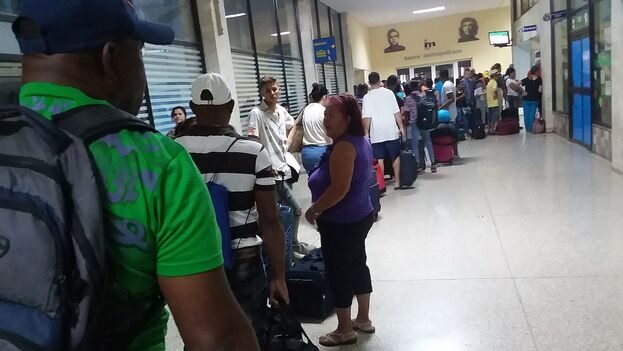
Passengers in the central bus terminal of Havana, in line to pay for excess baggage. (14ymedio)

14ymedio bigger14ymedio, Ricardo Fernández, Havana/ Camagüey, 6 March 2019 — A long line of passengers loaded with bags, boxes and suitcases wait at Havana’s Central Bus Terminal to pay for excess baggage. The traditional practice of carrying large quantities of food on the bus routes is now allowed, although the cost is too high for the travelers.

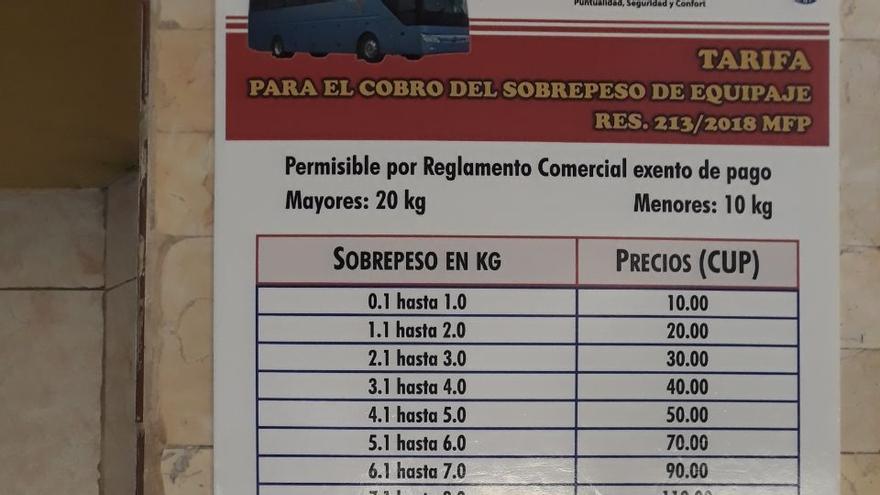
Since the beginning of the year, with the implementation of a resolution of the Ministry of Finance, it is now permitted to travel with more than the 20 kilograms of free luggage (10 in the case of children) that is allowed when paying for a regular ticket.

What was previously prohibited, was at that time dealt with by dropping some bills into the right hands. Now that it is regulated, it is difficult to do because of the high price. Each adult who wants to add weight to their luggage must now pay between 50 CUP (Cuban pesos,roughly equivalent to $2 US) for 5 kilograms and 750 CUP for the maximum allowed, 30 kilograms. The figure can reach up to ten times the price of the ticket. continue reading

“I have two brothers imprisoned in the Taco-Taco prison in Pinar del Río, and when I visit, I bring food to both of them,” says Carlos from Camagüey who frequently visits from the middle of the island. In February, I had to pay 300 CUP for the overweight luggage, the cost of my ticket was 33,” he explains incredulously.

Alberto Ramos, general director of the National Bus Company, explained that the new measures respond to users’ demands to “be able to carry more weight in their luggage, together with achieving greater discipline and order in transportation.”

However, for those who need to bring food home to their family, or bring food to a family member who is a prisoner, or move around the country with their belongings in hand, the price has turned out to be excessive. In this service, it is precisely the people with the fewest resources who can not travel by private taxi lines.

Alicia Fuentes travels abroad as a “mule” to look for merchandise that she later sells in the informal market. According to her experience, she says, Cuban rates are proportionally the highest. “In all the time I have been traveling to countries that do not require a visa for Cubans, the cost of bringing packages does not exceed 25% of what I paid for the passage. Now, when I arrive at the bus terminal in Havana, I have to pay 750 CUP for luggage, almost eight times more than the ticket,” she says.

“It may be that in airports charging for overweight luggage is more justified, but we are talking about a transport that moves by road,” says Fuentes, who does not understand that excess weight can pose a risk to passengers.

The Chinese-made Yutong brand bues destined for interprovincial transport have been suffering from the deterioration of their years and the lack of spare parts. Scenes of these vehicles broken down in the middle of the road are common and last December two of this company’s buses were in crashes that left several dead and dozens injured.

Rates for excess weight on the buses. (14ymedio)

“The buses were traveling on the roads overloaded and that is a danger,” an interprovincial bus driver who preferred anonymity told this newspaper. “People transport all kinds of goods in these buses and that wears out the equipment, in addition to increasing the risks, because there is less maneuverability with excessive weight.”

With a poor postal service, in Cuba the cheapest option to send cargo to another province is offered by the railroad. “Here we can transport everything from a washing machine and a bed to food if they are shipped well packaged,” explains one employee of the railroad company, but “many people prefer to carry their loads with them for fear of loss and misplacement.”

It is common for bus customers to trvel with products bought in one province and scarce in another. In bus luggage compartments often carry the purchases from the rationed market made by people who live in one place, but are registered with a ration bodega in another place.

“Every month I bring my daughter the rice they give her at the bodega (ration outlet) in Ciego de Ávila because she has not been able to use her card with an address in Havana and she still is registered in the ration system there,” says Rita, a 68-year-old retiree.

“With the rice, the jam the child [has a right to] and whatever else I bring, I already have excess baggage and this week I had to pay more than 200 CUP to take it,” she added. Before, Rita managed to bring all her bundles by “talking to the driver and coming to an agreement,” she explained. But she acknowledeges that the other passengers who traveled lighter complained that their bags were crushed by the excess luggage crammed in the compartments.

“I can clearly see that the excess baggage is regulated and that you officially pay to carry more cargo but the prices have no relation whatsoever to salaries and, practically speaking, I live only on my pension,” she protests.

Others have found a way to evade the high rates. “There are always good people,” says Dignora González. “At home I weigh the bags and separate the excess, so I can give it to someone who isn’t carrying any luggage and we make an agreement between ourselves,” she says,  despite knowing that, by decree, the weight is non-transferable between passengers. “The drivers have no way of knowing,” she concludes.

Raúl, from Manzanillo, who has a peanut selling business, buys three tickets every time he travels and takes his wife and daughter in order to transport the raw material from Camagüey to Manzanillo. “The return ticket costs me 51 CUP for each one and in the end it’s cheaper for me to take the family than traveling alone and having to pay for excess baggage.”

_____________________

The 14ymedio team is committed to serious journalism that reflects the reality of deep Cuba. Thank you for joining us on this long road. We invite you to continue supporting us, but this time by becoming a member of 14ymedio. Together we can continue to transform journalism in Cuba.
Etecsa Blames Excess Demand for 3G Malfunctions

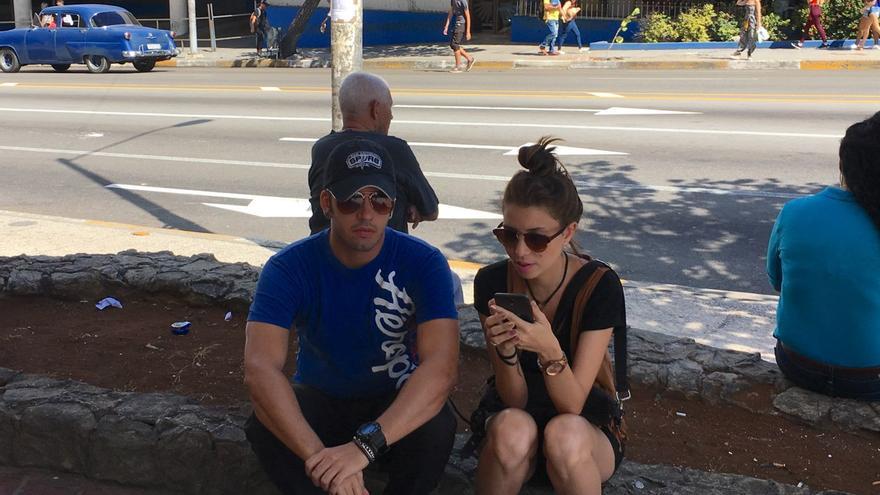
Many users complain about the worsening of the quality of the service, which Etecsa blames on the congestion of connections. (14ymedio)

14ymedio bigger14ymedio, Havana, 5 March 2019 — The directors of the Telecommunications Company of Cuba (Etecsa) have decided, after several weeks, to offer an explanation for the notable loss in the quality of the 3G connection that has led to a lot criticism from its users. Kelvin Castro, director of media projects for the monopoly, acknowledged on Monday on the television news that the demand has exceeded the forecasts and he asked customers for patience.

The official admitted that the company “prepared for two years for this service, but the increased use exceeded the established strategy… The number of users who connect at the same time exceeds the capacity of the installed network,” he acknowledged.

“You can only use it late at night,” protests Geovanny, a Havana resident who, despite living in a very central area, can not get on the internet from his cell phone during the day. “When you do connect, it constantly hangs up,” he describes. continue reading

Eliécer Samada, head of the Etecsa wireless group, also appeared on the news program to explain that “optimization is being worked on and the results will be seen in the coming days.” The manager could not offer an expected date for the 4G service but he insisted that work is being done to get it going and increase the quality.

“The strategy is to increase capacity, we are installing radio bases quickly and with a more focused coverage where there is little coverage now,” Samada said.

Customers doubt the efficiency in expense management, since, despite the high prices, the infrastructure does not deliver what was expected. “How do you use all the money that you collect in the refill recharges [that family and friends provide] from abroad? Calls and web browsing are expensive,” complained a customer through a website.

The price of the connection is 0.10 CUC per megabit, although customers most frequently buy one of the four data packages, ranging from 600 megabits for 7 CUC to 4 gigabits for 30 CUC; this latter plan costs the equivalent of the entire monthly salary of a professional.

Other voices demand that Etecsa publish its accounts or that the Government allow other companies to enter the market.

Since last December 6, when web browsing service was enabled from mobile phones, the speed and stability of the connection has deteriorated. In the last four weeks, the malfunctioning of 3G data service on cell phones has become evident and has also affected calling and text message services.

At the end of January, Etecsa had 5.4 million active lines and the average monthly growth is 50,000 new customers, according to official data. 40% of those clients “generate data traffic of some kind” either by ’Nauta’ email, MMS or web browsing. 35% connect to the internet from their terminals.

Samada believes that the company is now at 160% of the expected capacity. Compared to the more than 1.7 million customers who surf from mobile phones, only 70,400 Cubans are connected from their homes through a landline, the so-called ’Nauta Hogar’ service.

Until the appearance of mobile data, 60% of the 5.9 million Cuban Internet users accessed the network from their schools and workplaces.

___________________

The 14ymedio team is committed to serious journalism that reflects the reality of deep Cuba. Thank you for joining us on this long road. We invite you to continue supporting us, but this time by becoming a member of 14ymedio. Together we can continue to transform journalism in Cuba.
Minnie Mouse Wins the Revolution Game

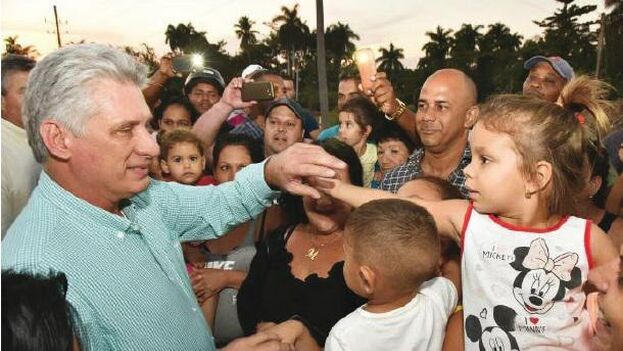
Miguel Díaz-Canel greets the crowd in this image published by the official press. (Granma)

14ymedio bigger14ymedio, Yoani Sanchez, Havana, Generation Y, 11 March 2019 — Do you remember those years when national television did not broadcast the cartoons of the “capitalist” world? My generation grew up looking at Soviet, Polish, Czech and Bulgarian cartoons; some well crafted, but others crude and boring, with a clear ideological message of “collectivization,” in addition to an excessive tendency to tragedy, drama, cold and steppes that had little to do with the need for entertainment of a child born in the tropics.

Well, I remembered that veto of Donald Duck, Mickey Mouse and his dog Pluto when I saw the photo of the “meet-and-greet” with Miguel Diaz-Canel published today by the official press. Every morning, the newspapers controlled by the Communist Party feel obliged to show images where the new (handpicked) president appears as someone popular and close to the people, but in the effort he inevitably blunders or ends up with details unwanted by the Cuban Communist Party.

In the camera’s flash, this girl’s shirt shows that Disney prevailed over the Revolution. Minnie has been stronger than censorship and these children today are closer to Bugs Bunny than to Bolek and Lolek.

____________________________________

The 14ymedio team is committed to serious journalism that reflects the reality of deep Cuba. Thank you for joining us on this long road. We invite you to continue supporting us, but this time by becoming a member of 14ymedio. Together we can continue to transform journalism in Cuba.

Cuban Doctors Survive on Gifts from Patients

The Martyrs Intermunicipal General Teaching Hospital in Sagua la Grande, Villa Clara. (14ymedio)

14ymedio bigger14ymedio, Marcelo Hernández, Havana, March 7, 2019 — Herminia does a rigorous inventory of everything she needs to bring to the hospital: a pillow, a fan, a bucket to flush the toilet, and some disposable syringes that she bought on the black market. Her 27-year-old grandson is hospitalized with dengue fever and the family is preparing for the shortages of the Public Healthcare system in Cuba.

In the bag, along with the cotton swabs and thermometer, Herminia carries a gift for the doctor and the nurses attending the young man. “No one has asked us directly but it’s clear that the conditions in which they work are very bad, so we try to help them.” The gift includes soap, several pens, and a women’s perfume.

Although in 2014 the Government approved a salary increase for the more than 440,000 workers of the Public Healthcare sector, the monthly salary still doesn’t surpass the equivalent of $70, a figure that is almost symoblic in a country where a liter of sunflower oil reaches $2 and a kilo of chicken is about $1.90. continue reading

For decades Cubans have been accustomed to bribing doctors with money or gifts to get a favorable treatment, a practice that the government prohibits but which has spread to all levels of service and all specialties.

In recent months several official voices have resorted to the traditional euphemisms calling for “raising the ethics” in patient treatment and “eliminating certain distortions” in Public Health, but doctors don’t seem prepared to renounce the bonus represented by the gifts, donations, and help that they receive from the sick and their relatives.

“It’s not that they have to give me something to receive good care, but everyone who comes to this clinic knows that I have to jump through hoops to be able to feed my family with this salary,” justifies Sandra, a young graduate in Comprehensive General Medicine who sees patients in a hospital in the Cerro neighborhood.

“Yesterday I was able to have a snack because the mother of a young man I attended gave me a steak roll and a drink,” says Sandra. “In my house I have half a bag of rice given to me by a grateful patient who I once helped recover from an allergy crisis, and the husband of another patient got me the only fan in this place,” she says.

Sandra’s salary, a little more than $50 monthly, is enough for her to defray the costs of electricity and gas, buy the few products that the rationed market still offers, and “go twice to a hard currency store to bring food home,” she reflects. “It’s enough to buy a few pounds of pork, some tomato sauce, and a little bread, and that’s it.”

With an extensive network of hospitals, clinics, and family medical consults, the Healthcare sector, which was one of the jewels in the crown of the system, has been particularly affected by the loss of the Soviet subsidy that had allowed the Island to reach the health indicators of a first-world country.

“We began to have problems with everything, since the equipment was breaking and there weren’t replacement parts or even medicine, going through the resources that workers receive like clothing or footwear,” recalls Jorge Echavarría, a retired urologist who had to work in the difficult years of the ’90s on the Island. “The levels [of care] prior to the Special Period were never recovered,” he believes.

Bathrooms without water, unpainted walls, broken air conditioning, and terrible food are what Herminia found upon arriving at the ward of the Freyre de Andrade General Surgery Hospital Clinic, in Havana, where her grandson was a patient. The medical center is still half-finished after a long repair, and patients enter between scaffolding and workers finishing certain places.

“We’ve even had to bring the power outlet to put it in the wall and be able to connect the fan because there was only a hole with two cables,” laments Herminia. A neighbor has lent them a small portable television and they also have brought all of the bedding from home. A mosquito net, also brought by the family, covers the patient’s bed.

A few meters away, another patient eats directly from a plastic container that his daughter has brought him. Beside the bed, untouched, is the tray with a watery soup, a little rice, and a greenish mash that they gave him in the hospital. “Those who don’t have family members who bring them food have to eat that,” he points out, because here “we have to move our home into the hospital.”

As a consequence of the precarious economic situation doctors are experiencing in health centers, many of them long to be part of the medical missions to other countries. Although once abroad they only receive between 10% and 15% of the total salary that the local governments pay the Ministry of Health, this quantity is much more than they receive on the Island.

The Cuban medical presence reaches 64 countries and it is calculated that more than 30,000 health professionals are currently working in “international medical cooperation.” The hope of the majority is to be able to bring resources to the Island so that their families can live better or to end up emigrating during one of those trips.

“My dream is that they send me on a mission,” says Sandra, the young recent graduate. “That is the only possibility I have to get out of this hole and get some money to fix my house.” Until that day arrives, the doctor hopes “to be able to keep surviving thanks to grateful patients,” those who never arrive with empty hands.

Translated by: Sheilagh Carey

_____________________________________

The 14ymedio team is committed to serious journalism that reflects the reality of deep Cuba. Thank you for joining us on this long road. We invite you to continue supporting us, but this time by becoming a member of 14ymedio. Together we can continue to transform journalism in Cuba.
4G Comes to Several Areas Along the Havana Coastline on Friday

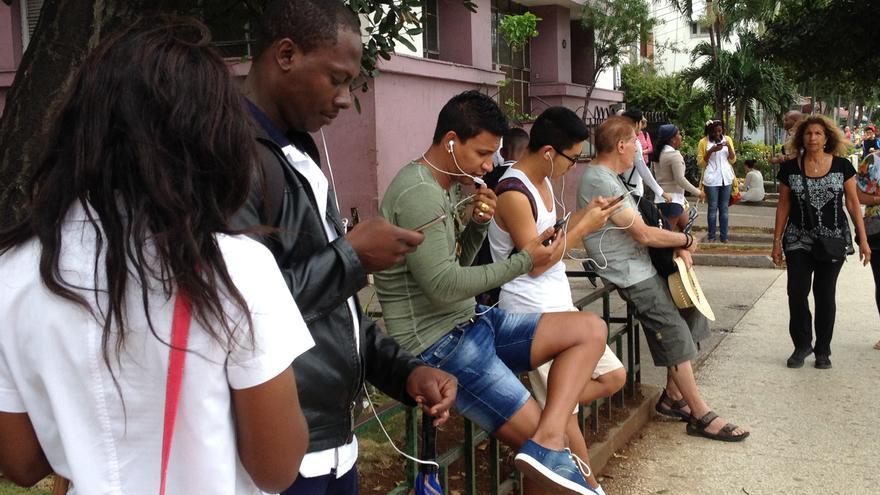
The arrival of 4G along the capital’s coastline coincides with a time of widespread dissastifaction among the customers of the telecommunications company. (14ymedio)

14ymedio bigger14ymedio, Havana, 7 March 2019 — In the midst of one of the worst times in its history, the Telecommunications Company of Cuba (Etecsa), surrounded by criticism and ridicule, announced on Thursday that as of March 8 4G service will be installed in several areas along the Havana coastline. This privilege will initially be only for the “highest consumption customers.”

The arrival of 4G in this area of the capital coincides with a time of widespread dissatisfaction among the customers of the telecommunications company, due to the deterioration in the quality of web browsing from cell phones in recent weeks.

“It’s like a cannon” and “this is incredible” are phrases heard from customers who have been able to try the new 4G service for mobile browsing. From the first early of the morning the text-only message with the announcement that it was already possible to navigate to the 4G network began to appear on the phones of customers selected by the state telecommunications monopoly, as several of them confirmed to 14ymedio. continue reading

“It’s an important change because before it took me a long time to open a page, upload a photo or send a tweet but now it’s so fast that I can’t believe it,” Yusleidi, 38, one of the customers who is part of the advance party of Cubans who has managed to navigate from the mobiles with the new speed, told this newspaper.

“The first thing I did was to communicate with my brother through a WhatsApp video conference and it worked for me and was very stable,” adds José Manuel, other of the beneficiaries. “They included me in this first group because since I opened the internet service for mobile phones I have been buying 2.5 and 4 gigabyte packages,” he says.

José Manuel has a small business selling vitamins, food supplements and medicines from home. He imports them from Miami and Mexico and then distributes them throughout Havana. “That’s why I have to be very connected because most of the communication with my clients is through chat messaging.”

“I watched a piece of a series on Netflix just to test if 4G runs well,” explains a young man, who on Friday night boasted on G Street, one of Havana’s major throughfares, about being able to navigate faster. “The difference is noticeable but as soon as I left the Vedado area I lost the 4G signal and everything was slow again.”

Since Internet service from mobile phones was launched last December, users have reported constant crashes, speed problems and large areas of the country where it is not possible to go on-line during peak hours. In the last four weeks the malfunction has increased and has ended up also affecting calls and text message services.

Customers are annoyed that, despite the deterioration, Cuba’s only phone company, the state-owned Etecsa, maintains the high prices of the connection that, in its fee-for-tariff version, is 0.10 CUC per megabit, although most users prefer to use the option to buy one of the four data packages, ranging from 600 megabits for 7 CUC to 4 gigabits per 30 CUC; the latter is the equivalent of the monthly salary of a professional.

Computer scientist René Bustamante, 32, who works in a repair shop for mobile phones and computer equipment, confirmed to this newspaper that the arrival of 4G can mean “a qualitative leap in the connection but also an increase in the technological gap.” The specialist predicts that there will be “areas of the country where Etecsa’s clients will be able to use applications that in other parts of the country will not open due to the slow speeds.”

“Undoubtedly we have to take staggered steps to cover the whole country, but there are still too many people who are only using 2G,” he laments. “As always, even without having consolidated a service, another is added and this creates important differences”. In your case, the 4G will be able to “improve the business and attract a clientele that intends to explore the web beyond”.

In telecommunications, 4G is known as the fourth generation of mobile phone technologies, after 2G and 3G. It offers maximum data transmission speeds ranging from 100 Mbit/s (12.5 MB/s) in movement to 1 Gbit/s (125 MB/s) at rest.

______________________________

The 14ymedio team is committed to serious journalism that reflects the reality of deep Cuba. Thank you for joining us on this long road. We invite you to continue supporting us, but this time by becoming a member of 14ymedio. Together we can continue to transform journalism in Cuba.

Reflections on the Coming Laws

From now, numerous laws will have to pass to Parliament to fulfill the terms planned by the new Constitution. (Granma)

14ymedio bigger14ymedio, Reinaldo Escobar, Havana, March 5, 2019 — Almost at the end of the definitive text of the new Constitution of the Republic, ratified on February 24, three temporary provisions appear imposing the terms for the enactment of the complementary laws.

Although a date has not been officially mentioned for their definitive publication in the Official Gazette, the deputies have proposed that the effective date for the new Constitution be April 10, 2019 to be implemented that day 150 years from the first Constitution of the Republic in Arms proclaimed in Guáimaro in 1869.

If that date is chosen, the established terms will be calculated from April 10 for each one of the steps planned in the temporary provisions. However, the dates indicated now could be moved up. continue reading

October 2019: Approval of a new Electoral Law.

This law was announced by Raúl Castro in February 2015 during the holding of the 10th Plenary of the Central Committee of the Communist Party of Cuba (PCC). Debate on that topic in official media was fleeting, but in the realm of independent civil society and the political opposition, proposals arose intended to eliminate the Candidacies Commission and to introduce the election of the president of the Republic by popular vote. The new Constitution has established that the president will be chosen by Parliament and for this reason the new electoral legislation will develop bound by that precept.

January 2020: The National Assembly of Peoples Power (ANPP) will choose, from among its deputies, its president, vice-president, and secretary, the other members of the Council of State, and the president and vice-president of the Republic.

If so, February 24, 2020 would be perhaps the moment chosen for the assumption of these offices. There rise several questions. The first is if, in the case that Miguel Díaz-Canel is designated president of the Republic, and if he managed to be chosen again for a second mandate, the regressive count of his time in power will be extended until February 2030. In what count is the year that he governed between 2019 and 2020 included?

April 2020: The president of the Republic proposes to the ANPP the designation of the prime minister, vice-prime ministers, the secretary, and other members of the Council of Ministers.

In the times in which Fidel Castro occupied the position of prime minister (from February 16, 1959 to December 2, 1976) his power didn’t depend on his investiture, but rather the other way around. That position was important because the Supreme Leader occupied it. From the time when he became head of state there was no more a prime minister although Carlos Lage was taken as such when he acted as secretary of the Council of State. Behind the scenes they called him “the administrator of the insane asylum.” Among the candidates to this position the names of Homero Acosta and Mercedes López Acea are put forward.

On that same date the president must propose to the municipal assemblies the choice of provincial governors and vice-governors.

Among the discrepancies with the Constitution project that had greatest resonance during the popular debates is the detail of the election of the provincial governors.  A good number of citizens who participated in these discussions suggested that this governmental position be proposed and approved by the vote of their electors.

The ANPP approves its regulations and that of the Council of State.

The ANPP will approve a one-year legislative schedule that complies with the elaboration of the laws that the established precepts in the new Magna Carta develop.

We will see, for example, how the jurists implement Article 4 of the Constitution which institutionalizes intolerance, repudiation rallies, and the repression of dissidents.  That provision gives citizens the right to “combat by all means, including armed struggle [. . .], against anything that tries to overthrow the political, social, or economic order established by this Constitution.”

July 2020:  The municipal assemblies designate the mayors.

October 2020:  The Governing Council of the Supreme People’s Court presents to the ANPP the draft of the Law of the People’s Courts and proposed amendments to the Law of Criminal Procedure and the corresponding procedure of civil, administrative, labor, and economic law.

It would be desirable to include in that law the prohibition against arbitrary arrests, the right of the arrestee to have a lawyer from the beginning of the process, and remedies against undue confiscations, disproportionate sentences, and limitations on travel within and outside the country.

April 2021:  The Council of Ministers presents to the ANPP the draft regulations of that agency and the provincial governors.

The ANPP approves the regulation of the municipal assemblies and their board of directors.

The process of popular consultation and referendum on the draft of the Family Code begins, in which the manner of establishing marriage must be included.

Those who placed themselves in opposite barricades with so much passion in order to settle the issue of whether marriage should be defined as between man and woman or between persons disposed to legalize their relationship will have to wait two years, at most.  Too much energy, too much time was dedicated to this topic compared to the irrevocability of the system or the single party.  But that’s how it happened.

In 2021 will begin a consultation process that presupposes a prolonged clash between the LGBTI community and the evangelical churches that have been so active on this topic.  By that time Raul Castro will not longer be first secretary of the Communist Party, and Mariela Castro will lack the symbolic support that genetics gave her.

Matters of greater importance will attract the attention of those who remain at the helm of this ship. Among them, to cite only those of greatest importance, one would have to mention the solution to the acute problem of the dual currency, the elimination of the rationing system, the liberalization of the non-state productive forces, a greater opening of the migration laws that restores all rights to Cubans who live abroad and, of course, the de-criminalization of political differences.

Translated by: Sheilagh Carey and Mary Lou Keel

_____________________

The 14ymedio team is committed to serious journalism that reflects the reality of deep Cuba. Thank you for joining us on this long road. We invite you to continue supporting us, but this time by becoming a member of 14ymedio. Together we can continue to transform journalism in Cuba.

Three Lessons for the Cuban Opposition from the Venezuelan Struggle

Julio Borges y Carlos Vecchio, representatives of Guaidó in Washington, meet with Mike Pence. (VP)

14ymedio bigger14ymedio, Jorge Hernández Fonseca, Lisbon, 8 March 2019 — The struggle of the Venezuelan people to liberate themselves from the Castro-Communist yoke is on the definitive path to victory. The sequence of events that have led to today contain lessons important for the struggle of the Cuban people, for the fundamental reason that the Castro regime provides the main political advisers of the Venezuelan dictatorship and the ones who direct it.

Three important lessons – among others – can be extracted as experience for the Cuban political opposition absorbed in a similar struggle to that of the Venezuelan people for their freedom.

A first lesson is related to the weight that international support has had in this struggle, recognizing, supporting, and encouraging democratic Venezuelans in their effort, above all, the almost total and unconditional support that the United States has offered. For the struggle of the Venezuelan people this is very important, because Cuban opposition sectors insist in keeping their distance from US support, to avoid the inevitable and hackneyed Communist propaganda. Being supported by the US does not mean being their puppet. continue reading

The second lesson that we Cubans must learn is the importance of the exile in the struggle for freedom. We know that the Castroite dictatorship has always sown the seed of division between “Cubans inside and Cubans outside,” a seed that has been absorbed to a certain extent by opposition sectors from within the Island. If, in the case of Chavista Venezuela there is a monolithic external support, it is in large measure the result of the work of the Cuban exile.

There is a third lesson that applies to the Cuban case, increasingly clear in the Venezuelan case. Despite the fact that all of Latin America insists on ruling out an external military solution, we Cubans know that Maduro will not hand over power if he is not forced to do so. When he was alive Fidel Castro coined a phrase that is also valid in Venezuela: “What we obtained by force, they will have to take away from us by force.” In Venezuela it’s a matter of the force being that of the Venezuelan army itself, but if that is not possible, then an outside force.

Additionally, the support for the democratic Venezuelan people to the current struggle is owed in large part to the work of American members of Congress of Cuban origin, like Marco Rubio and Miguel Díaz Balart, among other Cuban American officials, who have contributed decision-making support to the United States presidency, instructing it to take decisive actions in favor of the democracy and freedom of an oppressed and needy Venezuela, even humanitarian aid. The Venezuelan fighters inside the country feel heartfelt thanks for their Latin American brothers and sisters in key positions within the American administration, without feeling self-conscious about that support, selfless and in solidarity, as it is from fellow Latinos.

In Cuba there has been enough division over these three matters, now put on the discussion table and highlighted in the struggle of the Venezuelan people. The dictatorship of Maduro, like the Castro dictatorship, insists on placing the conflicting dichotomy between Chavismo and the US, copying the Castro regime’s outline, which repeats that the Cuban dilemma is not between the oppressed people of the Island and the oppressive dictatorship, but rather between “the Revolution and the US.” No one from the opposition within Venezuela rejects international support and much less do they reject the collaboration of the United States against Maduro. We Cubans must learn that lesson.

Translated by Sheilagh Carey

_________________

The 14ymedio team is committed to serious journalism that reflects the reality of deep Cuba. Thank you for joining us on this long road. We invite you to continue supporting us, but this time by becoming a member of 14ymedio. Together we can continue to transform journalism in Cuba.
Cuban Women, The Rights We Lack

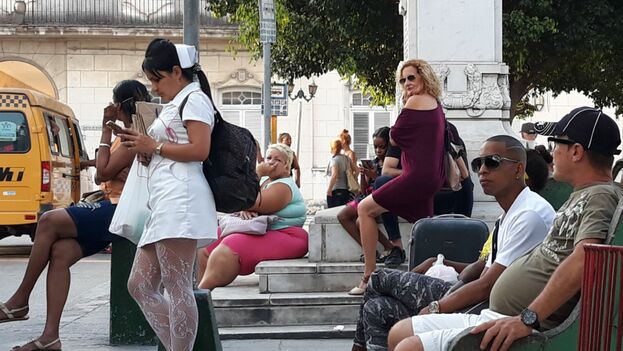
“We lack the freedom to walk the streets of the country without gender harassment, as an accepted practice.”(14ymedio)

14ymedio bigger14ymedio, Yoani Sanchez, Havana, 8 March 2019 — This Thursday, Cuban national TV broadcast some minutes of the first session of the Congress of the Cuban Women’s Federation (FMC) now underway in Havana. In the most of the speeches I heard, they were talking about women as a part of the Cuban economy and our role “in the production of food,” but barely mentioned were the gains, rights and demands that Cuban women have failed to achieve.

In the face of this official organization’s silence about the serious problems Cuban women are experiencing, I have made my own list of priorities, fully aware that each woman who reads the following inventory will add her own demands:

We need to have shelters for battered women and more severe laws against abusers. The police must be prepared and trained to deal with these cases and not keep repeating, when they receive a complaint, the harsh platitudes of “no one should interfere between a husband and wife,” “you’re the one who provoked him,” or “go home and resolve it between yourselves.” continue reading

We urgently need access to gynecological and obstetric care that respects us as human beings, does not pressure us, protects our privacy and intimate lives. Also, during childbirth, our care should follow the recommendations of the World Health Organization which do not allow for the practice of compulsory episiotomies without consulting the pregnant woman, as happens in Cuban maternity hospitals, but which the medical community rejects as a routine practice.

We want to receive a decent salary. Although the authorities boast that there is no gender gap on the Island, the truth is that the monthly salary of a professional does not exceed the equivalent of $50 and a package of disposable diapers can cost more than $10, so being a mother creates a serious problem for the family budget.

We lack the right to walk freely in our country without a policeman stopping a woman because they think she looks like a “jinetera” (a sex worker). Furthermore, when her identity card is checked if the address does not correspond to the province she is in, she is deported to her place of origin, harassed judicially and, often, interned in a reeducation center.

We want the tranquility of a dignified old age with a retirement that allows women who have worked all their lives to lead a decent life and not have to collect cans in the trash to sell as raw material, depend on their children who have emigrated abroad, or sell individual cigarettes on a corner.

“We want the tranquility of a dignified old age with a retirement that allows these women who have worked all their lives to lead a decent life.” (14ymedio)

We lack the freedom to walk the streets of the country without gender harassment, not only as an accepted practice but one that is considered gallantry. We want to be able to travel on public transport without being groped or assaulted by sexist and humiliating phrases.

We must have the opportunity to fill the highest positions in the country and to have real responsibilities of decision-making and influence, not just fill gender quotas, please international public opinion, or offer ourselves as “pretty faces” in the Government, Parliament or ministries.
We urgently need the right to free association because I believe that only when we are able to band together according to our affinities and represent ourselves, will Cuban women be able to build the structures, demonstrate and carry out actions to demand any other rights that we lack. As long as only one female organization is allowed, in our case the Federation of Cuban Women (FMC) which functions as a transmission line from the power to women, little can be done.

We need to be able to dissent, to disagree with power and still not be discriminated against, segregated or insulted because we are women, to have ovaries and to dare to challenge the Party in power, the political authorities or the figure of a leader. In short, we want the freedom of the power of membership in any political organization, without regards to its leanings, ideological color or platform, without being denigrated for that.

We have the right to know the true statistics and figures of what happens to us. We want to know the real number of femicides committed in Cuba each year, the true incidence of gender violence and female suicide, the numbers of divorces or abortions. Making up or hiding those figures does not solve the problems, and the national media, together with the police authorities, have an obligation to show them.

Even if we are migrating, as so many Cuban women are right now in the Panamanian or Colombian jungle, we are owed attention and support from the authorities of this island. The Cuban consulates throughout the world need to look after our rights as émigrés.

Lastly, we also lack the right to public protest, to claim our rights in the streets, to strike and to receive a response. The right to make a day like today not a day of complaisant slogans, praise to power and genuflections to the Plaza of the Revolution, but a day of demanding rights, clamoring for demands and naming, aloud, everything that we lack.

__________________

The 14ymedio team is committed to serious journalism that reflects the reality of deep Cuba. Thank you for joining us on this long road. We invite you to continue supporting us, but this time by becoming a member of 14ymedio. Together we can continue to transform journalism in Cuba.
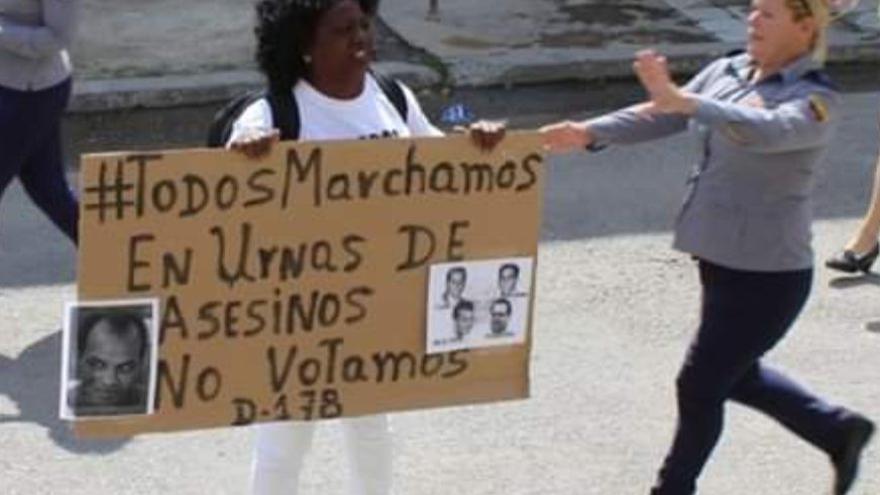
The Referendum Triggered Arbitrary Arrests in Cuba

Text of the sign: “#We All March. We don’t vote at the polling places of the assassins.” Among the most repressed independent organizations were the Patriotic Union of Cuba, Women in White, the United Antitotalitarian Forum, and the Cuban Association of Electoral Observers, among others. (@bertasolerf) 

14ymedio bigger14ymedio, Havana, March 5, 2019 — The detentions for political reasons in Cuba increased to 310 in February compared to 144 in January, the Cuban Commission of Human Rights and National Reconciliation (CCDHRN) denounced in its monthly report published this Wednesday. The number is substantially below the figure reported by the Cuban Observatory of Human Rights (OCDH), based in Madrid, last Sunday, which placed arrests at 405.

According to the CCDHRN, before the referendum held on February 24, a “large mobilization” of the police and para-police forces took place, capable of exercising “preventive repression and intimidation” on citizens classified as disaffected or non-sympathetic to the Government.

Likewise, it cites as two new cases of political prisoners those of Yasser Rivero Boni and Salvador Reyes Peña, arrested in Havana on 10 and 16 February respectively and interned in high security prisons.

On its list of political prisoners updated last December, the Commission cited between 130 and 140 people detained in one of the 150 prisons and internment camps currently operating on the island.

In its new monthly report it also denounces “48 acts of harassment (basically threats) and 12 physical attacks,” repressive actions carried out or orchestrated by the political police.

The OCDH, which counts almost one hundred more arrests last month, more than double the previous one, said many of these occurred “against the activists who promoted a No vote or abstention in the constitutional referendum.”

What happened “demonstrates that, in face of rebellious expressions and discontent over the economic situation, the Government of Cuba opts to intensify repression and not for reforms,” stresses the text published by the organization headquartered in Madrid.

“In addition to the arrests, the repressive action included raids on homes, confiscations of work materials, fines, house arrests, and violent episodes against human rights activists and independent electoral observers,” specified the OCDH.

The provinces with the greatest incidence of these repressive acts were Santiago de Cuba, Havana, and Matanzas, while among the most repressed independent organizations were the Patriotic Union of Cuba, the Ladies in White, the United Antitotalitarian Forum, and the Cuban Association of Electoral Observers, among others.

“We blame the Government of Miguel Díaz-Canel for the growing repression against independent activists. Almost a year after his appointment to the leadership of the country, the siege against civil society remains,” sustains the Observatory. Something that “reasserts the repressive line of the Government and shows Havana’s worry about the real results of the constitutional referendum,” denounced Alejandro González Raga, executive director of OCDH.

In a previous statement, the organization also lamented that “during seven months of campaigning for the referendum, not a single article has been published in the official press proposing No or abstention,” something which “violates international electoral standards.”

Translated by: Sheilagh Carey

__________________________

The 14ymedio team is committed to serious journalism that reflects the reality of deep Cuba. Thank you for joining us on this long road. We invite you to continue supporting us, but this time by becoming a member of 14ymedio. Together we can continue to transform journalism in Cuba.
María and the Lack of Cooking Oil

A line to buy cooking oil in in Camagüey, at El Encanto store. (Inalkis Rodríguez)

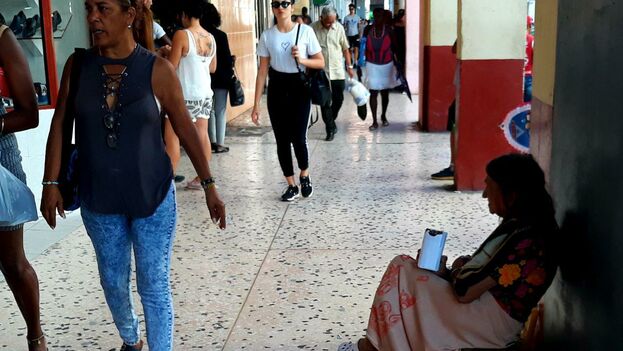
14ymedio bigger14ymedio, Yoani Sanchez, Generation Y, 6 March 2019 — Now that so many situations we are experiencing in Cuba remind us of those hard years of the 1990s, the stories of substitutions that were made in kitchens and in meals also return. People on the streets remember how they managed to cut a small bread into innumerable slices to eat during the day, how they dyed the rice yellow with pills from a food supplement, or turned a banana peel into fake mincemeat.

María is 43 and remembers very well those times when the national economy hit rock bottom. After petroleum and the buses, the next thing there was a shortage of was cooking oil. “My sister worked in a pharmaceutical laboratory,” she recalls, and this allowed her to bring mineral oil home, a product used as an ingredient in some medicines and one which has no smell or taste.

The problem of using mineral oil for human consumption, as happened in Cuba where it was substituted for cooking oil, is that it also worked as a powerful laxative. “When you put the food in the pan with the boiling oil it made a white foam, and after you ate it you had to put cotton in your underwear when you went out because it literally was dripping out of you like a broken car.”

“All my clothes were stained with grease and since there was no detergent and hardly any soap, that was also a problem,” recalls María. “Terrible things happened to me, like in my first interview I left an oil stain on the seat where I sat.” But now her concerns look not to the past, but to the present. “I don’t want my son to go through this, it’s shameful enough that I had to.”

María, with all the skills needed to adapt, currently prefers “to boil, steam or poach rather than fry,” something very common in Cuban cuisine, which has been impoverished in recent decades due to the lack of ingredients. “Specialists will say that it is healthier without oil, and perhaps they are right, but good nutrition is not imposed by scarcity, but rather by learning to choose,” she says.

___________________________________

The 14ymedio team is committed to serious journalism that reflects the reality of deep Cuba. Thank you for joining us on this long road. We invite you to continue supporting us, but this time by becoming a member of 14ymedio. Together we can continue to transform journalism in Cuba.
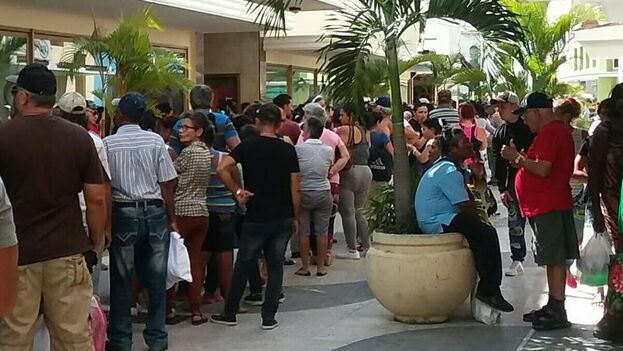
The Ghost of The Special Period Threatens Cuba in 2019, Warns Report

The worsening of the economy is seen not only in the “shortages in the hard currency stores,” but also in the lack of subsidized basic necessity products like bread and eggs. (14ymedio)

14ymedio biggerEFE (via 14ymedio), Miami, March 5, 2019 — The economic crisis Cuba is experiencing will worsen in the next few months and, if it doesn’t open itself to a market system, the country could fall into a new “Special Period,” the grave depression into which the island was sunk in the 90s, according to predictions from The Havana Consulting Group, headquartered in Miami.

In fact, the worsening of the Cuban economy is now seen not only in the “shortages in the hard currency stores,” but also in the lack of subsidized basic necessity products like bread and eggs, emphasized Emilio Morales, president of this firm that provides insight into the Cuban market and its consumers.

The report to which Efe had access warns that Cuba “urgently needs” to open itself to the market economy, “liberate once and for all the productive forces, and allow Cuban citizens to invest in their own country,” otherwise, the “reappearance of the ghost of the ’Special Period’” will become a reality. continue reading

At the time of the ’Special Period’ the grave crisis that gripped Cuba was due to the withdrawal of the subsidies that it used to receive from the defunct Soviet Union; today the “financial support that the island has [recently] been receiving from Venezuela is practically insignificant,” given the total collapse of the South American country.

Only by “avoiding the habitual dependence on third parties” and undertaking “profound transformations of its economy” will Cuba be able to get out of the crisis by itself, detailed The Havana Consulting Group’s report.

In that context, Morales noted that the Venezuelan subsidy, for some twenty years, “has helped the battered Cuban economy survive,” with the subsidized shipments of billions of dollars in barrels of oil in exchange for primarily medical services.

This commercial exchange between the two countries managed to reach $8.5 billion in 2012 and today barely reaches $2 billion, which is a decrease of 74%.

Added to this reality is the “failure of the economic reforms undertaken by Raúl Castro” approximately a decade ago and the “decrease in exports of nickel and sugar,” to the point where sugar production in 2018 was some 16.3% less than in 1905, which has now forced the country to buy sugar from France.

To these difficulties must be added another negative factor such as the “limits imposed to hinder the development and expansion of the private sector,” whose entrepreneurs took $2.39 billion out of the country in 2017.

And the nonexistence of free enterprise, the “non-recognition of private property, the prevalence of the monopoly established 60 years ago, and the lack of opportunities to invest and market goods and services that Cubans have,” undermine any attempt to revitalize the economy in medium and long term, says the report.

Another “chronic problem” is the deficit of the Cuban economy, despite the opening of the Mariel Special Development Zone (ZEDM) and its failure to attract capital, which barely reaches the 14.2% of the goal proposed when it was created six years ago.

To this devastating outlook must be added the “stagnation that the Cuban tourism industry has had in general,” with the decrease of the principal tourism markets: Canada, the United States, Germany, England, France, Spain, and Italy, it points out.

Air travel between Cuba and the US in 2018 declined some 18.3% compared with the previous year, a “declining tendency begun in the last trimester of 2017.”

In terms of the economic impact, this decline in toursim translated into an estimated loss of $1.283 billion.

Conversely, the low growth rate of the Gross Domestic Product (GDP) “hides a permanent recession,” with a fall to 1.4% in the last five years, according to official figures.

For that reason, “if the Cuban economy has not collapsed, it has been thanks to the Cuban exile,” 90% of which is settled in the United States and annually provides around $7 billion to the Cuban economy, between cash remittances and merchandise.

Additionally, Cuban Americans leave millions of dollars in the tourism sector of the island, since more than 50% of them who travel to the island stay in hotels with their relatives* living in the Caribbean country.

Close to 2.2 million Cubans live in the United States, some 90% of them in the state of Florida.

In 2017, cash remittances coming to the island represented 50.8% of the total annual income of the island’s population, The Havana Consulting Group pointed out.

Translated by: Sheilagh Carey

_____________________

The 14ymedio team is committed to serious journalism that reflects the reality of deep Cuba. Thank you for joining us on this long road. We invite you to continue supporting us, but this time by becoming a member of 14ymedio. Together we can continue to transform journalism in Cuba.

Isabela de Sagua: The Seafood Battle

The ’paladares’ (private restaurants) have flourished in Isabela de Sagua since the issuing of licenses to operate private businesses in the food service sector has become more flexible. (14ymedio)

14ymedio bigger14ymedio, Julia Mézenov, Isabela de Sagua | 1 March 2019 — State or private, the difference is no small thing in Isabela de Sagua, where a seafood dish can be half or double the size according to the structure of its ownership. The coastal town — which has spent decades in oblivion — is experiencing a rebirth after the flexibilizations for self-employment started almost a decade ago.

The so-called Venice of Cuba has benefited since 2011 from the liberalization in the food services sector, which authorized paladares (private restaurants) to serve up to 50 customers and allowed them to offer previously forbidden products such as shrimp, lobster and a wide variety of the seafood that is common in the area.

Now, years later, private businesses have flourished to such an extent that they outnumber the state business. And it is because of this, the private owners say, that state authorities have suddenly increased inspections of their successful businesses. continue reading

Up until eight years ago, visitors who arrived in Isabela de Sagua, in the province of Villa Clara, had to work hard to find something to eat in a city with decadent state cafés and a large informal fish and seafood market that forced tourists to plunge into illegality to be able to enjoy a moderately appetizing table. Anyone who approached a local restaurant barely found snacks and fried chicken.

Despite these dark years, the port, which has been demolished and has no commercial value, is still reputed to be one of the best places on the island to taste oysters, very common mollusks on Cuban coasts. With a reputation for being an aphrodisiac, along with an intense flavor and the ability to mix very well with tomato juice, this dish attracts thousands of travelers every year to Isabela de Sagua.

The group of cays that surrounds the area provides a favorable ground for oysters to thrive and, according to one of the cooks of the Las Casitas de Isabela restaurant, it is a dish in “high demand” among national and foreign customers. Oysters can be served stewed or smoked, although there are also many who prefer them in vinegar.

However, beyond the stoves and frying pans, this delicacy leaves some disappointed. Private restaurants receive a huge influx of diners regardless of the day of the week, because they serve large portions of seafood and are not victims of the diversion of resources (i.e. stealing) and corruption that mark the state services, which has put the authorities on guard.

Some owners consider that the increase in inspections by official inspectors in recent times is aimed at reducing their profits, fining them or even ordering their closure.

“Sometimes we receive up to 15 families on the same day,” says an employee of the Casablanca restaurant. When one paladar is full, the owners themselves send the customers to another location and, next to the menu, the most valued assets are the ocean breezes and the proximity to the sea.

The ’paladares’ often hide their seafood offerings for fear that the authorities will demand documentation proving they bought it on the legal market, which they do not have. (14ymedio)

Coinciding with this increase in controls on the private sector, state restaurants have launched into the competition arena and started offering seafood, although the price difference is still notable. While on ’official’ menus a lobster dish will never cost less than 11 CUC, in the paladares it barely exceeds 6.

The inspectors demand that the owners show invoices for having bought the product in an official store, which the owners consider “unfair and ridiculous.”

“If we’re so close to the coast, who’s going to buy seafood from a store freezer?” they ask.

The prohibition against Cuban citizens using motorized vessels to travel in territorial waters to fish on a larger scale, together with the prohibition that makes it illegal for private fishermen to sell their products to self-employed people, means that the people have resorted to the ’informal’ market. The sea is the wealth of Isabela and, also, its primary perdition.

Seafood fishermen are obliged to sell all their products to the State at prices far removed from those supported by the market, so they prefer to offer oysters, lobsters and shrimp on the black market, from which the whole town lives. The risk to them is fines and the confiscation of the flimsy boats they use for fishing, but the owner of a paladar faces a greater danger: the possible closure of their business.

“I do not put the seafood in the menu, but everyone who comes to Isabela knows that it’s included in rice, cocktails and enchiladas, they ask for it without our having to tell them it’s there,” says one of the owners consulted by this newspaper who prefers anonymity.

At the table of a restaurant, the Cuban-American Yisell Martín recognizes that the prices are tempting for those who come from abroad. “A grilled lobster comes out at less than 6 CUC,” she says, quoting a price that is about $6 US. “When you come home to visit the area, close to where you were born, you invite your whole family to taste seafood dishes. None of them could pay those prices with their official Cuban salary.”

“We do not go to the official restaurants because they put a lot of rice, sweet potatoes or lots of mayonnaise on the plate, but little seafood,” says another customer. “The best service is in the private ones, but without doubt you have to have some confidence to ask for certain dishes because we don’t want them to run out of food for the paladar to be closed,” he says.

In 2017 Hurricane Irma passed over Isabela de Sagua destroying innumerable houses. But private businesses are helping to recover the life of the town. “Who saw Isabela as she was and sees her now can not assimilate the tremendous change,” says Gertrudis, who lives there. “They offered to help me leave, but I love my land, even though we were not able to evacuate our belongings. Anyway, it’s already a memory, water under the bridge.”

The town is rising thanks to the seafood, the product that is both its danger and its survival.

_____________________

The 14ymedio team is committed to serious journalism that reflects the reality of deep Cuba. Thank you for joining us on this long road. We invite you to continue supporting us, but this time by becoming a member of 14ymedio. Together we can continue to transform journalism in Cuba.

"Journalism and Humor Cannot be Silent"

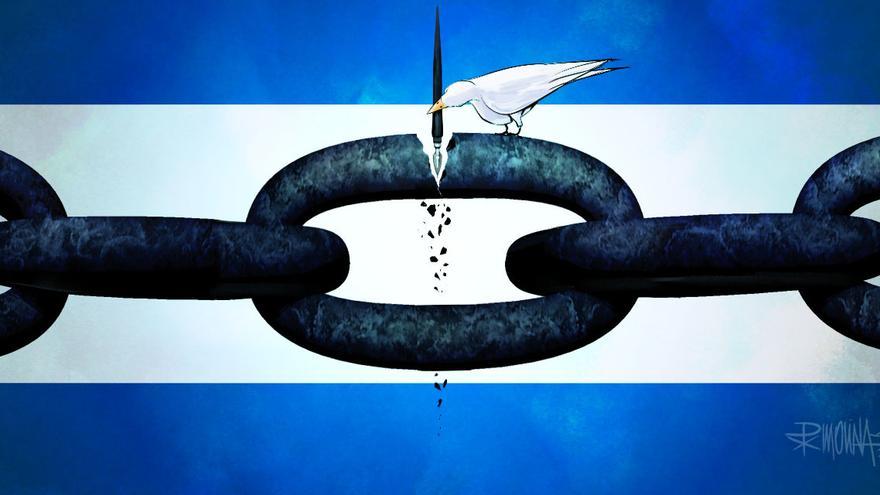
Pedro X Molina’s caricature for the Day of Journalism in Nicaragua, on March 1.

14ymedio bigger14ymedio, Yader Luna, Managua, March 4, 2019 — The Nicaraguan caricaturist Pedro Molina revealed that he was the victim of direct threats by fanatics from the regime of Daniel Ortega and Rosario Murillo, something that he said dozens of independent journalists in Nicaragua also suffer. However, he insists that they will not shut him up and that the commitment he has, along with his colleagues who work clandestinely or from exile, is every day greater.

The Confidencial caricaturist reflected on how difficult it is to practice the profession in these days of crisis that Nicaragua is experiencing because of the constant attack guided by the Government. “We continue doing our work, overcoming censorship and reporting,” says Molina, who maintains that this is the great triumph and seems optimistic.

“The optimism I have is based on the commitment that today every journalist doggedly doing their work has. Many of them, working clandestinely or from exile, have shown that they aren’t there (reporting) for a salary, but rather because they have recognized that with their work they can contribute to the liberation of the nation,” he affirmed during an interview with the television program Esta Noche. continue reading

Molina, a man who has drawn the powerful for years, is accustomed to annoying those personages who believe themselves untouchable. However, he admits that in the current context the threats have escalated to another level and he blamed Nicaragua’s dictatorial “first couple” for anything that may happen to him or any of his friends and family.

“There have always been threats because of my work, but they have risen in tone because they have begun to reveal details of my private life or of those of people close to me; and [Ortega and Murillo] being the ’butchers of El Carmen’ they cannot be overlooked and they have to be taken into account,” he insisted.

For the humorist, currently in Nicaragua “it’s difficult to get any kind of protection” because “we are all exposed to any kind of thing they can do to us.”

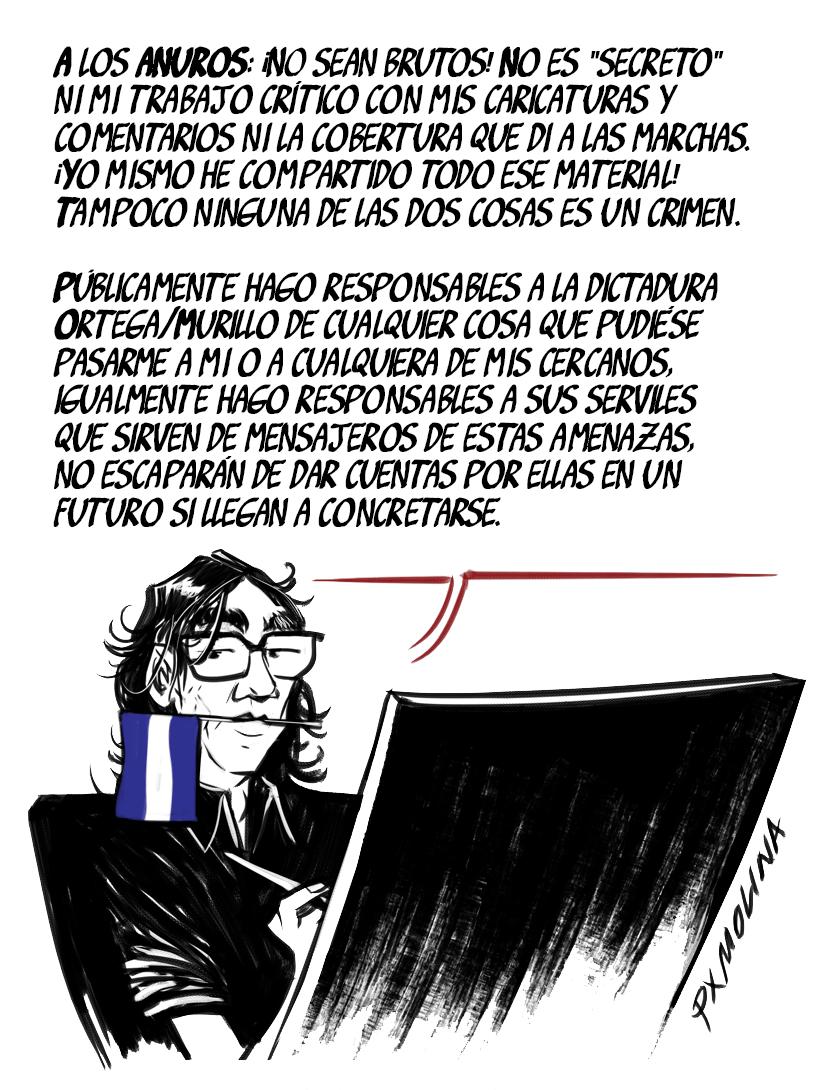
The most recent threat he received, and the one that motivated him to reveal his situation by publishing a caricature on his Twitter account, was conveyed to him through a person close to the Ortega-Murillo regime. But as for him, he preferred to not be silent.

#Nicaragua A little message… #SOSNICARAGUA #SOSJOURNALISM (In summary, the text says: My work is not secret and is not a crime. I hold Ortega/Murillo responsible for anything that might happen to me or those close to me. Equally responsible are others who act for them. Everyone will be held to account in the future that will come to fruition.)

Molina declared that the current situation that Nicaragua is experiencing is difficult for humor, because “there isn’t much to laugh about,” but he believes in the emotional value that his drawings can have.

“All of us who do journalism independent of power have to celebrate because we are doing it, in whatever manner, whether it be clandestinely or from exile. I think that we have to celebrate the commitment of independent journalism to the truth,” he stated.

The artist said that humor has the virtue that it breaks with the powerful because “for it to function it has to upset power.”

Molina explained that many of the characters in power cover themselves with a cloak of solemnity and omnipotence. “Because of that, when you make them see with humor or with a caricature that they are equal to any other person, they feel that they are diminished, that they are being lowered from the place where they deserve to be.”

During the program, he said he felt accompanied by the popular humor of Nicaraguans, which is expressed on social media. “I am happy that people empower themselves with that weapon, because it is a tool that can help you and liberate you in a situation that oppresses you.”

He recalled the assault on the facilities of Confidencial, Esta Semana, Esta Noche, and Niú; but he also appreciated the solidarity of audiences and the support they show by sending their materials (videos, photos, reports) to independent journalists, via platforms like Reporte Ciudadano (Citizen Report).

Molina declared that his opinion of young people has changed, he used to believe they were numb, and he appreciated their being “one of the driving forces of awareness raising in the entire country.”

“Many people (close to the regime) boast of threatening and humiliating people (…) there is a lot of rejection of the Government, but there is also a lot of fear; which does not mean that the people have given up, because all fear has an expiration date,” he pointed out.

Translated by: Sheilagh Carey

______________________

The 14ymedio team is committed to serious journalism that reflects the reality of deep Cuba. Thank you for joining us on this long road. We invite you to continue supporting us, but this time by becoming a member of 14ymedio. Together we can continue to transform journalism in Cuba.