The same document reminds transport operators who didn’t renew their licenses and those who didn’t make any tax payments that they will be canceled. (14ymedio)
14ymedio, Havana, 28 October 2022 — The Cuban Government will stop forcing self-employed workers (TCP) to become a micro, small or medium-sized business (SME) if they have up to three employees. As provided in the rule issued in August 2021, if they haven’t done the conversion within one year from the entry into force of the law (specifically, until September 20), the licenses of those who are self-employed will be canceled.
In a note published this Thursday, the Ministry of Labor and Social Security and the National Office of Tax Administration (ONAT) backed down and announced that they have agreed to “allow those who have up to three employees and have continued to pay their taxes to continue the exercise of their activities.”
The tax authorities don’t explain the decision beyond its being based “on the recognition that such TCPs continue to develop the same activity.” Similarly, they remind the self-employed that they can’t hire more than three employees, because otherwise they must “convert their business into a company” (SME or non-agricultural cooperative) “or cease the exercise of self-employment.”
In the same document, they remind carriers who didn’t renew their license and those who didn’t make any tax payments that they will be canceled. In addition, “companies that hire artists and eventual agricultural workers who don’t have another self-employment activity,” “TCPs without employees who carry out one or more economic activities” and the self-employed who, even if they have up to three employees, “own more than one business,” “will be updated ex officio,” that is, automatically converted into SMEs.
For the Cuban economist Elías Amor Bravo, based in Spain, the decision is nothing more than a victory of the workers in the “declared war” with the regime, which forced them “artificially” to become an SME “and thus aim for a political success with the approval of the new regulations of economic actors.” continue reading
“The final balance of the process has meant that the creation of SMEs, about 5,000, has been far below what the leaders expected,” says Amor Bravo, hence the decision of the Ministry of Labor and the ONAT. Meanwhile, in Colombia, more than 300,000 SMEs were created in 2021, and in Chile, more than 200,000 that same year.
However, he believes that with the measure, the Government has also “shown its claws,” by adding the matter of taxation. “The ONAT coming from behind has apparently managed to impose its criterion and set the precedent that, in turbulent times like these, it’s better to collect a peso than comply with a transitional provision of one more decree.”
The low acceptance of converting into a company could be due, among other reasons, to the fear of increased oversight by the Government and the banking system, and the lack of tax incentives.
This same Thursday, the ONAT also announced that it has created a “preventive embargo” on bank accounts “of all entities that didn’t make the payments on account or partial payments of the Value Added Tax and the Return on State Investment Contribution (non-tax income) corresponding to the third quarter of the current year.”
The decision, they explain, “responds to the fact that there are companies that stopped making these important contributions – whose legal payment deadline ended on October 24 — despite all the proactive actions deployed by the country’s tax offices to promote their correct and timely fulfillment.”
Translated by Regina Anavy
____________
COLLABORATE WITH OUR WORK: The 14ymedio team is committed to practicing serious journalism that reflects Cuba’s reality in all its depth. Thank you for joining us on this long journey. We invite you to continue supporting us by becoming a member of 14ymedio now. Together we can continue transforming journalism in Cuba.
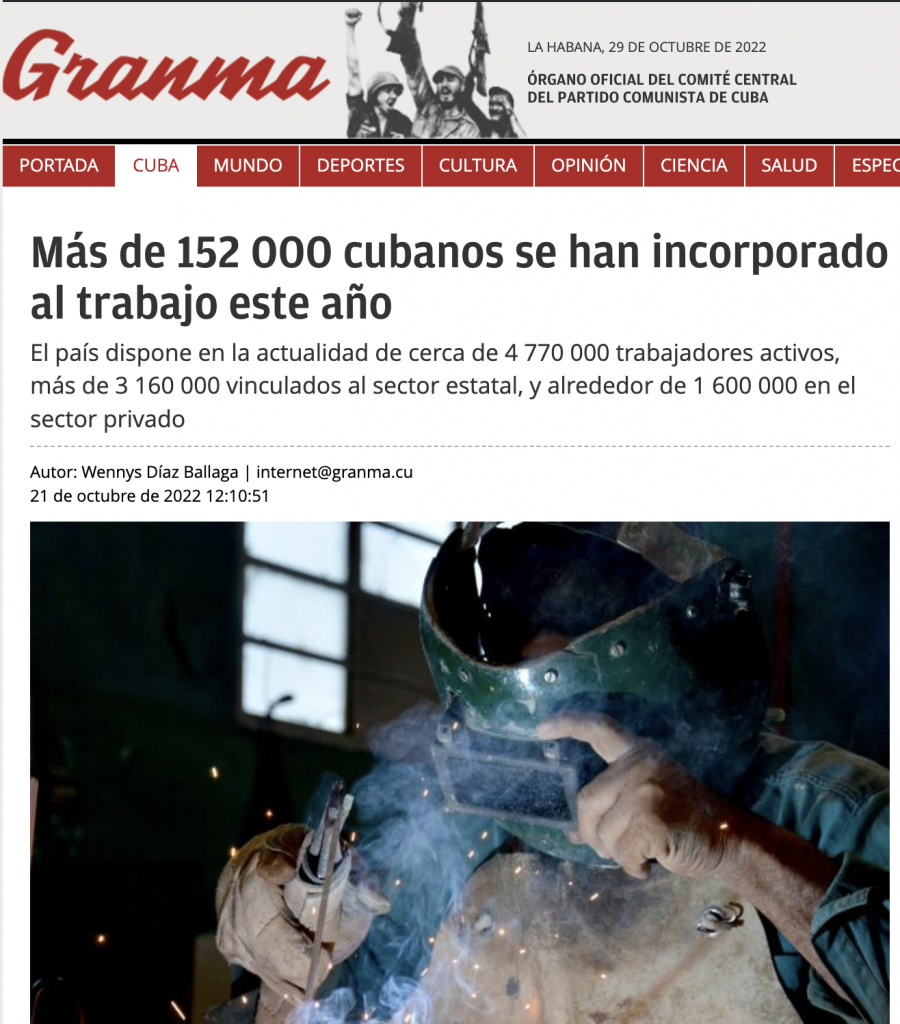
Granma masthead, headline and illustration. (Granma)
14ymedio, Elías Amor Bravo, Economist, 23 October 2022– Cuba’s official State newspaper Granma describes the more than 152,000 people who have joined the workforce in the non-state sector of the economy as a success and linked it to the measures to diversify society’s economic actors implemented in the country over the last several years. Neither one, nor the other. Enough of the propaganda, let’s get to objective conclusions that can be obtained from these data.
The labor market in Cuba continues to be dominated by the communist economy, the increase in employment is insufficient and the new economic actors, estimated at 5,500, have not played as large a role as was expected in terms of creating jobs. The results lead, if you will, in a different direction.
It’s all the same, the official communist periodical celebrates as a success the 152,373 people who, by the end of August, had joined the country’s labor force; of those, 123,321 are not associated with an employer, according to data from the Ministry of Labor and Social Security (MTSS).
The weight of the state sector on employment continues to be great and does not allow the private sector to close the gap. Even so, the job offers for those 44,619 were in public sector organizations; 107,754 in the non-state sector, of which 101,461 were self-employed, 4,491 in other forms of private business, while 1,802 benefitted from being allowed to use state-owned fallow land.
This increase in non-state employment, clearly insufficient, is purported to be associated with the measures to diversify society’s economic actors implemented in the country over the last several years. However, in reality, those data mask the requirement imposed on self-employed workers with more than three employees that they register as a ’mipyme’ (a microenterprise) if they want to continue operating legally. A good proportion of the employment created is related to the measures imposed by the regime to “whitewash” the data about the process of creating new actors. continue reading
Thus, highlights Granma, that of the people identified, 38% are people younger than 35 years of age and 31% women, while among those who are not employed, 44% are women and 29% young people.
A good example of the mediocre data presented by the ministry can be found in the comparison with the same period the previous year. If this is the case, the increase in those entering the labor force was only 16,117 people.
What do these data tell us? They quickly confirm that the communist regime’s employment policy is another failure, it continues without adequate linkages to the rest of the regime’s political and social economy. In essence, one policy aimed at padding the staff rosters of state-funded businesses and organizations, where there is underemployment, and low levels of productivity which are not commensurate with the salaries received. The labor market in Cuba is non-existent, and does not comply with technical functions to satisfy the staff qualifications needed by the companies, and it is much less socially useful to guarantee workers suitable career paths.
The most glaring example of this failure can be found in the non-compliance with the Communist constitution of 2018 and of the so-called labor code, Law 116/2013, which establishes fundamental labor principles, such as the rights and social duties of citizens, implemented through the Decent Work Program. But in practice they lead to this situation of state underemployment which tends to reproduce itself over time, without creating adequate space for private activity.
The failure of the employment policy at MTSS and the institutions that comprise it, in combined with the demands of the national economy, and the local development strategy of each territory is evident in the denouncement of the few foreign investors who venture to operate in the country: that they cannot find qualified personnel for the positions they have on offer.
Similarly, with slim offerings in the private sector, which attempts to carve out a path in the country, many high-level professionals (doctors and researchers) prefer the salary of a waiter or cook to those they get from the state-funded sector. That is an absolute communist mess; their employment priorities from “those graduating from regular day courses at several levels of education, those graduating from active military service and other people of interest to the state, especially women, people in vulnerable situations, and those who serve their [criminal] sentences or security measures while free,” do not satisfy those people who yearn to develop professional careers based on what they know how to do.
Proof of the failed employment policy can be measured alternatively taking into consideration that, of the total of 4,770,000 employed workers in the state sector as well as the private, the latter barely total 1,600,000 or 34%, which has remained stable since Raúl Castro, around 2011, authorized the reduction of padded state staff rosters. The largest employment sector in Cuba continues to be the communist state, reaching up to 66%, higher than any other country in the world, as a paradigm of inefficiency, low competition and wasted resources.
The fact that only 1,802 Cubans have applied to rent land, which is the only semi-private formula the communist regime will authorize in Cuba, it is a good example that private formulas in Cuba continue to be lower than their true potential, and that in this environment, like many others, one must work and hard.
The article in Granma also offered some indications of how the regime intends to continue promoting “modalities of telework and remote work as one form of employment that benefits the organization as well as the employee,” including that “diversification of the work force, in a way that is more flexible than the in-person modality.”
Nonetheless, at the same time, the article clarified that “this model is not applicable to all job vacancies as it depends primarily on the duties performed by each worker at their work place, the position they hold, among other things.
In summary, for the directors, telework and remote work depends “also on the employer creating the conditions, control mechanisms, and watching out for the security and health of the employee and guaranteeing that, in this way, neither the employee nor his/her work will be affected.” That is, that the regime doesn’t have a clear strategy for telework either and they are spinning their wheels. In reality, the limitiation lies in the area of information technology and the capacity of the networks to allow working from home. And then there are the blackouts. What productivity could they possibly be talking about for a teleworker who spends 12 hours a day without electricity?
The regime is not up to the task to provide for innovation in labor policies. Meanwhile, the communists entertain themselves embroiled in the labor framework and now they want the ministry to lead, through collective labor agreements, a registry of the posts, which by their nature, could be conducted in telework mode or working remotely; in this way there is collegiality among workers, the sindicate and each employer organization. Bureaucracy, paperwork and an even bigger mess. The Cuban communist regime’s labor policy is a total failure.
Translated by: Silvia Suárez
____________
COLLABORATE WITH OUR WORK: The 14ymedio team is committed to practicing serious journalism that reflects Cuba’s reality in all its depth. Thank you for joining us on this long journey. We invite you to continue supporting us by becoming a member of 14ymedio now. Together we can continue transforming journalism in Cuba.
In previous elections, the Government has stigmatized and ultimately frustrated the candidacy of opponents. (14ymedio)
14ymedio, Havana, 26 October 2022 — The D Frente platform, which brings together personalities and groups from the Cuban opposition, published a Citizen Letter on Facebook this Wednesday with proposals to “exercise sovereignty” in the municipal assembly elections on November 27.
These postulates have been taken as a program by a group of citizens backed by the Council for the Democratic Transition in Cuba (CTDC), who intend to present themselves as candidates to be nominated in the elections.
The names of the Cubans remain hidden, because in previous electoral processes the Government has stigmatized and finally frustrated the candidacy of opponents. “The only genuine representation is the plural representation of the citizenry. From below, from where democracy is built,” affirms the CTDC.
The D Frente program that will be promoted by possible candidates consists of five proposals addressed to those who participate in the municipal elections and, in general, “to the country.” The Citizen Charter invokes Article 3 of the current Constitution of the Republic and urges citizens to exercise “the fundamental power to decide our destiny… from law to law, peacefully.”
It insists that the contents of the proposals have been highlighted many times, and more emphatically during the protests of July 11, 2021. The first section demands that no more resources be dedicated to the construction of tourist facilities, but rather that budgets be applied to “five priority issues”: food, health, housing, subsidies for single mothers, women in situations of violence and the elderly, as well as solving the energy crisis.
The second point demands the elimination of stores that only take payment in freely convertible currency (MLC), since “they deepen discrimination” and have proven to be an ineffective solution to the shortage of supplies on the Island. It adds, as an additional effect, that basic and necessary merchandise has become more expensive and this has generated an “offensive” differentiation between those who have access to foreign currency and those who do not. continue reading
The release of political prisoners is the subject of the third proposal, which denounces that these citizens have limited themselves to exercising “the freedoms of demonstration, expression, assembly and association, and that they have only asked for changes that improve and give new hope to their lives and those of their families.” In this sense, D Frente demands a general amnesty for prisoners and adds that “the street belongs to Cubans.”
Fourth, D Frente demands the cessation of the calls by the Cuban authorities “to hatred and combat” that have become frequent in the media. They ask, “That our children do not continue to be used to exercise violence.”
Finally, the fifth point demands respect for the “voluntary solidarity economy networks that are being created autonomously and permanently,” and that serve as a channel to help the most vulnerable families on the Island.
The D Frente proposals that the CTDC candidates intend to promote if they manage to be among the nominees, hope to be shared with the public and circulated by “all possible institutions.”
The convening of the municipal assemblies of People’s Power is the first step for the subsequent appointment of provincial governors and deputy governors, and eventually the delegates of the National Assembly.
In 2015, two independent candidates, Hildebrando Chaviano and Yuniel López, managed to reach the electoral ballots of their respective constituencies in Havana. Their biographies, published by the electoral commission*, described them as “counter-revolutionary elements.” Neither of them got the necessary number of votes.
*Translator’s note: In Cuban elections candidates are only allowed to “campaign” through the posting of their “official biographies” – which are written by government officials — there are no other permitted campaign activities.
____________
COLLABORATE WITH OUR WORK: The 14ymedio team is committed to practicing serious journalism that reflects Cuba’s reality in all its depth. Thank you for joining us on this long journey. We invite you to continue supporting us by becoming a member of 14ymedio now. Together we can continue transforming journalism in Cuba.
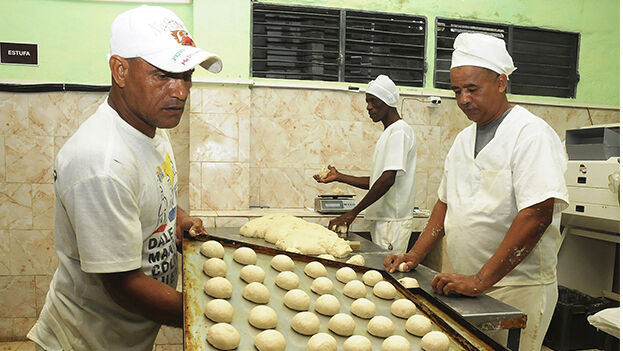
Guantánamo state bakeries didn’t their fulfill production goals last week due to lack of flour and fuel. (Venceremos)
14ymedio, Havana, 25 October 2022 — Bread didn’t reach the tables of Cuban families in several municipalities in the provinces of Guantánamo and Holguín last week. The lack of flour and fuel prevented companies from accomplishing the production needed to guarantee supplies.
In Guantánamo, the director of the Food Industry, Albis Hernández Díaz, recognized that they ended the week with 60,000 units less than what was needed, which mainly affected families in the municipalities of Guantánamo, Baracoa and El Salvador.
Hernández Díaz told the Venceremos newspaper that delays have worsened in the last two weeks due, mainly, to the fact that they don’t have enough fuel in the generators of the service centers, whose machines require large amounts of fuel, up to 10 pounds per hour.
The director said that she has had to restart the wood ovens for manual breadmaking for a smaller number of customers. The blackouts, programmed by the Cuban Government, also “conspire against us,” says Hernández Díaz, because the bread acquires an acidic flavor or doesn’t rise if they delay putting the resting dough in the oven. continue reading
Faced with the shortage of ingredients, Hernández Díaz said that they prioritize the flour available on the market with less fine grains loaded with wheat husks. They also use yeast with low fermentation, so the flavor and color of the bread is different, and this also slows down the production process.
The Provincial Government of Holguín had already warned last Friday through a post on its Facebook page that the lack of fuel and flour was preventing the standardized bread quota from being covered. The municipalities most affected by the shortage of the product were Gibara, Holguín, Calixto García and Sagua de Tánamo.
The shortages and high prices of bread have hit the bakeries and the pockets of Cuban families hard. Meanwhile, the Government recognizes that it can’t make more food derived from flour because what’s available is used only for the basic rationed bread, social consumption and the production of five tons of crackers for communities in remote areas of Guantánamo.
In the midst of the wheat flour deficit, state bakeries have resorted to other types of flour, such as in the province of Sancti Spíritus, where up to 20% of rice husks or yucca is mixed in.
But these mixtures don’t manage to convince customers because of the sour flavor of the bread. “Can you tell me what is this flour? Because this bread is disgusting, they haven’t brought it for three days and when it arrives (…) There is no one to eat it, they are killing people’s stomachs,” replied user Tamara González Serrano in the publication of the Provincial Government of Holguín.
Translated by Regina Anavy
____________
COLLABORATE WITH OUR WORK: The 14ymedio team is committed to practicing serious journalism that reflects Cuba’s reality in all its depth. Thank you for joining us on this long journey. We invite you to continue supporting us by becoming a member of 14ymedio now. Together we can continue transforming journalism in Cuba.
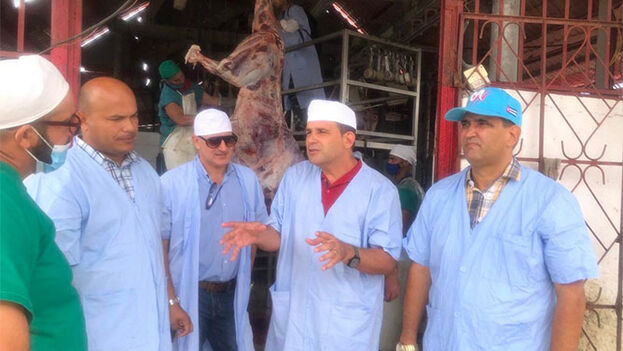
The Turiguanó Genetic Company made 1,330,000 pesos in profits, and sales reached 614,000 in freely convertible currency. (Invasor)
14ymedio, Havana, 23 October 2022 — In Ciego de Ávila there is one meat company that is functioning and will end the year with profits. In the ten months of this year, the Turiguanó Meat Company made 1,330,000 pesos in profits and sales reached 614,000 in freely convertible currency, a feat in the current context.
However, its success does not come close to the Cuban table; its meat has ended up for tourism and it is expected that, from now on, it will suffice to keep the hotels in the Jardines del Rey area fully stocked, completely replacing imports.
The company, founded in 1976 and located in Morón, has been an example for authorities in the area for several years. Just before the pandemic, in 2019, the state press dedicated a lot of attention to it. Miguel Díaz-Canel, shortly after being named president of the Republic, took a special interest in this plant. That year, around this time, the organization broke the historic record for total monthly sales, with 4,720,000 pesos, and a total of 42 million pesos for the year to date.
Its success was based on producing meat products from 132 cuts in their plant, 55 traditional, 62 special, 10 viscera, and five artistic. Sales to all the hotels allowed “the country to save four million dollars per year,” stated the Invasor daily newspaper at the time, imbued in the national logic that, everything is purchased outside the home and, as a result, whatever is produced domestically is “savings.” continue reading
Foreign investors have their eyes on Turiguanó Genetic, which this month signed a “letter of business intent” with German P.u.U, the details of which have not been announced, except that it has to do with pork and beef exports. Last year, it happens that they were negotiating with Treew Inc., a Canadien company established 15 years ago in Cuba and dedicated to international trade.
However, in the middle of the storm, even an apparently solid company is at risk. According to an article published on Saturday in the provincial press, Yoan Sarduy Alonzo, the president of the Ranchers’ Business Group (Gegan) visited the Turiguanó Genetic facilities during his trip to Ciego de Ávila and, at that moment, a power outage “once again put in check the industry where five freezers and two maintenance refrigerators preserve the meat.” Furthermore the company lacks a power generator.
The visitors pressed the company to directly import and do away with intermediaries, because they run the risk of losing profit. For example, according to the note, if the belts were functioning, 40 cattle would be slaughtered daily instead of 20.
In any case, the accounting could be less simple. The newspaper warned that the 4,200 heads of cattle owned by the company “are not guaranteed their feed for the year,” since the drought has wilted the pastures and, although they were able to fertilize the fields, there isn’t machinery to harvest the hay.
The number of animals has declined since 2019, despite predictions to the contrary. That report three years ago mentioned 5,300 Santa Gertrudis breed cattle, in which this company specializes, and predicted that the population would gradually reach up to 11,000 by 2030. To date, it has declined by 1,100.
In 2020, the zone where Turiguanó Genetic is located spent 74 days in quarantine due to COVID-19, although they met 98% of their target. Nonetheless, in 2021 the company also began working on diversifying and exporting charcoal.
Ranching authorities, in light of what they observed during their visit last weekend, urged “a transformation of reality, because protein must reach the table,” although the table, right now, does not belong to Cubans.
Translated by: Silvia Suárez
____________
COLLABORATE WITH OUR WORK: The 14ymedio team is committed to practicing serious journalism that reflects Cuba’s reality in all its depth. Thank you for joining us on this long journey. We invite you to continue supporting us by becoming a member of 14ymedio now. Together we can continue transforming journalism in Cuba.
After his defeat at the Tokyo Olympic Games, in 2020, Dainier Peró Justiz withdrew from the national boxing team. (Facebook/Lenier El Justiciero Però)
14ymedio, Havana, 25 October 2022 — Cuban boxer Dainier Peró Justiz, considered the best heavyweight fighter of the national team, the Domadores, left the Island and arrived in the United States this Friday. He was received by his brother, the boxer Leinier Peró.
The decision to leave the Island was made by Peró Justiz after his defeat at the Tokyo Olympic Games in 2020, at the hands of the American Richard Torrez Jr., who took the bronze medal from him. At that time, the media site FullSwing said that “the two-time Cuban king, who weighs over 200 pounds, withdrew from the national team to try to emigrate.”
The young man, 23, made several attempts beginning that year to leave Cuba by boat, but all had failed until now. His brother Leinier didn’t know how the boxer arrived in the United States this Friday but commented on his social networks that “a new path” would be opened, after “a week of tension.” continue reading
The sports record of Peró Justiz, born in Camagüey, is impeccable: world champion in the Cadet (2015) and Youth (2016) categories, with experience in Pan American and Olympic Games. Although he is still recovering from the trip, the boxer has already signed an agreement with manager Jesse Rodríguez, who also represents Cuban Yuriorkis Rodríguez, four times world champion in three different divisions, and the young men Yoelvis Gómez and Ariel Pérez de la Torre, also from the Island.
Rodríguez’s plan is to “get him fighting as soon as possible” and take advantage of his “amateur experience,” but first he needs to “make certain adjustments that will allow him to succeed,” the manager told ElNuevoHerald.
According to specialists, Peró Justiz possesses enough qualities to stand out in the U.S. professional championships. “He has a boxing style where his fundamental weapon is the speed of his hands and legs, something that you don’t usually see in the super heavyweights. He has an elusive style and is able to throw strong punches,” said RadioRebelde, before the athlete travelled to Tokyo in 2020.
In 2018, Dainier Peró Justiz was voted the best athlete of November in Camagüey, for his “outstanding performance” in the V National Boxing Series.
Translated by Regina Anavy
____________
COLLABORATE WITH OUR WORK: The 14ymedio team is committed to practicing serious journalism that reflects Cuba’s reality in all its depth. Thank you for joining us on this long journey. We invite you to continue supporting us by becoming a member of 14ymedio now. Together we can continue transforming journalism in Cuba.
Cuban regime is annoyed with social networks for labeling them as what they are: from the State. (SOURCE)
14ymedio, Yoani Sánchez, Havana, 26 October 2022 — The neck veins have swollen, the messages have risen in temperature and the headlines of the official press have been filled with demands. The reason for so much tension is a little blue bird that has been tormenting the Cuban regime for more than a decade: Twitter. This time the annoyance has been because the media controlled by the Communist Party on this Island have been labeled on this social network as “affiliated with the Government.”*
The hullabaloo is not understandable, because it comes from the same people who, at the beginning of the microblogging service, cataloged in their national newspapers the platform that, then, allowed text-only messages to be published with 140 characters, as a “technology created by the CIA.” All of us who, in those years of 2008 and 2009, used the potentialities of Twitter – blindly and publishing only by text messages (SMS) – were also put in the sack of “mercenaries,” “enemies,” and “traitors.”
What happened in this time so that now the official spokespeople are rending their garments before the new classification that this social network foists on them? What happened can be summed up in one word: they lost. They were defeated in a battle where they came to fantasize about putting bars on an unruly little character with a loose beak and bright feathers. After biting the dust of strategic and technological failure, little by little the Cuban institutions began to publish their first clumsy tweets. Other people’s grief is what they have given in this time.
They have never enjoyed a good footing with the San Francisco giant, this must be recognized. But not, as they want to make believe now, because they are victims of a universal conspiracy, but because their soldiers’ positions, their prefabricated slogans and the bots are immediately identifiable when it comes to tracking an opinion on Twitter.
Twitter has never been theirs. Everything that totalitarianism cannot control ends up being prohibited or domesticated. Thus we come to the present moment, in which official Twitter accounts complain of being classified abroad with the label that they feel no shame in using within national borders. Isn’t the Granma newspaper the official organ of Cuba’s only allowed party? Haven’t all those national media ratified in their statutes the unrestricted fidelity to an ideology, a model and a group of men? continue reading
What happened in these last few hours is nothing more than a shameful response to militant behavior. Militancy that is militancy has no itch to be labeled as such. The “revolutionary who is revolutionary” should rather feel very proud that Twitter signals he is close to the Cuban government. The contradiction emerges when it is verified that, during all this time since the Castro hosts disembarked on the wings of the blue bird, they have wanted to promote themselves as a progressive and alternative force, irreverent and independent. Nothing is so false.
This October the flight circle has closed. So much flapping to appear objective and trustworthy and end up, no longer, on the branch of the obedient. Twitter has just made clear what many of us have been saying for decades: these are not media, they are propaganda; these are not journalists, they are spokespeople. Now, the audience has a mark to decide what to read, whether to prefer pamphlets and sugarcoated articles, or to look further and immerse themselves, through independent media, in the bittersweet reality of this Island.
*Translator’s note: Twitter’s application of a “state-affiliated” identifier on Cuban government accounts began this week.
____________
COLLABORATE WITH OUR WORK: The 14ymedio team is committed to practicing serious journalism that reflects Cuba’s reality in all its depth. Thank you for joining us on this long journey. We invite you to continue supporting us by becoming a member of 14ymedio now. Together we can continue transforming journalism in Cuba.
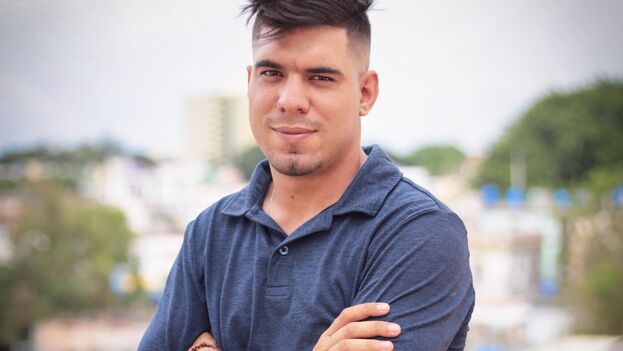
Adrián Martínez Cádiz has had to “chat” several times with the political police. (Facebook)
14ymedio, Xavier Carbonell, Salamanca, 25 October 2022 — Silent, emphatic, direct in what he thinks and says, the young Havanan Adrián Martínez Cádiz has had to “chat” several times with State Security. The agents are difficult interlocutors and gesticulate too much. The last appointment, on October 21, lasted an hour, with an effusive and rough lieutenant colonel who calls himself “Kenya,” a well-known stalker of numerous activists.
Martínez, who works as a journalist in several initiatives of the Catholic Church in Cuba and for the EWTN network, tells 14ymedio what it’s like to “dialogue” — so to speak — with the G2 officers, at the police station in Plaza de la Revolución.
“The gestures, the looks, the tones and the manner were threatening all the time,” says the young man, who spent an hour in interrogation with Officer Kenya and another soldier who identified himself as José Antonio.
“They wanted to officially warn me that I’m engaging in pre-criminal behavior by posting on my networks, ’inciting a crime’ and publishing texts that disparage Díaz-Canel, which they consider contempt,” says Martínez, who was threatened with criminal proceedings if he continued to be critical of the Government on his social networks.
The agents showed him photos of himself with activists and opposition figures such as Anamely Ramos, Omara Ruiz Urquiola, Rosa María Payá and rapper El Funky. “They won’t do anything for you,” they told him. “What they want is to send you to do things from the United States and ’perform theater’.” He replied that Ruiz Urquiola and Ramos, for example, had been prevented from entering the country. continue reading
Lieutenant Colonel Kenya then raised his voice and said that “it was a lie,” and that the Government didn’t prevent anyone from entering the Island. “Almost at the end he asks me what I was committed to, to write it in the warning act,” Martínez says. “Nothing at all,” he said, refusing to sign the document.
“Better for me,” the officer spat and left the room. After the interrogation, the police let in two officials of the Ministry of Communications. Martínez left the station with a fine of 3,000 pesos, although — by order of the officers — they didn’t confiscate his phone.
That day, activist Adrián Cruz, known as “Tata Poet,” a friend of Martínez, was also questioned. A group that included several Catholic priests was waiting for both young people outside the station.
“They’ve never clearly told me to ’get out of Cuba’,” he says, but indirect campaigns have become increasingly aggressive. Ciberclarias [online “catfish”], he continues, are increasingly active in the groups that buy and sell, on common access sites or popular pages. “And, unfortunately, there are people who still believe them. I have friends in Camagüey who went to a family member’s house where I was the subject of conversation, saying that I’m paid from the United States to publish and tell the truth,” he says.
Another notable difficulty arises when it comes to temporarily leaving the country. “It’s an odyssey,” complains Martínez. “They always review me exhaustively and ask me questions. Upon my arrival from a trip I was interrogated for 45 minutes in a room at the airport, and I was threatened with jail if I kept publishing.”
On that occasion they examined his luggage piece by piece, and kept “under investigation” two laptops, hard drives, USB sticks, cameras and other items related to communication. “When the objects were returned to me, the laptops had been forced and didn’t close well.”
For Adrián Martínez, life in Cuba is almost a “heroic act.” To the daily difficulties, blackouts and shortages, the surveillance of the political police is added. Religious spaces, such as Catholic university groups and “problematic” parishes, are continuously infiltrated by young agents.
“We Cubans have an ’extra sense’ to recognise them,” says Martínez, although he can’t specify what it is that immediately betrays the spies. “However, you have to be sure before accusing someone,” he says, “because there is also a tendency to think that we are always monitored. In addition, those of us who are disturbed, attacked and harassed can fall into the excess of thinking that everything bad that happens to us is caused by them.”
“There are infiltrators and collaborators at all levels,” he adds, “but you have to live without fear. We do nothing but tell the truth and try to do good.”
The persecution and surveillance of State Security on activists, religious leaders, artists and intellectuals has caused people of different ideologies to be united against the Government’s oppression. This has also contributed to many priests and nuns of the Island, such as Lester Zayas, José Luis Pérez Soto, Jorge Luis Gil and Nadieska Almeida, taking a more radical position against the regime in the capital.
’Each one of us has gone through these interrogations, through the threats, and we know what they represent,” says Martínez. “I understand that people are afraid, I am too, but there are things bigger than fear: that is what unites us in front of a police station to accompany, to embrace those who are being repressed not only for defending their rights, but also the rights of others. It’s not fair to abandon someone who is defending my right.”
The young man believes that State Security has managed to expel many “inconvenient” Cubans from the country. Those who remain on the Island — “those who are remaining” — will have to face the viciousness of the Government. “As for those who have left, I respect and hug them. I fight every day, like so many others, against the temptation to leave and forget everything.”
Regarding the passivity before the regime of which the Cuban bishops, who met last Friday with Pope Francis, are accused, Martínez points out that “many times I don’t agree with ways of proceeding, with particular opinions or other things. When I have the opportunity, I let them know and set out my opinions. I have always been listened to with respect.”
Translated by Regina Anavy
____________
COLLABORATE WITH OUR WORK: The 14ymedio team is committed to practicing serious journalism that reflects Cuba’s reality in all its depth. Thank you for joining us on this long journey. We invite you to continue supporting us by becoming a member of 14ymedio now. Together we can continue transforming journalism in Cuba.
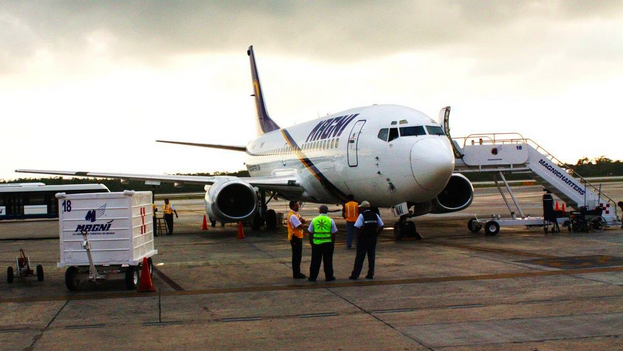
A letter has been sent to Cuban Airports and Airport Services, and to the authorities at José Martí International Airport Terminal 3. (México Destinos)
14ymedio, Natalia López Moya, Havana, 22 October 2022 – The tourist operator Bojórquez has sent a stern letter to the Cuban airport authorities, denouncing the misplacement of suitcases, removal of belongings from passengers’ luggage, and the substitution of waste matter for passengers’ property, in flights operated by the Mexican airline Magnicharters. The company considers these matters to be criminal and is even threatening legal action.
“Our airline takes seriously the care and protection of our passengers’ belongings”, warns the letter, dated 19 October, which has been seen by 14ymedio. “Every day we see an increase in this activity”, it emphasises, alluding to the interference with, and theft from, luggage. The letter, signed by Armando Bojórquez Patrón, president of the tourist operator Bojórquez, details some of the troubling discoveries they have made.
“Misplaced suitcases, suitcases broken, opened, with damaged locks (padlocks, cable ties), removal of contents, substitution of contents with other items in order to keep the baggage weight the same, broken items left inside cases, empty perfume bottles, used and soiled items of clothing”, explains Bojórquez.
The letter, sent to Cuban Airports and Airport Services and the authorities at José Martí International Airport Terminal 3, explains that the airline “backed the Cuban destination, under the conditions of the travel agents charter”. This season, in addition to carrying passengers between Cancún, Mexico City, Mérida and Havana, as well as on the new route of Cancún- Holguín, the company is transferring Cuban migrants who have been deported from Mexico. continue reading
“That is to say, in an active way it is maintaining its services to Cuba not only in a tourist capacity but in a governmental one”, Bojórquez emphasises. The company operates these routes with a fleet of Boeing 777’s, each with capacity for 136 passengers. Although Magnicharters “takes seriously the care and protection” of its passengers’ belongings, “it is becoming impossible” to maintain its standards on its routes to the island.
The airline, which flies mainly to Mexican beach destinations, had 12 aircraft in 2016, but with the arrival of the pandemic it was forced to keep a number of them grounded. There is a hold-baggage limit of 25kg plus 20kg hand luggage on the Cancún-Havana route, which makes the company a perfect choice for Cuban ’mules’.
The ticket price of 278 dollars makes the route between the Cuban capital and the Mexican resort an attractive proposition for those importing goods for resale on the black market in Cuba. “They are flights loaded with purchases — white goods, clothes, footwear and other products — carried for later profitable sale at the highest price”, admits an employee of the General Customs Service who works at terminal 3 of Havana airport.
Bojórquez’s letter demands that the Cubans do more to protect luggage: “It’s our intention to ensure that all parties are able to activate the mechanisms for security and protection to which we are duty-bound, in the handling of passengers’ luggage, and that we don’t lose, through being lax, the prestige that we have all earned in our daily operations”.
Last April, Magnicharters cancelled their flights between Havana and Managua, Nicaragua, a route which had been particularly profitable given that each ticket sold for over 3,000 dollars. This cancellation came in shortly after conversations about migration had been held between the Cuban and Mexican governments, in which they pledged to maintain an “ordered and secure” migration.
The letter ends by calling for the “minimisation of these unfortunate incidents” and the company offers its “collaboration in avoiding these occurrences, already happening repeatedly on Magnicharters’ flights” to Cuba. The document has already had an impact in the baggage section at José Martí airport, where management are looking to evade responsibility and are seeking out the culprits.
This very week several tour operators arrived in Havana on Magnicharters flights, at the invitation of the Cuban tourist authorities. “When they arrived at their hotel they noticed that their luggagehad been partly interfered with and stolen from”, an airport source told this newspaper, who blamed the incidents on the Mexicans themselves. “They seem to have occurred back there at the airport of departure, but we haven’t been able to verify that yet”.
However, other employees consider that what is happening fits with a “type of theft which is unique to Cuban airports where the workers are paid a very low salary and are put in daily contact with luggage containing belongings that are worth more than a whole month’s wage”, a worker connected to the main Cuban airport terminal told 14ymedio.
There are frequent complaints of luggage theft at Cuban airports and among victims’ testimonies are repeated accounts of broken locks, removal of items such as clothing, shoes, perfumes etc, as well as substitution of these items with old clothing, newspaper and even stones.
Translated by Ricardo Recluso
____________
COLLABORATE WITH OUR WORK: The 14ymedio team is committed to practicing serious journalism that reflects Cuba’s reality in all its depth. Thank you for joining us on this long journey. We invite you to continue supporting us by becoming a member of 14ymedio now. Together we can continue transforming journalism in Cuba.
Cuban farmers have been hit hard by lack of inputs, fuel shortages and drought. (Flickr / Kuhnmi)
14ymedio, Elias Amor Bravo, Economist, October 22, 2022 — There is not a single country in the world whose leaders spend as much time, or consume as much energy, revising and perfecting systems for monitoring and controlling the economy as Cuba. If one were to add up all the hours dedicated to this task, they would surely set a world record for pointless activity.
The consequences are plain to see. The communist economic model, obsolete and exhausted, is one of chaos. The more power its leaders have to devise legal tools and implement action plans for involving themselves in the economy, the worse it gets. Things work better without so much tinkering, oversight and control.
But will the communists acknowledge the failure of their system after sixty-years? Not in your dreams. On the contrary, Granma recently published an article, “Stay on the Path That’s Been Approved,” in which it reports that Prime Minister Manuel Morrero met with the country’s governors and their managers in the Palace of the Revolution to “promote high-priority programs and step up efforts to combat illegal activity.” Granma says his remarks were “right on target” but we fear they will be of little use. Let’s look at why.
Marrero stated that, even when a provincial or municipal problem concerns the central government, it may not be best resolved at the national level. In many cases, he pointed out, the best solution is a local one that takes into account to the conditions of a particular region. What problems is Marrero talking about? The usual ones: “Illegalities and violations that undermine the institutional framework and undermine governmental management.” Therefore, he points out, “the irregularities which are being committed today with such impunity, which have such a direct impact on the public, cannot be tolerated.”
What kind of “irregularities” is Marrero worried about? The ones he is supposed to fix. For example, the recurring issue of accounts receivable and payable. According to the prime minister, this area has been a breeding ground for corruption and criminality. A series of ongoing defaults, in which goods and services are provided before they have been paid for, is an example of poor economic management. This kind of financial malpractice results from the collusion and improvisation endemic to a communist economy. continue reading
Another irregularity that keeps Marrero up at night is the issue of coleros,* which he discussed during a meeting dubbed “Operation Anti-Colero.” This initiative is supposed to put an end to the widespread climate of disorder and illegality caused by the serious economic crisis that the nation’s leaders are incapable of solving.
There was also talk during the meeting about the low productivity of farmland and its impact on the nation’s food supply. The 63 measures intended to encourage the agricultural sector have been a failure. This was confirmed by the National Office of Statistics and Information, which reported that agricultural output has fallen for three consecutive quarters. Marrero was in charge of promoting an alternate reality that nobody else in Cuba has experienced, claiming that hard-to-find produce and other agricultural products were making their way to Cubans’ tables. The truth is that no such data confirms this phenomenon. Food in Cuba is scarcer now than it was a year ago. And its price has skyrocketed, with food inflation twenty points higher than the CPI average.
The problems are the same as always and caused by the regime. Besides the 63 agricultural measures that have not worked, there have been delays in leasing idle land to farmers and delays in the planting of seasonal crops. More than 3,800 hectares have yet to be planted and acreages set aside for growing banana, sweet potato and malanga have been reduced. As long as food is not a priority, the situation will only get worse.
There was also talk about meat and milk not being delivered, how roughly 4,143 suppliers have not fulfilled their contracts with meat companies. National leaders called for local authorities to conduct a case-by-case investigation but we already know the reason for this. It has to do with the disconnect between supply and demand, which is caused by sweeping state interventionism.
The communists feel they need more control, not in general but at the municipal level. The reality, however, is there is already too much control, rigidity and interventionism. If producers had more freedom to produce and to trade with whomever they wanted, the situation would be very different. There are already plenty of tools for control at the municipal level in the Castro economy.
Unlike what was claimed at the meeting, the process by which the state contracts farmers to grow food is burdened by excessive government control and interference. What is really needed is what Vice President Valdes Mesa called spontaneity. He should know because he remembers what Cuba was like before 1959. At that time, there was one cow for every person and no one had trouble finding meat to eat or milk to drink. Not only was there spontaneity back then, there was freedom too.
The meeting also addressed the subject of housing, one of the most intractable problems facing the country. Concerted efforts have yet to made on the ground, leading to understandable public frustration. It was announced at the meeting that, as of late August, 15,790 homes had been completed. Of those, roughly half had been built by their owners and 1,985 were basic housing blocks. With fewer than 30,000 new units in 2022, it looks like another terrible year for housing. Meanwhile, some observers say the country needs another million new units.
Housing construction is still not keeping pace with the production of building materials such as stone, bricks, concrete blocks, roofing and flooring. But the problem goes beyond the materials themselves. What is needed are builders capable of handling large-scale construction and remodeling projects.
The Maternal and Child Care Program was discussed at the meeting also. As of October, 72,846 live births and 539 deaths were recorded, and an infant mortality rate of 7.4 per 1,000 live births. The most common causes of death were perinatal conditions related to prematurity, low birth weight and intrauterine growth retardation, followed by congenital deformities and sepsis.
The problems with the program, such as staff shortages, ineffective attempts to reduce premature births and prenatal diagnostic errors, require immediate attention. What also requires attention is the mortality rate — currently, no one knows what it is — along with the fertility rate, a measure of the number of births by women of childbearing age. Cuba’s fertility rate happens to be one of the lowest in the world, which does not bode well for long-term population growth.
Inflation was also a topic for those at the gathering but little or nothing was said beyond mentioning the need to combat the illegalities without clearly indicating how to do it. There was also talk of new “economic players,” such as small and medium-sized private business, which currently number more than 5,340. There are 59 such state-owned operations, 58 non-agricultural cooperatives and 126 affiliated companies. While the contribution of these private businesses in supplying the public with goods and services was acknowledged, some new measures were announced that will contradict an essential principle of the communist economic model: the socialist state-owned company is the lead player while other types of businesses exist to complement it. This is a bad idea.
Marrero announced that progress is being made in drafting rules that would regulate these new businesses, from the national level all the way down to the the municipal. The idea is to include them as part of local development strategies. This would involve incorporating them into local economic ecosystems by linking them to state-owned companies, governments, universities and banks, and encouraging their participation in social responsibility efforts.
Hadn’t we agreed that these new businesses were to be set up so that they would be free to consolidate within a network of private companies? So why this new attempt to control them and interfere in their operations? Has the law gone into reverse? Many of these businesses are going to shut down if they start feeling too much pressure from the regime, as has happened before. And then we’re back to square one.
Translator’s note: people who are paid by others to wait in line for them.
____________
COLLABORATE WITH OUR WORK: The 14ymedio team is committed to practicing serious journalism that reflects Cuba’s reality in all its depth. Thank you for joining us on this long journey. We invite you to continue supporting us by becoming a member of 14ymedio now. Together we can continue transforming journalism in Cuba.
Police operation carried out last week in a shop on Neptuno and Galiano, in Havana. (14ymedio)
14ymedio, Natalia López Moya, Havana, 23 October 2022 — The urban landscape of Havana lacks an important element these days: informal vendors who, in parks and doorways, offer everything from matches to soft drinks. A police operation carried out last week swept up these vendors, who sell basic products that are scarce in state stores.
“Not even one was left. These doorways on Galiano Street were always full of people selling many useful things for the home,” said a resident in Centro Habana who, approached the central avenue with the intention of buying a washer for his Italian coffee maker. “At first I thought it was too early and they hadn’t arrived, but a neighbor told me that the police had removed them.”
According to this resident, the raid took several minutes. “They arrested some and took away all the merchandise. Others were fined and warned that if they see them here again the fine will be even higher,” explains Luisa, a resident on nearby Águila Street, who rents part of her room to informal sellers to keep their merchandise.
The operation reached the self-employed fair also located on Galiano Street. Although those who sell there are licensed to sell local handicrafts and other privately-produced goods, according to the police, some were offering industrial products brought from abroad or bought in stores in freely convertible currency. continue reading
Fe del Valle Park, in Centro Habana, without the vendors’ tables. (14ymedio)
The usually-bustling place on Tuesday was practically empty and without the in-and-out of customers that has characterized it for years. Through the doorways in Galiano, from time to time you can see police, who monitor the area so that the street vendors don’t return. A daring one manages to take advantage of the fact that the agents move away to quietly hawk sponges and small bags of detergent.
“There are people who say that it’s the fault of the resellers who hoard the little they buy in the store and then resell it, but most of the things that these vendors sell are brought from abroad,” explains the woman, alluding to the mules that import all kinds of goods from Mexico, Panama, the Dominican Republic and the United States.
“If you need a sewing needle right now, where do you buy it?” asks Luisa. “Many of the things they sell don’t exist anywhere else, for example, dyes for clothes, lighters for gas stoves or shoe polish,” the woman says. “None of them have become rich selling all that junk,” she emphasizes.
The panorama, when you walk along Reina Street or San Rafael Boulevard is strange without the small tables or blankets on the ground of these informal merchants. The hope that some of their most assiduous customers have is that the waters will soon reach a level when the police raids against them end, and then the stalls will return with their tubes of glue and belts for men.
They do this all the time but then the vendors come back,” considers another neighbor. “Now they are again with the ’battle against illegalities,’ but they don’t recognize that these sellers solve a problem.” In the Fe del Valle park, where until a few days ago the tables alternated with bargains and school items, now there are only a few people sitting on the benches or connecting to the wifi area. It looks like the same place as a few weeks ago, but it no longer is.
Translated by Regina Anavy
____________
COLLABORATE WITH OUR WORK: The 14ymedio team is committed to practicing serious journalism that reflects Cuba’s reality in all its depth. Thank you for joining us on this long journey. We invite you to continue supporting us by becoming a member of 14ymedio now. Together we can continue transforming journalism in Cuba.
Former Mexican deputy Beatriz Pagés pointed out that the mission of Cuban medical groups is “more political, more military and more indoctrination than health.” (Prensa Latina)
14ymedio, Havana, 22 October 2022 — The Government of Andrés Manuel López Obrador will pay more than $2,600 a month for each of the 749 foreign doctors he invited on October 11 to fill positions in remote areas of Mexico. The amount almost doubles the $1,400 that national physicians currently receive, according to data from the Government of Mexico.
“It’s an insult to Mexican doctors,” Marco Antonio, an orthopaedist who works in Mexico, tells this newspaper. “It’s not fair that while my salary is $1,600 a month, they’re giving $1,000 more to foreigners.”
He also explained that the data isn’t a surprise: “There’s a disparity between the salaries of the Institute of Health for Well-being (INSABI), those of the Mexican Institute of Social Security (IMSS), and the Institute of Security and Social Services of State Workers (ISSSTE).”
According to the Centre for Economic and Budgetary Research (CIEP), last year the salary of a specialist doctor was between $830 and $2,300. While at the INSANI, the average salary is $2,000; in the IMSS it is $537, and in the ISSSTE it’s $780.
Of the 2,067 applications received by the Mexican Government, 104 are from Cubans, said the general director of the IMSS, Zoé Robledo, last Tuesday. Another 169 specialists come from the United States, Argentina, Bolivia, Colombia, Ecuador, Nicaragua, Paraguay, Peru, and Venezuela.
For the contracted health workers, Mexico will pay the “round-trip airfare, transfer to the place of residence and work center, immigration procedures and requirements, academic validation of educational institutions, food support, and accommodation.” In total, expenses of $36,000 per year are expected for each doctor.
This salary is also higher than that received by the 436 Cubans from a group of 642 hired by the Government of Mexico, who are already serving in several hospitals in marginalized areas. The López Obrador Administration pays the Island $2,042 per specialist and $1,722 for each general practitioner. continue reading
Robledo confirmed that the hiring of new Cuban specialists will be carried out through the Island’s Ministry of Health and Cuban Medical Services, S.A. The latter company, created in 2011, has been accused internationally of human trafficking and forced labor.
The president of PD, Javier Larrondo, denounced the López Obrador Government for “allowing slavery on Mexican soil” and “financing” the Cuban regime.
Meanwhile, Beatriz Pagés, former deputy of Mexico and director of Siempre magazine, pointed out that the mission of the Cuban doctors is “more political, more military and more indoctrination than health.”
The most demanded specialties in that country are gynecology, obstetrics and anesthesia. Personnel specialized in pediatrics, general surgery, orthopedics, internal medicine, cardiology, neurosurgery, neonatology, ophthalmology, oncology, and cardiology are also needed.
Translated by Regina Anavy
____________
COLLABORATE WITH OUR WORK: The 14ymedio team is committed to practicing serious journalism that reflects Cuba’s reality in all its depth. Thank you for joining us on this long journey. We invite you to continue supporting us by becoming a member of 14ymedio now. Together we can continue transforming journalism in Cuba.
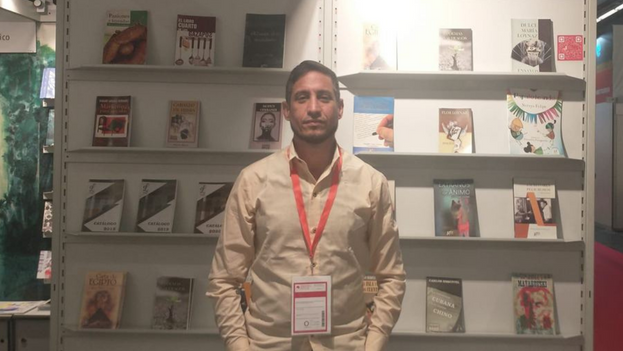
Editor Osmany Echevarría Velázquez represented Ediciones Loynaz on October 15 at the introductory seminar of the program. (Facebook/Ediciones Loynaz)
14ymedio, Havana, 20 October 2022 — Ediciones Loynaz, the publishing house of Pinar del Río that publishes Pedro Juan Gutiérrez and Dulce María Loynaz, presents its titles at the International Book Fair in Frankfurt (Germany), which is held from this Wednesday through Sunday.
The invitation was made possible thanks to a program for small publishers, from which twenty companies from Asia, Africa, Europe and Latin America benefited. According to reports on the event by the publishing house on its social networks, editor Osmany Echevarría Velázquez represented Ediciones Loynaz on October 15 at the introductory seminar of the program.
During the presentation, Echevarría introduced the publisher’s catalogue, its distribution processes and its “positioning as part of the Territorial Editions System,” an official network of the Cuban Book Institute in all the provinces of the Island.
Echevarría pointed out that, after the passage of Hurricane Ian through Pinar del Río, where the publishing house has its headquarters, the province was “wounded in its soul and its land.” He added that, after the hurricane, “we managed to save a selection of printed and digital titles.”
The publishing house was visited this Wednesday by the director of the library of the Ibero-American Institute of Berlin, Peter Altekrueger, and the director of Acquisition and Cataloguing of that institution, Ricarda Musser, who assured there were 180 volumes of Ediciones Loynaz. continue reading
For Ediciones Loynaz, the Fair is “a privilege, a recognition” for its three decades of work. Like other provincial publishing houses, it began in 1991, during the Special Period, in the midst of paper shortages and the Cuban economic crisis after the fall of the Soviet Union.
On the Island, Luis Enrique Rodríguez Ortega, its director, had guaranteed the official newspaper Granma that the organizing committee of Frankfurt invited them as a tribute to their three decades of work, but, even more so, as recognition of “the System of Territorial Editions created by Fidel.”
The mention of Castro tried to rid the publisher of all suspicion: it’s not the first time that members of Cuban delegations at international fairs take advantage of the trip to leave the country and request international protection.
Granma points out that titles such as CartadeEgipto [Letter from Egypt], from the Cervantes Dulce María Loynaz Prize, or CuentosdeGuane [TalesofGuane], by Nersys Felipe, will be part of the catalogue of Ediciones Loynaz. It modestly mentions the author from Mantazas, Pedro Juan Gutiérrez, whose novels are known worldwide thanks to the Spanish publishing house Anagrama.
Echevarría comments enthusiastically that Gutiérrez’s volume, Escritorespeligrososyotrostemas [DangerousWritersandOtherSubjects], is the jewel of Ediciones Loynaz: “This book shows another facet of its publisher, the facet of the journalist,” he told the EFE agency.
Born to disseminate the works of the Loynaz siblings, despised by the regime along with other Republican writers, it remains to be seen if the Pinar del Río publishing house will resist the temptation to not return to an Island that is experiencing its most critical moment in decades, after participating in the largest book fair in the world, dedicated this year to Spain.
Translated by Regina Anavy
____________
COLLABORATE WITH OUR WORK: The 14ymedio team is committed to practicing serious journalism that reflects Cuba’s reality in all its depth. Thank you for joining us on this long journey. We invite you to continue supporting us by becoming a member of 14ymedio now. Together we can continue transforming journalism in Cuba.
Yuri García was arrested by authorities and held for four days and was fired from the state trucking base where he worked as a technician. (Facebook)
14ymedio, Havana, 21 October 2022 — The United States returned to Havana a young Cuban, Yuri García, despite his request for asylum as a victim of harassment by the regime. García spent two weeks on an American Coast Guard vessel waiting for a response, but in the end he was returned, along with other migrants, on September 2nd, confirmedYucabyte in a note published on Thursday.
The young man stated that he had previously fantasized about migrating, but “never very seriously” until the attacks and harassment by the regime escalated. At the end of August 2022, García abandoned the Island along with other people in a rustic boat, an escape route hundreds of Cubans have used this year to flee the economic crisis, food shortages, and persecution.
On the second day at sea, when the motor had stopped working and they were left without GPS, they were rescued by the U.S. Coast Guard and were transferred to a vessel. There, the group of migrants requested asylum from officials who “listened to us but did not give us the opportunity.”
“I thought that at least they’d investigate, but now I believe it was just an act. I believe they did not give me the opportunity to show evidence that I am politically persecuted, that they did not take my case seriously,” he told Yucabyte.
García is one of the many persecuted by the regime after he held a sign with the phrase, “Martí Yes, Marx No” in front of the Communist Party building in Mayabeque province, as part of the failed Civic March for Change on November 15, 2021 (15N). continue reading
The 30-year-old Cuban was arrested by authorities and held for four days and was fired from the state trucking base where he worked as a technician. After months of pressure and from his co-workers, he was rehired in January 2022, however, García stated that the surveillance, the psychological harassment, and summons for interrogations did not let up.
The last meeting occurred on July 11, 2022 when authorities expected new demonstrations on the first anniversay of the massive July 11, 2021 (11J) protests. That interrogation was to “warn me that, if I went out to demonstrate, I could face three to six years in prision,” said García.
Desptie the danger, hundreds of Cubans have abandoned the Island this year on small rafts headed for Florida, while others migrate by air to Nicaragua, and then continue on their way to the United States. García stated that he could not afford to buy a ticket, so his only option was by sea.
Translated by: Silvia Suárez
____________
COLLABORATE WITH OUR WORK: The 14ymedio team is committed to practicing serious journalism that reflects Cuba’s reality in all its depth. Thank you for joining us on this long journey. We invite you to continue supporting us by becoming a member of 14ymedio now. Together we can continue transforming journalism in Cuba.
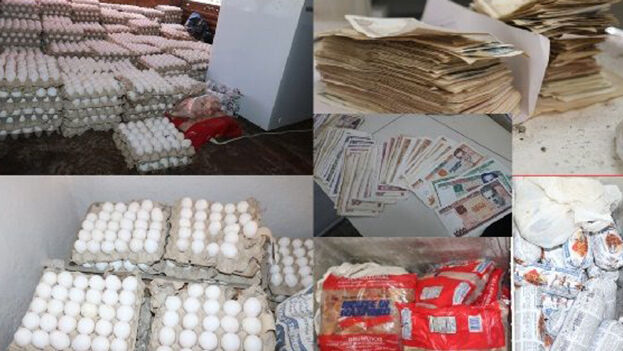
The authorities confiscated packages of chicken and more than 400 cartons of eggs. ( Facebook)
14ymedio, Havana, 21 October 2022 — At least 30 people were arrested by the Cuban police for reselling basic necessities in the area known as Feria de 100th and Boyeros, in Havana. In the police procedure, carried out this Thursday, hundreds of cartons of eggs, chicken and picadillo packages were seized, the official media confirmed.
Elements of the Police and the Technical Investigation Department (DTI), a unit of the Ministry of the Interior, participated in the search. The uniformed officers arrived at the popular fair in the morning, when “from one moment to the next, they began to take away all the resellers who always walk through the area,” said LaPáginadeMauroTorres, sympathetic to the regime.
A witness to the operation said that merchants sold the products at exorbitant prices, according to the official press, which reproduces the user’s text on Facebook. Among these were the egg cartons at 2,000 pesos and the chicken packages — which in stores costs 90 pesos — at 1,500. “This was an abuse, so good for the police and the DTI,” the neighbour allegedly added.
Another witness pointed out that the operation reached a house near the fair, where they removed a truck loaded with chicken and picadillo packages. This person said that the house “contained more than four hundred cartons of eggs,” which were seized by the officers.
The publication points out that this type of operation enjoys “popular backing” because people who “profit from the needs of others” by selling basic products from the Cuban food basket at prices ten times above the market value are stopped.
The shortage of food and basic products on the Island causes distortions that contribute to fueling the black market, where you can find everything from technology items to sanitary pads for women at high prices. continue reading
The news of the operation has been applauded by many readers of the official newspaper, but there have been quite a few who have complained to the authorities about the inefficiency in controlling “stockpiling” and not being able to guarantee the supply of basic products. “At last we see something that helps break the criminal chain, although they have to get to the bottom, because 400 cartons of egg don’t just come out of nowhere, even less now that there isn’t anywhere you can find them,” said a online commenter.
“Resellers are abusers, but who is to blame for this happening? Where do those amounts of products come from? Are they really resellers?” asks Elina Mendoza. Another commenter, identified as Freddy, asked that those who buy dollars in the Cadecas [currency exchanges] and then resell them on the street be investigated.
Officialdom, for its part, announced that this is one of the investigations they will carry out in Havana against the “resellers who do so much damage to the population.”
The popular Fair, also known as “the candonga [the joke] of 100th and Boyeros” specializes in the sale of hardware products, plumbing, household supplies and other high-demand items that are scarce in state stores. Although, according to the law, merchants or street vendors who offer their goods on site can only sell domestically-manufactured products or handicrafts, the truth is that usually a shopper can find accessories and parts imported or taken from state warehouses.
Among the tables that offer Superglue, children’s toys and pipe joints, other sellers, who quietly tout packages of frozen chicken, eggs, powdered milk and other food items often hang around. The practice is so widespread that the Fair has the reputation of being a place where “everything or almost everything can be found.”
Translated by Regina Anavy
____________
COLLABORATE WITH OUR WORK: The 14ymedio team is committed to practicing serious journalism that reflects Cuba’s reality in all its depth. Thank you for joining us on this long journey. We invite you to continue supporting us by becoming a member of 14ymedio now. Together we can continue transforming journalism in Cuba.

 14ymedio, Havana, 28 October 2022 — The Cuban Government will stop forcing self-employed workers (TCP) to become a micro, small or medium-sized business (SME) if they have up to three employees. As provided in the rule issued in August 2021, if they haven’t done the conversion within one year from the entry into force of the law (specifically, until September 20), the licenses of those who are self-employed will be canceled.