Panama Closes Three Border Crossings Cubans Use To Reach the United States

More than 195,000 migrants, including almost 500 Cubans, have used this route in pursuit of the American dream


An official of the Colombian Ombudsman’s Office on the Astí trail fenced with barbed wire / Colombia Ombudsman’s Office

14ymedio bigger14ymedio, Havana, 5 July 2024 — Panama closed three unauthorized border crossings on Wednesday, which more than 195,000 migrants – including 500 Cubans – have used to make the crossing to the United States this year.

With the support of 300 units of the National Border Service (Senafront), points were blocked on the coasts of the Pacific Ocean and the Caribbean Sea. In addition, barbed wire was placed on the short cuts that lead to the area of Hito de Chucurti, bordering Colombia. Several migrants have shared images on social networks of the barbed wire fence that prevents them from continuing on their way. According to Senafront, the objective of the measure is to channel irregular migration towards the Cañas Blancas crossing, which leads to the community of Bajo Chiquito.

The agency denied that the migrants had destroyed the wire fence. “It’s a video from 2019,” they explained, alluding to a recording that is circulating on social networks, “when, as a result of external situations, the crossing was closed at the border landmark of La Miel in the Caribbean.

At his July 1st inauguration, President José Raúl Mulino warned that Panama “will not be an open path for thousands of people who enter illegally backed by an entire organization related to drug and human trafficking.” The president specified that entry into the country will not be allowed “without a passport or valid document.” continue reading

The border closure came days after Panama’s Foreign Minister, Javier Martínez Acha, signed a memorandum of understanding and immigration cooperation with Alejandro Mayorkas, US Secretary of Homeland Security. The agreement includes the transfer of 6,000,000 dollars to develop the Mulino Government’s plan to repatriate migrants who do not have a legal basis to be in Panama.

The new director of the National Migration Service of Panama, Roger Mojica, explained that repatriation or expulsion from the country will depend on the immigration record, taking into account those who do not have the financial support to stay in Panama or have pending cases, according to Prensa Latina.

This year, Panama has deported 406 people, four of them from the Island. In addition, Migration has arrested, without specifying the reasons, four other Cubans.

The Colombian Ombudsman, Julio Luis Balanta Mina, warned this Friday of the humanitarian consequences of closing passage through the Darién jungle. He urged taking into account the health risk of migrants who cross.

https://www.facebook.com/DarienTV/videos/880205490622695/?ref=embed_video&t=43

“We urge the national government to request that the Panamanian authorities observe and be aware of how important the postulates of international human rights law are,” said Balanta, who insisted on the need to offer international protection to migrants.

Two months ago, the Colombian Ombudsman’s Office published an analytical study in which it simulated the closure of the Darién Gap and its humanitarian impact, putting the right to health on high alert, since it registered 502 health complaints between January 2020 and April 2024, the EFE agency noted.

This document was published before Mulino took power, when he communicated his intention to “close” the passage of migrants through the Darién jungle, which is complicated, since it is a great natural barrier of more than 500,000 hectares shared by Colombia and Panama. It is also the only point of the American continent not crossed by the Pan-American road or any other road.

Emigdio Pertuz Buendía, community leader in Capurganá, in the Colombian department of Chocó, and legal representative of the Major Council of Black Communities of the Acandí River basin and northern coastal area, Cocomanorte, said in an interview on NTN24, that “it was never imagined that a president would make the decision to place barbed wire to prevent the transit of migrants. This migration is supposed to be irregular but not illegal.”

Translated by Regina Anavy

____________

COLLABORATE WITH OUR WORKThe 14ymedio team is committed to practicing serious journalism that reflects Cuba’s reality in all its depth. Thank you for joining us on this long journey. We invite you to continue supporting us by becoming a member of 14ymedio now. Together we can continue transforming journalism in Cuba.

The Cuban Government Withholds Humanitarian Aid Sent by a Religious Organization From the United Kingdom

In a letter sent to 14ymedio, Reverend Bernard Cocker, director of the International Aid Trust, explains his growing concern with this “sad episode” and its lack of solutions.

Cuban authorities have raised objections to handing over the container that Bernard Cocker, director of International Aid Trust, because the organization also sends aid to Ukraine / International Aid Trust

14ymedio bigger14ymedio, Havana, July 5, 2024 — Since March, Cuban authorities have been holding in the port of Mariel a container of humanitarian aid sent from the United Kingdom by the religious organization International Aid Trust to the evangelical Church En Jesucristo Libres (Rehoboth Ministries), based in Havana. After the corresponding complaints, the Government has alleged that the shipment contains “prohibited items that could be used in a rebellion” and that the sender, the Reverend Bernard Cocker, has “some relationship” with Ukraine, a country that is an “enemy of Russia.”

In a letter sent to 14ymedio on Friday, Cocker, director of the International Aid Trust, explains his growing concern with this “sad episode” and the lack of solutions. The container, shipped on March 6 from the port of Liverpool, contains wheelchairs, clothing, mattresses, food and toys. In addition, according to religious media, the shipment also contains electric batteries, microphones and musical instruments, for a total value of more than $6,500.

“They have decided to appropriate the aid and continue to give us excuses to make the claim deadline expire,” he says. Another excuse given by the authorities is that they were not informed about the arrival of the container, something that Cocker categorically denies. continue reading

“Our people in Cuba contacted the port authorities daily about the arrival and status of the cargo”

“Our people in Cuba contacted the port authorities daily about the arrival and status of the cargo,” he said. The authorities also said that the International Aid Trust had lied to them, since the clothes were new and not donated, to which the reverend replied that they were school uniforms that had changed their logo and would therefore no longer be used.

The most serious allegation, about “prohibited items,” is also denied by Cocker, who says that his office worked for months and studied Cuban customs regulations so that none of the items sent would cause problems for the evangelical church En Jesucristo Libres. Furthermore, it is true that International Aid Trust has sent humanitarian material to Ukraine, but it also does so with India, Sierra Leone, Moldova and Transylvania.

The British Embassy and Consulate in Cuba were the first two official bodies whose mediation the International Aid Trust sought, at the beginning of June. The diplomats, rather late, replied on Friday that they were reviewing the case. Cocker trusts in the embassy’s intercession because, so far, “the authorities have not given any indication that they will respond favorably.” “I am increasingly worried,” he laments.

On June 4, Cocker sent a letter to Sir George Hollingberry, the British ambassador in Havana, informing him of the situation. He stated that the cargo held up in Mariel was made up of donations from English Christians interested in the welfare of Cuba, and that the International Aid Trust has been mediating so that containers of humanitarian goods reach poor countries like the Island since 1991.

“In 32 years of service,” Cocker explained, “the reputation of the International Aid Trust has never been tarnished by breaches of customs regulations, irregularities in accounting, or failure to comply with legal requirements.” The document also mentioned concerns that after too long a period of storage, the cargo could be looted.

“It is with great regret that I am forced to make this public statement to let everyone know that the Cuban authorities have confiscated all donations”

This is not the first time that Cuban authorities have seized containers of humanitarian aid sent by a church. In 2020, during the coronavirus pandemic, Pastor Mardoqueo Jiménez of the Hispania Bible Church denounced the confiscation of a shipment that was intended to help – according to his calculations – 15,000 Cuban families in need after the disease.

“It is with great regret that I am forced to make this public statement to let everyone know that the Cuban authorities have confiscated all of the donations. Despite complying with all the regulations and permits required in the United States and Cuba, the cargo was not delivered to its intended recipients,” Jiménez explained at the time.

The complaint reached the European Parliament, which acknowledged that, “Despite complying with all the necessary tax and legal requirements, the shipment of humanitarian aid is currently held up at the Port of Mariel by the Cuban authorities, with no clear explanation of why.” At that time, as happened in March with the shipment from International Aid Trust, the paperwork seemed to be in order.
____________

COLLABORATE WITH OUR WORKThe 14ymedio team is committed to practicing serious journalism that reflects Cuba’s reality in all its depth. Thank you for joining us on this long journey. We invite you to continue supporting us by becoming a member of 14ymedio now. Together we can continue transforming journalism in Cuba.

Ministry of Health Reveals the Number of Oropouche Infections in Cuba and Warns About the Increase in Dengue Fever

Right now there are 17 viral diseases that plague the Island

There are cases of Oropuche in 13 provinces of the country / Granma

14ymedio bigger14ymedio, Havana, July 5, 2024 — Cuba has registered more than 35,000 cases of Oropouche this year in 13 provinces of the country. The data appears in a table that the Ministry of Health shared –very discreetly and without expressly mentioning the number– in a broadcast of the State TV Mesa Redonda (Round Table) program dedicated to the epidemiological situation in Cuba.

Around 35,000 febrile cases were reported in Cuba / Minsap

Carilda Peña, deputy minister of public health, published another table in which she revealed the incidence rate of dengue fever in the country this week: about 20 suspected cases of having contracted the disease per 100,000 inhabitants. With this figure – which also appeared discreetly on the screen – the official intended to celebrate the results of Cuban health in comparison with the regional situation, based on a report from the Pan American Health Organization (PAHO) to which Cuba, however, did not send data. continue reading

Dengue infections in the region / PAHO
Both dengue and Oropouche – two of the 17 viral diseases that are affecting Cuba, along with influenza and coronavirus variants – tend to increase in number of infections. The reason, in addition to the summer and the increase in mosquitoes, is that in the cities of the Island there are too many sources of contagion, particularly piles of trash, which the vice minister urged the State to “clean up.”

17 viral diseases reported on the island / Minsap

Arleen Rodríguez, the show’s host, did not like the mention of government responsibility in the island’s deplorable state of hygiene and invited Peña to “not touch that key,” while asking her to continue addressing the epidemiological “literacy” of viewers.

The dengue infection curve on the island already exceeds –in week 25 of this year– that of 2022

Peña displayed PAHO graphs showing the regional situation to argue that Cuba, seen in context, was not facing such a serious situation. “We are talking about the fact that this week in the (Pan-American) region, 9,852,482 suspected cases of dengue have been reported. That means an increase of 231%, compared to the same period in 2023,” she insisted, in front of a regional map in which the lack of data on Cuba was clearly noticeable.

She admitted, however, that the curve of dengue infections on the Island already exceeds – in week 25 of this year – that of 2022, when the coronavirus was at its peak.

Dengue incidence rate in the last four years / Minsap

That year, at the same time, the rate was also around 20 cases per 100,000 inhabitants, and broke a record in September, when 113 cases were recorded per 100,000 Cubans. At that time, Peña claimed, “very little action was taken,” since all Public Health activity was focused on the coronavirus.

The vice minister attributed the current increase to Cuba’s contact with the outside world and the beginning of summer, and said, in its favor, that until week 20 the situation had been stable.

“When we reach week 20 of the year, which is the end of May and beginning of June, there is an increase in factors that generate the procreation of the vector that transmits the disease; the temperature, the rains, the humidity increase, and we already have the rest of the factors because we are in the tropics. Therefore, the vector population of the transmitting mosquito begins to grow and the disease begins to increase,” she explained.

Oropouche, judging by the graphs and Peña’s words, “is already an epidemic event”

It is a “complex situation,” the deputy minister said, leaving in the background what really worries the population: Oropouche. These fevers, which Vivian Kourí, director of the Pedro Kourí Institute of Tropical Medicine, spent a lot of time defining from a scientific point of view, are also on the rise, although the authorities have been hiding the real number of infections for months.

Oropouche, judging by the graphs and Peña’s words, “is already an epidemic event.” “It’s just a matter of time before there are more,” she observed, especially with the state of “the puddles of water, in the ditches, in the grass, bushes,” which are the habitat of the Culex mosquito, which transmits it.

Peña alluded – not without some discomfort on Rodríguez’s part – to the need for “environmental sanitation” and urban hygiene. “We have to continue fumigating inside the house and outside we have to mop, tidy and collect the garbage,” she asked, knowing that many of these tasks are the responsibility of the State Communal Services, whose debacle has been denounced even by the official press.

Summer heat, power cuts, shortages and illnesses create a distressing situation for Cubans, who experience a radical deterioration in their living conditions every July and August. The Oropouche virus, which has already set off alarm bells in Havana and whose spread is becoming increasingly difficult to conceal, is only complicating an already agonizing situation.

____________

COLLABORATE WITH OUR WORKThe 14ymedio team is committed to practicing serious journalism that reflects Cuba’s reality in all its depth. Thank you for joining us on this long journey. We invite you to continue supporting us by becoming a member of 14ymedio now. Together we can continue transforming journalism in Cuba.

Inspectors Resuscitate 3,200 Cows in Cuba’s Matanzas Province

The Cuban government continues its campaign to control livestock throughout the country

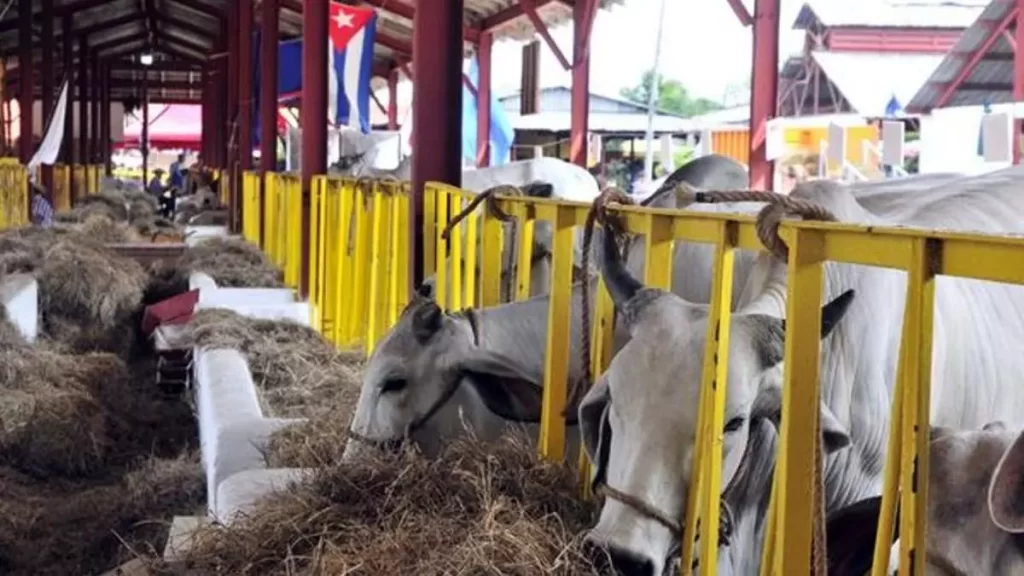
Livestock control has not been well received by many farmers / Cubadebate

14ymedio bigger14ymedio, Havana, July 5, 2024 — After beginning the livestock control exercise last March, the Matanzas authorities have reached a conclusion: the drop in the number of animals and the quantities of milk only occurred in state records. With 50% of the farmers and landowners inspected, the province has seen a recovery of 24.8% in the birth rate – 3,200 animals – and the option of demanding another 53,760 liters of milk from the farmers.

These indicators “express a response to control,” the official State newspaper Granma writes in an article published on Thursday. According to Roger Jiménez Ramos, deputy delegate for livestock in the province, 1,403 cases of missing animals, 12 undeclared births, 33 animals without a brand and 100 cases of illegal buying and selling have been detected so far.

For Jiménez, this is a reflection of the “lack of control” in the territory – which, according to the official press, extends to other provinces such as Las Tunas, Camagüey and Artemisa, where the authorities have even recorded cases of deceased people who are listed as owners of animals. So far, fines totaling 6,717,800 pesos have been applied, 33 animals have been confiscated and 39 have been forcibly purchased. continue reading

So far, fines totaling 6,717,800 pesos have been imposed, 33 animals have been confiscated and 39 have been forcibly purchased

“Of course, not everything is easy to explain. For example, there are producers who are missing two animals, but who at the time went to the Police to report these losses and, for various reasons, do not have the receipt in their possession to justify this situation. There are others who live very far from the Livestock Registry, and it is are more difficult for them to register or mark the animals,” admits the official, who foresees that the state control commissions must be prepared to offer better contract conditions to the ranchers.

Although the livestock census has not been well received by many farmers, who have been restricted for months from selling their animals or freely trading their produce, the authorities insist on their purpose: “The most important thing about this exercise of control, in our opinion, is that, thanks to greater order and discipline, a slowdown in the decline of the mass is now perceptible, a sign that had not been visible for a long time.” In other words, products (animals in this case) that the Government considers “diverted” have been brought back to the state coffers.

Granma also tries to show the most revolutionary side of the campesinos, interviewing cattle ranchers who agree with the registry, even if they have been penalized. “One of the most prominent farmers in the province, Miguel Cobo, was forced to pay 75,000 pesos, because at the time of the count he was missing six animals.”

The farmer paid, assuming responsibility for not having the documents that indicated the legal sale of the cattle

The farmers paid, assuming responsibility for not having the documents indicating the legal sale of the cattle, but the irregularity could perhaps have been avoided with better police surveillance on the farm. “Every day they killed a cow, they even slaughtered my team of oxen, and it is not possible to raise cattle like this,” Cobo claims.

Another testimony is that of Edismar Galán Quesada, leader of a cooperative, who, despite being in favor of the control, believes that the same effort could be devoted to containing the thieves. “The producers complain a lot because the necessary action is not taken with the necessary agility and firmness against theft and slaughter. There are those who file a complaint, sometimes they even catch the thief, and in the end nothing out of the ordinary happens. There is still a lot of benevolence on that point,” he declares.

He also complains about non-payments by state-owned Acopio companies, which sometimes delay up to 40 days after the deadline. “Another thing is that sometimes the thermos does not have a lacto-densimeter to measure the density of the milk and, then, Ecil (the Dairy Products Company of the province) violates the payment as established to our detriment,” he laments.

However, these are secondary issues for the authorities, who assure that “there is nothing worse than lack of control, which generally has a high cost.” In the case of Matanzas, private livestock accounts for 82.9% of the livestock, 80.5% of the cows and 88% of the total milk production. Therefore, officials estimate that the supervision of these resources will allow the State “to have real data at hand to know what exists in the countryside, and what we have.” Or, in other words, to make the products circulate once again, and exclusively, through official channels.

See also:
Dead owners
“Cow slaughter
“Cows disappear”

____________

COLLABORATE WITH OUR WORKThe 14ymedio team is committed to practicing serious journalism that reflects Cuba’s reality in all its depth. Thank you for joining us on this long journey. We invite you to continue supporting us by becoming a member of 14ymedio now. Together we can continue transforming journalism in Cuba.

Several Cuban Political Prisoners Are in ‘Serious Danger’

The international community is called upon to raise its voice against the regime’s abuses

Activists Carlos Michael Morales, José Daniel Ferrer García and Fray Pascual Claro Valladares/ Collage

14ymedio bigger14ymedio, Havana, July 4, 2024 — After 14 days on a hunger strike, the life of independent journalist Carlos Michael Morales, admitted to the medical unit of the Guamajal prison, in Santa Clara, is in “serious danger,” the organization Cuba Decide denounced on Tuesday.

The activist, who has already been in prison for two years and 10 months for demonstrating in Caibarién, Villa Clara, during the massive protests of 11 July 2021 (’11J’), and who was released in March of this year, was arrested again on May 4 and has been imprisoned for two months without a trial date. In that period he has gone on two hunger strikes, and the latest one has been the most severe.

After several incidents of police harassment, Morales was arrested during a summons in the Criminal Investigation Unit of Caibarién. He immediately began his first hunger strike, which he suspended on May 22, pending the response to a habeas corpus presented by his lawyer. continue reading

Morales was arrested during a summons in the Criminal Investigation Unit of Caibarién. He immediately began his first hunger strike

In a letter that Morales sent after that first strike, he said that, after a strong pain in his chest, he was denied medical assistance and, instead, was beaten by the unit’s commander. The event caused his transfer to the hospital in critical condition.

Almost a month later, after he was denied habeas corpus, the independent journalist resumed his hunger strike on June 19.

Given the seriousness of the situation, the Complaint Center of Cuba Decide reported that it submitted a request for an urgent appeal to the Inter-American Commission on Human Rights (IACHR), and also urged the international community to denounce human rights violations against Morales and other activists on the Island.

In addition, this Wednesday the IACHR issued precautionary measures in favor of political prisoner Fray Pascual Claro Valladares, sentenced to 10 years in prison for the crime of sedition, after participating in the demonstrations in the city of Nuevitas, Camagüey, in August 2022, and after using social networks to denounce police violence.

The Cuban Observatory of Human Rights (OCDH), which requested the measures from the commission, was notified that the IACHR warned – through a resolution – that Claro Valladares “is in a serious and urgent situation, since his rights to life, personal integrity and health face a risk of irreparable damage.”

Political prisoner Fray Pascual Claro Valladares was sentenced to 10 years in prison for the crime of sedition

In its report, the inter-American petition said that the 22-year-old has been subjected to severe conditions of isolation, intimidation and physical aggression, including a beating in February 2023. In addition, it accused prison officials of threatening him by taking away his medical care, family visits, phonef calls and shipments of medicine and food, if he and his mother continue to report his case.

Last April, Claro Valladares tried to commit suicide after hearing his sentence. After a brief medical evaluation, he was returned to the penitentiary. So far, the IACHR said that the young man had not received psychiatric care, despite the fact that it was not the first time he tried to hurt himself.

In its resolution, the IACHR called on the Government of Cuba to protect the rights to life, personal integrity and health of Claro Valladares; that his conditions of detention be in line with the applicable international standards; that they guarantee he will not receive threats, intimidation, harassment or violence, and that he will receive medical diagnoses and treatment.

Finally, another political prisoner who lives in degrading conditions is José Daniel Ferrer García, leader of the Patriotic Union of Cuba (UNPACU). Arrested within the framework of the 11J protests, “he has been without the right to phone calls or family and marital visits for almost a year and four months. All this time (he has been) confined in a punishment cell, isolated not only from his family but also from the entire penal community under inhuman, cruel and degrading conditions,” said his wife, Nelva Ortega Tamayo, in an audio sent to the media, organizations and activists.

José Daniel Ferrer is in prison for the third time for political reasons. He was part of the group of prisoners of the Black Spring

In the recording, he explained that he presented himself last Monday at the Mar Verde prison, in Santiago de Cuba, for the regulated visit of Ferrer García, and that they were only allowed to deliver food, toiletries and some medicines. Last May, Ortega Tamayo pointed out that in more than two years Ferrer García has only been entitled to 12 family visits and nine marital visits.

José Daniel Ferrer is in prison for the third time for political reasons. He was part of the group of Black Spring prisoners, with a death sentence commuted to 25 years in prison and released after eight years thanks to the efforts of the Vatican and the mediation of Spain, but he refused to go into exile like many of the other released.

In 2019, he was arrested on October 1 and sentenced to prison in February 2020, after a closed-door trial for an alleged crime of injuring another man, a charge that his relatives and collaborators deny. After six months in prison, and in the midst of strong international pressure, his sentence was changed for a sanction of four and a half years of house arrest.

However, more than a year later, Ferrer was arrested and imprisoned during ’11J’  when he barely left his house to join the mobilizations. In August of that year, a judge revoked his house arrest and ordered his re-entry to prison to serve four years and 14 days remaining from the 2020 sentence.

Translated by Regina Anavy

____________

COLLABORATE WITH OUR WORKThe 14ymedio team is committed to practicing serious journalism that reflects Cuba’s reality in all its depth. Thank you for joining us on this long journey. We invite you to continue supporting us by becoming a member of 14ymedio now. Together we can continue transforming journalism in Cuba.

Belarus Presents a ‘Sample of Weapons’ to a Cuban Army Delegation

The Minister of the Armed Forces of Cuba, Álvaro López Miera, and the Minister of the Armed Forces of Belarus, Víctor Jrenin, held their semi-annual meeting

The Cuban general inspected the communication and surveillance equipment of the Belarusian Army and was shown with the drones / Ministry of Defense of Belarus

14ymedio bigger14ymedio, Havana, 4 July 2024 — A Taurus military gyrocopter -a hybrid between a helicopter and an airplane – and Chinese Vans of the Dajiang special troops carrying machine guns, drones and communication equipment were part of a “weapons show” with which the Ministry of Defense of Belarus received the Minister of the Armed Forces of Cuba, Álvaro López Miera.

With frequent trips to Minsk, López Miera is no stranger in Belarusian military circles. About their visits, the official press of the Island is scrupulously silent, and local agencies – such as Belta – prefer to give few details. The photos that the Belarusian Defense publishes on Telegram say more, in which the Cuban general is seen enthusiastic about his host’s military equipment.

The Minister of Defense, Víctor Jrenin – a regular visitor to Cuba, where he was last January – received the Cuban delegation, made up of several senior officials of the Army, with which he held “negotiations.” During the meeting, both parties evaluated compliance with their agreements – the content of which is not known – during the past six months and ratified their commitment to “military collaboration.” continue reading

The Cuban military visited the barracks of the Special Operations Forces Brigade of Belarus / Ministry of Defense of Belarus

The Cuban military visited the barracks of the Special Operations Forces Brigade of Belarus, where an exhibition of the equipment used by the “small units” was held, as well as the training they undergo – which they exemplified with several exercises and detonations – and an explanation of the “special equipment” of the brigade, including its drones and vehicles. Belarusian Army officers showed López Miera the Taurus gyrocopter of the Polish company Trendak. Used by the armed forces of several European countries, the Trendak – a small aircraft – has capacity for three soldiers and can move at 170 kilometers per hour.

In addition, the Cuban general inspected the communication and surveillance equipment of the Belarusian Army, and he is seen in the photos interacting with drones. Belarus uses, in its arsenal, the Russian-made Irkut, Orlan and Supercam drones, and the Formula, VR-12, Moskit and Busel, Belarusian.

Belarusian Army officers showed López Miera the Taurus gyrocopter of the Polish company Trendak / Trendak Aviation

As for the MZKT-7930 trucks from Polonez, it is an old “Chinese tale” between Minsk and Havana. The Cuban regime has been claiming for months that it is interested in buying Polonez-M missiles, with a range of 300 kilometers, transported by the vehicles that López Miera saw.

Actually manufactured by China – Minsk only manufactures the trucks – Cuba’s interest in missiles was revealed by the Belarusian Defense in November 2023. The agreement for the alleged purchase was signed by the Chief of Staff of the Cuban Army, Roberto Legrá, but neither then nor now has the Island revealed why it wants that class of weaponry.

This Wednesday, López Miera congratulated his counterpart on the 80th anniversary of the liberation of Belarus from the Nazis, an anniversary in whose commemorative parade he participated this Wednesday. In addition, the delegation was taken to the commemorative complex of the Fortress of the Heroes of Brest.

The speeches, medals and tributes are the only things in which both countries have been transparent. The last semi-annual contact between the military chiefs of Minsk and Havana occurred last January in the latter capital, when Jrenin received a decoration from López Miera.

The official press was discreet about the trip and only reported the signing of a “military cooperation document” of secret content, similar to the one that six months earlier had been signed in Minsk, just after the uprising of the Wagner mercenary group against Moscow. In his press conference with Cuban journalists, Jrenin also did not reveal the reason for his stay in Havana and limited himself to stressing that the Island is “a strategic ally in the Western Hemisphere,” a phrase that has been interpreted as a geopolitical warning to the United States and the other NATO countries.

About his “important partner” in the Caribbean, the minister added that Cuba and Belarus are “very similar countries” and “do not give up their objectives.” At one point in the speech, quoting Belarusian President Alexander Lukashenko, he alleged that it was important for the armies of both nations to have good communication, since “military force has become the basis of political relations between our countries.”

Translated by Regina Anavy

____________

COLLABORATE WITH OUR WORKThe 14ymedio team is committed to practicing serious journalism that reflects Cuba’s reality in all its depth. Thank you for joining us on this long journey. We invite you to continue supporting us by becoming a member of 14ymedio now. Together we can continue transforming journalism in Cuba.

Russian Deputy Suggests Reinstalling Missiles in Cuba To Pressure the US

Sergei Mironov believes that the Kremlin must respond in this way to Washington’s support for Ukraine.

Cuba has no problem with positioning itself as a key military power in the region, after hosting a Russian flotilla in June / 14ymedio

14ymedio bigger14ymedio, Mexico, 4 July 2024 — Legislator Sergei Mironov, leader of the Just Russia coalition and close to Vladimir Putin, suggested this Thursday that Russia carry out a missile deployment in Cuba similar to the one that caused the so-called October Crisis in 1962. According to Reuters, the politician, a member of the Lower House of Parliament, stated that installing weapons on the Island is one of the Kremlin’s many options if it wants to respond to the West’s support for Ukraine.

Mironov explained that, if Russia sends missiles to Cuba, it could give a signal to the United States, which militarily supports Ukraine and whose missiles were used in Ukrainian attacks against Russian targets in Crimea. “The possible use of a base in Cuba, which was recently visited by Russian ships transporting hypersonic weapons, is just one of the many options,” he said in a statement quoted by the British agency.

The proposal of the leader of Just Russia is similar to that made last January by the first vice president of the Defense Committee of the State Duma, Alexei Zhuravlev, who at that time wanted Russia to place nuclear weapons near the United States in Cuba, Nicaragua and Venezuela.

Today, the Cuban missile crisis could occur anywhere…

The legislator mentioned the October Crisis, adding that “today, the Cuban missile crisis could occur anywhere, taking into account the modern capabilities of the Russian Army, Air Force and Navy.” He also said that Washington had embarked on an arms race that could have “devastating consequences” for the United States. continue reading

Last week, Putin stated that Russia should resume production of intermediate-range and even shorter-range nuclear missiles and consider where to deploy them, after the United States brought similar missiles to Europe and Asia.

That detail did not go unnoticed by Mironov, who said that “it is worth remembering that the cause of the crisis of the 1960s was the deployment of American missiles in Turkey,” and “now the United States is again plotting to deploy weapons near the borders of Russia, supply long-range weapons to the Kiev regime and plan and direct attacks against Russian territory.”

It was 56 years ago that the intelligence services of US President John Kennedy discovered that Soviet leader Nikita Khrushchev had deployed nuclear missiles in Cuba after the failed Bay of Pigs invasion.

The world was on tenterhooks for 13 days, from October 15, 1962, when the United States discovered the 42 Soviet missiles installed in San Cristóbal, until October 28, when Moscow ordered their withdrawal, in spite of the opinion of Fidel Castro, who had a more violent position in the conflict. This incident is considered the moment when the Cold War superpowers were closest to nuclear war.

In the middle of the Cold War, R-12 and R-14 missiles capable of carrying nuclear warheads, were installed in Cuba/ FidelCastro.Cu

The invasion of Ukraine in 2022 led Russia’s relations with the West to their lowest point since that moment and has earned Moscow the majority rejection of the international community. The Kremlin, for its part, has dusted off some old alliances that remained since the Soviet era, such as the one with Havana. The reactivation of this relationship has included a series of military exchanges, as well as the visit of a Russian naval fleet headed by a nuclear-powered submarine last month.

Cuba has no problem showing itself to its allies as a key military point in the region. Last December, the Cuban Army allowed a reporter from the Russian channel Zvezda to record part of its underground arsenal that includes war tanks, missile launchers, Russian Ural-4320 and Chinese Howo trucks. There were also soldiers capable of walking on barbed wire and a labyrinth of secret tunnels.

When the Russian flotilla entered the capital’s pier, at the beginning of June, the submarine Kazan and the frigate Admiral Gorshkov were carrying missiles of various types: hypersonic Zircon, cruiser Kalibr and anti-ship Onyx. On its way to Havana, the Russian flotilla passed very close to Florida, which set off alarms in the United States, which also deployed a flotilla in the area, in addition to sending a nuclear-powered submarine to its Guantánamo naval base, located in Cuban territory.

Translated by Regina Anavy

____________

COLLABORATE WITH OUR WORKThe 14ymedio team is committed to practicing serious journalism that reflects Cuba’s reality in all its depth. Thank you for joining us on this long journey. We invite you to continue supporting us by becoming a member of 14ymedio now. Together we can continue transforming journalism in Cuba.
Better and Cheaper, Spanish Beer Beats Out Cuba’s Own Domestic Brands

“You have to take an aspirin when you drink Bucanero because it gives you a terrible headache.”

Spain’s Mahou has seen its popularity in Cuba grow in recent years. / Screen capture / Cubavisión

14ymedio bigger14ymedio, Madrid, 17 June 2024 — Cubans do not like their own country’s beer, which is both more expensive and not as good as the imported brands. This helps explain why the island is the second largest overseas market for Spanish brewers. In 2023, 20% of their exports went to Cuba, right behind Portugal at 22% and well ahead of sales to the United Kingdom and France. The figures come from the “2023 Socioeconomic Report on the Spanish Beer Sector,” which was released last week. According to the report, Spanish breweries sold 416 million liters last year, 83.2 million of which were sold on the island.

Jacobo Olalla Marañón, general director of the Spanish Brewers’ Association, which produced the report, told “El Independiente” that private companies have clearly been key to this expansion into the Cuban market. Their dramatic increase in market share began in 2021, when sales of Spanish beer grew 62% over the previous year. They skyrocketed 196% in 2022 and another 193% in 2023. continue reading

Spanish breweries sold 416 million liters last year, 83.2 million of which were sold on the island

Olalla Marañón attributes this growth to expanded trade opportunities following Cuba’s relaxation of import restrictions in 2020, which he says have allowed beer and a wide variety of other goods to be brought into the country.

While there have been no new regulatory changes in the interim that specifically deal with foreign trade, Cuba did adopt legislation authorizing the creation of small and medium size private companies (MSMEs). This coincided not only with the Covid-19 pandemic but also with the precipitous fall of the country’s already meager domestic beer production, which has aggravated the trade imbalance.

“The growth of tourism in Cuba has [also] stoked demand for beer in a country where Spanish hospitality companies have a strong presence,” he somewhat erroneously adds. While the latter assertion can indeed explain the phenomenal growth in sales, Cuban tourism has grown only in relative terms since 2020, when the entire sector was shut down due to the pandemic and was starting from zero.

At that point, tourism had nowhere to go but up. It is still a far cry from where things were in 2018, for example, when Cuba had a record 4.6 million visitors from overseas. Subsequent signs of recovery have been very weak, with fewer than 600,000 tourists in 2021, 1.6 million in 2022 and 2.4 million in 2023. Meanwhile, most of the major players in the international tourism industry have fully recovered or surpassed their pre-pandemic levels.

Spanish beer imports arrived in the midst of a precipitous decline in domestic beer production. In 2023, the island produced 124,570,000 liters, more than the 81,600,000 in the previous year and a little more than the 100 million in 2021. Nevertheless, this was only half of what was produced before the pandemic. Cuba produced 264,680,000 liters of beer in 2018 and 258,690,000 liters in 2019. Even in 2020, the first year of the pandemic, the island’s breweries churned out 149,600,000 liters. Data from the National Office of Statistics and Information (ONEI) shows that imports from Spain have grown in relative proportion to the decline of the domestic industry itself.

 Data from the National Office of Statistics and Information (ONEI) show that imports from Spain have grown in relative proportion to the decline of the domestic industry itself

Sales figures and customer preferences indicate that domestic beer production has not recovered since the pandemic. With fewer tourists willing to pay more for something with a “Made in Cuba” label, and with new opportunities for importing better quality products, domestically produced beer has lost ground.

Cubans are the primary market for the locally produced products but beer fans tend to reject the local product because the “unstable” quality of the water affects the taste of Cuba’s Cristal and Bucanero brand beers. “You have to take an aspirin when you drink Bucanero because it gives you a terrible headache,” says one consumer who has switched to the Spain’s Mahou beer.

As part of measures to stimulate domestic production, Cuba introduced a special tariff on tobacco and alcoholic beverages and tobacco, with an exemption for beer, at the beginning of this year. In April, however, a new tax was levied on imported beer, though one that is 10% lower than on beverages with higher alcohol content. Instead of the 10% general tariff and 5% for the most-favored-nation tax they had been paying, importers must now pay 20% and 10% respectively (30% and 15% in the case of cigarettes, rums and other spirits). We will have to wait until next year to find out what repercussions of this tax increase will ultimately have but consumers have already noticed an increase in the price of domestic beer as well.

Meanwhile, Bucanero is hoping to improve production thanks to a four-million-euro investment by the Italian automated bottling company Comac. The plan is to design and build a new plant in Holguín to produce barrels with the goal of doubling production of its existing factory, which it has operated in the province since 1990. The factory now operates as a public-private partnership with the Canadian company Cerbuco, a subsidiary of the Belgian company Interbrew N.V. According to government press outlets, it currently produces two million liters of beer a month.

____________

COLLABORATE WITH OUR WORKThe 14ymedio team is committed to practicing serious journalism that reflects Cuba’s reality in all its depth. Thank you for joining us on this long journey. We invite you to continue supporting us by becoming a member of 14ymedio now. Together we can continue transforming journalism in Cuba.

Russia Supplies Cuba With the Record Amount of 126,000 Tons of Wheat in a Year

The figure is 1.7 times higher than the previous year, but in previous years between 20,000 and 40,000 tons were exported annually

Wheat flour at the José Antonio Echeverría mill. / Cuban Flour Milling Company

14ymedio bigger14ymedio, Moscow, 4 July 2024 — Russia supplied between July 2023 and June 2024 the record number of 126,000 tons of wheat to Cuba, almost 1.7 times more than during the previous year, according to Rusagrotrans, the Russian rail transport operator specialized in the transfer of grain and fertilizers.

According to the Russian agency Interfax, in the 2022-2023 season, Russia exported 76,000 tons of wheat to Cuba, a figure also considerably higher than in previous years, when exports of Russian grain to the largest of the Antilles ranged between 20,000 and 40,000 tons per year.

In addition, Rusagrotrans indicated that, if in previous years the wheat was shipped to the Island from the port of Novorossíisk, in the Black Sea, this year the bulk of the cargo (101,000 tons, 80% of the total) was dispensed through the Visotski port, in the Gulf of Finland. continue reading

Rusagrotrans indicated that the bulk of the cargo was dispensed through the Visotski port, in the Gulf of Finland

The wheat, sent by the Novosibirsk Food Corporation from Siberia and the Urals, was transported to the Visotsky port in special wagons for the loading of grain belonging to Rusagrotrans, and then left for Cuba by sea.

Last March, during a visit to Russia by the Minister of Foreign Trade, Ricardo Cabrisas, Russian Deputy Prime Minister Dmitri Chernishenko reported that a new loan would be made to the Island to “guarantee the stable supply of oil, petroleum products, wheat and fertilizers,” said Prensa Latina.

In June, Cabrisas returned to the country in search of funding for Cuba’s Development Plan until 2030, at the St. Petersburg International Economic Forum 2024 (SPIEF), where it was reported that exports of agro-industrial products from Russia to Cuba had doubled last year, compared to 2022.

In the meeting, the Russian Minister of Agriculture, Oksana Lut, indicated that Moscow considered it possible to further expand sales and assured that her country has all the necessary resources to “guarantee the food security of the Cuban State.”

According to official data, the trade between Russia and Cuba in 2022 amounted to 451 million dollars. Most of the trade was agricultural, although the Russians also invested in construction and tourism.

Translated by Regina Anavy

____________

COLLABORATE WITH OUR WORKThe 14ymedio team is committed to practicing serious journalism that reflects Cuba’s reality in all its depth. Thank you for joining us on this long journey. We invite you to continue supporting us by becoming a member of 14ymedio now. Together we can continue transforming journalism in Cuba.

Ten Days Guarding the Manzanares Building To Prevent the Theft of Belongings

A building collapse forced the residents to leave their apartments and they don’t want to lose everything

The collapse of part of an apartment created a domino effect / 14ymedio

14ymedio bigger14ymedio, Natalia López Moya, Havana, 3 July 2024 — San Francisco Street at the corner of Carlos III, in Central Havana, is still closed with a yellow ribbon and an old wicker sofa that prevents the passage of vehicles. Since part of the emblematic Manzanares building collapsed on Sunday, June 23, several affected neighbors have been stationed in the surroundings to avoid the looting of their belongings. This Wednesday, the arrival of some wooden beams, to shore up the entrance, gave them some hope of being able to evacuate some clothes and appliances.

The posts, brought by the state brigade that works on the collection of the interior debris, were placed on the asphalt, very close to the facade at the number 912, a wall full of moisture that for years showed the problems that affected one of the icons of art deco in Havana. With long faces, the victims who have been watching on the street calculated whether those reused wooden beams with signs of deterioration will also be able to support the structure and allow them to access their apartments.

The victims watch on the street, calculating whether the beams, with signs of deterioration, will be able to support the structure

Inside, the panorama is much more serious than can be seen from the outside. The collapse of part of an apartment on an upper floor, which began in the patio area, created a domino effect continue reading

that dragged down the apartments on the lower floors. The mountain of debris exceeds the height of a man, and the pieces of wall piled up have dimensions that are impossible to carry without heavy machinery. A hill of stones and twisted steel blocks the passage to the rest of the building.

San Francisco Street on the corner with Carlos III, in Centro Habana / 14ymedio

Above the ruins, the sun is reflected through the hole where once there were small interior balconies where the families hung their clothes. “The question is no longer whether we will be able to return to our homes but if we will be able to save some things that remained inside,” an old woman, who claims not to have moved from the place since that fateful Sunday, told 14ymedio. “We began to feel a bit of sand falling from above and we went out. Then we heard the roar, and we lost everything: ceiling, beds, televisions and even the food we had in the refrigerators.”

Now the residents hope to arrive before the thieves, who climb rooftops, go down drain pipes and come at night 

Now, the the residents hope to arrive before the thieves, who climb rooftops, go down drain pipes and come at night, approaching the wallet that was left on the table, the crucifix inherited from a grandmother that hangs on a wall or the electric pot which until two weeks ago a family used to cook rice. It is a race against the clock in which they are the ones who lose: the walls of rubble prevent them from entering what was once their home.

Translated by Regina Anavy

____________

COLLABORATE WITH OUR WORKThe 14ymedio team is committed to practicing serious journalism that reflects Cuba’s reality in all its depth. Thank you for joining us on this long journey. We invite you to continue supporting us by becoming a member of 14ymedio now. Together we can continue transforming journalism in Cuba.

More Than 220 Artists Denounce the Police Violence in Cuba Against Two Intellectuals

The letter is signed by Leonardo Padura, Fito Páez and Fernando Pérez, among others.

Image published by Jenny Pantoja Torres with Alina Bárbara López to report her departure from the police station on the day they were both violently treated. / Jenny Pantoja Torres

14ymedio biggerEFE (via 14ymedio), Havana, July 3, 2024 — More than 220 writers and artists signed an open letter in which they denounce the “police violence” with which the intellectual Alina Bárbara López and the anthropologist Jenny Pantoja were recently treated.

The letter, released on Tuesday by the independent website CubaXCuba (CXC), is signed among others by the writer Leonardo Padura, the Argentine musician and singer-songwriter Fito Páez and the film director Fernando Pérez.

“The use of force, the criminalization of dissent and imprisonment do not solve our real problems. All Cubans have the right to propose our ideas to get out of this crisis,” the signatories said.

“All Cubans have the right to propose our ideas to get out of this crisis”

The criticism refers to the treatment received by López, a member of the board of directors of CXC, and Pantoja, during their arrest while traveling from Matanzas to Havana to make a public protest.

According to the account of both intellectuals, the police hit them, threw them to the floor, forcibly put them in the patrol car and held them for hours in a police station.

López, 58, told EFE this Wednesday, two weeks later, that she continues to suffer severe pain in one shoulder and dizziness. continue reading

The signatories of the letter emphasize that Cuban artists and intellectuals “have the right to assume their role in this context, because culture is the stage on which the problems of any society are advanced and resolved in time.”

According to CXC, among the first signatories to the complaint are those who are also recognized figures of Cuban cinema such as the filmmakers and screenwriters Ernesto Daranas and Kiki Alvarez; the actors Luis Alberto García and Héctor Noas; the professor and critic Gustavo Arcos, and the researcher and critic Juan Antonio García Borrero.

Also among the signatories are the national prize winner of Plastic Arts of Cuba, Lázaro Saavedra, and the national prize winners of Literature, Luís Álvarez and Maggie Mateo.

López, a professor, historian and editor, has been arrested on several occasions in recent months for making symbolic protests, and as a result of these actions she was sentenced at the end of last year to pay a fine for a crime of disobedience.

Also among the signatories are the national prize winner of Plastic Arts of Cuba, Lázaro Saavedra and the national prize winners of Literature, Luís Álvarez and Maggie Mateo

The intellectual has declared herself in “contempt” of the sentence and refused to pay the fine, aware that she could go to jail, as she has written in different articles on social networks.

The NGO Prisoners Defenders, based in Madrid, said that this trial “without guarantees” had “political motivations” and sought only to “repress the exercise of the fundamental rights” of López, whom they described as a “victim of conscience.”

Translated by Regina Anavy

____________

COLLABORATE WITH OUR WORKThe 14ymedio team is committed to practicing serious journalism that reflects Cuba’s reality in all its depth. Thank you for joining us on this long journey. We invite you to continue supporting us by becoming a member of 14ymedio now. Together we can continue transforming journalism in Cuba.

Cuban Government Describes as Ineffective and Harmful the 30% Profit Cap on Sales from the Private Sector to the State

Economist Pedro Monreal points out that this measure “entails the risk of corrupt markets.”

The sale of imported flour by private parties has, on many occasions, allowed the state sector to have bread. / Escambray

14ymedio bigger14ymedio, Madrid, 28 June 2024 — Cuba’s private sector will be able to obtain a maximum profit of 30% on the goods and services it sells to the State as of July 1. This Thursday, the Cuban Government made public a resolution – dated Tuesday – in which this limit is established with the objective of “containing the expenses of state entities in their economic relations with non-state forms of management.” The measure is, as economist Pedro Monreal summarizes, a variant of “price caps,” which not only have not shown their effectiveness, but can even be harmful.

“State entities, in the process of economic contracting with non-state methods of management for the acquisition of goods and services, agree on prices and rates whose maximum profit rate does not exceed thirty percent (30%) of the total of costs and expenses, as well as the amount corresponding to the application of taxes on Sales and Services,” details the resolution published in the Official Gazette.

The text, which emphasizes the containment of inflation as its goal, urges lower-level administrations (provincial and municipal) to approve the maximum prices and rates of the goods and services they select based on the needs of each territory.

Private sector retail sales account for just 4.1% of those of the country as a whole. Although it is not known what part of them end up at the state sector

The impact of the measure, provided it works, would be more than limited. As Monreal points out, private sector retail sales account for only 4.1% of those of the country as a whole. Although it is not known what part of these sales ends up in the state sector, the percentage is too negligible to have any type of significant consequence. continue reading

“In addition to the fact that the base of ‘savings’ in state expenditures by limiting the rate of profit on non-state sales acquired by state entities does not appear to be very large, experience indicates that ‘price caps’ are not effective to reduce inflation,” the expert indicates.

The Cuban economist insists that the way to contain inflation, which has not stopped growing exponentially since the entry into force of the so-called Ordering Task (2021), is expense reduction. The largest State budget items go to Health (19%) and Education (17%), but both are essential for the Government, in addition to being “problematic” – Monreal describes – for society, which is why the specialist suggests the cuts in the next largest sector, Public Administration and Defense (16%).

“Prices must essentially be fashioned in the market (even in regulated markets). Replacing this function of the market with ‘powers’ of local officials not only restricts market prices, but also entails the risk of ‘corruption markets’, Monreal concludes in an X thread in which he has recorded his analysis of measures.

Replacing that market function with ‘powers’ of local officials not only restricts market prices, but also risks ‘markets of corruption’

The publication of the information in Cubadebate has generated an avalanche of comments in a few hours in which, in general terms, distrust is perceived regarding the measure. “With knowledge of the facts, it will mean a new brake on many activities. For example, tourism, which, in order to be able to provide services relies on many private companies. Imagine now, with the crisis of ITH [marketing company for the sector] not being able to supply its clients and, starting July 1, applying that measure, are we prepared?” a reader points out.

Others have seen, immediately, how corruption is going to run rampant. “Profit rate = Income – (costs + expenses). In other words, a high price can be perfectly justified by saying that the costs or expenses were high; no one can control that for an individual. We are kicking as we drown.”

Some readers point out that the measure is correct or that the 30% profit is already too much and the margins should be tightened even more, comments that are appreciated by the Ministry of Finance and Prices itself, which intervenes in the debate. However, a large group of users agree that the Government is insisting on a path that has never been successful.

“Although the price cap is considered counterproductive by many economists, practice has demonstrated its inefficiency in the best of cases, plus its counterproductive effect in the majority of cases. So, here we are, continuing to stumble over the same stone. Tripping over a stone is not bad if you do it for the first time, but in Cuba we do it so many times that we end up falling in love with them.”

____________

COLLABORATE WITH OUR WORKThe 14ymedio team is committed to practicing serious journalism that reflects Cuba’s reality in all its depth. Thank you for joining us on this long journey. We invite you to continue supporting us by becoming a member of 14ymedio now. Together we can continue transforming journalism in Cuba.

Flowers for One of the Many Defunct ATMs in Cuba

The ATM machine at the Metropolitan Bank of Estancia and Conill, in Havana, was a spectacle this Monday

The spontaneous offering confirmed that they had perished from breakdowns and the deficit of Cuban pesos / Cuba]

14ymedio bigger14ymedio, Natalia López Moya, Havana, 2 July 2024 — A flower on the keyboard of an ATM at the Banco Metropolitano de Estancia y Conill, in Havana, was the spectacle that greeted customers who arrived early this Monday to withdraw cash. Both ATMs were out of service, and the spontaneous offering confirmed that they had perished from breakdowns and the deficit of Cuban pesos.

Shortly thereafter, one of the ATMs was refilled, and the line grew as the morning progressed. Even the bank of Nuevo Vedado had residents coming from the nearby neighborhood of El Cerro, who walked from the vicinity of the Almendares River on 26th Avenue and some other neighborhood of the Boyeros municipality, where “there is no money in any branch,” as explained by someone who paid 200 pesos to ride in an almendrón (a shared taxi) in order to be able to collect her retirement.

The line moved very slowly. After noon, some of those who were waiting despaired and left, but workers from the nearby ministries and state agencies that abound in the area also arrived. “It’s my lunch hour, but I’m going to spend it trying to get my salary from last month,” said an employee who finally gave up in the face of the prolonged wait, aggravated by an interruption to recharge the device with cash, which forced the rapid depletion of the bills. continue reading

The murmur of customer dissatisfaction continued until a scream caught everyone’s attention: “They’re out of money!

After one o’clock in the afternoon, a scream invaded the line. Two employees of the Metropolitan Bank itself, who were in line, although they had spent most of their time inside the air-conditioned premises, came out, both with several credit cards in their hands, to extract money. “We are forbidden to take cash out of the window so we have to take it, like everyone else, from the ATM,” one of the women defended herself against the numerous complaints about the time they took with all the operations and the danger that the women would grab the few pesos that were left.

Finally, the bank workers took their dozens of bills and returned to the branch. The murmur of dissatisfaction of the customers was maintained for a while until a scream caught everyone’s attention: “They’re out of money!” A frustrated old man, standing in front of the ATM, removed his expelled magnetic card without receiving any cash. “Tomorrow will be another lost day for me,” he sighed.

The stampede wasn’t long in coming. As in those wakes where the coffee is finished and the chairs in front of the deceased’s coffin are broken or uncomfortable, people left the ATMs to rest in peace, with their screens off, their insides empty and the floral offering now withered by the passing of the hours.

Translated by Regina Anavy

____________

COLLABORATE WITH OUR WORKThe 14ymedio team is committed to practicing serious journalism that reflects Cuba’s reality in all its depth. Thank you for joining us on this long journey. We invite you to continue supporting us by becoming a member of 14ymedio now. Together we can continue transforming journalism in Cuba.

Private Businesses in Cuba Hide the Chicken and Other Products To Avoid the Capped Prices

State foreign exchange shops sell the same items at more expensive prices

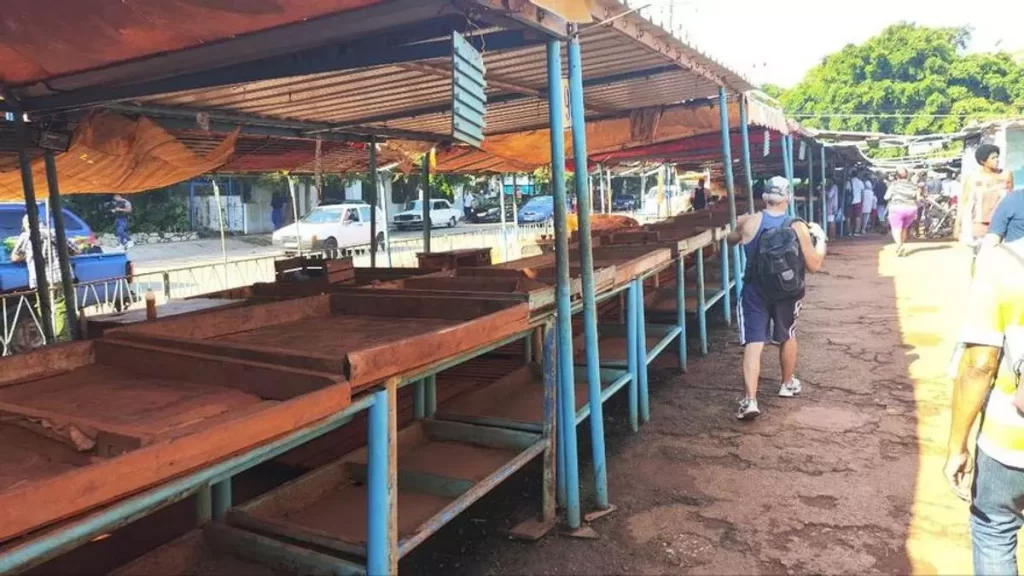
The EJT agro market at 17 and K in El Vedado, Havana, usually with very well stocked shelves, was almost empty / 14ymedio

14ymedio bigger14ymedio, Juan Diego Rodríguez/Olea Gallardo, Havana, 3 July 2024 — A day after the new measures announced by the Government on June 27, which establish a maximum profit margin of 30% on private sales to the State, it is not yet known with certainty whether or not the prices are capped for six products in private retail stores. There is only one thing certain: these basic necessities included on the list of capped prices by some municipal governments this weekend disappeared from the shelves on Tuesday.

On Saturday, the authorities of Plaza de la Revolución (Havana), Jobabo (Las Tunas) and Pinar del Río published lists of products with maximum prices for cooking oil (900 pesos per liter), chopped chicken (680 per kilogram), powdered milk (1,675 per kilo), sausages (1,045 per kilogram), pasta (835 pesos per kilo) and powdered detergent (630 pesos per kilo). But yesterday, Monday, when the regulation was supposed to come into force, in municipalities like Boyeros they said that they didn’t know anything, and among the businessmen it was all rumors and confusion.

“Does anyone know anything about the official prices? We’re confused.” The comment of Yulieta Hernández Díaz, president of Grupo de Construcciones Pilares, summed up the state of the matter well. continue reading

This Tuesday, the bewilderment of Cubans is even greater. The agro market operated by the Youth Labor Army (EJT) of the Armed Forces, at 17 and K in El Vedado, Havana, usually very well stocked, had almost all its shelves empty. The few products for sale were piled up together on the top shelves on the K Street side.

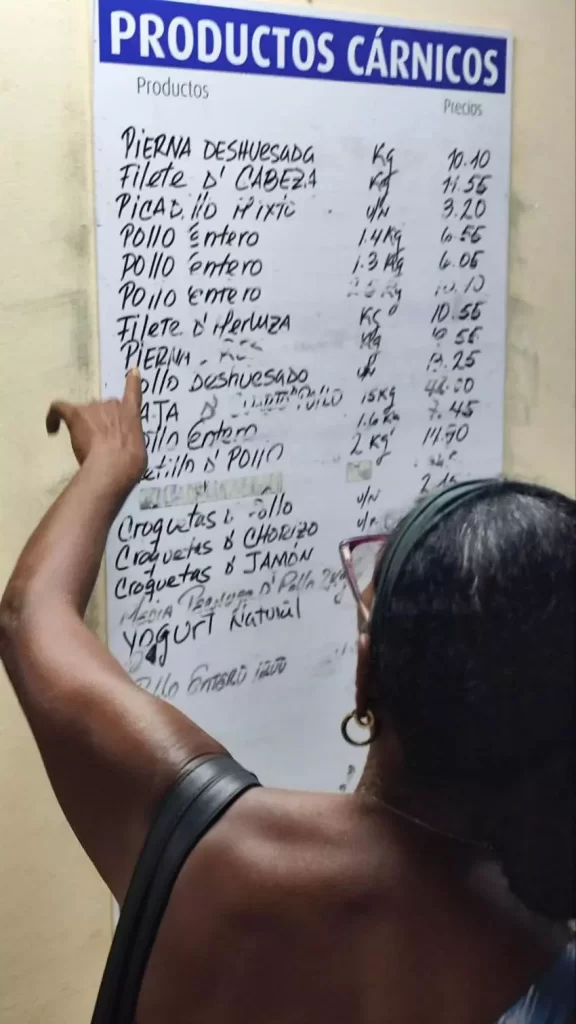
Prices of meat products in the state foreign exchange store La Época / 14ymedio

The sellers, however, responded to the surprised customers with a simple shrug of the shoulders. “They say they don’t know, but it’s clear that they must know something,” said an old woman. It was the same in the Arango market in Luyanó. “There’s nothing on the shelves; it’s dead, empty, a very strange thing,” a neighbor told this newspaper.

In the butcher shop at 17 and K, which operates as a private business, there was only chicken breast and picadillo [chopped meat]. The clerk said that he didn’t know why there were no chicken quarters or thighs, but customers could hear him talking on the phone with someone who told him that he that he had to change the blackboard: “Now I have to put the prices in kilograms.” He didn’t mention the amounts.

In the private business (MSME) Zona K’liente they weren’t selling the bird either. “There is no chicken or milk anywhere.” “There is no chicken and there won’t be,” was the forceful response of the butcher of the 19 and B market, also in El Vedado. The reason? “Because they capped the prices.” And he cried out: “Better to raise chickens at home!”

Something happened, of course, in the last three days, and the authorities were reluctant to report it. A butcher from Sancti Spíritus gave the explanation to this newspaper: yesterday he was introduced to some “comrades” of the Party along with two inspectors, who warned him of the entry into force of the regulations and “they read the prices.” They didn’t give him any citation: “It was just a verbal warning, and they told me that there could be consequences if I increased the price of those products.”

“They say they don’t know, but it’s clear that they do”

It was just what an anonymous official source had warned in an audio that spread like wildfire since Saturday, in which the “established” prices were specified. The voice, with an accent from the west of the Island, assured that “groups of confrontation” were going to go to private businesses to give them “a wake-up call.” Subsequently, it warned, there might be “a forced sale of these products or confiscations of them for the social institutions that also need these products.”

As a result of the uncertainty and the threats, private individuals have simply hidden the merchandise. Also in Sancti Spíritus, a neighbor said that he had managed to buy chicken in a nearby MSME, “just for being trustworthy”: 10 pounds at 4,000 pesos.

“Chicken cannot have disappeared from the face of the earth; it’s here in Cuba, but they hide it because they don’t want to sell it at the prices dictated by the State,” explained another Cuban, a resident of Central Havana. “It’s always the same: they capped the price of taxis, the taxis disappeared; they capped the price of malanga and the malanga disappeared. Well, now chicken has disappeared.”

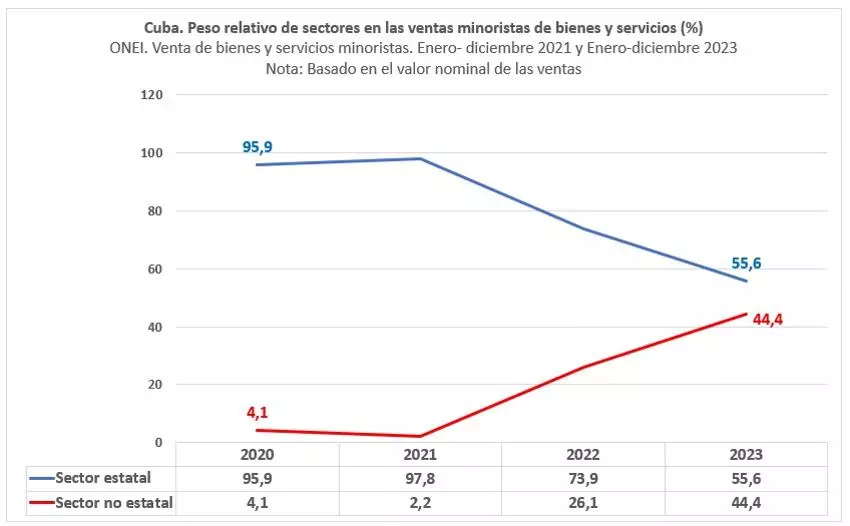
In four years, as seen in an official graph, private sector sales have gone from 4.1% of the total to 44.4% / Onei

Meanwhile, in the State stores selling in freely convertible currency (MLC), there were not only the lost products in that had been sold in pesos, but they were much more expensive. In La Época, in Central Havana, detergent of 1.5 kilos was at 5.45 dollars (1,908 pesos at the informal exchange rate), and 1.25 kilos of Argentine chicken was at 6.55 dollars (2,293 pesos).

“They’re never going to cap themselves, as you can imagine,” said a client at the doors of the MLC store.

The effort to attack the MSMEs (micro, small and medium-sized enterprise) by imposing a profit cap on them has been criticized by specialists such as Pedro Monreal, who insists that the way to contain inflation, which has not stopped growing exponentially since the entry into force of the so-called Ordering Task* (2021), is none other than the reduction of expenses.

The economist has again published a revealing post on Tuesday, based on figures published yesterday by the National Bureau of Statistics and Information (Onei) that indicate the spectacular increase in the weight of the “non-state sector” in retail sales. In four years, as observed in an official graph, private sector sales have gone from 4.1% of the total to 44.4%, while state sales went from 95.9% to 55.6%.

It remains to be seen whether prices will be discussed on State TV’s Round Table program scheduled for this Tuesday, to which “leaders of the Communist Party” are invited to “analyze partisan actions based on boosting food production in the country.” Cubans know what the end of the film is: a shortage of products and more difficulties to obtain them.

*Translator’s note:  The Ordering Task was a collection of measures that included eliminating the Cuban Convertible Peso (CUC), leaving the Cuban peso (CUP) as the only national currency, raising prices, raising salaries (but not as much as prices), opening stores that take payment only in hard currency, which must be in the form of specially issued pre-paid debit cards, and a broad range of other measures targeted to different elements of the Cuban economy.

Translated by Regina Anavy

____________

COLLABORATE WITH OUR WORKThe 14ymedio team is committed to practicing serious journalism that reflects Cuba’s reality in all its depth. Thank you for joining us on this long journey. We invite you to continue supporting us by becoming a member of 14ymedio now. Together we can continue transforming journalism in Cuba.

The Owner of La Carreta Is Rewarded and the Owner of the Diplomarket Is Punished

 Both Havana businesses are owned by Cuban-Americans

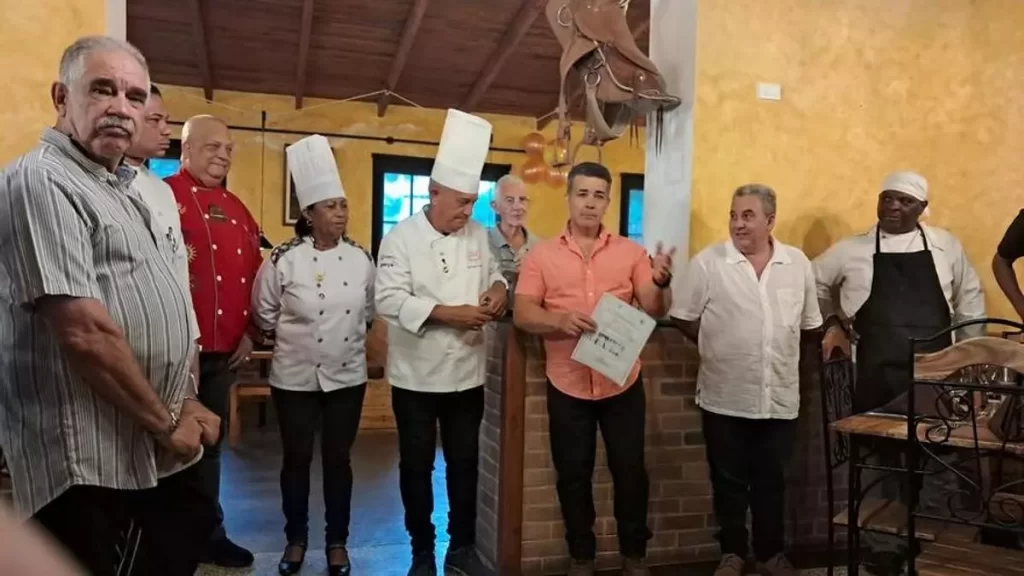
Obel Martínez (pink shirt) is the main owner of the restaurant La Carreta / Facebook of the Culinary Federation of Cuba

14ymedio bigger14ymedio, Havana, 2 July 2024 — Not all private businesses on the Island receive the same treatment by the Cuban Government. The La Carreta restaurant is one of the lucky ones. This Monday, a year after the iconic establishment reopened, now restored and in private hands, it has been recognized by the state Culinary Federation of Cuba for “promoting authentic Creole cuisine.”

In a Facebook post, illustrated with photographs, the institution highlighted the work of the owners of the premises, Obel Martínez and Ramón Feria, who “expressed their decision to make the restaurant a mandatory reference site for nationals and foreigners.” The text also says that “entrepreneurship” has rescued “the emblematic facility that had existed for 50 years before it deteriorated from the passage of time and abandonment,” not to mention the previous owner who ruined the place almost eight years ago: the State.

Since its reopening and with its rich gastronomic offer, La Carreta became a must, not only for foreigners, but also among the people of the emerging middle class with dollars to spend. However, the dazzling success of its main owner, Obel Martínez, raised suspicion. continue reading

La Carreta became a must not only for foreigners, but also among the people of the emerging middle class with dollars to spend

Just when his company was approved in Cuba, Martínez was granted U.S. nationality, specifically in December 2022. His signature is number 5,639 in the registry of private businesses with the name of Mojito Martínez, and with it he opened the Mojito-Mojito bar, in the heart of Old Havana.

“Obel fled Castroism and now makes a living from it, enjoying at the same time all the benefits and profits of the American dream: he plays a capitalist from Havana, with the support of local authorities,” an anonymous source told this newspaper at the time, who said that Martínez was still living in Miami, Florida.

As a local development project, the same source added, he had received a loan of 10 million pesos from the municipal government, specifically the 250 branch of the Banco Metropolitano, located on Línea Street, in El Vedado. As official television confirmed in a report last September, La Carreta “was recovered thanks to the close collaboration with the government of the municipality of Plaza de la Revolución.”

Martínez is one of the Cuban businessmen who emigrated to the United States and who, stealthily, for years and with the acquiescence of the regime, carry out business in Cuba. Another of them was Frank Cuspinera Medina, owner of Diplomarket, the so-called “Cuban Costco”. The past tense of the verb indicates his recent fall from grace, which contrasts with the praise received by Martínez.

Martínez is one of the Cuban businessmen who emigrated to the United States and who, stealthily, for years and with the acquiescence of the regime, carry out business in Cuba

Cuspinera was allegedly arrested, along with his wife, Camila, on June 20. The Facebook page La Tijera reported that a State Security operation had arrived at the supermarket along with “two buses” carrying auditors from Gaesa (Grupo de Administración Empresarial S.A.), the Armed Forces conglomerate.

On June 21, in the WhatsApp group managed by Diplomarket, a message announced that they were “closed until further notice,” explaining: “We have problems operating because of the commercial license that must be renewed.” Similarly, the app, which can still be visited, presents a caption: “We are out of service – Send us an email.”

Since then, there has been no news of the businessman and his wife, but there is indeed evidence that not all private individuals are equal before the law in Cuba.

Translated by Regina Anavy

____________

COLLABORATE WITH OUR WORKThe 14ymedio team is committed to practicing serious journalism that reflects Cuba’s reality in all its depth. Thank you for joining us on this long journey. We invite you to continue supporting us by becoming a member of 14ymedio now. Together we can continue transforming journalism in Cuba.