Dozens of Devotees Venerate the Virgin of Regla on the Eve of the Day of Cuba’s Patron Saint

The procession precedes the celebration of the Virgin of Charity of Cobre, patron saint of the island, popularly called ‘Cachita’

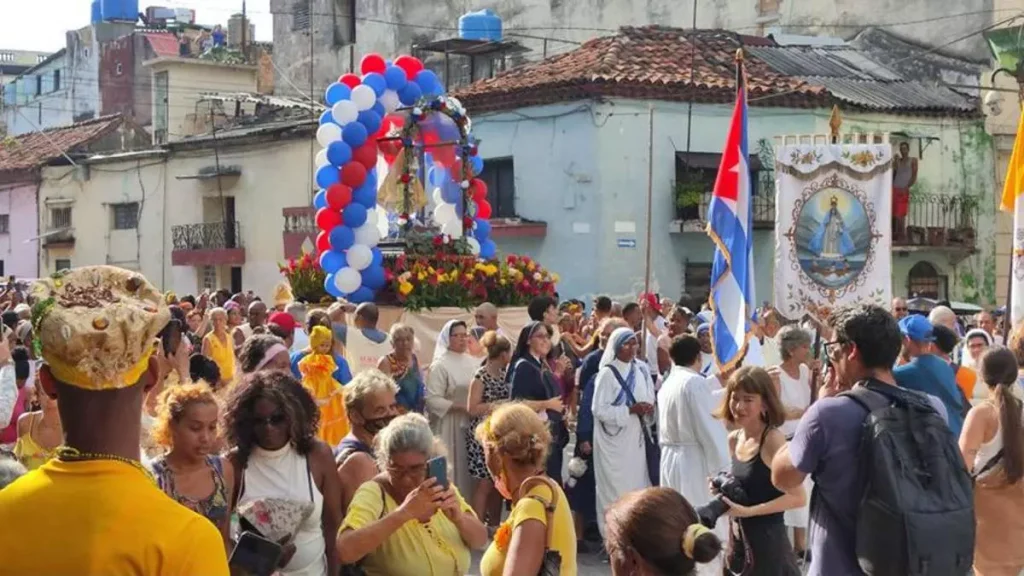
People participate in the procession of the Virgin of Regla

14ymedio biggerEFE (via 14ymedio), Havana, 8 September 2024 –Dozens of devotees attended the mass and subsequent procession of the Virgin of Regla this Saturday, in the Havana municipality that bears her name, on the eve of the celebrations for the day of the patron saint of Cuba, the Virgen de la Caridad del Cobre.

After the mass at the National Sanctuary of Our Lady of Regla, a crowd accompanied the procession as they do every September 7, dressed in blue and carrying black dolls in allusion to the virgin who, in the Yoruba religion, resembles Yemayá, the goddess of the sea.

The cult of the Virgin of Regla began in 1867, in a wooden hermitage in the fishing village of Regla / EFE

According to historical data, the cult of the Virgin of Regla began in 1867, in a wooden hermitage in the then fishing village of Regla.

In 1708, it was declared by the chapter of the town of Regla patron saint of the fishermen and the population, the port and the Bay of Havana.

This virgin was brought to Cuba by the Spanish colonizers who inherited the religion of Andalusia. This Catholic tradition has become common on the Island, where she is considered a protector of fishermen, sailors and all those people whose lives depend on the sea. continue reading

The church of the Virgin of Regla was built in 1811. It is a humble temple where the image of a black virgin dressed in blue with white lace stands out. The Sanctuary of Our Lady of Regla was declared a National Monument in 1987.

This tradition has become common in Cuba, where the virgin is considered a protector of fishermen and sailors / EFE

This Saturday’s procession precedes the celebration on Sunday of the day of the Virgen de la Caridad, patron saint of the Island, popularly known as “Cachita.” African slaves recognized her in their Yoruba pantheon as the deity Ochún.

According to Catholic legend, the Virgin of Charity first appeared in 1612 with a child in her arms, floating on a board with an inscription that said: “I am the Virgin of Charity,” before three fishermen who sailed in a boat through the eastern bay of Nipe.

Translated by Regina Anavy

____________

COLLABORATE WITH OUR WORKThe 14ymedio team is committed to practicing serious journalism that reflects Cuba’s reality in all its depth. Thank you for joining us on this long journey. We invite you to continue supporting us by becoming a member of 14ymedio now. Together we can continue transforming journalism in Cuba.

Cubans Pay Tribute to ‘Cachita’ in the Midst of Inflation and a Mass Exodus

The profound economic crisis has reduced the number of offerings left on the altar at the entrance to the church of the Virgen de la Caridad del Cobre /14ymedio

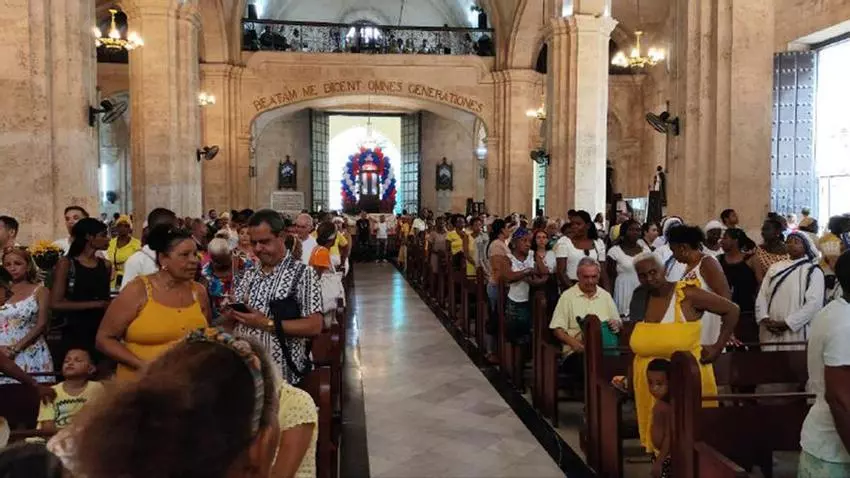
14ymedio bigger14ymedio, Natalia López Moya, Havana, 9 September 9, 2024 — The heat and lack of water in wide areas of the Cuban capital did not prevent the church of the Virgen de la Caridad del Cobre on the corner of Manrique and Salud, in Central Havana, from being filled with devotees, who celebrate on September 8 the day of the Patron Saint of Cuba. The effects of inflation and the mass exodus, however, were noticeable.

The bouquet of sunflowers, with its yellow petals in tribute to the saint, fondly called Cachita, now costs 1,000 Cuban pesos, twice the price of two years ago. On this occasion, the deep economic crisis has also reduced the number of offerings left on the altar at the entrance to the church, including candles, holy cards and gifts to the Virgin.

“Coming here was already a sacrifice,” says Celeste, 68, who arrived with her daughter and a grandson. “This is the only family I have left in Cuba, and we have come to ask Oshún (the equivalent of the Virgin of Charity del Cobre in the Yoruba religion) to send them quickly and safely on the way.” The family entered the church shortly after four in the afternoon for the mass given by Cardinal Juan de la Caridad García, archbishop of San Cristóbal de La Habana.

In the large enclosure, the average age of those present exceeded 50 years, a sign of the exodus suffered by the Island / 14ymedio

In the large enclosure, the average age of those present exceeded 50 years, a sign of the exodus suffered by the Island. Some children, accompanied by their grandparents, stood out among so many gray hairs and gave some amusement in the middle of the sober ceremony. At the base of an arch continue reading

supported by regal columns, a Latin phrase contradicted the reality of the missing young people: “beatam me dicent omnes generations” (all generations will hold me blessed).

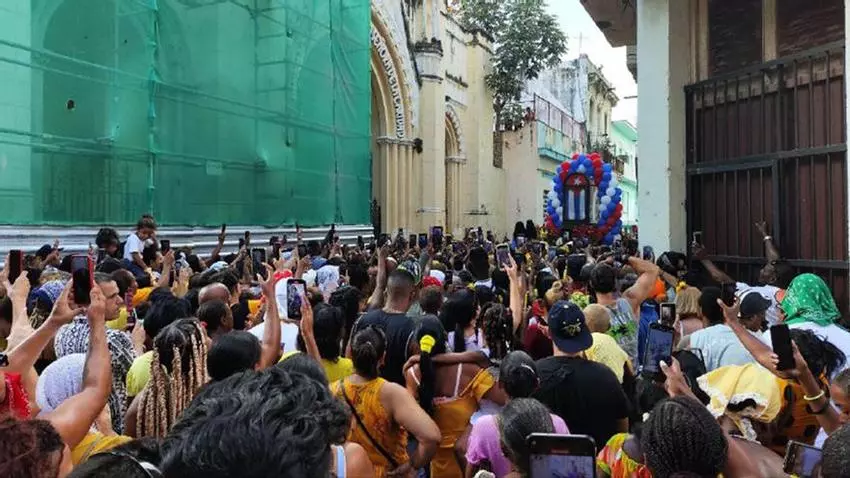
In contrast to the small number of young people and children, those who never miss the date are the police and state security agents who closely monitor, every year, the commemoration of September 8 and, especially, the procession that runs through several streets of one of the most populated municipalities of Havana. The rectangle formed by Manrique, Zanja, Galiano and Reina streets is the route along which Cachita’s followers walk, accompanied by priests, nuns, parishioners, santeros (practitioners of Santería) and segurosos (security guards).

From Galiano Avenue, metal fences and several police officers controlled the passage to the Havana church where tribute is paid to “the mother of all Cubans.” In the vicinity of the church, the surveillance cordon was stricter and, significantly, the large mountains of garbage that are now part of the landscape had disappeared from the area. Now that the filth was further away, the sellers were able to unfold their tables and display their necklaces, wood carvings with the mambisa* virgin’s image, bouquets of flowers and dolls dressed in yellow. But unlike other years, the merchants did not have an avalanche of customers this Sunday, because some were deterred by the high prices, and others, simply, weren’t able to make the journey.

Adorned with balloons with the colors of the Cuban flag, the image of the Virgin of Caridad del Cobre on procession was protected inside a glass case. After five in the afternoon the procession with Cachita peeked through the door of the church, and she was greeted with applause, tears and hundreds of raised arms trying to capture the moment with their mobile phones.

“There are many people but fewer than in other years,” said a young man who was trying to broadcast live on his social networks the moment of the Virgin’s departure. “I barely have 4G so I don’t know if the images are showing,” he said. “I’m trying to send the video to my sisters, who left a few months ago and used to come to this parish a lot. One is in Madrid and the other in Valencia, but they are still very devoted to Cachita.”

Smiles were also scarce. The procession that a few years ago had a certain touch of fiesta and revelry was this time more introverted and circumspect. There were thinner faces, fewer petals falling from the balconies due to the high price of flowers, more calm and fewer spontaneous screams like the ones a few years ago that broadcast the need for a national understanding to “accept us all, under the mantle of Cachita.”

The day has been influenced from the start by the prayers and complaints about the harsh situation that Cuban families are going through / 14ymedio]

During the procession, applause was heard, shouts of “Long live the Virgin” and tunes like “If you go to Cobre, I want you to bring me a a little Virgin of Charity.” Megaphone in hand, the Cardinal asked the Patron Saint of Cuba to help the residents of the Island to “solve the serious economic, political and social problems” they suffer in a debacle for which there is no solution in the short or medium term.

In other parishes of the country, processions and similar masses were held, especially the one that took place at the Cobre Sanctuary in Santiago de Cuba, where dozens of people celebrated the 412nd anniversary of the discovery of the image of the Virgin.

For the rest, the day was influenced from the beginning by prayers and complaints about the difficult situation that Cuban families are going through. For the occasion, the superior of the Daughters of Charity in Cuba, Nadieska Almeida, published a text on Facebook describing the deep crisis on the Island. “I also suffer as a Cuban when I have no strength to get up, when hope seems to be extinguished.” The nun regrets “so many unnecessary deaths due to hunger, lack of resources and, what is more serious, negligence, because our damage is so severe that we stop caring.”

*Translator’s note: In 1915, several veterans of Cuba’s War of Independence (“mambises”) wrote to Pope Benedict XV, asking him to proclaim the Virgin of Charity del Cobre as the patroness saint of Cuba.

Translated by Regina Anavy

____________

COLLABORATE WITH OUR WORKThe 14ymedio team is committed to practicing serious journalism that reflects Cuba’s reality in all its depth. Thank you for joining us on this long journey. We invite you to continue supporting us by becoming a member of 14ymedio now. Together we can continue transforming journalism in Cuba.

The Police Interrogate Former Political Prisoner Samuel Pupo for His Posts Against the Regime

They gave him a warning for being “prone” to committing crimes of “propaganda”

Pupo with his wife, Yuneisy Santana, in a photo taken in July, three months after leaving prison / Samuel Pupo Martínez/Facebook]]

14ymedio bigger14ymedio, Havana, 30 August 2024 — Samuel Pupo Martínez – who was imprisoned for two years, eight months and 21 days following the demonstrations of 11 July 2021 (11J) – was threatened again by State Security agents with being returned to prison, this time for his posts on social networks, which criticized the regime. This Tuesday they forced him to sign a warning. In the document they indicate that he is “prone to committing a crime of propaganda against the constitutional order,” he told 14ymedio.

“They told me to put social networks aside and not post anything more against the Government and the system,” he explained to this newspaper, alluding to his encounter with two agents who identify themselves as “Darío” and “Omar.” The duo has continuously harassed him since his release from the Agüica maximum security prison on April 1, when he received a reduction of his seven-year sentence for the crimes of public disorder and contempt.

According to Cuban law, the crime of propaganda against the constitutional order can lead to sentences of between four and 10 years in prison. On the warning, Pupo wrote that he did not agree with the accusation. continue reading

His posts on social networks criticized the regime

The agents were insistent, and they not only spent part of the interrogation intimidating him in a subtle way, but they also tried to find out what he’s been doing since his release from prison. “They asked about my employment, and I replied that I am not yet working in a permanent job because my computer is broken. I have not been able to repair it, and I need it to be self-employed,” he said.

Pupo has always been an enterprising man and has a good command of English. Before ending up in prison, he taught that language to a group of students. But now, with his computer broken and his health diminished, he does “the odd job, anything else that appears.”

The time he spent locked up in Agüica wreaked havoc on his body. During that period, in addition to enduring the hostile environment, he also had to deal with scleroderma, diabetes and glaucoma, which have afflicted him for years without his receiving proper medical care. “In prison, my illnesses had a field day, so now I’m just trying to survive,” he says. Among other consequences, the prison affected Pupo’s ability to see.

With his computer broken and his health diminished, Pupo limits himself to doing ’the odd job, anything else that appears,’ he told this newspaper

During the interrogation, the agents reproached him for having met with relatives of other political prisoners and accused him of using his social networks to spread what they described as “propaganda” against the regime. This is in reference to various posts on his Facebook page where he denounces prison abuse, among other things.

In the interrogation, “Darío” and “Omar” insinuated that, if he did not comply with the warning to moderate his posts, there could be repercussions for his family. “They told me that if my intention is to leave the country with my family, the best thing is to remain calm, because they could regulate my departure,” the activist explained about the attempt to dissuade him from exercising his freedom of expression.

“Everything happened in a calm atmosphere. They didn’t yell at me; they talked in a normal way but insisted on what I should do, telling me that I could return to prison and for a longer period this time,” he said.

State Security has not left Pupo alone since, in the protests of 11J, he climbed on top of a car in the middle of the demonstration in Cárdenas, Matanzas, in front of Party headquarters, and shouted “down with communism!” and “homeland and life!” The photo taken of him became one of the most iconic images of that day.

For Cubalex, the action of the agents this Tuesday, by harassing and threatening Pupo for expressing his opinions, “violates the Constitution of the Republic of Cuba, which requires public officials to respect the law and act within the bounds of their authority.”

In a statement published this Thursday, Cubalex emphasized that “discriminating against a person for his political opinion threatens human dignity,” and considered that the agents “exceeded the legal limits of their authority,” not only by trying to intimidate Pupo but also by initiating a process of illegitimate criminal prosecution, motivated solely by his political opinions.

The image of Pupo shouting ’down with communism’ and ’homeland and life’ on top of a car is one of the most iconic of 11J

Pupo also denounced on his Facebook account, one day after the interrogation, that he had been restricted from accessing the internet. “I have paid for mobile data, and in advance. But I don’t know why my service was cut off,” he said.

In his most recent post, the activist explained that after spending the whole day without internet he was able to connect to the mobile data network using another telephone line, and that’s when he changed his SIM card. “Something must have happened to my SIM card, or some problem in Etecsa left me without internet. I’ll find out tomorrow. If the Etecsa company could be sued, it would have gone bankrupt a long time ago,” he joked.

Translated by Regina Anavy

____________

COLLABORATE WITH OUR WORKThe 14ymedio team is committed to practicing serious journalism that reflects Cuba’s reality in all its depth. Thank you for joining us on this long journey. We invite you to continue supporting us by becoming a member of 14ymedio now. Together we can continue transforming journalism in Cuba.

The ‘Stylish’ Closing of the Cienfuegos Cultural Summer Celebration Ended in the Dark

The sound equipment was installed in front of Calle 56, very close to the Guiñol Theater / 14ymedio

14ymedio bigger14ymedio, Cienfuegos, 30 August 30, 2024 — It’s 8:00 at night, and much of Cienfuego’s El Prado is without electricity. The Asociación Hermanos Saíz (AHS) had announced a “stylish” activity to close the summer activities. The institution has developed a whole theatrical production in rural neighborhoods and communities whose completion was scheduled for this Thursday in coordination with the Provincial Council of Performing Arts.

The sound equipment was installed in front of Calle 56, very close to the Guiñol Theater for a show, called “El arte nos une” (Art unites us), which was supposed to start at 7:00. “I’ve been here since 6:00 in the afternoon, and when I arrived there was no electricity anymore,” says Betty, a young dancer who was supposed to participate in the evening. Her usual punctuality contrasts with the delay that characterizes the events organized by the ruling party.

“It’s incredible how in this country resources are moved around unnecessarily, with the misery that there is,” says Arturo, a man who sits every night on a bench in El Prado. “Then they post photos on social media as if it had been a success when, in reality, they don’t even have an audience to come see them. Those of us who are sitting here come to clear our heads for a while, not to witness an artistic gala,” he protests. continue reading

At 8:10 at night the electricity was restored, but the lighting continued to be terrible / 14ymedio

Finally, at 8:10, the electricity was restored, but the lighting was still terrible. “Luckily, I listened to my mother when she told me not to wear high heels. When these things happen, and they happen very often, I think about taking a leave from the AHS,” Betty confesses to 14ymedio. But she ends up discarding the idea because, she recognizes, “marking myself” is not going to solve anything.

To the cry of “the snack has arrived,” the cast of the “young artistic vanguard” prepares to consume the squalid assigned ration. “With this and a check of 200 pesos, most of our colleagues are satisfied. Then we go to the meetings to say that everything is fine, deceiving ourselves, because no one believes the story that the work of the Association has any social impact,” admits a leader of the institution.

“Anyone who sees our photos of the theatrical production would think that everything was wonderful” / 14ymedio

“Anyone who sees our photos of the theatrical production would think that everything was wonderful. However, once again, reality surpasses fiction by demonstrating the uselessness of theory and the pointlessness of practice,” says Betty referring to the countless problems that always end, when the performance is not suspended, by reflecting a poor aesthetic quality. Poor aesthetic quality or a suspension of scheduled activities. “I’m going to ask what they’re going to do with this, because I feel like leaving now,” she concludes.

“Could you tell me when the show starts?” Arturo asks, and, after 9:30 at night, a recorded song by the duo Buena Fe is heard, as a preamble to the delayed start. At this time some people stop at El Prado to observe what is happening. They have put a spotlight near the improvised scenario that improves visibility a little. Even so, the small crowd gathered remains in the shadows without any place to sit.

The small audience gathered remains in the shadows without any place to sit / 14ymedio

The show included music, dance, singing, plastic arts and circus acts. “They announced a lot and it lasted a little,” says Arturo, while the audio operator collects the equipment. “United by art” ended up uniting the hopeful young artists, who took advantage of the occasion to talk about future plans, most of them far away from the AHS and Cuba.

Translated by Regina Anavy

____________

COLLABORATE WITH OUR WORKThe 14ymedio team is committed to practicing serious journalism that reflects Cuba’s reality in all its depth. Thank you for joining us on this long journey. We invite you to continue supporting us by becoming a member of 14ymedio now. Together we can continue transforming journalism in Cuba.

General Sotomayor García, Sanctioned by the US for the Repression of the ’11J’ Protests, Has Died

His remains have been cremated and will be on display on Tuesday at the Calzada and K funeral home, between 3:00 pm and 5:00 pm

After the triumph of the Revolution, Sotomayor was sent to La Cabaña, where hundreds of people were executed under the command of Ernesto ’Che’ Guevara. / Radio Bayamo

14ymedio bigger14ymedio, Havana, 2 September 2024 — Hero of the Revolution for some, known repressor of the dictatorship for others, General Romárico Vidal Sotomayor García died in the early hours of September 1 in Havana at the age of 85. The soldier, a member of the Central Committee of the Communist Party of Cuba, deputy in the National Assembly and a senior position in the Revolutionary Armed Forces and the Ministry of the Interior for decades, was one of those responsible for the repression of the anti-government demonstrations of July 11, 2021 (11J), for which he was sanctioned by the United States.

“There are no mysteries in how General Sotomayor has successfully managed to fulfill such dissimilar and complex missions,” Raúl Castro had written about him in the prologue of “Sin olvidar mis raíces (Without Forgetting my Roots”), his biography. The former president stated in the text that his “unconditional loyalty to our people, to the Homeland, to the Revolution, to its Commander-in-Chief and to those who have acted on their behalf; confidence in the decisions of their superiors and absolute commitment to comply with them,” the official press reported.

Born in Bartolomé Masó, Granma Province, in 1938, Sotomayor joined the Rebel Army in 1957, where he was part of column I, and after the triumph of the Revolution he was sent to La Cabaña, where hundreds of people were executed under the command of Ernesto Che Guevara, although his continue reading

biography officially indicates that there “he continued his military studies.”

Sotomayor was in Angola from September 1975, and between 1982 and 1984 he was Chief of Staff, before occupying the post of head of the Southern Troops Group.

Sotomayor was in Angola from September 1975, and between 1982 and 1984 he was chief of the General Staff, before occupying the position of head of the Southern Troop Group

Among the decorations he holds are the order of Che Guevara; the order of Camilo Cienfuegos; the medals of the XX Anniversary of the Moncada; Fighter of the “War of Liberation” [Cuban Revolution] (1956-1958); Combatant of the Clandestine Struggle [the Escambray Rebellion] (1959-1966); First Class Internationalist Fighter; and several others, such as the Calixto García and the Ignacio Agramonte.

In addition, Raúl Castro awarded him the title of Hero of the Republic of Cuba in 2015, coinciding with his retirement, at the age of 77.

The Office of Foreign Assets Control (OFAC) included him on the list of those sanctioned by the US Treasury Department in 2022, for his relationship to “actions to repress peaceful and pro-democratic protests in Cuba,” which is why many Cubans have not regretted his death – in fact, just the opposite.

The messages of condolences – “Before his transfer to the Minint he was head of the 1580 regiment, where I met him. An exceptional boss, my condolences to his family and friends” – have alternated with messages of satisfaction and relief – “He won’t be missed, no great loss” or “I didn’t wish for his death, but we all eventually fade away.”

His remains have been cremated and will be on display on Tuesday at the Calzada and K funeral home, between 3:00 p.m. and 5:00 p.m., according to the official press.

Translated by Regina Anavy

____________

COLLABORATE WITH OUR WORKThe 14ymedio team is committed to practicing serious journalism that reflects Cuba’s reality in all its depth. Thank you for joining us on this long journey. We invite you to continue supporting us by becoming a member of 14ymedio now. Together we can continue transforming journalism in Cuba.

Lack of Security and a Health Crisis, New Reasons for Cuban Emigration

They are not driven by the desire for economic improvement, because they have lived for years in the bubble of receiving remittances in foreign currency

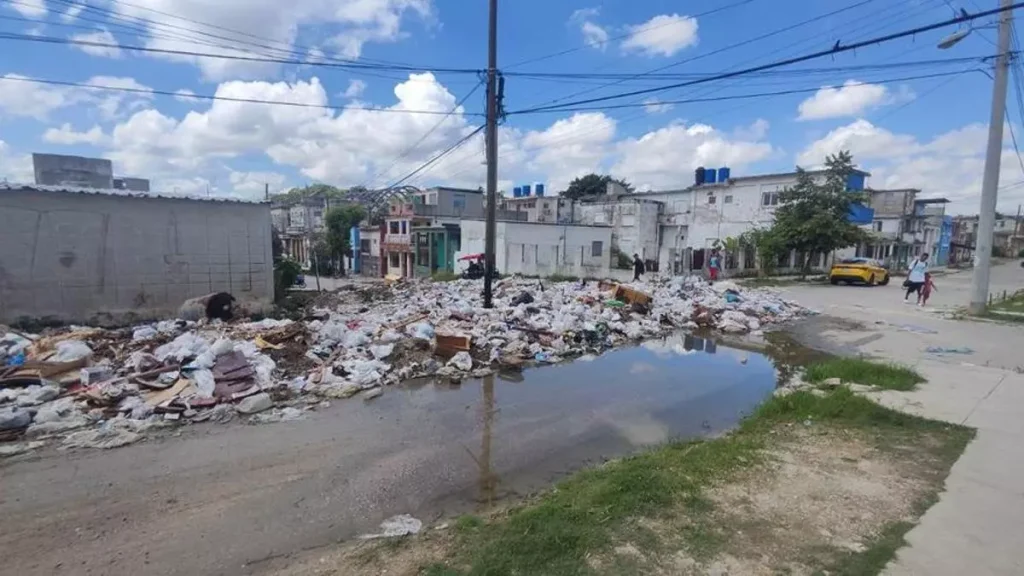
Trash and stagnant water in the  in the Luyanó neighborhood in Havana. / 14ymedio

14ymedio bigger14ymedio, Yoani Sánchez, Generation Y, Havana, 7 September 2024 —  She decided to pack her bags in less than 24 hours. It was a Tuesday. Gladys had gone out with a friend and left her house “as always, tightly locked.” When she returned, the door of the apartment on Ayestarán Street in the municipality of Cerro had been forced and the television, a cordless phone, some food in the refrigerator and other personal belongings had disappeared. “That same day I called my son in Miami and told him to get me the [humanitarian] parole,” she recalls.

After several weeks of police investigation, the pensioner has lost hope that the thieves will be caught and has had to ask a niece to stay overnight with her. “I’m afraid to be at home, that had never happened to me before, but now when I’m alone I even get palpitations. You can’t live like this.” The insecurity that is spreading throughout the island has become, in recent years, a new reason for emigrating.

Gladys was one of those who swore up and down that she did not want to start a new life in another country, far from the house where she was born 67 years ago. “I lived comfortably, because if I asked my son to fly away, he would send me away, but it is no longer a question of money, I am leaving because the next time they come into my house, if I am inside, they will kill me.” This week she auctioned off some appliances and, with the parole already approved, she is only waiting for the travel permit to get on the plane. continue reading

Low crime was portrayed for decades as one of the social achievements of the political model imposed in Cuba 65 years ago. Like all authoritarianism, with an extensive network of controls, vigilantes, informers, political police and repressive bodies, the Havana regime was very effective in detecting and neutralizing criminal groups, gangs and even lone wolves planning a robbery or some other misdeed. Security was, according to an independent journalist, a collateral benefit of the dictatorship.

You avoid going out at night, you look over your shoulder when you hear footsteps behind you and you hide your cell phone in your underwear

However, that sensation that one could walk through any Cuban neighborhood in the early morning without fear of being assaulted or murdered has long since disappeared. Doors and windows have been covered with bars, people keep a machete, a crowbar or a metal pipe somewhere in their house to defend themselves from any invasion by thieves and scoundrels. People avoid going out at night, look over their shoulders when they hear footsteps behind them and hide their cell phone in their underwear to avoid it being snatched away.

We Cubans live on tenterhooks, and not just because of insecurity.

Edwin woke up with pain all over his body and a fever. He had been suffering from constant mosquito bites for several days due to a huge pool of stagnant water in the corner of his building that has served as a breeding ground for the Culex insect and the gnats that fly freely through the Havana neighborhood of Lawton where he lives. “I spent almost a month without being able to even get out of bed,” he explains.

“When I felt worse, I decided to go to the Polyclinic, but that day there was no doctor on duty, only a nurse trying to care for almost ten patients with similar symptoms.” Edwin had tried, by every possible means, not to get infected: “I live locked up, I have air conditioning, mesh on the windows, I never go out at dawn or dusk, which they say is when mosquitoes bite the most, because at 71 years old and with diabetes, any illness can become quite complicated for me.”

But the game of hide and seek didn’t work. “I caught the Oropouche and I had a tough time.” Lying down, with shivers running through his body, one thought kept coming back to him: “I can’t stay in this country, where there aren’t even any aspirin.” When the virus allowed him to get up, he started selling some electrical appliances and auctioned off his Lada car. “I already have the money for the ticket to Spain. Years ago I got my passport through my father and my daughter lives in Madrid, so I’m leaving.”

Epidemiological problems and the deterioration of the Public Health system have been, in his case, the main reasons for leaving the Island. “The puddle on the corner will still be there and I can’t lock myself in a glass box so the mosquitoes don’t bite me and the next time I go to the Polyclinic, there won’t even be a nurse because she left on a raft.”

A year ago, neither Gladys nor Edwin had any plans to live anywhere else, but this summer they had reached their “breaking point.” They were not driven by the desire for better economic conditions, because both have lived for years in the bubble of receiving remittances in foreign currency and enjoying their own home. They packed their bags to escape the violence and unsanitary conditions. It is the knives and filth that are the reason they are shortly boarding a plane.
____________

COLLABORATE WITH OUR WORKThe 14ymedio team is committed to practicing serious journalism that reflects Cuba’s reality in all its depth. Thank you for joining us on this long journey. We invite you to continue supporting us by becoming a member of 14ymedio now. Together we can continue transforming journalism in Cuba.

The New Bet of the Cuban Regime To Stop the Tourism Debacle: ‘Peace and Security’

Faced with the decline in visitors from Canada and Europe, the Government tries to attract more Russians and Mexicans

Foreign tourists putting on sunscreen on a street in Havana/ 14ymedio

14ymedio bigger14ymedio, Madrid, 6 September 2024 — Cuba is wrapping up its first tourism law, which should be approved in December 2025. The news broke this Thursday in Montevideo when the Observatory of Tourism Law of the Americas and the Caribbean was inaugurated, a venue agreed on last May in Varadero.

Juan José Álvarez, legal director of the ministry headed by Juan Carlos García Granda, represented Cuba at the inauguration of the Observatory, where the regime will expose – he said – “the values that support its tourism policy, based on peace and security.”

The first task of the new body is to perform a diagnosis of regional tourism legislation in order to subsequently develop proposals and carry out best practices. The basis is sustainability, accessibility and inclusiveness, according to the Cuban official, who did not expand on how this will be transferred to the national context, whose policy has been marked for decades by the exclusion and overexploitation of resources, including natural ones.

Experts in Law and Tourism from the University of Havana are working on the elaboration of the Cuban law, and the only clue about its content is that it will be “a moment of consolidation of what the country has done in tourism,” which is not exactly a good omen. continue reading

Despite the fact that the Island joined the Spanish Smart Tourist Destination program in 2023, neither of the cities that applied – Cayo Largo del Sur and Guardalavaca – have yet managed to advance in the designation. Cities that aspire to enter this category must demonstrate a high level in the five segments that are valued – governance, sustainability, accessibility, innovation and technology – to advance to the fifth and final stage. Montevideo, at level three, is among the cities in the world that are achieving this goal.

The Cuban tourism strategy, despite the repeated declarations of intentions, is still anchored in the past

The Cuban tourism strategy, despite the repeated declarations of intent, is still anchored in the past: a lot of hotel construction and an apartheid attitude towards the national tourist that is no longer a written rule but is still the usual practice.

The result had been positive until, shortly before the pandemic, things began to change. Since then, the tourism data have disappointed by leaps and bounds, and the Island has been unable to catch its breath after the pandemic. In addition, even with the excessively bad investments in relation to both the results and the money, which could have been allocated to food, health and education – the data are worsening.

In July, the last month with available figures published by the National Bureau of Statistics and Information (ONEI), 153,261 travelers arrived in Cuba, similar to the same month of 2022, but lower by 13.56% than last year, when 177,306 tourists were received. In addition, if we count since January, the number of tourists is 1,463,097 – 26,230 fewer, or 1.8% – than for the same period of the previous year, which suggests that the goal of 3.2 million for 2024 is further away than ever. The 2023 target was not met either, when 2.4 million tourists were received compared to the 3.5 million planned.

Given the evidence of a reduction in travelers from some of its traditional markets, starting with Spain and continuing with a worrying setback for Canada, which was first in numbers for decades, Cuba’s strategy has been to seek new horizons.

“Our job is to bring more Mexicans to Cuba and recover the high presence of Mexican tourists that we used to have”

This attempt frames the efforts to capture the Russians, who arrived in record numbers even before the pandemic and, to this day, continue to be among the countries with the highest growth (41% in July). The increase in Mexican travelers, which in June was already 40,146, 221% more than in the same period of the previous year, has not gone unnoticed by the authorities of the sector.

Hence, the regime has pulled out all the stops to continue attracting citizens of the neighboring country, for which it has reserved an online visa program making it possible to obtain the document up to 72 hours before the trip, for a cost of 575 Mexican pesos, about 29 dollars.

The Cuban ambassador to Mexico, Marcos Rodríguez Costa, presented the tourist strategy in the country, stating that the Island, despite the difficulties, “is more than ready to offer an unforgettable experience, full of flavors, colors and a great diversity of places to discover, both on its beaches and in its vibrant cities.”

Aeromexico, Viva Aerobus and Magnicharters connect both countries, and Mexicana de Aviación also plans to fly to Cuba, according to the ambassador, after a meeting at the end of August with the company’s executives.

“Our job is to bring more Mexicans to Cuba and recover the high presence of Mexican tourists that we used to have,” said Rodríguez Costa. However, Mexican media specialized in tourism have echoed the debacle of the sector on the island. This Thursday, Preferente points out in a note entitled “Tourism for the Dominican Republic, Cancun and Cuba,” that the three main destinations in the Caribbean have recorded an “uneven first half of the year, with the enclave that covers Punta Cana at the head, in contrast to the Island, whose tourist axis is located between Havana and Varadero.”

The Dominican Republic has, it emphasizes, an outstanding year-on-year growth of 11%, compared to the 5.4% expected by Quintana Roo, which they consider poor. Cuba’s data, however, are in negative territory.

Translated by Regina Anavy

____________

COLLABORATE WITH OUR WORKThe 14ymedio team is committed to practicing serious journalism that reflects Cuba’s reality in all its depth. Thank you for joining us on this long journey. We invite you to continue supporting us by becoming a member of 14ymedio now. Together we can continue transforming journalism in Cuba.

Havana Claims To Have Repaired the Breakdowns, but There Are Neighborhoods That Are Still Without Water

Residents walk through the streets with bottles and buckets to fill them in houses with cisterns that still have a little water

Aguas de La Habana workers on Melones Street in Luyanó / 14ymedio

14ymedio bigger14ymedio, Havana, September 6, 2024 — The government of Havana assured this Friday that it is restoring the water supply service, two days after it was interrupted in the main sources of supply of the capital by “electrical interruptions.” According to a brief report, “17 pumps – out of 19 – are already operating in Cuenca Sur,” one of the three large conductors that suffered breakdowns along with those in Ariguanabo and El Gato.

The effects had an impact on numerous neighborhoods. In El Vedado and Nuevo Vedado, severely affected by the breakdowns of the last few days and by previous ones, the lack of water forced private businesses to close. On Tulipán Street, numerous coffee shops suspended the sale of pizzas and sandwiches. The cancellation disappointed students from several schools and workers from nearby ministries who are regular customers of these premises.

Near Boyeros Avenue, in one of the spots that sells fruit smoothies and sandwiches, this Friday morning a nearby neighbor warned that “not a drop of water has entered the cistern, so they can’t not even wash the glasses.” A nearby candy store also closed its doors waiting for the service to be restored in a neighborhood that, a few years ago, was described in the classifieds of buying and selling homes as a place where “there is always water, never missing.” continue reading

A nearby neighbor warned that “not a drop of water has entered the cistern, so they can’t even wash the glasses”

Despite the government’s announcement, in some neighborhoods, such as Luyanó, not even one drop of water has arrived. Residents walk through the streets with bottles and buckets to fill them in with houses with cisterns that still have a little water.

Frustrated, the inhabitants also see that the little water in the area is wasted. “How is it possible that there is no water in the city when a river is overflowing on the road in Luyanó?” a resident asked 14ymedio. This newspaper found that, in fact, there is a jet of water running all over the pavement. “A river is running all over the road. I don’t know where it’s coming from,” she says.

“I haven’t had water for three days,” she adds. “No one has water here, because almost no one has a cistern.” In addition, there are water thieves, who insert a hose into the pipes that run through the streets and sidewalks in front of the houses and suck up the water.

To the shortage must be added “the quality of the water, which is reaching the already contaminated neighborhoods, which we can detect by its color and bad smell. We have to prevent an epidemic from being triggered by this. Imagine the complications that such an event would bring, especially with the lack of medicines,” denounced Marilín López, a resident of Havana, in a Granma report.

The interruption of the supply in recent days has led to despair among the inhabitants in many areas of Havana. Last Tuesday night, in San Miguel del Padrón, the residents took to the streets to protest after more than two weeks without water. In previous days, in Central Havana, Old Havana and Luyanó, the demonstrations managed to restore the service.

“What else are they going to do, if they can’t flush the toilets? So they put a bag in a bucket as a toilet bowl and then close the bag and throw it in the dumpster”

That same Tuesday, the authorities recognized that currently more than 600,000 people suffer “affectations” with the water supply in Cuba. A report published by Granma explained that the number of people who do not have adequate access to water in Cuba has been increasing by almost seven percent.

Although the problem is not new, it has become more acute in the last two weeks. On August 21, 14ymedio reported that the shortage had caused the situation to become scatological in some parts of the capital. In the municipality of Nuevo Vedado, for example, like those who live closer, in Luyanó, they use plastic bags when “nature calls.”

“What else are they going to do, if they can’t flush the toilets? So they put a bag in a bucket as a toilet bowl and then close the bag and throw it in the dumpster,” where it ends up in the open-air landfills, says a resident of that municipality. This creates another problem, because the organic waste piles up in the 20,000 tons of garbage generated every day in the capital, and that remain on the streets for days.

The crisis was also serious in Caibarién, Villa Clara, where it started on August 18. It was not until two weeks later that the Villa Clara Aqueduct and Sewerage Company offered “apologies for the inconvenience caused.” Almost 35,000 were officially affected. The response to the delay in repairs and the “very critical situation” was the “policy” of selling bottled water to the population.

The official spokesperson Henry Omar Pérez reported this Thursday that 4,255 gallons of water had arrived in Caibarién. Each gallon costs 85 pesos. However, he said that distribution will be prioritized for children between zero and 13 years old (5,089). Then come “the bedridden, pregnant and sick”; if there is any water left, the rest of the population will be able to buy it.

Translated by Regina Anavy

____________

COLLABORATE WITH OUR WORKThe 14ymedio team is committed to practicing serious journalism that reflects Cuba’s reality in all its depth. Thank you for joining us on this long journey. We invite you to continue supporting us by becoming a member of 14ymedio now. Together we can continue transforming journalism in Cuba.

UN Agency Finances the Installation of Solar Electric Pumps for Agriculture in Cuba

The FAO, a United Nations agency, did not declare the amount it will spend on the project

The purpose of the initiative is to use solar energy to extract water / Granma

14ymedio bigger14ymedio/EFE, Havana, 31 August 2024 — The Food and Agriculture Organization of the United Nations (FAO) and the Global Environment Fund will support the installation of solar electric pumps for agricultural plantations and livestock facilities in Cuba, the State press reported on Saturday. “The collaboration responds to the common interest of introducing sustainable technologies in the agricultural sector,” explains the FAO in a statement quoted by the State newspaper Granma.

The report explains that the equipment will be installed in selected locations in the provinces of Sancti Spíritus and Granma, and in the Company for the Conservation of the Zapata Swamp, in Matanzas. The purpose of the initiative is to use solar energy to extract water for the wellbeing of the animals and the irrigation of the plantations, and to contribute to “the conservation of water resources and the reduction of the carbon footprint.”

“The innovative solution – part of the conservation of biodiversity and the sustainable management of ecosystems in agriculture, promoted by the Ministry of Agriculture – reduces dependence on fossil fuels and minimizes environmental impact,” according to the report. continue reading

Cuba is suffering from an intense drought that, says the Government, as a direct result of the climate crisis. It is not the first time that the Caribbean country has worked together with the FAO; since 2021, the Ministry of Agriculture has received technical assistance from the agency in a project called IRES,* dedicated to climate resilience in rural communities, the first Cuban initiative with funding from the Green Climate Fund.

The project seeks to mitigate the emission of around 2.7 million tons of greenhouse gases

The project seeks to mitigate the emission of around 2.7 million tons of greenhouse gases, involve 52,000 family farmers in the process and introduce better agroforestry practices for 35,000 hectares of land.

At the beginning of August, the FAO announced that it would devote 1.3 million dollars to promoting sustainable fishing practices and protecting the biodiversity on the Island. The sector is one of the most difficult due to the shortage of fishing gear, fuel and other resources. The objective is to strengthen the capacities of the Fisheries Research Center (CIP) of the Ministry of Food Industry and the technical departments of fishing companies operating in the Gulf of Guacanayabo, on the southeastern coast of the Cuban provinces of Granma, Camagüey and Las Tunas, according to FAO reports cited by the Cuban state press.

The initiative is part of the Conpescas Guacanayabo project that focuses on the sustainable management of marine resources, promotes the use of selective and environmentally friendly fishing gear and promotes the application of good practices in the sector, according to the FAO perspective.

The amount of money invested in the Island by the United Nations agency does not stop there. In 2020, Cuba and FAO agreed on the execution of a project to combat climate change in the amount of 119 million dollars, used to help vulnerable communities in three of the Island’s provinces.

*”Increased climate resilience of rural households and communities through the rehabilitation of production landscapes in selected locales of the Republic of Cuba.”

Translated by Regina Anavy

____________

COLLABORATE WITH OUR WORKThe 14ymedio team is committed to practicing serious journalism that reflects Cuba’s reality in all its depth. Thank you for joining us on this long journey. We invite you to continue supporting us by becoming a member of 14ymedio now. Together we can continue transforming journalism in Cuba.

Six Private Businesses in Cienfuegos Closed and Twenty Forced to Sell Their Inventories

The provincial government has issued fines totaling a million pesos

Private business owners are incensed over recently adopted price control measures / Beatriz Pérez/ 5 de Septiembre

14ymedio bigger14ymedio, Havana, 3 September 2024 — The price controls that took effect on July 8 have forced six privately owned businesses in Cienfuegos to close and led to the cancellation of thirty employment projects nationwide. In what it calls “forced sales,” the government is also requiring more than twenty companies to sell food products and other essential merchandise now being stored in their warehouses if they want to avoid being slapped with price controls.

According to Alexander Brito Brito, the provincial government’s Coordinator of Programs and Objectives, a total of 862 inspections were conducted, which resulted in 590 fines.

Brito did not indicate when the most recent “price control actions” had been carried out but said 630 violations of price control regulations had been uncovered. The regulations cap prices for chicken, cooking oil, powdered milk, pasta, sausages and laundry detergent. The provincial newspaper 5 de Septiembre stated that the measures, which apply only to private businesses, are intended to “provide some degree of economic relief to [Cuban] families.” continue reading

Provincial officials carried out 862 inspections and issued 590 fines

“Provide economic relief to families? What planet are these fine-levying legislators living on? They live in a bubble of manipulation. I’m going to Cienfuegos in two weeks. We’ll see how things really are and just how relieved families there are feeling,” replied one angry reader on Cubadebate, which reposted the 5 de Septiembre article on Monday.

Brito estimated that the provincial government’s actions have generated one million pesos in fines. Businesses were penalized not not only for violating this rule but also for violating Decree #30, a 2021 law that allows prices to be capped based on the needs of each jurisdiction. “We received and responded to five reports and fifty-six citizen complaints,” he is quoted as saying. “There were also actions taken to address illegal activities. In several jurisdictions we found minors engaged in self-employment.”

On a positive note, he adds that increased use and acceptance of digital payment systems was observed in business that were inspected. He points out, however, that many companies are skirting the law. “In an alarming trend, some decided to close up shop during normal business hours.” At no point, however, does he mention the problem of internet connectivity, which is one of the main reasons many Cuban businesses do not use electronic payment systems.

The price control measures adopted in July — presumably through an agreement with some businesspeople in exchange for an exemption from import duties — have incensed private business owners. “I ended up having to liquidate my inventory of powdered milk. Since I can’t make a profit on it, I won’t be carrying it anymore. From here on out, people will have to buy it on the black market for a very high price because a lot of us can’t afford to make bad deals,” said Ramón, a vendor at Cienfuegos’ Yarda market, last month.

Internet connectivity problems are one of the main reasons many Cuban businesses do not use electronic payment systems

He claims that, though the measure has been well received by the public, private businesses have reported losses of over a million pesos in less than a month. Having to sell off their inventories for less than what they paid for them means businesses have been unable to turn a profit.

The opinions expressed by readers of state media outlets such as Cubadebate to the news from Cienfuegos suggest a certain level of public approval of the price controls though some people appear to have reservations. Many view these measures as just the latest iteration of a policy that has been tried the island for more than sixty years to no effect. “These attempts to curtail illegality and control prices are nothing new. It’s like pouring rainwater on wet ground. It does not solve the problem,” reads one post.

Along with a group of skeptics — along those who believe these measures do nothing but push consumer products onto the much more expensive informal market — there is a large cohort demanding that officials adopt the same policy for state-run stores which, until now, have been oblivious to the situation. “Is there any information on price controls in hard-currency stores?” asks one. “Or perhaps in the online Cuban peso stores run by Cimex and Tiendas Caribe?” asks another.

In several jurisdictions minors were found to be engaging in self-employment

“Very good, excellent news. By the way, may I ask why are prices not being regulated in state-owned establishments such as hard currency stores or the National Bread Chain? Or is it that these places do not sell basic necessities?” asks one reader. The question is rhetorical but the answer for many is simple: state-run stores stopped satisfying the public’s needs long ago.

Meanwhile, another reader warns of consequences if businesses continue to close. “The state will have a problem if [private companies] sell off their inventory, collect the money and shut down. There will be two problems. First, nearly a million unemployed people will be looking for work. Secondly, these people will not have food to eat or money to pay taxes. Where will tax revenue come from if most of them are closed?”

____________

COLLABORATE WITH OUR WORKThe 14ymedio team is committed to practicing serious journalism that reflects Cuba’s reality in all its depth. Thank you for joining us on this long journey. We invite you to continue supporting us by becoming a member of 14ymedio now. Together we can continue transforming journalism in Cuba.

Black Beans Disappeared, the ‘Porotos’ and ‘Alubias’ Arrived

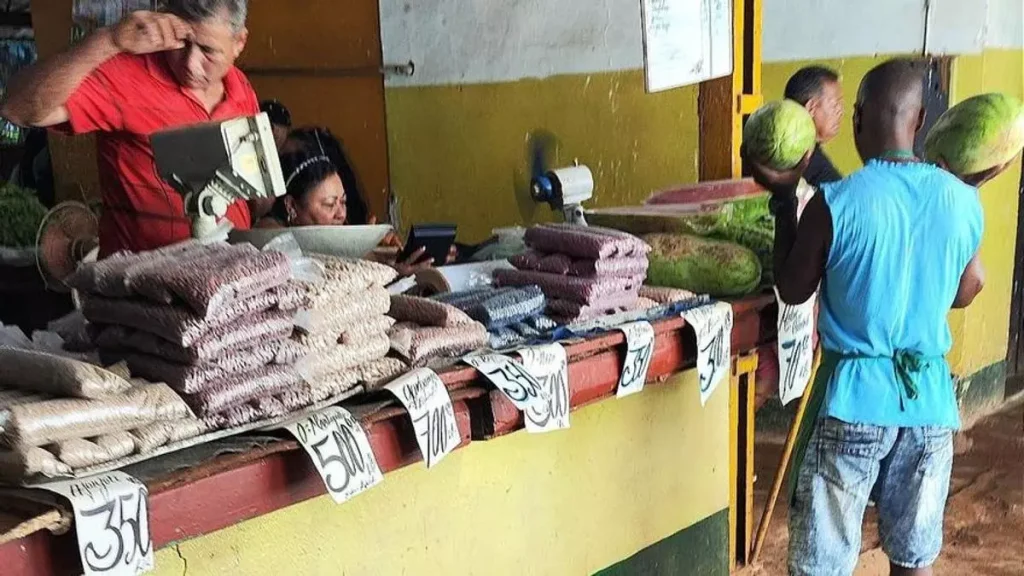
This week, in the market of 19 and B in El Vedado, black beans reappeared after being absent for days from the stalls

Sale of black beans at the 19th and B agromarket in Havana / 14ymedio
Sale of black beans in the agromarket of 19 and B in Havana / 14ymedio

14ymedio bigger14ymedio, Natalia López Moya, Havana, 3 September 2024 — She has never left Cuba, but the crisis has forced her to learn the names of some basic products from other countries. Janet now knows that corn is also called ‘choclo,’ that avocado is called ‘palta‘ in some parts of Latin America and that lemon is the sonorous ‘lima persa‘ (Persian lime) in other places. But it’s the beans that are known by the most names. Faced with the fall in national production, this 42-year-old from Havana has to buy imported beans that say ‘porotos‘ or ‘alubias‘ rather than ‘habichuelas‘ on the package.

“At first I often made a fool of myself by asking the MSME on the corner if what is called ‘caraota’ is cooked in the same way as our beans,” the woman recalls. “In my house I had never bought anything foreign; what we did all our lives was go to the agromarket and choose between the Creole products, which we liked the most.” But the plummeting of national production, the high prices of the legume that comes out of the Cuban fields and the presentation, many times, in packages of poor quality with split beans or stones included, have pushed Cuban diners to prefer the imported beans .

“If he were alive now and saw that we prefer the alubias and imported caraotas, he would have a heart attack and die again “

“I don’t know how they do it, if it’s with a machine or manually, but you don’t have to pick through the beans that come from outside to cook them: they arrive clean, without dirt, without pieces of branches, without different colors,” explains the woman. A one-kilogram package of black beans in a private store in her neighborhood of Cayo Hueso costs between 700 and 800 pesos depending on the quality and the brand. “They say ‘porotos‘ on the package, but now I know it’s the same bean with another name.” continue reading

This week in El Vedado’s 19th and B market, black beans reappeared after being absent for days from the stalls. A pound can go up to 300 pesos, but Janet prefers to “pay more for a package from Argentina or the United States, which arrives cleaner and with beans that get soft when cooked.” The woman regrets that this preference has also been extended to other families she knows. “My grandfather was from Abreus, in Cienfuegos, and he was devoted to planting beans. If he were alive now and saw that we prefer the alubias and the imported caraotas, he would have a heart attack and die again.”

In the province of Cienfuegos, the harvest of black beans planned for 2024 is 1,300 tons, below that of five years ago, when, according to official data, at least 1,500 tons were produced and the trend was to increase each year by 7.8%. At the national level, the numbers also plummeted. In 2018, Cuba reached 161,513 tons of this food, but in 2020 production decreased to 65,779, and in 2021 it was 57,642 tons.

If the Cuban fields are still so depressed, Janet may have to start calling the watermelon ‘sandía,’ the cabbage ‘col‘ or ‘repollo,’ and the cassava ‘mandioca.’

Translated by Regina Anavy

_______________

COLLABORATE WITH OUR WORKThe 14ymedio team is committed to practicing serious journalism that reflects Cuba’s reality in all its depth. Thank you for joining us on this long journey. We invite you to continue supporting us by becoming a member of 14ymedio now. Together we can continue transforming journalism in Cuba.

The Cuban Church Asks Spanish Catholics for Help in the Face of Difficulties on the Island

A campaign is launched to collect donations to “support priests and the religious”

The bishop of Holguín, Emilio Aranguren, and Pope Francis, during the latter’s visit to Cuba in 2015 /Holguín Católico/Archive

14ymedio biggerEFE/14ymedio, Madrid, 5 September 2024 — The power cuts and the shortage of fuel, medicines and other basic goods hinder the work of the Catholic Church in Cuba, according to the bishop of Holguín, Emilio Aranguren, who this Thursday asked for help from Spanish Catholics to face “the worst moment” of the many experienced in his long pastoral life. “The current situation is worse than the one we saw in the 90s, in the so-called Special Period,” the 74-year-old said. “There is a great shortage of basic necessities that are only available at exorbitant prices.”

“The issue of medicines is very serious,” he added. “For example, there are many problems to find the necessary drug in case of dementia and that makes the patients very upset and makes their lives and those around them very difficult.”

Faced with this situation, Aranguren connected this Thursday by videoconference with Spanish journalists to support the campaign “The Church in Cuba, where nothing is impossible,” promoted in Spain by the pontifical foundation Aid to the Church in Need (ACN).

The purpose of the campaign is to collect donations to “support the priests and religious in their survival” and to provide “material means so that they can exercise their pastoral and evangelical work,” said the director of ACN Spain, José María Gallardo.

“Cubans are experiencing many difficulties and need the comfort offered by priests,” said Aranguren, who recalled that Cuba has “very few priests,” and they have to travel great distances to be able to attend to all their parishioners. continue reading

“The Cuban Church is poor. It is a Church that does not generate income and has only what the faithful contribute”

“The Cuban Church is poor. It is a Church that does not generate income and has only what the faithful contribute, which in the current economic situation is very limited,” he stressed.

The Cuban Church has 374 priests, leaving Cuba with the highest ratio of Catholics per priest in the world: 20,872 faithful per priest.

In addition, the other religious – 490 nuns and 173 monks – are mostly foreigners, and there are only 27 seminarians throughout the country. Thus, “the cornerstone” of the Cuban Church are the 3,699 lay people who sometimes offer their own houses to install small chapels to celebrate the Eucharist.

The lack of priests has its origin, among other factors, in the secularist policies promoted by Fidel Castro after the Revolution

According to Aranguren, the relationship of the Catholic Church with the communist authorities has improved in recent years, and he pointed out that “attitudes against religious expression on the part of officials, teachers and authorities has decreased, although there are some specific cases.” The prelate did not give details about any of the priests who have been critical of the regime and have received pressure for it, such as Leandro Naún, Alberto Reyes and Lester Zayas. Last April, sources from the Cuban Catholic Church told this newspaper that relations with the Government, precisely, “are going through their worst moment.”

Without referring to it, Aranguren insisted: “There has been a process of learning and understanding of what a Church means within a secular State, and lately the authorities have even sometimes positively valued the actions of the Church .”

Translated by Regina Anavy

____________

COLLABORATE WITH OUR WORKThe 14ymedio team is committed to practicing serious journalism that reflects Cuba’s reality in all its depth. Thank you for joining us on this long journey. We invite you to continue supporting us by becoming a member of 14ymedio now. Together we can continue transforming journalism in Cuba.

Fifteen Years Waiting For A Food Store In Cayo de Mayabe

This July 26th the residents of the ceramicists’ community of Holguín didn’t have their dream fulfilled

Weeds and scrub have begun to grow around the structure / 14ymedio

14ymedio bigger14ymedio, Miguel García, Holguín, 27 July 2024 – The residents of Cayo de Mayabe, a village in the district of Holguín, have spent more than 20 years asking for the construction of a food store that would allow them to get their groceries locally without having to traipse to the main town four kilometres away. This year, with the characteristic slowness of all state projects, the first bricks were finally laid, but at this point the residents are already expecting that the whole thing will be of no use to them at all.

“We’ve been begging for a long time for a food shop and when they do finally get round to it there’s no food to sell”, complains one woman from the village. With the walls now built and temporary zinc roofing in place, the structure, however, seems to be taking one step forward and two steps back. “They had put in some aluminium doors and doorframes but after a short while they got stolen. They haven’t been back to start the joinery”, she says.

According to the residents of Cayo de Mayabe, they had expected that the building would include not only space for the market but also for a pharmacy. The project would be a big help for the hundreds of locals who have to travel frequently to the Pueblo Nuevo district of Holguín where they are registered for food rations. continue reading

They had expected that the building would include not only space for the market but also for a pharmacy

However, the slow pace of construction of the mixed premises is driving the neighbours to despair, having seen five months pass without anything more than the foundations and the walls being built.

The skeleton of the building has now even become filled with weeds, shrub and cacti, which wouldn’t survive if the cement or lime work were carried out at a proper, constant pace.

The residents of Cayo Mayabe – a community made up principally of ceramicists, who make bricks and tiles – were hoping that by this 26th of July (the date when the regime insists on renovating towns to simulate a festive atmosphere) the shop would already be selling vegetables and other foodstuffs.

However, the construction continues to be stalled, running the risk that, if the authorities keep letting time pass, the building will become weakened or will collapse and will need to be restarted from scratch. Many have even given up hope of having a functional food store: “If they didn’t open it 15 years ago when things were going better, then I don’t believe they’ll finish it now, when there’s nothing to build it with nor anything with which to stock it”.

Translated by Ricardo Recluso

____________

COLLABORATE WITH OUR WORKThe 14ymedio team is committed to practicing serious journalism that reflects Cuba’s reality in all its depth. Thank you for joining us on this long journey. We invite you to continue supporting us by becoming a member of 14ymedio now. Together we can continue transforming journalism in Cuba.

A Man Denouncing the Sale of Drugs in Old Havana Is Fined for “Public Disorder”

“The ‘chemical’ is cheaper than a soft drink,” says Alberto Turis Betancourt, outraged

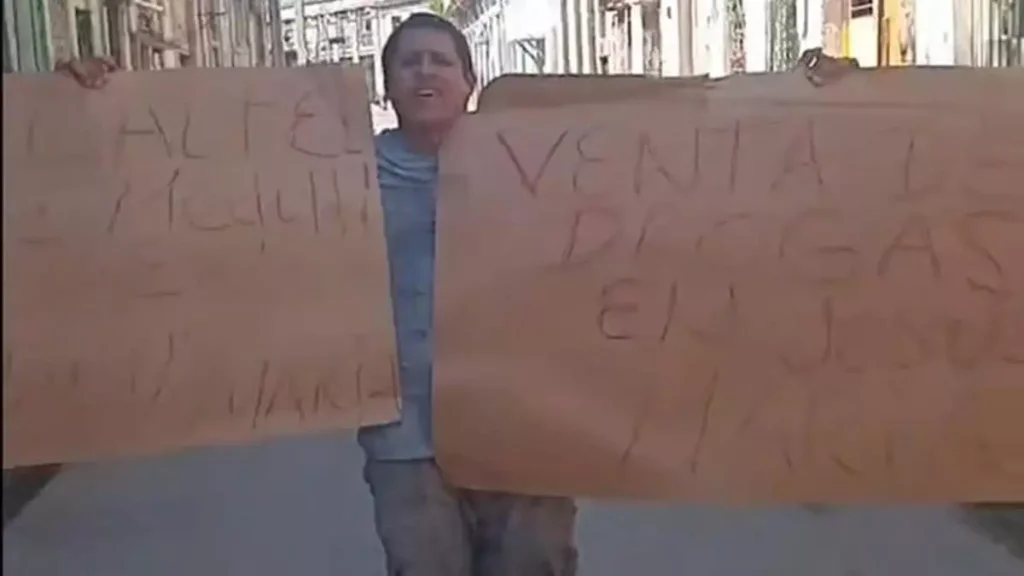
Alberto Turis Betancourt, during his protest this Wednesday in Havana / creen Capture/Facebook

14ymedio bigger14ymedio, Havana, 5 September 2024 — Activist Alberto Turis Betancourt Pérez was arrested this Wednesday for taking to the streets to protest against the sale of drugs in his neighborhood, Jesús María, in Old Havana. Carrying two large handwritten signs, the man let himself be recorded while walking. He denounced that on Gloria Street, between Carmen and Rastro, narcotics are being sold – the “so-called ‘chemical’, crack and heroin” – with total impunity.

“A chemical is cheaper than a soft drink; they take drugs every day, they live for that,” Betancourt shouts in the video on his Facebook page. Meanwhile, “the police don’t act, mothers are tired of having their things stolen, the people are dying and no one is interested.” In addition, he warns: “I want you to know that my life can be in danger because I am no longer just talking about the regime, but about all criminals who sell drugs without any kind of punishment.”

Questioned by 14ymedio, Betancourt says that after his demonstration he was fined “by Section 21 for public disorder.” He posted on Facebook that “they sent a patrol car and took me to Dragones [Police Station]; they fined me and threatened me. None of this intimidated me; on the contrary, it gave me more strength to continue.” He says that he has spoken to the authorities and has even filed formal complaints, but nothing changes: “The traffickers continue to operate as if nothing had happened.” continue reading

The activist does not know the origin, but he does know “the more than ten who sell the drugs without fear of being arrested

“The drugs are brought in by motorcycle, and the neighbors of the block sell them,” he explains to this newspaper. The activist does not know the origin, but he does know “the more than ten who sell the drugs without fear of being arrested,” alluding to the complicity of the authorities.

Just a few weeks ago, in a segment on State TV’s Round Table program about the subject, the special guest, Juan Carlos Poey, head of the anti-drug body of the Ministry of the Interior, insisted that the source of the narcotics that enter Cuba is “90 miles away.” Several times he repeated that it is Cuban emigrants who bring ‘the chemical’ from the United States, a “synthetic cannabinoid,” with 45 variants that come “in powder, in liquid, mixed with acetone, impregnated in paper or cut with vegetables.”

He did recognize, however, the seriousness of the problem, calling it “complex,” and he emphasized that it is young people and adolescents who consume the most and increasingly at younger ages, a fact that he had already warned about in previous reports. “There is now consumption, holding and selling among young people; even teenagers between 16 and 19 years old get involved as sellers,” he said.

As for the Jesús María neighborhood, it is one of the most miserable in the capital, despite belonging to Old Havana, whose center, largely rehabilitated with foreign donations, receives a large influx of tourists. In it, crime, in fact, seems to be rampant. It is, according to one of its inhabitants, an 80-year-old man, “a place forgotten by God.”

Translated by Regina Anavy

____________

COLLABORATE WITH OUR WORKThe 14ymedio team is committed to practicing serious journalism that reflects Cuba’s reality in all its depth. Thank you for joining us on this long journey. We invite you to continue supporting us by becoming a member of 14ymedio now. Together we can continue transforming journalism in Cuba.

For the United States, Cuba ‘Is Not a Strategic Issue,’ but It Bets on Its ‘Implosion’

Former Cuban ambassador to Washington, José Ramón Cabañas, describes the relationship between the two countries as “a war scenario”

The director of the Foreign Policy Research Center (CIPI) of Cuba, Ramón Cabañas, during an interview with EFE in Havana / EFE/Ernesto Mastrascusa

14ymedio biggerEFE/Juan Palop (via 14ymedio), Havana, August 26, 2024 — Cuba is used to “sailing in turbulent waters,” says José Ramón Cabañas, director of the official Center for Foreign Policy Research (CIPI) of Cuba, when asked in an interview with EFE about the potential expansion of the international context for the island.

The possibility of Donald Trump returning to the White House, the instability in Caracas after the elections, the change in the presidency of Mexico and the turn to the right in the European institutions after the last elections are elements that can affect Cuba, in itself in a deep crisis.

“Cuba has been able to navigate in very turbulent waters,” answered Cabañas, who was ambassador in Washington during the bilateral approach known as the ’thaw’.”

He recognizes that the tightening of the policies of the United States and the European Union towards Cuba, as well as the distancing of some regional partners, “can be one of the possibilities” in the “immediate future.” continue reading

In his opinion, the US sanctions against the Island have “exactly” the same effects “from an economic” and “social” point of view as an armed conflict

However, he adds that the Island is “a country of struggle and winning,” and its diplomacy “has experience” in adverse contexts. “In one way or another we have been at war since 1959,” he says in reference to the triumph of the Revolution led by Fidel Castro.

In his opinion, the US sanctions against the island have “exactly” the same effects “from the economic” and “social” point of view as an armed conflict. Then there is what he calls a cultural and media battle, which contribute to generating a “state of tension” equivalent to “a war scenario.”

On whether this situation justifies limitations on fundamental rights, he asks that Cuba not be asked “questions that are not news elsewhere,” and he points to the recent trials of violent far-right demonstrators in the United Kingdom.

According to independent records, in Cuba there are more than a thousand prisoners for political reasons, most of them arrested after the anti-government protests of July 11, 2021. Havana says that they were tried following due process.

Cabañas argues that American foreign policy will not be changed “dramatically” by the Democrat Kamala Harris or the Republican Donald Trump. “Biden has not been diametrically different from Trump,” he adds.

He believes that their positions with respect to Israel, Ukraine, China and Venezuela will remain the same. Cuba, he continues, “is not a strategic issue” for the United States, although it is part of “that great equation.” The Island is “fundamental” only on the issue of migration.

In Washington, he says, there is a “bet” on the “implosion” of Cuba, although there are also sectors that propose another approach.

Cabañas denies that there are Chinese espionage bases and that the recent visit of a Russian flotilla called into question his defense that Latin America and the Caribbean are “zones of peace.”

On this point, Cabañas disdains “the human rights argument” to maintain the sanctions: “They keep this handy when there is no other reason.” The key, he says, is that there be a “political decision” in the White House to talk and cooperate, despite the differences, as happened during the thaw.

With regard to Europe, he regrets that it always seeks “the reflection of the US” in its relationship with Cuba, when he believes that it would be more advantageous to “think in terms of the benefit of the EU as a group of countries, even in its relationship with Latin America.”

Asked if Cuba’s economic and energy needs generate decompensated relations that Moscow or Beijing take advantage of for their geopolitical revenue, Cabañas answered that the commercial relationship of an “underdeveloped” country with a power “is always asymmetrical.”

However, he defends independence from Cuban foreign policy: he denies that there are Chinese espionage bases on the Island and that the recent visit of a Russian war flotilla to Havana called into question his defense that Latin America and the Caribbean are “zones of peace.”

He also denies that Havana has followed the Russian argument in the war in Ukraine. “Cuba believes that the differences between states must be resolved peacefully,” says Cabañas, who asks not to forget the record and the role of NATO.

Despite the combined effect of the country’s dollarization, food insecurity and external economic and energy dependence, the director of the CIPI maintains that Cuban national sovereignty has not been eroded.

In his opinion, the Cuban crisis is the product of the “blockade,” an “imposed scenario,” although he recognizes that it is also due to Cuba’s own decisions, referring to the failed monetary reform of the Ordering Task, and he states that issues such as agricultural decline are within their “capabilities.”

Translated by Regina Anavy

____________

COLLABORATE WITH OUR WORKThe 14ymedio team is committed to practicing serious journalism that reflects Cuba’s reality in all its depth. Thank you for joining us on this long journey. We invite you to continue supporting us by becoming a member of 14ymedio now. Together we can continue transforming journalism in Cuba.