Stories of Ordinary People

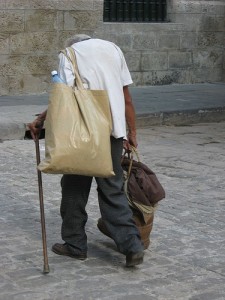
Life for Juan Domeq, age 69, is a vicious cycle. He gets up every morning at 5:30 am and slowly hobbles to a newsstand to buy 50 issues of the newspaper Granma, and the same number of Juventud Rebelde. Domeq spends 20 pesos (less than US$1) for the hundred copies. If he can sell them at 1 peso each, he gets 80 pesos profit, but he doesn’t often sell that many issues.

“People on the street are not very interested in what our press says. Also, the clerk at the newsstand can’t can’t always sell me 100 newspapers. I usually sell between 40 and 50. Then, if I have a good day, I buy some fruits or vegetables for my wife who has been bedridden four years from paralysis; I must also buy milk or yogurt. The little money I earn selling newspapers is spent on food, and I have to keep my eyes open, because several times the police have fined me 40 pesos for selling the newspaper without a license,” says Juan, a sad old man full of aches, who lives in a filthy tenement in the Lawton neighborhood of Havana.

At the same time that Domeq rises to buy the newspaper, Antonio Villa, 64 years old, physically disabled, wakes up and has a cup of hot coffee for breakfast. He goes in his wheelchair to the Monaco bakery, where at the entrance he sells bags (purses) made of nylon for one peso (5 cents U.S.) each.

According to Antonio, a person can sell a hundred nylon purses for 35 pesos. “Selling bags usually takes between 10 and 12 hours a day. Sometimes I have a good day and manage to sell 200 bags, but I usually sell only 80 or 90. With what I get — between 65 to 120 pesos (about 3 to $5) — I buy food and save some pennies to pay a woman who washes my clothes. The police have taken me to the station many times, and in addition to fining me they have confiscated my bags. But when they set me free, I go back to the only thing I can do to earn an honest living,” says Antonio, a black man who lost a leg during the war in Angola in 1987, and lives in a wooden shack with an aluminum roof.

Also not having much luck trying to scrounge a handful of pesos, Clara Rojas, age 70, old, dirty, and poorly dressed, lives in a decrepit nursing home in the La Vibora neighborhood. Clara sells cigarettes at retail. “In the home they give us lunch and dinner, but so poorly prepared that many old people who live there prefer to find some money on our own and eat in the street.”

After spending 14 hours selling cigarettes, the money earned her enough to eat a serving of rice, pea soup, and an unidentified fish full of bones, in a state joint where the prices are low. With a full stomach, she returns to the rest home to sleep.

Juan, Antonio, and Clara are three old people burdened with infirmities, with mild senile dementia, and without a family to care for them. They have to perform miracles to survive in the harsh conditions of Cuban socialism. And they are not unique.

Iván García

Translated by Marlise Lohmann and Tomás A.

No Man’s Land

For Yamil Domínguez Ramos, 37 years old, October 13, 2007 was an unlucky day.

Yamil, a Cuban man who emigrated in 2000 to the United States and who has been a U.S. citizen since 2003, is serving a sentence of 10 years in a maximum security prison in Cuba, the Combinado del Este, accused of “human trafficking.”

But the case is contaminated. I will tell you his story. On October 12, 2007, with a tourist map, Yamil left from a marina in Florida to go to Cancún, México, in a 26-foot boat, a Róbalo fast boat, with two outboard motors and a GPS system.

According to Yamil’s story, “I was thinking of spending a couple of days in Cancún and then taking a boat to Havana.” Bad weather obliged him to change his course toward the Hemingway Marina, a center of free access for international tourist boats on the outskirts of Havana.

Then began the witch hunt of the Cuban authorities, pressuring him and his family to admit he came for the purpose of human trafficking.

From the time he arrived in the United States in 2000, Yamil had visited the island seven times. To see his mother and other relatives, and because he had begun a sentimental relationship with Marleny González, a neighbor in his family’s building, in the district of Miramar.

He had plans to marry her. Since 2004 he had asked for a visa so his fiancée could leave for Miami. But by the time the United States Consulate in Havana gave him a satisfactory response on October 27, 2009, he was already a prisoner.

So the question floats in the air: “Why would Yamil Domínguez need to leave Cuba illegally, and run the risk of being caught?

Yamil isn’t immaculate. “Several times I thought about getting my fiancée and family members out secretly, but I always gave it up, not wanting to risk my security and theirs.”

As far as I know, no civilized law can condemn someone for thinking about a supposed crime. Yamil is a classic story of a Cuban who triumphed in the United States. On this island he never was part of the opposition. He formed part of that anonymous tide of people who attended, purely by compromise, the government marches or the neighborhood meetings.

His family was what is known in Cuba as “integrated,” or rather, revolutionary. Politically correct. In his fatherland he worked in tourism and rented out his car illegally to gain a fistful of pesos that would make his life more bearable. The same as thousands of Cubans, he lived on the border of legality.

But Yamil wanted something else. A society where to prosper and have ambition wasn’t seen as a crime. And thus he left. In a legal and orderly way, after having won the lottery. In the month of Christmas, he arrived in Miami, with an extravagance of lights and consumption that surprised him.

He started as an apprentice bricklayer, and thanks to the level of education he received in Cuba, a path was opened to him. In 2007, Yamil became a licensed contractor. He generated a business worth several million dollars, and this same year he hoped to earn an annual salary of one million dollars.

Life for Yamil was beautiful. He came to Cuba every time love and homesickness touched his heart. That was his weakness. Nostalgia. That feeling that after time becomes a thief that robs us of our strength. He commuted between Havana and Miami. His unlucky day was October 13.

“Every day I ask myself if what happened is just a nightmare. I spent two months in a cell of two square meters that was 105 degrees Fahrenheit in Villa Marista (seat of the political police). I was sentenced to 10 years, in hard prison conditions, where they applied different types of humiliation and torture to me. I saw my family every 45 days. At times when I wake up, I open my eyes slowly, thinking that I’m going to find myself in my home in Florida,” Yamil recounts with a sad voice on one of his family visiting days in prison.

His life changed into a Calvary. For non-payment, the bank foreclosed on his house in Florida. He lost his business. And lawyers fees came to more than five thousand dollars. It happens that by Cuban law, when it comes time to pay, Yamil is a North American citizen.

According to the Constitution of the Republic, Cuban citizenship is lost when you gain citizenship in another country. And the government of the United States, which is capable of unleashing a war on behalf of any United States citizen, in the case of many Cuban Americans, has a very weak position. Yamil Domínguez is in no man’s land.

According to a law firm of independent lawyers that Wilfredo Vallín directs, who have studied in detail the transcript of the case brought against Yamil Domínguez by the prosecutor, there’s a procedural error in the instructions in the case.

As is usual in the islands’ legal system, the accused are guilty from the start and must demonstrate their innocence in the course of the investigation.

In addition, for these independent lawyers, the type of crime is badly applied. “The only thing that can apply is illegal entry into the country. The penalty is two years, and they can’t confiscate your boat,” explains Laritza Diversent, one of the attorneys.

According to Yamil, the trial was a circus. He refused to sign any document that incriminated him, and he does not accept the confiscation of his boat.

An ex-functionary of the Ministry of the Interior, analyzing his case, says, “It could appear subjective, but the key to all this is the boat. Many bigwigs and generals lean over backwards for good boats. If you find out where the boat actually is, you will have your answer. It’s easier to sentence you to 10 years for human trafficking, and you can confiscate the boat, than to give a sentence of two years for illegal entry, a punishment where, after you get out of prison, you can ask for your boat back.”

The United States Consul in Cuba visits him every three months, and Yamil is not satisfied with his treatment. “To save medication they open the pills for me and leave me only a daily dosage. They allege that they don’t want to have a diplomatic conflict because of the Cuban Americans who are prisoners on the island,” Domínguez said.

And they do little. Or nothing. Meanwhile, Yamil does not remain with his arms crossed. He has opened a personal blog, Notorious Injustice, which is updated by his wife and his sister. He writes not only about his drama but also about life in prison, politics, or Orlando Zapata.

After two-and-a-half-years in prison, Yamil Domínguez is convinced that his only crime is having been born in Cuba and having chosen the option of emigrating. He believes that he’s paying for that. No more.

Iván García

Note: Since April 14, Yamil decided to stop eating food and to take only liquids, so that his case will stop being a notorious injustice.

Translated by Regina Anavy
The War of Insults: A Dead-End Street

Some old strategists of the partisan information in Cuba feel nostalgia when they evoke the first thirty years of the Revolution. No one doubts that in this period a majority supported the olive-green government of Fidel Castro.

Not Later. Certain things changed. The logical wear and tear of power. The proverbial economic inefficiency. The emergence of a peaceful opposition, of dispersed theories and tendencies, who for the most part, at some stage in their adult lives, supported the regime.

In addition, in the mid-’90s, the new information technologies. Earlier, in the 1960s, there were hard-line opponents, who confronted Castro through violence. The only commander who destroyed the tyrannical Fulgencio Batista by means of guerrilla warfare.

It was the time of the Cold War and a world divided in two. Castro had an iron tight control over the propaganda media, which he used effectively, and exercised almost total control over the flow of information. He ruled without major setbacks.

It was a period in which to listen to a foreign radio station, be a pen pal with somebody from another country, to read Occidental writers, critical of socialism, or forbidden authors in USSR or their Eastern Europe satellites, could cost you prison. We should not forget.

With the stale pretext, the same in use today — being under siege by “Yankee imperialism” — it cut short the diatribe and the debate. Any comment against the official discourse, and a wave of intrigue or suspicion would fall over that person

Fidel Castro was the most to blame for the Cuban Revolution losing its originality and aspirations of equality, democracy and justice. It is his fault that many people stopped believing in the future of his project. He bet on the dogma of the Soviet totalitarian socialism.

And when, on a June evening in 1961, frowning, he placed a 45 caliber pistol on a table, before the shocked eyes of a selected group of intellectuals, and screaming he proclaimed: “Within the revolution everything, outside the revolution nothing,” what he accomplished was to exile the creativity and the respect for differences.

Just on that day, in the National Library, the free exchange of political ideas was closed down. Almost 50 years has gone by since Castro’s words to the intellectuals. And nothing has changed. In different stages of the revolution, the official press, teased by the power, launched timid campaigns of criticism about the economy and some methods adopted by certain leaders.

However, they have been minor reproaches. The complaints of the press only go as far as to condemn the services, such as public transportation, and perhaps measures of the Party. In general it is criticism without mentioning names. They are more lethal when it is about the informal economy or the self employed.

Every time Cuba is condemned by an International organization, because of its harmful politics about Human Rights, by a country or the foreign media, pandemonium is unleashed.

In this spring of 2010, the insult and disqualifying campaigns turn each day more virulent. It just happens that we are in a century where the new technologies, like the Internet, Facebook, Twitter or mobile phones, quickly surpass the capacity of the media within the regime’s span of control, the so called “patio.”

In spite the thick lock that the Cuban government has put on the Internet, cable channels, or daily International newspapers, the people of Cuba are better informed than 30 years ago.

Hundreds of thousands of people are illegally connected to television through cable or Internet. A considerable number have mobile phones. In addition, some use the Internet services in their place of employment to check the information offered by the government.

The Castro brothers are very upset with the “Global Informative Monopolies.” Especially with Pedro J. Ramirez, Director of El Mundo, and the Prisa group, both in Spain and directed by Jesús Polanco.

Daily Spanish Newspapers like El Mundo and El País, are read by at least 5 per cent of the local population, but the articles published about the state of the things in the Island are spread with a speed that will awaken the envy of Usaín Bolt.

Because now the majority of the citizenship absolutely does not believe the propaganda of the government, in fact they do not trust the government. The Castros know this and they are involved in a media offensive of insults to all that dare to criticize them.

However, all the official information media have a weak spot, they lack autonomy and creativity. They are amanuenses who are waiting for orders from the Department of Ideological Orientation (DOR). In addition, the reporters who work for the State know very well the cost of stepping over the line drawn by the Communist Party.

They are always held in check. The independent journalists and the opposition, in 1995, used the Internet as a principal means of communication. After 2005, the bloggers joined with strength, at the edge of State control. It is true that they are read more out of Cuba, but is a start.

As long as the government does not understand that the best avenue to the solution of the problem in Cuba is to open a dialogue with the peaceful opposition, there will be no meeting of the minds.

With monologues, insults, condemnations of the world media or brainless campaigns against Twitter and Facebook, which are social networks and not generated by the CIA as it is assumed by some people within the government of the Island, the crumbling of the Country will continue long term and in slow motion.

Neither Pedro J. Ramirez nor the Prisa group are not the principal enemies of the Castros. It is the apathy of our own leaders and their fear of confronting political and economic changes. The rest is fireworks. Propaganda for local consumption, pure and simple.

Iván García

Photo: The Roundtable show on Cuban TV

Translated by: Mari Mesa Contreras

Unique and Incomparable

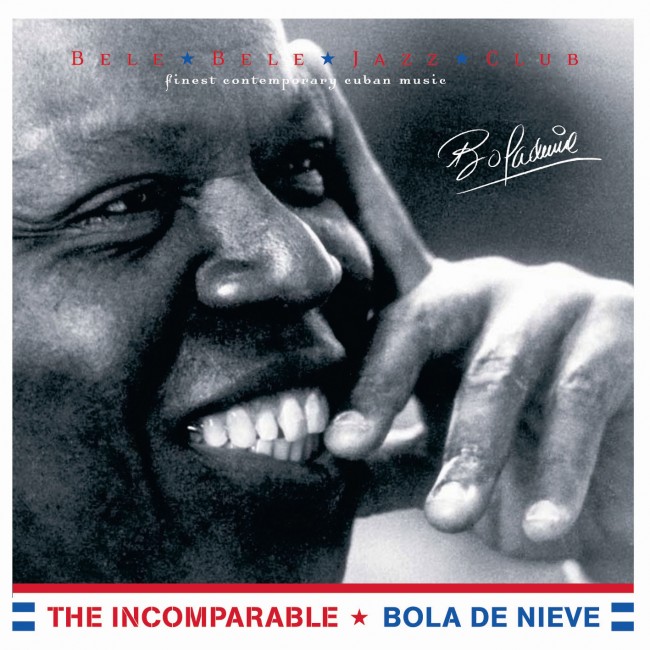
He was black and homosexual. He was not physically attractive and he had a nasal voice. But with a tone as perfect as his hands, which appeared designed to slide across the piano keys of the bar-restaurant, Monseigneur, on 21st and O, in Vedado, where Bola de Nieve (Snow Ball) had his sanctuary.

El Bola (The Ball), as Cubans liked to call him, is one of the three great icons of Cuban music born in the former Villa of Guanabacoa, a village east of Havana, popular for its resistance in the face of the attack of the English in 1762. The other two are the singer and actress Rita Montaner and the pianist and composer Ernesto Lecuona.

Ignacio Jacinto Villa Fernández, his given name, came into the world on September 11, 1911. On October 2, 1971, at the age of 60, he passed away in Mexico City, the city that discovered him before the rest of the world. He wanted to be a teacher, but he ended up as a musician. To the political convulsions in his youth was added his condition of being black and gay.

In the decade of the 1930s, Rita Montaner, who already was a star, helped him to earn some pesos as an accompanist on the piano at the Hotel Sevilla. He himself earned money by playing during the intermissions of silent movies in neighborhood theaters. At that time, he must have had the idea of singing while he played the piano. And that converted him into a unique piano man

The ’40s and the ’50s went by, and Havana was a city with an intense night life. El Chori played percussion in the casinos on the beach in Marianao. In the club La Red and La Lupe, with his histrionic qualities, he imposed a peculiar way of singing. Nearby, Elena Burke, the emotional señora, transformed into Scheherazade in the depths of Focsa, in the cathedral of bolero.

Without leaving Vedado, for very little money, every night in the Gato Tuerto, you could hear César Portillo de la Luz with his compositions, like Tú Mi Delirio (I’m Crazy About You) and Contigo en la Distancia (With You in the Distance). The night owls used to end up on the roof of the Hotel Saint John, in El Pico Blanco, where José Antonio Méndez, with his hoarse voice, interpreted La Gloria eres tú (You are Glorious) and Si me comprendieras (If you Understood Me).

This was before the bearded comandante arrived and ordered “so much partying” to stop. Still in the ’60s, in the Celeste bar, La Freddy, an old maid of elephantine proportions with the voice of a mezzo soprano, shook up Havana. Years later, she would serve as an inspiration for Guillermo Cabrera’s writing. She sang boleros.

In this Havana of bread with beefsteak at 15 cents and Polar beer at 20 cents a bottle, Bola de Nieve sparkled with authenticity.

Now, at the entrance of Monseigneur – inaugurated in 1953, with specialties like filet mignon and butterflied lobster – it’s common to see foreigners taking photos of the mythical spot. Or going out with sculptural mulatas, who don’t even know who Bola de Nieve was. They enjoy the same thing as most young Cubans today: rap and reguetón, with their repetitive, vulgar, or violent lyrics.

I was born in 1965, and I didn’t have the pleasure of enjoying those musical talents live. Much less a Havana often visited by famous people of the stature of Nat King Cole, Frank Sinatra, Lola Flores, Jorge Negrete and Libertad Lamarque.

Bola de Nieve is one of the essentials of Cuban music. Every time I pass the corner of 21st and O, facing the Hotel Nacional, where Monseigneur used to be, I can’t help imagining him, with his black suit and his big teeth, and his way of singing Drume Negrita, No puedo ser feliz, La flor de la canela, La vie en rose, or El manicero (Black Drum, I Can’t be Happy, Cinammon Flower, Life in Rose, or the Peanut Vendor).

[youtube=http://www.youtube.com/watch?v=dFQIacUgleo&hl=pt_BR&fs=1&color1=0x2b405b&color2=0x6b8ab6]

Iván García

Translated by Regina Anavy

Che Yes, Barbie No

An apparently simple act, like decorating student dormitories with Barbie dolls and advertisements for capitalist consumer goods, has unleashed a mini-storm with the authorities on the island.

Agustin Alfonso, age 20, a junior (3rd year) law student at the University of Havana, is the typical model of ideologist ambiguity who lives on the island at this end of the century.

If you look at the way Agustin dresses, to the naked eye you couldn’t tell if he’s a New York alternative rocker or a Boy Scout from the former USSR.  Not even he knows. He wears a Che Guevara-style beret, because he admires the Argentine guerrilla, but also wears Levi jeans and Reebok sneakers.  He completes his outfit with a Rolex watch, a gold chain with a small photo of John Paul II and an olive green shirt, the same color that the commander wears exclusively, but the young man wears the Benetton brand version.

His way of thinking is as orthodox as that of the so-called “hardliners” of the politburo.  “The U.S. is the spawn of evil, but produces very good things,” he says.  For Augustin, “Yugoslavia is a brave nation because it resists the aerial invasion of NATO, led by the gringos.”  But he has no clue where the Balkan country is and confuses the name of the dictator Milosevic with a footballer who plays in the Spanish league.

“And what about Castro?” I ask him.

“He’s a horse, although lately he’s been digging in the spurs too much.”

Alfonso Augustine recognizes that student media has unleashed an ideological offensive against capitalist consumerism. The official press has echoed it.

Juventud Rebelde, the Communist youth newspaper, put on the theme on roasting spit.  According to that newspaper, in the dorm rooms where the undergrad and grad students sleep, the walls are plastered with Western brands. The forties and stylish Barbie doll adorns the bed of the girls.  Advertisements for Nestle, Nissan, Adidas, or posters of American sluggers and Ronaldo, the Brazilian soccer star, paper the walls.

Since then the government has taken up the matter. Juventud Rebelde said that the Union of Young Communists (UJC) is trying to curb that “ideological diversion.” They have suggested that students pin up the Alma Mater university magazine pin-ups, where in each edition are different pictures of Ernesto Che Guevara, icon of the revolution.

The paper takes the opportunity to highlight the ideological purity of the students of History and Marxism, such as Yoandry Ruiz, who, despite the shortcomings, says there are things that are “not negotiable” and shows the journalist a closet where there is a collage of Cuban landscapes and next to it the ubiquitous image of Che.

On the subject, Cuba Press surveyed 32 senior level students and 30 said that examples like Ruiz are the exception. According to these 30, young people are tired of excessive ideology. The two who shared his views are members of the Union of Communist Youth.

However, all 32 like to watch American B movies, showing bucket-loads of violence. 20 of the 32 respondents polled take good doses of electronic opium, watching the Colombian soap, ‘Cafe, con aroma de mujer‘ [Coffee with the scent of woman] three times a week, which has more drawing power than any revolutionary act. 24 of those surveyed love to read ‘frivolities’, as the authorities call the romance novels talked about in the gossip magazines, such as the novels of Corin Tellado.

The most serious are also “ideological sinners” and admit their preference for writers banned by the regime, such as Guillermo Cabrera Infante and Mario Vargas Llosa. Despite this evidence, the government refuses to accept that long ago Cuban society left behind its uniform.

Faith in communism has gone for one simple reason, thinks Roberto Perez, a student of physics. “In no book on Marxism is it said that Communists have to be poor and dress like beggars.” Roberto believes that this image of “purity” is what is left from 70 years of communist propaganda in the former USSR, and four decades of Castro’s revolution.

Jesus Garcia, a medical student, says the UJC campaign will evaporate as fast as others. “They are in different times. In addition, you cannot forget that students are rebels by tradition and we will not accept, just like that, that those who govern us come with a trite story that we are the playthings of consumerism.”

Garcia adds, “The Cuban leaders dress in ‘guayabera‘  when attending public events, trying to sell this form of authority and sacrifice, but they are fat with swollen bellies, they have pink skin, travel in nice cars and live in homes filled with Western equipment.”

Many young students do not believe in the revolution. Those who still trust in it are severe critics and demand change to improve and transform society. This is the case for Hector Nunez, 21, a third year student of automated systems. “I see nothing wrong with people, particularly young people, wanting a higher quality of living. What happens is that, in Cuba, for that quality, you have to buy it with dollars.”

Hector thinks that “a person is not necessarily ideologically diverted away from his socialist ideals because he puts on Levi’s, and dreams of one day having a Mercedes Benz or a Honda motorcycle.” According to Hector, they can like all such capitalist products “and spiritually identify with the left, thirst for justice and admire Che Guevara.”

The government, established over 40 years in power, has other criteria. It wants to idolize the myth of the heroic guerrilla and demonize Barbie and Coca-Cola.

Iván García

Published in Cubafreepress June 3, 1999.

The Two Faces of a City

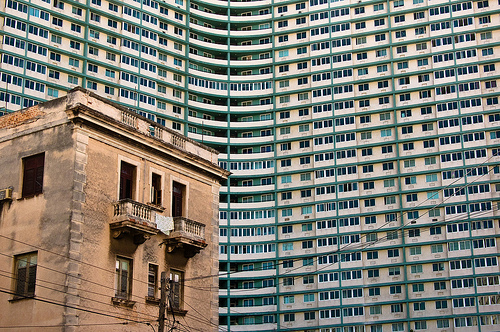
If something distinguishes the City of Havana it is its two faces, that quietly and peacefully coexist, in one the ugly and in need of painting and maintenance, and in the other the repaired and comfortable.

These contrasts have become more visible after the penalization of the dollar was lifted in 1993, when waves of capitalism spread first through the Capital and later through the rest of the country.

In Cuba, the differences hit you in the face. The services in stores and cafeterias paid with the national currency are deplorable. The variety of products can be counted with the fingers in one hand, and the bad quality of the products is insulting. The businesses are always dirty and empty and the service is bad, lacking work ethics, they spend their eight hours at work, talking to one another. To them they give the same, whether they work or not their salary won’t exceed 300 pesos, about 12 dollars.

The opposite happens in the islands of capitalism which, with an incredible speed, are popping up in the city. Malls, stores, cafeterias, restaurants, photo labs, gas stations and bookstores, are among the establishment with an acceptable presentation and a diversity of products that for a foreigner may not seem too extensive, but for a Cuban it is a novelty to see in the display case of a cafeteria around twenty articles.

To be able to buy or enjoy those establishments, you have to have Convertible Cuban Pesos (CUC) the hard currency that replaced the dollar after April 9, 2004. It was a superlative incongruity that the money of the United States, the number one enemy of Fidel Castro and his Revolution, would circulate freely and make possible any transformation or social improvement

It is estimated that only through the concept of the family remittances, around one billion dollars come in the country annually. According to official statistics, forty per cent of Cubans have access to the hard currency. But in Havana the amount could go as high as sixty or seventy per cent of the population. That is why the growth of the offers in CUC or Convertible Cuban pesos do not stop increasing.  Especially if it is known that the the merchandise that it is sold in CUCs has its value altered due to the taxes.

Antonio, a corporate financier, affirms that all articles sold in Cuba have a marked up price of about 100 or 200 per cent over the cost. If we credit that information, the earnings that end up in the government coffers are very high. Just because we classify the country impoverished and of the third world it is not an obstacle for the prices on the Island to compete with those of London, Paris or New York. In spite of this, the sales in hard currency increase year after year.

If Cubans could go shopping in Florida, Jamaica, Caiman Islands, Dominican Republic or Mexico, the situation would be different. The internal hard currency market has no competition, and the citizens have no choice but to shop in the Socialist stores with the convertible Cuban peso, a little more pleasant and stocked, but equally inefficient as the ones that use the National currency.

Added to the family remittances are the earnings of artists, writers, famous athletes, and the female and male hustlers (jineteras and pingueros). In this category, you will also find the people within the Country who have a bank account in hard currency.

The Cuban peso, the National currency, is a caricature. With it, you can only buy vegetables, beans, pork meat, rum, cigarettes, and one or another “freed” product of quality inferior to that available for convertible Cuban pesos.

While communist Havana looks like a metropolis demolished by a bombardment, reflecting the decadency of the system, its capitalist counterpart, in plain view, projects its impeccable and colorful paint. And with big glass panes, in some instances tinted, so that the poor outside can not see what it is offered inside.  Jewels of urban architecture such as “the Lonja Del Comercio” (1909) and the Bacardi Building (1930) both in Old Havana. They have been transformed to offices equipped with up-to-date technology.

Seventeen years have gone by since the penalty for owning dollars was lifted, announced by Fidel Castro on July 26, 1993. In this time, capitalism has advanced slowly through the City. Hotels, Malls, Taxi Fleets and leased cars for tourists serve as testimony. However, this has not been an obstacle to Havana having two faces.

Iván García

Translated by: Mari Mesa Contreras

Gotta Have Dough to Repair Your Pad

Take note. Two-thirds of the homes on the island are in fair or poor condition. Almost all the water works are deteriorated, and as a result of leaks, almost 65 percent of water distributed is lost. By way of example, in the City of Havana more than 80 percent of multi-story buildings cry out for major renovation.

If you walk down the streets of Havana, you’ll notice the unpainted walls of homes and buildings. Now, let’s cross our fingers. According to the 49-year-old architect Germán Delgado, a level 5 hurricane or an earthquake like the ones that hit Haiti or Chile, would take down 50 percent of the housing in the capital city of Cuba.

Before 1989, the paternalistic State was in charge of repairing buildings and used to sell construction materials for modest prices. That was long ago. Nowadays, the useless paternalistic State is senile and has a rope around its neck. There are no funds at all. The maximum it can do is rent to you a parcel or an old dysfunctional shop – if you are or seem to be pro-government – and you are on your own for building something.

Eighty percent of the Cubans own their homes. But that is only in appearances. A statistical mirage. A home owner cannot sell his house, and if he leaves the country he loses his rights to his property. But the critical moment is when a person decides to make necessary repairs to their home.

As a general rule, the tenants decide to make repairs on their dilapidated homes: to prevent the roof caving in on their heads, to install a door, window or similar emergencies.

Materials of certain quality, such as ceramic tiles, flooring, toilets or sinks are sold in hard currency. And they are expensive. Period. If you are going to fix a medium size kitchen, 15 meters of ceramic tiles are needed, you need to have a minimum of 150 Cuban convertible pesos or CUC (120 dollars). A square meter of the best ceramic tile costs 30 Cuban convertible pesos.

To continue, open your wallet again, to spend 90 CUC (75 dollars) if, for example, if you need 6 meters of ceramic tile for the kitchen floor. By now the bill adds to 240 CUC (210 dollars). To that amount add the cost of plumbing pipes, a new sink and water faucets, that could very well cost you 200 CUC (180 dollars). The cherry on top is the payment to the masons, who make 6 to 8 CUC per square meter to lay the tile.

And continuing on. For a medium size kitchen you have to come up with at least 800 Cuban convertible pesos (740 dollars).

The point is that in Cuba the vigilant and preoccupied Daddy State does not pay its workers in hard currency. Only for a segment of the work force, the ones who work the tourist industries, telecommunications and civil aeronautics, is a small percentage of their salary paid in hard currency, never more than 35 CUC (32 Dollars) a month.

That is why, with few exceptions, this type of repairs and reconstruction, can be done by Cubans with FE (Family living in the Exterior). Thanks to those dollars or euros, the great majority of Cuban families can aspire to have a worthy home.

The expenses do not end with the kitchen. Later is the bathroom’s turn.  Later the rest of the house. In Cuba it is a habit to save part of the remittance sent by relatives in exile with a thousand sacrifices, or the hard currency earned in a foreign country by those Cubans who have the possibility to travel or work part of the time in a foreign country

A detail, important. Paperwork and receipts have to be kept in a safe place and in order, because an avalanche of inspectors, the majority of them corrupted,  to check the people involved in home repairs often to “detect irregularities.”

And what does Daddy State do? Nothing. Only hard and pure propaganda in the official media, about the number of houses built or repaired.  But very few believe this news.

There are families who have lost their homes because they collapsed or because of the hurricane winds demolished them. Many have been living in dirty State Shelters, resembling prisons more than a home. In the country the situation is even more difficult due to the great amount of homes made out of palm trees and wood.

Besides being excessively expensive, the variety and the supply of materials to repair a house is very small. Not even with money in  hand can you find ceramic tiles, tiles, sinks or toilets. Nobody told me. I lived it in the first person. I am also trying to to repair my run down apartment.

Ivan Garcia

You Can Buy a Chevrolet

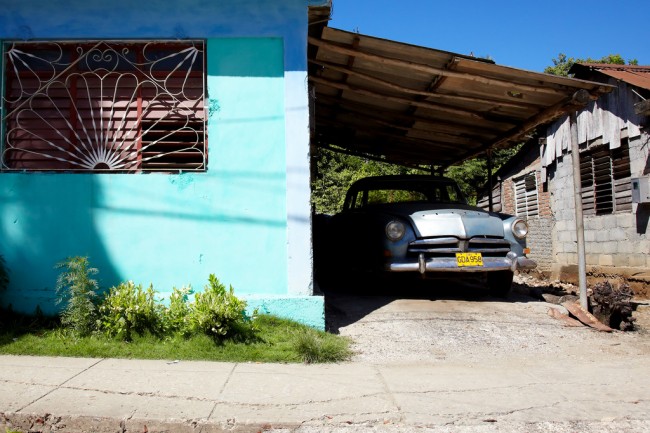
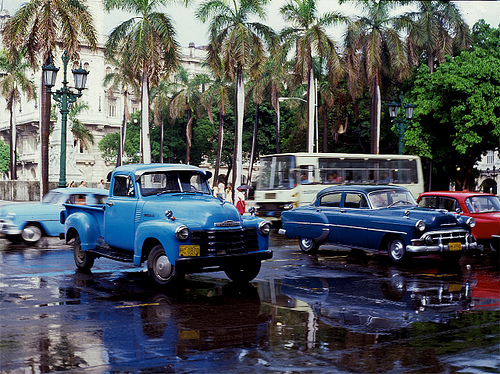
With money in hand, there’s something for every taste. A Chevy from the ’40’s or a well-kept ’54 Ford. A fin-tail Cadillac or a ’56 General Motors truck that looks like it just came from the factory. Cuba is the only country in the world in whose streets run thousands of American cars, jeeps, and trucks from the mid-twentieth century.

No doubt it’s the largest outdoor museum in existence for cars of that age. And because you can’t buy cars unless you have a state permit, in light of the poor state of public transportation, people with money have decided to buy a car manufactured in the workshops of Detroit several decades ago.

Jose Santiago, 42, calculator in hand, runs the numbers. He believes he will recoup his investment in seven years. Santiago wants to engage in the business of taxis for hire. It’s probably the only stable means of transportation on the island, although the government doesn’t sell so much as a screw to repair private cars.

In Cuba, buying and selling cars is only allowed for those owners who have a transfer certificate. So it is with the “big almonds”, as the old American cars are known on the island, because their owners bought them before the Castros came to power.

According to Roberto Diego, 34, it is common for a Chevrolet or a Ford to have had a dozen owners. Prices have gone through the roof. “In the ’80s, you could buy a ’57 Chevrolet for 3,000 pesos (when that amount was equivalent to 3,000 dollars, as the currency was illegal and the government swapped one for one with the dollar). Now, in 2010, it can cost 20,000 Cuban Convertible pesos (18,000 U.S. dollars), if it’s been kept like a jewel,” said Diego, who drives a Ford Austin from the ’40’s whose condition provokes envy.

Not that the drivers of the island are lovers of antique cars. They just have no other option. Luis Valle, 52, would prefer driving an Audi or a Cherokee “air-conditioned and with a computer, but I’m realistic; here, that’s impossible.”

State tourism agencies annually hold antique car parades, where you can see everything from a 1918 Ford, to rare versions of cars that had a limited production. On the interior streets bordering the steep steps of the National Capitol, dozens of old “jalopies” belonging to the Gran Caribe company are rented, for hard currency, to tourists who want to take a ride in an antique car through a city frozen in time.

For the ordinary citizen, when racing against the clock, the cheapest and fastest method is to take one of the “big almonds” that circulate on the various downtown streets of the capital. They charge 10 pesos, or 20 if the trip is longer. And they work four times better than the state-owned taxis, which have been missing in action for some time.

The ingenuity that keeps these cars running is worthy of admiration. General Motors engineering pales in comparison to the unique native solutions for the vintage cars. Without spare parts, and with a touch of fantasy, Cuban mechanics are able to keep these cars rolling.

Real monsters. Mechanical Frankensteins. With engines from Russian cars, transmissions from Spanish cars of the Franco era, and gear boxes from Italian Alfa Romeos from the ’70s. Their hard bodies, made from the abundant steel of World War II military equipment, have been painted and massaged numerous times.

Some are as beautiful as that of Javier Cueto, 65, owner of a 1958 Chevrolet, intact and without modification. “I’ve been offered 21,000 Cuban convertible pesos (19,000 U.S. dollars), but I pay no attention.” And he amiably shows the good conditions under which he keeps his car.

When you take an old taxi in the streets of Havana, the first thing the driver says is “please don’t slam the door.” While some cars have been rolling for nearly 70 years, faced with the uncertain future that is emerging in Cuba, the drivers of mid-twentieth-century American cars know they should continue taking care of them in detail. They may have to continue “boteando” (renting) them for a long time.

And if despair knocks on the door, it won’t be the first time that a Chevrolet is converted into a boat with an outboard motor. En route to Miami.

Iván García

Translated by: Tomás A.

The Chronicles of a Deceived Generation

I saw it today.  It is in black and white, has little yellow spots on it, and smells like cockroach.  I recovered a photo from my adolescence, frozen in time and already in Sepia color.  It is a portrait of 11 young men, joyful under the effects of the poor man’s drink, alcohol mixed with water, which we used to buy for 5 pesos per bottle from Giralda’s house, located on Buenaventura street.

It took place, perhaps, towards the end of 1988.  I had been demobilized from military service, and while we sat on the steps of the Vibora Institute, I celebrated the fact that I would never again have to wear that horrible and hot olive green uniform which was designed by some Russian sadist who apparently hated the tropics.  Besides forcing millions of youths to wear that horrendous garment, he also made them march with heavy steel-tipped boots which were fabricated in a factory in Minsk, in the former Soviet Union.

From that group of eleven only three remain in Cuba. The rest have all left. Damian is now an overweight nostalgic. He works in a canteen in Manhattan and, while a harsh cold sweeps through New York, every night he dreams of once again sleeping in his house on Carmen street, at the corner of Saco.

Mario resides in some corner of Germany. But he and I both know how much he really loves La Vibora, his small country, his neighborhood, and all of his people. When he has enough euros he takes a flight toward Havana to ease his troubles, drink some rum, and cry at the feet of the Jose Marti statue, in front of the Institute, in the hot Havana nights.

In the photo, Ariel Tapia was young and very thin. I remember the moments we shared as amateur independent journalists for the agency, Cuba Press, surrounded by giants of the writing world, like Raul Rivero, Ricardo Alfonso or Tania Quintero.

I can’t forget the day when Raul Rivero asked Ariel and me to cover a story. It was the trial of a dissident from the 30th of November party and we were to chat with the guy and later publish the story. While we waited for the trial to end under that falling sun, Ariel and I bought a bottle of Caney rum, sat under the shade of a horrendous Yugoslavian technology building at the Esquina de Tejas, where the Valentino theater once was, and chatted about women and baseball.

When we returned to the court, the trial had finished.  It was a true odyssey, the mother of the dissident was screaming for help at the top of her lungs out in Calzada of 10th of October and shouting at the cops. We didn’t give up. We followed the exasperated woman and managed to find out where her dissident son lived. The news came out. Like the pair of stories which we wrote about the hunger strike carried out by Dr. Oscar Elias Biscet in Tamarindo 34 street.  Biscet lived in Lawton, the neighborhood adjacent to La Vibora, and was sentenced to 25 years in prison in 2003.

More than twenty years have passed.  Ariel now walks around Florida.  Three of the other friends are shown in the photograph also reside 90 miles from here:  Javier, David, and Frank. They watch time fly by in Miami, the second homeland of all Cubans.

There is another guy in the picture, but I forgot his name.  And I really don’t know how he ended up in Tel Aviv, Israel. They have told me that he makes a living by planting oranges in a Jaifa cooperative and has converted to Judaism.

Erick married a Danish woman and has 6 kids, an uncommon family in that very tranquil society.  As for Arturo, I have bad news.  He signed up with a drug cartel in Colombia. His body was found in the bathroom of some bar in Medellin. They had cut off his penis.

Only three of us remain on this island of material shortages and poverty.  Today, Fernando is a successful music producer who lives between the Mexican capital and his Havana. Frometa, a “jabao” (mestizo) standing at almost 7 feet who played basketball like Kareem Abdul Jabbar, is now 44 years old and is a regular at Cuban jails due to the most insignificant crimes.  As for me, I write posts for my blog titled From Havana and for the newspaper “El Mundo”.  It’s a way of keeping those ghosts of loneliness away from me.

That’s how a great majority of us have ended up living our lives in Cuba. With divided friends and families. Withering away by the heat of a slow fire, under a revolution that claimed itself to be socialist, and that years ago, many of our fathers, and even we ourselves, would have been capable of giving our lives for.

We belonged to an obedient generation.  One which no one consulted about anything with. We marched towards the tobacco fields singing hymns under the agricultural reforms of the secondary countryside schools. Bursting with patriotism we marched towards Angola or to any other lost war in the African continent.  No kidding.  All of this to glorify the name of a man who only cared about himself and his life’s work.

But all of that was already lost. And black and white photographs, like the one I found in a box, are abundant in the Cuba of 2010.  An indelible sign that our lives were lies. That all of this was a trick. A great big fraud.

Ivan Garcia

Translated by Raul G.

Raul Castro Closes the Wall*

Cuba today is more of an island than ever before.  The discourse which took place this past Sunday, 4th of April, by the Cuban general and president, Raul Castro, has slammed the door to any anticipated reforms.

During the closing ceremony of the IX Union of Young Communists (UJC), Castro II, with his hoarse voice, guttural and worn out, returned to Cold War discourse, a tone that unmistakably resembles that of his brother Fidel.

When Raul rose to power two years ago, various “Cuba experts” predicted that an era of reforms was on the horizon.  The supposed tropical “perestroika” limited itself to changes in design. Pure make-up. A slight touch of the brush, no substance.  Cubans were allowed to rent cars and hotel rooms.  They now could own cell phones and surf the web, as long as they paid the equivalent of the minimum salary on the island.

The rest was just a war between clans.  It is a fact that the tough guys exert power with a clique of men who are loyal to their man.  And Castro II did not even remotely trust in the men who were trusted during the Fidel era.

And there was a change of furniture.  When you move the furniture around in your house you get a new look, another perspective.  But it doesn’t change the fact that you continue living under the same exact roof.  That was what the General did.  With his chess moves, he dethroned 12 ministers and a hundred lower-ranking functionaries.

He surrounded himself with his people.  He was advised by his son-in-law Jose Luis Lopez Callejas, the type who stays away from the cameras and the limelight, but actually ended up being one of his most valuable advisors in everything dealing with businesses that report in hard currency.

At his side on each foreign trip or public act within the island, one can see his grandson Alejandro, also known as the “Crab,” and of whom it is rumored he will eventually have an important role in the future of Cuba.

Mariela, the daughter, pretends to be the First Lady.  She is supposed to be the tolerant one of the family, reaching out to gays and lesbians who decide to come out of the closet.  Pouting, she asks her dad to allow homosexuals into the military.

Another one of his trusty men is the Minister of the Armed Forces (FAR), General Julio Casas Regueiro.  The Cuban military, just like that of China, has become excessively involved with businesses.  The majority of those companies that are succesful just so happen to be those that are being run by military-businessmen.

Abelardo Colome Ibarra, Furry, another of Castro II’s right hand men, is in a delicate position. The current Minister of Interior, it is whispered – on the island almost everything is rumor or speculation – is very ill. Also, he might be involved in acts of alleged corruption.

Among the key personalities in the era of Castro II is Ramiro Valdés Menéndez, Minister of Computing and Communications, now with super minister powers. He is the same one who goes to Caracas to whisper advice in the ear of Hugo Chavez, who travels to the eastern province of Santiago de Cuba, 900 kilometers from Havana, to monitor water rehabilitation works.

The economic changes that lie ahead are timid. First aid for an economy that has called for help for many years. There is talk of giving autonomy to a number of state establishments that have never worked, such as barbers, cafes and small domestic appliance repairers. They would work as cooperatives. But everything is still on the table in the hierarchy.

In this year of 2010, the death of the opponent Orlando Zapata Tamayo and the hunger strike that Guillermo Fariñas is staging have become a big fat problem for General Castro.

Much of the world openly criticizes the political inertia of the Castro brothers. The European Parliament signed a condemnation that has greatly upset the regime in Havana.

In his speech on April 4, Castro closed the wall. He hid in his shell. He said more of the same. To increase productivity, to respect disagreement and he criticized the submissive unanimity in all sectors of Cuban society.

Of course, all these disagreements are within the Revolution. For the others, dissidents, free journalists and opposition supporters, he shot them with the usual verbal shrapnel: mercenaries and traitors paid by U.S. or European imperialism.

The hardship of this Numantian policy is that they speak in the name of the people of Cuba and of ethereal ideals that do not put food on the table. General Raul Castro has had a hard job. To bring to safe harbor a leaky old boat, worn out by 51 years of hazardous travel.

Now nothing is the same. A high percentage of the population does not believe in its leaders. And does not look favorably on a course that takes the country back to polarization and the speech of the bully. And worse, nobody knows the final destination.

Iván García

(*) “To close the wall” is an expression used in Havana as in other cities. In the seventeenth century, due to the constant attacks of corsairs and pirates, the Cuban capital had to be walled. The wall was closed at 9 pm, when a cannon was fired from the fortress of El Morro-La Cabaña. More on the history of the Wall of Havana. In 1958, Nicolás Guillén, national poet, wrote a poem called The Wall, which became famous when set to music and performed by the Spanish duo Víctor Manuel and Ana Belén.

Translated by: Raul G.

The 15th Birthday in Cuba: Dreams and Expenses

The day arrived. On January 30th, Rogelio Sarduy and Maritza López woke up very early in the morning to finish up all the details of Yailén’s – their only daughter – fifteenth birthday party.

Nervous and glad they were running all over Havana. In a little notebook, they had written down the pending to do’s. See if the man in charge of baking the cakes has them ready. Keep calling to confirm the attendance of the TV anchorman hired to be the emcee.

Everything started twelve years ago when, with endless patience, the parents started saving – in the pocket of an old coat – part of the money being sent by their relatives on the other side of the Florida Strait.

“We deprived ourselves of many things, but we always had in mind a huge party for our daughter. And it paid off. She ended up being a good student and very well mannered; she deserves all the sacrifices we have made,” said the happy parents, a few hours before their daughter reached the age of dreams.

It’s a Cuban tradition that upon reaching their fifteen birthday, teenagers are showered with enormous parties that include choreographed dances, dances with long gowns and endless sessions of photos and videos. Even the poorest people work wonders to celebrate that important birthday. That tradition is not followed with male children, though.

A juicy private business has been born surrounding these quinceañeras (the birthday girl), especially in Havana. Now, take notes. The Sarduys paid $110 convertible pesos for two photo albums, shot in two different locations. For six hours in an upscale ballroom in the capital, $150 convertible pesos. Add on $600 in food, beer, appetizers, desserts and the elegant cakes.

As if that wasn’t enough, a week prior to the party, on top of buying sets of clothes and shoes for Yailen, they spent $900 convertible pesos for a weekend in a hotel in Varadero (the famous beach 100 km East of Havana), the three of them together. The young man that created the ball’s choreography for 15 couples charged them $60.00. But the TV anchor ended up being more pricey: $100.00.

The hard currency pipeline didn’t shut down there. Renting several taxis and minibuses was almost $300. After gulping down a big shot of Havana Club Añejo 7 Años, the father smiles. He doesn’t believe the time to sit down and do the math has come. Although, off the record, he says, “Here and there, we have spent $4,000 convertible pesos, all the money we had saved for 12 years.”

Just to put it in context: the equivalent of $4,000 convertible pesos is $100,000 Cuban pesos. That is the money earned by a professional in 14 years of work, assuming he gets paid 600 Cuban pesos a month (around 24 dollars) or about 7,200 a year.

As you can imagine, not everybody in Cuba can do what the Sarduys just did. But, in the name of celebrating their daughter’s fifteenth birthday, even poor families spend what they can not afford, sinking themselves in debt.

It’s the tradition. Maybe in Europe and other parts of the world this could be seen as kitsch and senseless: spending the money they don’t have on superficial parties, where photo shoots with the girl posing as an international top model are common.

There are only a handful of Cuban families who, despite not having enough to eat and having only coffee for breakfast, do not overspend on that day. Other sell valuable items, borrow money and go into debt. Whatever it takes. Anything to celebrate the daughter’s quinceañera.

Next morning, with an empty wallet, a hangover and the happiness of having thrown the best party in the neighborhood, is when life really slaps you in the face. In those moments, the Sarduys resort to a very particular philosophy. “Tomorrow will be another day,” says Sarduy, while he watches, emotionally, the video recording of his single child. “It is worth it. It is a party that you celebrate only once in your life.”

Iván García

Note: This post, published in El Mundo/America under the title “Extravagant fifteen birthday parties in the midst of Cuba’s poverty” has more than 200 comments. While reproducing it in this blog, we enriched with two different chronics on the same topic: My 15 and Yania’s 15.

Translated by Cubanita / M.Salabarria

Chronicle with First Quarter Moon

Perhaps I’m not the right person to write this chronicle. Or maybe I am. I know colleagues who personally knew Silvio Rodríguez in that first stage of the revolution, ingenuous and difficult, crude and contradictory, where children magically became men.

Further, I’m going to talk about the spell that Silvio provoked in my generation, by many considered “lost.” Anyone under 50 years had a similar experience in the way we listened to his songs.

Perhaps in school, in the subject interpreted by an infantile adventure or in the voice of a friend, I don’t remember now exactly, but when I discovered Silvio it was while he composed songs and had been one of the founders of the Sound Experimentation Group of ICAIC, together with the indispensable Pablo Milanés, Noel Nicola and Vicente Feliú, among other, all directed by Leo Brouwer, who already was a maestro.

One year later, in 1973, the Movement of the New Trova had been created, of which Silvio was the main part. The Beatles, with their myth spreading around the world, had disintegrated in 1970, and it was no secret that the geniuses of Liverpool, with their ballad-rock music, had left an incurable vacuum after their dissolution, in spite of the psychosis they gave the Cuban cultural and political authorities.

Then, I think, the strategists of culture saw a vein of gold and thus supported that scruffy group that sang about strange things, because when it came down to it, they were “revolutionaries.”

A truce was declared. The media, little by little, put themselves at the service of Silvio and the New Trova movement. With reserve, of course. At the start, because of disinterest in the trovadors, they were heard only at political events, patriotic commemorations or on days of national mourning.

The official propaganda put emphasis on the known themes of Silvio Rodríguez, like The era is giving birth to a heart, Gun against gun, Song to the chosen and the Chief, songs that with their metaphoric and poetic language demonstrated support for the revolution. Silvio also sang about the everyday and alienation, but from moment to moment, until he didn’t show his complete loyalty, those texts navigated in semi-secrecy.

The singer-songwriter from San Antonio de los Baños was a kind of moon in the last quarter: we could appreciate only one part of his face. Thus, in this way, he came to our generation.

We hummed the lyrics on patriotic anniversaries or in memory of the martyrs. Silvio was growing with us. Upon reaching the decade of the 80s, the tested Cuban composer still was not being censured. It had been a painful and traumatic birth, but here was this Rodríguez, in his rightful place. One of the best Cuban composers of the 20th century.

The lyrics of Summary of the news and Hopefully didn’t raise suspicions. On the contrary, he was a prophet in his own land and also in Latin America and Spain. Many, like I, followed and harassed him from recital to recital. We knew almost his whole repertoire by heart.

Human beings need myths, leaders, chosen people…and for us, Silvio was it. Or, at least, he made a valuable mark on a portion of Cuban youth, although some later became critical of his work and his ideological position. Others say that he stagnated, adapted, and lost his nerve.

My current political position differs a good bit from that of Silvio Rodríguez now that I am 63 years old. Not for that reason am I going to stop admiring his songs: that would be denying and betraying an important part of my life.

Now, Silvio, we see you clearly, without the halo whose light deceived us. And we are grateful to you for having enriched us spiritually and distracted us from superfluous and useless music. Thousands of my generation are far away, in other lands, beneath the sea, or departed forever.

I don’t know about others, but I want to express my thanks to you for having proposed something to us, not imposed it. For having transmitted good values to us, freely. This is more important than any militancy.

Iván García

Translated by Regina Anavy

Havana Celebrates for its Ball Players

[youtube=http://www.youtube.com/watch?v=nEYX1CJEEKI]
This April 1st, we forgot about the lack of food and the tragedy of living without a future.  We set aside our empty refrigerators, as well as all the anachronistic internal politics that don’t work. We ignored the bad taste left by an inoperative government, and the empty wallets.

It is Thursday of Holy Week, but Havana is partying. Yes. This Havana of columns and porches, of the Prado and the Malecon, is enjoying the victory of its baseball team, which was just crowned National Champion.

Baseball, a sport introduced during the 19th century by Cubans residing in the U.S., is a passion in Cuba.  It’s play became widespread and resonates deep within the country.  Before 1959, when Fidel Castro took power, a series of winter championship games, which were followed by millions of fans from all the provinces, would take place throughout the island.

These games were made up for four teams:  Almendares, Havana, Marianao, and Cienfuegos.  The majority of the people would root for the Almendares “Blues” or the Red Lions of Havana.  Huge stars who later became popular in the US, such as Orestes (“Minnie”) Minoso, Camilo Pascual, Luis Tiant, and Adolfo Luque, debuted in our very own local classics.

The oldest fans can remember that final match in 1944 between the eternal rivals, Havana and Almendares, won by the latter when no one believed it possible. Industriales, the new lions of Havana, now wear blue.  And in the 2010 finals, the Blues of the capital and the Oranges of Villa Clara brought back the same drama from that 1944 series.

Industriales are not just the icons of the capital, but also of the entire country.  Since 1959 they have won the most, with 12 titles.  It is a team that is either hated or loved, but never unnoticed.

It is also the team that, without a doubt, has lost the most players, thanks to the ceaseless trickling of desertions.  Players who leave the island, tired of their worker salaries and full of dreams of becoming millionaires in the best baseball in the world, the Major Leagues in the United States.

Industriales were three-time champions with the New York Yankees’ pitcher Orlando “Duque” Hernandez, a great among the greats. Their ranks also yielded some who showed promise, and now actually shine in the majors, like Yunel Escobar with the Atlanta Braves and Kendry Morales with the California Angels.

In the last twenty years, Industriales have lost more than 40 first-rate players. All decided to go to the United States, the baseball world’s mecca. Despite this, those who have remained are always in the mix. From 2003 to date, they have won four crowns. First with manager Rey Vicente Anglada and now with Germán “The Wizard” Mesa.

Germán Mesa is considered the best shortstop of all time in Cuban baseball. He was removed in the late 90s, per government decree by Fidel Castro, who accused him of being part of a network of players and major league scouts who instigated the defection of native players. For three years “The Wizard” was absent from the baseball fields. Until he was redeemed in 1999 and authorized to play again.

In this championship, Industriales’s chances of taking the title were slim. In 2009, the ninth pair of their most outstanding pitchers left: Yadel Marti and Dennis Suarez, who were central to the team. If to them you add the whole litter of its members who have defected since 2003, Industriales had no chance of winning.

The year before, they had occupied 12th place. They didn’t even qualify for the post-season playoffs. It was expected that this campaign would straggle into mediocrity. True, they had been reinforced with young talent, but it was felt that they were still very green.

Hence the great merit of this team. They were never favored in the final three games, against Sancti Spiritus, Havana, and Villa Clara. But the men did it and defeated the Spiritus, the best team of the season, Havana, with the best pitching, and then the Orange of Villa Clara, the most consistent in the last dozen years.

The final best-of-seven-games with Villa Clara were full of suspense. They were a drama. And are regarded as the most tense and hotly contested games since 1959.

When after two in the morning, Industriales won the crown in Augusto Cesar Sandino Stadium in Santa Clara, at that hour, 300 kilometers away in the capital, they beat the drums and, in the absence of cava or champagne, uncorked bottles of rum. Hundreds of fans lined the streets between rumba steps and mouthfuls of rum, to celebrate the title of their Blues.

In swirling lines they marched to Central Park – the Havana version of La Cibeles – and until well into the morning they celebrated the win. About 3 p.m., in convertible cars, the Industriales players made their entry into the capital, cheered by hundreds of thousands of fans who lined the route of the procession.

Cars horns honked furiously all day long, and many people didn’t go to work. People were exulting on the rock in Central Park, the same one often visited by Orlando Zapata Tamayo, the political prisoner who died after a prolonged hunger strike on February 23rd, and a rabid lover of baseball.

In this Holy Week, Havana is celebrating. People have brought large speakers to the balconies, and with loud reggaeton music they revel in the victory. I’m also out in it. Since I was three years old – and I’m now 44 – I’ve been a fan of Industriales.

I have pity for Guillermo “Coco” Fariñas, the dissident journalist and psychologist on a hunger strike in Santa Clara, a follower of the Oranges. According to his friends, was glued to the TV until late in the game. I feel for you, Coco.

Iván García

Translated by Raul G. and Tomás A.

Cuba, Passion for Some Good Football

Nobody disputes the fact that baseball is the island’s passion. It is the only spectacle that is capable of filling entire stadiums to the point of bursting. During these days, in a Spring that caresses us already, the framboyan trees begin to release their red flowers, as if they were being guided by an invisible and powerful hand.

Amid so much natural beauty, the baseball championship play-offs are underway.  And in the city of Havana, they are being entertained by the performances of their favorite team, the Industrials, Cuban baseball’s banner team.

But our national sport has a heavy competitor amongst those who love sports. Football: the most universal sport over the last 147 years which has become the second most followed sport in the country.

Despite the fact that in Cuba tournaments that take place in backyards are of little quality, or they play in rough fields sown with potatoes, and the players could not be more mediocre, yet the number of football fans grows each day.

Of course, people don’t follow the local games. Instead, they look to the prestigious European leagues. Especially the Spanish league. Of all the clubs, Real Madrid, coached by the Chilean Manuel Pellegrini, and manager Pep Guardiola’s Barcelona are the ones that attract the most following.

The idols of young Cubans are the Portuguese Cristiano Ronaldo, from Madeira, or the Brazilian Kaka of “los merengues” (Real Madrid), and the golden boot winner of 2009, the Argentinian Lionel Messi, in the starting eleven of Barcelona.

The nostalgic colony of naturalized Galicians feel homesick for Deportivo de La Coruña, very far away in current performance from that of the great Super Deportivo, of the mid-90s, where Brazilians Bebeto, Djalmiha or “the grandfather”, Donato, shone.

Also, the Malian, Kanoute, and the Brazilian striker, Luis Fabiano, of Sevilla have fans in Cuba. The national television commentator, Reinier Gonzalez, the person most familiar with football on the island, supports Valencia, along with “The Kid”, David Villa.

There are numerous fan clubs for Real Madrid and Barcelona in the capital and the provinces. Biting their nails, they anticipate the phenomenal duel between the two Iberian football teams, on 10 April, in Chamartin stadium, which, by any reckoning, will define the league.

Nor are we forgetting the fans of the Italian Serie A, the French league, the English Premiership, or the German Bundesliga. Before the fever for illegal cable antennas, fans followed their clubs on short-wave radios.

The programme Tablero Deportivo, of Spanish National Radio, has thousands of listeners. Cubans are among those that send the most emails and letters from Latin America for the attention of the legendary Chema Abad.

Those who pay 10 Cuban convertible pesos ($8) per month to have satellite television coverage follow soccer on the American channel ESPN, which transmits all the details of the European, Mexican and South American leagues. There are incredible disputes at home when watching TV with women hooked on the soporific Aztec or Brazilian soap operas.

But even the official media, which do not deign to write a line about Major League Baseball or the basketball players of the NBA, have two football programs on national television. And all sports radio slots tend to announce the results of the European leagues.

But when it comes to betting on a team, as they approach the World Cup or European Championships, the weight of opinion is for the Argentines and the five-times Champions, Brazil, with its strong but magical touch.

However neither the DT Diego Armando Maradona with his poor results with the albiceleste (Argentine team colours), nor the Brazilian Dunga with his defensive strategies, in a team full of guys who have ‘goal’ in their blood, are viewed favorably by Cuban fans.

The Spanish team of mustachioed Vicente del Bosque is the third choice in Cuba to win the World Cup. Villa, Casillas, Xavi, Iniesta and “El niño” Torres are icons in the ‘green caiman of the Caribbean’.

Baseball is already playing its final phase. South Africa is in sight. And passionate football fans anxiously await the great event. They are feeling like orphans, because since 1938 a Cuban team has not qualified for the finals of a World Cup.

Tired of seeing a selection process in which some tough guys try to “play the violin,” and without outstanding results for a long time, people are ready to support European or South American teams.

But there are still three months until the start of the World Cup. Meanwhile, football lovers warm up with the long-awaited derby between the two great teams of Spain at the Santiago Bernabeu.

Already fans of Real Madrid suffered a considerable blow when they were beaten by Lyons in the Champions League. Now they hope to take revenge against Barcelona. That’s all they have left.

Iván García

Translated by: CIMF

Havana, a Day Just Like Any Other

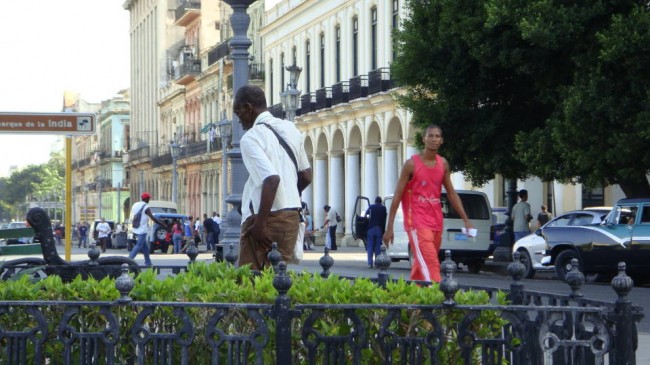
At whatever time, the hustle and bustle around India square, next to Fraternity Park, in front of the National Capitol, is always constant.

It is a coming and going of people from all the provinces.  Also tourists, with their hats and their cameras.  Despite the ruins and her age (she has already turned 490 years old), Havana sill preserves her enchantment.

The Cubans, as usual, in the streets.  Taking care of things.  Each one of them dealing with their own problems.  “Struggling”, “Solving”, “Surviving”: three of the most common phrases on the island of the Castro brothers.

In the former building of the Marina Newspaper, which now serves as the headquarters of the Provincial Court, the public is much different.  Cuffed prisoners, police and jailers, lawyers and judges, witnesses and onlookers all impatiently await the commencement of the trial.

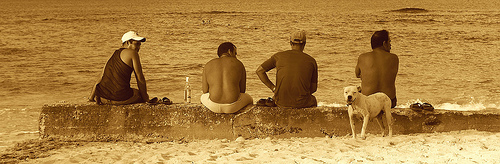
A few blocks down, where El Paseo del Prado ends, one can see those who prefer to pass the time sitting on the best spot the city has to offer, the wall of the Malecon, morning, noon and night.

Text and Photos:  Ivan Garcia

Translated by Raul G.