[youtube=http://www.youtube.com/watch?v=WizTQ-EI40E&hl=es&fs=1]
Intellectuals: Between Loyalty and Complicit Silence / Miriam Celaya
 Haroldo Dilla, Cuban historian and sociologist. Photograph from the internet.
A few days ago, a friend of mine gave me an interesting opinion piece by Haroldo Dilla Alfonso, entitled “From Loyalty to Complicity.” I can’t tell the readers where it was published, because I don’t know, though it is dated Tuesday, September 14th, 2010, but it is a core article that puts back on the table a tricky issue: the role of Cuban intellectuals on the Island during the past 50 years and in the face of changes taking place in the country.
I must declare, for honesty’s sake, that I usually chase Dilla’s writings, because they are always illuminating and marked by moderation, sober analysis, synthesis, and a deep understanding of the Cuban reality. The article referred to has the additional benefit -which is appreciated- of being as full of energy as it is devoid of passion, a truly rare thing when it comes to debate among Cubans.
Its plot is not, in itself, a novelty: the characters are Cuban intellectuals, those who remain on the island and those in exile. The argument is based primarily on the debate –which took place ten years ago- about what Jesús Díaz called “the silent complicity” of intellectuals inside Cuba in the face of the negative traits of the system, defined by Aurelio Alonso, in turn, as “loyalty on the side of the more genuine revolutionary program.” The scenario in which the theme develops, about which Dilla is commenting now, is the current Cuban reality, not a new theme, but a lot more complex than what it used to be 10 years ago, hence the importance of his article.
Dilla’s piece has also brought me back to the memory of another debate between intellectuals, which took place during the months of January and February 2007, following a TV show in which several individuals responsible for what, in the decade of the 70’s was known as the “gray quinquenium” (and “the gray decade” for others), an act that sparked true and spontaneous virtual discussion that went as far as to include strong questions about the cultural policy of the Cuban revolution. Since the debate took place through e-mails among many Cuban intellectuals inside and outside the Island, the phenomenon transcended into “the little e-mail war” and slowly faded away, after the Culture Minister held a closed-door meeting at the Casa de Las Americas with a group of intellectuals and other personalities in the field of culture, by previous invitation only and with strict controls that prevented entry to a multitude of interested people and participants in the debate itself, who were swarming outside of the meeting place.
Those events, which I experienced personally as part of the editorial board of the magazine Consenso (later Contodos Magazine, both at Desdecuba.com web page), had a kind of expectation that Haroldo Dilla calls a “little ray” of enthusiasm, because we then believed that –finally- Cuban intellectuals would join in the push for change in Cuba and, as opinion leaders, they would generate the thinking guides necessary to equip the ideas of the aimless dissenters or the fed-up and disoriented “masses.” We were hoping that the voices of many renowned intellectuals, who at times had even lent some prestige to the revolutionary process with their talent, would also rise against the lack of freedoms of Cubans and of their own group. It did not happen that way, with some exceptions.
There are special cases, like the poet Ena Lucía Portela, writer Leonardo Padura, actors Pablo Milanés and Pedro Luis Ferrer, and director Eduardo del Llano, among others, who dare to express concerns about the Cuban reality. Others, younger ones, are representatives of a generation that has broken ties with a system alien to their interests; they might represent hope if we could bridge the schism that often characterizes the alienating and escapist stances slowing down their self-consciousness about civic responsibility.
After that memorable virtual revolt of 2007, silence and luke-warmth again dominated. Official counsel returned to its ivory tower retreat, fear silenced almost all the protesters, and many of that time’s lost sheep tamely returned to the fold. The burning fires in some of the more illustrious were placated through small favors granted by the magnanimous power: some of their minor works were published or some others were edited. Some trips and other little perks were granted, and those who could have become prestigious tribunes or promising compasses were, once again, silent.
Our best social scientists in dozens of institutions, witnesses of the critical social situation in the country, have been silent (silenced?) for too long, and, when they have spoken, it has been quietly and asking shyly and humbly, for permission of the authorities, like someone who fears to offend. Now the most devious insist that they are most useful remaining in their respective research centers, “discovering” the truths that we all know and suffer daily. They allege that they are waiting for “the most opportune moment” to bring their proposals to light. Perhaps some of those are good intentions, but who is better served by that silence? I know about what and of whom I am speaking, because I was trained in a social research center where some valued researchers denied in the courtyard what they did not dare to disclose at an event’s podium.
Today, we are faced with the dilemma of a Cuba that is divided between a capitalist government and a country suffering the rigors of a failed socialist project. The banquet among the elite of the ruling caste has intensified; discontent and uncertainty among modest Cubans pile up, and a death silence seems to reign among intellectuals, packed away and untouchable in their Parnassus. They, the ones with tribunes and microphones, with the authority granted by the knowledge, choose the silent complicity in the face of government corruption and the total absence of civil rights.
I fully embrace Haroldo Dilla’s denouncement, when he insists that “there is no reason to be complaisant with the Cuban political elite, including the outspoken octogenarians who have labeled themselves “the historical leadership.” There is no room to believe that the silences, the cryptic criticisms and the requests for excuses are the price of loyalty to the revolution, socialism and the motherland, as the old slogan goes.
And, indeed, in Cuba, the revolutionaries of yesterday are the burden of today. They represent the most reactionary class society. The Cuban Revolution died decades ago. It is time to break the comlicit silence of which Jesús Díaz spoke, and which researcher Haroldo Dilla has brought to the debate arena recently.
Translated by: Norma Whiting
September 28, 2010
Long-Distance View / Regina Coyula
 There are people who cannot look forward. It’s not about them being dispossessed or abused after 1959, it’s not even about their refusal to support the ideology that dominated the country. It’s about their personal philosophy, a feeling of inevitability, because I have talked to people who have been heavily affected by the revolutionary laws yet their major interest is not getting back their worldly goods but getting back freedom.. the country !<em>Patria</em>! the poor country, so worn out. Looking at one’s past is more about personality than the magnitude of loss.
There is also the idea of punishing those who collaborate with the government. In a country where the State has been the sole employer for the last 50 years and where any kind of job with responsibility, at any level require political endorsement, everyone turns into a collaborator. Those who didn’t adapt or refused to applaud, have paid for it.
This is not my case, nobody had to convince me. The hardest part came later, when I started raising doubts, when I felt I was betraying my ideals and the memory of my father.
I know that this political process failed by having all the defects of socialist countries in Eastern Europe. The only difference, the one that prolonged the agony of this corpse, is that the leader of the 1959 revolution is still alive; and while Stalin imposed friendly governments in the countries where the Red Army defeated the Nazis, nobody put Fidel where he is.
I’ve already been in the Communist Party and for that now I feel immunised against joining another party, not even one for the protection of flora and fauna. I like the idea of having this space to criticize the current administration and the future ones….but also for talking about friendship, tv series , and what happens to me, because we can’t live only for politics.
ps. Miriam de La Vega thank you so much, I’ve already sorted things out.
Translated by David Bonnano
September 29, 2010
Blockade vs. Embargo: Reason Hijacked / Ernesto Morales Licea
 In my judgment, few issues of the Cuban reality are more complex to objectively analyze than the controversial economic, financial and trade blockade-embargo which, since 1962, the United States has maintained against the Island’s government.
While there are topics that we can dissect almost surgically, separating their components with pinpoint precision, on this topic there will never be a last word; there will always be one more argument up someone’s sleeve that merits further discussion.
The conflict is born from the etymology itself: whether someone calls it a blockade or an embargo implies, per se, taking sides. The same thing happens with the name of our former leader: it is enough to call him Fidel or to call him Castro, for an interlocutor to divine the political affiliations of the speaker.
I will take a stab at the definitions: it is not an embargo in the strict sense, nor is it a blockade. A simple embargo, speaking literally, would not include pressure on third countries to prevent trade with Cuba: it would apply exclusively to the transactions with the United States, and it is an open secret that this isn’t the case.
On the other hand, the term “blockade” that the Cuban government uses to define these sanctions, is even less relevant. A true blockade implies military maneuvers so that nothing, by land, sea or air, would be allowed into Cuba from other countries. It might be worth asking the inhabitants of Gaza if they know what a true blockade is.
Despite this double inaccuracy, I see the “embargo” as closer to the truth, although the other term is much preferred by the official sensationalists of my country.
It’s clear: this is not the fundamental issue of a subject that has generated heated debates, by both detractors and defenders of the Cuban Revolution, and even among ourselves those of us who reject the totalitarianism of the system that governs us have not been able to reach a consensus.
Why? Well because to evaluate a measure like this, in my opinion, three fundamental questions would have to be defined, each of which is more complex and subjective than the last. The first: whether its origin, its initial application, was justified or not. The second: its objectives today. The third: the results achieved.
Approaching an analysis with these three premises helps to satisfy a criteria based on a method that separates the issues, which, luckily for us, Aristotle inaugurated many centuries ago.
Genesis
No one doubts the true origin of this severe measure: the outrageous expropriations by the Revolutionary Government after their triumph in 1959.
Hundreds of American citizens and companies were dispossessed, in a flash, of their investments and properties with this Revolution that wanted to change even the water table of the Island. Capital invested according to the laws in force up to that moment was vaporized by the new leaders.
Small national proprietors suffered the same fate: anyone who owned a pharmacy, a barbershop, a candy store, lost his personal achievement at the hands of a collectivist dream that was, also, barbaric and thoughtless.
For these Cubans, however, there was no option but to adapt to the new rules of the game. They could leave the country, live cursing the bearded ones, grow old filled with an understandable hatred, or get aboard the triumphant train, with faith in the promised future. I prefer not to speak about other cases I know of: those who could not bear their helplessness in the face of such arbitrariness, and who took their own lives.
But the U.S. citizens and investors had a government response that sought to impose pressure in return for justice. The embargo was born. The date of its full implementation takes us to February 1962.
At this point, I can’t but admit the validity of a coercive measure that tried — today we know unsuccessfully — to reverse these angry and capricious interventions, disinterring the hatchet of war from the very beginning of the process.
Revisiting Machiavelli
Starting in 1992, after being in place for thirty years, the embargo against Cuba changed its principles and purposes. It ceased to be, first, an effort to pressure the Cuban authorities by calling on their sanity; it ceased to be, then, a robust vengeance in kid gloves; and it became, at last, a premise to reestablish diplomatic relations with the Island.
As reflected in the “Cuban Democracy Act,” these sanctions would last as long as the Cuban government refused to take steps toward “democratization and showing more respect for human rights.”
And here was born the first hurdle to determining the fairness and legitimacy of the measure.
I don’t believe I need to repeat that, personally, I have few desires more deeply embedded than to help in the real democratization of my country. I do not want to die without evidence that this land will distance itself from the intolerance, the hate and the exclusion, to build a just nation in which all its children can find their place. This blog is my microscopic contribution to that.
But not to know if these new demands to lift the embargo were already approaching interference in the internal affairs of an independent country, would not be honest. All possible arguments to that effect do not change the ultimate truth: the blockade is a clear interference in Cuba’s own affairs.
I think that little could answer those who approve of fire and brimstone, against a fact as against a lie: but in the last decade, there have never been more than seven countries that have supported the blockade at the United Nations (in 2004), and never fewer than 155 that have voted against it. On the last occasion, in 2009, only Israel and Palau joined hands with Uncle Sam.
Not even nations frankly, and justifiably, hostile to the communist system, such as Poland and the Czech Republic, or U.S. Allies in its war efforts like Great Britain and Australia, have accepted the role of explicitly and publicly defending the embargo.
Why, one wonders. Because in no way is the Machiavellian precept that the ends justifies the means acceptable, in democratic and reasonable international politics.
That the Cuban government deserves to be rejected in infinite aspects, especially with regards to the human rights of its citizens, is an almost universal axiom. That it is worth the trouble to exercise pressure — as recently happened with the releases of the prisoners of conscience — to get at least the smallest signs of flexibility: one hundred percent agreement.
But it will never be valid to violate the sovereignty of a state with economic sanctions, in order to achieve such purposes. At the instant in which such crude measures to reclaim the nationalized properties were resorted to, while wielding the precept of democracy, the validity of the embargo cracked.
Especially because, the house itself, at times, was glass.
Would it have been acceptable for countries like China and Russia to approve economic sanctions to force the United States to close the shameful prisons at Abu Ghraib and Guantánamo? On the other hand, could anyone explain how the United States government adopted this policy against Cuba for being a communist and totalitarian country, yet is a strong trading partner with China and Vietnam?
Snowball is to blame
With each day that passes, the embargo sets new records for longevity. It has outlasted all known members of its species. It even exceeds the record for the longest stay at the helm of a western country, held by ex-president Fidel Castro.
It has had a few touch-ups. The Helms-Burton Act (1996) which reinforced its punitive character; the Trade Sanctions Reform and Export Enhancement Act (2000) which turned the United States into the principal supplier of agricultural products to Cuba (6.6% of imports in this sector come from the country of Lincoln). Data that is, of course, deftly hidden from the Cuban people by the official media.
But the question arises, speaking objectively: does anyone get anything from this policy of sanctions?
Of course they do. The Cuban government gets the perfect excuse to whitewash their economic failures and their authoritarian methods. In the book Animal Farm, by George Orwell, when the pig Napoleon wants to justify the excesses and incompetence of his administration, he resorts to the enemy: Snowball. The renegade pig, according to Napoleon’s propaganda, is equally to blame for the crops failing to thrive, as for the water mill that broke for lack of resources.
For the Cuban establishment, the embargo could be renamed “Snowball.”
The “cruel and inhumane blockade” justifies everything from the decrepit economy, to the astronomical debts to foreign firms, to the shortage of drinking water. The “genocidal blockade” guarantees, according to official propaganda, that Cuba cannot allow democratic openings such as a free press, or lifting the restrictions on Cubans traveling freely throughout the world. The blockade carries the melancholy blame for a hurricane that hits us, a drought that makes the earth crack, the pollution in the streets of Havana, and the hunger in the Cuban countryside.
What has been the affect of this policy? On the ordinary Cuban, the dispossessed? The government has used it to justify its excesses and incompetence, and on the other hand, to keep the population from clearly understanding who has been the cause of the ruin that has overtaken the country. It has, also, made the existence of the poor even more difficult, because though the official figures of the losses caused by the blockade are, at times, scandalously hyperbolic, still there is a share of truth in them.
The powerful have never felt its impact. The corrupt have managed to carve out a living standard that sticks out its tongue at the ineffective embargo. But the workers, the lowly ones, they know its consequences.
Has it strangled the government of the Island? No. Has it succeeded in democratizing our battered country? No? Has it achieved international support? No. Has it affected Washington’s credibility with respect to a humanitarian willingness to help Cubans in need? Yes.
Too much time hijacks reason
Even those of us who argue that the centralized economic model, as opposed to the market and foreign investment, cannot achieve the individual prosperity of a man, and that the malformed creature they are presently trying to install can only result in an archaic and dysfunctional economy, even we have to admit something: while the Cuban government continues to be burdened by the embargo, we cannot measure with any exactitude its inefficiency in providing for the welfare of the nation.
When not competing on equal terms, it is unfair to proclaim winners and losers.
To minimize the importance of the embargo, as its partisans tend to do, collecting figures of trade agreements with other countries in the world, traps them between a rock and a hard place: If, then, it is so ineffective, why keep it?
To not admit that it has been a damaging and prejudicial policy for the progress of this country, to not admit that the iron fist of a totalitarian system has found in the embargo a loathsome ally, is to kidnap a reason too obvious in the conflict.
Let me close these particulars and discuss opinions with an anecdote that is strictly true:
When Barack Obama won the election, in November 2008, I had been working for just two months at the radio station in my hometown. I attended, as a curious spectator, an emergency meeting of all the journalists at the station with the top management.
The government concern, this time, was not the ridiculous possibility of an invasion, or a new “destabilization campaign from the Empire.” Now what was keeping the Party up at nights was the possible flexibility on the part of the new president with regards to the antagonism toward Cuba. The bottom line could be summed up very simply: “He is a charismatic and intelligent leader and he might lift the blockade!”
Behind the somber faces of these officials, lay a frank concern: “How can we guarantee the continuity of our Revolution, or our ideology, if Obama allows Americans to travel freely to the Island, and lifts the blockade all at once?”
September 24, 2010
Chaplinesque / Yoani Sánchez
 The Water Seller of Seville: Diego Velázquez
The man in the threadbare suit, bowler hat and huge shoes carried pieces of glass on his back. His sidekick, a boy of about five, tossed stones through the windows of shops and houses so the glazier could sell his services to desperate clients. Together they formed a duo of survival, an “emergent” work team, that still yielded barely enough to keep the fire burning in their home. The story, described in the 1921 Charlie Chaplin film, The Kid, has returned to pass in front of my eyes as I read the list of self-employment activities published in the newspaper Granma. Like a repertoire of destitution and dependency, this enumeration of private work seems more in tune with a feudal village than a 21st century country.
Reading through it in one sitting — containing my disgust — it is obvious that there are hardly any occupations directly linked to production. Entrepreneurs would need to be able count on a wholesale supplier to provide raw materials, and the possibility of access to bank loans has barely been mentioned, and without any details about what interest rates would be. Nor is there any talk of the self-employed being able to import merchandise directly from outside our borders, as this continues to be an absolute monopoly of the State. Of the 178 eligible activities, many are already carried out without a license, so being included in this list changes only one thing, being required to pay taxes. Hence the skepticism that accompanies the announcement of these “flexibilities” to let private ingenuity contribute to solving the serious problems of our economy.
What will come as a consequence of this slowness in applying the necessary changes? Citizens will continue to swell the long lines in front of consulates so they can leave the country, or they will fully immerse themselves in illegality and the diversion of resources. If our authorities believe that this trickle of transformations will keep the system from falling apart in their hands while they try to update it, they are underestimating the sense of urgency that runs through the Island. Such a half-hearted approach to applying long-delayed openings weakens the social situation and no one can predict how the frustrated “kids” — those disadvantaged by the massive layoffs and lack of expectations — will react. Hopefully they won’t end up breaking out all the windows.
September 29, 2010
THE REVOLUTION EVENING POST 1 / Orlando Luis Pardo Lazo
Click Image for Link to Magazine
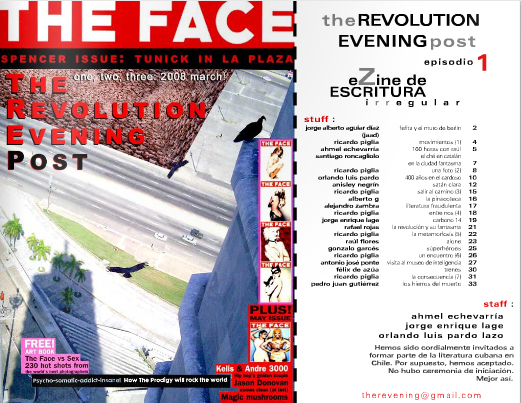
September 29, 2010
Enriquito, a Good Man, Much Loved, and a Dreamer / Juan Juan Almeida
 My name is Ramón Enrique Ferrer Yero, son of Enrique Ferrer (an electrical engineer) and Elisa Yero (a homemaker), I was born on 6 September 1941 in Cuba’s Oriente province, in my dear Palma Soriano, in a home located on Cisneros Street, number 4, top floor, between Martí and Maceo Streets. You can imagine that, with that kind of address, I was born a patriot.
I went to a Catholic school of the Claretian Brothers, then studied at the Sanderson Institute, and later, in the Sinai Baptist school. I didn’t make it to college, due to my views, openly contrary to the evil Revolution, the government didn’t allow me to continue exercising my right to study and chose to cut short my professional life.
In 1962, they started to make my life impossible. They summoned me to the offices of State Security, they pressured me, they tried to blackmail me, they surveilled those who visited my house. All of these things I’m telling you would provoke a discontent in me that I shared with many people.
 I’m a practicing Catholic, and I used to attend the church of the late Father Cayo Simón, the parish priest of Palma Soriano. One June day of 1964 or 1966, during a celebration of Saints Peter and Paul, after so much pressure, several of my friends and I agreed to meet in the church to go out and protest, with pots and pans. State Security found out, and together with the Communist Party, brought out many people armed with planks with nails to repress our march. The echo of their cries of “To the firing wall! To the firing wall! Down with the gusanos*!” still sound in my ears… all of a sudden a mob removed me from the church, dragging me before a rudimentary tribunal that they had organized for such needs. I don’t know how I got out of there. The mob that chased me took it upon themselves to stone my house, yelling those stupid chants that struck with the same force as rain against sheets of zinc. Someone I knew well, whose identity I don’t wish to reveal, got me out of that severe nightmare through the patio of my house, put me in a car, took me to the province of Holguín, and, from there to Havana. After some time in the capital, I decided to return to Palma. Immediately after, I was called up to conscripted military service, which wasn’t even military service at that time, but rather the Military Units to Aid Production (UMAPs, by their Spanish initials). There, there were students, doctors, engineers, lawyers… it didn’t matter if they were for or against the Revolution.
 They cut the lights off on the town, put us on trucks, and took us, after stopping along the way and picking up youths in Contramaestre, Baire, Jiguaní, Bayamo, Holguín, Tunas… to the stadium in Camagüey, where it rained unceasingly. After registering us, they put me on a cart and sent me, together with a group of lads, to these camps bordered by barbed-wire, in the town of Vertientes, that looked rather like the concentration camps of Hitler’s Europe. Trenches, mud, beatings, torn Bibles, mistreatment, drowning victims, suicides, long walks, early mornings, bad nights, rotten food, thirst, fasting, heat, cold, sickness, skin infections, shivers, rain, sun, forced labor, sugarcane fields, beatings, lost teeth, bayonet-stabbings… Who could forgive such an atrocious thing?

When all of that ended I started looking for work, but I was now labeled and no one wanted to hire me. I got caught by the Slacker Law and they took me to work at a stone quarry, breaking up gravel. On returning to my town, they put me to work sweeping all the parks of Palma Soriano, from where I kept conspiring in activities against the evil Revolution.
The constant threats, disrespect, and summons were my inseparable companions. In 1995, I was taken in by the refugee program offered by the U.S. Interests Section in Havana.
 A long while later, and after offering various bribes, they finally allowed me to travel. Upon reaching my destination, I was received with an admirable and emotional welcome that left me speechless. But, to tell you the truth now, in that precise moment, my body was here in the U.S. and my mind over there in Palma, from where I never departed. I want to be among Cubans, so I came to Miami. I could not, nor can I, abandon the cause of Cuba. Here, I signed up with all the different organizations to which I belong to today.

I’m an only child, and my mom wanted to see me after such a long absence. I attempted to go back to Cuba to give her my last farewell, but they denied my entry. That has been the worst punishment. My mother died of sadness; you can imagine how much family separation can hurt. Today I live here with my Virgin of La Caridad del Cobre, with my St. Jude, and with my little dog, Niña. What I most wish for, when that horrific tyranny falls, is to fly off to Palma even if I have to live on the banks of the River Cauto in a house built of palm fronds and timber. I want freedom and democracy in my country; maybe that’s why, each time I lay down in my bed, I can’t fall asleep without first going for a stroll, in my mind, all over my Palma Soriano.
* Translator’s note: although less in use today, gusano, literally “worm”, has been the political epithet historically used by the state, its media, and its supporters in post-1959 Cuba to denounce counter-revolutionaries and citizens who wish to leave the country.
Translated by: Yoyi el Monaguillo
Subtleties of the Jaw / Claudia Cadelo
Photo: Claudio Fuentes Madan
The line for the bus at Coppelia is a special place, one of the corners so eloquent that if it disappeared one day Havana wouldn’t be the same. Yesterday at ten at night I was waiting for my P4 bus when a woman standing next to me with her daughter commented how “alive” the city was for the anniversary party for the Committees for the Defense of the Revolution (CDR). “Is that a joke, ma’am?” I asked, and she gave me a serial killer look.
The driver swore that not one more person could fit on the P4, so I got on through the back door. A drunk behind me was pushing to cut the line, but he was staggering around and trying to hold onto his bottle of alcohol at all costs and he lost his balance and fell. The driver started while the man was still trying to get on and he was almost killed in the attempt.
The woman of the “lively party,” at my side started screaming, and me, I answered, “He’s so plastered he won’t even make it to the corner!” She added, “He had to be black, all blacks are the same,” and started a lecture all about “those blacks” which if Martin Luther King had heard he would have died a second time. I looked around embarrassed. Everybody nearby was white. No one opened their mouths and I realized that they would all remain mute rather than defend the blacks. I got hysterical, I regretted it later, but at the time I wanted to strangle her, especially since her ranting was quietly being listened to by her young daughter, what a great example!
“Madam,” I said to her, “if I scream ‘Down with Fidel!’ you would be the first to jump on it. May I ask, then, why I have to put up with you talking like you’re the president of the Ku Klux Klan? And if I scream, ‘Down with Estaban Lazo!’ are you going to jump on that too or is it not the same?” The phrase came out rather awkwardly. She said nothing. People were staring at me and soon I felt like I’d stepped out of a tomb at the Colón cemetery, with worms crawling out of my half-gone skull.
I knew I couldn’t stop myself. That should not be the approach to dialog but sometimes dialog is simply beyond my capacity for tolerance. I got off at the stop at 23rd and A and walked the half mile home, talking to myself.
September 29, 2010
Who Will Bell The Cat? / Fernando Dámaso
- Exhausted from accessing power through armed struggle, a typical method in the ’60s and ’70s of the last century, the Latin American left reorganized itself and adopted a new tactic: using the institutions and instruments of democracy. Consistent with that, populist leaders outlined politically attractive programs, offered solutions to accumulated social problems, and launched mass media campaigns to capture power in elections.
- The new tactic yielded good results and leaders on the left, both democratic and totalitarian, adopted the same. The first, once in power, respected the democratic institutions they used to get there and ruled their countries without political or social trauma. The latter, once in power, have taken on the task of dismantling democracy with the objective of keeping themselves in power, considering themselves chosen by history as the only capable leaders of their nations.
- This reality has been ignored by regional and global institutions, based on the criteria that they are democratically elected governments who came to power through elections.
- It is generally assumed that these governments were elected by the people. In reality, no government is elected by all the people: it is chosen by a portion of them (fifty percent plus one, or sixty percent, or sixty-five percent of those who voted; there is another forty-nine percent, or forty-five percent, or thirty percent who did not vote for it). It should also be taken into account that a certain percent abstained from voting, usually quite a high number, between forty or fifty percent. All of these taken together would really constitute the people.
- It seems that the fact of being elected gives them carte blanche to do and undo whatever they like, forgetting that they should govern for the whole nation, and not only for a part of it, with a cooperative attitude, or at least taking the world into account.
- Before the new tactics of the totalitarian left, the democrats, always ready to confront the totalitarian right, have not known how they should react, and have allowed the expansion of evil to become a real epidemic. What can be done with a democratically elected government that, once in power, dismantles democracy? Should one respect their anti-democratic actions. Should one stand by with folded arms because they emerged from the ballot boxes? The answers to these questions either don’t exist, or there is no consensus on them.
- It is time to adopt a tactic of confronting these totalitarian leftists governments in power, and not allowing them to go on forever. Not to do so, out of respect for established democratic principles, is to defeat democracy.
September 25, 2010
A Visit to Hard-Core Socialism / Regina Coyula
The day classes started, my son came up with the bomb that he did not want to continue going to his sports school. This is his last year of high school, so I advised him not to make any move and spend six months of classes taught in grade 12 and then start preparing for entrance exams to college. As my son stood by his decision, on Friday, I had to go find his file at the school, and do the paperwork to move him to a school newly opened near the house. Back, and with the record, my son suggested we go for the P-3, the bus route that leaves us closer to home, the first stop, for which we came to a place called Alberro. Alberro is a horrible accumulation of buildings and dusty microbrigades. Unlike Alamar, it has no consolation of being on the coast. I was impressed by the number of stray dogs, so in tune with the place. While my son took several glasses of strawberry soda in a seedy beach bar, I was looking across the balcony railings, each according to its possibilities, and a spot of color in the grayness without form, of a family that decided to brighten up their own facade. On their own, I also saw several signs of a locksmith, an electrician, and Mavys, a hairdresser, but even those signs were as ugly as the environment.
And at the bus stop, of a very good concrete, large, with benches and urine smell, a man with four 40-watt fluorescent bulbs piqued my curiosity. I’ve searched these bulbs for months, they are the same that the workroom of my husband uses, so loudly, and with astonishment, I asked the man where he got them. The man approached with a smile: “Madam, that question should not be said aloud.”
So with the right tone, close now, the man was standing beside us, I repeated the question.
Are you interested?
Sure, I am interested!
40 each and they are yours.
But I am not going to buy them without testing them first.
Do you live far?
Too far. Almost at the end of the bus route.
Oh, that looks good. I have a meeting in Vedado, and if you want, you can give me your address and I will come to your home, you test them so you can see they are fine.
I gave the address rushing because the bus was approaching. I was glad to get away from that place with the firm intention of not returning. It is not contempt for the people living there, many have worked very hard in the construction of their apartments. But why so ugly and badly made? The movement called microbrigades did nothing salvageable. This is socialism, I thought.
I lingered with the procedures of the school and when I got home, my husband had installed not one but two lamp bulbs and I did not remember since when it had operated with more than one. This is socialism, I said.
Translator: Luis Rodriguez
September 26, 2010
The Good Optimist / Fernando Dámaso
“Ole,” they said in my childhood, is a word that has no explanation. With NO, it is the same. You go walking through the streets of God in this atheist city, at least officially, thirst grabs you and tightens your throat, and all you find, written with various materials in different ways, an infinity of little notices: There is no water. Then you wonder: Is it that it hasn’t rained all year? Have all the rivers dried up? Are the aqueducts extinct and the did the pipes explode? No one gives you a logical explanation. You only hear about rescuing the culinary honor, etc. etc. etc.
You are optimistic. You keep walking. And continue to find little signs: Keep Out. No Visits Allowed. No Unauthorized Entry. Don’t Touch. Do Not Disturb. Don’t Talk. And much more. You, continuing to be optimistic, sit on a bench (after looking everywhere to see if there is a No Sitting sign) and ponder longingly some little signs that for many many years made you happy. No Illiteracy. No Bureaucracy. No Slums. And then you wonder: What became of them? Where are they? And you get up and keep walking (I already said it, you are a magnificent optimist!).
You come to your workplace (because you’re going to work, you just have to walk there because there’s not enough transport!), greet everyone you meet (some respond, most don’t), go into your office and sit at your desk. Your secretary, helpful as always, comes and says, “We haven’t received authorization to do what you want to do, there is no possibility you can resolve it.” With a slight headache you ask her to please leave you alone for a moment and then she continues her report. The secretary, half puzzled half hurt, leaves, looking at you with incredulous eyes. “Today the boss is a jerk!’ she thinks.
You — of course! — remain optimistic. You decide to draft a waiting document and ask, through the intercom, for some bond paper. You receive the following response, “There is no bond paper, only bad newsprint.” You accept it. Sit down to write. Finish. Ask for an envelope. There aren’t any, she answers. You, who continues being optimistic, decide to take a break and leave to walk walk walk, to clear your head.
You visit a few local currency stores, which is what you receive your salary in: There is no deodorant, no razor blades, no toilet paper, no soap, etc. etc. etc. You go to the milk store: There is no milk. You go to the bakery: There is no bread until further notice. You think: man does not live by bread alone. You go to the market where you are supposed to buy the things on your ration card. There is no detergent. There is no chicken and no fish for those on a medical diet (mackerel — the only fish in the entire sea — or at least the only one that allows itself to be caught).
You remain optimistic, a great optimist, the greatest of all optimists. You think all these things are trifles, articles of consumer society, simple, shoddy, material. You think of spiritual values: There is no begging (in the newspaper); There is no prostitution (in the newspaper); There is no gambling (officially); There are no drugs (or are there?). You keep thinking. You start to get annoyed by some fastidious gremlins whispering in your ear, so no one else can hear it: it’s not good to say these things, it is not a principled position to do it, it’s not good for you, who is an Optimist, the scare of a slap.
You get home. You climb the seven flights of stairs since the elevator doesn’t work because it broke yesterday morning. Finally you put the key in the lock and turn it. You’re covered in sweat. You crave a cool bath and sleep. There’s no water, your neighbor tells you from the hallway. The motor couldn’t pump it because there’s no electricity. Then you start to scream and run headlong into the walls. The neighbor calls the other neighbors. José has gone crazy, she says. The neighbors gather and grab you. Try to hold you. You keep screaming and wanting to get away from them. You do. You run down the stairs. You go out. The neighbors are behind you. Other passersby join them. Some people scream, not knowing what’s going on.
“Stop the thief!” A cop crosses your path and stops you with a karate chop. Then comes then ambulance (with the letters in reverse) and they take you away. You go to the hospital. They inject you and when you are sedated a doctor comes and asks you strange questions. You realize he is a psychiatrist. They think I’m crazy, you think. You answer some and others not. He writes and writes and writes. In the end he says, “You have nothing, you may go. It’s all been a nervous shock. Your nerves betrayed you, friend!”
You leave the hospital and look for a taxi. There are none. You try to catch the bus. It’s late. You decide to walk, and certainly walking is healthy. Don’t step on the grass — Decree 80. You pass a collective dumpster. Close me, I am your friend — you read. You’re not sure whether to shake its hand or hug it. You control yourself.
You just got out of the hospital. You have absolutely nothing. You keep walking. Return to your normal life. Try not to read the little signs, to forget the No’s. You, in spite of everything, continue being an optimistic man. You manage in the daytime but at night the dreams come. It’s as if you continually read a grammar book with only two little letters on each of its pages: no no no no no no no. Tenaciously. You can’t. And then you decide to go to the psychiatric hospital and ask for admission. How? Why can’t you let me come in? Because I didn’t come through the established channels?
September 22, 2010
Happenings on My Planet / Rebeca Monzo
 Not all things on my “planet” are bad. It’s true that almost nothing works properly and the dilapidation is very noticeable, but, in spite all of these years of frustrations, sacrifices, losses, and painful goodbyes, there’s also something that keeps going: friendship and the warmth among some friends.
A couple of nights ago we had the immense pleasure and privilege of being invited to a cordial evening at the home of a friend. The main attraction consisted of a mini violin concerto, with which Maestro Evelio Tieles congratulated the host.
It was marvelous to hear that beautiful, impeccably performed medley by the famous violinist. Beginning with Manuel de Falla’s Nana, he went on to present, note by note, a review of the most beautiful Cuban music of all time: Veinte Años, Quiéreme Mucho, La Bayamesa, La Tarde, and, as a finale, El Mambí.
As marvelous as the interpretations of such precisely chosen pieces were, equally good were the conversations after, spanning the most varied topics. We left feeling more than grateful for such an unexpected invitation, like one who emerges from a radiant shower of light.
This undeserved privilege was complimented by another invitation, last Sunday, this time extended personally by the Maestro: a piano and violin recital at the Basilica of San Francisco, in the heart of Old Havana. The chosen setting couldn’t have been better.
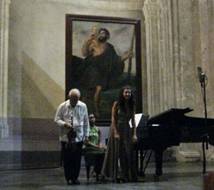 On this occasion, the strings and bow plucked by Tieles brought us the whims of Paganini, those nocturnes by Chopin, and crowned the majesty of the repertoire with Schumann’s Sonata in A Minor, Opus 105.
It seemed as if sparks flew off the strings of the violin, to say nothing of the trial faced by Yamilé Cruz, the young accompanying pianist, who soared before the challenge imposed by the mastery of the multi-award winning Evelio Tieles. It was a magical evening, wherein the absence of figures from the nomenklatura and propagandistic introductions was noted with pleasure.
Translated by: Yoyi el Monaguillo
September 21, 2010
Rejected Invitation / Fernando Dámaso
- The ambiguous Silvio Rodríguez, good at music, doesn’t rise to the political rumor. His written invitation, reproduced in the today’s edition of Granma, to his personal blog, Second City, is an unoriginal repeat of the official black history coined over the republican years. There’s a reason Granma published it.
- Accepting that Havana wasn’t the ruins it has turned into today, and even daring to share responsibility, to immediately tell us the sad story of the poor boy who was, having no money for a toy, one of the black beggars beaten by the police and urinated on by a drunk sailor (he used another word) against the statue of José Martí in Central Park.
- Silvio takes isolated incidents, that happened or could have happened, and magnifies them, generalizes them, as if they were the norm, as if this Havana lost in time existed only for the bourgeois and the powerful. However, it also existed for those of us who lived in neighborhoods like Mantilla, Párraga, La Víbora, Los Pinos, El Cerro, Luyanó, El Diezmero, etc. It existed for everyone, only our parents worked and this allowed them to put a roof over our heads, feed us, clothe us, educate us, and even buy us a toy at the Galiano Ten Cent Store, which had them costing ten cents.
- It would be desirable if the singer-songwriter worried a little more about knowing the true history of his country and was able to tell the difference between light and shadow. In fifty-six years of the Republic, despite the problems and unresolved tasks, a country was built that came to be among the first in the Americas and other parts of the world in education, public health, constitutional and workers’ rights, infrastructure and development. In our archives and libraries there are documents attesting to this. One only has to consult them.
- Regarding his criticism of the changes in political positions and people, I consider it nonsense. The only Cuban thing that doesn’t change is the baseball team. If humans can change their religion, why not their politics? What’s more, as the years go by we acquire new knowledge and experiences, discard what doesn’t work and look for the new. This has always been the path to development. No one tries to return to the past, which is impossible because it doesn’t exist. What is needed is to incorporate the present and advance with it. It should not be allowed that, once again, we step aside and end up tossed out on the San Antonio de los Baños train platform, as happened to Silvio.
September 14, 2010
Amanda / Fernando Dámaso
Amanda was a nightingale. Every morning, with the first rays of the sun, she flapped her wings and started to warble. From her prodigious throat came, one after another, the most dissimilar and original musical notes: now a fortissimo treble, now a deep note that penetrated the soul. All the songs of the birds were contained in her and acquired a level magisterial execution. She reveled in them, absorbed in her own song, without paying the least bit of attention to what was happening around her. All who passed near Amanda’s window stopped to listen. Sometimes she caused traffic jams, and the police had to intervene to get things moving. Amanda’s song was the most famous in the city and there were those who rose at daybreak to listen, in the stillness of the dawn, before the noise, her first trills. Connoisseurs comments that they were the most beautiful, always new.
The months and years passed and Amanda’s singing became an important part of the city. All the tourists who came demanded that their schedule include a visit to hear her. The same thing happened with official delegations. People gossiped for days about the visiting president who rescheduled his flight, breaking all protocol and ruining the official welcoming ceremony to listen to Amanda at dawn. Given the number of people who gathered in front of Amanda’s house every day, the authorities decided to connect microphones to the radio network, so that everyone could listen to Amanda singing from home. From that time on she was a part of breakfast, lunch and dinner. She was present when people were talking, making love, being born and dying. And her singing was always new. She sang without pause from morning to night, as long as the sun shone. On cloudy and rainy days she remained silent and only sang when a rainbow appeared. Then she sang with the same force as at dawn.
On day Amanda stopped singing, and the city, little by little, began to die.
September 28, 2010
11 September 2001, A Despicable Crime / Rebeca Monzo
 View of the model that was inside one of the twin towers.
I took this photo when I visited the towers in January 2001. I found myself in that city, a guest of a friend from my adolescence, who, on hearing I was in the United States for a personal exposition, wanted me to visit.
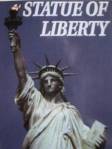 A few months later, back in my planet, I received an urgent call to turn on the TV. At first I thought it was a run-through for a movie. My brain couldn’t believe what my eyes were seeing. What horror! What helplessness! What sick minds could have been capable of carrying out such a crime. Later we knew.
  Almost three thousand innocent people died, many of them of Hispanic origin, as well as other nationalities. No strangers to a generous country which has always welcomed immigrants of every ethnicity. No one deserves to be the target of terrorism, the United States didn’t deserve such horror. Crimes such as these must never be repeated.
My respects to those strong men and women who have made that Nation great.
September 11, 2010