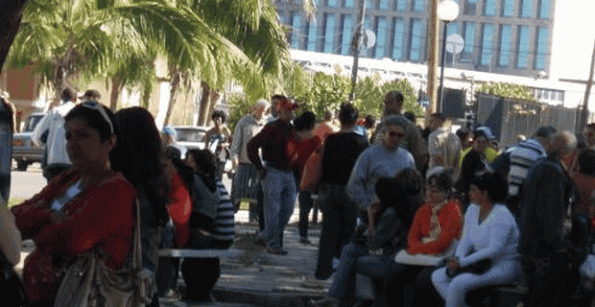
The Malecon Uprising / Rosa Maria Rodriguez

12 -- The Maleconazo. (Wikimedia)
The Maleconazo uprising of August 1994. (Wikimedia)

This August 5 will be the 19th anniversary of the Maleconazo. The rumor that boats from the United States were reaching the Havana Malecon to transport Cubans to that country, turned into the gunpowder that moved hundreds of people — aware of the Mariel Boat Lift in 1980 — to the north coast of Cuban with the intention of migrating to the democratic and supportive land of Lincoln. Many expressed their desires to live in freedom and also, with public expressions, their discontent toward the caudillo Cuban government which by then was 35 years old.

Like many disturbances that arise spontaneously and in which there are no specific demands nor is there a clear pre-established and agreed on objective, the vandals of the Cuban political police mingled with the crowd, smashed shop windows and caused various damage.

We thought then, as we do now, that they had been duly instructed and oriented through “their channels” to take the initiative and to internationally discredit and minimize the impact of the civic protest. A police device that seems to have been anticipated all possible scenarios and their rapid responses pre-established for every social action.

Later, when the authorities’ reinforcements arrived in vehicles with soldiers dressed in plain clothes, and paramilitaries armed with rebar to “fight” for the government, the “barbarians” joined the side and shouted the same “Revolutionary” slogans of the last 50 years. So it turned into the largest anti-government protest recorded in the history since 1959.

Almost twenty years later, the Castro dynasty continues in government, with Raul at the front (or the side?), and with a political intolerance that is closer to the rigidity of a systemic rigor mortis.

Connoisseurs of the current speed and diversity at the global scale, have had plenty of time to prepare for change before the eyes of the world: a gradual and controlled Maleconazo that wins them and their families 19 more years. Hopefully, so much political stubbornness and irresponsibility will not cost our noble people an irreparable national fracture!

7 August 2013

Did Fidel Castro Make a Revolution Of the Humble, By the Humble and For the Humble? / Ivan Garcia

ivan fidel humblecuba-mendigosOn April 16, 1961, just before the end of a fiery speech at the speech delivered during the funeral for the victims of the bombardments that marked the prelude of the Bay of Pigs invasion, Fidel Castro exclaimed:

“Comrades, workers and peasants, this is the Socialist and democratic Revolution of the humble, by the humble and for the humble. And for this Revolution of the humble, by the humble and for the humble, we are willing to give our lives. Workers and peasants, humble men and women of the country do you swear to defend to the last drop of blood this revolution of the humble, by the humble and for the humble?”

Those words were spoken on the corner of 12th and 23rd, in the Havana neighborhood of Vedado. Fifty-two years later, less than five miles from that place, every night, at the break of dawn a trio of beggars begin their task in a rickety abandoned school in the neighborhood of La Vibora.

Armed with a chisel and a small sledgehammer, they take almost a hundred bricks manufactured before 1959. “Given their quality, we sell them for two pesos each. People buy these recovered bricks and use them in the construction of their houses or to make a closet. We work for hire,”  explains one of the beggars. continue reading

Later, with their profits, they sit in a wide, airy doorway to drink domestic alcohol filtered with industrial carbon, the drink of the forgotten. The indigent trio cries for a good bath and medical attention. They are alcoholics cubed. Emaciated and dirty, they drink the infamous homemade rum.

“I shower once or twice a week. When some important guy visits Havana — like when Pope Benedict XVI came in 2012 — they collect us and put us in a camp where we have two meals a day.  We can also wash up more often. Once the personage has left, they throw us out in the street again. We sleep in the courtyard of the House of Culture in the 10 de Octubre municipality, or in a building in danger of collapse facing Red Square in Vibora. We did fine when we were healthy. We never got sick,” confessed another of the beggars.

The beggars have transformed the busy corner of Carmen and 10 de Octubre into a hardware store of old things.

René, 32, lived with eight people crammed into a room without a bathroom in a tenement in Central Havana. “I decided to live as a nomad. I earn some money cleaning up flowerbeds and gardens. For lunch I eat leftovers that people throw in the trash. Pick up empty cans of beer and soda. When I accumulate several bags, I go to an office where I paid raw materials according to how many pounds I collect. I live day to day. If I have money I stay in a motel. If I’m broke I forage for dinner in the trash cans. I used to be ashamed, people shouted names at me, but every day there are more of us beggars in the capital. The social service? They don’t even remember that we exist.”

When the sun gets hot, several beggars put down a filthy blanket with old objects and used books. For a few pesos, you can get a 206 VEF radio from the Soviet era. Some raggedy sandals from the now disappeared East Germany. Or Socialist Realism novels like “Here we Forge Iron,” “Nobody is a Soldier at Birth,” or “August 1944” from Russian writers. They also have faded copies about Marxism-Leninism and collections of speeches by Fidel Castro.

Arnaldo, a habitual in the doorways of Calzada de Octubre, says the things go for very little. “People buy from us to help us. But these Soviet books sell less than Fidel’s speeches.”

Next to Vento street is Casino Deportivo, belonging to Cerro municipality. Before the bearded ones came to power, it was an upper middle class neighborhood. It remains an attractive development, despite the five-story buildings badly designed and shoddily built after the Revolution next to some buildings of quality architecture.

In Casino Deportivo, in the full light of day, three vagrants searched the trash. “In places where people with resources and “favored” by the government live, they find pleasant surprises in the trash cans. Remains of shrimp or beef, almost new clothes, pieces of computers and foreign magazines. These tennis shoes that I’m wearing I found in one of the bins,” said one of them.

According to Havana beggars, the best neighborhoods to ’fight a buck’ (make money) or get good food from the trash are Miramar, Nuevo Vedado, Vedado and Casino Deportivo.

“What happens is that in those neighborhoods the police pick us up. Before, they took us to the station and gave us a bath with a pressure hose. They gave us food and we spent the night in the cells, which to me, seemed like a palace. But for some time here, they’re detained us for a few hours and then sent us on our way with nothing to eat,” said a homeless man.

Others prefer begging for change and with the proceeds to buy food. Around the Capitol, elderly people with physical limitations beg for coins from tourists. Some Japanese shooting photos turn their backs when a lady comes over and asks them to buy a quart of oil.

“It makes money. There are tourists stingy, but most give you ’chavitos’ (convertible pesos). Sometimes even a five or ten convertible peso note. Thanks to panhandling, I can buy soaps and canned food in hard currency stores,” says an old woman with trembling hands by Alzheimer’s.

Forced by their parents, children are also asking for money from tourists and passersby. But it is on the busy Obispo Street, in the old part of the city, where begging has become a business. Women beggars proliferate.

Police and political authorities seem to have no effective response to this scourge plaguing Havana. Those years of the Revolution, where beggars could be counted on the fingers of one hand, are over.

As tens of Habaneros walk around carrying smart phones, oblivious to reality, hundreds of countrymen dig through the trash to survive, without social help from the State. In a revolution of the humble, by the humble and for the humble, announced by Fidel Castro in 1961, today we have a bad copy of the worst capitalism: every man for himself.

Iván García

Photo: Taken from The Beggars of Fidel Castro.

28 July 2013

Thoughts in Havana / Lilianne Ruiz

It’s been a while since I blogged. I’m wanting to learn to write articles on the reality of my country. Reality is complex. It’s based on a discourse, and our thinking is a discourse. The panopticon described by Michel Foucault in Discipline and Punish, was implementable in hospitals, prisons and insane asylums and totalitarian societies are a little bit of all these. Yesterday I talked this over with a friend.

During the day I was in a taxi at a stoplight and while the light changed I noticed the car that came up beside us. The classic employees and civil servants of the State were  arguing over papers, probably receipts. I saw this happen so many times in my father’s work. Then they divided up loot. They settled with food. How disgraceful. But we toasted at the end of the year with Chivas Regal. Brought directly from the warehouses of Guatao. My father was a decent man, in other circumstances he wouldn’t have accepted the whisky, the Spanish nougat, or the meat to celebrate. “I had a family to feed,” this is how the Cubans excuse themselves. This is how the dictatorship lives. How it is prolonged. With terror and corruption. This is only going to change on the day that we Cubans make it stop. The day we strike to demand dignity. Here, and personal.

After 8 at night, they were broadcasting Chancellor Rodríguez Parilla’s speach. More of the same. The deceiving bet of Latin America on Socialism.  What a venture. After that it could be half a century before we reach the yearned-for liberty. Why don’t I give more time to this dictatorship. Be careful with wishes in the right mailbox. Mine always come true.

7 August 2013

Prison Diary XLIV (of an isolated prisoner). Another life snuffed out in Prison 1580 / Angel Santiesteban

Angel Santiesteban remains not only a prisoner in solitude, but also kidnapped and incommunicado in the hands of the repressive forces of the Castro dictatorship, that doesn’t know how it is teaching the world how it systematically violates the law within the island, how it violates the civil and political rights, humiliates and impoverishes the Cuban people who have supported it for more than half a century, how to mock all international treaties, all covenants, all protocols.

And for all this, the reward is shaking hands, firming up trade agreements, being given the presidency of CELAC. Meanwhile, about 120 political prisoners are, like Angel, caged at the mercy of hired murderers of the dictator Raul Castro.

Those who are locked up are those they have not been able to blackmail, intimidate or break.

This post, that Angel sent me a few days before being “kidnapped” and confined to the military base, where he is kept in complete isolation, is the strongest evidence that they had been preparing further punishment for him after his having refused to accept on July 4, on the last visit he received from the State Security, his “freedom” in exchange for giving up his political position.

The Editor

Regular Tenant of the Punishment Cell

Being consistent with the real reasons that I am imprisoned, which are my ideals, my desire to see my country free, my longing for the dream of José Martí to be fulfilled once and for all, and to enjoy a democratic system, where people actually make decisions, and the President is just the person elected to achieve the desires of Cubans; and not by the cowardly and badly staged theater that the government wanted to make the world believe, which I was not the first nor the last to suffer, my duty is to denounce the abuses and human rights violations committed in the prison system of the Island.

While that dream is on the way, we must first end the nightmare imposed on us by the Castro brothers.

They’ve made a habit of putting me in the punishment cell; they always find a “reason,” and not even my family knows because they released me Thursday before the giving me the three weekly telephone minutes granted by the regime. So, while I’m in the cell, I take advantage of it to interview the others being punished, and this is how I learn what’s happening in the prison.

As I already know their game, when they need me to stay in the cell they provoke one of the “indisciplines” that they punish, like saying “down with the dictatorship” among other truths, and at the time of the cunt, they moved me there.

There I was able to talk to a man beaten for falling asleep in the dining room, I could see him as he walked by on the way to doctors and his face, literally, resembled that of a monster.

I also learned of an inmate imprisoned for 23 years, named Miguel Veloz Vento, 48. He was sentenced for accusing a police officer of corruption in the municipality of Mariel, and the truth is that the officer, the prosecutor and the judge, after talking in the office of the latter, changed the legal order, and the accuser became the accused, with a request for six years, there at the trial, and they forced on him an inexperienced lawyer, whom they intimidated and she bowed to the pressure of the judge.

Right now, Miguel Veloz’s life is compromised by a hunger strike. When he is in serious condition, they take him to a special room they’ve prepared for these protests in the Combinado del Este prison, and there his light will go out, without the world knowing that he is another of the many who die in that place.

Now it only remains to pray for Michael, but if we humans join together, in addition to prayer, in a cry for the ending of the dictatorship, then it will indeed be a great tribute to those who died anonymously in the totalitarian regime of the Castro brothers: Down with the dictatorship!

Ángel Santiesteban Prats
Prison 1580. July 2013

7 August 2013

Two News Stories, One Focus / Yoani Sanchez

Recently I have been reading an excellent book by Carlos Salas, currently the director of the site lainformacion.com. One of those texts essential for any newsroom and for the library of every reporter. With the title, “Manual para escribir como un periodista” (Manual on How to Write Like a Journalist), in its pages he dissects the art of writing headlines, the skills of a good interviewer and the need for research as a prelude at any article. This professional who has devoted decades to narrating reality gives us an agile volume where he shares the knowledge others keep only for themselves.

Wearing my “Salas glasses,” I began a meticulous analysis of the accuracy with which the official media reports the news. I did not have long to wait for the first inconsistency and deficiencies to spring into view.

Throughout the week, the news media reported on the unfortunate story of a group of people poisoned by methyl alcohol. A party in a proletarian neighborhood in Havana that ended in tragedy. Eleven dead and dozens of people affected by ingesting this dangerous substance, it was a sad sequence of lack of control, contraband, the black market, economic precariousness and irresponsibility.

Drama is an inseparable companion of journalism, as those of us who exercise this profession know well. But in the midst of tragedy, we must maintain the ability to discern why the national media treats certain events as so significant, while other news is simply completely silenced.

Almost on a par with the drama of those poisoned by methyl alcohol, was an accident during a Children’s Carnival in Guantanamo. The bleachers gave way and several children were injured, one of them with head trauma. The confusion, chaos and terror that must have resulted from the collapse of this structure in the middle of a celebration are obvious. Why wasn’t such an incident reported both on television and in newspapers across the country? Because in the case of a product stolen from a warehouse and consumed in secret it was citizens who acted illegally? Who bears the responsibility for a badly constructed grandstand at a public event? The State, that omni-proprietor, that judge of everyone… judged by few.

The news of those who died from methyl alcohol is meant to hold the victims up as examples of people who had fallen into such circumstances by violating established norms or because they suffered from an uncontrollable addiction. They always try to put responsibility on the people. The fact that, in a country with a tradition of producing rum, many prefer to buy their beverages on the black market, says more about our national penury than it does about vice. Nevertheless, the official moral was summed up as: This is what happens to the unscrupulous and to drinkers. The victims are doubly victimized.

But in the incident of the bleachers collapse, where children and adults were injured, the official journalists could not assign guilt to the injured. Inevitably, they would have to relate the shoddy work of the state enterprise that built the structure, without any consideration for safety. Or instead, confess that a good part of the materials for the job were embezzled, which presumably caused its weakening and subsequent collapse.

Both episodes, unfortunate and avoidable, point to a widespread and chronic problem in our reality: the need to steal and divert resources to survive. Thus, poverty wages and economic insecurity are the direct cause of these two tragedies. The culprits are not only sellers of illegal alcohol and the workers who take home some screws or pieces of wood, but also the order of things that turns us into criminals to survive.

7 August 2013

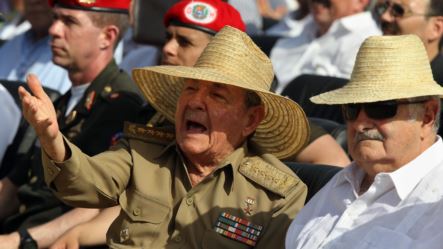
“General Sunhat” and the Moncada / Miriam Celaya

    genreral sunhat2C00CF99-55A1-404A-AC88-EC7E35D54B78_w443_r1_cy1HAVANA, Cuba, August, www.cubanet.org- A few days ago, I decided to to explore around my neighborhood, Centro Habana, about people’s opinion on the evening of the general-president’s speech to mark the 60th anniversary of the assault on the Moncada Barracks.

Neighbors, parking attendants, taxi drivers, forklift drivers, self-employed jewelers, hallway drunks (their votes also count) and known neighborhood persons, individuals spanning several generations were the chosen sample to sound out opinions “from the bottom” They, the “beneficiaries” of the violence of the past six decades, which has become a source of legitimation of power, should have been the most interested in the official dictate.

In vain. Of those questioned, none had seen the act, heard the speech or witnessed the artistic gala. The wittier ones told me they had just turned on the TV without the sound, waiting for the entire ceremony to be over, so they said they had seen “Raul in uniform and a sunhat”. “Don’t ask me anything, just tell me what you thought of General Sunhat”, one of the surveyed countered. It’s marvelous what tact the man on the street has to always discover the most obvious of any event.

Many of the members of the opposition and of independent journalism, however, often listen to the official speeches. It is an exercise in discipline or self-flagellation, depending on your point of view, in which we train ourselves to read signs or to interpret the coded language of the Druids in olive-green. Given the secrecy and the erratic nature of official politics, there are few options left for us, so, at the very least, we speculate about the intentions of the [ivory] tower. However, this time we were left wanting: General Sunhat’s speech contributed nothing at all.

Obviously, only the attendees — guests or those obligated to attend — under the punishing hot Santiago sun, and dissidents, set up at home in front of our TVs, had the infinite patience to listen again to the boring fable of what was really a clumsy attack on an army headquarters of the Cuban Republic, once again glorified as an unparalleled act of heroism in the most lackluster and deficient ceremony yet organized for the occasion.

The speeches of the “friends” who attended the event, some presidents and other individuals representing countries in the region, were also at the height of the date: in the subsoil. Ignorance about the history of this country, about the reality we live today and of the most painful footprints on which Cubans walk today was obvious. It was no wonder, for example, that the President of St. Lucia had the unfortunate idea to remind us of the participation (interference) of the government of Cuba in Africa during the war in Angola, according to him “an example of solidarity and a feeling of racial equity” on the part of the Cuban people. Some political leaders in the region can’t understand that, sometimes, the more proper thing is to remain discreetly silent.

As for the closing speech, its flatness stood out. Without any achievement to celebrate, plans to announce, or ideas to propose on the part of the government, this was, without a doubt, the most nondescript of all speeches made in the history of the ritual embodied by the revolutionary liturgy, held, this time, in a Santiago wrecked after the passage of those other non-uniformed hurricanes, the natural ones that have devastated the city in the past four years, and in the midst of the embarrassing undeclared diplomatic crisis stemming from the detention in Panama of the North Korean ship

Perhaps it would have been more propitious to delegate again the uncomfortable task to the Dauphin Díaz-Canel, in his role as the emergent du jour, in order to disguise, with the “freshness” of the relay, the decadence that filtered through the commemoration, but maybe the pressure of a closed anniversary forced the mandatory presence of one of the protagonists of the epic. “There are still some of us left…” said the general president himself, with a certain justified melancholy. And those “some” have the difficult task, amid the national ever-darkness, to continue selling the Moncada as a luminous dawn.

Thus, in the twilight of the lack of political or economic projects, the chronic lack of productivity of the system, the failure of the reforms and the general apathy, perhaps Castro II wanted to divert the attention of public opinion by premiering his sunhat that contrasted sharply with the well-pressed epaulets of his general’s uniform. Something had to be done, a touch of nonchalance in the midst of so much barren memory, so those present would not fall asleep during the speech. Too bad that, judging from the comments out there on the street, the results fell short of the efforts.

But there is no need to be skeptical. Beyond the ridiculous, let’s be grateful: that unusual sunhat was the only novel touch throughout the ceremony of the consecration of the past in a nation increasingly strapped for the future.

Translated by Normal Whiting

5 August 2013

Cuba Maintains Silence About North Korean Ship / Ivan Garcia

cuba-barco-norcoreanoIf, from the island, a person wants to read about the rusty North Korean freighter Chong Chon Gang, where the Cuban regime was caught with obsolete Russian weaponry, they must pay 4.50 CUC an hour — ten days of a worker’s wages — in one of the 118 Internet rooms opened on June 4.

They can also learn through a shortwave radio. But the daily worry about getting food and the indifference of many people to the comments from politicians, results in a soft landing for the-olive green autocrats.

The control is simple. It’s enough to silence the official media with regards to the news of the soap opera that occurred in the Panama Canal.

After Tuesday July 16, the Foreign Ministry issued a terse note, published in the State media, information about the cache of weapons on a North Korean ship, hidden behind a mountain of raw sugar, has been made invisible.

Cuban officials did not hold a press conference, explaining the reasons for the government to violate the arms embargo established by the UN on the impoverished Kim dynasty.

On July 26, contrary to what some Cubanologists expected, Raul Castro did not address the issue in his speech to mark the 60th anniversary of the assault on a military barracks in Santiago de Cuba.

The internal information policy, for now, is to bear up under international criticism without replying. Even the multinational television broadcaster, Telesur, created with Venezuelan capital generously donated by the late Hugo Chavez, has given little impact to the event.

The news in Cuba must be learned by reading between the lines. Expecting on August 5th that the UN will impose a penalty on the island, the ideological Taliban who control the media, preferred to highlight the military parade held in Pyongyang July 27, celebrating 60 years of the Panmunjom armistice. Among the delegations invited to the celebrations for the ’end of the Korean War’ (1950-1953) was one from the Cuban government, led by José Ramón Balaguer, the ousted Minister of Public Health and the current head of the department of foreign relations for the Communist Party Central Committee.

It is a coded message intended for world public opinion. The regime in Havana doesn’t regret smuggling weapons into the rogue state of North Korea. Two weeks before the incident, a North Korean military delegation, headed by General Kyok Sik Kim was on the island and was received by Raul Castro. “I visit to Cuba to meet with colleagues in the same trench, which our Cuban comrades are,” said Kyok.

Democratic nations should take note. The tepid and insufficient Cuban economic reforms apply only to maintain the status quo.

It’s purely cosmetic. Political oxygen facing the international gallery. A strategy to attract investment and capital from foreigners or moderate Cuban residents in Florida.

A lifesaver to perpetuate the regime. The changes are not driven by an urgent need to push for democracy. No. They are a mechanism to buy time, recapitalize and strengthen state finances and reinforce the regime’s institutions.

The Castro philosophy remains. The enemy of my enemy is my friend. Therefore, news of North Korean ship and its weapons will never occupy the island headlines.

While the Castro brothers hold power, Cuba can change some things, but its anti-imperialist essence remains: America is the enemy.

Ivan Garcia

Photo: Search of one of the containers with weapons from Cuba, hidden under thousands of sacks of raw sugar on the North Korean vessel Chong Chon Gang, detained in the Panama Canal since July 10. Taken from EuropaPress.

6 August 2013

Louis Vuitton in a Little Shop in Havana / Juan Juan Almeida

It’s been so long, I hardly remember when it was that I first heard the phrase “Social Division of Labor” as a concept. This describes the emergence and separation of different types of work in the same society.

A phenomenon that — according to the enlightened — helped to raise productivity, create private property and a society of classes. Masters and slaves, masters and servants, employers and employees.

All this happened naturally. Work originally began divided by sex or by age group. Then came the distance between farmers and herders, and later that of those who, without producing basic inputs, set out to build necessary things, indispensable tools and useful services. Then, to close that big business cycle, capable of linking producers and consumers, traders and/or merchants appeared.

Over the years, this same division separated the sectors of the economy (industry, construction, agriculture, transportation….) and production sectors such as light industry, machine building, metallurgy, horticulture, etc.

It seems to be a lie; but in today’s Cuba, the division of labor has been, little by little, responding to the same sequence so often repeated both in history. Election, inheritance, necessity, chance, permissibility, circumstances and fashion.

It is impossible to forget that for a long period of time, anyone who had a car, including myself, dreamed of being taxi drivers. Doctors, engineers, artists, lawyers, undertakers, officials, military, police or ambulance drivers. All, because get to a place where we can say, “I am private taxi driver,” was similar to shouting “I’m Napoleon and Josephine Bonaparte.”

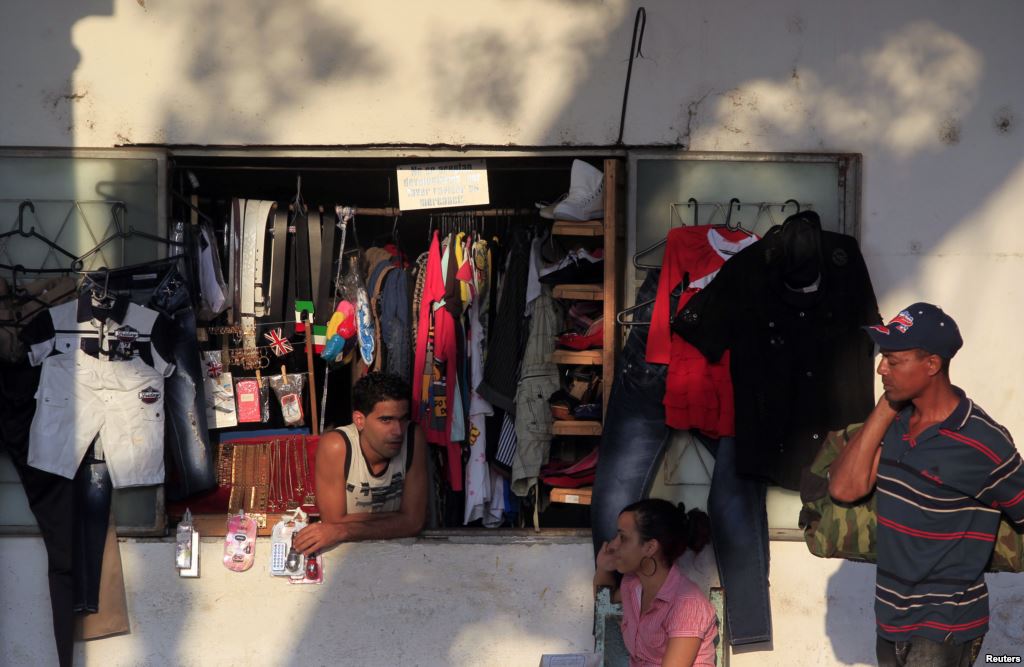
Of course, things have changed and today, at least one’s dreams, the new Cuban aspiration is to buy cheap merchandise, set up shop and go on almost aristocratic national selling spree.

Houses, halls, corridors, rooms, garages, with a little imagination any space is transformed into a great commercial center.

Centro Habana, for example, is now more like the Grand Bazaar in Istanbul; too much merchandise for too few buyers.

In the former Monte Street there’s not a single bit of it that is uninhabited, counters everywhere (they call them showrooms), where you can buy cheap clothes (or brand knock-offs), toothpaste, tubing used, latte, or industrial talc.

Usually these places are supplied by the almost noble act of several battalions of children who dedicate themselves to stealing; state employees who cheerfully take up the art of official theft,  criminals who attack tourists, foreigners traveling to Cuba in plan to lower their costs, hundreds or thousands of Cubans who today form the new Spanish Legion; and let’s not forget hundreds of exiles that for politics (commercial) decided to emigrate and today remember the song “You have to get to school on time.”

Of course, every rule has its exception, there are also gentlemen entrepreneurs who subtly, like temptation, and soft as danzón, hit the target in Havana. On one side of the corner where Avenues and 41st and 42nd converge, in the municipality of Playa, there is more than stores, bridging the huge differences, a tendon stretched to Sarria-Sant Gervasi, the most chic neighborhood or district of Barcelona.

This unique little shop that to the eyes looks somewhat clumsy, hides Roberto Cavalli, Jimmy Shoo, Michael Kors, Louis Vuitton, and all the famous brands, as synonymous with exquisite taste and studied distinction, occupy high positions in the hit parade of national ready-to-wear.

And to find the truth, you have to increase creativity.

5 July 2013

Cuba: Eases Travel to the United States / Ivan Garcia

parquecito-la-habana-cubaTwo days before multiple entry visas good for five years, for Cubans with relatives in the United States, I walked around the outside of the U.S. Interest Section in Cuba (USIS), a few feet from the Havana Malecon.

In the small triangular park located in front of the Rivero Funeral Home, at Calzada and K, where hundreds of people with appointments gather from Monday to Friday, the news spread like wildfire, despite not yet been released by the official media. People had heard through Radio Martí or emails and calls from family and friends across the pond.

As of August 1, Washington decided to extend from six months to five years the period of non-immigrant visas granted to residents on the island to visit the country as tourists. Until now, they had to apply for a permit for each trip and the process could take up to two years.

“With this visa, Cubans who qualify to be granted one would not have to renew and pay $165 each year, as was previously the case for a visa to the United States,” an official located in Florida who requested anonymity said by telephone.

With the new visa, Cubans could travel from the U.S. to a third country. The measure does not include business travel, cultural exchanges or other from Cuba to the United States.

For years, the little park at Calzada and K, has become a gauge of the opinions of many Cubans about the push and pull between the governments of Cuba and the United States.

Not only because every day there are hundreds, and because they come from all provinces. The number of those waiting to be approved for emigration to the United States, under the heading of family reunification, in force since 1994, is significant.

The place also is filled with citizens seeking temporary visas, with the intention of visiting relatives or wanting to settle in the northern nation as political refugees.

The daily grind has transformed the blocks surrounding the Interests Section into an emerging local industry for many residents, who have opened fast food cafes. Eating a lunch of rice and pork I met Eugenio, 43, and asked his opinion on the new measure.

“For two months I have been arranging to visit my daughter and my mother, who have lived in Hialeah for 15 years. It’s the first time I’ve tried. They say that for those who want to visit for three months and are under 45,  the Consulate automatically denies the visa. Apparently, it is for fear they will seek asylum on American soil. Young people are often not granted a visa. In the morning my mother called from Miami, she had read the story in the Journal de Las Americas. I’ll wait a few days and see if I can opt for a multiple entry visa.”

Among those waiting to be interviewed, are also those who say that the USIS officials are too demanding when granting visas to Cubans who are going to visit.

Jorge, 38, has another argument. “It’s because of the Cuban Adjustment Act. I’m crazy for them to repeal it. For three years I have been trying to visit my family in Tampa and have been rejected twice for potentially being a migrant, although I am married and I have two children. But when they look at my age, they are deaf to my reasoning.”

According to Jorge, among USIS officials there is an unwritten rule: to catalog all those who are younger than 50 as prospective emigrants. “I just want to see my family and return. I understand them, but repealing the Adjustment Act would make it easier. I hope this new measure makes the requirements easier for people who request temporary visas regardless of age.”

But also in line are citizens who travel unhindered repeatedly to see their children and grandchildren in Miami. “I guess it’s because of my age. I am 74 and the first time I traveled I had turned 50. The Americans know that I live in one of the best buildings in Havana and it would be crazy not to return,” he smiles.

Coinciding with this relaxation of U.S. immigration authorities, the National Bureau of Statistics and Information has reported that 46,662 people have permanently left the island (in the last year), the highest number since 1994, when due to the so-called “boat people crisis,” 47,000 Cubans took to the sea.

Meanwhile, according to data provided by the USIS, in the first half of 2013 they granted 16,767 temporary visas, versus 9,369 granted in 2012. The 79% increase is directly related to the entry into force on 14 January, a new Cuban migration law.

Although you have to give it time to see the results, respondents applaud the new measure. “Anything that is done to lower costs and facilitate family reunion is positive,” says Clara, a woman in her 60s queuing for free internet browsing on one of the two rooms fitted by the USIS that accommodates anyone requesting access.

In the August 2 online edition of the newspaper Granma, in an article titled New Tools, two specialists appeared, giving their points of view. “It’s a pragmatic decision that lightens the work of the Consular Office of the U.S. Interests Section in Havana”, said the researcher and former diplomat Carlos Alzugaray. For political analyst Ramon Sanchez-Parodi, “It does not change one iota the hostile policy toward Cuba, which remains the same. This measure does not cover ’people-to-people exchanges’ at all, nor does it address prohibitions on Americans traveling to Cuba. However, it can’t be described as a measure openly hostile; it’s convenient, practically and politically for the U.S. government.”

In the squabble that the olive-green autocracy has maintained for five years with eleven leaders in the White House, common sense has been a rare bird. And the openings and relaxations of both sides have been scrutinized with suspicion. Now, it couldn’t be any different.

In the scuffle that for five decades has remained olive-green autocracy with eleven leaders of the
Ivan Garcia

Photo: Miguel Iturria Savon. The little park Calzada and K and in the background the U.S. Interests Section in Cuba. Taken from Cubanet

Iván García

5 August 2013
Alone / Raúl Flores

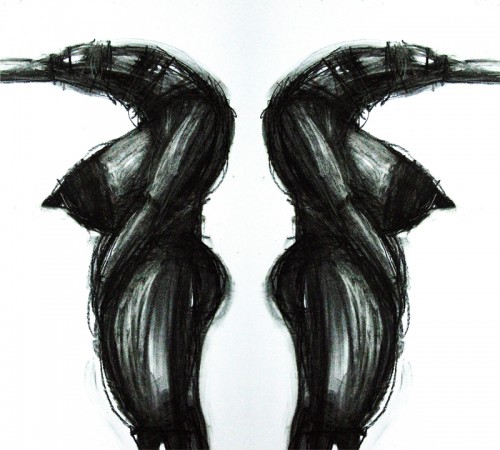
Drawings by Luis Trápaga.

By Raúl Flores

She had the overwhelming feeling that we were alone in this world.

She said to me “Come and look thru the windows”, and I went and looked around and could only be aware of the typical landscape of one of those ordinary evenights rounding October: Foggy shrubs smoothing sadly along deserted streets in the city, and the moon like a white giant patch across the darkened sky.

“Don’t you realize?” she screamed, “Can’t you see?” again she screamed and her voice multiplied echoes in the fall (can’t you see? can’t you see? can’t you see?). “We’re all alone”, she whispered, “Totally alone in this world.”

“What?” said I, “Why do you think so?”

“Don’t you realize?” she screamed again, and her shouting was shooting in the middle of the night: solitude standing, a stone cast towards the moon. She said “Let´s go out. Somewhere. To see what’s new.”

I said yes. So she’d be quiet. I’d have given anything so she’d be quiet. To get all those crazy ideas out of her head. Her poor alienated little head filled with golden hair. Like a Barbie doll. And that’s how I used to think about her sometimes: My little Barbie doll, lost in her little beautiful Barbie world, filled with broken dreams and lost illusions.

So I said to myself: OK, Barbie, let’s go out, let’s be swallowed like Jonah by the fog of these restless times of October, let´s be lovingly mugged by zealous maladroits in the midnight hour.

READ THE REST OF THIS STORY AT SAMPSONIA WAY MAGAZINE,  in its Cuban Newrrative series, Literature from Cuba’s Generation Zero.

Original in English

Breaking News / Jorge Enrique Lage

image23-e1374855259369
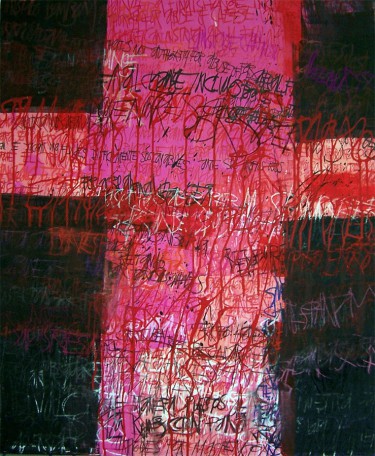
Acrylic on Canvas by Luis Trápaga

She doesn’t mean a thing to me, and yet
I’ll pursue the mystery of her death.

-Rodolfo Walsh

By Jorge Enrique Lage

They say the freeway will crisscross the city. What’s left of the city. By day the bulldozers advance, sweeping away parks, buildings, shopping centers. By night I wander close to the sea, amid the ruins, the machinery, the containers, trying to catch a glimpse of the magnitude of what’s coming. There is no doubt the freeway will be something monstrous.

This is what happens with freeways: It doesn’t matter where they might pass through, at each side the desert begins to grow (like an intention of space, a possibility).

I run into him again tonight. I call him Autistic Man. At one time he was a nerd, a geek, a freak in his own manner. Now he is beyond all that. I find him sitting beside some skeletons of American cars that must be more than a century old. He has made for himself a tangle of various colored cables from which he gets enough light to read the latest issue of Wired Magazine. I gesture hello to him and keep walking. Someone should make a documentary about him.

A mysteriously open container. I shine a match on the metal door. A whole bunch of stickers that say: SNACK CULTURE. Outside, on each end, in even bigger letters, it probably says the same thing: SNACK CULTURE. Inside there is a corpse (there has to be).

“Anything else?” asks Autistic Man.

“Tons of boxes, boxes, boxes.”

“I mean, are there any other bodies?”

“You and I are here, right?”

“Other bodies. Other bodies.”

He is almost asking me for them. I tell him:

“I don’t know why there’d be any.”

A helicopter patrol crosses in front of the moon. When they disappear, Autistic Man stares at me with his expressionless face and says:

“It’s always the same. You, me, and a dead woman.”

READ THE REST OF THIS STORY AT SAMPSONIA WAY MAGAZINE,  in its Cuban Newrrative series, Literature from Cuba’s Generation Zero.

Translated by Guillermo Parma