Sports Euphemisms / Rebeca Monzo

These days on the television screens, fortunately, they have dedicated one of the few existing channels to broadcast (usually delayed but sometimes live) the competitions from the 2013 World Athletics Championships, which are being held in Moscow.

To enjoy this magnificent spectacle, we must disregard the Cuban narration. What for everyone else is a competition, is for our officials “a battle.” While all the athletes from other countries came to participate with brains, legs, arms, etc., the Cubans came to “fight with heart in hand” (something very difficult and uncomfortable in my view).

The “Cuban warriors” seem disconcerted by the noise in the stadium, which is strange for people who live in a country like ours where there is so much noise at all hours, while athletes from other countries do not seem distracted. This was the case with the pole vaulter Yurisley Silva; that’s why the favorite failed, according to our commentators. The same thing happens with public pressure, which seems to affect only Cubans, and not competitors such as Elena Isimbaeva, who was not only going for the gold, but after already announcing her retirement–reasons to be under more pressure, yet she nevertheless got it.

Finally, what I find most ridiculous is that when a Cuban participant earns a medal, it is rare that it is not dedicated to Fidel, rather than to the athlete’s family. I’ve never seen any athlete from another country dedicate a medal to the leaders in power instead of to their loved ones. Another thing that caught my attention, to conclude my disquisitions, is that when a Cuban wins a bronze medal, it usually shines brighter than gold.

To tell you the truth, as much as I like sports, I have to consciously prepare myself not to get infuriated at the bias, the yelling, and the crassness that usually accompany the commentary of Cuban broadcasters, experts in sports and euphemisms.

Translated by Tomás A.

14 August 2013

A Dirty Text on This Wall / Luis Felipe Rojas

Text and Photos: Nilo Julián González Preval

[From LFR: Today begins a series of photographs and texts from the experimentalist artist, Nilo Julián González Preval. My blog, Crossing the Barbed Wire, opens its windows to the artists and writers on the island. On this occasion Nilo presents us with a text, which is nothing more than a photo-reportage on daily life, “if you want it and believe it,” he told us from Havana.]

“Today I went to visit your aunt. I don’t know why this week I haven’t been able to stop thinking about her. How can you live well in Holguin? She is fine. As fine as you can be in an institution of blankets and loneliness. I brought her a pudding and some sweets. A soft drink of mate. I slipped when I was getting out of the truck and looked to see who was laughing. The first one to laugh was going to get it. Gracefulness was what cost me our divorce. Is she very nice? She doesn’t ask me for anything. That is how people lie and lie without any reason. I know that you told me the truth. That you went, and I am grateful to you for the sincerity, although my heart was broken, until Miguel appeared, and it’s not that he is a watchmaker but he took me out of the hole and we could both advance. Are you following what is going on with the Party and politics? In the factory they’re talking about a Chinese boat that Cuba was hiding to make war in America and for the trafficking of arms and other things. I know that this separates us. I was thinking only of the family and about food for our children. As for their education…my politics is a united family and some children who will know that, for me, homeland means the love of my children. Their kisses every morning.

“What is her name? If you ask me to I’ll send you dulce de leche with your cousins who are truckdrivers.

“A big kiss.”

Lavidaenrosas@gmail.com

Translated by Regina Anavy

12 August 2013

Look! Look how the people support us! / CID

“Look! Look how the people support us! You say that the people condemn us…look how the people support us.”  This is what Zuleidys Perez Velasquez repeated on Monday, August 5th to the members of the State (In)Security when the bus that carried 14 detained opponents passed through the center of Holguin.

The opposition leaned their heads out of the windows and yelled “Down with the dictatorship, Down with the Castros, Long live human rights!” and the majority of the people on the sidewalks and streets supported with their cheers, arms and jumps.

Zuledys Perez Velazques, national president of CID (Independent and Democratic Cuba) and a group of activists from various organizations had gone to the provincial offices of State (In)Security in Agramonte street between Area and Libertad in front of the San Jose Park, to protest the abuse against Ramon Zamora Rodriguez and other members of the opposition.

When they arrived, a mob of more than 200 people waited for them with an act of protest.  Zuleidys, Danai Mediola Duquesne and Julio Cesar Ramos Curbelo, as representatives of the group, headed to the offices of Stte (In)Security to demand an explanation for the act of protest.  Major Eliseo ordered that they could not be there.

Zuleidys responded that they were not going to leave until they were given an explanation of those who the henchman said were people who had gathered on their own accord and that they (State (In)Security) were there to protect the opponents to public disturbance.

She responded that they wouldn’t move until they received an explanation and that she had video and witnesses that it had been he who had taken workers out of La Casona (a business of construction materials and an adjoining bakery) so that they would protest.

Realizing that he’d been discovered, the henchmen Eliseo made a signal to the mob to start up again.  The opponents linked arms together.  In response to this attitude, he gave orders for the arrests and the men and women were put onto the bus with punches and pushing.

When they arrived to the Center of Operations in Pedernales they were detained for three hours in the summer sun inside the metal bus.  Later they were let off one by one to be interrogated. They were put into very cold and very hot rooms until 9 at night when they began to be released.  Julio Cesar was threatened, told that they would go to his house and give him a beating.

They savagely beat Juan Zacarias Verdecia, 63 years old and nearly blind. Zacarias’s mouth is destroyed and his ribs are bruised and he was released 8 kilometers away in the neighborhood of Guirabo.  Since he can barely see, he walked for three hours to arrive back to Holguin.

Zuleidys stated that the meeting had been called for all the organizations to come to an agreement to support each other in cases of repression and in reality the agreement  was accomplished through action, it was a success that they facilitated with their abuse.

The reuinion was celebrated in the house of Ramon Zamora Rodrigues, representative of the Orlando Zapata Tamayo National Front for Civic Resistence. Before all the opponents arrived the dictator had  assembled an act of protest and the henchmen took several out of the house by force, among them Zamora, and terrorized the women and children.

The 43 opponents detained on Monday, August 5th, 2013 in Holguin were:

Zuleidy Lisbet Pérez Velázquez
Carmen Oropesa Ramírez
Rosa María Naranjo Nieves
Danai Mendiola Duquesne
Yolanda Pérez Días
Marisol Pupo Rodríguez
Damaris García Martínez
Berta Guerrero Segura
Magdelivia Pelegrino Guerrero
Liliana Campos Bruzón
Livia Hernández Pérez
Maidolis Leiva Portelles
Julio Cesar Ramos Curbelo
Alexander Marrero De La Rosa
Alexei Jiménez Almarales
Jorge Luis Recio Arias
Emir José Bermúdez Pérez
Julio Cesar Albares Marrero
Luis Jaime Meriño
Mauricio Martínez Días
José Luis Ricardo Soberats
Yuri Miguel Carralero Vázquez
Bernardo Cintero Gonzales
Gilberto Solí Gonzales
Ramón Zamora Rodríguez
Maylin Ricardo Góngora
Pedro Leiva Góngora
Juan Sacaría Verdecía
Rafael Leyva Leyva
José Isidoro Urbino Zaldívar
Mairin Pozo De La Torre
Yosbanis Pupo Pérez
Fidel García Roldan
Franklin Pelegrino Del Toro
Rubier Cruz Campo
Yolangel Pupo Pérez
Ricardo Rodríguez Feria
Amauri Güero Mora
Roberto Gonzales Hernández
Eladio Pupo Nieves
Arlenis Rodríguez Ávila
José Luis Mir Cruz
Amilkar Pérez Riverón

7 August 2013

I Have Two Homelands / Reinaldo Arenas (from the blog of Luis Felipe Rojas)

Reinaldo Arenas, the genial writer from Holguin, the dissident against all the banners he saw fluttering before his path. Those homelands of Marti that he could rewrite, Cuba, his immense sorrow, and the night, that friend who accompanied him up to that final hour in which we all find ourselves.

I have two homelands: Cuba and the night.

By Reinaldo Arenas

Both plunged in a single abyss.

Cuba or the night (because they are the same).

They both confer the same reproach

In the foreign land, of a braggart ghost.

Until your own fright is an illusion,

A lost wheel of a foreign coach

that rushes into a cataclysm

where breathing is itself a waste.

The sun has no light and it would be cynicism

that the time you were living was for loveliness.

If that is the homeland (the homeland, the night)

that has left us centuries of egoism,

I await another homeland, that of my madness.

*Translator’s note: The title of this poem is the first line of a poem by José Martí, titled “Two Homelands.”

Translated by Regina Anavy

24 July 2013

Photo-report: A Demonstration in the Middle of Miami

The activist, Jesús Alexis Gómez, during an hour of rest, showing symptoms of fatigue.

I have just come from the corner of 13th Ave. and 8th Street in the heart of Little Havana. There the activist for human rights, Jesús Alexis Gómez, and the leader of the Democratic Movement, Ramón Saúl Sánchez, have been carrying out for 17 and 10 days, respectively, a hunger strike. Their goal is to call the world’s attention so that the Governor of the Bahamas frees and stops torturing the Cubans who are detained there, when they arrived on the coast in search of a longed-for liberty.

Alexis converses with his brothers in struggle.

Ramón Saúl interacts with the activists.

Ramón Saúl Sánchez took advantage of the occasion to exchange words with his organization’s activists and give instructions about the strategy to be followed. In the state in which he finds himself, he writes his opinions about the boycott of the Bahamas and the purpose of the strike.

The leader of the Democratic Movement continues his work to call for the world’s attention and solidarity with the prisoners now in the Bahamas.

An activist, upon leaving church this Sunday, went to the tent to offer a Christian prayer for the strikers and the prisoners in the Bahamas.

Posters, placed in public view.

Many visitors pass by without asking, although their curiosity is aroused.

…but others arrive and ask about the reason for the strike.

The activists help expand the space and put up signs.

The demands go from the cessation of torture to the unconditional release of the detainees in the Bahamas, without sending them back to Cuba.

Translated by Regina Anavy

4 August 2013

Understanding Another Reality / Fernando Damaso

Photo: Peter Deel

Cuba’s state-run press has been commenting on the protests by students in Chile and their demands for free education. Not surprisingly, it has used these protests to generate propaganda extolling the benefits of Cuba’s own form of free education. I have no intention of reiterating the well-known and long-standing deficiencies in the Cuban education system, or for that matter in the healthcare system, both of which have been funded by subsidies, first from the former Soviet Union and later from Venezuela, courtesy of Hugo Chavez. Instead, I would like to imagine what “the morning after” might be, with some personal considerations in mind.

In spite of the economic difficulties it would entail, I believe that the new Cuban state would be obligated to guarantee that both education as well as healthcare remain free to all citizens, which logically should be of better quality than the systems currently in place. To realistically deal with the associated costs, it will also have to allow for the existence in both sectors of private institutions for those who have the financial resources and the inclination to make use of them.

The false and demagogic egalitarianism underlying both of these cost-free systems is in reality based solely on a shared misery endured by most of the population even as the differences between one citizen and another becomes increasingly evident every day. On the morning after — no matter how quickly it comes — these differences will be even greater, a result of “updating the model” and the “change” that will ultimately occur in any event.

We will have to confront it with our feet planted firmly on the ground and without unreal utopian visions. Undoubtedly, free state institutions will co-exist alongside private ones, as they do in most countries. Citizens will choose to access one or the other based on their own economic conditions and personal preferences. The false concept of the patriarchal state which controls, guarantees and decides everything has, after fifty-four years, been roundly proven to be a failure. It must fade away and be replaced by a modern, democratic state — one marked by economic efficiency and social justice — whose potential will be determined by the nation’s wealth, which will be the product of the initiative and hard work of all its citizens.

13 August 2013

Change: The Power of a Word / Reinaldo Escobar

Change

Perhaps the most interesting and at times heated discussion of today with regards to Cuba is that around whether or not it is lawful to recognize that changes are occurring in the country. In this area the most frequent responses are usually: “Nothing has changed here,” or “Things are changing, but not enough.” What I haven’t heard anyone say is: “We’ve already changed everything that needs to be changed.”

Someone told me that in North Korea the most recent of the Kims authorized six new styles of haircuts as part of what he considers a process of reforms. I don’t dare assert that this is true, but I like the example. One can’t deny that a measure of this type, apart from highlighting the existing level of prohibitions, would have to have brought ounces of joy to Koreans, especially the youngest.

I remember how some foreign correspondents accredited in Havana celebrated, almost with jubilation, the news that we Cubans could now legally contract for cellphone service. Suddenly the cancellation of a xenophobic ban, which for years had placed nationals in a humiliating and discriminatory situation, was exposed, along with the permission to stay in hotels, as an unequivocal sign that Raul’s reforms were serious.

Later, in drips and drabs, we were authorized to sell houses and cars, the list of approved self-employment occupations was expanded, the hiring of labor was permitted, and some extensions were made in the matter of land leased in usufruct.

More recently, the long awaited and controversial migration and travel reform was approved, and some places were opened where one can connect to the Internet. Right now the so-called “non-agricultural cooperatives” have the illusion that they will be the prelude to small and medium-sized private businesses.

Surely I’ve forgotten some aspect that could be incorporated in the rosary on which the prayers for change are said, especially in some academic circles, however it is not in the tiresome enumeration of the previously mentioned measures where it can be demonstrated that something is moving in Cuba. The change is seen in the results.

Starting with cellphones, I must say that the vast majority of opponents, independent journalists, bloggers, human rights activists and other spheres of civil society, use this tool systematically, especially to communicate any complaints or news via text messages or tweets.

The decrease in the dependence on the State sector, personified by nearly half a million self-employed in the country, has produced a change of expectations in the work environment, with deep social and political connotations.

The now numerous trips abroad by the majority of the opposition leaders and civil society activists, has contributed to breaking what was, until now, a monopoly on the export of a vision of the country in international events, and has encouraged a stream of contacts at the highest level between Cubans on the Island and those in the diaspora.

Moreover, and no less important, the middle class is no longer demonized, and taking advantage of the decrease in prejudice against them they have started to find their own spaces, initially to exercise their inherent consumer exhibitionism; sooner or later to develop new external paradigms and to negate all the “New Man” rhetoric, proclaimed by the now-exhausted social engineering of Communist affiliation.

All this has happened in just seven years. The most important argument to deny that these things can be seen as “the change,” and even simply as “changes,” is that the only intention of their promoters is to stay in power.

I share this view in reference to the intention of those who govern, but the paradox is that they have understood that the only way to stay in power is to cede it; and the governed — that is us — we have realized that it is no longer enough to repress us, monitor us, arbitrarily imprison us, to organize hordes to stage repudiation rallies against us. We know they are ceding and we have the civic obligation to take advantage of every inch, as adolescents with authoritarian parents have always done.

If we aren’t capable of seeing and appreciating the cracks that we ourselves have helped to open and widen; if we keep our eyes fixed on what has not changed without noticing what is changing, we run the risk of acting like the elephant that keeps walking in circles around the axis where it once was bound, not realizing that the old rotten stake can no longer hold.

13 August 2013

Alvarez Guedes: Let’s Keep Everything Among Cubans / Ivan Garcia

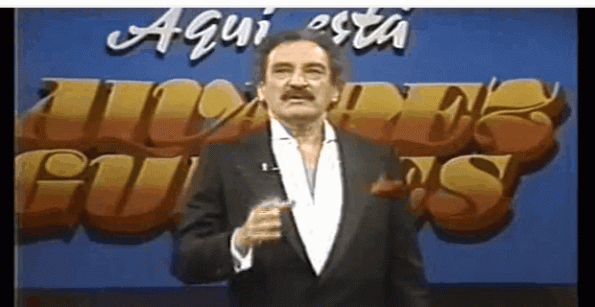
alvarez-guedesIn spite of being censored on the island, the Cuban comedian who passed away on July 30 in Miami at the age of 86, left us a saying indelibly etched upon all of our lives.  If someone was trying to be a wiseguy, you would say: “Hey, don’t get cute.  The only one capable of making a living telling stories is Álvarez Guedes.”

After Fidel Castro closed the daily papers and reigned in freedoms of expression in 1960, those of us born after know well how the secret police pursued and banned the humorists who, with laughter, criticized the daily comings and goings of the olive green madhouse.

It got to the extremes.  One evening, a retired reporter once told me that an urgent meeting was called in the offices of Granma, the official newspaper of the Cuban Communist Party, to disclose and analyze an erratum that occurred in the previous day’s print run.  In a column of newsbriefs, a humorist had drawn a skull and crossbones that, when held up to the light, ended up transposed on the chest of a photo of Fidel Castro.

This stirred up the hornet’s nest.  The ideological censors never had much imagination.  The poor type-setter was interrogated by the counterintelligence hounds, seeking out a double-meaning that he swore on his mother he hadn’t intended.

More than a few times, from his office in the Palace of the Revolution, the Comandante would walk down a secret hallway that led to Granma’s editorial department and review the features, news, and articles that sat on the starting grid awaiting publication.

Believe me, these aren’t simple rumors.  Ask any Cuban comedian about the difficulties and censorship they’ve encountered in their work.  Some were let go.  If it hadn’t been so serious, it could’ve been thought of as a farce.

During their performances, while the public laughed, a dour agent of the secret police would take note of the jokes supposedly harmful to “the figures and institutions of the Revolution”.

Of course, the man who transformed jokes into an artform was thoroughly banned from the Cuban media.  Considered “counterrevolutionary” by the regime, his tales reached us as contraband from the other side of the Straits.

Guillermo Álvarez Guedes was born on June 8, 1927, in Unión de Reyes, a town full of troubadours and rumberos in the province of Matanzas, just over 140 kilometers east of Havana.  He was the second-to-last of seven children produced by the marriage of Conrado Simeón Álvarez Hernández and Rosa Guedes Fernández.  Eloísa, his eldest sister, who passed away in 1993, was a magnificent radio, theater, film, and television actress.

Guillermo’s first public performance was at the age of six, in a neighborhood cinema house.  At 13 he left home, doing odd jobs for a theatrical circus.  At 19 he went to New York, where he earned a living washing dishes, cutting grass in a cemetery, and as a porter in a hotel.  In 1949 he was deported back to Cuba and began working first for Unión Radio, and then for Radio Progreso, on the Poor Man’s Attorney show.

He was 22 years old when he was signed on by Gaspar Pumarejo.  He played an improvisational singing peasant with three giants of Cuban humor: Germán Pinelli, Aníbal de Mar and Leopoldo Fernández.  But the role that would make him famous was that of The Drunk, beginning in 1951, on the stellar Casino of Joy on CMQ-TV.  That’s when he teamed up with the one and only Rita Montaner on Rita and Willy, short-lived due to differences between Montaner and the producers.  Then, on Fridays at 8:00, he would have a lead role at the side of Minín Bujones.  In 1953, he was a cast member of the musical review The Courtyard, sharing the stage with Carlos Pous, Luis Carbonell, Benny Moré, Rita Montaner, and Olga Guillot.  That was also the year of his cinematic debut as an actor and producer.  Let’s Keep Everything among Cubans would be his last film (1993).

In 1957, Álvarez Guedes and his brother, Rafael, partnered up with the pianist and composer Ernesto Duarte and founded Gema Records, the label responsible for the international launch of Cuban artists of such stature as Bebo Valdés, Chico O’Farrill, Rolando Laserie, Elena Burke, Celeste Mendoza, and Fernando Álvarez, and of groups like El Gran Combo de Puerto Rico.

He made his last show in Cuba with Rosita Fornés.  On October 23, 1960, he emigrated to the United States with his wife and two daughters.  Celia Cruz was a passenger on that same flight.

The first LP of his jokes, of the more than 30 that he recorded, was premiered in Madrid in 1973, as an homage to the Sevillian flamenco-dancer Pastora Imperio.  His only LP in English, How To Defend Yourself From The Cubans, has sold more copies than all of the ones recorded in Spanish.  In 1983, at age 56, he packed the house at New York’s Carnegie Hall.

An anecdote: in the 80s, as a teenager, at the home of a classmate, on a beat-up, old tape recorder on a very low volume setting, almost inaudible, I heard a collection of jokes by Álvarez Guedes for the first time.

My friend’s relatives, who lived in the Cayo Hueso neighborhood of Central Havana, had managed to sneak the cassette through customs by hiding it inside a cookbook.  Álvarez Guedes’ stories, like the athletic feats of one Atanasio Pérez, always reached us as contraband.

With the death of Álvarez Guedes, we’ve lost one of the best exponents of Cuban theatrical humor, an innovator of modern comedy; but we’ve especially lost a human being who knew that his countrymen on the island lived between hardship and Orwellian single-mindedness, and we needed to laugh.

We’re grateful for his legacy of stories, preserved today in so many Cuban homes on cassettes, CDs, DVDs, or flash drives.

Like no one, Sir Guillermo knew how to leap over the walls of censorship.  Humor and laughter can never be contained.  Álvarez Guedes proved it.

Iván García

Translated by Yoyi el Monaguillo

1 August 2013