Humanitarian Demand / Rafael León Rodríguez

  1. In recent weeks we have heard some information in the United States media about the possibility of selling medicines produced in Cuba in that country, particularly Heberprot-P, a drug for the treatment of diabetic foot. On the other hand, the Cuban authorities continue to express themselves about the obstacles facing them in buying certain medications and medical instruments produced in the US, due to the restrictions occasioned by the politics of the US embargo on the island.
  2. There are different opinions about this issue, both for and against, dismissing the urgencies of those priorities which should be considered: the diabetics in the United States who could be treated with Heberprot-P avoiding, in some cases, dangerous amputations of their extremities, and of patients in Cuba who can’t access treatments to cure them or to improve their quality of life because some medications and specialized instruments produced in the U.S. can not be purchased by Cuba.
  3. Faced with any discussion on this issue, it is important to take into account Articles 12 and 15 of the United Nations International Covenant on Economic, Social and Cultural Rights and the “Declaration on the Use of Scientific and Technological Progress in the Interests of Peace and for the benefit of humanity,” among other things.
  4. For all these reasons, the undersigned, Cubans and Cuban Americans, members of independent civil society and citizens in general, affirm our determination to support, from a vision of respect for human rights, the possible analysis that would permit the expansion of everything related to scientific exchanges in the areas of drug development and medical techniques. Also, the marketing of medicines and specialized instruments for these purposes, in order to meet the medical care needs of people who need to be treated in both countries.

Julio Aleaga Pesant — Independent Journalist
Hildebrando Chaviano Montes — Independent Journalist
Manuel Cuesta Morúa — Progressive Arc
Siro del Castillo Domínguez — Solidarity with Cuban Workers
Gisela Delgado Sablón — Independent Libraries
Eduardo Díaz Fleitas — Pinar del Rio Democratic Alliance
Reinaldo Escobar Casas — Independent Journalist
René Hernández Bequet — Cuban Christian Democratic Party
Rafael León Rodríguez — Cuba Democracy Project
Susana Más Iglesias — Independent Journalist
Eduardo Mesa — Emmanuel Mounier Center
Marcelino Miyares Sotolongo — Cuban Christian Democratic Party
Héctor Palacios Ruiz — Liberal Union of the Republic of Cuba
Oscar Peña — Cuban Pro Human Rights Movement
Pedro Pérez Castro — Solidarity with Cuban Workers
Rosa María Rodríguez Torrado — Cuba Democracy Project
Wilfredo Vallín Almeida — Cuban Law Association

21 November 2013

Marta Beatriz Roque, Injured by State Security / Lilianne Ruiz

On Tuesday we learned of the beating of Marta Beatriz. They didn’t just beat her, they also dragged her up the stairs, 31 steps, beating her neck and whole body. I did not ask Marta’s age but she is an older woman, perhaps older than 60. She was the only woman in the group of 75 (from the Black Spring of 2003), imprisoned for her activism and for publishing her opinions against the regime.

She, a group of activists and friends, had been standing in front of the Zanja police station to protest the harassment she suffers from some of her neighbors.

That morning Marta had refused to let her house be fumigated with smoke and oil, an invasion on the pretext of doing away with the mosquito that carried dengue fever. There are other methods of fumigation, which here they call “special” that also eliminate the larva and the mosquitoes, but that was not available and the smoke was spreading into the house through the slats of the blinds, and the smoke is toxic for people with asthma and any respiratory problems, like her.

I can’t stand even the noise these smoke machines make and also that any stranger can come into our rooms. Sometimes they must enter our houses along, because if the smoke injures us they assume we have to leave for them to fumigate, and trust they won’t touch any of our personal things.

To me, it seems like a form of violation of our spaces. On the other hand, the city is full of trash dumps and potential breeding grounds for mosquito larva, huge deposits of stinking water. But our houses are preferred by the State.

Marta had spent the whole night in front of the police station, protesting. At 7 in the morning a police car stopped in front of her she was taken by force by two of those rude women who join the Ministry of the Interior — it’s sad to see what they turn into because of their envy and hatred, attacking without scruples any enemy o the government.If the order was to kill they would kill. It seems they have no conscience.

They are the result of ideological propaganda and the zone of ignorance fed to them by the free education of the State. Later you see them coveting any trinket, proudly receiving some jewelry, probably the fruit of Customs forfeitures, as a reward for their cruelty.

The two MININT women were beating Marta the whole way, stopping at the entrance to the building where she lives, on Belascoain, and dragging her out of the car. They continued dragging her up the stairs without allowing her to stand up, the 31 steps to the door of her house.

Since then her home has been under siege by the police. The second day didn’t let her 17-year-old nephew come up to bring her juice. The two activists with her happened to be in the house because they went there to make coffee to take to the Station, and were surprised to see Marta beaten, swollen and bruised, with the veins of her arms and legs on the point of splitting from so much trauma. They won’t let them see her, which seems to be the point of the siege at the house; perhaps they are waiting for the bruises to fade.

But Marta Beatriz hasn’t been able to be seen by a doctor. She is taking anti-inflammatory pills that have begun to damage her stomach. Yesterday they were arresting all those who came to visit.

21 November 2013

Never-ending Wait / Cuban Law Association, Esperanza Rodriguez Bernal

Esperanza Rodríguez Bernal

Juan José returns to the Cuban Law Association for advice because the Compensation Fund has paid only 3,000 of the 39,000 pesos that he was awarded in the judgment of the People’s Municipal Court of Arroyo Naranjo as compensation for the injuries and damages caused by Ernesto, the driver of the Ministry of Agriculture truck that collided with his vehicle.

He told us that he has gone to the Fund many times and that the answer is always, “we have no money to pay.”

His health condition caused by the accident has deteriorated: he has had to undergo two operations on his arm, and two on his spine, declining a third because of the risk of being rendered completely disabled.

To make matters worse, his wife had to undergo surgery for breast cancer, resulting in expenses for transportation and food that his retirement pension cannot cover.

Juan contends that if he could have recovered the majority of the compensation he could at least have fixed their vehicle, and this would have allowed him to get a taxi-driver’s license in order to improve their economic situation.

A letter from the Director of the Compensation Fund dated March 13, 2012, informed Juan, among other things, that “the obliged or debtor has not begun to pay the civil liability imposed by the Municipal Court of Arroyo.”

The letter added that the Fund serves as an intermediary through which the injured party can collect, but it does not take on the responsibility of the debtors to pay the compensation, and therefore it has no funds for assuming that responsibility.

The judgment declaring Ernesto responsible was dated July 6, 2011, and in May 2012, Juan José had recovered only a fraction of it.

According to Article 26 of the Constitution, Juan has the right to make a request to confirm the legality of the judgment of the Arroyo Naranjo Court because it has not been complied with, as regulated in Article 474 in relation with Article 473 of the Labor and Economic Administrative Civil Procedure Law, as well as that established in Law 82 of the People’s Courts in Articles 6 and 7, paragraphs a), b), c) and f), which expressly states:

The courts must effectively implement the rulings that they issue and monitor compliance with them by the agencies charged with being involved in the implementation process, and must also perform the acts prescribed in the appropriate procedural laws, when the execution of their rulings lies with other state agencies.

How much longer must Juan wait to collect the compensation that the Municipal Court of Arroyo Naranjo ordered in a final judgment?

If the agencies charged with enforcing the law do not take the matter in hand, Juan’s wait will be never-ending.

13 November 2013

To Disparage, It’s a Pleasure / Fernando Damaso

Photo: Peter Deel

Since the introduction in early 1959 of the term bitongo* to refer to youths who voiced opposition to the newly formed regime, Cuban authorities have routinely used denigrating terms when referring to those who do not share their ideas or their proclivity to publicly express them.

Annexationists, Plattists, mercenaries, imperial lackeys, traitors, stateless, anti-Cuban and many other epithets have been extensively used for more than fifty-four years. They continue to be used even today as tools in campaigns to discredit opponents. The term most commonly employed, however, has been gusanos, or worms.

Gusanos were professionals, intellectuals, artists, workers and students who first said no and they are those who continue to say no. The term has become so ingrained in the public’s mind that many people use it indiscriminately, without thinking about its meaning, to refer to anything that veers from the official party line. For these people there is no such thing as someone who thinks differently; there are simply gusanos.

Inertia has led some opponents and dissidents to also use the term when referring to themselves or to others who sympathize with their ideas. A well-known woman, now deceased, who was opposed to the regime from its very beginnings, used to say with pride that she was a “protozoan worm.”

While not going such an extreme, the term’s usage continues to grow even today within Cuban society, throwing a log on the fire of division and political confrontation. It is the preferred term among defenders of the regime during disturbances carried out by students, workers, professionals, artists, housewives and others mobilized under the official banner of “an enraged people” who participate in “acts of repudiation” against the Ladies in White and other peaceful opposition figures.

The term anti-Cuban is reserved for those living overseas, wherever they may be, who carry out orders issued by “Miami’s anti-Cuban mafia.” In reality what exists in Miami is a powerful group of Cubans opposed to the government — a situation repeated in other cities around the world — just as there were Cubans opposed to the Batista dictatorship in the 1950s. It did not occur to anyone at that time to label them anti-Cuban because they were not that then nor are they that now. Politics is one thing; Cuba is something entirely different.

Distorting terminology to take advantage of the confusion this creates and generalizing disrepute has been a regular practice of Cuban authorities. This is not conducive to creating the climate of tolerance and mutual respect essential to producing the national dialogue that Cuba needs.

Translator’s note: Someone who is arrogant, haughty, vain, swell-headed; a bourgeois youth.

19 November 2013

Prison Diary LXVIII: New Challenge for Castro: Violate Human Rights While Being a Member of the UN HumanRights Council

The dictatorship frightened and cautious

The Cuban government has decided once again that the “Bastion” exercises would be held just on the even of December 10, the day celebrated for Human Rights.  It’s their way of oiling the “defense” machine, which is intended only to send a sly message to the opposition that they are prepared to attack the smallest anti-government movement, and who have already activated their repressive measures.

Young woman attacked with machete by Castro supporter

Young woman attacked with machete by Castro supporter

Laura Pollán and other Ladies in White attacked by a government mob

Laura Pollán and other Ladies in White attacked by a government mob

Ladies in White being arrested

Ladies in White being arrested

To manage the infrastructure deployed war, the country is spending millions that it can’t afford to waste, especially knowing that thanks to the military investment for more than five decades, they have plunged this country into total misery.

Days before I see the concern of State Security that opposition groups will carry out a demonstration, especially the dreaded Ladies in White. They have their spies desperately seeking information about the planned day and time.1385046202_che1385046203_raulcastroexecutes1385046203_raul-castro-sierra-maestraRaul Castro knows that in becoming a part of the United Nations Council on Human Rights he is committed to respect them. He has to wonder, what he disrespects them, what is that same UN Council going to say about such a breach. Will it be the first time a member of the Commission is expelled for not honoring what it is supposed to respect?

Newspaper article about the concentration camps for religious, gays and other “counterrevolutionaries”

In fact, it’s a great contradiction, like being the “President” of the Community of Latin American States (CELAC) and not showing respect for it, nor for the countries represented. What is corroborated by the Castro brothers is that it’s all a chess game to gain time in power and to manipulate international public opinion. To be part of the Council is their “Sword of Damocles.”

Mourners arrested at Oswaldo Payá’s funeral

What we do know is that the dictatorship has a new challenge ahead of it: to ridicule the UN or give way before the basics that prevail in this 21st century, which is respect for individual rights. We can only wait, call on the international news media to pay attention to current events in Cuba, because December 10 will not pass unnoticed.

Ángel Santiesteban-Prats

Lawton Prison Settlement, November 2013

21 November 2013

Public Services: Horror and Nightmare / Jose Hugo Fernandez

cap
The Rapid of Ayesteran and Boyeros in Cerro. Photo: Jose Hugo Fernandez

Havana, Cuba, November,  www.cubanet.org — In a state cafeteria called The Rapid, in the Havana neighborhood of Cerro, the clients do not have access to the television installed there for public purposes.  The equipment shows them only its backside while the screen remains facing the employees, who hoard it for their exclusive use.  It may be a trivial detail, but it really is an expression of a very serious conduct, on which rests the chronic crisis of public services in Cuba.

Because of a malformation that has become endemic and whose origins are rooted in the bad example and bad seed that the totalitarian dictatorship disseminated among us, the employees of this kind of public service seem to be convinced that it is their customers who owe service to them, not the other way around.

If bureaucrats abuse on a whim the time and patience of those who pay them to be attended to, or if the employees of the business and food receive customers as if they were intruders who slip onto their private property, that is not due only — as is customarily said — to the “employment unsuitability” nor to the big gaps in their school preparation.

The destruction of the culture of good service among us is above all a consequence and expression of the system of government that we have suffered in the past five decades. In fact, the regime itself represents the first major evidence of the problem, since instead of being a servant of the people, as all governments are required to be — in concept and in practice — it inverted the terms from the first day, making us its servants.

No analysis, no project to address the debacle of our public services, could be purely objective if there is no recognition of the basic causes and if it does not conceive of their eradication as a first step.

As in the oldest and and most rancid monarchies, Cuba is marked by many small fiefdoms. With the disadvantage that our offspring of feudalism reached a high in that it ceased to be functional even for the king’s own interests, and turned into  just a surreal counterproductive nightmare.

At the summit are the chiefs of the regime as absolute sovereigns. Then come the subordinated of power, who have their parcels distributed according to the influence of each group or individual, and how close they are to the king. In this direction the pyramid descends to the most ridiculous extreme. So anyone who is holding anything in their hands needs those who are lower on the scale, making a fiefdom of their limited domain. And in the end there are only the serfs, whom, moreover, also create tiny fiefdoms, such as public service employees.

Life right now is showing us that it was naive to think that with the opening of small businesses by the self-employed, that at least in this area headway would be made in improving customer service.

The truth is that in its fundamental aspects, the culture of good service is not enjoyed in the establishments and other means of self-employment. Both when they stop doing what they should, and when they do they should not, the way that most of the self-employed serve their clientele does not distinguish them as people who have had a change of mentality.

Negligence and sloppiness is so deeply rooted for so long among us, that it is not possible remedy it unless we start by removing the evil at its root.

José Hugo Fernándaz

Cubanet, 18 November 2013

ETECSA, A Bankrupt Monopoly / Pablo Pascual Mendez Pina

DSC07931That we are in a state of ruin is something that no Cuban in his or her right mind really questions, though we have become all too accustomed to the cynicism of the architects of this disaster, who continue to blame the “Yankee blockade” for all the misery afflicting people.

As though this were not enough, it is appalling to see Havana overrun with billboards and posters touting utopian slogans such as “Let us fight for a prosperous and sustainable socialism.” And “Revolution means never lying or violating ethical principles.” Or “Banish the fear of looking for problems in fulfilling our duties.” One cannot walk even a few kilometers to refill a mobile phone account, to wait in line in hopes of resolving some bureaucratic issue or to file a complaint without coming across a marquee announcing, “ETECSA, on line with the world.”

What is obvious is that the state telecommunications monopoly, commonly known as ETECSA, is no longer a public-private partnership with financial backing from the multi-national telecommunications firm Telecom, whose employees wore uniforms, drove a fleet of vehicles and had access to spare parts in order to respond to the needs of its customers.

Some 85% of workers questioned believe that, ever since ETECSA fell into the hands of GAE – a business arm of the Ministry of the Interior (MININT) – it has become a kind of Cinderella. Innumerable questionnaires indicate that it has also become known for its inefficiency.

Rolando Chapotín, a 70-year-old retiree from Vedado, describes how an ETESCA employee fit together various bits of cable to fix a problem with his landline. “It was obvious he did not have the parts he needed,” says Chapotín, “but he worked hard to resolve the problem until fortunately it was fixed. That young man made me forget about all the waiting in line and arguments with bureaucrats. Now I would like to know where the hell all the money that GAE takes in is going.”

To the question “Why does it take so long for ETECSA to resolve problems that have been reported?,” a technician replies, “We don’t have the vehicles, we don’t have the materials, we are short-staffed, wiring is no longer well-sealed and whenever there is a downpour, the problems multiply. There’s also a significant number of customers who have spent three months waiting for their landlines to be repaired.” The technician summed it up by saying, “ETESCA might be on line with the world, but not so much with Cuba.”

From Moron to “Cuba Says”

The government sponsored website Cubadebate reported that this past October a meeting of company directors from the eight eastern provinces was held in the town of Morón. It was chaired by Mayra Arevich, an engineer and the current chief executive of ETECSA. The goal was to prioritize the handling of complaints from the public and to analyze problems associated with mobile phones and landlines, services to which only three million customers currently have access.

Hilda Arias, ETECSA’s head of mobile phone services, told those present that there would be an increase in capacity of 270,000 just this year, resulting in a growth of two million mobile phone lines, or the equivalent of 18% of Cuba’s population.

According to anonymous sources a significant part of this increased capacity is destined for use by the Revolutionary Armed Forces Ministry (MINFAR), the Council of State, the Council of Ministers, the offices of the Communist Party and other governmental organizations. These are services to be paid for indirectly by private customers.

A recent installment Cuba Dice (Cuba Says) — an ongoing series broadcast by Star Television News (NTV) in which official journalists solicit opinions on pertinent topics from people on the street — raised the issue of problems with telecommunication services.

As might be expected, 90% of respondents complained of punitive fees on mobile phone and internet services, and the ludicrous 5 CUC mandatory monthly charge for maintaining cell phone service.*

Other complaints involved overcharging to refill pre-paid cell phone accounts, long lines at branch offices and retail outlets, and the inability of local customers to take advantage of double-airtime offers available to overseas customers.

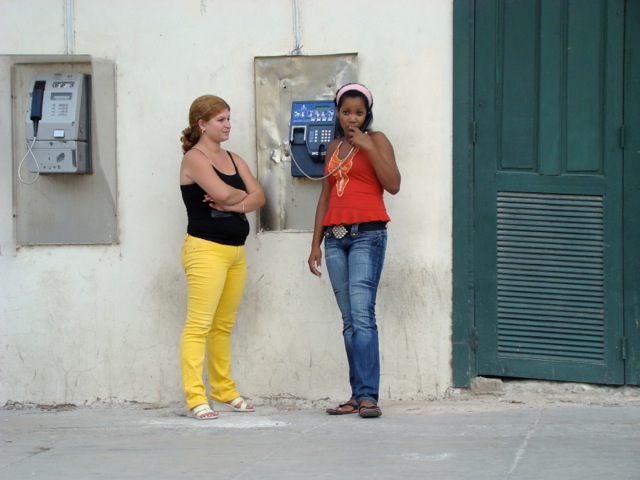
However, the most pointed criticisms involved the refusal by officials to increase the number of landlines and pay phones, restrictions which impact the poor, who cannot afford the cost of mobile phone service.

In interviews company directors distanced themselves from the serious financial problems facing ETECSA and its inability to made new investments in infrastructure. They say that most of its income, which is in the form of convertible pesos (CUCs), is spent just on subsidizing local phone service.

“Mobile phone service in Cuba costs 2.50 dollars a month,” says Hilda Arias, the aforementioned director of ETECSA’s cell phone services. According to Arias the company is obliged to offer double-airtime minutes to attract overseas customers due to the need for “fresh sources of hard currency.”

Sniffing around

A former ETECSA director, who requested anonymity, stated that in the 1990s a Telecom vice-president informed his Cuban partners that his company was willing to make the investments necessary to provide a landline to any Cuban who asked for one.

“At the time international calls were the principal source of ETECSA’s revenue and it was clear that increasing the number of domestic customers would increase profits,” he says.

“The company’s Cuban partners, however, were strongly opposed and agreed to only a modest expansion, with priority given to workers in healthcare and education. Assigning the remaining increase in capacity was left to the mercy of Revolutionary communities and organizations.

“Up till now,” says the former director, “Cuba has not even been able to double the capacity it had in 1959, when there were eight landlines for every hundred residents and it ranked 14th in the world in terms of telephone coverage.”

In contrast the former director points to the case of neighboring Haiti, which had a rate of phone coverage lower than that of Cuba. But because landlines and pay phones were considered obsolete, it successfully extended mobile phone service to nearly 85% of the population in a very short period of time.

Asking not to be identified, a former MININT official stated, “One of the justifications for slowing the growth of phone service in Cuba is that there is a requirement that any increase in private telephone coverage be augmented by an equivalent increase in the monitoring capabilities of the CIN, MININT’s counter-intelligence branch. The systems for telephone surveillance, known as K1 and K2, must have a capability of 100%, as was the case in the former East Germany.”

According to this source, internet use is also under surveillance. Monitoring, however, is not clandestine. State Security actually likes citizens to feel they are being watched.

“ETECSA has become a military organization,” says an anonymous worker. He is referring to the change in administrative structure under the aegis of GAE. “Now the old branches are called divisions and other department have been reclassified with names like Strategic Projects and Logistics.”

In spite of these changes, some ETECSA directors and workers are still dipping their hands in the till. As is the case in any given part of Cuba, corruption thrives in the absence of other financial incentives. Sources indicate that one distinctive feature of ETECSA is that it is the employees who previously worked at MINFAR and MININT who have proven to be the most corrupt.

Some ETECSA workers admit to having been shocked when Miamir Mesa, an engineer and former head of the company, was given a promotion and put in charge of the Ministry of Communications after a notorious corruption scandal which came to light in July 2010 involving Cubacell as well as Logistica, a firm with ties to foreign companies.

During his tenure at ETECSA he used and abused “means of collateral responsibility” for which company directors were called to account for irregularities and misdeeds by their subordinates.

The client is never right 

At the end of the October 25th broadcast of Cuba Says on NTV, a constituent from the Carmelo people’s council in Havana’s Vedado district — a man nicknamed “el Master” in reference to his level of college education — made a statement.

“No one has yet explained to me why Cubans complain so much,” he said. “A mobile phone contract costs 120 CUC but they have reduced it to 30. A nation’s mobile phone system is not some trinket meant to be sold on a street corner. ETECSA serves society and a society must work with the resources at its disposal. Let’s be clear. Mobile phone and internet fees are high but no one is taking money out of anyone’s pocket. We might pay 4.50 CUC for one hour of internet time but we might also get a surgical procedure for free that would cost $20,000 in the US.”

He added, “We Revolutionaries have not seen the need for an election in fifty-four years. To those non-conformists who have left for other parts, well, let them stay there.”

Pablo Pascual Méndez Piña

Diario de Cuba, November 18, 2013

*Translator’s note: The fee, roughly equal to five US dollars, is equivalent to 25% of the average monthly salary in Cuba.

The Best Art School in the World / Yusimi Rodriguez Lopez

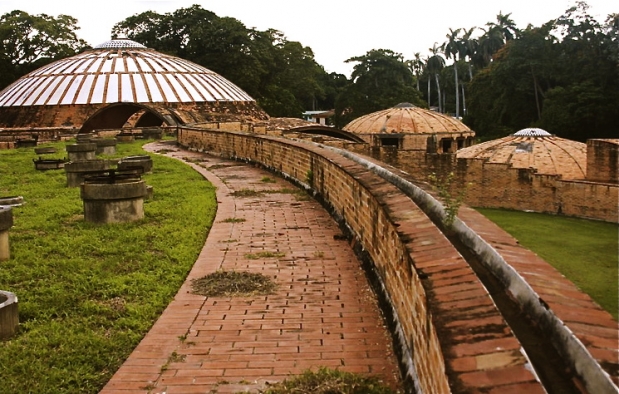
Escuela Nacional de Arte / National Art School

Six months ago I took an American photographer to meet to the former model and ex-ballerina Luz Maria Collazo. She had served as an interpreter with two other important Cuban ex-models and that would be our last evening of work. She was the main target of his lens and his interest, but when he saw that chance had led him also to the house of the architect Roberto Gottardi, he was surprised and pleased by the opportunity to meet and take a photo with him.

I had met Gottardi in 2020, when I interviewed Luz Maria Collazo. Until that time, her name and history at the National Art School was completely unknown to me. I suppose the same is true for many of my compatriots. She promised me an interview, but time passed and I was postponing that decision until I forgot about.

The reaction of the American photographer surprised me: Gottardo was an internationally well-known and respected architect. The school designed by him, along with Ricardo Porro and Vittrio Garatti, is considered one of the most representative works of Cuban architecture from the sixties.

The photographer knew about him from the documentary Unfinished Spaces by Alysa Nahmias and Benjamin Murray, which tells the story of the emergence of the idea of creating the National Art School, its design, construction and… its non-completion. That was how I learned of the existence of this film and a few days ago a friend made me a copy on a flash drive.

Unfinished Spaces shows us the National School of Art in the first half of the sixties, showing, almost from the beginning, images of the first moments after the victory of 1959: the real joy of the Cuban people in being liberated from the tyrant Fulgencio Batista; hope of the announced glorious future; the revolutionary ferment.

It was during this period that Fidel Castro and Ernesto Guevara appeared at the very exclusive Country Club, where they were not members, and while playing a round of golf, the leader had the idea of creating a school of art in that space. “We are going to build the best school of art in the world,” says the architect Selma Diaz, who was charged with leading the project.

The task of designing five faculties of art was assumed with overwhelming enthusiasm by architects Ricardo Porro, Vittrio Garatti and Roberto Gottardi; and not only by them, but also by the builders and the students who took classes within the site under construction and later participated voluntarily in the work to finish it, at the rhythm of small orchestras also composed of students. The actress Mirta Ibarra, a student at the school at the time, described the atmosphere as one of total freedom and creativity.

Very often, looking at those images of those early years of the Revolution, I wondered if, had I been a young woman at the time, would I have managed, or wanted to, hold myself apart from the effervescence. The music of Giancarlo Vulcano accompanying the images of Unfinished Spaces awakens a nostalgia for a past I didn’t experience and that in my eyes is like a legend, a fantastic epic, something unreal.

But amid the nostalgia an alarm sounds in my head: the leader of a country has the power to go to a private club, without invitation, and to decide to transform the space into something else?

Does being president mean being the owner of the country? In those moments I remember Fidel Castro was not then the president of Cuba. I see him playing golf with Ernesto Guevara and the image I see is consistent with the recent victory of his son Tony Castro in a golf tournament, and the courses that they built in this country to play this sport. I think that if gold was ever stigmatized as a “bourgeois sport” it was only in my imagination.

Half built, have destroyed

But Unfinished Spaces is not a documentary focused on criticizing the “Revolution” nor its maximum leader. The film puts its drama and music at the service of showing the history of this architectural masterpiece and its passage from a colossal project — the best art school in the world — to abandonment, neglect, “official marginalization” (the words of the architect Mario Coyula) and stigmatization of its creators.

Unfinished Spaces lets us hear the voices of those who were victims of unjust decisions that destroyed the school and with it an important project in the lives of these three artists; but it also shows the opposite view, that allows us to ask ourselves whether the construction of a school that size, with an unlimited budget, wasn’t a mistake, given the circumstances and resources of the country, although in practice the architects had decided to use the cheapest materials at your fingertips. There is also the testimony of the then students who witnessed the militarization and the expulsion of gay students.

Those who studied there then talk their way through the place that was turned into ruins before it was finished being built; the naturalness of one of them is striking when he says: “I think most students didn’t wondered why the school wasn’t finished, as there are many things in Cuba where the same thing happens.”

Buildings half built or half destroyed come to mind, building that never come to be repaired; the streets that are fixed and broken again in less than a month, the ruins visible from the buses. Are we living in an unfinished country, half built (or half destroyed)?

The National Art School has not only been the victim of wrong internal decisions, scarcities and looting by the homeless. The documentary doesn’t hide the fact that it could have been repaired and completed just a few years ago, but the regulations of the American “blockade” prevented it.

One of the questions I would have wanted to ask Gottardi is why he remained in Cuba, why was he the only one of the three architects who stayed. Now I won’t have to ask. His life, and also the lives of the other two artists abroad, have remained linked to the National Art School.

The shows the moment in which life rewards them, after 45 years, and it is just Fidel Castro, the first person to have a vision of that school, who decided the work should end. His confession of having fallen in love with the project when they showed it to him is surprising, but for a long time he reserved his opinion before the specialists who underestimated the work. His words are surprising because this is a man whose failure to listen to the specialist who warned him that it was impossible to produce ten million tons of sugar still devastates the country, nor did he listen to those who counseled against the planting of Caturra coffee or the closing of small businesses.

Anyway, the important thing is not the past, but rather resuming construction on the project. Porro’s two faculties were finished and only need to be restored. Those of Garatti and Gottardi need to be finished. Gottardo, however, realizes that his faculty is not going to be the same as it was going to be 45 years ago, the circumstances aren’t the same, the country is not the same. Nor could it be now what would have been more than 50 years ago, what was promised to our fathers.

Then, the end comes, not of the construction of the School, but of the documentary: due to the world economic crisis and the two hurricanes that hit the Island, the State stopped funding any unproductive architecture project, including the National Art School. It’s hard to know if we will see it brought to completion, and also whether this documentary will come to theaters in this country. But at least it is circulating from flash memory to flash memory, and to remain in this memory is bigger than our collective memory.

Yusimí Rodríguez López

From Diario de Cuba, 20 November 2013

Documentary by Alysa Nahmias and Benjamín Murray, 2011.

"The Student" and #ShameOnUnitedNations / Mario Lleonart

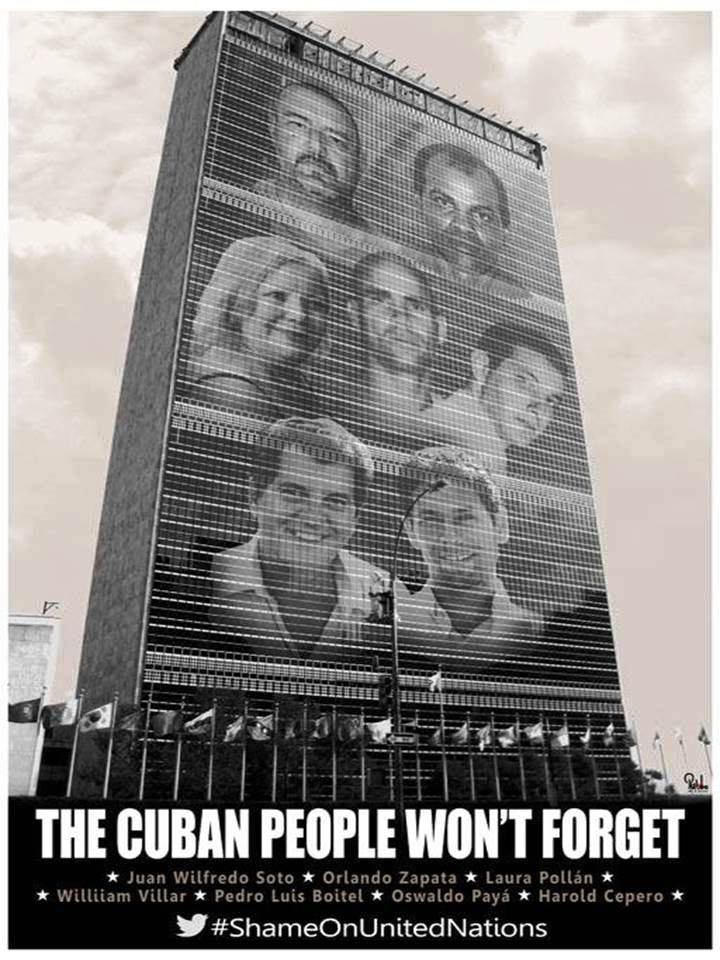
Poster for the campaign #ShameOnUnitedNations. By Rolando Pulido.

The beginning and end of yesterday were inextricably linked.

I woke up to the publication on Facebook, by my brother Orlando Luis Pardo Lazo of the recently initiated campaign, and we’ll be waging it as along as the United Nations remains occupied by regimes tied to terrorist, or which are guilty of State Terrorism.

Independently of each of the faces on this poster, my soul is touched by all the martyrs, the victims of the feudal government that reigns in Cuba. The first of them, Juan Wilfredo Soto Garcia, nicknamed “The Student,” moved me deeply, for being the face of a friend, whose story of life and death God involved me in during the last year of his life, the irrevocable proof of which is my tweet of May 5, 2011 at 11:55 a.m., a few minutes after the he was fatally beaten.
At the closing of the night I was sent “The Price,” by its composer, Ciro Javier Díaz Penedo dedicated to my assassinated friend.

The death of “The Student” — nicknamed this for his early imprisonment when he was only sixteen — invalidates the bad government in Cuba, not only for a seat on the UN but also for the chair that it occupies there. The worst thing is that there are many more deaths, a multitude of faces far beyond those shown on the poster; and the worst of the worst is that 148 States have become accomplices.

14 November 2013

“Prince of Peace” Around My Neck / Mario Lleonart

Preaching the Gospel: Prince of Peace Lutheran Church

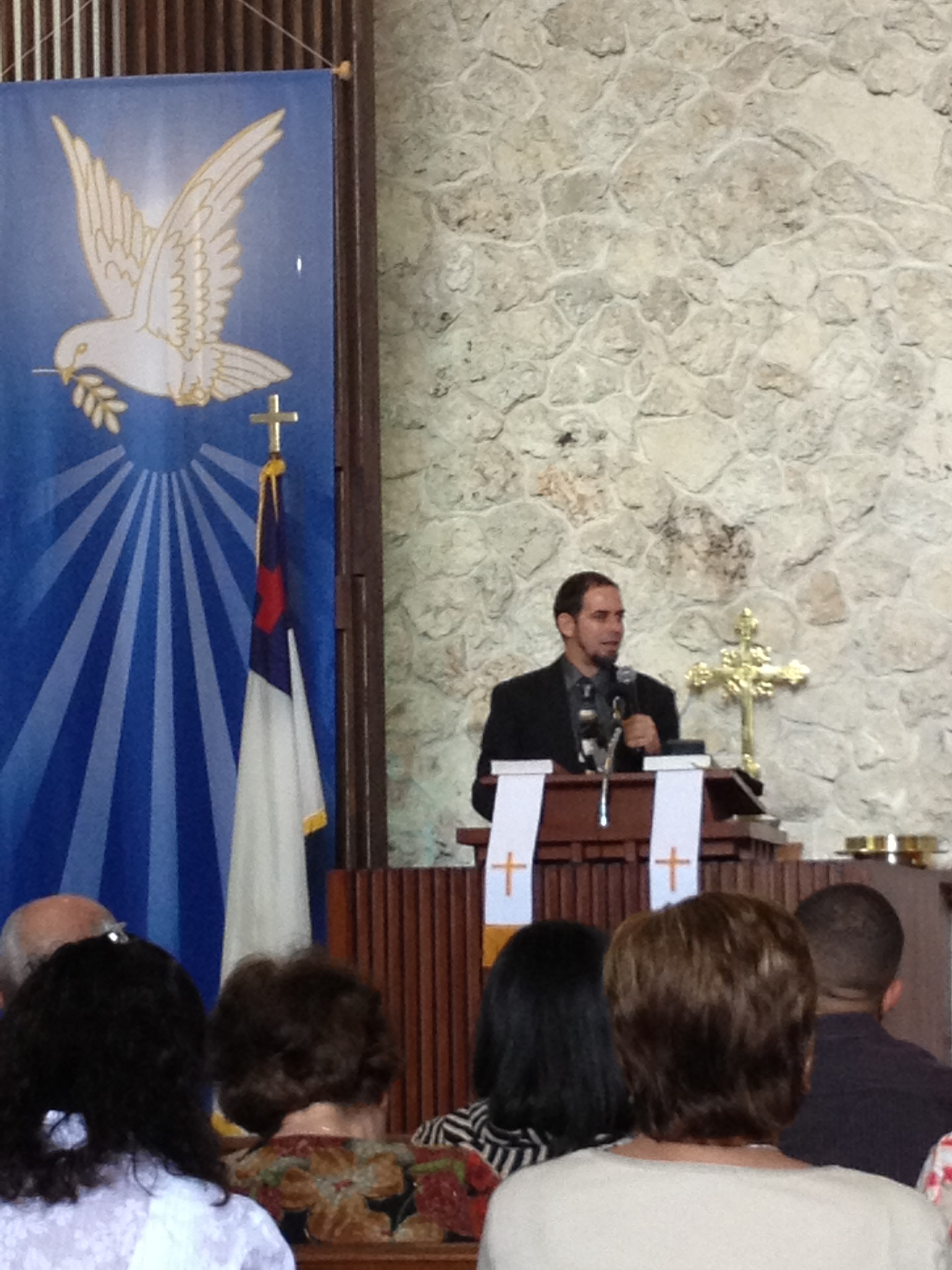
When I was just a kid, discriminated against in Cuba for attending the Baptist Church of my town, I could not imagine that one day I would receive the special Prince of Peace honor that is granted by the Lutheran Church on 6375 West Flager in Miami.

Every Sunday before going to Sunday school, I would listen to the program “Ayer, hoy y siempre” (Yesterday, today and forever) on radio WQBA “La Cubanísima” on 1140 AM. And Good Friday was not truly Good Friday if I did not listen to the “Sermon of the Seven Words” presented by the pastor, Reverend Lenier Gallardo, on the same radio frequency.

Receiving the medal from the hands of Rev. Lenier Gallardo

I had the blessing of being present when the same medal was conferred to Reverend Marcos Antonio Ramos who honors the name of the Baptists among the Cubans in exile. He gave an extraordinary sermon about the “Day of the Protestant Reformation” and later the Reverend Lenier Gallardo put the meaningful medal on his neck. What I didn’t imagine was that the next Sunday the same scene was repeated for me. It had been years since the church had given its symbolic award.

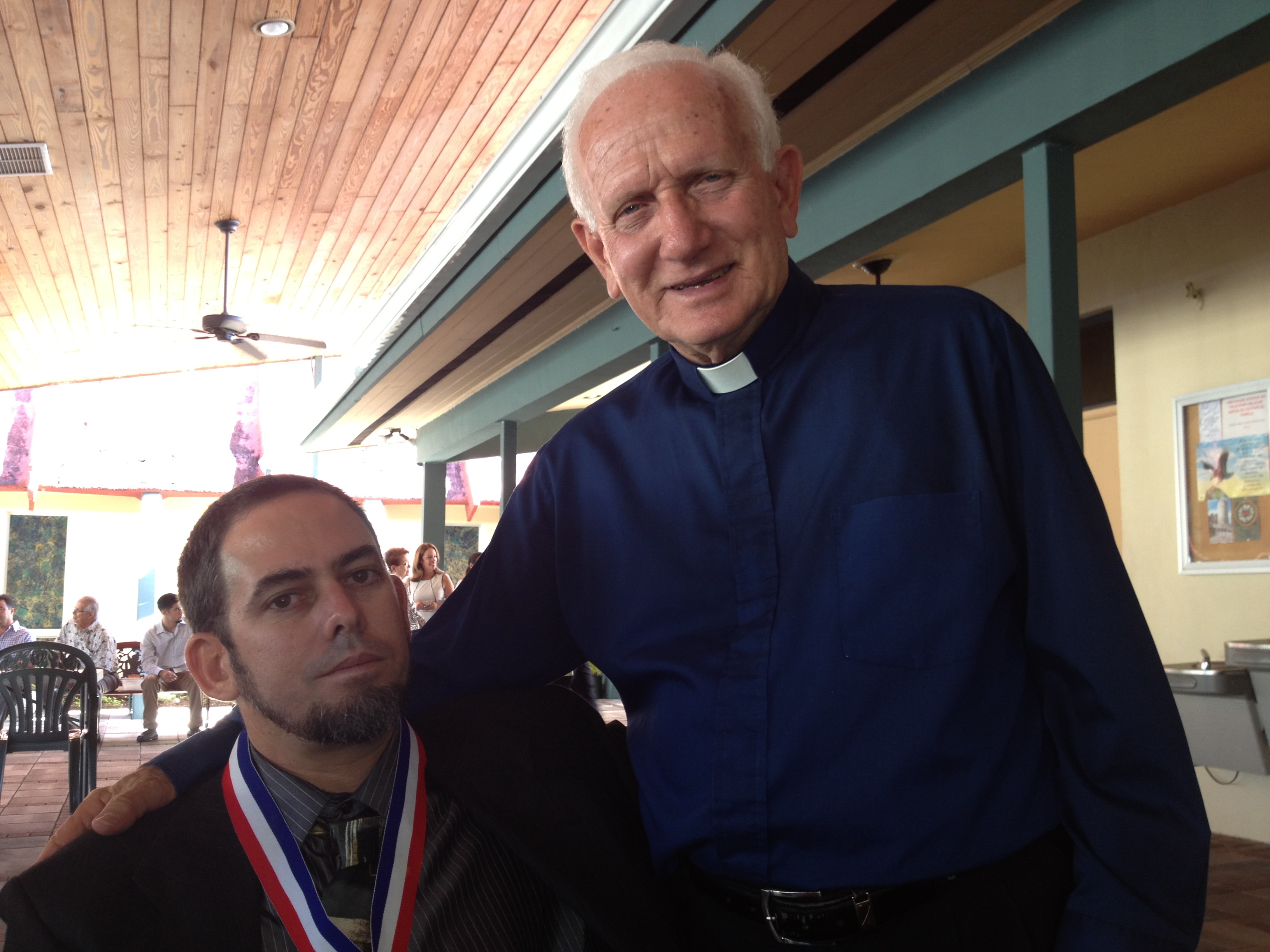
With Rev. Lenier Gallardo after ceremony

To be so close to and shake hands with two men of God as the Rev. Lenier Gallardo and Dr. Marcos Antonio Ramos are for Cuba was already enough. But being feted with the Prince of Peace medal at the hands of the saint that is the Rev. Lenier Gallardo was more than I could dream of. Receiving the blessing and the affection from these spiritual leaders of the exile strengthens my commitment and responsibility to the Gospel of Christ for Cuba. Hopefully I can reach the level of the ministries that they have achieved.
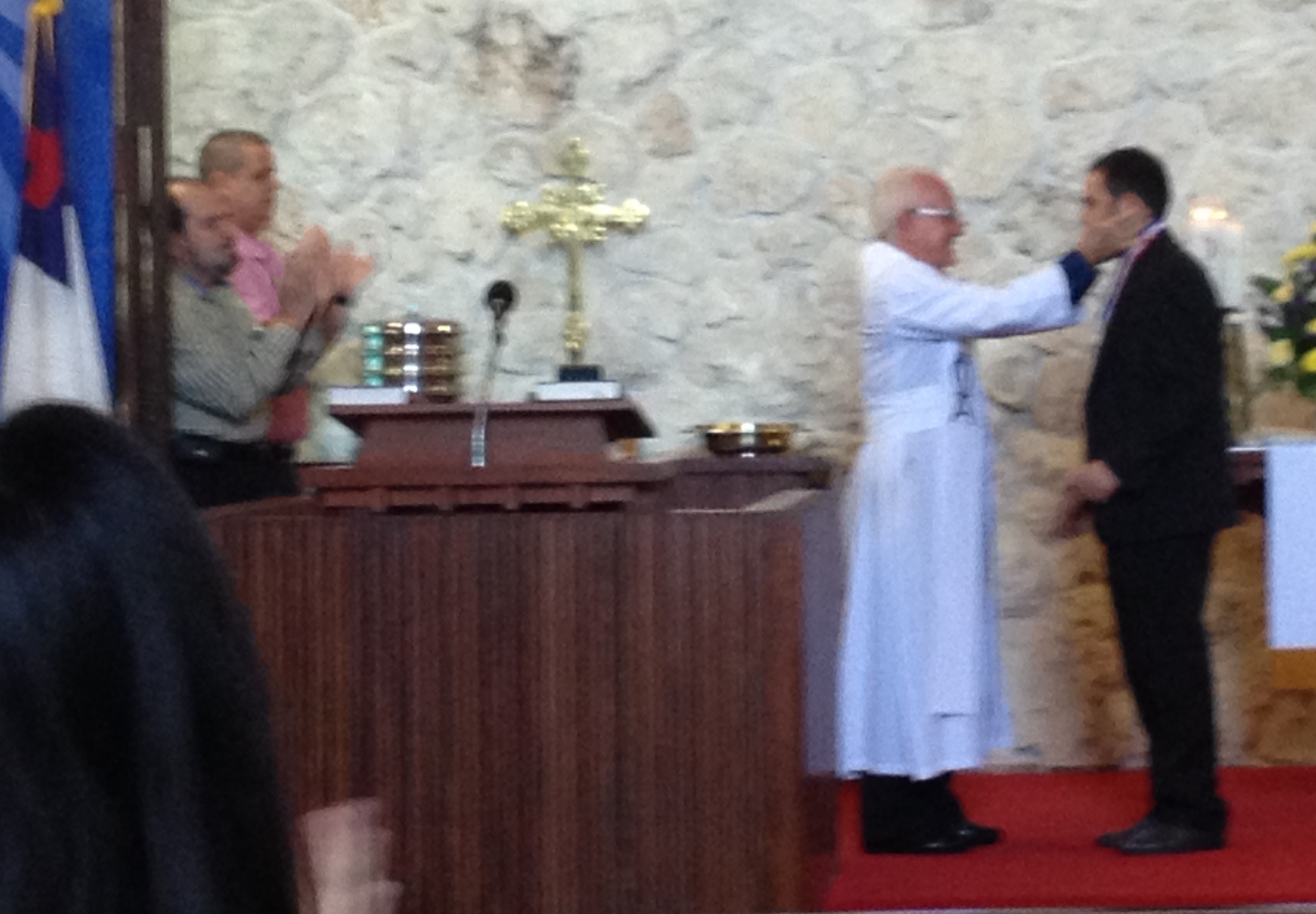
The award to Dr. Marcos Antonio Ramos a week before, celebrating the Day of the Protestant Reformation

Translated by Boston College CASA (Cuban American Association) Member: Elio Andres Oliva

14 November 2013