A report by Casa Palanca reveals concrete data on the structural corruption that extends from the orderly to the doctors.
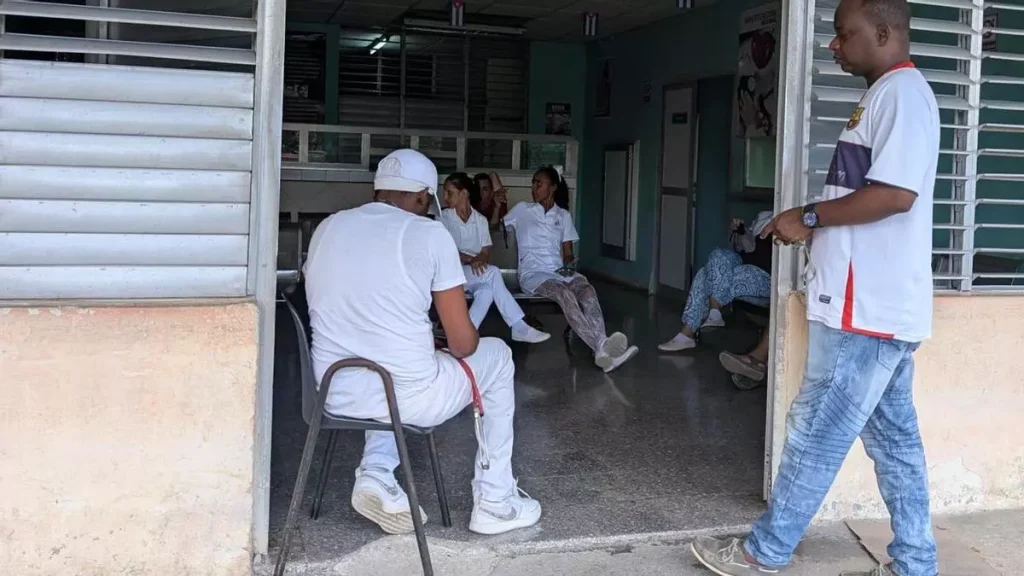
 14ymedio, Madrid, 10 July 2025 — Under the title Silent Privatization: Practices of Corruption in the Cuban National Health System, the independent platform Casa Palanca has published exhaustive and demolishing research that unmasks the structural deterioration of the health system on the Island, and documents with names, data and witness statements the transition from “guaranteed right” to “conditional service.”
The work is based on a national survey of 2,141 people prepared by Cubadata, dozens of interviews with patients, doctors, nurses and family members, as well as official statistical sources and current legal documents. Its central finding is not new, but it is striking: the National Health System (SNS), formally free and universal, operates de facto under a highly corrupt market logic, where those who do not pay either wait or die.
According to the report, 74.3 per cent of respondents reported having had to pay for services or medicines allegedly free of charge, and 78 per cent admitted using personal contacts to obtain medical care. Corruption is not an anecdote, but an installed structure: from stretcher-bearers and food workers to doctors and service managers.
More than half of respondents (56.9%) said they make these payments “always or often,” with Havana leading the way (66.6%). By region, it is as follows: West (58.8%), East (55.8%) and Center (51.9%).
The most informal “priced” services are obtaining medicines, surgical procedures and diagnostic tests with medical equipment
The most informal “priced” services are obtaining medicines (57.6%), surgical procedures (27.9%) and diagnostic tests with medical equipment (10%). Even interventions such as cesarean sections, abortions or treatment of fibroids require the disbursement of sums between 25,000 and 45,000 CUP (65 to 117 dollars, depending on the black market exchange rate), without counting the inputs that must be purchased from outside the system.
The paradox is brutal. Cuba allocates just 2.1% of the state budget to health and social assistance, but maintains 24,000 doctors working in 56 countries, which in 2022 reported revenues of $4.882 billion, according to official data. Of these, between 75% and 90% of the salaries paid by the recipient governments remain in the coffers of the Cuban State.
Meanwhile, national pharmacies have a shortage of more than 50% of the basic list of medicines, and hospitals show signs of abandonment, with collapsed ceilings, rodents, closed rooms and poor hygiene, documented in multiple independent reports.
The report intersperses the figures with shattering testimonies: an anesthesiologist who operates with stored supplies “for my own family,” a neonatal nurse who admits delaying care to patients without “recommendations,” or a patient who had to give two pigs to the doctors for a hernia operation. Others, like Alexis Dominguez, are waiting for urgent surgery while paying up to $150 just to be put on a list.
The situation of women is even more outrageous. The chapter dedicated to gynecology and obstetrics documents payments for cesarean sections, abortions, regulation of periods and even a minimum medical protocol during delivery. A young woman, for example, paid 10,000 pesos to have her cesarean section performed because her baby was in danger, after 36 hours of labor. “Paying gives you the ability to be demand,” she says bluntly.
The research highlights that the most alarming thing is not the existence of corruption, but its normalization. Almost 83% of respondents believe that corruption in health is “widespread” or “very widespread,” and more than 52% say they have stopped seeking medical care due to illegal payments.
The report qualifies this phenomenon as a form of institutionalized violence, which is exercised not only by action but also by omission
The report qualifies this phenomenon as a form of institutionalized violence, which is exercised not only by action (improper charges, mistreatment and negligence) but also by omission (inefficiency, endless waiting and lack of resources). “What used to be a right is today a privilege,” she summarizes crudely.
The authorities, for their part, have chosen to minimize the problem. Miguel Díaz-Canel acknowledged in April 2025 that there are “negative trends” such as the illegal sale of services, but he limited himself to calling for them to be addressed “forcefully.” In the absence of a structural strategy, the government only punishes isolated cases, without admitting that corruption is the direct result of low wages, lack of resources and chronically low investment by the state.
The study concludes that the Cuban SNS is not being privatized in the classical sense, but in practice. Health no longer depends on the state, but on the patient’s pocket or contacts. And what is more worrisome, even newly graduated doctors are deserting, invalidating their degrees rather than practicing in these conditions. Between 2021 and 2023, more than 63,800 health professionals left the system.
“Your health service is free… but it costs money.” The poster at the entrance of some hospitals might seem like a cruel joke. But in Cuba, where pain and disease have become a product of the black market, that irony is already an undeniable truth.
Translated by Regina Anavy
____________
COLLABORATE WITH OUR WORK: The 14ymedio team is committed to practicing serious journalism that reflects Cuba’s reality in all its depth. Thank you for joining us on this long journey. We invite you to continue supporting us by becoming a member of 14ymedio now. Together we can continue transforming journalism in Cuba.