/ Minrex
 14ymedio, Havana, October 17, 2024 / 14ymedio, Havana, October 17, 2026 – The Cuban regime, which for more than three decades has turned the United Nations General Assembly into the setting for its main “annual diplomatic victory,” has now protested because the United States intends to use that same forum to denounce political repression on the Island. The reaction comes on the eve of a new vote against the U.S. embargo, after Cuba obtained its worst result in decades in 2025, despite retaining a large majority in its favor.
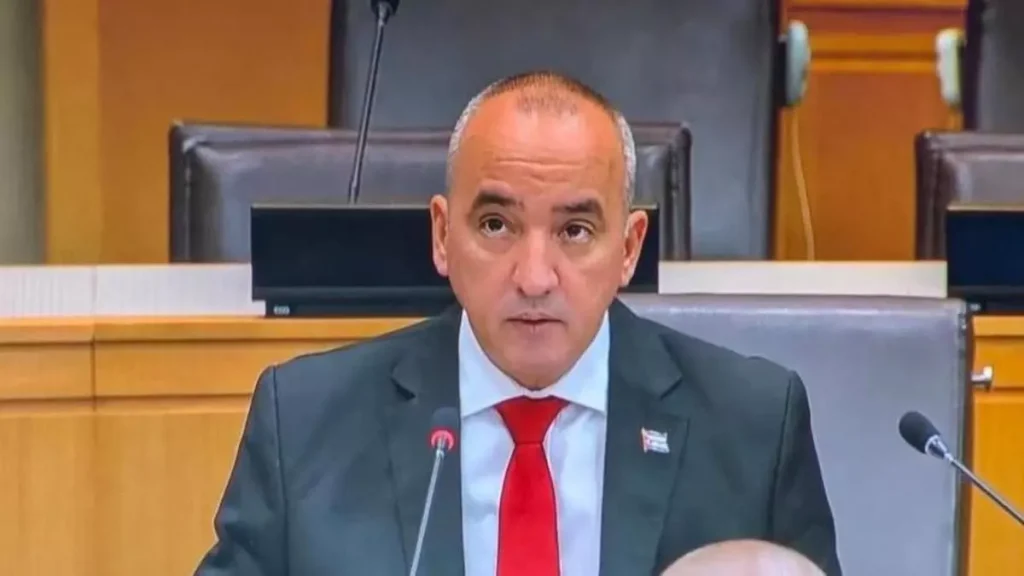
Cuba’s Permanent Representative to the UN, Ernesto Soberón, denounced this Friday a meeting scheduled for next Monday, October 19, convened by the U.S. Permanent Mission under the title Free Cuba: The Oppression Havana Hides. According to the diplomat, this is a maneuver intended to attack the Cuban Government and promote a hostile narrative against the country.
“The United Nations is not a platform for political persecution, interference in the internal affairs of states, or campaigns intended to undermine their sovereignty,” Soberón stated, accusing Washington of violating the rules governing the use of the international organization’s facilities.
In 2022, Beijing responded with a diplomatic protest, almost identical to the one Cuba is now making and called a similar meeting a “political farce”
However, administrative instruction ST/AI/2019/4, invoked by the ambassador himself, states in section 4.4.c that the permanent missions of member states may indeed request venues to organize meetings, conferences, and other events, including those involving outside entities they sponsor.
The regulations require that activities be compatible with the principles of the United Nations and allow administrative authorities to reject requests or cancel meetings. Nevertheless, the Cuban Government has not publicly presented any specific evidence establishing that the event convened by Washington violates these conditions.
Nor is this an unprecedented initiative. In December 2017, Australia, Canada, France, Japan, South Korea, the United Kingdom, and the United States organized a conference at the UN headquarters in New York on the torture, arbitrary detention, and sexual abuse suffered by North Korean women forcibly repatriated to their country. Participants included a defector from North Korea and international experts.
In October 2022, the United States, the United Kingdom, and other Western governments promoted another meeting on the persecution of the Uyghurs in China. Beijing responded with a diplomatic protest almost identical to the one Cuba is now making and called a similar meeting a political farce, accusing Washington of exploiting human rights to harm its adversary.
The seven votes against the resolution represented a record since these votes began in 1992
Venezuela was also the subject of a similar initiative. In March 2019, the United States and ten other governments sponsored an event at the United Nations headquarters in Geneva, featuring testimony about arbitrary detentions, torture, and the persecution of opponents under Nicolás Maduro’s regime.
Havana’s protest also coincides with an especially delicate moment for its traditional diplomatic campaign against the embargo. In October 2025, the resolution entitled Necessity of Ending the Economic, Commercial and Financial Embargo Imposed by the United States of America against Cuba received 165 votes in favor, seven against, and twelve abstentions.
Although the majority once again supported lifting the sanctions, Cuba lost 22 favorable votes compared with the previous year. The seven votes against the resolution represented a record since these votes began in 1992. Argentina, Paraguay, Hungary, North Macedonia, and Ukraine joined the United States and Israel in voting against it. Kyiv, in particular, justified its rejection by citing the Cuban authorities’ attitude toward the recruitment of citizens from the Island to fight on Russia’s side in Ukraine.
Soberón now accuses Secretary of State Marco Rubio of directly pressuring heads of state and government to change their votes at the next session, scheduled for October 27 and 28. Although Washington has pursued diplomatic efforts to reduce support for the resolution, the Cuban representative did not specify what concrete threats underpin his accusations of blackmail.
The resolutions calling for the lifting of the U.S. embargo are nonbinding and have a primarily symbolic impact. Havana has turned every vote into a supposed “victory” for the Revolution, deliberately confusing international opposition to the sanctions with support for its political system. Now, as Washington seeks to put the repression that the regime prefers to keep out of the debate on the table, the forcefulness of Cuba’s protests reveals its fear that this year’s result will deepen the diplomatic setback it suffered in 2025.
Translated by Regina Anavy
______________________
COLLABORATE WITH OUR WORK: The 14ymedio team is committed to practicing serious journalism that reflects Cuba’s reality in all its depth. Thank you for joining us on this long journey. We invite you to continue supporting us by becoming a member of 14ymedio now. Together we can continue transforming journalism in Cuba.