Another of the migrants had to be taken ashore to receive specialized medical care.
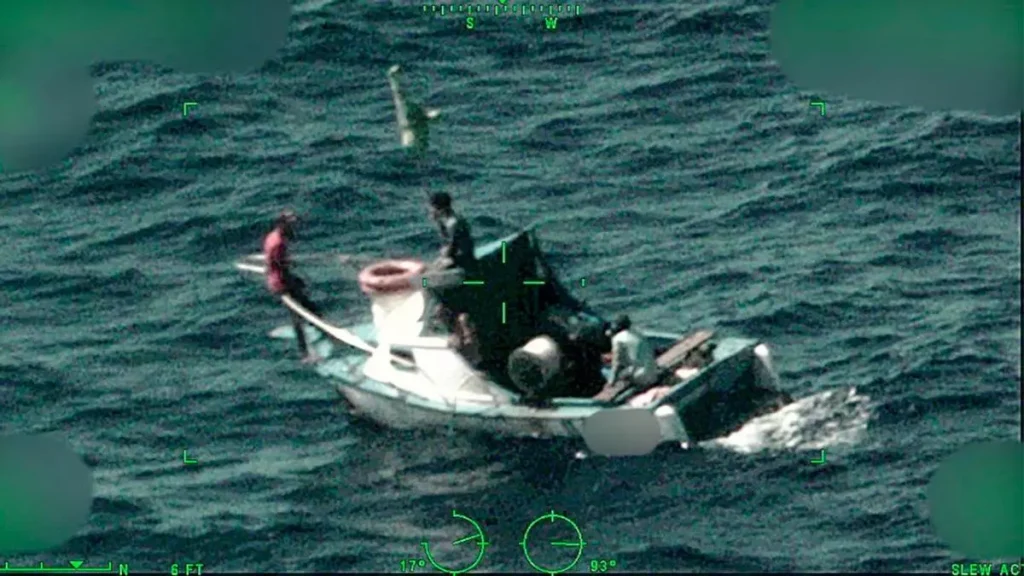
 14ymedio, Havana, October 14, 2026 – Two Cuban rafters and four fishermen were repatriated this Tuesday by the U.S. Coast Guard aboard the vessel Isaac Mayo. The return of these people took place one day after a man was found on pieces of polystyrene foam tied together with cords and wood, 16 miles from Key Biscayne.
According to official data, last Thursday, the crew of an HC-144 Ocean Sentry patrol aircraft spotted what “the U.S. Coast Guard described as a makeshift vessel southwest of Salt Cay,” an uninhabited island in the Bahamas located between Cuba and South Florida.
The authorities specified that three people were assisted by the crew of the Raymond Evans. However, one of the rafters “had to be taken to the mainland for a specialized medical evaluation,” without specifying what kind.
U.S. authorities reiterated their usual warning to Cubans: “Anyone attempting to enter the United States illegally by sea will be intercepted and repatriated to their country of origin.” They also recalled the surveillance operations along all maritime routes into the country to deter illegal migration.
Last Sunday, during one of these operations, the crew of the Miami Air Station spotted a disabled Cuban fishing boat with four people aboard, drifting about 46 miles southeast of Key West. The fishermen were transferred aboard the vessel Isaac Mayo.
U.S. authorities reiterated their usual warning to Cubans: “Anyone attempting to enter the United States illegally by sea will be intercepted and repatriated to their country of origin”
The commander of the Coast Guard Air Station in Miami, Aarón Ortenzio, emphasized that “these cases demonstrate the Coast Guard’s commitment to preventing illegal maritime entry and responding to the needs of mariners in distress.”
Meanwhile, the man who reached Florida on pieces of polystyrene foam is awaiting his return to the Island. His relatives identified him as Enrique René Reyes Martínez. According to Yosmany Mayeta Labrada, a journalist living in exile in the United States, he is “a fisherman from Santiago, born in the Los Cangrejitos neighborhood and residing in Havana.”
Reyes Martínez was reported missing last Thursday. His cousin, Reynier Estiu Álvarez, explained that the man set out from Cojímar Beach to fish despite unfavorable conditions.
Despite these arrivals, Sebastian Arcos, director of the Institute for Cuban Studies at Florida International University, sees no indication that rafters will try to turn the strait into a viable route again in the short term.
“Given the recent drastic shift in policy toward Cuba compared with previous administrations, Havana will likely want to avoid an uncontrolled wave of refugees like those of 1980 or 1994, since that could well provoke a harsh reaction from the Donald Trump Administration,” he told the Miami Herald.
Translated by Regina Anavy
______________________
COLLABORATE WITH OUR WORK: The 14ymedio team is committed to practicing serious journalism that reflects Cuba’s reality in all its depth. Thank you for joining us on this long journey. We invite you to continue supporting us by becoming a member of 14ymedio now. Together we can continue transforming journalism in Cuba.