The official end date is still unknown, as courses that have already begun will be completed, said a senior military officer
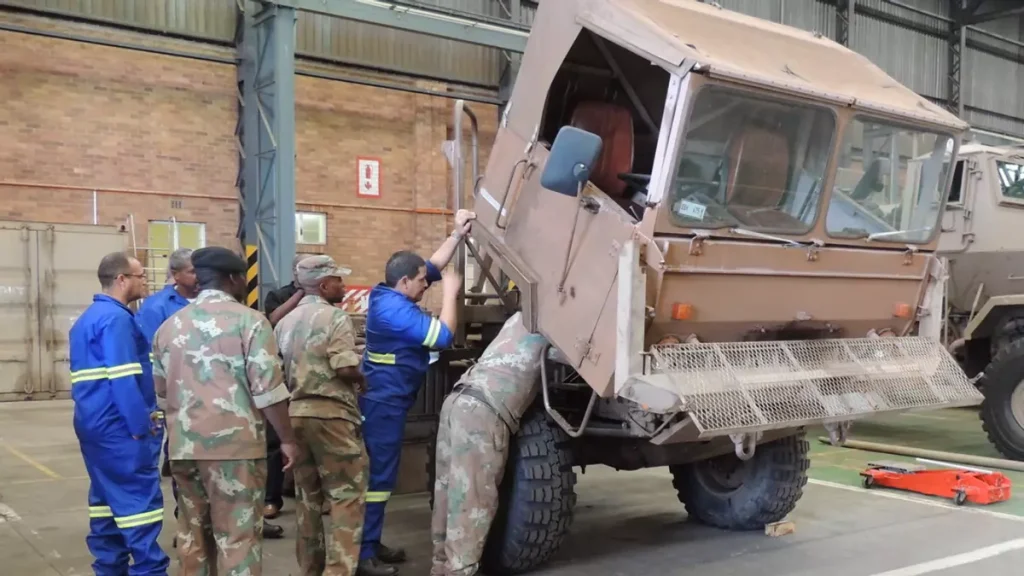
 14ymedio, Madrid, 15 October 2026 / The South African Army will finally halt Project Kgala, a controversial military cooperation program with Cuba that began in January 2025 and on which some 279 million rand, equivalent to 16.9 million US dollars, has already been spent irregularly. The agreement had been hanging by a thread since South Africa’s Auditor General declared it invalid four months ago.
The news was announced by the local press this Thursday, which quotes a high-ranking officer in the South African National Defence Force (SANDF), Navy Lieutenant James Matshimane. This officer, the Army’s new head of military policy, strategy and planning, told Parliament that “an instruction has already been issued” to stop the Project, in which, in his own words, 119 Cubans have taken part.
With such a fleeting statement, Matshimane left questions unanswered, such as the date for the definitive end of the cooperation, who the order came from, or whether payments to the island will continue while the courses already underway, which “will be allowed to conclude,” are completed.
Project Kgala, which replaced Project Thusano almost two years ago, brings Cuban engineers and technicians to South Africa to help the SANDF with the maintenance and repair of military vehicles, as well as air and naval transport equipment.
The agreement had been hanging by a thread since South Africa’s Auditor General declared it invalid four months ago
The report produced by the Auditor General’s office last May documented in detail what both agreements have involved. In the 2024-2025 period alone, more than 1.5 million dollars was spent on the Cuban technicians’ upkeep, accommodation, travel and operating costs. The Army documented that during the Thusano years (2021-2024), 18,498 “job cards” – official documents certifying that a task has been carried out – were issued, including more than 10,210 interventions on Army vehicles, 1,067 on aircraft and Air Force (SAAF) vehicles, 107 in the Navy and 4,505 operational and medical interventions in the Military Health Service (SAMHS).
In the little less than a year that it had been in force when the audit was carried out, Kgala had completed 2,502 work orders, with 1,198 component repairs for the Army, 418 on vehicles and aircraft, 196 interventions in the Navy and 659 medical tasks for SAMHS. Although the report considered the volume of work credited to be considerable, that did not justify how the agreement had been reached.
According to the Office of the Chief State Law Adviser, the pact with Cuba bypassed the country’s public procurement rules, which require a tender or, failing that, a special permit (an exemption request) from the Treasury. However, the Department of Defence signed directly with the Cuban side under a memorandum between the two countries. In addition, the program had spent almost a million dollars at the time it was examined, which, lacking a permit, was irregular expenditure. Moreover, as the total value of the agreement was 11 million dollars, that entire amount – not yet delivered – was likewise considered “irregular.”
The military leadership defended the viability of the agreement at the time. Vice Admiral David Mkhonto, the SANDF’s Chief of Logistics, explained to the committee that the cooperation arose from a bilateral government-to-government Memorandum of Understanding (MOU) and that, although it should have been processed by requesting the exemption, it was the right choice.
“The studies revealed excessive costs, prolonged response times and capacity limitations in the domestic industry. Cuban collaboration represented the most cost-effective, sustainable and operationally viable option for restoring the core mission equipment,” Mkhonto said, adding that the Department is already working on an internal delegation framework and oversight mechanisms to correct the irregularities.
The halt now acknowledged by the Army does not necessarily guarantee that South Africa will do without the Cubans. Having already renamed Thusano in 2025, after it had been in the eye of the storm, it could now adjust – and even rename the agreement once again – in order to keep the personnel.
Having already renamed Thusano in 2025, after it had been in the eye of the storm, it could now adjust – and even rename the agreement once again – in order to keep the personnel
Cooperation between Cuba and South Africa, which dates back to the days of Nelson Mandela and Fidel Castro, has accumulated controversial episodes. Among the best-known cases is the sale of Heberon Alfa R for the coronavirus crisis, purchased by Defence – when, at the start of covid-19, it believed it was a bacteriological weapon – without the required authorization from the Health Department. In that operation alone, the island pocketed almost two million dollars, which could have been 17 if the purchase had been completed.
The collaboration also includes the exchange of doctors or engineers between the two countries, which has led to further questionable spending, as well as more than generous donations, including one of 3 million dollars that was ultimately annulled by the courts of the African country in 2023.
Last September a new controversy broke out, when the military trade union South African National Defence Union demanded an investigation into all the details of the complaint by a group of 38 officers who were training on the island and were allegedly pressured to donate money from their salaries to the Cuban side. The donations were to be recorded on a list, next to each officer’s name, with the suggested amount, which, although voluntary, was expected to come to about 940 dollars for officers and at least 188 dollars for those of lower rank.
This month there has also been a flood of complaints from South African students who are doing or completing their studies on the island, in some cases because of the lack of opportunities their country offers them on their return – since, after paying for their training on the island, it has no money to hire them – and in others because of the poor conditions they face in their daily lives as residents in Cuba.
Translated by GH
______________________
COLLABORATE WITH OUR WORK: The 14ymedio team is committed to practicing serious journalism that reflects Cuba’s reality in all its depth. Thank you for joining us on this long journey. We invite you to continue supporting us by becoming a member of 14ymedio now. Together we can continue transforming journalism in Cuba.