Habanos S.A. sells cases of three Cohibas in London for 860 dollars, while on the island people smoke unbranded cigars for 150 pesos
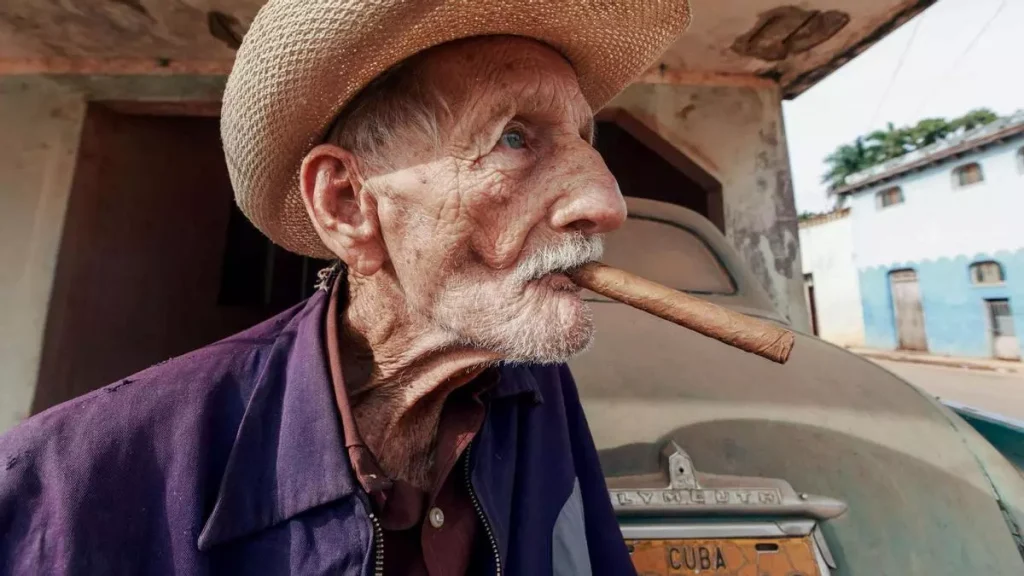
 14ymedio, Havana, October 11, 2026 / Cuban tobacco seems increasingly divided between two worlds. In one are exclusive parties in London, editions costing thousands of dollars and luxury humidors. In the other, the smoker on the island buys a nameless cigar on a street corner, with no band and far from the quality that has made Cuba’s flagship product famous.
“For a while now I haven’t seen any cigars except that kind, the bad ones,” a Havana woman whose stepfather is a cigar smoker tells 14ymedio. “In the neighborhood you can get an unbranded cigar for 150 pesos. It’s been a long time since I’ve seen anyone on the street offering the well-known brands.”
The product circulates outside the state retail network. According to sources consulted by this newspaper, part of the raw material comes from leaves diverted by growers or workers at tobacco companies and ends up in the hands of clandestine rollers. The quality varies widely.
“Some of them are pitiful and others have a wrapper of acceptable quality,” explains another Havana resident. Around the Tulipán market, in Nuevo Vedado, he adds, it is common to find vendors of these homemade cigars, which can cost between 100 and 150 pesos apiece.
“Some of them are pitiful and others have a wrapper of acceptable quality”
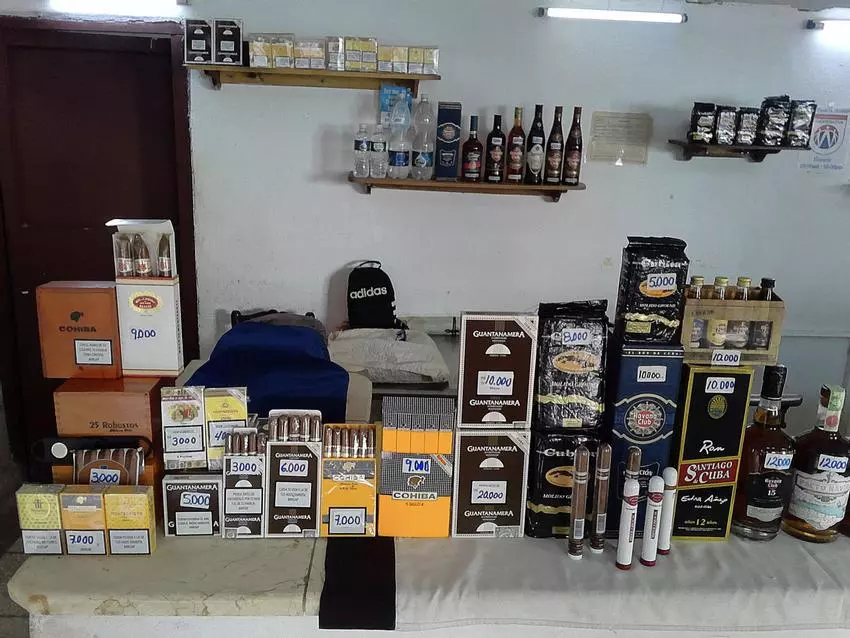
Branded cigars, however, have not completely disappeared from the capital. This week, 14ymedio visited a privately run establishment on Obispo Street, where Cohiba, Montecristo, Partagás and Guantanamera are on display. Prices range from several thousand up to 20,000 pesos.
The State still sells cigars for domestic consumption at a regulated price of 10 pesos apiece. In 2026, several provinces have announced controlled distributions through the bodegas [state ration stores], generally of just one or two cigars per household per month, although with frequent delays.
Meanwhile, Habanos S.A., a joint venture between the Cuban State and the Spanish company Tabacalera, continues to bet on the international luxury market. Last Wednesday, some 400 guests attended a party in London to present the Cohiba Talismán, which kicked off the celebrations for the brand’s 60th anniversary. The event took place under an air-conditioned marquee, decorated in the style of The Thousand and One Nights, with live music and exclusive cocktails.
The Talismán, originally presented in 2017 as a limited edition, is now joining Cohiba’s regular catalog. For the British market, 6,500 exclusive cases of three cigars have been prepared, valued at around 600 pounds sterling (860 dollars) each. Guests received one of these packages as a gift.
The party included a charity raffle to raise funds for food and medical supplies in Cuba. Jemma Freeman, managing director of the British distributor Hunter & Frankau, acknowledged the enormous challenges the island faces in maintaining its tobacco production.
The initiative contrasts with the backlash provoked by the previous edition of the Habano Festival, held in 2025, when some 600 guests enjoyed a lavish gala evening at the National Capitol, while the country was suffering blackouts and shortages. The images of that celebration unleashed a wave of outrage on social media.
The energy crisis also affected the organization of the 2026 Habano Festival, initially scheduled for February in Havana. The event was postponed and, in July, canceled for good. The festival, which every year attracted collectors, distributors and international buyers, could not be held just as the company was stepping up its launches abroad.

London was not the only venue for these presentations. In September, Habanos premiered the Trinidad Vigía Reserva Cosecha 2022 in Montreux, Switzerland, before some 300 guests. The production included 5,000 numbered boxes of 20 cigars, priced at 3,800 dollars. Days later, in Cannes, France, it presented the Montecristo Fragata, aimed at the travel retail market, at around 1,280 dollars per humidor of 20 cigars.
Habanos announced record revenues of 827 million dollars in 2024, up 16% on the previous year. However, that year Cuba exported some 50 million cigars, compared with 93.9 million in 2018, according to figures from Tabacuba reported by Al Jazeera. The rising price of the product has helped sustain turnover despite the fall in export volume.
European distribution is also facing difficulties. In September, Fifth Avenue Products Trading, responsible for Habanos in Germany, Austria and Poland, was placed under preliminary insolvency administration. Almost simultaneously, the accounts of Tabacalera, which is linked to the distribution of Cuban cigars in Spain, were frozen due to European sanctions related to businessman Chen Zhi.
Tabacuba’s agricultural director, Osvaldo Santana, acknowledged that the harvest “will once again be difficult” due to fuel restrictions
Despite the difficulties, the sector continues to receive investment. Cuba began the 2026-2027 tobacco season this Saturday, with planned planting of 20,000 hectares, of which 12,000 are in Pinar del Río, Tabacuba told EFE. The state group’s agricultural director, Osvaldo Santana, acknowledged that the harvest “will once again be difficult” due to fuel restrictions. Meanwhile, Sancti Spíritus aims to expand its cultivated area by some 300 hectares and has received more than a hundred photovoltaic systems for pumping water.
The tourism crisis has also transformed the clandestine cigar market. Around some factories, where a few years ago it was common to hear offers of supposed Cohibas, Montecristos or Partagás, the vendors have largely disappeared. “Every so often I walk past the factory on 20 de Mayo, near the Latinoamericano [stadium], and another one in Old Havana, and you no longer hear anyone hawking cigars,” says a resident of the capital.
The business depended mainly on foreign visitors, willing to pay for boxes and bands imitating the well-known brands. With the collapse of tourism, that clientele has also shrunk. “That packaging was designed for tourists. Cubans look for any ‘smokable’ cigar, even if it has no band,” explains the same source.
Translated by GH.
______________________
COLLABORATE WITH OUR WORK: The 14ymedio team is committed to practicing serious journalism that reflects Cuba’s reality in all its depth. Thank you for joining us on this long journey. We invite you to continue supporting us by becoming a member of 14ymedio now. Together we can continue transforming journalism in Cuba.