The president of the region, Roberto Occhiuto, reveals that the Joe Biden administration had already tried to pressure him to suspend the cooperation
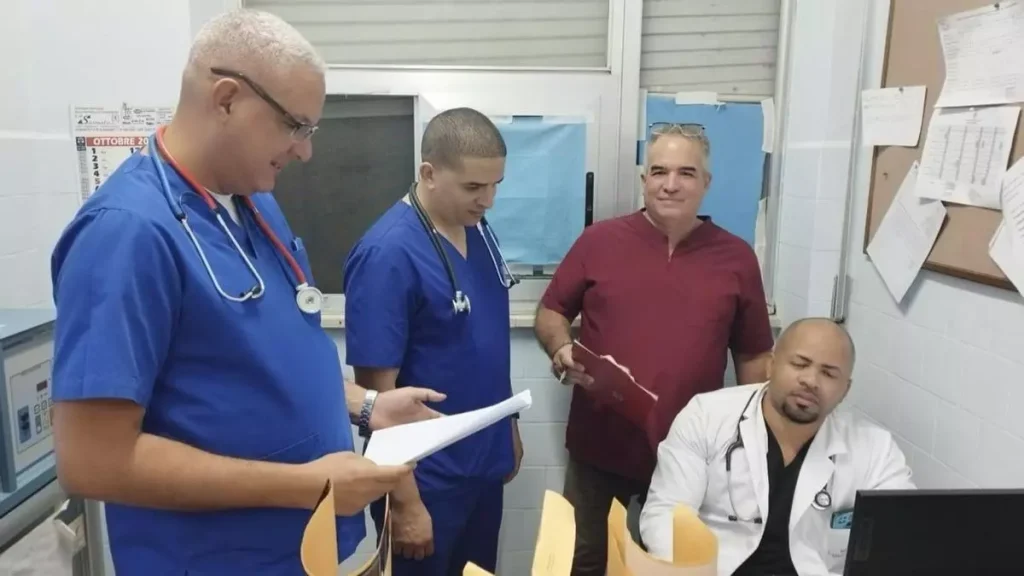
 14ymedio, Madrid, July 9, 2026 – It had long been an open secret, but a Cuban doctor contracted to work in Calabria has, for the first time, openly acknowledged that part of the salary paid directly by the health authorities of the Italian region goes to the Cuban State. “We are all aware of the economic situation Cuba is going through. It is a voluntary contribution because Cuba trained us, educated us, and made us doctors,” Zoila Yakelín Arévalo Cruz said in an interview with the Associated Press.
According to the AP correspondent in Italy, who traveled to the southernmost region of the Italian peninsula to report on the only part of Europe that receives Cuban doctors under an agreement with the Island, the donations amount to as much as half of their salaries.
Roberto Occhiuto, president of the Calabria region, has become one of the few political leaders to stand up to the demands of the Donald Trump administration, as well as those of its predecessor. The revelation comes directly from the politician himself: “I also faced some pressure during the Biden administration. But it increased under Trump,” he said.
The governor even laughed about the fact that the Cuban regime had turned him into an almost heroic figure. “Can you imagine? My picture appeared in Granma!”
The governor laughed again as he told AP: “Can you imagine? My picture appeared in Granma!” Occhiuto is a senior member of Forza Italia, the party founded by Silvio Berlusconi, which the reporter describes as having “strong roots in anti-communist sentiment.”
Nevertheless, the regional leader says reality has forced him to accept the situation. Although Cuban socialism does not align with his political views, the region depends on the Cuban doctors. Last February, he promised U.S. Ambassador to Cuba Mike Hammer that he would continue working on incentives to recruit Calabrian doctors, but for now nothing has changed.
“I reiterated to U.S. Ambassador Hammer that I needed to keep the hospitals open and that I intend to keep the Cuban doctors currently in Italy in their positions,” Occhiuto insisted, maintaining the same position he made clear earlier this year. His original intention had been to triple the number of Cuban doctors, but apparently that has not happened.
According to AP, Calabria ranks last in Italy in healthcare services, reflecting the country’s deep divide between its wealthy industrial north and its less-developed south. Healthcare professionals there earn salaries 30% lower than elsewhere in Italy, while unemployment is twice the national average. On top of that, decades of mafia influence and corruption drove thousands of professionals to move north in search of better opportunities.
Calabria ranks last among Italy’s 20 regions in access to public healthcare, according to the Ministry of Health. “It was a disaster. I kept the emergency room open completely by myself,” said Francesco Moschella, chief physician at Polistena Hospital.
“For a First World country, in Europe, we had a completely different idea. We never imagined the shortage of doctors was so severe,” said the Cuban specialist interviewed by AP. She left her son behind in Cuba in 2023 and now works in the emergency department of a medical center in Polistena alongside six other Cuban doctors, making up half of the hospital’s 12 physicians. “There used to be lines lasting eight to twelve hours at this hospital. Now, thanks to our work, you can see a doctor in less than an hour,” she said. She now speaks Italian fluently and has even picked up some Calabrian dialect from talking with her patients.
“They’re intelligent, they’re compassionate, and they’re also humble, something you don’t often see in Italian doctors,” local resident Maria Morano told AP. “We’re lucky they came; otherwise, our hospital would have closed”
“They’re intelligent, they’re compassionate, and they’re also humble, something you don’t often see in Italian doctors,” local resident Maria Morano told AP. “We’re lucky they came; otherwise, our hospital would have closed.”
Calabria signed its first agreement with Cuba in 2022 in the presence of Cuban Health Minister José Ángel Portal Miranda and his Italian counterpart, Orazio Schillaci. At the time, the Italian local press reported that 3,500 euros per month was paid in salary for each doctor, plus another 1,200 euros for maintenance, housing, travel, and training.
The terms were later modified, switching to individual contracts. According to Occhiuto, 63 Cuban doctors who originally came to Calabria through the Cuban State have requested to remain under the new arrangement. The doctors now receive their salaries, whose amount has not been disclosed, in accounts at Italian banks. “We absolutely do not consider ourselves modern slaves, as some have called us. We love our country, we make an economic contribution, and we’re happy to do so,” admitted another Cuban healthcare worker, cardiologist Daisy Luperon Loforte.
For more than a year and a half, the U.S. has been working to reduce the Cuban government’s income from the export of medical services, and it has largely succeeded. Countries such as Jamaica, Honduras, Guatemala, Antigua and Barbuda, Dominica, Guyana, and Saint Vincent and the Grenadines have either modified or ended their agreements. For now, however, Mexico, several Persian Gulf countries, and Calabria continue to participate.
Translated by Regina Anavy
______________________
COLLABORATE WITH OUR WORK: The 14ymedio team is committed to practicing serious journalism that reflects Cuba’s reality in all its depth. Thank you for joining us on this long journey. We invite you to continue supporting us by becoming a member of 14ymedio now. Together we can continue transforming journalism in Cuba.