“How long will the benefits for a few continue while everyone else endures this like animals?”
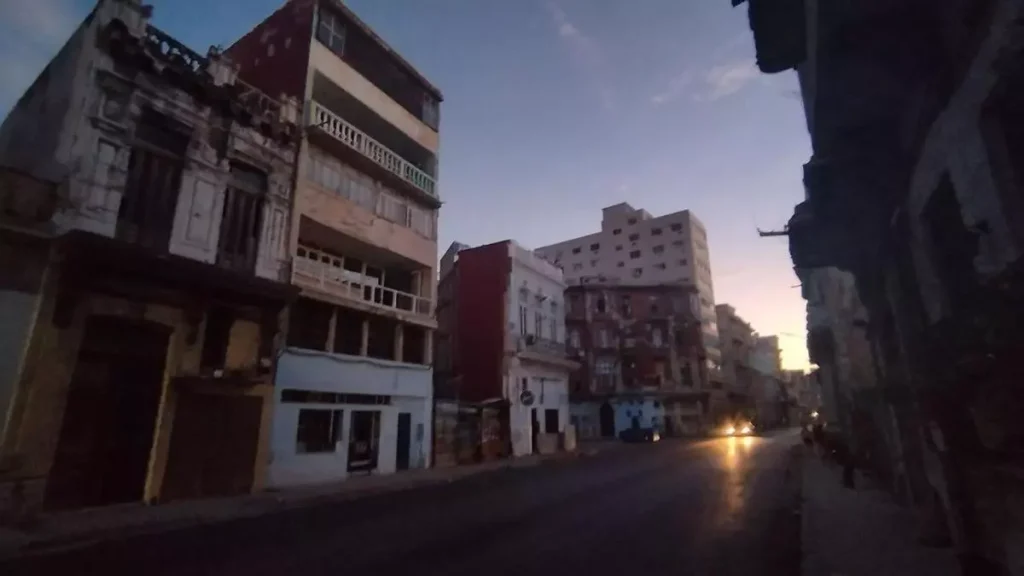
 14ymedio, Havana, October 18, 2026 — When the electricity came back on, after exactly 37 hours and 19 minutes without power, an unusual flurry of activity broke out in the buildings on circuit PZ15, in Havana’s Plaza de la Revolución municipality, even though it was not yet seven o’clock on a Sunday morning. Each resident could hear their neighbors starting washing machines, turning on fans, and rushing around to do everything that requires electricity.
At dusk on Saturday, the sounds of people banging pots and pans and clear shouts could be heard here and there from these Soviet-style buildings, like the one housing the 14ymedio newsroom: “We want electricity!”
According to the authorities, the last time the area had electricity, a breakdown occurred in the main transformer supplying the circuit. Immediately after the protest, a vehicle from the Electric Union (UNE) arrived to try to repair it, something that did not happen until early this morning.
The demonstration was unusual in a neighborhood inhabited mostly by government officials and regime supporters, who are not particularly inclined to protest. “UNE thinks we’re born to put up with anything, but everything has a limit,” a resident who, yesterday afternoon, had neither electricity, water, nor gas, told this newspaper.
“How long will this shamelessness continue in Nuevo Vedado?” one user asks
Criticism is also multiplying on social media, although behind pseudonyms.
“How long will this shamelessness continue in Nuevo Vedado?” asks user yo27190610, who complains that while her district and the surrounding areas receive only two or three hours of electricity a day, there is a “priority” circuit where the power never goes out. It is precisely the circuit where a 12-story building belonging to the Ministry of the Revolutionary Armed Forces is located.
The so-called llega y pon settlement known as the “San Pedro and Hidalgo favela” is also there, provoking the greatest irritation. “Not only do we have to sleep without electricity, but we also have to sleep with blaring music coming from the favela,” the same source says. “How long will social indiscipline be allowed to continue? How long will the benefits go to a few while everyone else endures this like animals?”
The complaints have even reached areas fortunate enough to have a medical center nearby, giving rise to what is increasingly being called the “war of the circuits.” In Luyanó, complaints from residents on circuits other than those serving the “hospitals”—the Miguel Enríquez Clinical-Surgical Hospital and the Diez de Octubre Gynecological-Obstetric Hospital (Hijas de Galicia), where the power was cut very rarely—had an effect.
A resident of the apartment block benefiting from the hospitals’ priority status explains: “Before, we had electricity and they didn’t, and they’ve been complaining for months. They collected signatures and went to the government, and it ended with them distributing the misery equally, as they usually do. Now they give us one week with electricity and them one week, and vice versa.” There is an additional problem: “The bad thing is that when they don’t have power, we don’t have internet either, because the Etecsa antenna is on that circuit.”
Friday’s fire at the Ernesto Guevara de la Serna thermoelectric power plant in Santa Cruz del Norte, in Mayabeque, was the final blow to the disastrous situation facing Cuba’s power plants
Nevertheless, the capital can be considered privileged. In other parts of the country, blackouts are approaching unimaginable limits, and even the official press is not concealing the situation. In Matanzas, for example, there are areas where power cuts last nearly 70 hours, such as Manuelito and Bolondrón. According to TV Yumurí, the time without electricity is at least 39 consecutive hours, as is the case in the city of Matanzas itself.
By way of explanation, the provincial television station says that when circuits trip in the most remote locations, someone must go there in person to restore them “because they have a manual system.” The “on-call vehicle” is not always available promptly.
For yesterday, the Electric Union forecast a shortfall of 2,072 megawatts (MW) against demand of 2,800 MW during peak hours. In other words, only 26% of the electricity needed was available.
Friday’s fire at the Ernesto Guevara de la Serna thermoelectric power plant in Santa Cruz del Norte, in Mayabeque, was the final blow to the disastrous situation facing Cuba’s power plants. The country’s main thermoelectric plant, the Antonio Guiteras facility in Matanzas, is also still out of service, although the official press predicts that it will be reconnected to the National Electric System this Sunday.
This was the subject of a message circulating in the WhatsApp groups for circuit PZ15, which rebelled on Saturday. The fire has also left insufficient gas supplies. “With the Santa Cruz and Guiteras thermoelectric plants out of operation, the Energas plant has to operate at maximum capacity,” the message argued. “This leads to high gas consumption and makes it impossible to deliver the necessary pressure at the plant’s outlet, resulting in reduced natural gas supplies to the plants in Havana and Marianao.”
The situation will remain this way, the message warned, “until electricity generation in the western part of the country recovers somewhat.”
Translated by Regina Anavy
______________________
COLLABORATE WITH OUR WORK: The 14ymedio team is committed to practicing serious journalism that reflects Cuba’s reality in all its depth. Thank you for joining us on this long journey. We invite you to continue supporting us by becoming a member of 14ymedio now. Together we can continue transforming journalism in Cuba.