According to the official newspaper ‘5 of Septiembre’, these vehicles transport 80% of the passengers in the province
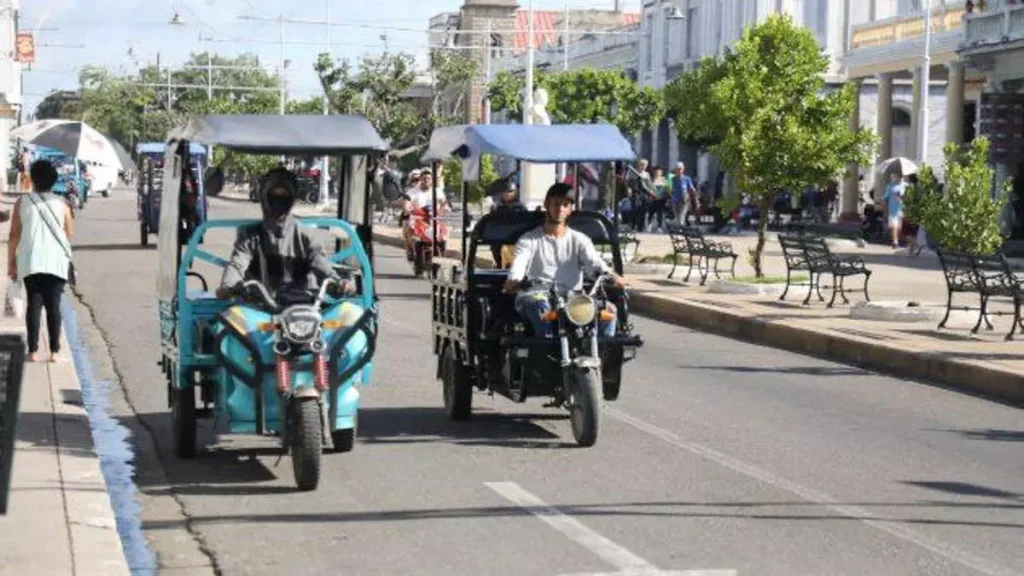
 14ymedio, Havana, October 10, 2025 –This Friday, the official press of Cienfuegos launched a diatribe against the drivers of private electric tricycles. Although at a time of “extinction of urban buses” vehicles represent a relief in passenger transport, their presence in the province has gone out of control and spreads “disorder, chaos, speculation, scams, excessive fees to the people and collisions that can be avoided.”
For one kilometer of road, 5 of Septiembre criticizes, from Avenue 36 to the funeral home of the capital city, the drivers can charge 200 pesos per passenger, an amount that the newspaper calls “irrational,” which increases if the route extends just five more blocks. The “urban road landscape, depressed” by the lack of public transport and fuel, has been the perfect scenario for speculators to proliferate, and fares rise without any price cap.
The newspaper also wonders why, despite the number of tricycles that have been added to the city’s routes, prices do not go down. The answer, it argues, is because they agree “to charge more and more for really insignificant stretches.”
“It is known today that about 80% of the movement of people here is done thanks to these electric tricycles. From their inception, the Ministry of Transport identified them as a real possibility to move personnel, authorizing their conversion for this purpose, provided that the standards and the same requirements for each electric vehicle were met. Thus, their presence in the cities has multiplied, both legal and illegal, on and off the main arteries.”
However, what is unacceptable, the newspaper stresses, is that the streets of Cienfuegos become an “uncontrolled jungle” thanks to them
However, the newspaper stresses that what is unacceptable is that the streets of Cienfuegos become an “uncontrolled jungle” thanks to them. “Their owners have added them to the local fauna on wheels, competing with private and state transport, in the struggle to see who gets paid more in very short stretches.”
These actions are to the detriment of citizens, it claims, “already bored by so many failed inventions that only affect their pocketbooks.” The reason for the high fares, the drivers defend, is the high price they pay not only for the vehicle but also its batteries, which are usually of poor quality and don’t last long.
As if that were not enough, 5 de Septiembre claims that many “circumvent” the traffic laws and circulate without a license to carry passengers. “There are hundreds that circulate without such a license, something that can be seen in the poor driving by some of the drivers,” adds the newspaper.
This may be due, it admits, to the “sometimes very long” delays in the technical testing of tricycles and the certification required for them to serve as public transport, which leads drivers to start driving without the necessary permits.
In many cities, as in Cienfuegos, it is the private ones that transport the largest mass of passengers daily
Sold on online platforms, mostly in dollars, the electric tricycles have been widely purchased by Cubans whose families abroad can afford to buy them. Business owners and MSMEs* also started buying them to use in the movement of goods. Recently, they have become vehicles to carry passengers with the approval of the State, which lacks the means to take care of public transport on its own.
In many cities, such as Cienfuegos, it is the private sector that transports the largest mass of passengers on a daily basis, since buses have disappeared, and the State tricycles, imported from China and distributed throughout the country in small quantities, usually do not last long or don’t suffice.
Even with the “help” of private individuals, transport in Cuba is at its worst. According to data published in September by the National Statistics and Information Office (ONEI), in the first half of this year, 407.9 million passengers were transported in the country, 10.2% fewer than a year earlier.
Not only does the number of people being transported by conventional means decrease but there are also fewer travelers using “alternative means,” such as animal-powered cars, bicitaxis, trucks and private cars. Between January and June 2025, there were 169.1 million, compared to 191.5 million in the same period of 2024, some 11.7% fewer.
*Translator’s note: Literally, “Micro, Small, Medium Enterprises.” The expectation is that it is also privately managed, but in Cuba this may include owners/managers who are connected to the government.
Translated by Regina Anavy
____________
COLLABORATE WITH OUR WORK: The 14ymedio team is committed to practicing serious journalism that reflects Cuba’s reality in all its depth. Thank you for joining us on this long journey. We invite you to continue supporting us by becoming a member of 14ymedio now. Together we can continue transforming journalism in Cuba.