Fear of contagion is changing daily habits in a city where obtaining safe water has become a luxury.
 Yoani Sánchez – Journalist, founder and director of 14ymedio, Havana, November 3, 2026 / There’s a word that, this Tuesday, has been haunting me since I left home. It appears in conversations, jumps from one sidewalk to another, and even sneaks into my text messages. It has four syllables and a sound that is beginning to sound all too familiar: hepatitis. In Havana, where bad news travels faster than water through the pipes, the fear of contagion is changing even our daily habits.
I walk up Belascoaín Street behind a woman and a child of about six. They both avoid the uneven surfaces and the dirty puddles that collect in doorways. A vendor passes by with a basin full of chiviricos, fried dough balls, on his shoulder. “Delicious and cheap!” he calls out. The little boy asks for one of those sugar-coated fritters, but his mother quickly dashes his hopes: “You can’t eat anything on the street, there’s a lot of hepatitis.”
An elderly woman recounted that her two grandchildren were ill, with yellowish skin, inflamed livers, and an exhaustion that barely allowed them to get out of bed.
By then, I had already heard the term three more times during the walk. A little earlier, an elderly woman was saying that her two grandchildren were sick, with yellowish skin, inflamed livers, and an exhaustion that barely allowed them to get out of bed. In front of a clinic, a nurse was warning a young man that he needed to rest because “hepatitis isn’t something to play with.” Further on, in a café, the waitress was boasting about the cleanliness of her glasses: “Clean, clean, nobody’s going to catch hepatitis here.”
The disease has entered our everyday vocabulary, alongside other words like blackout or mosquito. No one knows for sure how many are sick, but reports are multiplying, and fear of contaminated water and food is forcing people to take extreme precautions. Even an innocent-looking candy can arouse suspicion.
Hepatitis has entered the everyday vocabulary, along with other words like blackout or mosquito
Upon reaching Reina Street, I turn left, heading towards Fraternity Park. My phone vibrates. A friend has just written in a WhatsApp group that his nephew has hepatitis. The fifth time this morning I’ve encountered that dreaded word.
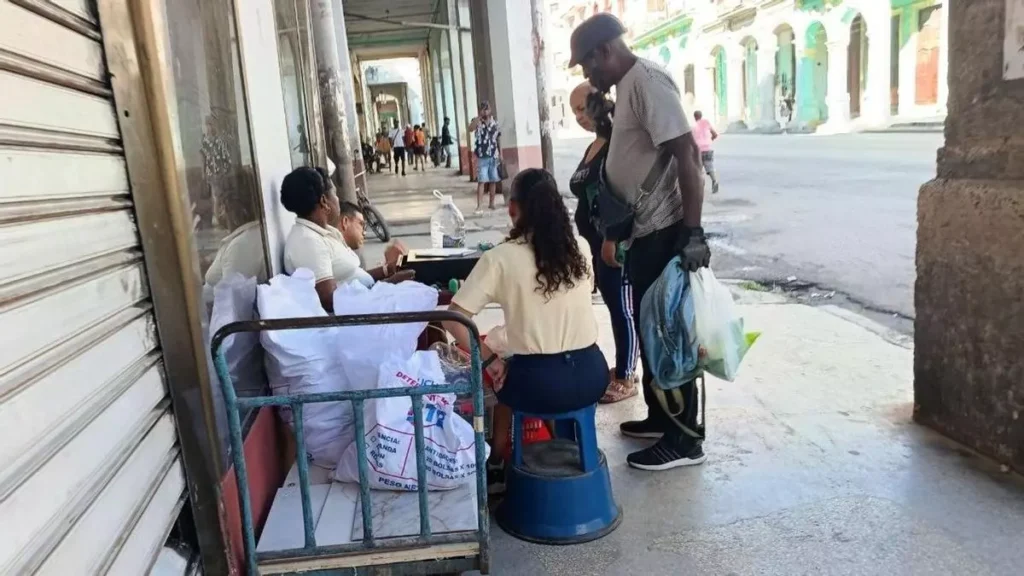
A little further on, I find the La Cubana hardware store, popularly known as Feíto y Cabezón, closed. It frustrates me not to be able to go in, but outside some employees are sitting behind a makeshift table with various products. Among them, a large bottle of water stands out at $2.20, a price that encapsulates the new priorities of Cuban commerce.
An elderly woman stops to examine the merchandise. She asks questions, looks around, and eventually walks away when she realizes everything is sold in foreign currency. There are no saws, screws, or even adhesive tape. The once-famous Havana hardware store, where generations of Cubans once sought tools and materials to repair their homes, has now joined the business of quenching thirst.
Because it is no longer enough to get water. It has to be safe. The prolonged blackouts and interruptions in the gas service make boiling water difficult, while home water filtration systems are prohibitively expensive for many and not entirely effective against certain pathogens. The sealed water bottle thus acquires the prestige of a preventative medicine, a promise of protection against the decay spreading through the city.
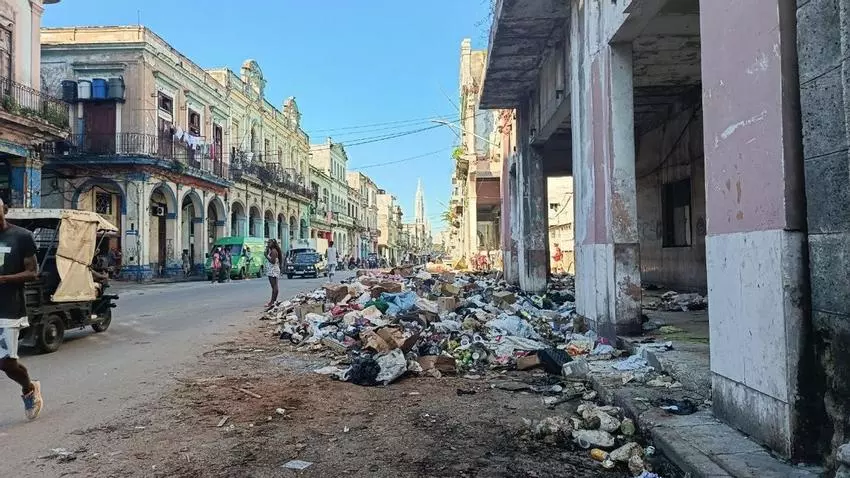
I continue on to El Curita Park, where I manage to catch an electric tricycle to go home. At the corner of Reina and Rayo streets, a mountain of trash spills onto the sidewalk and overflows into the street. Cardboard, bottles, bags, and other waste are piled up in front of the dilapidated doorways. In the distance, the spire of the Sacred Heart Church stands out against a pristine blue sky. I avoid touching the seat of the tricycle because I might unconsciously put my hands to my mouth afterward. I take the opportunity to pull the water bottle I’ve been carrying all morning out of my bag and take a long sip of boiled water. I feel privileged.
Read more Havana Chronicles here
____________________________
COLLABORATE WITH OUR WORK: The 14ymedio team is committed to practicing serious journalism that reflects Cuba’s reality in all its depth. Thank you for joining us on this long journey. We invite you to continue supporting us by becoming a member of 14ymedio now. Together we can continue transforming journalism in Cuba.