The scant information in Cuba about the authorization of Salvadoran President Nayib Bukele’s indefinite reelection is very eloquent in itself.
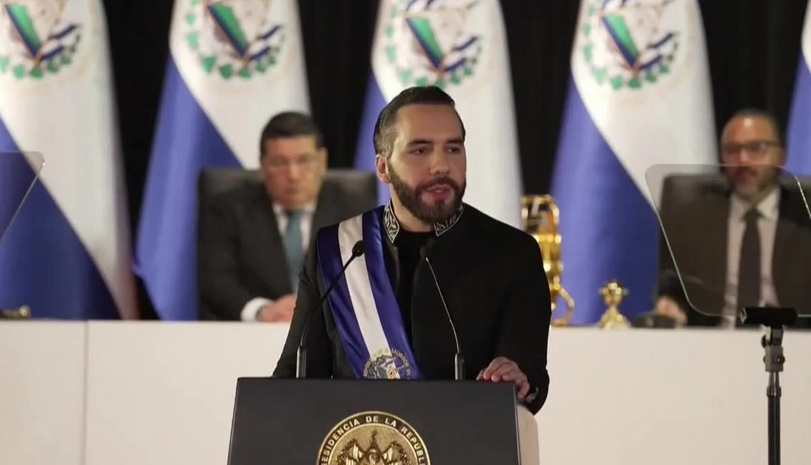
 14ymedio, René Gómez Manzano, Havana, 5 August 2025 / Last Friday, one of the main international news stories of the day in its own right was the adoption, in fraternal El Salvador, of a constitutional reform that, along with a series of other diverse measures, authorizes the indefinite reelection of the president of the Republic.
Reports on the matter indicate that, this Thursday, the government forces of the small Central American nation approved what undoubtedly deserves the epithet used in various media outlets: “express reform.” To this end, these forces made use of their overwhelming majority in the Salvadoran Legislative Assembly, which includes only three parliamentarians belonging to other parties.
It is worth clarifying that Bukele’s next reelection, under the new reform, would not be his first. Despite the fact that such a move was expressly prohibited by the current Constitution, the president resigned six months before the end of his first term. Adding to this ruse was a rash interpretation of supralegal precepts by the Constitutional Chamber of the Supreme Court of Justice, conveniently renewed entirely by the Legislative Assembly, already controlled by the president’s party. Thus, Bukele was reelected in 2024 with an impressive 88.3% of the valid votes.
Despite the fact that such a thing was expressly prohibited by the current Constitution, the president resigned six months before the end of his first term in office.
This staggering figure is neither unfounded nor arbitrary. It is a fact that, before Bukele’s arrival as head of state, criminal gangs (the famous “maras,” a Salvadoran term that has become a standard in our language) were rampant in the country.
With a mix of energy and severity (sprinkled, according to some critics, with a certain degree of violation of gang members’ human and procedural rights), Bukele and his government managed to reverse this lamentable situation. At the same time, the homicide rate per 100,000 inhabitants plummeted: from 105 in 2015 to 1.9 in 2024 (which, in turn, was 26% lower than in 2023).
These realities allow the Salvadoran population, with all the right in the world, to have a much better perception of their country’s security situation. In this context, the high level of popular support for Nuevas Ideas, the party that nominated and successfully elected Bukele, as well as the overwhelming majority of the assembly members, is explicable and perfectly comprehensible.
Thus, in 2024, of the 60 members of the legislature, the governing coalition obtained 57 (54 of them from Nuevas Ideas); the opposition, as mentioned, obtained only three. The only national representation (some name must be given) that surpasses it in this regard is Cuba, where each and every member of the so-called “National Assembly of People’s Power” (ANPP) is openly from the governing party.
But there are immense differences between these two legislative bodies. The overwhelming majority in El Salvador’s government was elected thanks to the aforementioned popular support, and against opposition candidates who had every opportunity to develop their respective electoral campaigns.
In Cuba, no. In our country, the sole party’s absolute control over the legislature stems from the so-called nomination committees. This deceptive mechanism, enshrined in the Electoral Law, allows for only one candidate for deputy to be registered for each seat to be filled. In other words, the “election” of each candidate is guaranteed in advance, as demonstrated by all the elections held under the Castro-communist constitutions.
But, even recognizing the abysmal differences that exist in this regard between the two countries, it is legitimate to ask some questions in the case of El Salvador: Is it appropriate for the electoral system of a democratic country (as until now, I believe, the Central American republic continues to be) to allow for virtually absolute control of the legislature by a single political force? Is it right for the country’s Magna Carta to be amended in a single day? Because it must be said that, in this last aspect, there were also too many similarities between what happened in Havana a few days ago and what happened in San Salvador last Thursday.
Is it appropriate for the electoral system of a democratic country (as until now, I believe, the Central American republic continues to be) to allow for virtually absolute control of the legislature by a single political force?
It is assumed that a country’s Constitution establishes, so to speak, “the rules of the game.” Its precepts—of course!—must be constantly updated, but important decisions like these are supposed to be made in an informed manner, and citizens are supposed to participate broadly in this process. This requires a certain amount of time: if not years or months, then at least a few weeks.
That was missing from the Salvadoran supralegal reform last Thursday; as it was from the Cuban one on the 18th. But, well, we already know that if there’s one thing that characterizes our long-suffering island, it is precisely the undemocratic nature of its system of government. And this latter fact is so significant that it has been reflected in the scant coverage that news from Central America has received in our archipelago.
The independent Cuban press, in reporting this important development, has recognized its significance. This newspaper, 14ymedio, as well as CubaNet and Diario de Cuba (to name a few), have reported on the Salvadoran constitutional reform.
The same cannot be said of the official Cuban press. Several days have passed, and the news has barely appeared in the digital media outlets that agitate and propagandize in favor of the Castro-communist government. I don’t believe this caution should be attributed to the negligence of the editorial staff of the various media outlets that serve the regime.
I think the blame should be fall in one place: I’m referring to the infamous Ideological Department of the Central Committee. In accordance with the written (but unpublished) rules that govern the functioning of that body, it is responsible for determining what is and is not published in the official press; and, in the first case, how the information should be framed and what kind of assessment it should receive.
And if we situate ourselves in the Ideological Department, we would have to ask ourselves other questions: How do we approach information?
With system so ineffectitive, any omission by bureaucrats in the Ideological Department will necessarily result in inaction by information professionals at government sites like Cubadebate, Granma, or Juventud Rebelde, to name just the most prominent.
And if we were to situate ourselves in the Ideological Department, we would have to ask ourselves other questions: How should we approach the information? Should we praise the speed shown by the Salvadoran Legislative Assembly, so similar to that of the Cuban National Assembly? Should we criticize the lack of a broad national debate on the reform (when there wasn’t one on our island either!). Should we approve or criticize the very idea of unlimited reelection? (It is true that the current version of the Raúl Castro Constitution—which, of course, can be reformed in a single day when the leaders so decide—establishes a limit of two consecutive presidential terms, but it is also true that the founder of the dynasty was reelected as many times as his health allowed…).
Of course the doubts are reasonable. But, as the popular saying goes, they brought it on themselves. Who ordered them to serve as spokespersons for an anti-democratic, totalitarian regime like the Castro-Communist regime?
____________
COLLABORATE WITH OUR WORK: The 14ymedio team is committed to practicing serious journalism that reflects Cuba’s reality in all its depth. Thank you for joining us on this long journey. We invite you to continue supporting us by becoming a member of 14ymedio now. Together we can continue transforming journalism in Cuba.