Political Immunity / Laritza Diversent

Raul Castro

Revolutionary justice is extremely rigorous: it punishes illegal exit or plans to hijack a boat. The law also gives a more severe punishment to someone who kills a cow than to someone who commits murder. However, such intransigence is left aside when dealing with misconduct by a government official.

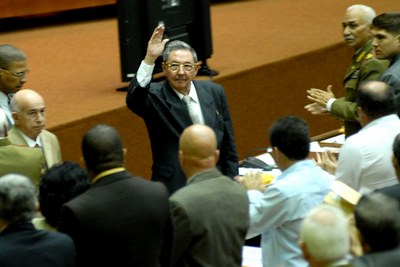
Raúl Castro, in his last speech before the National Assembly, acknowledged that “some comrades, without a fraudulent purpose, provide inaccurate information from their subordinates, without having tested it, and unconsciously fall into the lie. This false information can lead to wrong decisions, with greater or lesser repercussions for the nation,” he argued.

The maximum leader of the Cuban State and Government prefers the resignation of the leaders at any level, when they feel unable to perform their duties fully, rather than dismissing them for not complying with his guidelines. An example of this dominant feature of his administration, one of the most unstable of late, is the dismissal of ministers, mostly for incompetence.

More than 20 cadres were removed from their government posts, including Carlos Lage, Felipe Pérez Roque, Rogelio Acevedo, Juan Escalona, Carlos Valenciaga, Marta Lomas Morales, José Ramón Balaguer, Otto Rivero, Ulises Rosales del Toro, Pedro Sáez Montejo, Yadira García Vera, José Luis Sierra Cruz, etc.

All were put on trial before the Politburo of the Communist Party of Cuba (PCC), but no one went before the courts. The Criminal Code, which by reason of the charge is obligated to provide information, conceals and omits information or doesn’t verify it. The penalty is increased if it causes damage to the national economy. It doesn’t matter if the intent had been fraudulent or incompetent.  Ignorance of the law is no excuse.

Even the historic generation, the leader, is outside the reach of the law. No court of justice has the power to question the many recognized errors in the management of the country, despite the results. Today the Cuban economy is on the verge of collapse.

It’s the same law that puts them beyond the reach of justice. It’s logical; they created it. The courts need authorization to investigate and prosecute members of the Politburo of the PCC — the president, vice president and secretary of the National Assembly, members of the Council of State and the Ministry. The Law on Criminal Procedure sets this out.

On the contrary, the historical leaders feel they have a right that gives them “moral authority” to correct the errors committed in “these five decades of building socialism in Cuba.” They enjoy this privilege thanks to the fact that the courts on the island are constitutionally subordinate to a political body, the Council of State.

The fact that justice depends on politics permits the historical leaders to turn their personal beliefs into law, to impose absurd rules of behavior on the citizens and to severely punish those who dare to challenge them. Above all, it assures them political immunity, both for themselves and their clique.

Translated by Regina Anavy

February 5 2011

Message from Jorge Ángel Pérez / POLEMICA: The 2007 Intellectual Debate

A further lapse in judgment just happened on Cuban television: Luis Pavón, one of the most frightful and terrible people in the history of Cuban culture, just received praise on the Cubavisión program, Imprint.

In those days when so many lashed out against “The Difference,” I suppose, I hope, that they also are pointing now to this nonsense that is so absurd, and please allow me the tautology.

JORGE ANGEL PÉREZ

January 6, 2007

Message from Jorge Angel Pérez to Sifredo Ariel

Of course, dear, I saw, with these eyes that the earth will swallow, the program Imprint, where that old man appeared. No one could believe, if you looked at his face, that he had left any mark. As we all know, yes, he left a trace, but it was unfortunate. I agree with you about the national awards or those who suffered from the “Pavo-Nato,” those who should speak out, testify, demand; but I don’t think, Sigfre, that we should be just spectators, critical observers or spectators who follow television. It’s true, as you say, we do not live in those times, but you, I, and many others of our generation know how terrible it was for them. And also how terrible another Pavón would be for everyone.

A kiss.
Jorge Ángel

Message from Jorge Angel to Reynaldo González

Rey, I’m still connected with this story, and I think that we shouldn’t let it slip out of our hands. The days can pass and in a few days we’ll have Ana Lasalle as the winner of the National TV Award and later, Aldana as president of the ICRT.

A hug.
Jorge Angel

January 6, 2007

Translated by Regina Anavy

Message from Jorge Luis Arcos / POLEMICA: The 2007 Intellectual Debate

The recent events triggered in Cuba after the resurrection of Pavón-Quesada-Serguera, to wit, the many outcries of various kinds by email, articulating a common domestic front to protest the raulista attempt to clean their old repressive instruments, to whitewash historical memory, and, incidentally, to humiliate their victims once again, and in general, all intellectuals, if not also, incidentally, to warn that the nightmare could come back again, etc. This is just one more episode in a shattered reality.

Many of the reactions are negative, in spite of themselves. Some advocate that the problem be resolved in-house, as if a significant proportion of the victims weren’t outside Cuba. Others try to deny the obvious: that it all has to do with a strategy of power, as it was in the past and even in the present. Many are critical of what happened; they call for public atonement but, of course, without naming — before or now — the real culprits.

It’s simply incredible. It seems that a considerable part of Cuban intellectuals assume that the current regime will continue to exist, and they, inside the same, with their wide range of complicity, silence, opportunism, or even happy approval. Because even when they correct themselves publicly — which happened recently — that would constitute only a slight rearrangement within a cultural policy essentially subject to a totalitarian power.

It’s all very well to protest the resurrection of the image of that ominous past, but how do you live in the present with a regime that restricts all basic freedoms every day? Worse than forgetting the past, is to have amnesia about the present. Even the most honest critics of what happened show that in the present they themselves remain subject to some censorship, to a fear shaped by decades of repression. As if the terrible thing happened only in the past, as if this cannot be questioned in the present.

In any case, a great deal of conformism reigns.

They have, therefore, a relative civility, selective, pragmatic, opportunistic or conservative. They are afraid, in short. And it’s not bad because we all are, but yes they wield it only when they see the possibility of being affected again themselves, more than they’ve always been.

One of them gives an opinion about those who are on the right inside and outside of Cuba, giving the sense that he is on the left. But what “left” is it that does not want to recognize that the “right” has always been in power?

Well, I also was afraid, I also suffered censorship and especially self-censorship. I had to leave my country to enjoy the dubious privilege of being able to write this article without expecting retaliation, to be able to put in black and white what I really think without fear of losing my job, being kicked out of society, or even going to jail.

But, at least, let’s also respect those in Cuba who suffer a direct repression by the simple sin of saying what they think, and even also let’s respect those who have had to give up our country so we can at least sleep with a better conscience, if that’s still possible.

You who live in Cuba also deserve respect, but — like everyone — you will have to win that respect, either through acts or even silences and significant sacrifices, since how even can you be respected by the same regime that humiliates you every day with its diverse collaborations or selective and timely amnesia? How far can you play the game sincerely at being a reformist? Reforms, what for, to maintain the current state of affairs?

This is the crossroads. If current events do not make them see the obvious, that the regime has been essentially the same, then very little can be expected of a future “with all and for the good of all.” It’s very convenient to advocate that Cuban culture be united and suddenly forget the victims both inside and outside the country. Cuban intellectual friends, the game isn’t played like that.

Jorge Luis Arcos

Madrid, Spain

Another comment by Jorge Luis Arcos

I write the comments that follow (and I now quote Eliseo Diego) “with the melancholy of those who draft a document.”

Surprised by a language of the ’70’s, from Pavón himself, I read the recent statement by the secretariat of UNEAC. As for 10 years I attended many meetings of this secretariat — since in everyday life it became “expanded” so that different people could attend according to the issues under discussion or their responsibilities in UNEAC — I know more or less, after almost three years away, its members and regular attendees. But the Cuban population doesn’t. I have to admit that many of the discussions that take place there have nothing to do with the rhetorical language of the mentioned declaration.

Similarly — and this is perhaps the most important of all that has happened — in countless emails and in some publications outside Cuba, with an understandable passion, this recent phenomenon has existed, before which Cuban intellectuals inside and outside the island have expressed their necessary and healthily different points of view, of course in a very different way, both in form and content – as they say – regarding the document in question.

But also, apart from these passionate disputes or different claims or moving testimonies, something very profound must have occurred there, invisibly, I mean in the minds of so many people who have been affected not only by the pavonato (the so-called “Five Gray Years”), but also in many other circumstances and other times, some very recently. However, according to this declaration by UNEAC, it appears that the matter has been settled. To fail to remember, as one bolero says, again and quickly, that — as a Greek chorus a lo Piñera seems to say in the background — the Party is … immortal?

I have to admit that the mere publication of the text in the newspaper Granma is a rarity. But it seems that such was the magnitude of the unrest that it was almost inevitable to declare oneself and publish it. Yes, they wanted to repair to some extent the mistake, and, moreover, to cap it off, in one case indeed it was remarkable as what our country is going through now. But, as you know, the image is always the most important — the image for the outside and inside, as they say, too. And in the name of that image, truth, passion, memory, as well as the endless contradictions that are inherent to life … are buried. Although, it would be worth asking, for how long?

As for the publication of that unsigned pronouncement, it’s a very widespread custom in Cuba to produce documents “in the name of the population” (actually, in politics, everything is always done “in the name of”; I mean in the name of that abstract entity that can appoint itself as “our people” or “our intellectuals,” etc.), or to call for others’ signatures so as to show support for certain statements or measures.

Why didn’t they appeal, for example, to those mechanisms when they “deactivated” — a delicious euphemism, in which we are experts — Antonio José Ponte from UNEAC? Because then the management of UNEAC itself knew it couldn’t count on majority support even among its members. That is, they resort to those methods that suit them. What Wendy Guerra proposed was an interesting challenge. But even if what she asked had been done, driven by a basic democratic principle and a respect for individual, rather than collective, opinion, who can guarantee that once it happened, all opinions really would be known?

But that’s not even the problem: the problem is the lack of real democracy. It’s been so many years with no democracy in Cuba (over half a century) that very often we can say quite naturally that there is … Because much of the population has been born in a country without democracy. In any democratic society the varied opinions of Cuban intellectuals — I repeat, all Cuban intellectuals — would have been published or presented in different media — even by individual initiative — without a hint of censure.

In Cuba, unfortunately, that is unthinkable. But, even more, we already know the understandable reluctance to express aloud true opinions on any subject. On the one hand, we fear the so-called subtle reprisals, if not the direct ones. On the other hand, as with the now-legendary case of the call to the Fourth Party Congress, we know the futility. As a former work colleague warned on that occasion:

“The well-known argument to justify this lack of democracy is ‘Don’t give ammunition to the enemy.’ But the price of not giving ammunition or not playing to the enemy has been, strangely enough, to suffer an absolute lack of freedom — and the true” [gap in the original]

But was anyone really surprised with this innocuous statement from UNEAC? I think it was predictable in essence. What was not so predictable is the trite tone, full of cliches, not really fitting for the intelligentsia that is left in UNEAC. As Fefé says, what is this story of “annexation” but the purest rhetoric of the Roundtables and the so-called Battle of Ideas — doesn’t that say it all? To always disqualify an opponent or anyone holding a different view has been, as we know, a permanent practice.

But I express all these arguments, I confess, more from weariness or an infinite boredom. It always leaves a bitter taste, as if one lived an infinite postponement… ah, when life happens only once and is so short… After nearly half a century of authoritarian and anti-democratic practice, that is, theatrical representation, what can you expect really? The most bitter taste is experienced — at least that’s my case and I understand it might not be so for others — when at the end of the declaration they mention jubilantly the two people responsible not only for the pavonato but also the sad and complex history — with light spots, too, is their room for doubt? — of the so-called cultural politics of the Revolution. But that was perhaps most predictable. No?

As always, the people of Cuba are truly absent from all these representations. An undeserving people, to their rulers, still not knowing the critical opinions and testimonials of the so-called counter-revolutionary intellectuals, “enemies” or spooky “annexationists” etc. — “Get out, scum! Get out, fags”! Don’t you remember Granma in the ’80s, by the way, without Pavón? — or even the criticisms and testimonials — ah, memory, what a danger — of the considerate Revolutionaries?

I would like to be wrong, but in the end, sadly, this time, visibly or imagined (as Lezama would say), as in so many other cases, “there is nothing new under the sun.” So don’t worry, friends and Cuban intellectual colleagues, inside and outside Cuba, you can rest easy, because, at least for now, absolutely nothing will happen — visibly, I mean.

Jorge Luis Arcos

Spain

Translated by Regina Anavy

January 2007
I Propose That the Government Legalize Prostitution / Iván García

Yaima Beltran, 32, wants to contribute to the public treasury. “I have spent 13 years practicing prostitution. I have gone to jail twice for hooking. And I always return. It’s not easy to go around scared at the prospect of getting caught by the police. I propose that President Raúl Castro legalize prostitution. I know his daughter Mariela wants to create a climate of tolerance toward gays. Shouldn’t they consider something similar with us prostitutes? Each person should be free to do what they want with their body.”

She isn’t the only one. Girls, who the day before got off a passenger train after a long, exhausting journey of 18 hours from a province in eastern Cuba, mill around in the areas near the National Highway.

On the cold nights of January they ply their trade. They wave brazenly at the vehicles traveling at 100 kilometers per hour. And if a driver stops, dazzled by the fine figure of a sculptural mulatto, without exchanging greetings, they make their offer.

Regina, 19, charges five dollars for a quickie in the back seat of a truck or an adjoining banana grove. She’s never been to the tank (prison), and just thinking about it makes her panic.

“It’s time now for a change of policy with hookers. It would be good for the government and the customers. We would have a health card, which would attest that we don’t have any sexually transmitted disease. And we would pay taxes,” says Regina.

Three black girls, regulars at fashionable discos, agree with Regina and Yaima. “To us it seems only fair to pay a tax for hooking. Sure, it shouldn’t be abusive. I don’t think any country in the world can abolish prostitution. With all the prostitutes there are in Cuba, the State is missing a chance to make money,” says one of them.

Perhaps one day the government will recognize the real causes of the phenomenon of prostitution after the triumph of the revolution in 1959. At times, the hookers are more effective for the local economy than a speech by Fidel Castro. Not a few businessmen sign contracts after being seduced by the ardor of a voluptuous Creole.

Almost all the young girls who become prostitutes do so in search of a visa or marriage to a foreigner. When they succeed, they often come back, turned into respectable ladies.

The Cuban regime does not accept the practice of prostitution. But a good part of the two million visitors who enter the island every year come with a lust that goes through the roof, eager to carry out their sexual fantasies with the greedy and appetizing Cuban women, who are cheap and cheerful.

Whether you like it or not, prostitutes are part of the publicity for tourism. Like music, cigars and rum. Either way, it’s unlikely that Raul Castro’s government will legalize prostitution. It goes against his doctrines. Even though they want to pay taxes.

Translated by Regina Anavy

February 2 2011

The Mazorra Case: Has the Curtain Come Down? / Laritza Diversent

On Monday, January 31, the Havana Provincial Court imposed sentences of between 5 and 15 years imprisonment on the 13 people accused in the deaths, by starvation and cold, of 26 patients in the Psychiatric Hospital, located on the outskirts of the capital. The incident occurred in January 2010.

The steepest penalty, 15 years, went to Wilfredo Castillo, director of the Psychiatric Hospital. The vice-director was sentenced to 14 years and the dietitian, to 12. As authors of the crime of abandonment of disabled and disadvantaged patients, the vice-directors of clinical surgery and nursing were sentenced to 10 years each. The head of psychiatry received a penalty of 7 years.

For embezzlement, sentences ranged between 6 and 10 years, and the accused were seven employees who were in positions subordinate to the hospital, as managers of the store, kitchen, dining room and bar, among others. Moreover, the Court issued a fine for the head of the center’s pharmacy, for “dereliction of duty to preserve the assets of economic entities.”

All those convicted may appeal to the People’s Supreme Court. The ruling also states that “outside the judicial process severe administrative sanctions were also imposed against other responsible parties.”

These, in brief, are the results of the trial held between January 17-22. A trial that was presented as bad theater by the official press, which tried to decorate with legal technicalities what everyone knows: the collapse of public health, a weak legal system, rampant corruption in all sectors of national life and media hypocrisy.

The newspaper Granma omitted the number of those involved and killed, but gave details on the number of witnesses examined by the Court and the specialties of the members of the commission created belatedly by the Ministry of Public Health to investigate the causes and conditions that led to “the deaths that occurred.”

Have the judges of the Second Criminal Chamber of the Havana Court seen the photos of the deceased that surreptitiously circulated in the city? The skins lacerated by blows, evidence of physical abuse? The faces of those who vainly tried to keep warm when the rigor of death reached them? Emaciated bodies, that received severe punishment because, being unconscious, they couldn’t perceive their abandonment and protest it?

Hunger lashed them with the same harshness as their nurses and doctors, who possibly were tired by such hard work and robbed of human sensibility by material need. Granma called this negligence “insufficient patient care.”

“The prosecution alleged that those involved knew that winter could produce an increase in deaths from respiratory diseases,” explained the journalist. However, “the pattern found in the clinical outcome” showed severe signs of malnutrition, anemia and vitamin deficiency.

A cold front did not cause this suffering. The 26 mental patients died as a result of low temperatures, but also from the lack of adequate nutrition, for months or years. In these physical conditions, death was a matter of time. The sharp drop in the thermometer was a catalyst, perhaps desired.

So the trial ended. Sentences were handed out, but many questions remain.

Couldn’t this sad ending have been avoided? Did no prior medical analysis reveal these diagnoses? What did the government officials and Communist Party members who worked at the center do? In all that time didn’t any historical leader pass through there? Wasn’t the Psychiatric Hospital a strategic objective of the revolution?

One last question: Where was José Ramón Balaguer, the Minister of Public Health at the time? Maybe he was eating, all snug and protected, and then went to sleep in a warm bed. Meanwhile, thirty people who had gone mad, who were human beings, died of hypothermia and malnutrition in a part of the system he managed.

Like other incompetent ministers, he was removed in late July 2010, but he continues his work in high government circles, as if nothing happened. No apologies, no regrets, no public acknowledgment of his error. Balaguer is part of that select group of untouchables, men loyal to the Castros, who are entitled to enjoy “the honey of power” until the end of their days.

Maybe that’s why the court did not get permission to investigate. Justice focused on the cooks, employees and directors of the hospital.

The curtain came down. Case closed. Within days, no one will remember the tragic events. Thanks to the official press, which chose to disguise the human misery of a “sector which is the pride and bulwark of Cuba and many countries around the world.”

Laritza Diversent and Tania Quintero

Photo: People wait to enter the trial in the Peoples’ Court on October 10.

Translated by Regina Anavy

February 2 2011

The Masochistic Left is “Pavonating” Itself / POLEMICA: The 2007 Intellectual Debate

Masochism is the “sexual perversion of someone who enjoys being humiliated or mistreated by someone else,” says the dictionary. Did the writers who now rightly denounce the official television revival of Luis Pavón, Serguera and Quesada actually enjoy it?

“Pick little fights, don’t try to be a hero,” the current director of the Cuban Academy of Language advised me one afternoon in 1997 in Mexico City. Are most of the protests against the resurrection of the deputy commanders perhaps following, with discipline, the morals of this picaresque warning?

Please, the impossible? — to finish with Sancho Panza. Except in one of the protesting jousts — by a talented storyteller — there appears not the slightest intention of judging the lion, nor the brother, by those who never publicly repented of perpetrating that National Congress for Education and Culture in April, 1971, after the disaster of the Ten Million Ton Harvest and the subsequent submission to the Moscow of scientific communism and socialist realism.

Critical thinking in 2007 by the same people who shut down the magazine Critical Thought and the Department of Philosophy at the University of Havana? Is it naiveté or fear on the part of some who today accuse the television — as totalitarian now as it was in the “black decade” — of complying with an order handed down from the Party. Is this similar to what happened then?

Will it be tacitly understood, implied? Let’s hope so … What is not clear or hinted at in the Aristotelian rhetoric of complaints against the media tribute to the supporters of Pavón is, simply, whether they have now lost the little faith they had in the Halls of Power. That’s what, apparently, eludes them.

What did Luis Pavón do before being named president of the National Council of Culture? Was he not perhaps the director of the magazine Olive Green, a cadre very near the absolute confidence of Raúl Castro? Who could appoint the former prosecutor Papito Serguera at the Cuban Institute of Radio and Television? And by the way…

Ah, memory. I suggest a campaign to collect “perfumed love letters.” As I have not lost my memory — nor want to lose it — I remember clearly Fidel Castro’s speech at the closing of the Stalinist Congress on Education and Culture. The same contempt for intellectuals that the vice presidents show at the beginning of 2007: the proof flared up on the small screen.

I agree in general with Duanel Díaz’s article. Perhaps what is worrisome is not the posture of critics that some masochistics now assume, but the message that brings such resurrections with it. Is there another turn of the screw that has been sweetened? Will there be changes in the staff running the government’s cultural policy? Are we witnessing the resumption of blatant repression against artists and writers they consider dissidents? Are we done with being in limbo?

In any case….

José Prats Sariol

México

Translated by Regina Anavy

Transportation in Havana Goes Backwards / Iván García

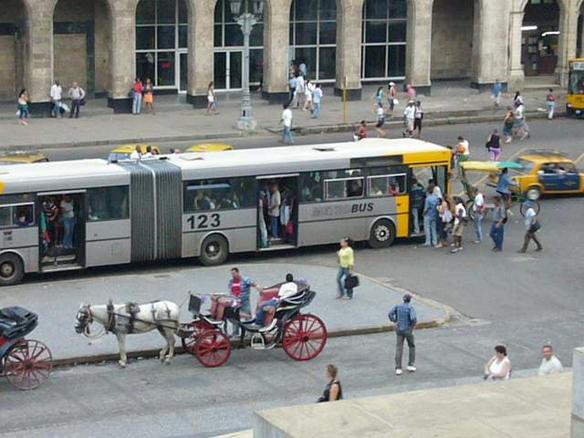
It takes Esteban, 43 years old, four hours every day for the round trip to his job on the outskirts of Havana. Around 7 am, along with a bunch of people, he tries to board the P-8 bus on the Acosta P-8 and Calzada 10 de Octubre line.

“For several months, the city bus service has taken a dive. I don’t know why. Every day going to work is a disaster,” he points out, sweating after running 60 meters to catch a bus that paused beyond the bus stop.

In Cuba, the only means of cheap public mass transit are the city buses (they cost less than a nickel U.S.). State taxi service has disappeared. It’s a fleet of Ladas manufactured in the mid-80’s in Russia.

These cars have seen 20 to 25 years of service and generally are in poor technical condition. The state has leased them to the drivers, who must pay for repairs and extra fuel after serving half a day providing assistance to hospitals, funeral homes and air terminals.

The fee is ten pesos (0.50 U.S. cents, the average salary for a day), the same as private taxis. But there are very few Ladas in service. And it doesn’t occur to anyone who uses public transport to spend part of his daily wage to get to work on time.

So the only option is the bus. In 2008 the government bought around 750 buses from China, Russia and Belarus to improve the disastrous service in the capital. It designed a main line of 17 routes identified with the letter P, which usually run along the main thoroughfares of the city.

These buses are articulated and initially arrived every 5 to 10 minutes during peak hours. There was also a support network of buses, to transport people to the inner neighborhoods and suburban areas, where the main lines often did not go. They have the letter A and run every 25 minutes.

But by mid-2009, with the policy of conserving fuel and tightening the screws on the local economic crisis, they stopped purchasing the buses, and improvements in the quality of urban transport suffered a setback.

Everything went to hell. In December 2010, the situation became precarious. Media predictions of half a million people unemployed prompted an increase in the number of people taking the bus every day.

At all hours the bus stops are filled with people who are anxious and desperate to get to their destinations. The main lines like the P-12 or the P-16 can take up to 45 minutes to arrive.

The frequency of the rest of the P line has also deteriorated. And this leads to overcrowded buses all day. Alberto, an employee of the company Metrobus, which is in charge of transportation in Havana, asserts that more than 80 buses are out of service. “For lack of financing and debts with China and Russia, it hasn’t been possible to get batteries, tires and other essential parts for the maintenance of these vehicles,” he points out.

Given this reality, habaneros like Esteban will have to keep suffering every morning to try to get to work on time. The same as with most economic sectors on the island, investments in urban transport are paralyzed. Until further notice.

Photo: Martijn Vrenssen

Translated by Regina Anavy

January 28 2011

“Don’t Be Afraid to Say What You Think” / Laritza Diversent

Photo: AFP

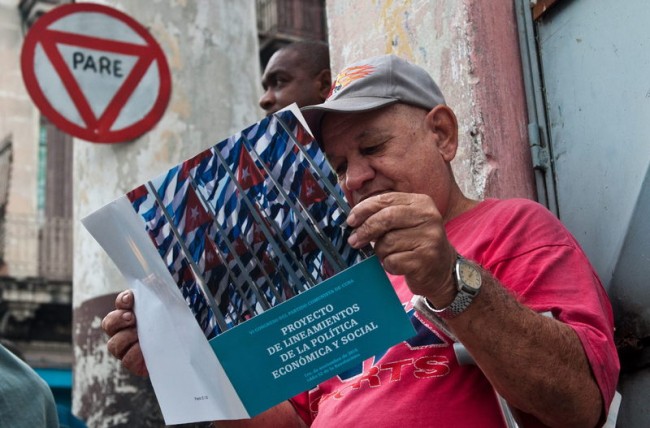
“A massive discussion of the Guidelines contributes an enormous and rich wealth of arguments,” said Esteban Lazo, member of the Politburo of the Communist Party of Cuba, speaking before the National Council of the National Union of Writers and Artists of Cuba. The information appeared in Granma on January 13.

In addition, Lazo said it was very difficult to carry out the proposed changes without the consensus and opinions of all. According to the newspaper, over 55,000 “discussion meetings” had been held in the country, about one-third of those planned.

As a worker of the Municipal Court of Arroyo Naranjo, I attended the meeting in my workplace on January 7. What was disturbing about the proceeding was not the opinions, but the method by which they were received.

The meeting had been announced three days before and scheduled for 4 p.m., half an hour before the end of the workday. As they had not announced what was going to be discussed, the comments started in the halls and fears surfaced. Everyone was waiting expectantly. They thought they would address the issue of who was “disposable,” that is who was going to be laid off.

At the time and place agreed upon, in a narrow room where the majority stood, the meeting began. A lady with sharp acrylic nails, claiming to be a member of the PCC and chair of the event, then reported the matter to be discussed: the economic guidelines for the next five years. They knew that if the matter had been revealed earlier, they wouldn’t meet the required attendance rate.

While each of the participants registered on a piece of paper and signed it, the Party member explained how the meeting would take place. First the document would be analyzed chapter by chapter, and then whoever wanted to give an opinion would raise his hand, give his full name and the number of the guideline he wanted to discuss.

“Don’t be afraid to say what you think, all approaches will be heard,” she said. “The proceedings will go into a computer and will be sent in an encrypted and encoded message to the Council of State, not to fall into enemy hands,” she explained, like telecommunications in Cuba were so developed and available to all, and information could be easily stolen.

I was amazed and I wanted to laugh. Was it fiction or did they want to make us feel like we were the center of the world? The vices of Cuban socialism are difficult to eradicate. Obviously, its followers have not internalized the words of Raul in his latest speech, when he confessed that we should struggle against state secrecy.

While the señora tapped her fingers on the table, my subconscious processed the information that I saw and heard. Would her salary allow her to keep her hands so beautiful? In the informal market, acrylic nails cost 200 pesos in national currency (8 cuc) and 100 pesos (4 cuc) to put them on and fill them periodically. Her Party militancy was not in keeping with her attire or the message she was trying to convey.

“First and last names, for the encrypted information.” In other words, they need to know who gave an opinion and what the workers were thinking, I thought. Under these conditions, the smart ones would weigh their words, especially when after this assembly another one could come, declaring who was “disposable.” Is this the way to encourage debate and divergent opinions?

If they really wanted consensus and everyone’s opinion, they would conduct a constitutional referendum as is legally required by the new transformations. In one day and with one single question, they would know how many Cubans support the upgrade of the socialist model. Of course, the country’s socio-economic conditions do not support that procedure.

Discussion meetings are more effective and reliable. It was the method used when they increased the retirement age. In France, faced with such a prospect, the workers took to the street and protested, creating a government crisis. In Cuba, the proletariat marched on May 1 to give its support for the Revolution.

The political propaganda calls it “a popular consultation mechanism.” And it’s a subtle way to control the citizens and silence opinion. It even allows you to predict the results and put in Granma headlines like this: “The people of Cuba unanimously approve the guidelines. ”


Translated by Regina Anavy

January 30 2011

José Martí , a Hero for New Generations to Discover / Iván García

Photo: Daniel, Picasaweb

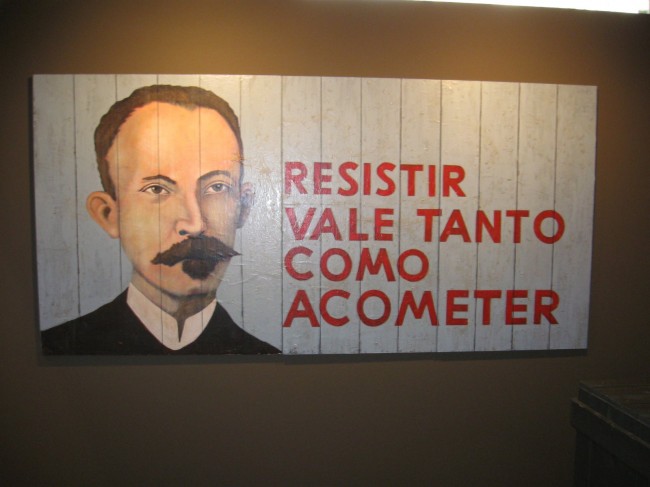
José Julián Martí y Pérez was born on January 28, 1853 and died on May 19, 1895. For Cuban politicians, he is what Christ is to the Catholic Church. No matter the ideology or leaning. Everyone prides themselves on knowing him inside out.

It is politically correct for any official or dissident document to be preceded by a phrase from the great man. Even in my blog we have put one: “Nothing comes from hypocrisy.”

On the island, they really like taking photos with his picture in the background. In the independent libraries of the opposition and on shelves in government offices, you can see thick volumes of his complete works crammed together. It’s rare not to find a bust of him in a Cuban public school.

On the ideological propaganda billboards that surround the main arteries of the country, developed by unimaginative designers from the Department of Revolutionary Orientation, epic sentences from the hero appear on top of gloomy colors, where Martí always looks very serious, dressed in a funereal black suit.

The government likes to sell the image of a sad guy, committed to the independence of his homeland. Martí was much more. It’s not wise to sanctify men of such stature. Nor advisable.

It often causes hives in the new generations, who are not pleased with this frozen image of José Martí . Nobody likes to contemplate statues of ice.

Two Cuban intellectuals have tried to remove him from his pedestal. One was the late writer Guillermo Cabrera Infante, who won the Cervantes Prize in 1997. In various chronicles, Cabrera Infante offered us a flesh-and-blood Martí. The other who gave us ‘Pepe’ unwrapped is the filmmaker Fernando Perez, in his film The Eye of the Canarian.

158 years after his birth, José Martí is still an indispensable paradigm. But a re-reading of his work is needed. A disclosure without a cover-up that demystifies for us the undeniable greatness of this habanero, the son of a Spanish soldier, who lived his childhood in a small house on Calle Paula.

As a political genius ahead of his time, he was misunderstood. Rough military leaders of the jungle watched him closely. Guys who had strong arms to launch brutal machete charges against the Spanish troops, but of limited intellect.

They were people who were quick to take up arms, believing that they would win stripes by shooting or by collecting their enemies’ heads as trophies. And Marti was a scholar, a humanist and political strategist. In spite of everything, he won prestige working tirelessly for a different, democratic Cuba. In 1892 he founded the Cuban Revolutionary Party in Tampa, Florida.

On February 24, 1895, he landed on a beach in eastern Cuba, to start what he called a “necessary war.” Which it was. Although according to some historians, his presence was not needed on the battlefield.

But “Pepe” Martí wanted to prove he was more than a brilliant pen. He wanted to put himself to the test. He fell into the trap of his political enemies, who pejoratively called him “Captain Spider.”

Some scholars of his work agree: It was a real political suicide to join the insurgents. Three months later, on May 19, 1895, he was killed in an absurd skirmish, near the village of Dos Rios.

In this 21st century, the mandarins of the regime keep the island full of his images. At the first move, they place wreaths on him. But when the time comes for state policy, they value the guts and courage acquired in the trenches of combat more than men of ideas.

Martí was also a universal Cuban. The best ever. A precursor that serves as a catch-phrase for politicians from both sides, inside and outside Cuba. But the reality is that Marti is not yet fully known. They all take advantage of the aspect that best reflects their interest. The rulers and the opposition take the spoils of the national hero for their own ends.

Everyone believes they deserve Marti. One more useful dead man. A cliché. When the undercurrent of these stormy times passes, the work of rediscovering the Apostle, as they called him before 1959, will fall into the hands of Cuban intellectuals. Debt and obligation.

Those young people who have taken up the banner of banalities and whose goal is a passport and an exit permit need to do that. That decaffeinated figure of José Martí annoys them a lot.

Translated by Regina Anavy

January 27 2011

Dégas in Havana / Iván García

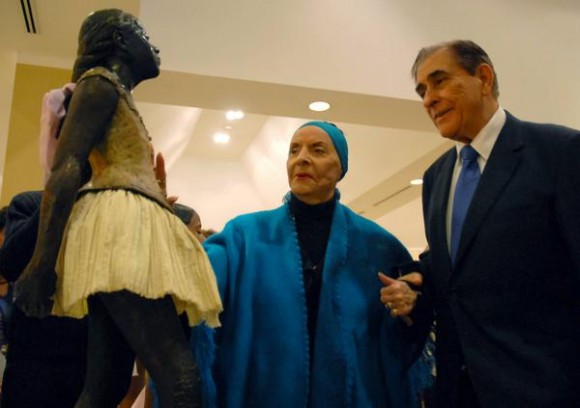
The new policies of flexibility in the U.S. embargo against Cuba have permitted an exhibit, provided by the MT Abraham Center for Visual Arts in the United States to be displayed at the National Museum of Fine Arts.

Nestled in Zulueta Street, a stone’s throw from the Spanish embassy in Havana Vieja, the Museum shows a complete collection of sculptures by Edgar Dégas (Paris 1834-1917), one of the key figures of world art.

The exhibition is part of the tributes that in 2010 were conducted in different institutions and countries to mark the 90th birthday of the prima ballerina assoluta Alicia Alonso (Havana 1920).

Under the title “All the sculptures of Edgar Dégas,” the exhibit consists of 74 pieces, shown previously in Athens, Tel Aviv and Sofia. It will remain in the Cuban capital until the end of January and then continue its tour in Spain.

The star of the collection is The Little Ballerina of 14 Years, sculpted between 1878 and 1881, the only sculpture that this controversial and contradictory Frenchman showed while he was alive. Praised and reviled, Dégas is known as one of the founders of Impressionism. He was considered by Renoir as the best modern sculptor, ahead even of Rodin.

Despite the heavy and persistent rain over the weekend in Havana, the show has had an extraordinary reception. Cubans who advocate ending the embargo and normalizing relations with the United States are grateful for the possibility of cultural exchanges between the two countries and also the measures taken for the benefit of the families on both sides.

Now, from the United States, you can send through Western Union up to $10,000 and receive it on the island in convertible pesos with a 10% tax. Soon, direct flights to Havana will depart from several U.S. airports, not only from Miami, New York and California.

Raul Castro’s government is rubbing its hands. The Dégas exhibit can be a beginning. The icing on the cake would be to end the old, obsolete embargo and have droves of Yankee tourists arriving. It would not be bad for an economy that is leaking. Despite the drought.

Photo: Cubarte. Alicia Alonso contemplates The Little Ballerina of 14 Years, by Edgar Dégas at the Museum of Fine Arts in Havana.

Translated by Regina Anavy

January 27 2011

The Government Demands More Rigorous Police Work / Laritza Diversent

According to the January 6 edition of the newspaper Granma, “Updating the Cuban economic model demands concrete actions from the police to ensure the safety of families and order in society.” The Ministry of Interior made this known during the celebration of the 52nd anniversary of the National Revolutionary Police (PNR).

Apparently the Cuban authorities are fully aware of the dangers surrounding the application of its new policies — mainly, the plan to lay off 500,000 workers this quarter. This is something unprecedented in the history of the socialist revolution, which promised, in its state constitution, full employment for all its citizens.

The situation on the streets is tense. “Transportation is getting worse, food is scarce, prices have gone through the roof, and there is no money. The only option left is to steal,” says Peter, a young man of 38, self-employed, who fills lighters. “I chose this activity because I can be on the corner waiting for some business to fall into my hands. The license at least gives me some cover,” he comments.

The government is aware of this reality. It knows that the new self-employed workers need the black market and the illegal trafficking of merchandise in order to finance their economic activities. It’s the only way to guarantee enough resources to stay in business and pay the state taxes. Classified by the population itself as excessive, given the precarious state of the island’s economy.

Cuba has a population of 11.2 million people, and the State, the main employer, has the ability to hire fewer than 3.9 million. There are too many people “inventing,” and we all know that illegal activity is the main source of survival. Faced with this phenomenon, the government increases its repressive force, mainly in the capital. In July, the Interior Ministry graduated nearly 600 officers, and in September, 500 were added to the new class.

The Cuban police, to curb black market activity, control the inter-provincial highways and deploy operatives who hunt down traveling vendors. They can detain someone and make a record of his belongings on a public street, although this power is not derived from the law, but rather from the excessive power that the government places in this body, whose members do not skimp on abuse.

In fact, they decide which citizen will be tried or not by the courts. The Penal Code gives them the power to impose an administrative fine instead of referring a crime to the court. There are quite a few police officers who accept bribes to apply the law at their convenience.

This truth is well silenced by the government. They warn: “The law is applied with the utmost rigor and severity.” However, they tolerate corruption and abuse, in exchange for impunity for members of the police. They are the main force of repression and the only one that guarantees them that an unsustainable system in maintained.

Translated by Regina Anavy

January 26 2011

Havana Without Water, Another Headache for the Regime / Iván García

Photo: Martha Beatriz Roque

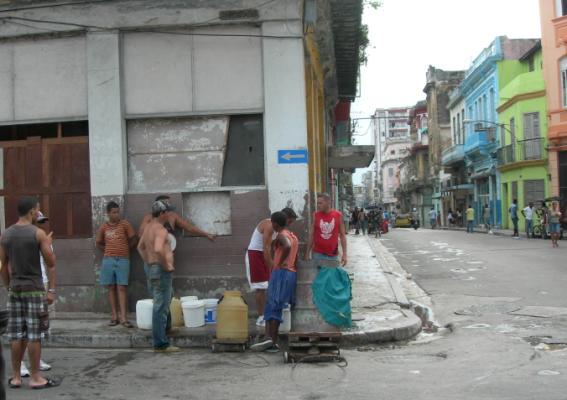
“Not even by paying 10 CUC (12 dollars) can a family get a pipa (water truck) in order to fill buckets, tanks and containers,” says Liudmila, a resident of El Calvario, a desolate hamlet south of Havana. Although there have been deliveries of water lately, shortages continue.

In the first week of January, in El Calvario there were 5 days without water. The lack of pipas to alleviate the water shortage created a very tense situation for people. The same thing has happened in other places, where there have been no lack of protests.

The drought that has affected the Cuban capital for 7 years has caused a deficit of more than 328 thousand cubic meters of water. The dramatic shortage has led to reductions in the delivery of the precious liquid to 10 of the 15 municipalities of Havana.

If you add to the disastrous drought the fact that 60% of potable water distributed in the city is lost due to breaks and leaks in the pipes, and that 128 major industrial centers in the capital use three times what they need, then in addition to being serious, the problem becomes complex.

Excessive exploitation of surface and ground water has resulted in the collapse of different supply points to the capital, with water quantities well below their capacity.

From 2003 to date, the average rainfall for Havana was as high as 89%. This has been the driest period in the last 49 years.

The provincial supervision of water resources in the capital has activated a Code Red. Five years ago, the company Aguas de La Habana, with hard currency financing from a Catalan society, began to restore the deteriorating distribution networks, but the work has been slow and insufficient.

Only 20% of the pipes in the city have been repaired, due to their age and a chronic lack of maintenance, which has left them severely damaged. The broken pipes in turn make a mess of the public roads, which are full of holes, due to torrential water flows daily in the streets.

Then there is the main aqueduct, the Albear, which was built in the 19th century and designed for a population of 400,000. Today Havana is a city of over 2,500,000 inhabitants. The most critical situation in the water supply occurs in the municipalities of Arroyo Naranjo, Habana Vieja and Centro Habana.

In the late 80’s the El Gato water main, on the outskirts of the city, began to function. But between the severe drought, the absence of systematic repairs and the lack of spare parts, it is working at less than 50% capacity.

To reverse the delicate situation, the Institute of Hydraulic Resources intends to quickly implement 14 investments to alleviate the crisis. They are valued at 7.5 million convertible pesos (about $9 million) and involve placing 22 kilometers of pipes. If these works are not carried out soon, for spring, the deficit of water will reach 493,640 cubic meters of water.

In Havana, more than 70,000 families have no direct access to drinking water. They have to carry it in buckets, tanks and other containers. When stored, it becomes a dangerous breeding ground for the Aedes aegypti mosquito, a transmitter of deadly diseases such as dengue hemorrhagic fever.

Due to the scarcity of water in poor neighborhoods, there are people who are paid 100 pesos (5 dollars) to fill a 55-gallon tank. “In addition to earning money, I get exercise,” says Philip, a bodybuilder engaged in the business of carrying water.

If in the coming months the powerful drought continues, if water is squandered and doesn’t reach households and production centers, the government of General Raúl Castro will have a new headache. Another one.

Translated by Regina Anavy

January 25 2011

Message from Jorge Ángel Hernández / POLEMICA: The 2007 Intellectual Debate

About the text “A little ashamed of ourselves” by Luis Manuel Pérez Boitel, in response to “The crisis of low culture” of Francis Sánchez.

My friend Riverón,

Although I consider friendship one of the gifts that should be defended at all costs, I also think that standards about things that happen in life, art and literature, should, if not considered equally, at least be ahead by a nose at the finish line. Quite often our personal discussions have raised the tone to the point that only friendship has stopped the harmful avalanche of blindness on both sides. I also value highly the grateful recognition of good deeds from others who are not exactly part of that small group of friends, even more those that honestly spring from the adversaries who have accompanied us on the same journey.

This long speech, that you know well, maybe with more humorous tones and turns, as I like to talk person to person, allows me to introduce, in this communication that already I’ve given permission for you to use publicly if you feel it necessary, an idea that, although predictable given the many anecdotes that I can relate as a witness, does not stop surprising me negatively:

I’m referring to the treacherous message that Luis Manuel Pérez Boitel circulated and in which he tried to insult you “considering that an editor at the head of a publishing house with which he began to reach his first little bit of prestige,” is obliged to assume, without any benefit of the doubt, the fair and deserved price of his pay.

I remember at that time our poet and anti-fascist fighter, not “litigious” as he says, (as a lawyer, knowing what the word means by which meaning you would have put in a cumbersome legal process that did not occur) but haggled over I believe with good cause, his fees, which were set at the amount he demanded, in my opinion unjust, much less than he would have deserved.

I know the details because I also saw a dodge that consisted in declaring that he didn’t agree with the price, and, from respect for the scandal and out of solidarity with Boitel, he settled for a meager sum, and I hope the copies of the contract may serve as further proof and challenge as well a search for any proof of a “claim.”

What he did was to lobby senior officials to press his demand for payment and talk about the incident to many, too many, people. I also remember how you assumed as your own problem that he could attend the award ceremony for the poetry prize, which he won in a closed vote in the Casa de las Americas contest, news he received a few hours before, and how you pledged both your institutional influence and your personal courage as an intellectual and editor at a time when he was the subject of satirical gossip in much of the country.

I assumed he was grateful for these efforts, happily accomplished, even more upon hearing himself reclaimed — during the meeting, or encounter, that we had in the Villa Clara UNEAC with Iroel Sánchez and Omar Valiño, that is, the “duo of the Party,” who took the trouble to talk to us about what was happening around what I named the “Pavonazo” phenomenon at work — that attendance at the awards was definite and that the Casa de las Americas, naming Jorge Fornet as the irresponsible person, and careful of saving the “diplomatic decency” of Roberto Fernandez Retamar, had failed to inform him the following year, once his book was in circulation, about “What his role would be in the activities of the award,” and that they would not offer him any support.

That said about your commentary “Eating from the new-born turkey” (“pavo” — turkey — is a play on “Pavón”), which now seems so suspicious to him and about which he did not issue any opinion even though we were provoked to do it during those conversations. That attitude confirms that the title of what was written by Francis Sánchez continues to be accurate, since it confused the low cravings for the role with the lower passions and culture is something mean in the most Marti concept of the term. And although perhaps the overwhelming majority feels that he justly deserves not even the honor of the insult, the basic instinct of my low passions requests a retribution.

So, friend, on behalf of those dishonest and opportunistic intellectuals with a double standard, that like the dreadful English of Neruda we still hate, in virtue of what appears unthinkable “to take them out of circulation and credit” I ask you for an apology. I am ashamed that such a fight broke out in the midst of a moment that in my opinion is crucial to the cultural destiny of those of us who continue deciding to build from within.

A hug, and no antidepressants.

Jorge Angel Hernández

Translated by Regina Anavy

January 2007

Papa’s Boys / Iván García

The children of certain heads of the nomenklatura have their own style. They wear designer clothes. Drink cognac or whiskey. They have their own cars. Internet at home. They’re fond of good food and spend nights dancing in the best discotheques in the city.

They have a passport to travel abroad. And in private they inhale more cocaine than a vacuum cleaner. They’re fans of lesbian pictures and sex with several girls. To obey form and follow in the footsteps of their parents, they study at military colleges.

They study either administration or marketing at prestigious schools abroad. Their double standard is exquisite. In front of strangers, they parrot the typical nationalistic and anti-American speech.

Among friends, they await the final outcome of the revolution to see which side wins. Until the moment arrives, their parents position them in good jobs.

When there is real change in Cuba, not the artificial one designed by the gurus in olive-green, Papa’s children will be the future managers of the companies, banks, hotels, golf courses or any other business that makes money in post-Castro Cuba.

Now they go about under cover. They waste fuel and spend hard currency on Havana nightlife. They live well and eat three hot meals a day. They dance salsa at night clubs like the Red Room of the Capri or the River Club, a discotheque in Miramar, a few meters from the Almendares River.

The always leave smiling, with a full wallet. They end the night in cafes that are a stone’s throw from the Malecón. Drinking Heineken beer and snorting a mixture of drugs in the back seat of their cars. They usually go to bed at the time that many people are going to work. They lunch on meats and seafood while they watch the latest world news on giant plasma-screen televisions.

Their parents are allowed to have satellite dishes and ADSL (high-speed Internet access). They are trustworthy revolutionaries. The cream of the socialist revolution. When the official discourse calls on simple Cubans to tighten their belts, these offspring, the sons of important men, sleep for ten hours, have central air conditioning in their homes and spend their weekends fishing on the old man’s yacht.

The good thing about being the son of a “big-shot” (leader) in Cuba is that they don’t have to worry about paparazzi or scandals in the tabloids. Their dirty laundry stays at home. Their parents have the power. They control the army, the communications media and production.

These young people have a free hand to lead a dissipated, easy life. And their parents? They prefer to look the other way.

Translated by Regina Anavy

January 23 2011

Cuban Dissidents: Looking Inward / Iván García

The WikiLeaks revelations have shown the Cuban opposition in a bad light. What a sector of U.S. diplomacy thinks about the poor performance of traditional dissent is the same thing that independent journalists and foreign correspondents talk about.

If a series of shameful acts of corruption, nepotism and caudillismo committed by the leaders of opposition groups haven’t been brought to light, it’s because of that old straitjacket that makes alternative journalists think that making such issues public is a favor to the island’s secret services.

I don’t share that opinion. It’s time for the local opposition groups to change their tune. If they don’t turn 180 degrees and plot their strategies looking inward, they will remain simply a movement of courageous people who openly challenged the Castro brothers’ regime.

To their credit, many opponents must have passed through the harsh island prisons without breaking. It’s admirable that Cubans who could have been peaceful parents or grandparents had the courage to establish political parties and organizations that the government considers illegal and that Cuban laws punish by several years in prison.

But being brave is not everything. Inside the traditional dissent there are quite a few autocrats who pretend to be civil. They are intolerant and dishonest gossip mongers. They have become accustomed to living off U.S. government agency aid or groups and people of different political leanings in Europe.

I am one of those who thinks it’s not healthy to accept money from any government. I could be wrong. Years ago, in a public and transparent manner, the opposition had to tackle that uncomplicated issue.

It’s true: when they take the path of dissent against Castro, as a rule, dissidents lose their jobs and stop collecting a paycheck. It’s also true that they need money to do any political work.

Hiding the issue of money has led to the unfortunate rise of corruption. By not having effective controls, internal democracy and transparency at the heart of many dissident organizations, certain group leaders have shamelessly appropriated money and material assistance.

The list is long of heavyweights inside the dissident movement who steal hand over fist. Out of decency I will not reveal their names. In addition to being corrupt, with some exceptions, the Cuban opposition is mediocre and ineffective. A banana dissidence. You can count on one hand their political projects that try to involve citizens.

The local opposition is directed toward the Exterior. From their living rooms, small groups of people write a document, quote the foreign press, read it on Radio Marti and then feel they’ve accomplished something.

Ordinary people in Cuba don’t even hear about it. It’s painful. The number of people upset by what the government does, I assure you, is broad. If the opposition parties started proselytizing, they would be known in their own country.

There is unexplored territory for the dissident movement. The lack of materials and services in Cuba affects everyone, loyal to the regime or not. Both sides want to repair their children’s schools, the hospitals and streets of the neighborhood. Both sides want to have clean water every day, and not lose 60% due to leaks.

Regardless of ideology, every one suffers from having to travel like sardines in a can on the crowded buses of chaotic urban transportation. Think like they think. Cubans want more and better food. Decent wages. Clean cities. A single currency. To be able to travel without state permission. To have Internet access and satellite dishes for reasonable sums.

In 52 years, the Castros have failed to solve these problems. If the dissidents would do community work in the neighborhoods, they could inspire a number of small and modest projects that would involve and benefit the people. You hardly ever meet activists like Sonia Garro, a black woman living in a slum in Mariano, who helps children living in homes that are small hells.

It’s good to demand democracy and freedom from the regime. But it’s also good to look for options – and solutions – for the women and men deep inside Cuba.

Of course, the secret services do everything in their power to make sure the dissent doesn’t forge a real social base. It’s also true that the traditional opposition has adapted to living from unrealistic projects, better known in Miami than in Havana.

It’s healthy to have different political tendencies and discrepancies inside the dissent. But there are four or five points of agreement between the opponents that would allow them to design joint projects.

Disagreements do not mean the opposition groups are enemies. It’s what happens. But so many quarrels and hatreds have diminished coherent and serious political work.

The current opposition, if it’s not recycled and doesn’t democratize the rules of the game, will be a political corpse. But it’s never too late to change.

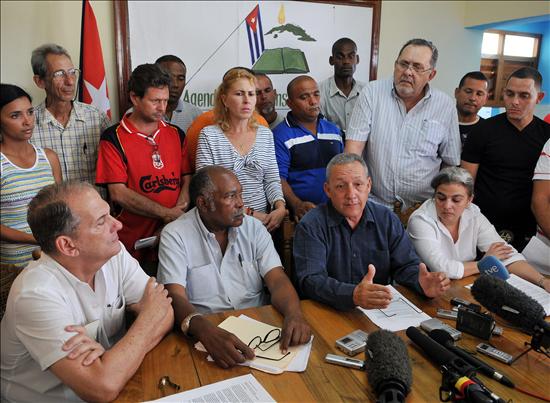
Photo: EFE. Press conference of the Agenda for the Transition, Havana, April 2010.

Translated by Regina Anavy

January 23 2011