Medications Crisis in Cuba: Rationing vs. Reasoning / Miriam Celaya

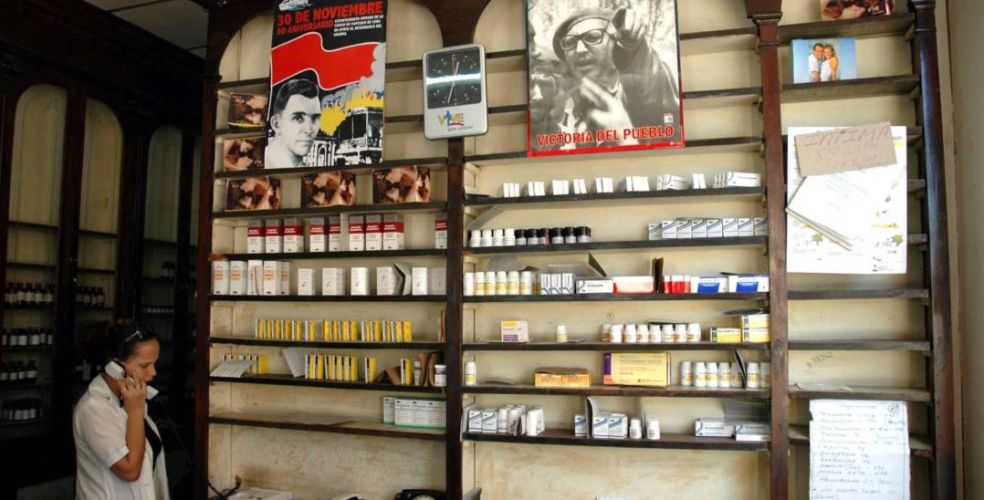
Pharmacy in Cuba (EFE)

Cubanet, Miriam Celaya, Havana, 12 June 2020 – Another hot summer day has barely dawned in the city, but dozens of people are already gathered in the vestibule at the Carlos III Pharmacy in Central Havana. The day before, the drugs were “unloaded” and since quantity and variety of the assortment never meets demand, exactly every ten days an anxious human conglomerate fills the area and its surroundings for several hours.

In the past three to four years, drug shortages have become an increasingly tricky topic at this medical powerhouse. The impact of the crisis is such that neither the pharmaceutical industry nor the importing companies -both monopolies of the State- are able to insure even those drugs assigned to patients with chronic diseases, acquired through the Controlled Medicines Acquisition Card, popularly known as “the big card”.

“I warn you that only part of the Enalapril arrived, and antihistamines or dipyrone, medformin, or psychotropic drugs didn’t arrive either, so those who come looking for this already know it, and don’t bother to line up!”, warns one of the pharmacy employees, who has come out to face the crowd like a gladiator before lions. The answer, in effect, is a kind of collective roar. Discontent spreads. continue reading

Moments later the same employee returns to the crowded vestibule to report, with the same subtlety, about the great “solution” that pharmacies are going to apply to the shortage of medicines: “Shut up and pay attention here, so you can’t later say that you didn’t know!” Right after that, he makes an announcement that only half of the dose prescribed by the corresponding doctor will be filled for each card. And he ends with an absolutely irrational warning: “So save [your medicines]!”

The supposedly altruistic idea is that with this rationing of what has already been rationed, a greater number of patients have the possibility of acquiring part of the medicine that is required to treat their ailment. The bad news is that, in practice – and by the grace of the authority of the administrators of destitution – what this achieves is the multiplication of the number of people who cannot duly comply  with what is indicated by a trained physician, and consequently, the risks of health complications that are derived, increase.  Numerous of these cases include extremely serious events, such as cerebral or cardiovascular infarctions, hypercholesterolemia, hyperglycemia and kidney problems, just to mention a few.

Thus, the alternative to these shortages ignores such a basic principle that can be stated simply and mathematically: consuming half the dose equals twice the risk for patients. Because it so happens that there are no half-hypertensive, half-cardiac or half-diabetic cases. Health problems cannot be adapted to the inadequacy of the medicine market.

If it were not for the highly vaunted benefits of a Revolution that leaves no one helpless, we could imagine that we are witnessing a scenario of neo-Malthusianism, where the excess of population added to the increasing scarcity of resources imposes an inevitable socio-demographic selection: the weakest, the old, the ones with lowest incomes and the sick will be the decimated sectors and only the most solvent, strong, young and healthy will survive without further damage, be it or not- or not necessarily-  a State policy.

It is obvious that, despite the accelerated aging of the population in Cuba and with that the increase in chronic patients with diseases related to advanced age, an effective government strategy was never devised to alleviate the stumbling blocks of the fragile national pharmaceutical industry or to protect the so-called “pharmacological groups by control cards”.

Going back in time and appealing to the long history of shortages on the Island, there are numerous drugs that have disappeared from the shelves since the 1990’s, never to return. Even those that were once available over the counter began to be sold by prescription only, a situation that remains to this day. Pharmacy supplies have never come close to what it was until 1989, despite frequent official promises for improvements or recovery of the industry.

Furthermore, the crisis has become so severe that eventually the official press has been forced to bring up the matter. Thus, for example, on 3 February 2018, the article On the Pharmacy Counter (by Julio Martínez Molina) appeared on the digital page of the State newspaper Granma, reporting that in 2017 dozens of shortages of drugs had been reported in throughout the country that year, and the persistence of “the absence of high demand pharmacological items” had been acknowledged, among them hypotensive, antidepressant, anti-ulcer medications and many more.

The BioCubaFarma association reported that the instability in drug deliveries was due to “the lack of adequate financing to pay suppliers of raw materials, packaging materials and expenses.” There was no lack of the favorite “blockade” among the causes for the pothole, which forced “the use of third countries to acquire equipment, American-made spare parts, chemical reagents, etc.”

Other data pointed to interesting figures: of the 801 drugs that make up “the basic picture” of Cuba’s drug demand, BioCubaFarma was responsible for 63%. In total, 505 medicines were produced by the National Pharmaceutical Industry and 286 were imported by the Ministry of Health (MINSAP); while of the 370 lines that were distributed to the pharmacy network, 301 were domestically produced and 69 imported.

Despite everything, explained authorities in the pharmaceutical industry, the critical situation “would change gradually” (would improve), up to the recovery of the production and distribution of medicines, which should take place around the first quarter of 2019.

But BioCubaFarma officials also suggested that the doctors carry some of the responsibility for not being sufficiently informed about the supplies of the drugs they prescribed to patients. “If the doctor has the correct information about the difficulties of a certain medicine, he should avoid prescribing it.”

The real problem, beyond this colossal simplicity, was, and still is, the almost absolute shortage of entire groups of medications, including antibiotics to fight infections or analgesics for pain relief which has caused many doctors – at the risk of being penalized – to recommend to their patients to arrange for their own medicines through family or friends overseas.

In 2018, during a presentation before the National Assembly, the then Minister of Public Health, Roberto Morales Ojeda, beckoned to “combat the misuse of medical prescriptions”, an exhortation that automatically led to the rationing of the doctors’ prescription books. After that, they would receive a limited number of these in order to tackle mismanagement among corrupt doctors and medicine smugglers, a business that had been confirmed for years and that grew in direct proportion to the decrease in supply in legal networks.

This was the rampant official strategy designed to eradicate the wide and deep hole of illegal maneuvers that let medicines slip through pharmacy networks, aggravating shortages and feeding the informal market. Simultaneously, a limit was also placed on the number of medications that could be indicated in each prescription, which – oh, paradox! – forced doctors to issue a greater number of prescriptions to each patient.

The result of so much nonsense was immediate: the drug smugglers diversified their strategies, but survived, while the insane rationalization of prescription books had a null, if not counterproductive effect, in the control of medications.

Meanwhile, more than two years after BioCubaFarma’s triumphant promises, and far from improving, the shortage of medicines in Cuba has deepened and is headed to getting even worse. Because at the end of the day it is not a medication crisis but a system whose disease has no cure.

Just around noon, the Carlos III’s Pharmacy had run out of medications. The line scatters, among whispers, complaints, and resigned faces. The curtain falls on a scene that will repeat itself in exactly ten days.

Translated by Norma Whiting
COVID-19 in Cuba: Eliminated by Decree? / Miriam Celaya

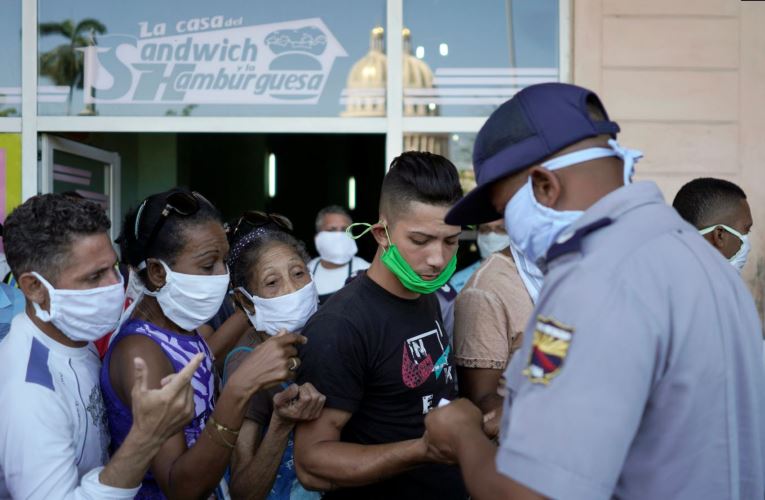
Masked police agent controls line to buy food in Havana (photo file)

Cubanet, Miriam Celaya, Havana, 27 May 2020 — If the Cuban official figures are taken as true, we could be certain that the days are numbered for the COVID-19 epidemic on the Island. In fact, saying “epidemic” is to disagree with the phases which the Chinese flu has gone through in Cuba, as established by the authorities, since in the more than two months that have transpired since the first cases were confirmed – three Italian tourists who presented with symptoms and tested positive – up to now, an epidemiological alarm stage has never been declared in the country.

The numbers trend indicates such a sharp and rapid drop that fear of contagion has begun to fade among the population and the perception of risk has been largely lost. Almost no one remembers that just a month ago the Cuban health authorities predicted the approximate date of mid-May for the “peak” of COVID-19 in Cuba; a forecast that was updated shortly after, on April 27th, when the pro-government site Cubadebate announced that it would actually take place during the following week, between May 4th  and 10th.

We would thus place ourselves 77 days at the midpoint of the international peak, we would have a minimum peak of 1,500 cases and a maximum of 2,500 cases, instead of the 4,500 cases originally anticipated. Cuba – Cubadebate also reassured – would not go through a “critical scenario.” continue reading

In line with such good wishes and apparently in compliance with the guidance of Mr. Miguel Díaz-Canel, Cuba’s president, who shortly before had declared that the patient numbers were very high and it was necessary to lower them, the MINSAP report of the same day, April 27th acknowledged only 20 new positive cases (out of 1823 samples analyzed). The figure more than doubled (with 48 cases in 1859 samples) the following day, before starting a sustained decrease in the trend, only interrupted on May 2nd, when the exception of an increase of 74 cases was registered. Since then, and up to the writing of this article, there has been a downward trend, with slight fluctuations that averaged 9.85 cases of infection in the last week (May 18th to May 24th).

It is worth pointing out that, regardless of the natural mistrust that official statistical data may arouse in a country where a strong monopoly of information is maintained, and where secrecy prevails and there are no independent institutions of the State against which to compare these reports, the truth is that everything indicates that the Chinese flu has not spread with the same virulence on the Island as in other regions. This is especially the case if we bear in mind that – in view of the imperatives of searching for food, medicine and other products of basic necessity on the part of the population – the measures of social isolation and distancing between people, in addition to quarantines in disease cluster zones that were established by the OMS and formally reiterated by the government, have not been practiced.

However, the crowds circulating through the streets, the lines in front of the scarcely supplied markets where hundreds of people gather, among other agglomerations, are the perfect breeding ground for the spread of a pandemic that in most countries has been claiming hundreds or thousands of human lives. And this is why, considering the low overall incidence of the pandemic among us, many ordinary Cubans have begun to believe that the Island is protected by some divine miracle.

And while that feeling, a mixture of false immunity and trickery, is spreading dangerously among the poorest (and also most vulnerable) people, one needs to question the low number of tests that have been conducted – a total of 95,511 samples analyzed in a population of 11 million inhabitants – and the failure to carry out massive testing, even in neighborhoods where outbreaks of infection have been detected and have been declared “hot zones.” In official reports, and only in them – these neighborhoods have been placed under a supposed “quarantine,” although in fact they have been kept open to the free movement of people.

Fewer still are those who associate this miraculous drop in infections in Cuba with certain information – apparently unrelated – that have begun to appear on official sites, as if by chance. Thus, for example, there is already talk of returning to an opening to international tourism as soon as this coming June. The “closure” of the Varadero beach resort has been announced to nationals, and the airport in that town is also undergoing an accelerated renovation process. The Varadero hotel workers and those of the resorts at Jardines del Rey are being quietly reinstated to their respective positions.

Of course, to sell ourselves as a reliable tourist market, it is urgent to eliminate the Chinese flu as soon as possible, which is why the official treatment of the figures always has as its ally the naive tendency to confuse reality with wishes on the part of the average Cuban, together with the urgent need to generate family income in a country where no free food aid or monetary support has been distributed by the State during these months of unemployment.

Thus, step by step – or perhaps “without haste but without pause,” as the previous president once coined the phrase – in Cuba we are perhaps approaching the long-awaited “coup de grace” to COVID-19 that the hand-picked current president, Díaz-Canel, asked for, no matter how much a stubborn group of skeptics may distrust it.

The case could not be more sui generis: it would be the first time that a never-declared epidemic was eliminated from the national scene, not because of a revolutionary mass vaccination – such as those that once banished (it is fair to admit) many other diseases – but practically because of an “unwritten official decree.” And so it will be, because, whether we like it or not, certain “miracles” only happen under totalitarian regimes.

Translated by Norma Whiting
When Myths Are Not Applauded / Miriam Celaya

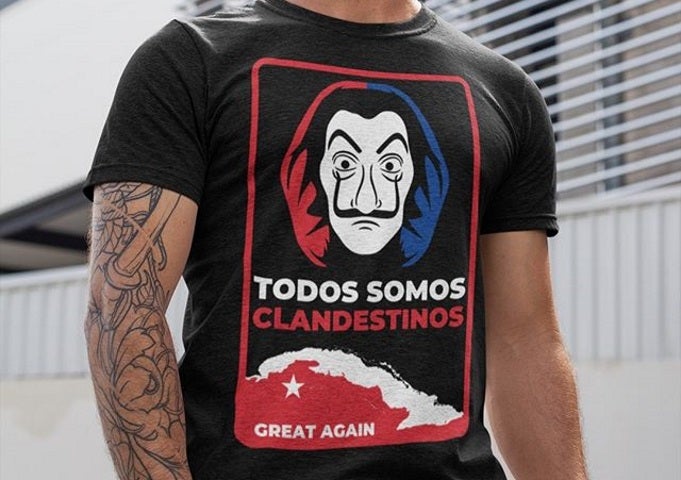
“We are all Clandestinos.” Instagram

Cubanet, Miriam Celaya, West Pam Beach, 29 January 2020 – This is a textbook case: to question a myth is to unleash hysteria. And as it usually happens, the loudest blabbermouths tear off their hair and their clothes against those who dare refuse to follow the little troupe on duty. And in the cast of outraged moralists there is no shortage of cap and gown academics or some famous press figures who, whether with an admonitory finger or with feigned condescension, take the opportunity to “scold” those who dare to speak loudly about what many think of, but do not have the audacity to express. Nothing new.

However, beyond the good name, fame or reputation -deserved or not, for this is about the right to an opinion and not to display emblems or symbols- the beauty of acceptance is not an argument when analyzing the facts. Popularity or fame does not guarantee the supremacy of a principle. What it entails is common sense and, of course, the tangible reality… that which exists in everyday life despite the wistfulness of cyberspace.

Because, while it is true that the opposition and any movement or person who oppose the Cuban dictatorship have  been “suspicious” at some time, or unfoundedly accused of belonging to, or at least collaborating with the (In)Security of the Castro State, it cannot cast aside an essential fact: Oswaldo Payá, as well as the Black Spring prisoners, opposition leaders and civil society groups and we, the independent journalists who reside on the Island, have a real and tangible physical existence, a verifiable job and the common denominator of keeping at the head of the dictatorship’s opposition. You can be for or against our proposals or ideas, but nobody can question our existence. continue reading

That said, it should be clear enough that it is absurd to compare any of the aforementioned with that cyber-hierarchy called “Clandestinos”,  whose real existence no one can confirm beyond cyberspace, whose directives -which, among the most recent, invite to no less than the takeover of a radio station- are absolutely absurd and unrealizable, and whose bravado (always through the networks and hiding their faces) frequently calls for acts of violence, sabotage and anarchy, that in the Cuban circumstances are not only quasi-chimeric actions, but also termed as reckless in a setting that neither they nor anyone else would have control of.  Is this really what we need in Cuba? Is this a solution? Has anyone, among the hard defenders of “Clandestinos” stopped to think about the consequences of these actions and about the day after? Obviously not.

It is understandable that many Cubans, fed-up after 61 years of dictatorship, repression, misery, absence of expectations and hopelessness, tend to stick to any libertarian mirage. Exiles, or at least some of them, are likely to fall into that incantation. It is understandable, I repeat, but not reasonable.

Meanwhile, any opinion that threatens the illusion of a mirage is taken as a declaration of war or, at least, as a “disunifying” proposal of something that has never been united. Thus, the mere fact of questioning the spooky event -until now it is nothing more than that- self-denominated “Clandestinos” is like taking candy from a child, while speculating about its possible origin in the murky labyrinths of the Cuban G2 (State Security Forces) is the worst of sins. “Inverse logic,” says a well-known journalist who doesn’t want to seem too caustic.

And to “prove” that my criterion is about inverse logic and not about anything else  he compares these ghosts with real people and movements within Cuba, in this case, opponents of renown prestige, activists, etc., projects as noteworthy as the Varela Project and movements of proven track record such as the one for Human Rights. Seriously, does the cyber soap opera “Clandestinos” seem comparable? Should it seem like good “logic” to us?

And since citing names and events of the most diverse nature constitutes a good resource when there are scarce arguments, entangling the reader in a lush ajiaco (a Cuban stew) where the name of journalist Yoani Sánchez is invoked along with the names of opposition member Rosa María Payá, of Elian [González], of former US President Jimmy Carter, of the Embargo, of the Five released spies and of another cluster of unrelated issues that vary differently in time and context -the Twin Towers, the attack on Iraq, World War II, the explosion of the USS Maine…- that supposedly conclude by demonstrating that if we do not believe in the much discussed “Clandestinos”,  or if we believe that there is a relationship between their (non)existence and the G2 we are “conspirators”. Which, in any case, results much or more gratuitous than suspecting those who summon violence under the cover of anonymity or from the comfortable protection of cyberspace.

The rest are common places. It is a Perogrullo truth that whenever the opposition has won spaces it has been against the official will. Personally, I am pleased to be part of those who pushed for those little conquests. But it is illusory to suppose that “Clandestinos” has gained space, much less that it is something that has slipped out of the hands of the dictatorship.

In another order, it is true that the Cuban dictatorship opened its arms to Jimmy Carter, but it is no less true that it went back in terror when Barack Obama’s rapprochement  and Cuban support for the flexibility of the Embargo seemed too risky because it endangered the absolute control of the state over life and property of the “governed”, when the dictatorship felt that within Cuba an air of hope was being promoted in terms of economic freedoms and citizen autonomy. That terrifies them. This shows that two similar events at different times and circumstances do not have the same effect on the dictatorship. It is called dialectic.

As for the Embargo, which is not a subject related to “Clandestinos”, but also (because it was useful?) it floated in the ajiaco, it is not only true that it served as a pretext for the dictatorship and that continues to be used, although it has lost effectiveness, but I dare to affirm that the majority of the so-called ordinary Cubans, who suffer the infinite vicissitudes of the system imposed by the political Power, would be happy to have it repealed. I also dare to predict that any credible popular survey (not of the Castro regime, of course) about whether those inside the Island want its repeal will have an overwhelming result in favor of YES. Because, regardless of the wishes of one or the other, everyday reality is what is imposed on people’s lives, especially if survival is of the essence. Most Cubans, with or without foundation, believe that if the Embargo is lifted, they will improve issues related to food, transportation and material goods.

Of course, we know that repression does not depend on either the Embargo or “Clandestinos”. That would be the day! But that does not mean that both factors, although unrelated, do not eventually constitute excuses -no one in their right mind would suppose them to be an “alibi”- that the dictatorship uses for control purposes. The stubborn facts prove it; they are not “conjectures.”

The psychological factor could not be missing in the convoluted “analysis”. A good session on the couch is the supreme resource for attributing failures to the “hot minds” of those who consider that “everything has a why.”

I do believe it. Everything happens for a reason. Everything has causes, consequences, a background. Even if we don’t know them at the moment. But when talking about “Clandestinos” especially when even they have rejected the title of opponents (“We are not the opposition”, they have repeated), it seems at least an exaggeration to label them as a “political novelty”. If those who are, up to now, only an imaginary “group” of network agitators with actions unproven by the general public classify someone as a political novelty, we should start turning off the lights.

If not falling exhausted at the foot of a myth, call it “Clandestinos”  or any other trendy designation that may arise, if not agreeing with what, so far, does not go beyond the bravado of cyberspace, if not supporting incitements to chaos and violence turns me into an “elite” (criteria that I don’t share), then I am so. I confess myself as an “elite”, at least in the diagnosis of this psychoanalyst.

Nevertheless, I have always said and repeated that I would be the first to acknowledge my mistake, if that were the case. In short, the existence of “Clandestinos” if true, does not take away any merit from my work in the field of independent journalism since 2004, or at the time within opposition activism. I have never considered myself a hero for writing and disseminating what I think, nor did I contribute to the manufacture of altars and heroes of any color, let alone of sacred cows. I do not follow leaders of any political hue or nature. I am an irreversible irreverent.

Anyway, whether “Clandestinos” is a conspiracy or not, it does not directly affect me either. With or without “Clandestinos” I am aware that when the dictatorship has wanted to repress me or harass me, it has done so and can do it again in the way and at the moment it decides, since I live on the Island and I am -like any freethinker- at the mercy of its whim. And I also know that, with or without “Clandestinos”, the end of the dictatorship is inevitable.

I fully understand that decades of absence can create a distortion about the reality of Cuba to such an extent that it becomes misleading to think that a cyber fantasy is the flame that would initiate a Cuban rebellion. Only when the reference is lost can one believe in a popular uprising in Cuba against the dictatorship from a cyberspace cry, except for the one that may occur due to the despair of hunger or the shortages of poverty, which would doubtfully have root or any political leadership.

Such is Cuba’s reality, whether we like it or not, such is its degree of civic orphanhood. Those who read my articles or follow me on the web know that I do not seek to please readers if such a thing involves sacrificing that in which I believe, my feelings and what I see every day. Not even my adversaries could accuse me of being a hypocrite. That said, I find that most of those who today support the anarchy and violence they call the “Clandestinos” networks are many miles away, as safe from it as the ghost that created them. Let us allow time to carry out the mission that will show on whose side reason is.

(Miriam Celaya, a resident of Cuba, is visiting the United States)

Translated by Norma Whiting

See also:

Clandestinos: Outcome and Teachings of a Hoax / Cubanet, Miriam Celaya

The Controversy Over The Identity Of The Clandestinos Is Growing

Clandestinos, Legitimate Protest or Provocation by State Security?

Clandestinos: Heroes or Collateral Damage? / Cubanet, Miriam Celaya

With Testimonies from Detainees, Cuban TV Accuses Miami’s “Mafia” of Financing Clandestinos

Clandestinos: Outcome and Teachings of a Hoax / Cubanet, Miriam Celaya

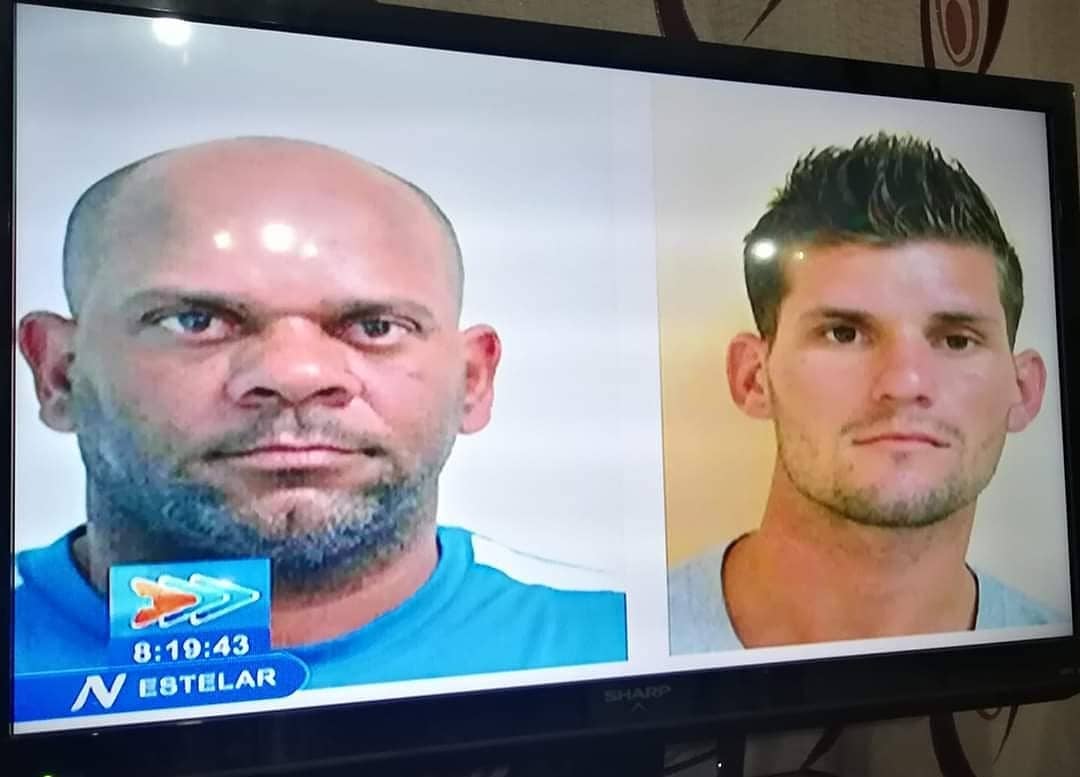
Panter Rodríguez and Yoel Prieto, alleged members of Clandestinos presented on Cuba TV. (Facebook photo)

Cubanet, Miriam Celaya, West Palm Beach, 23 January 2020 – the hare has finally jumped. The recently starred report on Cuban television news about the capture and information of the alleged members of the spooky group “Clandestinos”, tends to seal the fate of what, so far, has the appearance of a warped creation developed in the offices of the State Security rather than that of a true “rebellion” in the Castro ranch.

Showing the usual media manipulation to which the regime has so accustomed us -and which, nevertheless, continues to surprise us by its rampant bungling- this time they have presented a group of alleged criminals who confess their participation in the graffiti to the Busts of José Martí and other “symbols of the revolution”, which the authorities themselves claim, without offering images, were occurring in the first weeks of this year.

Incidentally, the statements of the aforementioned accused offer “testimonials” about financing from Miami by the long-established and cliché “anti-Cuban mafia”, also linked to other counterrevolutionary groups on both sides of the Florida Strait. Nothing new in the official script. continue reading

Leaving aside the unreliable television reporting which is lacking in evidence, it is worth highlighting the repetitiveness of the scheme created by the political police. Not only is a plot organized and financed from the US and carried out by stateless mercenaries within the Island; not only is the dissident scheme reiterated, the same as the criminal scheme that all critical sectors to the system within Cuba  have been demonized -which this time brings the additional component of drug possession and consumption- but they have taken advantage of the opportunity to expand the scope to include independent art and journalism sectors in the saga, at the same time raising the tone of the threat to a few, not too veiled insinuations of applying the death penalty to such “crimes” that affront the Fatherland.

I strongly attracts attention that in the midst of the increasingly pronounced economic crisis, given the growing uncertainty about the future that awaits Cubans, and with a permanently bleak horizon with no signs of a viable exit, in just a matter of days it has “emerged” and has been “defeated” by a police force that presumes to be among five best in the world, an imaginary liberating group that had an ephemeral but meteoric life in the networks only to stir up the hopes of the most naïve, and also serves as wild card to the regime to justify any repressive action against the opposition and against any manifestation of dissent or questioning the dictatorial power. All very suspiciously opportune.

But, although crushing, the message of this television report is not harmless: it points directly to the fact that any demonstration against the designs of the Power class will be severely punished, without ruling out the maximum death penalty by execution. And in that broad “criminal” spectrum that the regime has staged are included from a blueprint that summons legitimate citizens right to vote against a spurious Constitution, from staining a bust of Marti or a billboard of the official ideology to peacefully opposing the application of a government disposition, as is the case of Decree 349 that prohibits independent art demonstrations, but note, not in favor of the political power. All the unhappy and freethinkers are absolutely susceptible to falling into the dark sack of disloyal mercenaries.

Paradoxically, it is this murky media escalation of Power that seems to shed more light on the hoax. If anything is demonstrated, it is that “Clandestinos”, far from meaning a libertarian advancement, as its most ardent defenders wished it were so, has proved to be a maliciously useful trick to the dictatorship both to quell the outbreaks of citizen protests that have begun to bargain in different parts of Cuba and to stop future similar manifestations and through its course, to maintain the iron fence of isolation around dissidence.

However, the set could collaterally transmit a subliminal information: such wear of police “intelligence” and so much time and resources destined to plan the bluff, discredit any manifestation of nonconformity and raise the repressive emphasis suggest that the internal Cuban situation is a lot more complex and delicate than what we see or guess at.

the moment is definitive critical but defining, not only for those who hold the absolute Power and for all its cohort of Amanuenses, hitmen and other thugs, but also for the entire independent civil society that aspires to rights and freedoms long denied. Now the cards are on the table. As far as I am concerned, Clandestinos does not go beyond being the most recent deception of Castro’s “intelligence”, although confirmation of my suspicions does not give me any satisfaction.

If this unfortunate episode can be of any use to us, it is to stop believing in masked mirages and put aside our differences. Because it is clear that they come for everyone: opponents, journalists and independent artists, network activists and even corner protesters, that is, all those who defy the regime’s excesses or exercise citizen freedoms without asking permission and with unmasked faces.

If Castro’s media has convinced me of anything with this TV report, it is that Clandestinos is its Frankenstein: an invention of State Security “think tanks” meant to hunt the unsuspecting, deepen the divisions that weaken civil society, create false expectations to provoke disenchantment and discourage Cubans’ aspirations for change, make believe that any resistance to the dictatorship is impossible (even that which is framed and hidden), and create a matrix of negative opinion about any manifestation of confrontation to the regime.

But it so happens that not only the dictatorship and its dark repressive apparatus depend on the success or failure of this awkward presentation. Ultimately, it is also up to us, opponents, dissidents, journalists and independent artists and freethinkers of all trends not to let us be tempted with ghostly creations and keep our claims. Let the Power invoke its specters. And good luck to them and the past that awaits them!

Translated by Norma Whiting

Clandestinos: Heroes or Collateral Damage? / Cubanet, Miriam Celaya

(Facebook/Clandestinos)

Cubanet, Miriam Celaya, Havana resident currently visiting the US, 15 January 2020 — A new year has just begun and “its Cuban peculiarity” is already being revealed to us in all its glory — that wicked vice of losing ourselves in sterile digressions around minutiae that characterizes us so much — elevating to the category of “event” what hardly deserves the nickname of scam. Thus, while there are events in the world whose deep political implications occupy and concern citizens, institutions and governments, we Cubans remain tied to what seems to be our irreversible village destiny.

Not merely satisfied with the fractures and polarizations harvested after 61 miserable Januarys, the natives of the captive Island have found a new reason these days for vernacular discord. And what is worse, in the absence of anything more substantial, the dispute this time revolves around what until today remains a cybernetic fable: the group so-called Clandestinos.

Among the apologists and the detractors of these new social media stars, insults have rained and passions have been exacerbated. But what really is Clandestinos beyond the uncertain images of red stained busts and other quite questionable presentations in terms of authenticity? Who can provide evidence that it is a “group” and not a manipulation by the media of uncertain origin or a colossal tease? What bases of reality hold so much hectic patriotism and so much confidence of its cyber-followers? So far, none of these questions has any convincing answer. continue reading

That is why the foolish enthusiasm unleashed in the networks is so much more unfathomable, where simply inquiring over the existence or not of these imaginary (and imaginative, we must admit) rebels, whose righteous and audacious actions have filled so many hearts with hope, is sufficient reason to be mistreated and even accused of being an agent of the Castro regime: the explosion of Cuban idiosyncrasy in its purest state.

Because Clandestinos, in addition, has that charm of a soap opera and of theatrical drama heroes that hypnotize the masses: masked men who act secretly against the villain under cover of night, video messages with a mysterious central character wearing a ski mask, daredevils in paint-splattered  busts of Martí and apparently also in communist screens, and above all, a profusion of labels in social networks with libertarian cyber-concepts. And according to the most enthusiastic fans, these are “actions that have the dictatorship in check.”

In summary, it turns out that, after decades of resistance and the efforts of several generations of opponents who have suffered repression, harassment and banishment as a result of their direct confrontation without masks against the Castro gang, the final solution for Cubans has magically appeared with an intangible prodigy that nobody knows either its form or its content, but one which has, nevertheless, managed to conceive an extraordinary capital of faith, especially among certain groups of exiles.

Who could have told us that a few disguises and a bit of red paint would be enough to make the Cuban autocracy tremble? In fact, the heroes of the moment feel so imbued with their leadership that they have even disseminated an Instruction Manual on the internet that summarizes the key to success in their “fight”, the cornerstone that will boost the Cubans to end six decades of the Castro regime in a short time. All that is needed is to follow the elaborate tactics step by step: study the area of operations, carry on the usual ration of crimson dye, don’t step on the paint and act in pairs.  Thus, each oppressed Cuban can make his own heroic graffiti. There is no doubt that we will bring down the dictatorship in 2020!

We are definitely not a serious people.

However, if there really is a group called Clandestinos, if they truly were this sort of new age urban guerrillas who define themselves as “non-opponents” but who say they fight against the dictatorship – which makes their discourse even more incoherent – and if it were true that this group arose in an autonomous and spontaneous way (and not a fabrication that has emerged from twisted minds with no one knows what clumsy intentions), we would have to admit that, in addition, we are facing a genuine consequence of six decades of deterioration of a bogged down and failed nation.

Clandestinos would be, in a good skirmish, more than the ridiculous staging shown on the networks, the reflection of our own inability to find possible and sensible solutions to the serious Cuban crisis. More than heroes, they seem like collateral damage. But they would also be a good reason to reconsider the levels of absurdity we have achieved and to win in common sense. The latter is the only truly positive thing that should be recognized so far to this entire saga.

For my part, I refuse straight up to applaud or endorse ghosts. Which is what Clandestinos amounts to until proven otherwise. By nature, I am suspicious of masked faces that evoke the Tupamaros (Uruguayan Urban Guerillas), the ETA (Basque Country and Freedom members) and other denominations of ominous remembrance and equivocal causes. In any case, I prefer the frontal and open-ended resistance against the Castro regime because I have the stubborn conviction that the right to have a free, democratic, plural and inclusive Cuba is not, and should not be, a clandestine matter, but quite the opposite.

The aspirations of millions of Cubans have been hidden for too long, for the benefit of the dictatorship. It is time to banish all the masks.

Translated by Norma Whiting
In Mid-Millenium: The Other Havana / Cubanet, Miriam Celaya

Restoration will benefit Teatro Campoamor (Author’s photo)

Cubanet, Miriam Celaya, Havana, 16 November 2019 — The Cuban capital is preparing to celebrate its half millennium, and although it is obvious that this November 16th many of the construction plans will be unfinished, numerous building facades on the main avenues will not be painted (as had been planned) nor will all the details for the restoration of the National Capitol — the undisputed star of the party — be 100% completed, the grandstand at the foot of the majestic staircase is being prepared for the solemn act and for the speeches of the occasion.

“Havana is real and it’s wonderful,” has been the kind of mantra throughout the year behind which authorities have struggled to exalt and recover only the relevant and original beauties of the most iconic buildings in the old city.

For foreign and national visitors who don’t know Havana, the vision of one of the most scenic spaces of the city will seem like a marvel: the profusely lit Paseo del Prado and the beautiful buildings from the republican era adjacent to the majestic Capitol, Parque Central and Parque de la Fraternidad flanking the ends of the future seat of Parliament. From that spacious and majestic setting, the belt of poverty that runs nearby is invisible: the dirt of misery will have been swept under the rug. continue reading

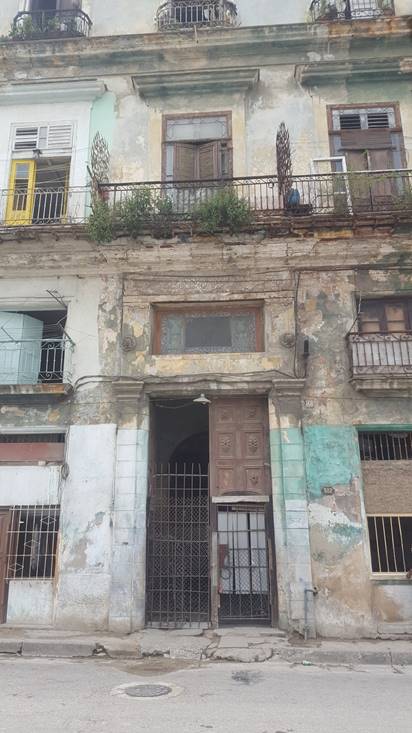
However, one would only need to walk around in daylight through the adjoining neighborhoods to discover the real Havana, abandoned to its own fate, that which, in official documents and institutions, is standardized under the label of “housing stock” or “domestic sector” and that  ̶  judging by the neglect and ruin — seems to suggest a perverse government policy: to ensure that in the short and medium term the dilapidated buildings end up collapsing or having to evict their residents by force, leaving  those spaces available for tourism and investment opportunities, which the old part of the capital and its popular neighborhoods are becoming, in a kind of theme park for the enjoyment of foreign visitors.

It is really notorious that none of the many multifamily buildings in Old Havana and Centro Habana have been favored by the restorations. In fact, the run-down houses of the early twentieth century turned slums, which are the most abundant and typical buildings in the area, have not even had the benefit of a measly paint job.

Corner of Industrias and Barcelona. The building is being held up miraculously by wooden braces. Author’s photo.

In the midst of the general deterioration, there are only rescue and reconstruction plans for buildings of State interest. The Campoamor Theater is among them, located behind the Capitol at the corner of Industrias and San José streets, with only its curved facade preserved, for whose restoration an important investment project exists. Currently, it is surrounded by a fence that displays photographs of celebrities who once performed on its stage: an unequivocal sign that it will be rescued.

However, a few steps away from it, on Industrias Street itself, corner of Barcelona, there is an old multi-family building, peculiar because it’s the site of the installation of the first Otis elevator. Several families are crammed in the space, under threat of a possible collapse, since the property’s construction has suffered major deterioration.

In this building, behind the Capitol, the first Otis elevator for residential buildings was installed in Havana. (Author’s photo)

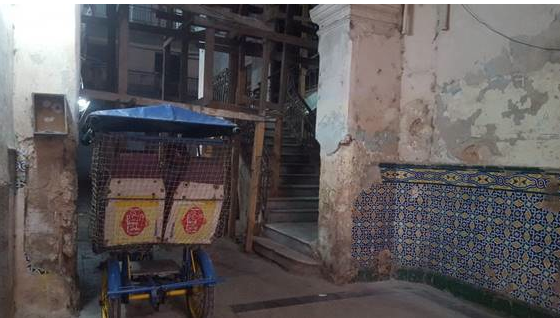
Some old hotels in the capital also became residential buildings years ago and are now in a dire state, precariously supported by wooden struts and in imminent danger of collapse. It is, to cite an example, the case of the nearby hotel Perla de Cuba (Amistad and Dragones streets), where families still live in the lower floors, as can be seen in the photographs.

For greater uncertainty of those who inhabit these dilapidated spaces, a significant part of them are in legal limbo due to their status as “illegal,” since they have come from the interior provinces and have not been able to change the status of their residence in the capital. Decree 217 functions as a kind of “green card,” legitimizing a humiliating segregation among the nationals of this Island.

In these cases, not only is their helplessness reinforced  ̶  since they can be deported at any time to their places of origin using police force against them ̶    but their inability to repair their homes legally, since on one hand they do not have access to building licenses or financial credit, while on the other, these buildings are mostly declared as “uninhabitable, non-repairable” by the Housing Institute, which eliminates any legalization process.

For their part, the “privileged” who are native to the capital or have obtained the grace of legal residence, although they might risk repairs of a cosmetic nature often lack sufficient capital to undertake structural improvements, which are extremely expensive and require state intervention.

A circle that closes and seems to be sealing the fate of thousands of families that, 500 years after Havana was founded, do not have much to celebrate. The gap between the beautiful and the ruins, the political power and the “governed,” the poor and the rich, the ordinary Cubans and the privileged elite continues to widen. The benefits of the imaginary “socialist model” have turned out to be increasingly bogus and unrealizable.

Translated by Norma Whiting
At Havana’s Mid-Millennium: The State of the Central Railway Station / Miriam Celaya

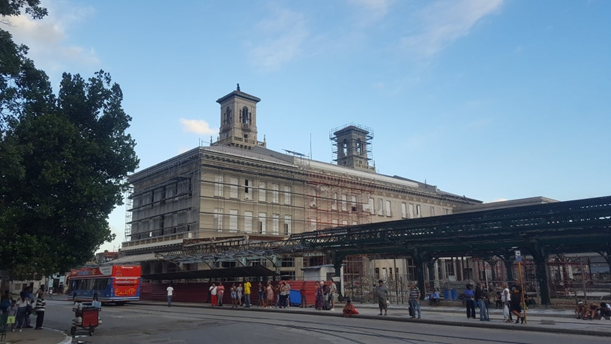
Central Railway Station. Restoration works have stopped (Photo by the author)

Cubanet, Miriam Celaya, Havana, 20 November 2019 — Seventy-five years after the opening of the first railway station in Cuba (Bejucal, 1837), Havana’s Central Railway Station was built and inaugurated, and its construction – finished in just two years – was carried out under the government of José Miguel Gómez by The Frederick Snare Corporation, an American company.

The brand-new station – completed on November 30, 1912 – was an imperative for the capital, since the old Villanueva station (1859) did not meet the requirements of a growing population. Equipped with a colorful four-story building, a mezzanine, a large 151,000 square feet train yard and a colorful eclectic façade with two elegant towers, central clock and craft decorations of shells and shields on the wall, the “Train Station” – as it is known by Havana’s residents – stands on the corner of Egido and Arsenal Streets, in the historic area of the capital.

In 1983 it was recognized as a National Monument for “its architectural and historical values,” but even this jewel of Havana’s architecture could not escape official neglect or the system’s own decline, especially when accelerated by the fall of the USSR, which marked the beginning of the economic crisis of the 1990’s. continue reading

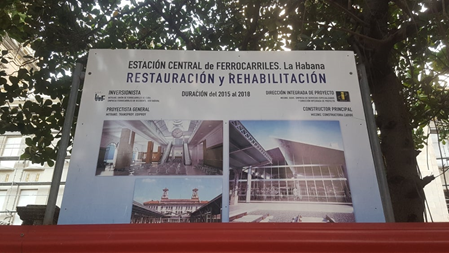
The deterioration of the rail passenger transportation service and the Central Station itself occurred simultaneously, and after some cosmetic refurbishment, works that did not solve the constructive or functional problems that already demanded major investments, it finally stopped providing services in 2015. It was then closed for restoration and rehabilitation, to confront the major repairs that are now being carried out, which should have been completed in 2018, as is indicated by a large sign placed on the fence that surrounds its façade.

Restoration was supposed to be completed in 2018 (author’s photo)

However, it’s enough to walk near the vicinity of the building and its related facilities to realize that not only have the completion deadlines have been breached, but that we will not be able to attend its re-inauguration at any time in the remainder of 2019, though in February of this year an optimistic report of the official site Cubadebate assured us that workers were laboring intensely in double shifts in order to deliver the finished work in time for the celebration of the 500th anniversary of Havana.

Back then, there was talk of “a 100-day delay” with respect to the original program, due to “the importation of steel for the stabilization of the north tower, as well as other materials for the façade,” to which should be added such complexities as the works required to strengthen the towers; the remodeling of the façade, retaining all its decorative and traditional values; the renovation of the blacksmith and carpentry shops; the creation of new rooms; the installation of escalators; the installation of new air conditioning services; lighting; and comfortable furniture sufficient to meet the demands of “more than 16 thousand daily travelers.”

Among the “renewal pride” which will be added to the services, the referenced report mentioned Wi-fi service and retail shops, which — it stated – would place the Central Station at the same level as its world peers.

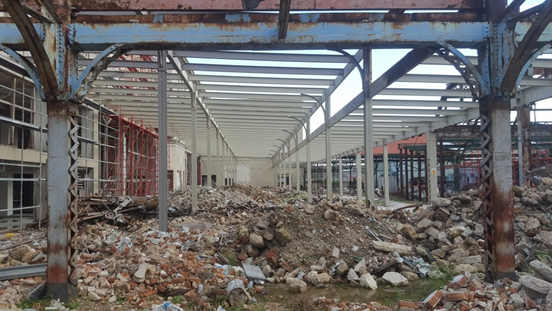
On the other hand, it is said that the platforms are also undergoing restoration, but though the report ensures that “all their steel was restored” and that “the pluvial system was rebuilt from scratch,” in fact, today the train yard offers an image of chaos and debris scattered throughout almost all of its spaces. Nothing evidences the existence of platforms, much less rain lines or systems.

Partial view of the train yards (author’s photo)

Obviously, if it were the restoration of one of the “mixed capital” hotels or some other work of greater interest to the authorities, the delivery program could have been fulfilled. But in the case of an installation designed to serve primarily nationals – and therefore not constituting a promising source of hard currency income, at least as long as there are no more efficient and comfortable locomotives and cars that meet the standards for foreign visitors. Thus, to date, there are no foreign investors who will inject enough capital to complete the work.

If the published data is assumed to be true, in this case the construction work of the Central Station – whose project was formulated by Cuban architects and engineers in coordination with the Office of the Historian – is the responsibility of the Transportation Ministry, the Union of Railways of Cuba, the Ferrocarriles de Occidente Company and the Havana Base Business Unit, so there is no need for much optimism.

This November 19th will be the 187th anniversary of the inauguration of the first railway station in Cuba and the beginning of this means of transportation on the Island; the second one in this Hemisphere – just behind the US railroad – and the first railroad system in Latin America.

The anniversary, however, should be a cause of shame and not pride. The collapse of the Cuban railways, evident in the rail infrastructure, as well as in locomotives, freight and passenger wagons and stations, is an incontestable sample of the destructive capacity of a socio-political and economic system that only needed 60 years to destroy what was built over the previous 127 years.

Moreover, the Castro regime not only spoiled the previously efficient railway capability of the Island, but it also interrupted the existence of a sector with a long working tradition in Cuba.

The building has been partially rehabilitated (author’s photo)

Today the workers of the depressed railway sector ignore that it is next Tuesday, November 19th – and not January 29th, the date imposed in 1975 by Fidel Castro’s egomania – when they should be honored. Recovering the rail efficiency achieved during the 19th century and the beginning of the 20th century, almost 200 years after the first train circulated in Cuba, remains an aspiration.

Translated by Norma Whiting

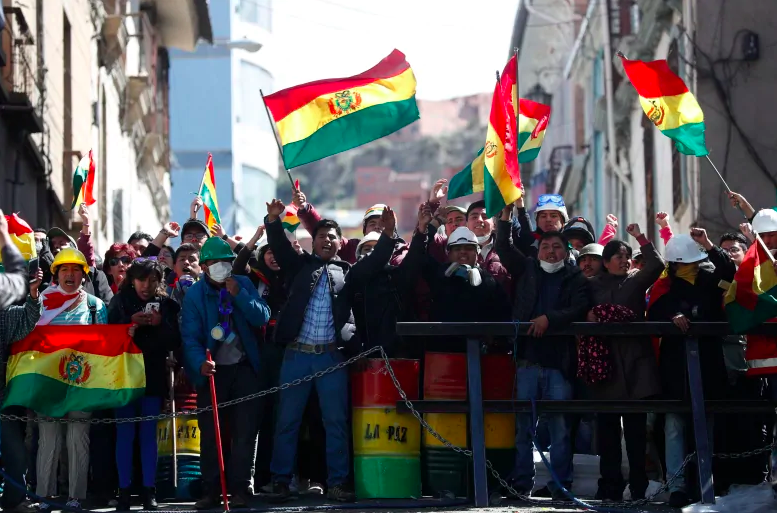
Lessons Bolivia Left Us / Cubanet, Miriam Celaya

The lessons Bolivia left us. Photo: Juan Karita/AP

Cubanet, Miriam Celaya, Havana, 12 November 2019 — The usual weekend informative spasm was broken this Sunday, November 10th, with bombshell news: after accepting the results of the audit of the Organization of American States (OAS) – requested by the president himself for the review of the elections of October 20th – and announcing that new elections would be called, Evo Morales has just resigned from Bolivia’s Presidency.

Just a few hours passed between the call for new elections and the resignation of the president. Such a decision, however, was not the result of a sudden epiphany or a mandate from Pachamama (an Incan deity), but rather the epilogue of a process that began after Mr. Morales’s unfortunate decision to present himself as a candidate for a fourth term, in rampant contempt of the popular will that had withdrawn authorization for him to do so in the referendum of February 21, 2016.

Unhappy with the setback suffered then, Evo Morales got approval from the Constitutional Court – openly his supporter – that gave him the possibility of running for elections for the fourth time. He also ensured that the Supreme Electoral Tribunal (TSE) was made up of officials who were loyal to him. continue reading

Despite this, the results of the elections were altered by the TSE itself to grant a narrow and controversial “victory” to Morales, thus opening the door to the political crisis that has been shaking Bolivia for three weeks, with violent clashes between supporters of the opposition and those of the President, a crisis that would have continued indefinitely with unpredictable consequences.

The days to come will show if the action of the commander of the Armed Forces, General Williams Kaliman – who kindly and without pointing a gun at him suggested to the president he should resign – managed to cut these weeks’ spiral of violence and avoid greater ills to the country.

Together with Morales, his vice president, Álvaro García Linera, resigned. Both denounced the consummation of “a civic, political and police coup,” but the truth is that neither the army nor the national police used force against the President. If we were really witnessing a coup d’etat, it should be recognized that – despite the fact that at least three deaths and thousands of injuries have been reported in the confrontations between the protesters in favor of one side or the other – it has been the least violent coup that has ever taken place in this Hemisphere.

Looking at the facts from an ethical and political logic, it would have been a contradiction that the same candidate who was favored through fraud could present himself for a new election. Fraud in itself is a serious crime that disqualified Morales in the race for the Presidency, so that the president  himself summarizes the cause of the crisis and the consequence of his excessive ambition for political power at the same time, although now the most rabid continental left – with Havana at the helm – cry out against “the coup d’état of the anti-Bolivian right, orchestrated from Washington.”

And this leads us directly to the outright ridiculousness of the insular ruling dome. Just two days before the television news of the official press monopoly overflowed with jubilation and proclaimed two “resounding victories”: that of the “Resolution Against the Embargo,” presented (again) before the UN General Assembly, and “Evo’s overwhelming victory in the Bolivian elections.” The sagacious political analysts could barely contain their jumping for joy amid the most absolute triumphalism.

For greater scorn, Morales’s resignation comes just a day after the Cuban Foreign Ministry, in open interference in the affairs of the Andean country, made an Official Declaration, publicly “vigorously denouncing the coup in progress against the legitimate president of Bolivia” orchestrated by the Bolivian right “,with the support and leadership of the US and regional oligarchies,” and called for all involved sectors to stop this dangerous maneuver which constitutes a threat to the stability of Bolivia and the whole region.

“Evo’s historic victory, against the maneuvers of the internal and regional right, the Imperialism and an intense media war, is also a triumph of the entire Great Motherland,” proclaimed the pamphlet. And it commended the Bolivian president that “in a further demonstration of equanimity and political stature, he summoned the political forces to the dialogue table for Bolivia’s peace, and called the organizers of the violent protests to deep reflection and urged the people to mobilize to defend democracy.”

What idiocy for the revolution’s “common cause” that after so much fuss, the once-hardened indigenous should crack like a reed.

Undoubtedly, the Palace of the Revolution would have preferred a thousand times for Evo to immolate heroically, Salvador Allende style. At least then it would have been possible to count on a new martyr – indigenous and of humble origin, to boot – whose ghost could be opportunistically shaken against the imperialist enemy.

How mean, Evo, not sacrificing yourself for the continental glory of the Castro regime and its measles epidemic of radical lefts and not letting you burn at the stake of the progressive ideals, so passionately defended by the high ruling Cuban bourgeoisie from their comfortable mansions at El Laguito. What a disappointment, Evo… we expected more from you!

However, the most immediate balance of the latest events in Bolivia is the moral of the story that politicians in this region should capture. The defeat of Evo Morales comes against the progress made in the country during his tenure. Bolivia certainly has remarkable economic growth and can exhibit amazing social achievements in health and education, especially for the humblest sectors.

But just as the leader of the coca growers is responsible for these advances, he is also responsible for the political crisis that he caused when he presented himself for the elections of last October, and to a certain extent, for the direction the country takes in the immediate future.

It is the cost of those who impose a personal government and set out to appropriate political power ad infinitum. Because the masses can be faithful and enthusiastic, but they are also often fickle. In this sense, Bolivia’s experience can be a very useful lesson for both rulers and the governed.

Let’s take note.

Translated by Norma Whiting
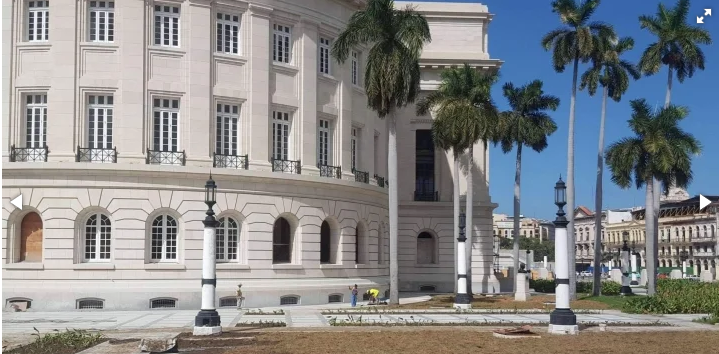
Havana’s Capitol: The Other Face of the Restoration

Two weeks before the 500th anniversary of the founding of Havana, the Facade and Rear Gardens of the south side of the Capitol (photo: Amelia)

Cubanet, Miriam Celaya, Havana, 4 November 2019 — There are those who would swear that everything in Cuba, from the most solemn to the most mundane act, has an air of a one-act farce. The dramatic and the jocular intermingle in a scenario full of contrasts and absurdities, in a reality that far exceeds any fiction plot.

These days, the metal fences that covered the gardens of the southern area of the National Capitol were finally removed, and the neighbors who reside in the popular (and populous) neighborhood that runs behind the monumental building, glance curiously at the feverish restoration activity. There is an intense agitation, since there are only two weeks left for the 500th Anniversary of the Cuban capital, to be celebrated on November 16th, and the delivery of this iconic building is one of the highlights of the event.

“I think they will not finish it on time”, says a septuagenarian of humble appearance who says he is a retired construction frame worker, who returns daily to contemplate the work. “I, who worked all my life in construction, tell you that a lot of work is still missing. Now they are in earthworks because they removed all the old tiles in the garden in order to restore them. Then they have to tamp, press them firmly and fuse them so that these tile slabs remain fixed. Add to that all the landscaping, and not counting the windows that have yet to be installed and the facade that is still covered and must be finished.” continue reading

And he points to a huge mesh cloth that covers a portion of the rear facade and numerous empty openings where all the blinds should already be in place. “They are going to have to work in 24-hour shifts and still doing it that way they might be able to complete just what shows. Just cosmetic work, the same as always happens.”

Nearby, there is a standing policeman on duty facing the work.  Police surveillance is permanent, as well as the presence of guards at a nearby checkpoint, to prevent the usual shoplifting of construction materials: the illegal sale of cement, stone dust, joists, etc., is a constant in every construction job in Cuba.

“This has been difficult here from the beginning,” says a lady who also watches the work. “I live here back on Amistad Street, and several neighbors of mine tried to get some cement and other things… but nothing. There is great vigilance with that, and there are people in this neighborhood whose houses need repairs, because they are falling down… There are no materials for the unfortunate.”

Occasionally, some official media have made reference to the intervention of foreign capital and the support of private institutions to achieve the restoration of this building, paradoxically the most important symbol of Republican Cuba, crushed after the 1959 revolution.

The Castro regime, unable to create their own symbols that can compete in quality and beauty with those of the past, is trying now to appropriate allegories that are completely alien to them. Since they failed to completely destroy the city that they despise – and those who despise them – they prefer to make use of its meaning and its unyielding architectural wealth.

According to government sources, the German company MD Projektmanagement, owned by Michel Diegmann, is responsible for the restoration work. However, nobody fully knows the total amount of the investment, although everyone infers that the sum must be in the millions. “With half the money that this cost, a lot of buildings in Centro Habana could have been repaired,” the same woman muses next to me.

The restoration of the dome alone, exquisitely coated with pieces of gold leaf on copper sheets, is the result of a large donation from the Russian Federation. The work undertaken to return it to its former splendor was carried out by specialists from that country, assisted by Cuban personnel.

The southern facade of the building is still missing windows and the gardens need to be completed (photo: Amelia)

Re-inaugurated August 30th by the City Historian, the golden dome contrasts sharply since then with the poverty of its “backyard”, that is, the collapsed roofs and facades of the adjoining buildings, hidden behind the architectural magnificence not only of the Capitol, but also of the Havana Prado, the Havana Lyceum, the Grand Theater, the Saratoga Hotel, the Fountain of the Indian Woman, and the Central and Fraternity parks. A majestic urban complex that flanks and conceals the ugly face of gloom, the crust of decay, accentuated after 60 years of neglect that the authorities do not want the world to see.

And it is not that it is wrong to rescue those symbols, buildings, squares and spaces that made this city beautiful; quite the opposite. We just need to not forget that Havana, like any city, is much more than the sum of its architectural symbols and historical spaces.

The beauty of cities, what makes them peculiar or “marvelous”, lies in the soul of their people, in the spirit of those who inhabit them. To artificially brighten the old trappings of our city for one occasion, as if it were a showcase to display it to the world, while prosperity and freedoms are still forbidden to Cubans who live it, love it and suffer it, it’s not worth a thing.

New “Economic Measures”: Another Trap to Catch the Gullible / Cubanet, Miriam Celaya

Cubanet, Miriam Celaya, WEST PALM BEACH, United States. – The highly announced Roundtable TV show on Tuesday, 15 October 2019, where the “new economic measures” of the Cuban government were revealed, has just deflated any expectations that those who were waiting for some opening in the internal economy of Cuba might have had.

This time the cast was headed by Salvador Valdés Mesa, the brand new Vice President of the Republic, accompanied by the ministers of Economy and Planning, Alejandro Gil Fernández; Finance and Prices, Meisi Bolaños Weiss; Internal Commerce, Betsy Díaz Velázquez; Foreign Trade and Foreign Investment Rodrigo Malmierca Díaz; along with Irma Margarita Martínez Castrillón president and minister of the Central Bank of Cuba, and Iset Maritza Vázquez Brizuela, the first vice president of the CIMEX Corporation.

Taking into account the profound structural crisis of the system and the uncertainty of the lives of Cubans in pursuit of a promised future of prosperity, which remains increasingly distant and elusive, one would expect that such a choir would have deployed a whole package of reforms aimed at liberating and stimulating, to some extent, the initiative of the repressed private sector, in order to alleviate the state of the permanent asphyxiation in which the majority of Cubans live. continue reading

Far from it, and validating once again its proverbial folly, its lack of sense of reality and its total indifference to the hardships suffered by the governed, the news released this Thursday are far from “favoring the people,, and much less are they directed at improving the standard of living of the population, as stated by the conga line of the Palace of the Revolution.

In reality what it is about, is to turn on a twisted financial machinery, fundamentally guided to collect foreign currency from abroad, thus avoiding the tight fence imposed by the iron Helms-Burton Law against the Castro cupola.

The excuse wielded by Castro’s birds of prey could not be more childish: the increase in domestic demand for consumer goods has led to an informal trade where products are offered at high prices, which leave copious profits to natural persons, even after paying the corresponding customs tariffs on the goods they import. Regarding this, Mr. Valdés Mesa has said: “Although the goods enter the country in a framework of legality, after receiving them they are marketed irregularly.”

In addition, he stressed that “the current US administration has also intensified the financial fence to prevent Cuba’s transactions in its collections and payments abroad,” factors that “have caused the country to lack sufficient financing to import raw materials destined for the industry and for our market supply chains.”

Thus, the informal market — the official vultures confess — has compensated for the usual shortages in the retail network, supplying those goods that the official market does not offer or that it does offer but at higher prices. Therefore, with the sagacity that characterizes it, the government has been “working with a strategic vision” to develop a plan that allows expanding the available goods, establishing “competitive prices” and “developing our industry,” while facilitating Cubans’ purchasing ability.

It is worth stopping at certain interesting details: for the first time the almighty State recognizes informal merchants as competitors, and pretends that we believe that a mechanism as precarious as that of the underground commerce – merchandise stands, street vendors, traffickers, the on-line site Revolico, etc. — and its primitive import system through the so-called mules, has exceeded the commercial capacity of all the economic-financial machinery of the Castro regime, that murky monopoly known as GAESA (Grupo de Administración Empresarial, SA*), forcing the government to create a trading system parallel to its own network of retail trade, collector of foreign exchange.

On the other hand, the subterfuge that the State seeks to diversify the goods on offer and lower prices for the benefit of the people does not hold, because if it were the real objective it could reach it through the existing retail network, supplying shops and lowering the inflated prices of the products.

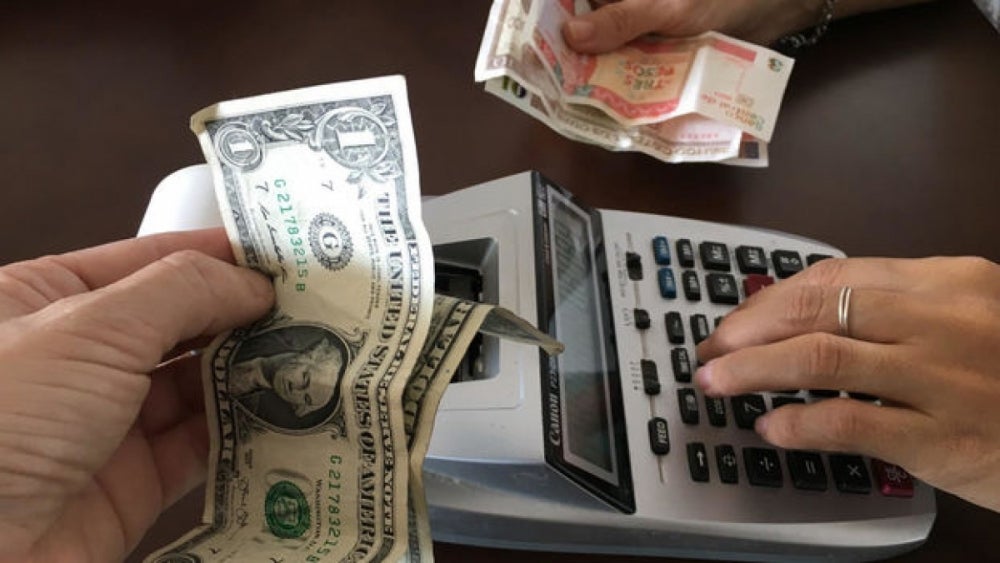
What is involved, then, is not to snatch customers from the informal market, but to create a system of direct currency inflow to the government, thus circumventing the pressures of the US embargo and especially the effect of the measures dictated by the Trump administration. To achieve this, the State’s profits must not be in the Cuban convertible peso, CUC — that bastardized internal token that only works in the home front — and even less in the Cuban peso, CUP, 25 times less valuable, but rather in cold hard cash (read ‘dollars’).

Based on this, it was decided to authorize ‘natural persons’ to conduct sales in convertible currencies and to import products through state-owned companies, for which the “thinking tanks” of the government conceived a new mode of payment in currencies through the Central Bank’s financial system of Cuba (Banco Metropolitano (BM), which operates only in Havana; the International Financial Bank and the Popular Savings Bank).

The customer – the natural person – will also be able to make purchases at “favorable prices” in the new network of retail stores that will operate throughout the country and will be “opening” in time, until a total of 77 are completed. In this first stage and starting next Monday October 21st the first 13 stores (12 in Havana and 1 in Santiago de Cuba) will open, the rest will be implemented “gradually.”

Likewise, the measures will allow natural persons to import goods through import companies designated by the Ministry of Foreign Trade and Foreign Investment, provided that the payment for such imports is backed by freely convertible currency, for which existing “customs warehousing areas ” will be used, in addition to others that may be created, for the sale of merchandise through importing companies designated by the Ministry itself.

For their part, the state entity Automotive Services, S.A. (SASA), the CIMEX companies (“and others that may be necessary”) will provide marketing services for parts, accessories and other multi-brand automotive products to natural persons. As an additional benefit, bonuses or tariff exemptions will be granted for the importation of raw materials and supplies as well as for dire need items and products in greater demand.

None of these measures will affect existing customs regulations, which will maintain the limitations and tariffs on already established imports.

All purchases and transactions will be made under the electronic commerce mode — with virtual stores, online sales and the use of national and international payment gateways — so it is absolutely essential that the buyer create an account, in foreign currency only, in any of the banking varieties that function in the country to obtain his magnetic card, which will be used for each transaction upon presentation of the buyer’s identity card.

Permanent residents in the country may open accounts only with the presentation of their identity card. These accounts must be associated with magnetic cards in the offices of the Metropolitano SA, Credit and Commerce and Popular Savings banks, and among the attractions offered to them are the waiver of a minimum balance, plus that interest will not be calculated or applied, while limits to the amount and number of transactions per day may be defined, which constitutes “a security mechanism for the customer in case of loss or misplacement of the card, which can be changed at any time.”

And since all this machinery is designed in the interest of attracting the maximum possible currency, these bank accounts can receive funds through transfers from abroad, including remittances that until now were processed against bank accounts, as well as cash deposits in American and Canadian dollars, Euros, Pounds Sterling, Swiss francs, Mexican pesos, Danish, Norwegian and Swedish Krone, and Japanese yen.

Deposits in Cuba’s national currencies, the CUC and CUP, will not be accepted. The exchange rate that is applied will have the US dollar as a reference value, and in case of US dollar cash deposits, a 10% tax will be applied, as established in Resolution 80 of October 23, 2004.

The government hopes that retail sales in freely convertible currency will allow the revenue collected to be translated into the development of the national industry — without specifying what these industries will be — to guarantee the sustainability of the supplies, boost the economy, satisfy domestic demand and generate jobs.

In addition, Valdés Mesa said that the new measures will improve both the after-sales servicing (warranty) of household appliances sold in the national market, as well as repair and maintenance servicing, a benefit not offered by the equipment imported by the buyer. “The prices that will be offered will be competitive with those existing in the retail market of the countries of our geographical area. They will not be fixed prices, but they will not be collectible either,” he added.

However, a brief glimpse of the “favorable” prices of “high-end products” through several examples offered by the Roundtable allow us to anticipate that they still do not conform to the reality of common Cuban’s purse, and that the welfare of many families will continue to depend on remittances. Thus, a 43-inch Samsung LED TV is priced at $549; a 13.6 cubic foot Daytron refrigerator at $519; a 1-ton Royal brand ductless air conditioner at $361, among other examples presented.

Clearly, these numbers do not relate to the income of the poor majority of the Island, so it is the government itself that widens the gap between Cubans with access to consumer goods and the vast majority that remains in a permanent state of survival.

The officials, in general, were profuse in details and in financial terminology that failed to show an understanding of the common of mortals in Cuba, and also extended in tariff matters, transactions, types of cards, benefits of bank accounts, etc. They could well have explained it in Mandarin Chinese, since knowledge of financial management, which they generally lack, is not precisely the strength of most of the natives of the Island.

What was clear to everyone who had the patience and discipline to watch this Roundtable from the beginning to the end is that there are still no effective measures for the millions of disadvantaged, low-income Cubans without access to remittances.

Gone and buried is that slogan that years ago made a revolution famous.  It went like this: “of the humble, with the humble and for the humble.” Now the greedy Castro regime will only have to sit down and wait for the unsuspecting people who will bite the hook and commit the supine stupidity of placing their capital and their confidence in the dark banking system of Cuba. Those naive people had better think twice.

*Group of Entrepreneurial Association, Public Limited Company

Translated by Norma Whiting
Structural Crisis and “Elections”: It Won’t be Easy for The Designated One / Miriam Celaya

Díaz-Canel at the 1st National Conference of the Culture Union. 2018 (granma.cu)

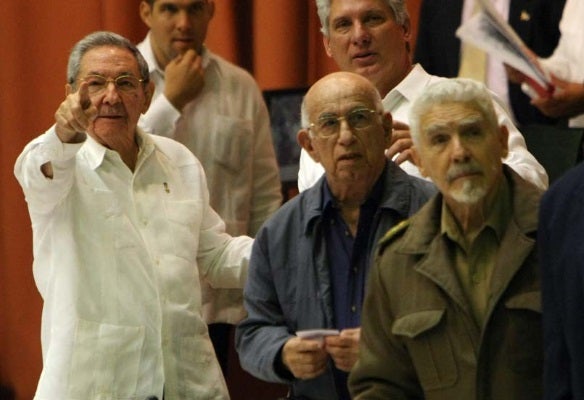
Cubanet, Miriam Celaya, Havana, 9 October 2019 – There is just one day left before the 600 deputies that make up the National Assembly of People’s Power (ANPP) “elect” who will be the country’s president and vice president for the next five years, re-eligible for a second term, as the new Electoral Law (Law No. 37) reads, approved last July in ordinary session of Parliament.

However, the millions of Cubans who are part of the so called sovereign people as well as the deputies themselves, who will obediently tick the boxes corresponding to each position and to “applicant”, previously selected by the true power, still ignore who the candidates to lead are, at least in name, the always precarious directions of the nation.

It is fair to say that the subject doesn’t interest hardly anyone either. The most widespread opinion among Cubans in Cuba is that it matters little who holds the title of president when it is known that those who truly rule in the country are the surviving members of the historical (de)generation and their closest heirs and collaborators, directly responsible of the whole disaster generated over 60 years. continue reading

Whoever those designated for such responsibilities are, they will be puppets without real power and without sufficient courage to undertake the essential changes, beginning with the general transformation of a system that is clearly obsolete. 

The only certainty derived from the experience of four generations who have barely survived the six decades of crises and hardships labeled under the deceptive heading of the Cuban Revolution, is that if the promises of the future were not fulfilled by now, not one of the ones they put in place will solve anything. Such conviction weighs like a tombstone on the popular spirit, as if, at the unconscious level, people have finally begun to internalize an unquestionable truth: Cuba’s evil is not cyclical but systemic.

In fact, the civic orphanage of an entire peoples blames itself in the daily language of the so-called ordinary Cuban. In any moderately democratic society and in the middle of the electoral stage, nobody would think of referring to “the one they are going to place,” rather they would say “the one I am going to vote for.” This, of course, after public knowledge of the respective government programs of each candidate and which party they represent.

In Cuba, on the contrary, the single party and the dictatorship have been legally consecrated — not “legitimately” — in the new Constitution; and so also, after 43 years of training in social compliance under an electoral system barely modified since 1976, the recently passed Law 37, in open contempt of the popular will that reclaimed direct participation in the election of the president of the country, constitutes a true armor to avoid fissures in the official filters that could eventually allow the rise to power of candidates unwanted by the privileged elite.

Thus, the Electoral Law Draft formally presented on July 2019 to the parliamentary commission designated “for discussion and approval,” made rampant omission of direct elections, one of the most important demands of Cubans during the so-called popular consultation process that preceded the unanimous approval of the Constitution now in force.

Nevertheless, it was unanimously approved by Parliament, in the same way that the “election” of the president and vice president will be approved on the morning of this October 10, 2019, under the protection of a paradoxical legislation that was renewed with the sole purpose of perpetuating a system anchored in the past.

Perhaps the few “innovative” brushstrokes of these supposed elections are summarized in factors that right now do not seem very relevant, but of which it would be wise to take note.

Namely, they are the first votes in which none of the members of the historical generation will be part of the candidacy — although they will continue to hold the Royal Power until nature takes its course.

Secondly, it is to be assumed that, in the course of five years, their survivors  will disappear or completely lose their already scarce capacities and, consequently, end their pernicious symbolic or real influence on the decision-making of the direction of the country.

And thirdly, with marked importance, to maintain the current deepening of the crisis of the system, the “new” government will have no more than two alternatives: to implement economic changes that would eventually result in the transformation of the “model” itself or to face chaos which would derive from social discontent over the accumulation of problems in all areas of national life, thus assuming the consequences of the mistakes made by the “historicals.”

Nor should we discard the importance of new leaderships that may emerge in the independent civil society and that would join the already known groups with long experience in resistance. Recent times are showing a rebound in sectors pushing for spaces of freedom and participation within the Island. Presumably, such growth will be sustained and they will diversify their proposals and demands to the extent that political power in Cuba is not even capable of generating a plan to alleviate the structural crisis of the system.

Meanwhile, expectations must be moderate. The Cuban landscape offers no reason for optimism but rather the opposite. The increase in repression, the sharpening of the crisis, the retreat, in terms of openings of the private sector and the ideological entrenchment, are some clear signs of the cupola’s lack of willingness to change; a situation from which there is no glimpse of an exit and whose solution does not depend at all on the X’s that will mark the ballots of the deputies in the electoral farce that will take place next Thursday.

It is clear that the president will not inherit the power, but will inherit the responsibility for what happens in the future: he will need to dare to move things or accept the role of accomplice and scapegoat of the dictatorship. It won’t be easy for him.

Translated by Norma Whiting
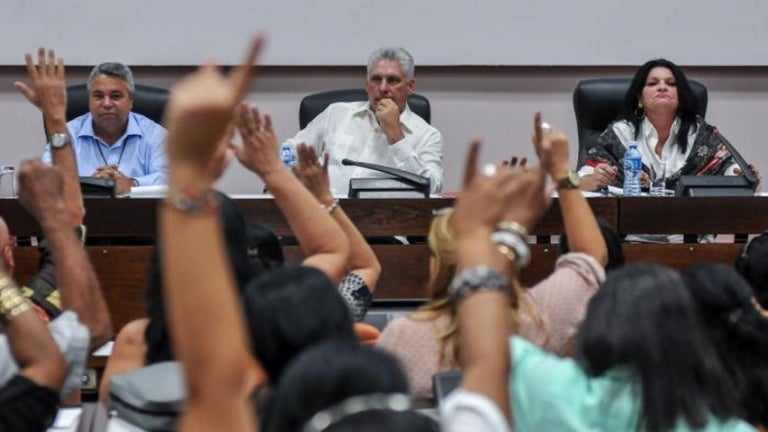
We In The Cuban Opposition Should Take A Lesson From Ricardo Bofill / Cubanet, Luis Cino

Ricardo Bofill. Miamiherald.com

Cubanet, Luis Cino, Havana, 15 July 2019 — Despite my great admiration for him, I never thought I would write about Ricardo Bofill, who died this past 11 July. I thought that such a task would fall to, and be done much better by, those who knew him and were at his side during the hard years when the struggle for human rights in Cuba was begun. But I feel that there are things that should be said, and I don’t want to choke them back.

We in the opposition should take a lesson from Ricardo Bofill. In many respects, we should look to him as a role model.

With the creation in 1976 of the Cuban Committee for Human Rights while he was imprisoned at Combinado del Este, and later of the Pro Human Rights Party in 1988, Bofill was among the first to show that what up to that point had been unthinkable was actually possible: to deal with the Castro regime through peaceful means. Bofill and those who dared to follow him – Tania Díaz Castro, Reinaldo Bragado, Rolando Cartaya, Adolfo Rivero Caro, and others – who, for their recklessness were called crazy, proved that it could be done. Had it not been for them, the current pro-democracy opposition and independent journalism would not exist on the Island. continue reading

Thanks to Bofill and his partners, the world, which up to then had not listened – indeed had refused to listen – realized that in Cuba ruled a dictatorship that violated the most elementary human rights.

Said dictatorship, upon feeling challenged by Bofill, tried to crush him but was unsuccessful, despite devoting its most vile energies to the task. Imprisonment was not enough. Personal attacks by Fidel Castro (who denounced him as though to write against the Revolution were a terrible crime) were not enough. Neither were threats, character assassination, insults, Granma newspaper dubbing him “The Fraud,” – nor state-run television that reran to exhaustion that video edited by State Security which, to discredit him, cut and spliced it to take his words out of context so that Bofill would appear to be saying, “living off of this [dissent], man, living off of this…”

It was all counterproductive for the regime. The world understood what was going on and would never again view the Castro regime the same way.

That Bofill did not end his days in the regime’s dungeons was thanks to international pressure, particularly from the government of France.

In 1988, Bofill was able to travel to Germany. The regime forced him into exile upon not allowing him to return to his country.

They say that Bofill lived his last years in poor health, in poverty, in a humble house in a sketchy Miami neighborhood. Luckily, he was not without the company of Yolanda, his wife, ever faithful and unwavering.

Bofill, modest as he was (too much so), never sought honors or starring roles – and he had every right to do so. Certain dissidents who chase after recognition and renown even to the point of ruining the best project should learn from him and follow his example. I refer to those who refuse to sign a document if their signature is not at the top or if they disagree with even one comma, who think that they are always right and arrogantly view as enemies any who are not in total agreement with them.

We ought to be grateful to Bofill for the struggle that he initiated – but above all, for the example of virtue and dignity that he leaves to us. Hopefully, we will learn from it.

luicino2012@gmail.com

Translated by:  Alicia Barraqué Ellison

Special Period or “Situation”?

Díaz-Canel appearing on the Roundtable TV show on Cuban State television (Twitter)

Cubanet, Miriam Celaya, Havana, 12 September 2019 — As announced by the official press in the morning hours of September 11th, a special appearance of the Cuban President (not elected), Miguel Díaz-Canel, took place in the usual space of State televison’s Roundtable program, in order to report on the “current energy situation” that the country is experiencing this September. This time, the program was broadcast from the Palace of the Revolution, and the Ministers of Economy, Energy and Mines, and Transportation accompanied Díaz-Canel

Looking tired – due to a day that began early, at a meeting of the Political Bureau with Raúl Castro leading, where “the measures to alleviate the situation” were approved – the “president” made his speech without departing a milligram from the script that, in broad strokes, began with the causes of all evils: the new “onslaught” of evil of the American Empire (and here, a direct mention of the funds allocated by the government of that country for “subversion in Cuba”), in addition to the capricious commitment of the current administration of the nation to the north to inflict suffering on the Cuban population, with the risky intention of blaming the inadequacies and deprivations on government inefficiency.

According to Díaz-Canel, the newly announced limitation of remittances and the efforts of the Trump administration to prevent the arrival of oil in Cuba were, among other factors, the most important ones that conditioned the “low availability of diesel,” which is directly impacting on public transportation and on freight. continue reading

Because it turns out that “there are no longer supply problems, such as those we faced at the end of last year and in the first months of this year.” It is said that there are food boats in port – loaded with meat, flour to make bread, etc. – whose cargoes have not been able to be unloaded due to the “current energy situation.” “Situation,” a word mentioned on numerous occasions during the speech by Díaz-Canel, which seems to be the new euphemism to refer to the economic crisis in the 90’s which the fertile imagination of Castro I termed The Special Period, and whose return the regime refuses to recognize.

Meanwhile, the Minister of Energy and Mines announced the “possibility of blackouts” which would be scheduled and announced in a timely manner to the population, while the Minister of Transportation referred to the inevitable “reprogramming” of inter provincial travel – that “will not be suspended, but extended” in time, which implies that “there will be people who bought their tickets but cannot travel on the planned dates” – a situation that will affect both national bus services and train travel, a service with an ephemeral life since it was reopened with much fanfare in recent weeks.

The Minister of Economy, in turn, made a triumphant mention of the financial contribution of tourism and other income derived from foreign investments, etc., all of which, in addition to the development plans undertaken throughout the country, means that we can be assured that this year’s growth in GDP will be guaranteed

There will also be effects “on the distribution of some products”, but at least they gave us the good news that “blackouts should not occur until next Sunday, September 15th, unless there are interruptions due to breakage or other factors.”

However, this time the government fortunately has a Plan. It is not without purpose that the president reminds us that we have now what we lacked in the 90’s, namely, the Cuban Communist Party (PCC) Guidelines, the Conceptualization of the Model and – as if that were not enough – a brand new Constitution, very useful tools that now allow us to successfully face imperial tricks and plots. Now, a smiling Díaz-Canel tells us that the Cuba Plan faces the USA Plan. “Plan against Plan, as Martí used to say” he stated, very pleased with himself.

And what is the wonderful Master Plan secretly created by the Druids and their “continuity”? Well, literally: “dust off some of the experiences learned during the Special Period”, such as “work at home” (if possible work is done from the home base, taking advantage of “the advances in connectivity we now have”, to alleviate the use of public and labor transportation).

State vehicles (not normally used for passenger service) must pick up passengers at bus stops, provided they have available capacities (which seems like a repeat of the famous “yellow ones”, a name that the popular wit during those hard, turn of the century years, gave to State inspectors due to the color of their uniforms. The State inspectors’ function was to force the State drivers to carry passengers, and to apply the “popular control” (a euphemism for “snitching”) for any violation of measures and laws, “to move work schedules” even to the dawn hours, if necessary, and to reintroduce animal traction – as in horse-drawn carts, ‘buses’ and trucks – in places where this variant was possible, among other pearls.

And if that were not enough to convince us that this “tense energy situation” is not a Special Period but “a training opportunity, since it can be repeated in the future” — which contradicts the very concept of what is understood as situational — Now we have a “socio-economic development strategy” based on tourism and on “the exportation of medical and drug services,” in addition to other items such as the production of eggs, pork and chicken.

But the best news is that the above “situation” is only a matter of days away. The oil contracts for the month of October have already “been negotiated,” which implies that the coming month will not be energetically tense, and on the 14th of this month of September an oil ship will arrive — from a mysterious place that our president, so shrewd and naughty, did not want to reveal so that the Empire does not find out — which will be the solution for this small energy slump.

So, in the end, it was all about “a ship’s” arrival! Could it mean, perhaps, that with that solitary oil vessel that will arrive secretly, as if it were a seventeenth century filibuster, all the problems of this Island of 110 thousand square kilometers and 11 million low-life souls can be situational? And then, wasn’t it sufficient to do a press report explaining the fact instead of inventing implausible and medieval plans at the highest governmental level? Does the main plan of the cupola really take Cubans for fools?

But I will tell my readers a secret suspicion that’s eating me alive: I know that we are not in the Special Period because neither the person who became president because he knew somebody nor his team of babbling ministers has yet to mention that artifact that was the hallmark of the dark crisis: the bicycle. Or is it that it has not yet been possible to unload the ship “loaded with cycles” due to the lack of diesel?

In the end, all this absurdity of a “sovereign and independent” Island that makes such painful boast of its blarney economy reminds me of a phrase a poor madman repeats like a parrot to enliven his meaningless speeches and slogans at the Emergency Hospital bus stop, where his involuntary public crowds together. At the end, even if irrelevant, the poor man ends his rant by invoking that not so innocent other lunatic: “This did not happen with Fidel.” In Cuba, from the highest of Power to the lowest of the outcasts you can hear any nonsense.

Translated by Norma Whiting

We Are Not Continuity, We Are Rupture / Miriam Celaya

Raúl Castro and Díaz-Canel, Ramón Machado Ventura and Ramiro Valdés (photo: rtve.es)

Cubanet, Miriam Celaya, West Palm Beach, United States, 2 August 2019 —  On July 30th, the digital edition of the Granma newspaper published yet another of the usual hodge-podge stew texts we are so used to, in which the term “mercenary” (through Wikipedia), the crisis of Venezuela, the Helms-Burton Act in its Third Chapter, the recent report on Venezuela prepared by Michelle Bachelet, the United Nations High Commissioner for Human Rights, which the autocrats of the Palace of the Revolution have found so hard to swallow, and – finally as a main course – the “stateless” in Cuba who, “by vocation” and even for chump change (…) lend themselves to any shady deal against the country that saw them draw their first breath”.

This time the official regurgitation would be perfectly inconsequential, except for its timing, in the midst of a true offensive against independent journalism and autonomous groups of the civil society.  Also, by the prosaic manipulation of facts and terms with the sole purpose of conditioning public opinion in favor of an eventual raid against all public action that they deem adverse, it is punctually directed against the “traitors, stateless and ill-born mercenaries”, who have had the inexcusable audacity of exercising their legitimate right to request the presence of the United Nations High Commissioner for Human Rights and its observers in Cuba, as well as the preparation of the corresponding report. continue reading

In this regard, and putting aside the fact that Cuba is a UN member country, the Castro scribe says “that these reports come with the script and writing of the US Department of State and it is worth noting that all these infamies have crashed against Cuba in the presence of truth (…) and with the dignity of a whole people that knows how to identify, fight and defeat its enemies, be they internal or external ”.

Because the Plaza de la Revolución has an instrumental and bipolar vision of the international organizations to which it belongs: they are legitimate if they condemn the Embargo (“blockade”, as they call it), but they are spurious if they denounce the excesses of Castro’s power or that of their allies.

But not because it’s overused is the official strategy less perverse, especially when all the setbacks suffered in recent times by the cream of the crop of regional progress -today almost folded into Havana’s Palace of the Revolution and the Palace of Miraflores in Caracas -is added “the betrayal” of someone who was assumed until the day before, and not without foundation, to be a reliable ally, tolerant of the dictatorial excesses of her leftist friends, socialist Michelle Bachelet. Good times are definitely not here for the Castro regime’s “progressive” millionaires, and they prepare to defend their power, their lair and their privileges with equal intensity.

Thus, although neither the international organizations attached to the United Nations nor Bachelet herself in her years as President of Chile have ever given due attention to the demands of Cuban civil society and to allegations of human rights violations in Cuba, the dictatorship prefers to shield itself inward, just in case. And since the elders of the Historical Generation are running out of health or biological time to continue to face displeasure or to fight “battles” — even less so now that the adversaries are the current generations of Cubans who have taken the pleasure of feeling like citizens and not plantation slaves — their beneficiaries and scribes have the sacred mission of stepping out.

They are, paraphrasing Granma’s servile scribe, the true mercenaries of vocation (himself included). Or perhaps it is more accurate to call them insignificant low-cost mercenary slaves. It is they who function as verbal minions against Cubans who, for dignity and for their love of Cuba, have the courage to rebel against the dictatorship, it is they who bark “emboldened” because they feel protected by the landlord, they are also the ones that live on crumbs and “sell their soul to the devil” for travel and small perks and those who “lend themselves to the most vile actions against their fellow citizens.” If it were not for the poison he extracts and the danger that he contains, we almost would have to thank the reporter for the accuracy of the self-portrait.

And it is not that too many expectations need to be made about an eventual (and practically unlikely) incursion of the UN High Commissioner in Cuba, starting with one insurmountable obstacle, the dictatorship would not allow it. But the initiative is worthwhile, not only because Bachelet’s functions include attending to the claims of those who have been systematically violating basic human rights for 60 years, but because every civic front in Cuba undermines the foundations of totalitarianism, and sets precedents for the civic rebirth of Cubans.

The Scribe lord, mercenary slave of the Granma libel, does not understand, and neither do his masters understand that those of us who signed that letter that so much frightens them are not traitors or stateless, but quite the opposite. They do not understand, in their infinite stubbornness, that more and more Cubans than they can imagine are not “we are continuity”.  We are rupture.

Translated by Norma Whiting
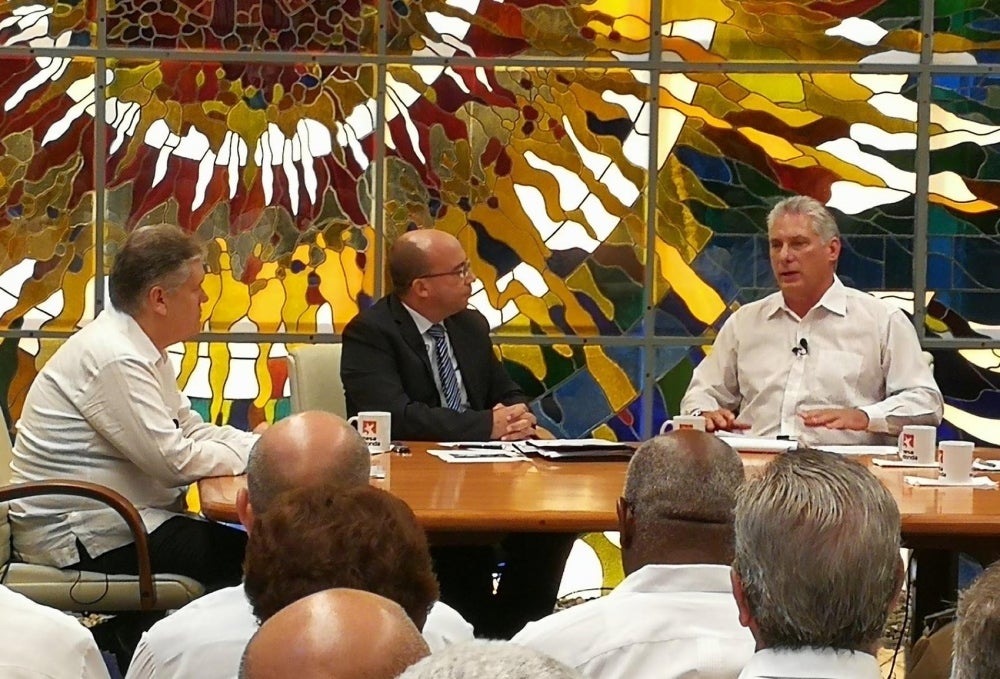
To Live Without a Future: Cuban Migrants’ “Legitimate Fear” / Miriam Celaya

Cuban migrants in Ciudad Juárez. File photo.

Cubanet, Miriam Celaya, West Palm Beach, 16 July 2019 — Just five years ago, when the governments of the United States and Cuba reestablished diplomatic relations after 18 months of secret talks, there were ominous voices that predicted the end of the privileges for Cuban immigrants to the northern country.

According to this gloomy forecast, an accelerated increase in the number of nationals leaving the Island, both by sea and by land, began to take place. The continental exodus has not stopped even with the end of the policy of “wet foot/dry foot”, when – rumors turning into reality – the then outgoing president, Barack Obama, announced its immediate repeal on 12 January 2017.

Meanwhile, the incoming president not only did not restore that migratory privilege, but rather reinforced the obstacles. In fact, during the current administration, there was a cessation of consular functions in the US embassy in Havana, which makes it difficult to carry out the corresponding procedures. Added to this is the significant decrease in the number of visas granted in the last three years, the recent elimination of the multi-entry visa, valid for five years, and the marked slowing down of family reunification processes. continue reading

But the problems do not stop there. In recent times the avalanche of asylum seekers in the US southern border, mostly from Central America, exceeds the response capacities of the US authorities and prevents both the processing of the requests and the assimilation and adequate attention at the border posts destined to the temporary reception of migrants.

Thus, in an attempt to overcome the crisis, this Monday, July 15th, the official US Department of Homeland Security website has published a new regulation for asylum seekers, which will go into effect on Tuesday, the 16th of this month. The new regulation does not make a distinction among national origins in its text and, consequently, it could potentially also apply to Cuban immigrants.

“A foreigner who enters or intends to enter the US through the southern border without having sought protection in a third country outside of their countries of citizenship, national origin or of his last customary legal residence, who has been en route to the United States, is not suitable for asylum,” reads the rule that casts another shadow of uncertainty on the future of island migrants, especially those who cannot justify a “legitimate fear of being persecuted” or who generally avoid seeking protection in transit countries , either for fear of being deported to Cuba or to avoid the usual extortion from a large number of corrupt officials.

Meanwhile, the Trump administration continues to weave containment strategies against illegal migration and seek agreements with the countries of origin or transit in order to contain the disorderly exodus to the US border. Nor is it known to what extent the Cuban-American exile community can influence (or be willing to do so) in favor of the current Cuban migration. There are sectors that – understandably – distance themselves from the new waves of migrants. At the border, these sectors declare themselves to be “politically persecuted”, and once they get the coveted green card, they return to visit the Island as economic emigrants.

It is early for the lapidary assertions, but all signs tend to spread alarm among the most suspicious hopefuls to reach the American dream, awakening fears about the eventual disappearance of the Cuban Adjustment Act, in force since 1966, the last remaining prerogative for Cubans that allows them to legalize their immigration status and apply for the permanent resident card one year after their entry into the United States.

For the time being, far from slowing down the migratory flow from the Island, each new obstacle seems rather an incentive to escape as soon as possible to any point in the hemisphere, preferably in the northern direction. Because, what is unquestionable is that the only true and legitimate fear of the tens of thousands of Cubans who emigrate each year, is to have to live and die in a country where they feel condemned not to have present or future.

(Miriam Celaya, resident in Cuba, is visiting the United States)

Translated by Norma Whiting