Obama’s Hopes Focused On Meeting “With Cuban Civil Society” / 14ymedio

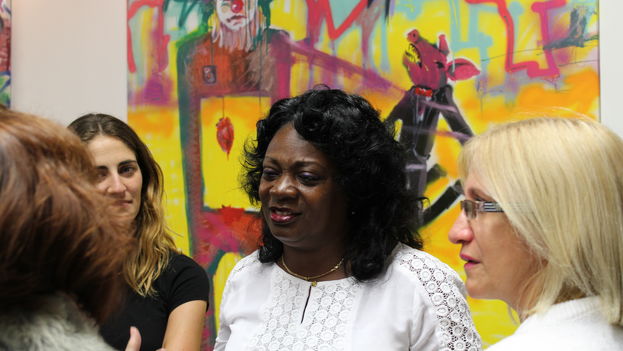
Berta Soler, leader of the Ladies in White, during El Sexto’s art exhibition in Miami, Florida. (14ymedio)

14ymedio, Havana, 13 March 2016 — The Ladies in White Movement has made public this Sunday the letter sent to them by Barack Obama through his advisor Ben Rhodes, during a meeting with representatives from civil society and the exile that took place on Friday in Miami. In the letter, the president emphasized that “the United States will always stand for human rights,” and said that he is looking forward to his meeting “with civil society” during his stay in Cuba.

The president thanked the Human Rights organization for “taking the time” to write. In a previous letter, signed by the movement’s leader Berta Soler, the women expressed their concern for “38 consecutive Sundays” on which they have been “repressed by the Department of State Security,” at the end of their peregrinations along 5th Avenue in Havana. continue reading

Obama said his administration takes “seriously the concerns you have raised about human rights in Cuba” and said he plans “to raise these issues directly with President Castro.”

“After 50 years of trying an isolation approach that simply did not work, I believe we can do more to support the Cuban people,” the president reiterated. The United States believes that “no one, in Cuba or anywhere else, should face harassment, arrests, or physical assault simply because they are exercising the universal right to have their voices heard.”

The US President also said that the Ladies in White “are an inspiration to human rights movements around the world.”

This Saturday, Soler told that press that she was concerned “because President Obama said he would only come to Cuba if he saw progress on human rights, something that has not happened.” The activist also wished the president to meet with opponents to learn about the repression firsthand.

The president’s visit has deepened the differences among the internal Cuban dissidence, divided between those activists seeking to leverage the new context with the United States to promote changes, and others who see any dialogue with the Cuban government as a way of giving legitimacy to the regime.

Another Myth In Cuba-U.S. Relations / 14ymedio, Regina Coyula

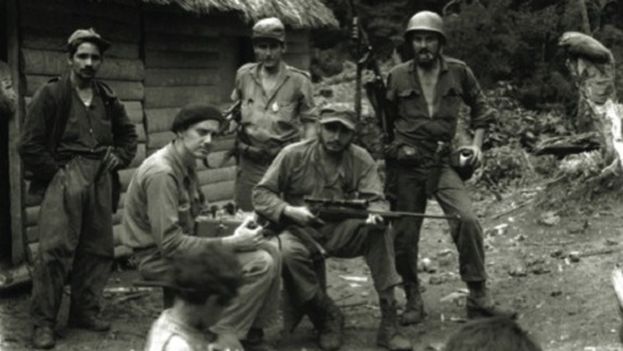
Fidel Castro (2nd from R.) in the Sierra Maestra (CC)

14ymedio bigger14ymedio, Regina Coyula, Havana, 8 March 2016 — “It was the Revolutionary government in Cuba that pushed the situation to the rupture of diplomatic relations in January 1961.”

It is well known that Herbert Matthews’ interview of Fidel Castro in the Sierra Maestra, shortly after the landing of the yacht Granma, favorably predisposed American public opinion towards the personality of the guerrilla leader and the objectives of his struggle, which had been detailed in the document “History Will Absolve Me.”

However, in the months following the triumph of the Revolution, the summary trials and executions of numerous collaborators of the overthrown Batista regime served to tarnish in this good impression. It was not possible to overlook the judgment annulled in a public speech by Fidel Castro – an attorney well acquainted the procedures – of the aviators in Santiago de Cuba in February, which ended with the suicide of Felix Pena, commander of the Rebel Army and president of the court that absolved them. continue reading

A revolutionary movement recently installed in power, in a small and underdeveloped country, needed international sympathy to pave the diplomatic path. Matthews created the conditions to organize a trip for Fidel Castro to the United States. The Cuban leader visited the country in April 1959, at the invitation of the American Society of Newspaper Editors, thanks also to the mediation of the journalist Jules Dubois.

The revolutionary government had been recognized by the United States, but by the date of the trip the executions were figuring prominently; in fact, a reading of Fidel Castro’s speeches at Princeton, Central Park in New York, and the Hilton Hotel in Washington, suggest the effort to leave the hearer (and public opinion) the impression of a humanist, familiar with bourgeois values, and one who would accommodate a political correction acceptable to American citizens.

Eisenhower rejected a personal meeting with Castro, to establish distance and because Fidel Castro was a political conundrum. Allen Dulles’s intelligence agencies could not help but observe that in the security bodies recently created by the rebels, members of the Communist Party were invited to participate; the same Party that followed directions from Moscow not to join the anti-Batista guerrillas.

But as historian Ramirez Cañedo has confirmed, what was happening in Cuba was calculated, and affinities increasingly outlined with the Soviet Union did not arouse optimism in Washington. In terms of bipolarity and the Cold War, of course, the turn of events in Cuba must have been of great concern to the anti-communist Eisenhower and his government. Anti-communism was the natural state of the immense majority of the politicians on Capitol Hill, who had accepted with relief a nationalist government in Cuba, but one as far from Moscow as they themselves were.

“…the nationalization of U.S. properties in 1959 and 1960 was not a deliberate provocation by Cuba to seek a break in relations with the United States, but a necessity of the Revolution, planned by Fidel since 1953, in his famous plea of self-defense before the courts of the Batista tyranny, “History Will Absolve Me,” and foreseen in the 1940 Constitution.” [Source]

This is an interpretation. While giving land to the peasants was an aspiration of the 1940 Constitution and was contained in the well-known plea “History Will Absolve Me,” the measure had a scope much greater than an act of justice for tenants and sharecroppers. The lands given to individual farmers and to the cooperatives created by the National Institute of Agrarian Reform (INRA) were expropriated; but on expropriating every extension exceeding 400 hectares, most of the land remained in the hands of the state through INRA.

A considerable number of farmers benefited, receiving land that was of good quality and, in many cases, idle. The large landholdings that were productive remained in state hands under the name of People ‘s Farms, a name, by the way, that disappeared from the official vocabulary many years ago.

With respect to compensation, the environment did not favor a difficult collaboration with those affected, who could not understand how the leader of the Revolution spoke of slander when he was accused of being a communist, while meanwhile he was dynamiting the pillar of private property and enjoying vodka and caviar, according to the correspondent from the Soviet news agency Tass, the future ambassador of the USSR in Cuba.

Investments of the other countries affected by nationalizations did not reach a third of that of the United States, so it was relatively easy to reach agreements on compensation. The Revolutionary government offered to pay with 20-year bonds with 4.5% annual interest. However, the U.S. companies were demanding cash, which the Cuban government didn’t have, and as their bank reserve was depleted and they were not willing to divert money “to pay the landowners.”

The popular phrase “everything is in the eye of the beholder” serves well with regards to this long dispute. Combing through this skein of secrets, tangles, polarized testimonies and all the elements needed to approach the truth seems a task more suited to the historians of the future, although approximations are always welcome.

‘Moviecide’ in Havana

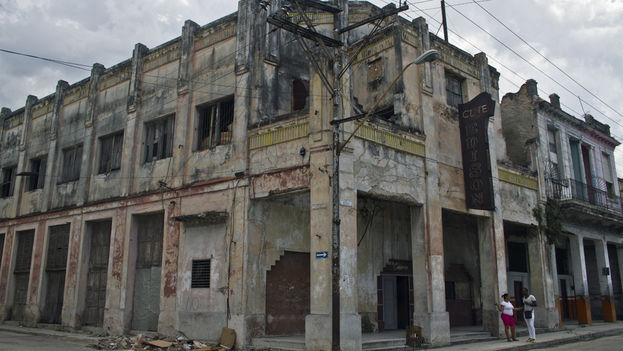
Edison Movie House, converted to apartments and now in danger of collapse. (14ymedio)

14ymedio bigger14ymedio, Miriam Celaya, Havana, 11 March 2016 — In its primetime broadcast on Tuesday, The Cuban Television National News (NTV) released a report by journalist Milenys Torres about what were once called “neighborhood theaters,” most of which are entirely shut down or intended for other “social functions.”

With that deviousness that characterizes official journalism and allows reporters to skirt the periphery of the information without committing to the causes or the solutions, Torres briefly interviewed several locals and showed pictures of some of the theaters that once proliferated in the Cuban capital. Since the latter part of the 20th century, they have been closed and have been turning into unsanitary landfills that are infecting neighborhoods and creating sources for disease. continue reading

Rats, cockroaches and other vermin swarm among sewage leaks and all kinds of filth in places where we Havana citizens used to enjoy an occasional movie, a wholesome entertainment that was cheap and accessible in our own neighborhoods.

No movie theatre management, regardless of the causes, was able to decide, unilaterally and without consultation, on closing down the theaters and throwing away the key

During the Republican era, the great American influence made us avid movie buffs, and we were used to “keeping up” with all film production, not only from Hollywood, but also from Europe and Latin America. From then until the 1980s, the general public in Cuba had the same access to a first-run American movie, a Mexican drama or a French comedy, while the most demanding would enjoy New Wave, Swedish or German movies, among other treats. Of course, Soviet and other Eastern European cinematography also had its glory days in Havana movie theatres.

Although many times, and over a long period, the independent press has dealt very critically with the issue of vanishing Havana movie houses, the recent NTV report tries to present it as a priority of the official press and as if the event had taken place only yesterday and not three decades ago.

Milenys Torres introduces the news almost candidly from the landfill that the old Duplex and Rex Cinemas have become, in the midst of a boulevard in Centro Habana, using an ambiguous phrase that diffuses responsibility in a vacuum: “It is said that it all began when the air conditioning broke down and the movie house was closed.”

But it so happens that all Cuban movie houses have been state-owned since the Revolutionary government nationalized them, also monopolizing film production. No movie theatre management, regardless of the causes, was able to decide unilaterally and without consultation, on closing down the theaters and throwing away the key. Neither should the responsibility be shunned by the Comunales (the local People’s Power organizations), municipal political management entities, and instances of Public Health – all of them State-run institutions – for the loss of those cultural places and the steady accumulation of all kinds of refuse that affect not only the physical aspect but the health of such a densely populated environment.

Making an incomplete list of some neighborhood movie theaters that have been closed, just in the municipalities of Habana Vieja and Centro Habana, the list speaks volumes.

Spirituality and culture did not put food on the tables of a population uniformed in poverty

Besides the movie theatres mentioned above, the following movie theatres no longer exist in Centro Habana: The Majestic and The Verdún (Consulado Street), and The Neptune and Rialto cinemas (street of the same name), The Caprí – later renamed Mégano – and the The Campoamor (corner of Industria and San José, the last one in ruins). The Cuba and The Reina (Reina Street), this last one being used by a dance group, The Jigüe and The América (Galiano Street), currently used for musical shows, The Pionero (San Lázaro Street), The Findlay (Zanja Street), and The Favorito, the current headquarters for another dance group.

The moviecide is repeated In Old Havana, although this municipality never had the large number of theatres that Centro Habana had. Movie houses Guise, Negrete and Fausto (Prado Street) disappeared, as did The Ideal (Compostela Street). The Actualidades (Monserrate Street) remains in operation, but is markedly deteriorated, while The Universal (Bernaza Street) is a ruin converted into a parking lot, and The Habana (Mercaderes Street, Plaza Vieja) was rescued and converted into a Planetarium by intervention of the Office of the City Historian.

While new technologies have brought to households the opportunity to enjoy movies at home, in the rest of the world they have contributed to the closure of old, big theaters which have been transformed into smaller spaces to accommodate fewer spectators. The initial causes of the closure of Cuban cinemas run counter to technological developments, although multiplying the offerings.

The deep unprecedented economic crisis that followed the collapse of socialism and the sharp drop to a situation of survival took precedence over cultural and recreational matters. All of Cuba, and especially the capital, were overwhelmed by emergencies such as food, health and material shortages of all kinds. Spirituality and culture did not put food on the tables of a population uniformed in poverty.

On the other hand, political power began to be questioned in homes and even in public spaces, whether in a covert way, as in the isolated outbreaks of public discontent. Many of these outbreaks occurred precisely in cultural places. On one occasion, when images of Fidel Castro appeared in newsreels, viewers broke out chanting a popular hit song – just released in a Cuban rock-opera – whose lyrics repeated in crescendo “That man is crrrazzzy!” The movie house ended up being emptied by police, though there were no arrests, and no subsequent showings of the newsreel were aired.

The theaters were centers of potential disorder and anti-government political expressions

The authorities thus found out that movie theatres – being public places, where the public congregated and were protected by the anonymity of darkness – were potential centers for disorder and anti-government political expressions, which could easily get out of official control, so they stationed plain-clothes State Security and uniformed police agents in all movie houses.

Deliberately, as the cinemas were deteriorating, they were closed “for repairs” that never took place, until the theatres were sacrificed on the altar of ideology.

Years later, when a handful of private entrepreneurs started up small theaters, they were quickly forced to shut down by the authorities. The State was not able to meet the demands of Cuban moviegoers, but it would not allow public movie transmission out of its exclusive control: nothing could escape the Revolution’s rigid sieve of cultural policy arranged in 1961 by its supreme leader.

Currently, a few State projection rooms have been renovated and adapted to new trends. These are, for example, The Multicine Infanta in Centro Habana; or The Fresa y Chocolate Theatre in the heart of El Vedado. Yet the feverish movie-goer activity that developed in the shadow of the lavish theaters of Havana seems to have disappeared forever. Only, unlike countries where new technologies have brought the glamour of movie viewing to domestic spaces, Miledys Torres’ report is hypocritical and inopportune, when she questions the calamitous state of this or that movie house.

The official journalist seems to be asking naively: “Who shut down the movie houses?” She might find the answer parodying playwright Lope de Vega, but inversely. Because, in this Cuban movie-buff drama we are not only before the consecration of abuse of power, but the culprit was not Fuenteovejuna*, but precisely the Commendador.

*Translator’s note:Fuenteovejuna is a Lope de Vega 1614 comedy of the genre “Comendador” depicting conflict between villains and noblemen, abuse of power and finger-pointing.

Translated by Norma Whiting
Gorki Aguila Detained and Interrogated Returning To Cuba From US / 14ymedio

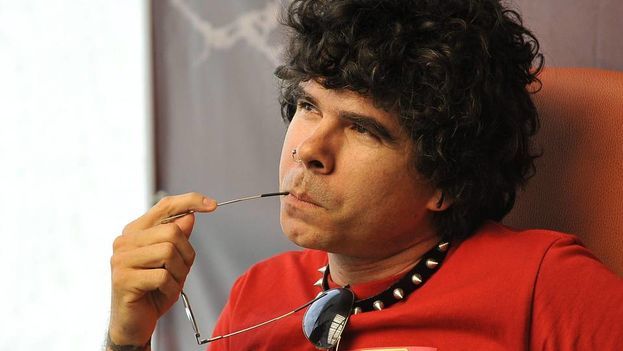
Musician Gorki Aguila (Photo EFE)

14ymedio bigger14ymedio, Havana, 11 March 2016 — Gorki Águila, a musician with the band Porno Para Ricardo, has denounced that he was detained and questioned Thursday at Jose Marti airport in Havana, on his arrival from the United States.

Speaking to 14ymedio, Aguila said that the State Security agents who interrogated him initially presented themselves as immigration officers, and were even wearing those uniforms, but when he told them they were from the political police they put him in a room where he was threatened, telling him, “If you up the ante, we’re going to raise it higher still.” continue reading

Aguila said that, after the interrogation, on collecting his suitcases, he found that his luggage had been searched. “They read it item by item, inspecting every piece and they really concentrated on anything with writing, like T-shirts with the group’s logo. They took photos of everything, placing a sign with a number next to every item.”

“They detained me and threatened me in every way they know how. They did an exhaustive search, very exhaustive at Customs,” said the musician, in a phone interview with Radio Marti News.

Aguila, a regime opponent as well as an artist, was held for 4 or 5 hours and T-shirts were messages such as “Todos Marchamos” (We All March) and “Boitel and Zapata Tamayo, assassinated by Castro” were confiscated.

“State Security asked me if I had plans to go and see the Rolling Stones,” Gorki added. The rocker accused the authorities of having threatened his daughter and with not being allowed to travel any more.

When the musician was asked why he thought this situation happened, he replied, “They are very concerned with President Obama’s visit to Cuba. They want to try to show a peaceful country, they want to put on a show, a circus with happy and contented people.”

The activist Lia Villares, who arrived on a later flight, also was detained for nearly three hours at airport customs, her luggage and carefully checked and several CDs of the group Porno Para Ricardo were confiscated, along with T-shirts with slogans such as “Down with you know who.”

Martí News reports that several opponents claim Villares is continuing to be held.

Americans and March 10, 1952 / 14ymedio, Gabriel Barrenechea Jose

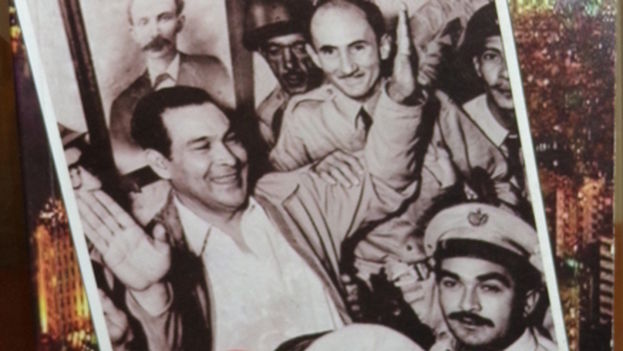
Fragment of the cover of the book 'Batista, The Coup’ by Jose Luis Padron and Luis Adrian Betancourt.
Fragment of the cover of the book ‘Batista, The Coup’ by Jose Luis Padron and Luis Adrian Betancourt.

14ymedio bigger14ymedio, Jose Gabriel Barrenechea, Santa Clara, 10 March 2016 — In the early hours of Monday 10 March 1952, a coup closed the democratic cycle in Cuba, open since the Constituent Assembly of 1940 which has begun with the Protest of the Thirteen and the university reform movement captained by Julio Antonio Mella.

Despite what Fidel Castro and his less serious historiographical followers have stated so many times, in no way can the responsibility for the coup be placed on the Americans or specifically on their secret agencies, the CIA and the FBI. As has been recognized even by a long series of Cuban historians publishing on the island since the 1959 Revolution.

Among them is Newton Briones, who, in his semi-fictional “The General Returns,” describes step-by-step the process of preparation for the coup. From the Orthodox party dalliances of its promoters led by Captain Garcia Tuñón, to inspiration from a professor at the Army War College, Garcia Barcena, until the final links with Fulgencio Batista. continue reading

Even in the highly biased The Cry of Moncada, by Mario Mencia, a complete representation of Castro-regime historiography, we find nothing to support the official version according to which the Americans inspired and even led the coup; it only manages to draw on an alleged “approval by omission” by the Embassy, having not warned President Carlos Prio.

According to the author, not only did the members of the US military mission know what was being cooked up in Columbia and Kuquine, the well-known hacienda of the “Mulato Lindo” – as Batista was called – but so did almost all of Havana and even the country. If no one took this stew seriously, it is due to the circumstances of that time in Cuba, where almost all shared the same blind confidence in the solidity of democracy.

At the end of February, in the face of the warning from the Venezuelan Romulo Gallegos – fired three years earlier – of what was afoot, someone as sharp as Raul Roa responded with absolute certainty that something like this had no place in the Cuba of 1952.

The latest example is Batista, the Coup, by two historians closely linked to State Security, Jose Luis Padron and Luis Adrian Betancourt. The central thesis of this book is that in essence there is nothing to prove American inspiration behind the barracks coup, and that, on the contrary, everything seems to demonstrate that the coup was not very well received by most of the institutions of the United States.

This work admits that it was not the United States that was among the first to offer de facto recognition to the regime, but rather among the last, at least in the Americas. It goes on to detail, based on abundant declassified documentation from the US State Department, the tense process of recognition and the subsequent chill that the American embassy in Havana maintained for months toward the de facto regime. The authors do not fail to clarify that the motives for it were the well-known links between Batista and the Cuban communists, who generated great suspicion in the circles of American power.

We can affirm that this lack of a link is no longer based only on the opinions of the intellectual authority, but on simple and plain common sense. Still, through covert operations, during the dawn of the Cold War, Americans have only intervened where it was clear, or at least highly possible, that the advance of the Communists, or any political force which by its nature had some chance of allying itself to the USSR (this breach of tolerance was what allowed the consolidation of the Fidel regime soon afterwards). This kind of situation could not have been further from that of the Cuba of the late forties and beginning of the fifties.

The Communist Party, the PSP, had seen how the masses withdrew their already low support historically during the democratic period. If in the 1948 elections they got 142,972 votes, less than 6% of the total, in the reorganization of the parties in November of 1949 and 1952 it fell respectively to 126,542 and 59,000. This last figure was just a few thousand votes from the 2% required in the Constitution to legalize a political party, and, therefore, its electoral demise.

Moreover, to pretend that the Americans promoted the coup to stop the certain victory of the Orthodox party is complete nonsense. Would the Yankees have feared the party of Chibás, which was entirely in the hands of the most implacable and popular enemy of communism in Cuba? Not to mention, the only Cuban politician of the first-rank who opposed the leftist government of Juan Jose Arevalo in Guatemala or who sent a parliamentary commission to investigate the violation of human rights during the uprising of independence supporters in Puerto Rico in 1950… that is, the Cuban politician of the first rank least likely to upset Washington.

It is not very well understand how it served the foreign policy of the United States to get rid of what was then its democratic showcase in the Southern Hemisphere. It was an alliance that played an extremely important role in the defense mechanisms of the hemisphere, in a moment of incomparable popular approval in Latin America, and in which there was seen no immediate possibility of marked retreat.

On the contrary, there is abundant evidence of the American displeasure with the coup, and the supposed complacency of the military attaché in Havana suggested by Batista, the Coup is highly doubtful. In the post-coup report the barracks attack was called a danger for American interests on the continent, which leads us to interpret differently the efforts of those officers to convince many military of the academy and great technical capacity to remain in the Constitutional Army. The American military in reality did not try to strengthen the Batista regime, but rather to leave a door open for the return of institutional democracy without the need for a popular insurrections, that is, thanks to a future civilian-supported military coup.

With regards to the Americans finally giving recognition to the de facto Batista government, its doing so more than two weeks after it had usurped the Presidential Palace, and when all of Latin America had already done so, was the best possible attitude for the continuity of Cuban political independence.

Calmly analyzing the last 64 years, we understand that the U.S. Department of State ended up adopting the recognition promoted by the Democratic administrations since 1933, very knowledgeable about our susceptibility on the subject, such that we could not accuse them of interfering with their enormous force of gravity in the seriousness of our internal issues. The lack of support from the United States is clearly what got Batista to leave power in less than six months, as was well-known by many Cuban politicians of that time, but in turn it profoundly discredited our independence, or at least our capacity to manage our own sovereignty with a minimum of responsibility.

It is here where the inextricable relationship between our two nations becomes transparent: having denied recognition, having demanded the immediate return of the previous government, in the face of a situation that after almost three weeks did not seem to result in civic rejection by Cuban citizens, the United States would in consequence become the de facto guarantor of our democracy and real sovereignty.

From that moment, our authorities could be elected in the most free and democratic way, but at the end of the day their remaining in their jobs would depend on the will of the United States to maintain them in the face of our own authoritarian and anti-democratic forces. This would have ultimately led us into a quasi-similar position to the years of the Protectorate, or an even worse one.

It is worth remembering that the alleged control over Cuban society of the institutions of American intelligence is belied by events occurring after the 1952 coup, as it failed to discover the massive conspiratorial movements of Fidel Castro, who came to gather more than one thousand men who trained for months around the University of Havana.

Obama Advisor Ben Rhodes Meets With Cuban Activists In Miami, During A “Historic” Meeting / 14ymedio, Marion Penton

 President Barack Obama’s key advisor on Cuba policy, Ben Rhodes, during his meeting with representatives of civil society on the island. (14ymedio)
President Barack Obama’s key advisor on Cuba policy, Ben Rhodes, during his meeting with representatives of civil society on the island. (14ymedio)

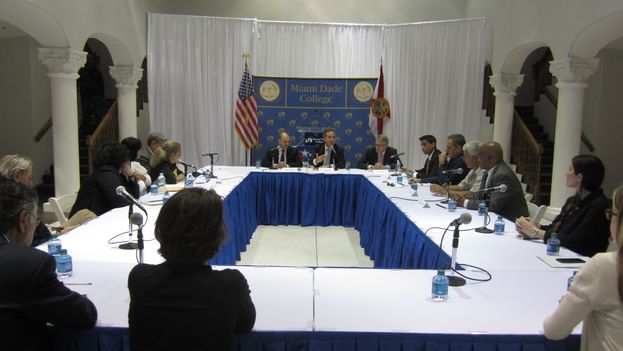
14ymedio bigger14ymedio, Mario Penton, Miami, 11 March 2016 – President Obama’s top advisor on US policy toward Cuba, Ben Rhodes, met this Friday with representatives from the island’s Civil Society and exile organizations. The meeting took place in Miami, concluding with a chat with Cuban-Americans that the official held at Miami Dade College.

The purpose of the meeting, which lasted several hours behind closed doors, was for Rhodes to listen to the aspirations and opinions of those groups in advance of President Obama’s visit to the island. Several of those attending agreed that the meeting was an “historic moment.” continue reading

Remberto Perez, vice president of the Cuban National Foundation (CANF) in New Jersey, explained that everyone expressed their points of view regarding the national reality before the US president’s visit. “It is a unique and extraordinary opportunity. The fact that we are doing this is a sign that the work of the internal and exiled dissidence has borne fruit,” he said.

Opposition member Martha Beatriz Roque, a member of the Black Spring’s Group of 75, confirmed that she will not meet with the US president, as speculated in some media. “It is not necessary that Obama receive me because I have been able to express my concerns to Ben Rhodes,” and she added, “I am super satisfied with this meeting,” said the dissident, who will not be on the island during the president’s visit because she is going to be traveling to Spain.

Leticia Ramos, a representative of the Ladies in White from Matanzas province, announced that Obama sent a letter to the organization and expressed his desire to meet with them in Havana. “So far we have high expectations and the president has informed us that he wants to meet with us,” said Ramos. Although she said they are “facing an uncertainty” because “the regime is going to prevent it at all costs” and “the arbitrary arrests will be massive to avoid this meeting.”

The Ladies in White have let Rhodes know that the visit should be directed “truly by the Cuban people” and he should try to ensure that “his speech reaches ordinary Cubans.” Initially, the position of the Ladies in White had been very critical of Obama’s visit to the island. With regards to the letter sent by the president, no details are available because “it was sent sealed” to Berta Soler, the representative of the organization.

The youngest activist at the meeting, Carlos Amel Oliva Torres, national coordinator of the Youth Front of the Patriotic Union of Cuban (UNPACU), told this newspaper that “the meeting surprised all of us in the most positive way,” because “we thought we would be coming to explain to Obama’s advisor the reality of the Cuban people, but to our surprise he knows it very well.”

Oliva Torres agrees with the rest of those present that it was an “historic” meeting and, in his opinion, “there was very good communication, great harmony between our approaches and his responses.”

“We are all demanding the same thing: we want the American president to go to Cuba and direct his discourse to the people of Cuba, not to the government,” said the UNPACU member.

The meeting was moderated by Jorge Mas Santos, president of the CANF, who praised the attitude of “these brave men and women (…) who keep alive the flame of hope on the island.” The Cuban-American extended his appreciation to the White House and stressed that meetings like this show that “beyond the Straits of Florida that separate us, we are one people.”

Mas Santos said that “President Obama’s advisor was able to listen to you directly, your dreams, your aspirations, the totalitarian nature of a regime that has oppressed our island for more than five decades, and through your suggested this liberating message can reach the mouth of President Obama on his visit to Cuba.”

The Mosquito and the Democratization of the Cuban Political System / 14ymedio, Pedro Campos

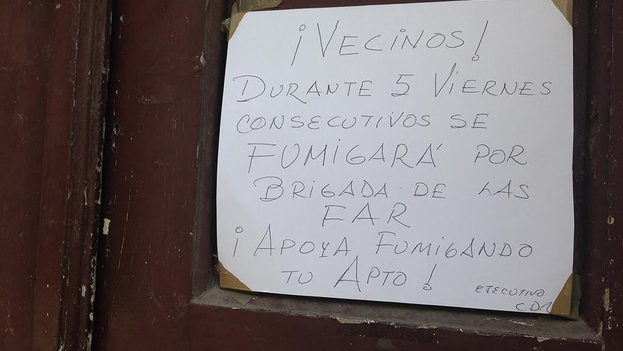
Sign warning of fumigation. “Neighbors! For 5 consecutive Fridays the FAR (Revolutionary Armed Forces) Brigade will be fumigating. Help fuigate your apartment! CDR (Committee for the Defense of the Revolution) Executive (14ymedio)
Sign warning of fumigation. “Neighbors! For 5 consecutive Fridays the FAR (Revolutionary Armed Forces) Brigade will be fumigating. Help fumigate your apartment! CDR (Committee for the Defense of the Revolution) Executive (14ymedio)

14ymedio bigger14ymedio, Pedro Campos, Havana, 10 March 2016 – You don’t have to be a doctor or an epidemiologist to realize that mosquitoes are not defeated by occasional fumigation battles and the collection of debris and trash, much less with military interventions that both kill mosquitos and violate basic human rights “because nobody can prevent the fumigation.”

Threats of the use of violence against people are a part of the military campaign against the mosquito: “If you aren’t there when we come to fumigate, we break down the door,” “You have to leave the key with a neighbor,” “If we can’t fumigate we will fine you,” “They will go to court,” “Stop going to work to be able to fumigate”… The armed forces majors themselves leading the campaign have acknowledged some of the blunders. continue reading

All this has come out in one way or another in the official press, in citizens’ complaints. The soldiers are trying to carry out what has been put in their hands with the methods of command and control, but that does not solve social, political, economic and health problems.

Behind the mosquito is a serious health problem, which the state that prides itself on having the best public health system in the world does not find it convenient to recognize.

Health is not only having doctors, hospitals and the ability to offer medical care. The basic problem resides in the general sanitary conditions where people live. And this is not resolved by military campaigns against the mosquito.

Traditionally, the state campaigns, both by the Ministry of Health (MINSAT) and the Army, are concentrated on homes. But the most serious and largest breeding areas are in the piles of trash, the lack of hygiene due to lack of running water, and above all that the countless leaks in the clean water pipes and the sewers that flood the streets, potholes, drains and vacant lots and whatever pit they find on their way, are not solved with some campaign, just like agricultural production isn’t increased by harangues, but by engaging those directly affected.

Everything is always directed from above, where the municipalities and the communities are “objects” of the campaign, not active “subjects” in them. The reason has to do with the current political system, which concentrates power at the central level, it does not provide space for citizens’ democratic participation and ignores self-government and the autonomy of the municipalities. The bureaucracy flees, like the devil, from self-management.

The mosquito’s defeat would be permanently guaranteed if the municipalities could have adequate budgets to systematically address the problems of health as part of a systemic work, not from a ministry or a campaign, but from the the Municipal People’s Power with full financial autonomy to confront the task and the local social mobilization.

That implies a change of conception about the current state. We should democratize it, decentralize everything related to the creation, discussion, approval and control of the budget and also income. Where should the taxes from the tourism companies in Varadero go? To the municipality, the province of Matanzas and finally the State or the Armed Forces?

The municipal mayors and provincial governors should be directly elected by secret ballot to respond to the interests of those who voted for them and not those who appointed them from above.

Those who prevent this being possible are those who do not want to “change everything that should be changed*.”

The persistence of the Aedes aegypti mosquito, despite all the permanent and temporary campaigns and the MINSAP campaign, and now the FAR’s campaign, is a demonstration of the failure of the concentration of power on the part of the populist paternalist state and “state socialism.”

*Translator’s note: A slogan of the Revolution in Cuba.

Campaign #Otro18 Holds First Forum in Cuba / 14ymedio

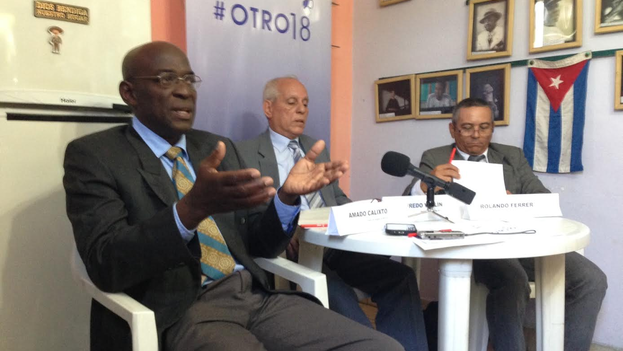
The lawyers Amado Calixto, Wilfredo Vallin and Rolando Ferrer during the press conference for the #Otro18 campaign. (14ymedio)

14ymedio bigger14ymedio, Havana, 9 March 2016 – On Wednesday, the Civic Platform #Otro18 (Another 2018) held a press conference and its first forum in the Vedado neighborhood of Havana under the theme “For Freedom of Choice” with twenty people in attendance. The initiative promotes several proposals to influence the elections in 2018 for a democratic opening in the country.

Several independent media and foreign correspondents based on the island attended the forum from 9:35 in the morning, to the press conference organized at the home of activist Juan Antonio Madrazo Luna, coordinator of the Citizens Committee for Racial Integration. The activist Boris González Arena presented the initiative and gave the floor to lawyers Amado Calixto, Wilfredo Vallin and Rolando Ferrer, who explained the legal details on which the project is based. continue reading

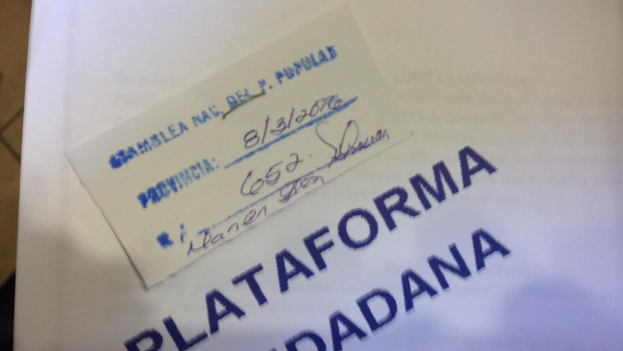
The meeting with journalists went smoothly and without a visible police operation around the site. The managers of the initiative showed a copy of the proposals presented last 8 March in the National Assembly of People’s Power which was received and acknowledged by the authorities.

The organizers explained that, so far, the intiative’s management group is made up of the Patriotic Union of Cuba (UNPACU), Independent and Democratic Cuba (CID), United Antitotalitarian Forum (FANTU), the Roundtable of the Cuban Youth (MDJC), the Progressive Arc Party, the Citizens Committee for Racial Integration, the Center for Support of the Transition, and the Cuban Law Association. The Forum says that it is open to the “incorporation of other civil society organizations and independent actors.”

Among its proposals are: the elimination of current Candidacy Commissions and the Nomination Assemblies (both controlled by the ruling Party); recognition of the right of any citizen to stand as a candidate; and restoration of the election of the president of the Republic by popular vote and secret ballot for a term of four years.

Proposed electoral campaign #Otro18 delivered to the National Assembly of People's Power on 8 March.(14ymedio)
Proposed electoral campaign #Otro18 delivered to the National Assembly of People’s Power on 8 March.(14ymedio)

When asked how they take the accusation made by other sectors of the opposition that the electoral alternative “plays into the hands of the dictatorship,” Amado Calixto suggested reviewing the process of “the Spanish transition, which ended a dictatorship through existing law.” Ferrer, meanwhile, explained that now came a phase of work of building “awareness and popular mobilization to gather support and pressure the government to make the proposed reforms.”

After the press conference, the forum, currently still in session, began with presentations and including Citizenship Revisted: The Plural Vote by Manuel Cuesta Morua; Citizen Mobilization, by Rolando Ferrer; and Election Observation: A Civil Society Monitoring Tool, by Madrazo Luna.

During the day on Tuesday, several dissidents were detained to prevent them attending the #Otro18 Forum. Jose Daniel Ferrer, leader of the Patriotic Union of Cuba, still remains missing after being arrested Tuesday by police in the Cuban capital.

Other members of the opposition were prevented from leaving their province to attend the event, as in the case with Suleidis Perez Velazquez and Pedro Pablo Serafin Reyna, members of Independent and Democratic Cuba.

‘Matryoshkas’ of Exile / 14ymedio, Rosa Pascual

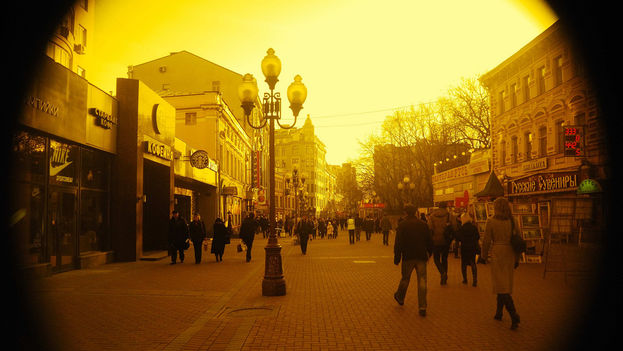
Arbat Street in Moscow. (Flickr)

14ymedio bigger14ymedio, Rosa Pascual, Madrid, 10 March 2016 — Moscow 1989. Mario, a Cuban journalist working in the press department of the secretariat of the Organization for International Economic Cooperation (OCEI) representing the island in the Soviet capital, attends, with his family, the premiere of the play The Master and Margarita, whose main female part is being played by Dolores, his lover. He has spent months rehearsing the part with her, playing at confusing reality and fiction in its portrayal of the main roles of the novel. Bulgakov’s Russian literature satire, censored in the USSR since 1973, borrows shamelessly from Goethe’s Faust to talk about good and evil and the decadence of Russian Society. In the same way, Arbat Alleys, a novel by the Cuban-Swede Antonio Alvarez Gil featuring the character of Mario, exploits The Master and Margarita to recall the strategies of the dictators over artists and their works.

Arbat Alleys (Verbum, 2016) works like Russian matryoshka dolls. Hidden stories of totalitarianism, of lack of freedom and censorship, of love, of literature and exile, one within the other. Mario’s story contains that of Santiago, Dolores’s father, a child of the Spanish civil war who left his country fleeing fascism to live in another; and Santiago’s in turn, contains that of the Stalinist purges of the artists of Russia’s Silver Age. continue reading

Mario is a moderately correct son of the Cuban Revolution in 1989, the year in which Arbat Alleys is set. He studied at Moscow University, he married a Russian, he already has two sons in Cuba and works as a journalist again in Moscow on the day he had to cover a press conference where Nazarov announces a renovation of the organism by the “transformation processes that are being tested in member countries” of the Eastern bloc.

One night in the OCEI building he meets Dolores, with whom he initiates a friendship that leads to passion. It is the young woman who introduces Santiago to Mario, weaving the small and large story of Arbat Alleys, although at times we don’t know which is the greater and which is the lesser.

Santiago Gomez had fled Spain as a child, leaving the side of the vanquished and heading to Moscow, where he grows up and comes into contact with Ariadna – daughter of the retaliated-against Russian poet Marina Tsvetaeva – who appears in the novel as a ghost. Through his literary collaboration – the Spaniard translates Russian literature – is born a deep friendship that lets the young exile know first hand the pain of the vanquished, the repression, and the censorship suffered by artists such as Anna Akhmatova, Boris Pasternak, Isaac Babel, Osip Mandelstam and Vladimir Nabokov. Someday Santiago’s annotations should serve to construct a novel about the drama of silenced Russian authors, so that Stalin’s crimes are not forgotten and the injury to the Soviet Union’s national literature is remembered.

Santiago entrusts his notes to Mario who, from them, writes the novel of the purges of Russian literature. Fascinated by the harshness of history, with his own works censored by Stalin and by Dolores, the journalist embarks on the narration of a story that ends up consuming him.

Mario is not an enthusiastic revolutionary. He is suspicious of the behavior of senior officials, is aware of the shortages that consume the island, and knows that his criticisms of the Cuban government cannot be made in front of anyone. But the regime’s hypervigilance weighs on him, as it does on all Cubans. However, his criticism is lukewarm because he still believes in the many benefits of the Revolution.

But throughout the year – and the novel – the fall of the Soviet bloc passes before his eyes and with it, the principals in which he has been educated crumble. In the historical background of Arbat Alleys is perestroika, the Prague Spring, Solidarity’s victory in Poland, the execution of Ceausescu and the Tiananmen massacre. But the news of drug trafficking in Cuba and, especially, the execution of General Ochoa, cause the final blindfold to fall from his eyes and he begins asking questions.

“Examples like the one I just cited in the cases of Pasternak and Mandelstam are an example of how the arrogant dictator is allowed to humiliate the rebel writer. The laudatory poems, letters of contrition and public acknowledgments of guilt are only the most visible edges of lives and talents that are consumed and disappear in the trough of totalitarian power. Disgracefully, the cultural life of our country has not been exempt from issues of this kind. Although I do not believe it is necessary, I could cite here several cases of humiliating and despotic treatment toward Cuban writers.”

Mario writes this paragraph thinking of Lezama Lima, Reinaldo Arenas and Virgilio Pinera, without being fully aware that as soon as the manuscript falls into the hands of the machinery of power he is immediately classified as a counterrevolutionary.

His friendship with Santiago – whose past as a child of war isn’t enough to relieve him from being suspected by State Security for having visited Spain during the dictatorship – his affair with Dolores, the friendships of his children and even the discussion at customs at Jose Marti Airport in Havana appear in Mario’s seemingly spotless file, making him into a subversive element.

“I am a Cuban who is dying defending that same Revolution that you’re questioning in this book,” charges the State Security official from the Cuban delegation in Moscow. And Mario understands finally that not even his first idea of suppressing the “most problematic” paragraphs will save him. That the only lifeline has been the loyalty of an official who decides to put friendship ahead of the Revolution and the Party. That the only redemption possible is in his family and in the preservation of the original manuscript, which should be published somewhere in the world to denounce the terror to which dictators subject their artists, surely out of fear of the force and power of intellectual creation and its capacity to make others think.

Alvarez Gil has squeezed the maximum from The Master and Margarita as an explicit reference throughout the novel to make his own denunciation almost 75 years since Bulgakov began his master work and his fight for freedom of expression. In 1930 the Russian writer sent a letter to the government of the USSR where he said, “The fight against censorship, of any kind and under any government, is my duty as a writer, much as it is an appeal for freedom of the press. I believe firmly in freedom and even would say that if a writer only suggested that freedom is not necessary, it would be the same as if a fish declared that it did not need water.”

The Cuban-Swedish writer Antonio Alvarez Gil. (Wikicommons)

But Arbat Alleys also contains a lot of the life experience of its author. Antonio Alvarez Gil (born Melena del Sur, Havana, 1947) worked in the secretariat of the Council for Mutual Economic Assistance (COMECON) in Moscow for several years, where he experienced the era of perestroika, he married a Russian, translated the country’s writers – Pushkin among others – and ended up in exile, in 1994 in Sweden, although he has recently lived in Spain. His life and career path have served, without a doubt, for the construction of the character of Mario and to make this novel indispensible for recalling the collapse of the Socialist Bloc and the horror stories of those who cemented its construction. An adroit story that leaves a strangely bitter taste, because Mario flees knowing himself persecuted by a regime 30 years later still controls its citizens and intellectuals, but he does it thinking of a future filled with hope.

  • Arbat Alleys was first published in Puerto Rico by Terranova Publishing (2012). It has just been reissued in Spain by the publisher Verbum.
  • Antonio Alvarez Gil published in Cuba before going into exile. In 1986 he won the Cuban Writers and Artists Union David Award for A Girl on the Platform. With The Long Hours of the Night he was a finalist for the Casa de las Américas Prize in 1993. Outside Cuba he won the International Award for Short Narrative Generation of ’27 in 2005 or XIV Vargas Llosa Prize for Literature in 2005, among others.

The Impossible Reciprocity / 14ymedio, Reinaldo Escobar

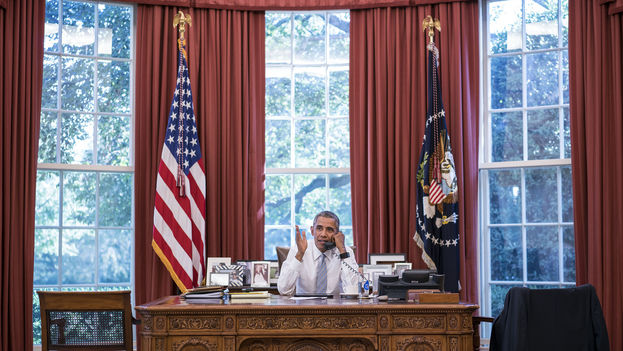
US President Barack Obama talks with his Cuban counterpart Raul Castro. (White House)

14ymedio bigger14ymedio, Reinaldo Escobar, Havana, 10 March 2016 – In the official newspaper Granma’s latest editorial there is a lot of fat to be cut, but in this commentary I will limit myself to what can be defined as a double interpretation of legitimacy.

At the end of the second paragraph of the text it states that “this will be the first time a president of the United States comes to a Cuba that is master of its own sovereignty and with a Revolution in power, led by its historic leadership.”

The nexus between the country’s sovereignty and the prolonged stay in power of the self-styled “historic leadership” already offers enough confusion, but the contradiction becomes greater continue reading

when we get to the last lines of the next paragraph, where it says that the process towards normalization “has barely begun and (…) has advanced over the only possible and just terrain, respect, equality, reciprocity, and the recognition of the legitimacy of our government.”

When it comes time to discuss bilateral issues and long-standing accumulated problems, we will have to listen to the voice of those who took power by force of arms and who maintain, by force, repression, building on the maxim that a revolution is an indisputable source of law. However, to be recognized as legitimate, the mask of “our government” is put on some gentlemen in collars and ties (or an impeccable guayabera) who should have been elected in a democratic process and who should lead the country under the rule of law.

This is not an editorial failure produced from neglect or passion, but a deliberate intention to make President Barack Obama’s visit something more than the turning of a page, something more than a “clean slate.” It is trying to convert it into the acceptance (and, why not, a round of applause?) for events that, like a revolution. typify everything that has happened in Cuba over the last 56 years, which include not only “the undeniable achievements” so often advertised, but also the atrocities, whose simple enumeration would make this text interminable.

If conversations with leaders elected by the people, leaders who have no responsibility for the past, as is the case with Obama – according to what the general-president Raul Castro himself has acknowledged – then one could speak of reciprocity and equal treatment. It is not the same to sit down with those who refuse to apologize for their mistakes as it is to do so with something who does not carry the blame. It is not the same to argue, “We had not choice other than to act this way,” as it is to say, simply, “I wasn’t there, I wasn’t born when that happened.”

The editorial of 9 March deserves other observations with regards to its real intentions, but that would require too much patience from readers.

Activist Sirley Avila Arrives In Miami For Medical Treatment / 14ymedio

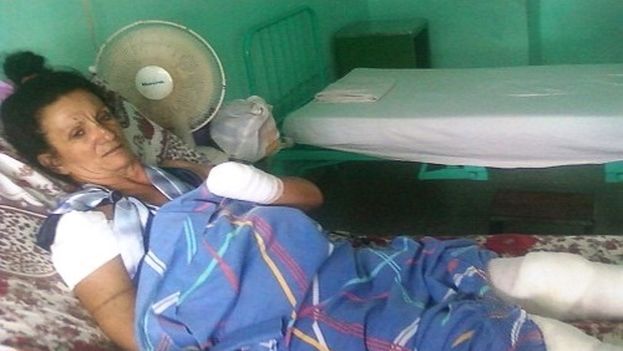
Activist Sirley Avila. (Ernesto Garcia Diaz)

14ymedio bigger14ymedio, Havana, 9 March 2016 — Sirley Avila Leon arrived in Miami on Tuesday for medical treatment and to try to regain her mobility. The activist, 56, was the victim of a brutal assault last May, which has left serious wounds and forced her to use a wheelchair.

The trip has been organized by the Cuban Democratic Directorate in coordination with the Commission of Municipal Women of Miami. The patient will be treated at the Miami Medical Team Foundation, as reported to14ymedio by activist Agustín López Canino.

Sirley Avila became known when, as a delegate to the People’s Power from the village of Limones in the municipality of Colombia, Las Tunas, she staged a protest in 2013 to demand the reopening of a small school in her district that the local authorities had closed because of the small number of students.

Disagreements with the local authorities grew louder and the delegate was sanctioned. From that moment, she strongly denounced the harassment by State Security and collaborated with several opposition groups, including the Patriotic Union of Cuba (UNPACU).

On 24 May 2015, after a discussion with Osmany Carrion, a worker on her farm, Avila was attacked with a machete, which caused her the loss of a hand, a broken collarbone and problems in both legs, among other injuries. After several weeks in the hospital, Avila was discharged in a delicate state.

Girls For Sale / 14ymedio, Pedro Acosta

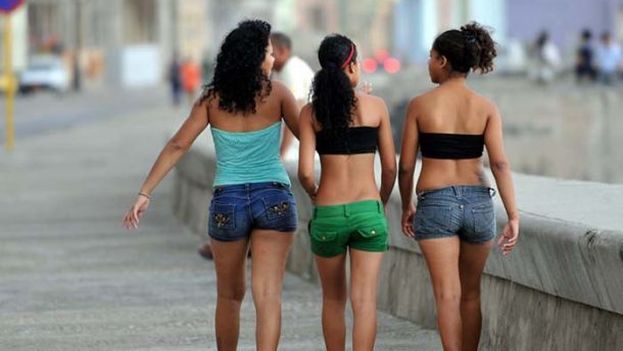
The Cuban government continues to deny the existence of child prostitution in Cuba beyond isolated cases.(EFE)

14ymedio bigger14ymedio, Pedro Acosta, Havana, 9 March 2016 – The teenage girl looks at the display window of CUPET at Santa Catalina and Vento with greedy eyes, a girl hungry for candy. She is tall, thin and fragile. She looks at me and seems to be saying “throw me a rope,” so I buy her a chocolate bar for 1.25 CUC.

Her name is Barbarita, she lives in the Palatino neighborhood and is 14. She opens up after having lied to me when I asked her age when she promised she would “pay me” if I bought her a pair of sandals. No, she’s not 16, let alone 17. She’s been prostituting herself since she was 13 for between two and four CUCs. Her father died when she was three, trying to reach the shores of the United States, and her mother is an alcoholic. She hasn’t studied since she quit elementary school two years ago. From the way she expresses herself it seems unlikely she passed the fourth grade. continue reading

Tonight Barbarita was waiting for Dayana and Lisandra, two friends age 21 and 16 respectively, who soon arrived. The three of them in front of my eyes gave the lie to the official statistics. In a 2013 report, the authorities assured that “cases of prostitution involving minors were minimal” and denied that Cuba is “a destination, transit or source country for human trafficking.”

Dayana and Lisandra are cousins and live in El Cerro where they have been providing sexual services since they were 14. The younger girl is called la Yegua (the mare) and the older Tetris, like the computer game. Dayana has two children to support; their fathers are unknown but she doesn’t give that much importance. “Look, Lisandra knows who the father of hers is, but what good does it do her? She gave birth at 15 and went with him until she was 17 and the wretch hasn’t given her a single CUC.”

La Yegua explained that she couldn’t support her daughter if she didn’t do “this.” “My dad kicked me out of the house and I live with my cousin who charges me even for the water,” she laments.

Dayama maintains a relationship with an 84-year-old Canadian who comes frequently and, according to her friends, since then hasn’t lacked for anything. “Paul has bought me everything,” showing off an iPhone and a Rolex, “but with the money he leaves me I can’t support five people.”

The increase in tourist arrivals has caused a surge in prostitution. Last year the United Nations Committee on the Rights of the Child called on the Cuban government to establish “an archive to analyze and monitor the possible impact of child trafficking with regards to the sale and trafficking of children for sexual purposes and prostitution.”

The committee showed particular concern about the definition of adulthood as age 16, leaving a group of children very vulnerable to sexual abuse and prostitution without legal protection. Last September, the Cuban Justice Minister, Maria Esther Reus González, said in an interview that the country was considering legislative changes including, among other measures, raising the age of criminal responsibility and freedom to marry to 18.

But below age 16, these are still cases of child prostitution. “La Reina (the queen) also works at this and she is only 12 and is ‘an expert’,” says Lisandra.

Three days earlier in the Monoco wifi zone, I had met Leydis, an exhuberant mixed-race girl from the San Peditro neighborhood in Santiago de Cuba. “At 12 I already had this great body. I wanted my mother to give me a little party for my 14th birthday, I was mad for it. And one day, in the middle of the street, I told myself I would go to bed with some foreigner, and I would be yummy and he would give me a lot of dollars,” she said. A week later, she went to bed with an 18-year-old Cuban, the son of a businessman. She got pregnant and was thrown out of the house and went to live with her grandmother. She had just turned 14. Her son is now five and she lives in Santiago with her great-grandmother.

Leydis is embarrassed, but told me her story after a beer. “In Santiago, between my pimp and the police they barely leave me a cent, and I bring in 10 CUC for Cubans and 15 for foreigners. Also, since they’ve already fingerprinted me, they could put me in prison at any moment for ‘dangerousness’*,” she explains.

Her situation brought her to Havana, where she settled in the home of an uncle without a residence permit.** “I wanted to quit with the bad life and go after my little bucks, although not legally, but without bitching and without stealing. And you see, today they fined me 1,500 pesos and they seized from me soaps and tubes of Colgate toothpaste worth 100 CUC.”

When I ask her if she is thinking of selling her products to pay off her debt she tells me that I’m crazy and reminds me that now she is fingerprinted. “What I’m going to do is what I did in Santiago, hit the streets. Here, in the Monaco neighborhood, there are rentals nearby and a lot of people with money. I already met some girls who do it, even from Santiago, and they tell me that so far the police don’t pick you up for that.”

In 2014, the Interior Ministry said in a report that most crimes of sexual abuse of minors occur “domestically” because in Cuba there are no “criminal networks” engaged in trafficking or child abuse. This was the response to a United Nations report which placed Cuba among the countries with the most cases of sexual exploitation of children in the world – along with Argentina, Brazil, Sri Lanka and Chile – while the authorities continue to close their eyes to the evidence.

Translator’s notes:
*Prostitution is not a crime in Cuba but “pre-criminal dangerousness” is and carries a sentence of 1 to 4 years.
**Cubans non-native to Havana require a residence permit to live in the capital city.

The New Defeats Of ‘Che’ / 14ymedio

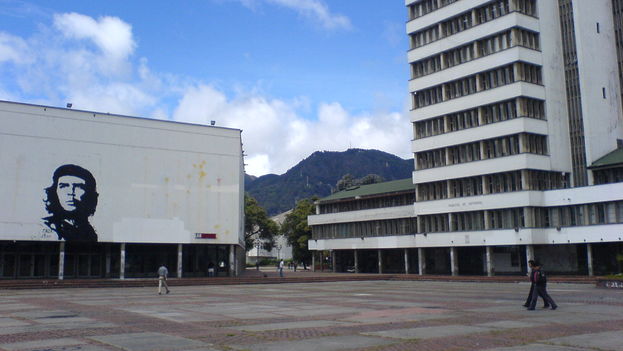
The face of Ernesto 'Che' Guevara in the central square of the ogota headquarters of the National University of Colombia. (Wikicommons)
The face of Ernesto ‘Che’ Guevara in the central square of the Bogota headquarters of the National University of Colombia. (Wikicommons)

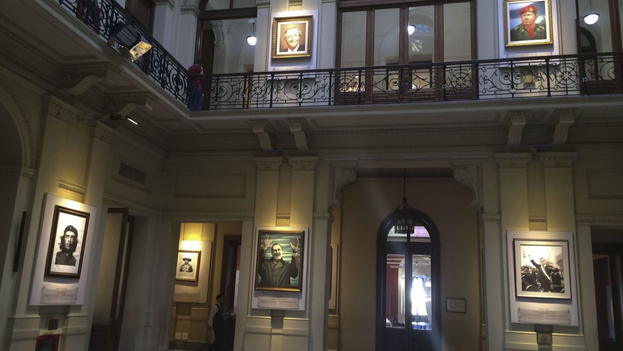
14ymedio bigger14ymedio, Havana, 8 March 2016 — The face of the Argentine guerrilla is awaiting two expulsions, one unilateral and the other by democratic vote. In his reorganization of Casa Rosada, the government of Argentine president Mauricio Macri will eliminate all the paintings in the Hall of Latin American Patriots and the gallery of popular idols, which means the removal of the portrait of Ernesto ‘Che’ Guevara, among many others.

In early February, the Argentine government removed from the president’s official residence the portraits of Hugo Chavez and Nestor Kirchner. In the new phase, also eliminated will be the face of the guerrilla, those of Eva Peron, Salvador Allende, Pancho Villa, Simon Bolivar, Tupac Amaru, Augusto Sandino and the photographs of Charly Garcia, Diego Maradona, Alberto Olmedo, the Coca Sarli and The Gauchito Gil. continue reading

As sources from Casa Rosada explained on Monday, the idea is to replace the portraits and photographs left by Cristina Fernandez “with quality works whose theme is related to Argentine history and, when possible, that recall events that have occurred in this sector of La Casa Rosada.”

Guevara’s face could also disappear from the central plaza at the Bogota site of the National University of Columbia. A Political Sciences student, Juan Carlos Rubiano, asked the rector of the institution for authorization to convene a virtual consultation so that students, professors and workers can make the decision to remove the portrait of the Argentine guerrilla, created in the eighties.

The portraits of the presidents will be relocated to the Bicentennial Museum for permanent display

This request is in addition to the one made in 2005 by another student, Edgar Eduardo Muñoz Manrique, who argued the protection of the collective rights of the public and cultural patrimony of the nation. His actions led to removing the image in the square, despite the rejection of the idea by the great majority of students of the Atheneum, who repainted the face of Che.

Cuban Council of Churches Welcomes Obama’s visit, a “Win” For All / EFE, 14ymedio

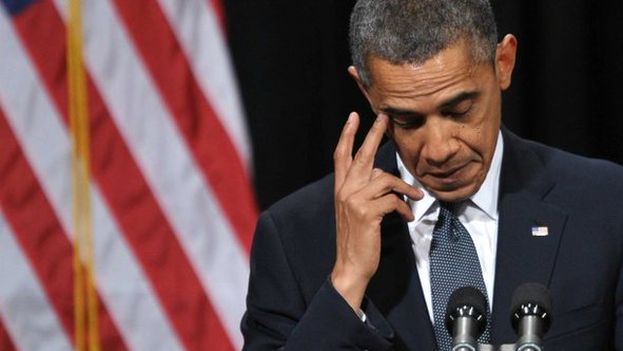
US President Barack Obama, this February

14ymedio biggerEFE (14ymedio), Havana, 7 March 2016 – The Cuban Council of Churches (CIC) said this Sunday that it “salutes and celebrates” the President of United States Barack Obama’s visit to the island on the 21-22 March, which will be “profitable” for both countries, the region and the world in the current international context.

“We appreciate that this visit is being realized from a position of mutual respect and recognition of the sovereignty of peoples, cultures and specificities of each nation,” said a statement by the CIC, which brings together a community of Protestant and evangelical churches and ecumenical institutions of the island.

The Council of Churches believes that the visit of Obama, the first US president to travel to Cuba in 88 years, is an “important step forward” in the normalization of relations, which can positively affect both countries and all of Latin America, it says in the statement released today in the official media on the island. continue reading

“Many of the Cuban Protestant and Evangelical churches are heirs of the work of American missionaries and American,” institutions that have become “a bridge of friendship” between Cubans and Americans in search for a possible normalization between the two countries, he said.

The statement also says that the American president will visit an island of “peace and diversity,” with European, African and Asian cultural roots, and where different branches of Christianity, along with eight religions live “in harmony.”

US President Barack Obama, announced on 18 February that he will travel to Cuba with the first lady, Michelle Obama, with the goal of expanding progress with bilateral normalization, which began in December 2014, and to influence pending improvements on human rights.

In addition to holding a bilateral meeting with Cuban President Raul Castro, Obama will meet with members of civil society and business. However, an interview with the US president and the Cuban ex-president, Fidel Castro is not expected.

This will be the first trip by a US president to the island since Calvin Coolidge travelled to Cuba in 1928.

In 1948, then US president Harry Truman visited the Guantanamo Bay Naval Base and US-controlled territory, and Jimmy Carter has also traveled to Cuba several times, but never during his presidency.

Computer Union Is Committed To Maintaining “Loyalty To The Fatherland” / 14ymedio, Zunilda Mata

Many graduates of the University of Information Sciences and other related fields currently working in the field of cellphone repair and the installation of apps. (14ymedio)

14ymedio bigger14ymedio, Zunilda Mata, Havana, 8 March 2016 – On Monday, more than 6,000 professionals in the technology, information and communications sector created the Union of Information Scientists of Cuba (UIC). The new entity has been unable to shake off political language in its founding journal, and in its Code of Ethics there is a commitment to maintain “a conscious and voluntary loyalty to the fatherland.”

The process of creating the UIC began in February of 2015, and throughout this year there have been provincial assemblies to discuss the objectives of the organization. This process has coincided with a significant increase in the use of information and communication technologies (TIC) on the part of the Cuban population and in the private offerings of audiovisuals. continue reading

The UIC carries part of the heavy burden of the “revolutionary organizations” founded primarily in the sixties. Despite which it expects to be flexible, bold, connected and committed to its time, as well as demanding fidelity to the principals of the Revolution, as was clear from the day of its founding.

Some 200 delegates participating in the Constituent National Assembly of the UIC signed its Code of Ethics, which governs the behavior of affiliated professional. The principals range from ensuring compliance with the laws, to maintaining strict confidentiality of information that comes to them through their work.

Ailyn Febles Estrada, president of the Organizing Committee of the UIC said that this organization will be “self-financed and non-profit.” In its statutes it specifies that it has legal standing and its own assets and that its legal seat is in the province of Havana.

In the opening act, where many government officials participated led by Vice President Miguel Diaz-Canel, the National Council and the Board were presented. Several speakers noted that this is the first organization founded in the 21st century.

The news has caused barely any reaction in the information sector, which is dedicated mainly to developing custom applications and software and installing programs on smartphones, tablets and computers.